If you're a manufacturer, this probably sounds familiar. Leads come in waves. A trade show fills the pipeline, then everything goes quiet. Your sales team follows up when they can, engineering gets pulled into quote support, and somewhere in the middle a good prospect goes cold because nobody had a reliable system for staying in touch.
That isn't a traffic problem. It's a systems problem.
Marketing automation for manufacturers works when you treat it like production infrastructure, not a pile of emails. The point isn't to send more messages. It's to capture buying signals, route them correctly, and support smarter human conversations over a long, technical sales cycle.
Table of Contents
- Why Your Factory Needs a Marketing System Not Just More Ads
- The Foundation Your Automation System Blueprint
- Building the Engine Lead Capture and CRM Integration
- Designing Nurture Sequences That Build Trust
- Measuring What Matters KPIs and ROI for Manufacturers
- Your 90-Day Proof-of-Concept Plan
Why Your Factory Needs a Marketing System Not Just More Ads
Most manufacturers don't have a lead generation problem in the way they think they do. They have an inconsistency problem. One quarter is strong because referrals hit, distributors send business, or a rep has a good month. The next quarter feels thin, and leadership starts asking whether the answer is more ad spend.
Usually, it isn't.
A key issue is that many industrial companies still rely on disconnected tactics. Trade shows. Rep relationships. Quote requests from the website. A few email follow-ups. Maybe a CRM that acts more like storage than an operating system. None of those tactics are wrong. They just don't form a dependable system on their own.
The shift from campaigns to infrastructure
Marketing automation for manufacturers matters because industrial buying rarely happens in one sitting. A prospect may download a spec sheet today, ask engineering a question next month, request a quote later, then disappear while procurement and operations review options internally. If your process depends on manual reminders and tribal knowledge, follow-up becomes uneven.
One industry guide reports that 56% of manufacturers currently use or plan to adopt marketing automation within the next 12 months, and 63% report a significant improvement in lead generation and customer retention after doing so in Waypost Marketing's guide for manufacturers. That matters less as a trend headline and more as a signal that buyers now expect faster, more relevant follow-up than many factories are built to deliver manually.
Practical rule: If your best leads only move forward when a specific salesperson remembers to follow up, you don't have a system yet.
A good automation system does a few plain, useful things:
- Captures intent: It records what the buyer asked for, viewed, or downloaded.
- Routes context: It tells sales or engineering what this person appears to care about.
- Maintains continuity: It keeps the conversation active between first inquiry and real buying readiness.
- Creates visibility: It shows leadership where leads are stalling and why.
Why more ads often make the problem worse
More traffic into a weak process just creates a larger mess. If your forms are vague, your CRM fields are inconsistent, and no one agrees on when sales should engage, added spend only increases noise. Manufacturers feel this quickly because their sales cycles are expensive. A weak lead handoff burns engineering time, sales time, and margin.
That's why we usually push companies to diagnose the operating system before they chase more top-of-funnel volume. A structured strategic marketing consultation for manufacturers is often the right starting point when the issue isn't visibility alone but how sales, CRM, and marketing fit together.
The companies that win in this environment aren't always louder. They're more organized. They know what signal matters, when to respond, and when to let a human expert take over.
The Foundation Your Automation System Blueprint
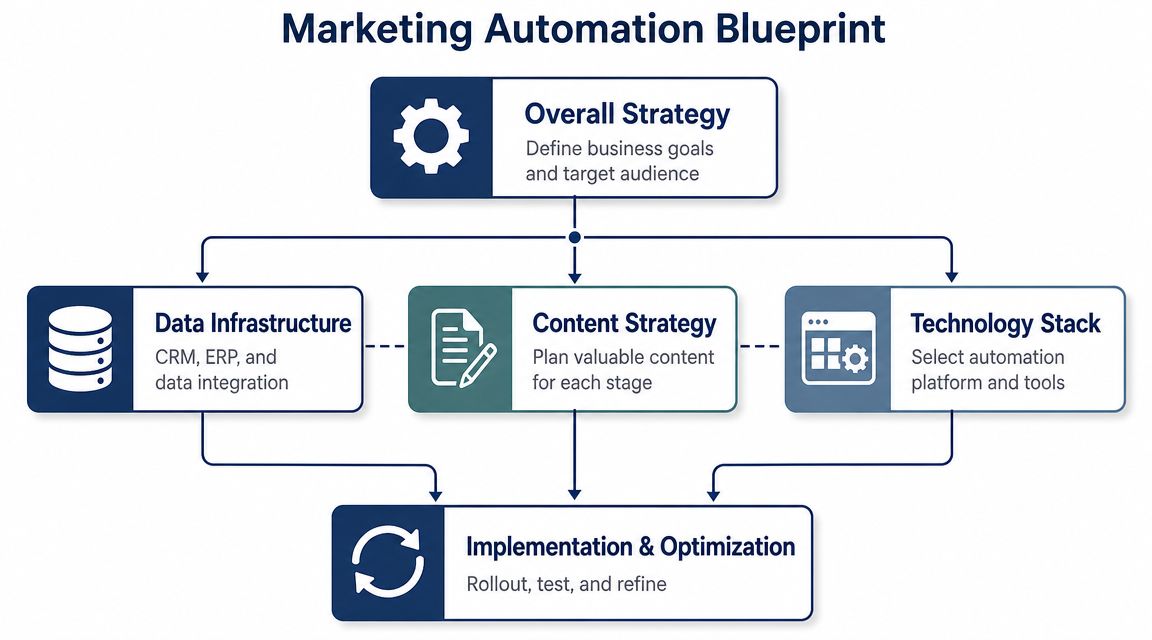
Before you build workflows, you need a blueprint. This is the step many organizations rush past, then regret. They buy software, connect a form, draft a few emails, and call it automation. A month later, nobody trusts the data, sales ignores the alerts, and the platform gets blamed for a strategy problem.
A better build starts with two questions. Who exactly are we trying to influence? And what systems already hold the data needed to do that well?
Start with the buying committee, not the contact record
Manufacturing teams often talk about "the customer" as if one person buys. In reality, you may need approval from engineering, procurement, operations, maintenance, and leadership. If your automation treats them the same, your messaging gets generic fast.
Start by documenting one ideal customer profile and one buying committee map. Keep it practical.
Ask questions like these:
- Who starts the search? Is it an engineer looking for a component, a plant manager solving a downtime issue, or purchasing trying to qualify a new vendor?
- What does each role need to believe? Engineering may need tolerances, certifications, and integration detail. Procurement may care about lead times, vendor stability, and commercial terms.
- What slows the deal down? Missing drawings, unclear compatibility, delayed sample requests, or no clear internal owner.
- What action signals intent? A CAD file download means something different from a general brochure request.
If you can't answer those questions clearly, don't automate yet.
The best manufacturing workflows aren't built around channels. They're built around decisions the buyer needs to make.
Audit the stack before you automate anything
The second part of the blueprint is less glamorous and more important. You need to know where customer and lead data currently lives. For many manufacturers, that means some combination of CRM, ERP, website forms, spreadsheets, inboxes, and rep notes.
Look for these failure points:
| System area | What to check | Why it matters |
|---|---|---|
| CRM | Required fields, lifecycle stages, duplicate records | Bad CRM structure makes scoring and routing unreliable |
| ERP | Customer status, product history, quote or order data | Useful for segmentation and account context |
| Website | Form mapping, hidden fields, conversion paths | Determines whether lead source and intent are captured cleanly |
| Email platform | List structure, suppression logic, sender ownership | Prevents chaotic outreach and bad follow-up timing |
One practical way to manage this is to define a simple field governance sheet before launch. Decide which fields are required, who owns them, and what values are allowed. That sounds boring. It also saves months of cleanup.
A broader marketing technology stack for manufacturers should support the process you want, not force one on you. The right setup might include a CRM, automation platform, form builder, analytics layer, and ERP connection. But the sequence matters. Strategy first. Data structure second. Automation third.
A blueprint that leadership can approve
If you need internal buy-in, present the blueprint in operational terms, not marketing jargon. Show leadership:
- The target segment
- The key workflows to launch first
- The systems involved
- The handoff points between marketing, sales, and engineering
- The reporting you'll use to judge success
That turns automation from a software purchase into a business process improvement project. In manufacturing, that's usually the difference between adoption and shelfware.
Building the Engine Lead Capture and CRM Integration
Automation transitions from a concept to a working machine. Your forms, your offers, and your CRM mappings determine whether the system gets useful fuel or junk input. Many manufacturers have decent website traffic and poor capture design. That's fixable.

What manufacturers should offer instead of generic lead magnets
A generic ebook rarely earns attention from a technical buyer. Manufacturing prospects respond better to assets that help them do real work or reduce evaluation time.
Better offers include:
- CAD files and technical drawings: Useful when engineers are evaluating fit and feasibility.
- Application notes: Strong for buyers comparing methods, materials, or use cases.
- Detailed spec sheets: Good when the buyer is narrowing options.
- Configuration tools: Helpful if your product line has many variables or compatibility rules.
- Certification and compliance resources: Important when regulated environments shape the purchase.
The key is relevance. If someone downloads a dimensional drawing for a specific component family, that action says far more than a generic newsletter signup ever will.
What your forms should actually capture
Most forms ask for too little or ask for the wrong things. You don't need to interrogate the buyer. You do need enough information to route and segment intelligently.
Capture fields that help answer three questions:
- Who is this? Name, company, work email, country or region.
- What are they evaluating? Product category, application, industry, or machine type.
- How urgent is the need? Project timeline, request type, or whether they want contact from sales.
Some manufacturers also add a role field such as engineer, procurement, operations, or executive. That can be useful if you'll use it in follow-up logic.
Avoid these common mistakes:
- Too many mandatory fields: Long forms reduce useful submissions.
- No product context: Sales gets a lead but not the reason they converted.
- No source tracking: You can't tell which campaign or asset drove the inquiry.
- No consent logic: Your team starts with compliance and deliverability problems.
Where CRM integration usually breaks
A key reason automation projects fail is poor execution. 52% of teams cite lack of an effective strategy as the biggest barrier, while 56% report integration across systems as a major challenge, according to EmailMonday's marketing automation statistics overview.
That lines up with what we see. The biggest failures aren't creative. They're structural.
If your website says "request a quote" but your CRM stores every submission as a generic lead with no product context, your team has already lost useful information.
Typical integration problems include field mismatch, duplicate contact creation, no account association, and lifecycle stages that don't match how the sales team works. If you're using GoHighLevel as part of your stack, the same rule applies as with any platform. Map the fields first. Define the pipeline stages first. Test every handoff before traffic hits the workflow.
A purpose-built CRM for manufacturing companies should support account-level visibility, lead source tracking, and clean handoff rules between marketing and sales. Machine Marketing is one option for companies that need CRM structure and automation logic aligned to industrial sales workflows, especially when existing tools are present but underused.
Build the engine carefully. Every workflow after this depends on the quality of what enters the system.
Designing Nurture Sequences That Build Trust
Manufacturers damage trust when they confuse automation with pressure. A buyer asks for a technical document, then gets a string of aggressive sales emails that feel like they were written for software trials or commodity products. That doesn't speed the deal. It makes your company look like it doesn't understand how industrial decisions get made.

The better model is quieter and more useful. One practical perspective from 42DM's automation strategy coverage puts it well: the best use of automation for manufacturers is not volume for its own sake. It is routing the right signals to the right people at the right time, while preserving engineer-to-engineer credibility.
A bad sequence versus a useful one
Consider a prospect who downloads a spec sheet for a custom motion component.
A poor sequence looks like this:
- Email one: "Book a demo now"
- Email two: "Are you still interested?"
- Email three: "Limited availability"
- Sales alert: Sent immediately, with no context beyond the form submission
That sequence assumes intent that hasn't been proven. It also ignores the buyer's likely next question, which is technical.
A better sequence respects the stage of evaluation:
| Timing | Message type | Purpose |
|---|---|---|
| Immediately | Transactional follow-up with requested asset | Deliver what was promised and confirm the product category |
| A few days later | Helpful application content | Answer a likely technical question tied to the download |
| Later | Proof-oriented content | Share use-case detail, material guidance, or integration considerations |
| When behavior justifies it | Human outreach | Trigger sales or engineering contact based on clear intent signals |
That structure works because it mirrors how industrial buyers think. First, "give me the file." Then, "help me judge fit." Later, "show me you can support the application."
Good nurture doesn't try to close the deal in email. It prepares the buyer for a productive conversation with the right person.
Lead scoring that respects technical buying behavior
Open rates and random clicks don't tell you much in manufacturing. Technical engagement does.
Better scoring signals include:
- Return visits to product pages: Especially when the buyer revisits the same family or solution category.
- Technical asset engagement: Drawings, certifications, or application content usually indicate deeper evaluation.
- Quote-related behavior: Requests for pricing, samples, or sales contact should trigger faster review.
- Multi-role activity from one account: When engineering and procurement both appear, the opportunity may be maturing.
What shouldn't score heavily? Casual newsletter opens, generic blog clicks, or a single homepage visit.
The handoff threshold also matters. If every small action triggers a sales task, your team learns to ignore alerts. If the threshold is too high, real opportunities sit untouched. Manufacturers do best when they set a few behavior-based rules and review them with sales monthly.
Human expertise still needs to carry the conversation at key points. Automation should support that handoff, not replace it. In technical sales, credibility often comes from the person who can answer the hard question clearly and quickly.
Measuring What Matters KPIs and ROI for Manufacturers
Manufacturers often struggle to prove marketing impact because the sales cycle is long, the buying group is broad, and some critical conversations happen offline. That doesn't mean ROI can't be measured. It means your measurement model has to match reality.
Vanity metrics won't help you here. A leadership team doesn't need a report full of opens and clicks. They need evidence that marketing is helping the business create qualified pipeline, support sales efficiency, and influence revenue over time.
The metrics leadership actually cares about
One useful benchmark set comes from Salesforce's overview of marketing automation benefits. It notes that marketing automation can improve sales productivity by 14.5%, reduce marketing overhead by 12.2%, and that nurtured leads can generate purchases that are 47% larger than non-nurtured leads. For a manufacturer, those are meaningful because they connect automation to labor efficiency and deal quality, not just campaign activity.
The KPI set we recommend usually includes:
- MQL velocity: Are qualified leads entering the pipeline consistently, or still arriving in bursts?
- MQL to sales-accepted lead conversion: Does sales agree the leads are worth pursuing?
- Time to first follow-up: How fast does a useful human response happen after a meaningful inquiry?
- Opportunity creation from nurtured leads: Are your workflows contributing to pipeline creation?
- Sales cycle duration by source or segment: Which channels and workflows support faster progression?
- Closed-won revenue influenced by marketing touches: Which assets and sequences appear across successful deals?
These metrics work because they bridge marketing activity to sales outcomes. They also force alignment. If marketing says a lead is qualified and sales keeps rejecting it, your definition is wrong or your scoring is weak.
How to report ROI without fooling yourself
A good manufacturing ROI report needs attribution discipline. That means connecting website behavior, CRM stages, and sales outcomes over a long timeline. It also means accepting that not every touch gets equal credit.
A practical reporting model includes:
- First-touch visibility so you know what started the relationship.
- Lifecycle stage tracking inside the CRM so lead progress is visible.
- Meaningful touch tracking for asset downloads, product page visits, quote requests, and sales meetings.
- Revenue connection once the deal is won.
If your team needs a clean framework for the math side, Constructo Marketing's ROI guide is a useful reference because it helps frame the calculation in business terms instead of channel-specific jargon.
Report early indicators to prove momentum. Report revenue influence to prove business value.
One more point matters here. Historical ROI data gives automation a strong business case. A widely cited Nucleus Research finding, summarized in Cropink's roundup of marketing automation statistics, says companies earned $5.44 for every $1 invested in marketing automation over three years, which represents a 544% return. That doesn't guarantee the same outcome for any individual manufacturer. It does reinforce that the category has moved well beyond convenience software into measurable operating infrastructure.
Your 90-Day Proof-of-Concept Plan
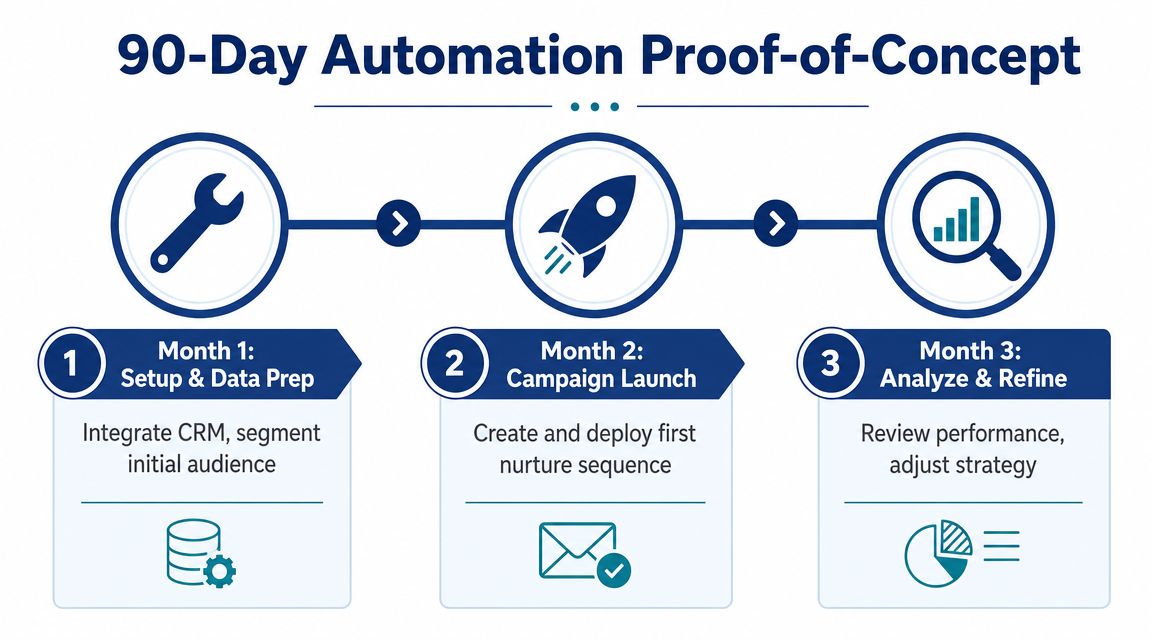
A full rollout across every product line, region, and sales process is too much for most manufacturers to do well at once. A proof of concept is the smarter move. Keep the scope tight, tie it to revenue behavior, and prove that the system can capture, route, and nurture real demand.
Days 1 to 30 setup and diagnosis
Pick one audience, one offer, and one conversion path. Don't start with your entire catalog.
Your first month should include:
- Choose one ICP: One segment is enough. For example, design engineers evaluating a specific product family.
- Define one valuable conversion asset: A CAD file pack, application guide, or spec sheet bundle works better than broad awareness content.
- Clean the CRM structure: Confirm required fields, lifecycle stages, ownership rules, and duplicate handling.
- Map one form to one workflow: Every field should have a destination and a purpose.
- Agree on handoff rules: Sales should know exactly when they get notified and what context they'll receive.
If your team can't explain the workflow on one whiteboard, it's too complex for the first 30 days.
Days 31 to 60 first workflows live
Month two is about controlled launch, not perfection.
Build and activate:
- A transactional confirmation email: Deliver the requested resource fast.
- A short nurture sequence: Focus on useful, technical follow-up tied to the original interest.
- Basic lead scoring: Score meaningful actions, not vanity signals.
- Internal alerts: Trigger them only for behavior that suggests real buying movement.
- A feedback loop with sales: Ask which leads look credible and which don't.
This stage should feel operational. The purpose is to see whether the system creates cleaner conversations, not to produce a huge content library.
Days 61 to 90 reporting and refinement
In the third month, review actual behavior and tighten the system.
Use this checklist:
- Inspect form submissions: Are the fields capturing enough qualifying detail?
- Review nurture engagement: Which messages got technical buyers to return or request more?
- Check sales acceptance: Are alerts surfacing useful opportunities?
- Audit CRM records: Are stages, owners, and source data staying clean?
- Build a simple dashboard: Leadership needs a clear view of inquiries, qualified leads, accepted leads, and influenced opportunities.
What you're looking for at the end of 90 days isn't a perfect machine. You're looking for evidence that the process works, where it breaks, and what deserves expansion next.
The strongest proof-of-concept projects stay narrow, measurable, and honest about trade-offs. If the first workflow produces poor fit leads, that's useful information. If sales says the context is finally good enough to follow up intelligently, that's useful too. Both outcomes move you closer to a real system.
If your team has the tools but not the operating plan, Machine Marketing helps manufacturers connect CRM, automation, content, and sales process into a measurable growth system. If you're ready to test this with a focused proof of concept, start by diagnosing one audience, one offer, and one workflow instead of trying to automate everything at once.