If you're a business owner struggling with inconsistent lead follow-up and spending too much time on repetitive marketing tasks, you're not alone. We see this all the time—and the root cause is often a lack of a reliable system. The manual marketing efforts that got you here are now holding you back.
This guide will show you how to diagnose the real problems your manual process is causing and give you practical, step-by-step instructions to build your first essential automations. This isn't about buying complex software; it's about building a dependable engine for growth that works for you 24/7.
Diagnosis: Why Your Manual Marketing Isn't Working
Feeling like you’re always chasing leads, sending the same follow-up emails one by one, and scrambling to keep up? That’s not just a busy schedule—it’s a broken system. The real problem is that manual marketing is unpredictable, prone to error, and impossible to scale.

This is precisely where marketing automation for small business provides a solution. The goal isn't to replace your team, but to give them a dependable engine that nurtures leads and serves customers around the clock. This frees you and your team to focus on what really matters: strategy, building relationships, and closing deals.
The Hidden Costs of Doing Everything by Hand
Manual marketing has real costs that hit your bottom line. What are the symptoms we see in almost every business we diagnose?
- Wasted Hours on Repetitive Tasks: Your team’s time is your most valuable asset. Every hour spent manually posting, copying and pasting emails, or updating a spreadsheet is an hour they could have spent talking to a high-value prospect.
- Missed Sales Opportunities: When a new lead fills out a form on your website, the clock is ticking. A slow, manual response gives them time to find a competitor. Automation guarantees an instant, professional follow-up, striking while the iron is hot.
- Inconsistent Customer Experiences: Did every new client get a welcome email? Did every inquiry get a response? Manual processes lead to human error, creating a choppy experience that can damage your brand’s reputation.
The real cost isn’t just the time you lose; it’s the lost revenue from leads going cold and the customer churn from a disjointed experience. Automation builds the consistency you need for sustainable growth.
This move toward automated systems is quickly becoming the standard, not a luxury. With the number of small and medium-sized businesses expected to hit 400 million globally by 2025, the fight for attention is only getting tougher.
It's a key reason the marketing automation market is projected to skyrocket to $14.55 billion by 2031. Small businesses are adopting these tools to keep pace. You can read more insights about the growing market for marketing automation to see just how fast this is moving.
Ultimately, marketing automation swaps chaotic, person-dependent tasks for a reliable system built for growth. It’s about creating an operational backbone for your marketing so you can stop reacting and start proactively building your business.
Your Pre-Automation Readiness Checklist
Jumping into marketing automation without a clear plan is a recipe for wasted time and money. Before you book a demo, you need to diagnose if your business is actually ready. Think of it as a pre-flight check; getting these fundamentals right ensures your new system solves real problems instead of creating new ones.
Automation is a powerful tool, but it's not a magic wand. It amplifies what you’re already doing. If your current processes are a mess, automating them will only create faster chaos. Let's make sure you're building on solid ground first.
Question 1: What Problem Are You Actually Trying to Solve?
This is the first question we ask every client: "What specific, measurable outcome are you really after?" Vague goals like "get more leads" won't cut it. We need to diagnose the specific bottleneck.
What does a huge win look like for you six months from now? Is it:
- Slashing lead response time from 24 hours to under five minutes?
- Boosting qualified sales appointments booked from your website by 25%?
- Re-engaging at least 15% of your cold customer list?
- Cutting down manual time on email follow-ups by 10 hours a week?
Pick one or two primary goals to start. This sharp focus keeps you from getting distracted by shiny features and gives you a clear benchmark to measure your return on investment.
Question 2: What Does Your Current Customer Journey Look Like?
You can't fix a bottleneck if you don't know where it is. Get out a whiteboard and trace every step a customer takes, from first contact to post-sale. Be brutally honest.
- Awareness: How do people find you? (Google, social media, referral?)
- Consideration: What happens next? (They land on a service page, download a guide?)
- Inquiry: How do they reach out? (Contact form, phone call?)
- Follow-Up: What’s your exact follow-up process right now? Who is responsible, and when does it happen?
- Sale: What are the steps to close the deal?
- Onboarding & Post-Sale: What happens after they become a customer?
Once you map it out, the gaps will become obvious. Maybe your follow-up is inconsistent, or you see a huge drop-off after someone downloads a pricing sheet. These are the perfect opportunities to target with your first automations.
Question 3: Is Your Data and Content Healthy?
Your automation system will run on two things: your contact data and your content. If either is a disaster, you're going to get garbage results. It's that simple.
An automation platform is only as smart as the data you feed it. A messy, outdated contact list will lead to low engagement and wasted effort. A quick data health check is non-negotiable.
Before you go any further, ask yourself:
- Is my contact list clean? Do you have one central list, or are contacts scattered across spreadsheets, inboxes, and notebooks? You need a single source of truth.
- Do I have basic content? You don’t need a massive library, but you need something useful to send people. This could be a simple welcome email series, a few educational blog posts, or a helpful FAQ guide.
Getting these three elements in order—clear goals, a mapped-out journey, and healthy assets—is the most important step. It’s what transforms an investment in marketing automation for small business from a hopeful gamble into a calculated strategy for growth.
Choosing the Right Automation Tools
The world of marketing automation tools is noisy. You've got everything from simple email platforms to massive systems like HubSpot. How do you pick the right one without getting stuck in an expensive contract that doesn't solve your problems?
The key is to think like an engineer: diagnose your needs before you look at solutions. Stay laser-focused on the core functions that will fix the specific bottlenecks you just uncovered.
Integrated Platforms vs. Standalone Tools
Your first decision is whether to go with an all-in-one platform or piece together several specialized tools. There are trade-offs, and what works for one business could be a mess for another.
- Integrated Platforms (All-in-Ones): Systems like GoHighLevel or ActiveCampaign bundle your CRM, email marketing, SMS, and landing pages into one ecosystem. The advantage is that everything works together out of the box. You're not wrestling with APIs and integrations.
- Standalone Tools (Best-in-Breed): This is the DIY approach. You pick the best tool for each job—maybe Mailchimp for email and a separate CRM. While you get deep functionality in each category, you're now managing multiple subscriptions and praying they all play nice together.
For most small businesses we work with, an integrated platform is the smarter, more scalable choice. The time saved by having one central hub almost always outweighs any minor feature gaps.
Our Takeaway: Don't build a "Frankenstein's monster" of disconnected apps. An all-in-one system cuts down on complexity, which is the single biggest reason time-strapped teams fail with automation.
Core Features to Evaluate
Once you start demos, it's easy to get overwhelmed. Keep your diagnosis focused on these non-negotiable features. Use this as a checklist to compare options against your business goals.
Here’s a glimpse inside the GoHighLevel platform, which brings multiple marketing functions into a single dashboard.
This unified view is what you're looking for—a command center for your entire marketing and sales operation.
Before you sign on, be sure the platform can handle the fundamentals. A side-by-side comparison is the best way to cut through the marketing fluff.
Automation Platform Feature Comparison
| Feature | What to Look For | Why It Matters for SMBs |
|---|---|---|
| Email & SMS Marketing | A visual workflow builder that lets you create "if/then" logic without code. | This is the engine of your automation. You need to build sequences that send the right message at the right time based on what a contact does (or doesn't do). |
| CRM Functionality | A complete history of every touchpoint: emails opened, pages visited, forms filled out, calls logged. | Your CRM is your single source of truth. Without a clear view of the customer journey, your automation will feel robotic and impersonal. |
| Forms & Landing Pages | Simple, drag-and-drop builders you can use without needing a developer. | Lead capture is everything. You need to be able to spin up new forms and pages quickly to capitalize on opportunities without waiting on technical help. |
| Reporting & Analytics | Clear, easy-to-read dashboards that connect campaigns to revenue. | If you can't measure it, you can't improve it. You have to see a straight line from your automation efforts to your bottom line. Otherwise, you're just guessing. |
The right platform won't just have these features—it will make them intuitive for someone who isn't a full-time marketer.
Essential Questions to Ask During a Demo
Software salespeople are masters at showing you shiny objects. Your job is to stay grounded and focus on what matters. When you're on a demo call, have these questions ready.
- "Can you show me, step-by-step, how I would build a workflow that sends a text and an email to a new lead who fills out our contact form?"
- "How does your system track a lead from their first website visit all the way to a closed deal in the CRM?"
- "What does your support and onboarding process look like? Will we have a real person helping us get set up correctly?"
- "What are the most common reasons a business like ours fails with your platform, and how can we avoid those pitfalls?"
Asking direct, scenario-based questions forces a demonstration of practical value, not just a feature list. This is crucial for companies navigating business-to-business marketing automation, where sales cycles are longer and nurturing is more complex.
Picking the right tool is less about finding "perfect" software and more about finding the right partner. Choose a platform that meets your technical needs today and provides the support and scalability to help you win tomorrow.
Your First Three Essential Automations
Theory is great for laying a foundation, but the real transformation happens when you start building. We’re going to walk through your first three automations—the core workflows that deliver immediate, tangible results for almost any small business.
Don't try to make everything perfect from the start. The goal is to launch simple, effective systems that handle mission-critical tasks. These will prove the value of automation right away and give you a solid framework to build on.
This visual guide breaks down the process of setting your goals, weighing your options, and landing on the right tools to bring these automations to life.
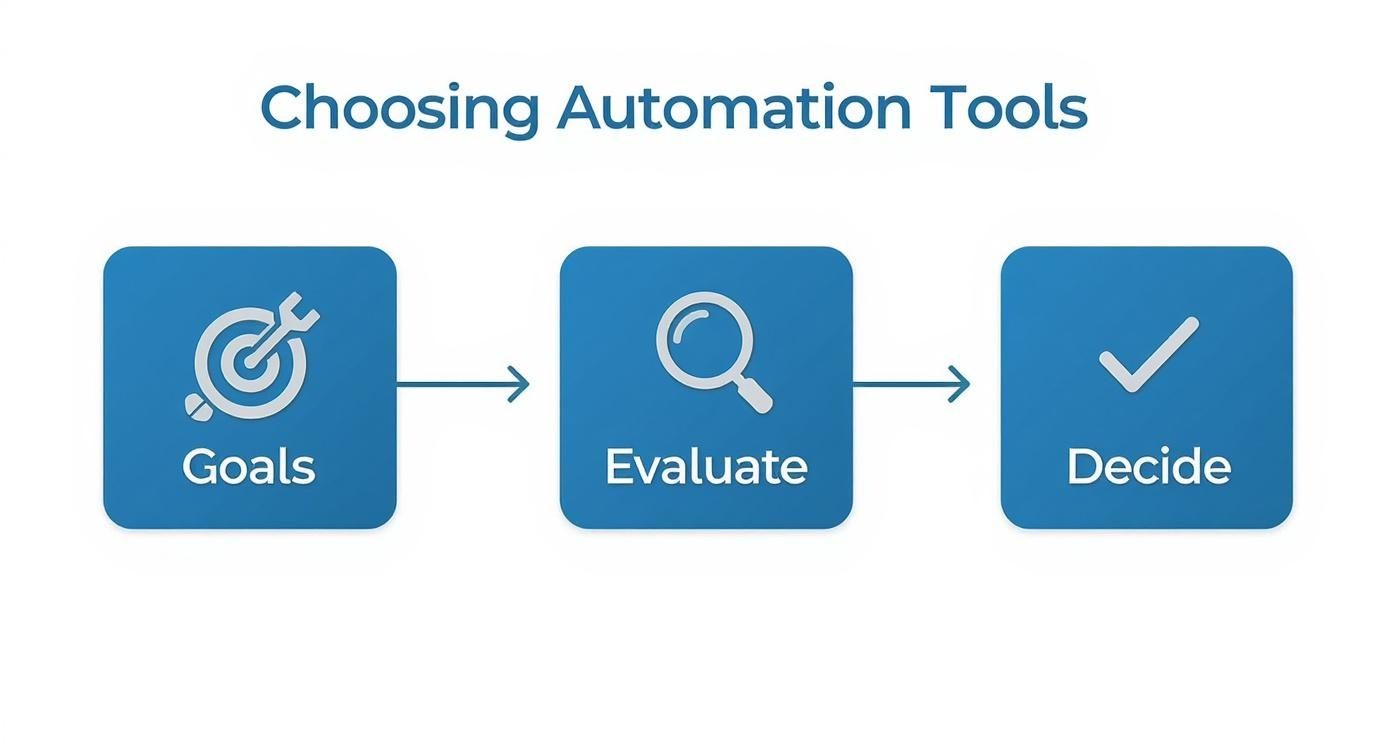
Think of this as your decision-making map. It ensures the tool you pick is directly tied to the results you need, like the essential automations we're about to build.
Automation 1: The Instant Lead Follow-Up
- The Problem: Speed. Every minute you wait to follow up with a new lead, their interest cools. Doing it by hand is too slow and inconsistent.
- The Solution: An automated workflow that ensures every single lead gets a professional, immediate response, 24/7.
- The Transformation: You make a great first impression, engage leads while they are most interested, and book more appointments.
Here’s the basic logic:
- Trigger: A contact fills out a form on your site (e.g., "Request a Quote").
- Immediate Action 1 (Email): An email is sent instantly. It should confirm you got their request and set clear expectations for what happens next.
- Immediate Action 2 (SMS): A quick text message follows. A simple message like, "Hey [First Name], just sent that info you wanted to your email," feels personal and urgent.
- Internal Action: Your team gets an alert. Send a notification to the right person with the lead's details so they can follow up intelligently.
Why this works: You're striking while the iron is hot. By hitting them on multiple channels within seconds, you create an impressive first impression and get the ball rolling before they have a chance to get distracted.
Automation 2: A Simple Nurture Sequence
- The Problem: Most leads aren't ready to buy the second they find you. Pitching too early scares them off.
- The Solution: A sequence of emails that builds trust and educates prospects over time, keeping you top-of-mind.
- The Transformation: You become the only logical choice when prospects are ready to buy, shortening your sales cycle.
This workflow picks up after the instant follow-up. For a deeper dive, check out our articles on lead nurturing techniques.
Here is a simple three-email sequence:
- Trigger: A contact is tagged as a "New Lead."
- Wait 2 Days: Let them breathe.
- Email 1: The Problem Solver. Send an email that digs into a common pain point. Offer genuine advice or link to a helpful blog post that shows you know your stuff.
- Wait 3 Days: Keep that helpful vibe going.
- Email 2: The Case Study. Share a quick success story. Frame it as, "Here’s how a business like yours solved [the problem]…" This provides social proof and makes your solution feel real.
- Wait 3 Days:
- Email 3: The Soft Offer. Now you've earned the right to ask. Gently introduce your solution with an offer for a free consultation or demo. The ask feels natural because you've provided value first.
Automation 3: The New Customer Welcome Series
- The Problem: Making the sale is just the beginning. A clunky onboarding process creates confusion and buyer's remorse.
- The Solution: An automated welcome series that makes every new customer feel seen and sets them up for success.
- The Transformation: You reduce churn, increase customer satisfaction, and create more loyal advocates for your brand.
Here’s what a simple welcome workflow looks like:
- Trigger: A customer's status in your CRM changes to "Active," or they complete a purchase.
- Email 1 (Immediately): The "Welcome & Next Steps" Email. A warm welcome from a team lead. Clearly lay out the next steps, link to key resources, and tell them how to get support.
- Wait 3 Days:
- Email 2 (Day 3): The "Pro Tip" Email. Share one valuable, lesser-known tip that will help them score a quick win. This shows you're invested in their success.
- Wait 5 Days:
- Email 3 (Day 8): The "Check-In & Feedback" Email. A simple, proactive message asking how things are going. This can stop small issues from becoming big problems and shows you care.
By putting these three automations in place, you’ll have a rock-solid system that captures, nurtures, and retains customers with little hands-on effort. This is your launchpad for turning marketing from a list of chores into a predictable, scalable growth machine.
How to Measure Your Automation ROI
An automation system is only as good as the results it produces. Measurement isn't just about looking at dashboards; it's about diagnosing what's driving real business growth and what's just noise.
Too many businesses get hung up on vanity metrics like email open rates. They might feel good, but they don't pay the bills. The real ROI comes from tracking the numbers that directly impact your bottom line.
Moving Beyond Vanity Metrics
If you want a clear picture of your return on investment, focus on Key Performance Indicators (KPIs) tied directly to revenue and customer health.
We always recommend our clients start by tracking these:
- Customer Acquisition Cost (CAC): What's the real cost to land a new customer? Good automation should drive this number down by making your marketing more efficient.
- Conversion Rate by Channel: What percentage of leads from different sources (website forms, ads) become paying customers? This tells you which automated funnels are working.
- Sales Cycle Length: How long does it take to turn a lead into a customer? A well-built nurture sequence should shorten this cycle by educating prospects on autopilot.
- Customer Lifetime Value (CLV): How much is the average customer worth over their entire relationship with your business? Automated welcome and retention campaigns can bump this figure up significantly.
Don't get lost in a sea of data. Pick three or four of these core metrics and build a simple dashboard to watch them week over week. This gives you a clear, actionable view of your system's performance.
Calculating Your Direct Return
The financial argument for marketing automation is clear when you look at the right numbers. Research shows companies can see a return of $5.44 for every $1 spent on automation. Many businesses report revenue boosts of over 10% within the first 6-9 months.
To figure out your own ROI, the formula is simple:
(Revenue Gained from Automation – Total Cost of Automation) / Total Cost of Automation
Let's say your software costs $3,000 for the year, but your automated campaigns brought in an extra $20,000 in sales. Your ROI would be 567%. This calculation cuts through the noise and gives you a tangible number to prove the impact. To dig deeper, you can learn how automation can boost your engineering firm's ROI in our detailed guide.
Using Data to Refine and Improve
That dashboard you built? It’s your diagnostic tool. When you review your numbers, you're not just looking for a score; you're hunting for opportunities to get better.
Is the conversion rate on a landing page weak? Time to A/B test new copy or a different offer. Are leads stalling in your nurture sequence? That means an email in the chain isn't helpful enough.
Treat your automation system like an engine. Regular check-ups and fine-tuning, based on performance data, are what keep it running at peak efficiency and driving predictable growth.
Where Automation Goes Wrong (And How to Avoid It)
Marketing automation is a game-changer, but it’s not a magic wand. We've seen that the real trouble doesn't start during setup. It's what happens after that initial excitement fades. You build a few workflows, see them working, and then… you walk away. That's where things crumble.
The single biggest trap is the "set it and forget it" mindset. Your market shifts, customer needs evolve, and your business goals change. An automation that was brilliant six months ago might feel irrelevant today.
Don't Sound Like a Robot
The next big pitfall is losing your human touch. You can’t sacrifice connection for efficiency. When every email sounds generic, your audience learns to ignore you. People want to do business with people, not a faceless email sequence.
Your goal isn't just to automate tasks; it's to automate a fantastic customer experience. Using a first name is the bare minimum. Real connection happens when you deliver the right message at the right time because you understand where your customer is in their journey.
Trying to Boil the Ocean on Day One
Finally, many business owners try to build a complex, all-knowing automation system from the get-go. This almost always ends in a tangled mess that no one understands. The only way to win is to start with simple, clear wins and build from there.
Ready to sidestep these mistakes? Here’s a simple checklist:
- Schedule monthly check-ins: Put 30 minutes on your calendar each month to review your main automations. Do they still work? Do they still reflect your brand's voice?
- Inject personality: Read your email and SMS templates out loud. Does that sound like something you’d actually say to a customer? If not, rewrite it.
- Solve one problem at a time: Perfect your instant lead follow-up before you build a complicated re-engagement campaign. Master the basics first.
By being aware of these common pitfalls, you'll ensure your automation system remains a tool for building genuine relationships, not a machine that pushes people away.
Your Burning Questions Answered
When you're considering automation, a lot of questions come up. Let's tackle the big ones we hear from business owners so you can get the clarity you need.
What's the real cost of marketing automation for a small business?
Prices vary, but a robust system with a built-in CRM and SMS tools usually starts around $97 per month. The final cost often scales with your number of contacts and the features you need.
However, focusing only on the monthly fee is the wrong approach. The real question is about the return. If a system costs a few hundred dollars a month but brings in thousands in new sales and frees up dozens of hours, it's not an expense. It's an investment.
Is this going to make my marketing feel robotic?
This is a valid concern. Automation can feel impersonal, but only if it's done badly. When done right, it does the exact opposite—it makes your marketing more human.
By letting software handle repetitive tasks, you and your team are free to have real, meaningful conversations where they matter most.
The secret is to use automation to deliver the right message at the right time. When you segment your audience and write copy in your own authentic voice, your messages feel helpful and personal, not machine-generated.
How much time should I budget for setup?
Be realistic: you'll need to invest focused time upfront. A simple welcome series might only take a couple of hours. But if you're integrating a full system with your website and CRM, set aside a few days to get it right.
That initial effort pays you back for years. Our advice is always the same: start small. Get one critical workflow humming—like the instant lead follow-up—and build from there. The time you save in the long run will make the setup period a distant memory.
Ready to stop chasing leads and start building a system that works for you? At Machine Marketing, we help businesses diagnose their growth bottlenecks and implement smart automation that moves the needle.
The first step is a clear diagnosis. Book a discovery call with us, and we'll map out a custom 90-day growth plan for your business.