If you're a general contractor, you probably know this rhythm too well. Work gets busy, crews are moving, estimates are out, and then a quiet week hits and you start wondering where the next solid project is coming from. Referrals still matter, but referrals alone don't give you control.
That problem is bigger than most contractors think. The U.S. construction market reached $2.2 trillion in 2024, and about 1.7 million people in the U.S. search online for independent contractors every month, which makes digital visibility too important to ignore. The same source notes that content marketing generates 54% more leads than traditional methods for contractors because it builds trust before the first call (contractor marketing statistics).
The fix isn't another random tactic. It's a system. Good marketing for general contractors should work like a well-run job site. Clear plan. Defined handoffs. Tight follow-up. Measurable output.
Your Contracting Business Needs a Marketing System Not More Tactics
A lot of contractors don't have a lead problem. They have a systems problem.
They try a website redesign, then some Facebook posts, then a Google Ads test, then they ask for more referrals. None of those pieces are wrong on their own. The issue is that they aren't connected, and nobody's managing them like one machine.
We see the same pattern often. A contractor does excellent work, has a solid reputation, and still rides a feast-or-famine cycle because marketing only happens when work slows down. That creates long gaps between activity, follow-up, and pipeline visibility.
Good contractors use plans, schedules, and process on the build side. Marketing needs the same discipline.
A working system for lead generation has a few basic parts:
- A clear market position: You know exactly who you want to attract and why they'd choose you.
- Digital assets that convert: Your website and Google Business Profile pull in local demand instead of just sitting there.
- A central follow-up engine: A CRM tracks every inquiry, every estimate, and every next step.
- Reliable lead sources: Paid search, organic content, reviews, and referral partnerships feed the system.
- Measurement: You know which channels produce jobs, not just clicks or calls.
Tactics still matter. Google Ads can work. SEO can work. Email follow-up can work. But when those pieces aren't tied together, you get leaks everywhere. Missed calls don't get answered. Form leads sit untouched. Past estimates never get reactivated. Good prospects choose the contractor who followed up first.
The contractors who grow steadily usually aren't the ones doing the most marketing. They're the ones running the cleanest system.
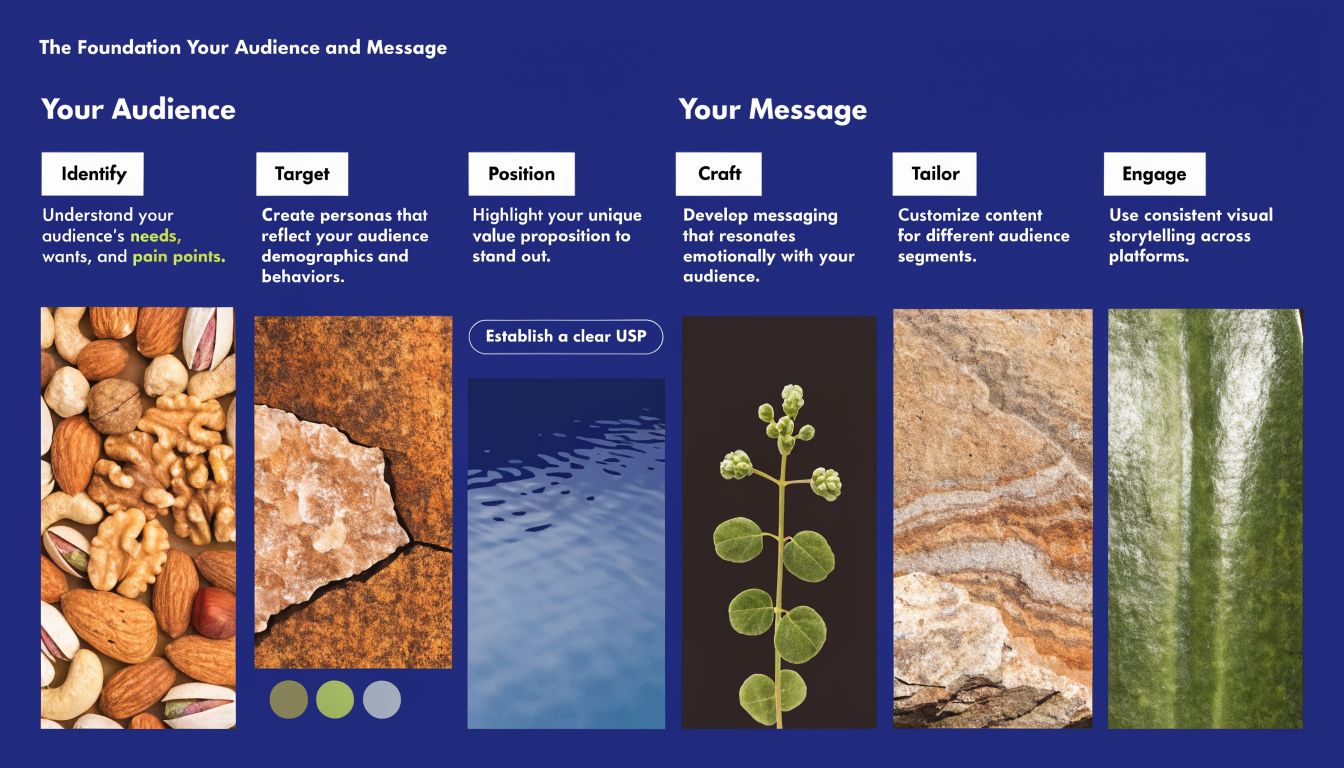
The Foundation Your Audience and Message
A contractor can spend thousands on ads and still get the wrong calls.
That usually starts with a positioning problem, not an ad problem. If the market hears the same message from you that it hears from every other GC in town, price becomes the deciding factor. “Quality work” and “great service” do not help a buyer choose. They are table stakes.
Analysts at Market Veep note in their construction marketing planning guidance that clear audience research and messaging can improve traffic and conversion performance. In practice, the bigger payoff is operational. Better positioning improves lead quality, shortens sales conversations, and gives your team a cleaner way to qualify opportunities inside the CRM.
Start with your best jobs
Build your message around the work you want more of and can deliver profitably.
I usually start with a simple review of the last 12 to 24 months of jobs. Which projects had strong margins? Which clients made decisions on time? Which jobs stayed organized from estimate to closeout? Which ones led to repeat work, reviews, or referrals? That exercise gives you a much better foundation than a brainstorming session about brand words.
A broad service list creates weak marketing. A focused offer creates useful marketing.
For a remodeling contractor, the right message may center on planning discipline, communication during construction, and a clean job site because those are the issues homeowners worry about before they sign. For a commercial GC, the message often needs to focus on pre-construction support, schedule control, documentation, and fewer surprises during handoff between stakeholders. Same company structure. Different buyer logic.
Separate the audiences before you write the message
A lot of contractor marketing underperforms because it blends homeowners, investors, property managers, and developers into one generic pitch. That creates confusion on the website, in ads, and later in follow-up workflows inside a platform like GoHighLevel.
Start by defining the buyer, the job type, and the sales cycle.
| Buyer type | What they usually care about | Message that tends to work |
|---|---|---|
| Homeowners | Trust, communication, craftsmanship, timeline clarity | Show the process, explain what to expect, reduce fear around disruption |
| Property owners or investors | Speed, reliability, scope control, minimal surprises | Highlight responsiveness, documentation, and repeatable project management |
| Commercial developers | Early budget guidance, schedule confidence, feasibility input | Lead with estimating discipline, coordination, and decision support |
Those distinctions should shape everything that follows. Your landing pages, estimate forms, pipeline stages, automated follow-up, and review requests all work better when the audience is defined first.
This matters for local search too. If you want homeowner remodeling leads, your service pages, project photos, and Google Business Profile categories should reflect that. If you need help tightening those local signals, this guide on how to optimize a Google Business Profile for contractors is a good reference.
Write a value proposition your team can actually use
A strong value proposition should help your estimator, office manager, or salesperson handle the first call with confidence. If it only sounds good on a homepage banner, it is not doing enough work.
Use a four-part structure:
- Who you serve
- What problem you solve
- How you reduce risk
- What outcome the client should expect
Plain language works best.
- Residential remodeler: We help homeowners complete major remodeling projects with clear planning, steady communication, and fewer surprises once construction starts.
- Commercial GC: We help owners and developers move projects forward with organized pre-construction support, dependable budget guidance, and execution that protects the schedule.
That kind of message gives your team a script for ads, service pages, intake forms, and sales calls. It also makes CRM setup cleaner because each lead source can route into the right pipeline with the right follow-up sequence.
Use proof that matches the buyer's concerns
Proof needs to support the claim you are making.
Homeowners want to see finished work, reviews, process clarity, and signs that your crew will respect their home. Investors and property owners want confidence that you will communicate, document changes, and finish without constant supervision. Developers want evidence that you can price incomplete information responsibly, coordinate well, and keep a project moving.
That is why a photo gallery alone rarely closes the gap. Case studies, before-and-after explanations, review snippets, and short project summaries do more. The best ones explain the starting problem, the scope, the constraints, and the result.
There is a useful parallel in optimizing rental property listings. Listings perform better when the message matches what the buyer or renter is screening for. Contractor marketing works the same way. Relevance beats generic polish.
Questions to answer before you write any ad or page
Use this as a working filter:
- Which project types do we want more of
- Who is the actual decision-maker
- What makes that buyer hesitate
- What proof do we have that we handle that risk well
- What language does that buyer use on calls and estimate requests
- Which leads should we stop attracting
Good messaging does not try to appeal to everyone. It screens in the right work and screens out the jobs that clog your pipeline, waste estimating time, and create bad fit from the start.
Build Your Digital Job Site Website SEO and Google Business Profile
A homeowner searches for “bathroom remodeler near me” at 8:30 p.m. They open three companies. One site makes them work to figure out services, locations, and next steps. Another has nice photos but no proof, no process, and no clear way to request an estimate. The third is simple. Clear service page. Real project photos. Review proof. Service area spelled out. Google Business Profile matches the site. That company gets the call.
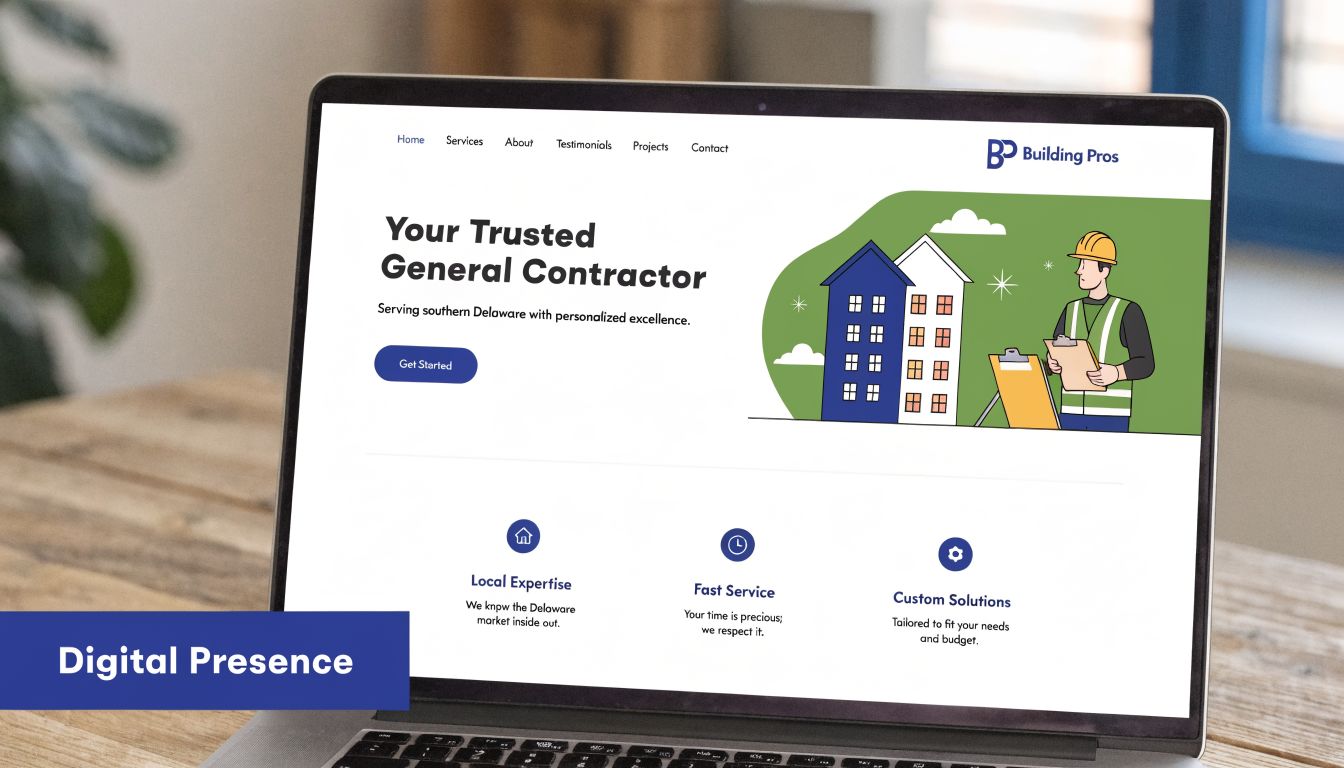
Your website and Google Business Profile should work like one system. The site builds confidence and qualifies the lead. The profile gets you into the local search conversation in the first place. If those two assets are disconnected, lead flow gets inconsistent. If they reinforce each other, they become a reliable intake channel you can route into your CRM.
What a contractor website needs to do
A contractor website has one job. Help the right buyer decide whether to contact you.
That means the site needs to answer a few questions fast. What do you build? Where do you work? What kinds of jobs are a fit? Why should the buyer trust your team? What happens after they reach out?
The best contractor sites are structured around buying intent, not around the company org chart. A kitchen remodel page should exist because buyers search for kitchen remodels. A tenant improvement page should exist because commercial prospects want to know you understand occupied spaces, schedules, and coordination. One generic services page usually fails on both search visibility and lead quality.
A useful site usually includes:
- Dedicated service pages: Separate pages for the work you want more of.
- Service area clarity: Clear city, county, or regional coverage without stuffing every page with place names.
- Project examples with context: Show photos, then explain the problem, scope, constraints, and result.
- Trust builders: Reviews, licenses, certifications, warranty details, and process steps.
- Strong calls to action: Request an estimate, book a site visit, or start a project discussion.
- Mobile-first usability: Fast load times, tap-to-call, short forms, and readable page layouts.
Presentation affects lead quality more than many contractors expect. The same lesson shows up in optimizing rental property listings. Different service, same buyer behavior. Clear information and lower uncertainty produce better inquiries.
SEO for contractors is structure, relevance, and proof
SEO gets treated like a technical side project. For contractors, it is mostly about building the site in a way search engines and buyers can both understand.
Start with structure. Each core service needs its own page. Each page needs a clear title, useful copy, internal links, real project examples, and a next step. Then add local relevance. Your business name, phone number, service area, and core services should be consistent across your site and local listings. Add proof on top of that with reviews, job photos, and pages that show real work in real locations.
Schema can help search engines interpret your business correctly, especially when it is tied to the right service and local business data. It will not rescue a weak site, but it supports a solid one. The bigger win is usually simpler. Give each profitable service a real page and connect that page to proof.
A practical example makes the trade-off clear. If you do decks, additions, and window replacement, you can cram all three into one page and save time now. Or you can build separate pages and give each service a chance to rank, convert, and feed cleaner lead data into your CRM later. The second path takes more effort up front. It usually produces better search visibility and better attribution.
Your Google Business Profile needs weekly attention
A neglected Google Business Profile costs calls.
Contractors often claim the profile, fill in the basics, and leave it alone. Then a competitor with fewer years in business but better profile activity starts showing up more often in the map pack. That is not unusual. Google wants current signals.
Use this operating checklist:
- Choose the right primary category: Pick the closest match to the main service you want to sell.
- Complete the service list: Add the actual services you want tied to inquiries.
- Write a useful business description: Focus on service area, buyer fit, and how the process works.
- Upload recent photos: Finished projects matter. Progress photos, crew photos, and clean job-site images help too.
- Collect and answer reviews: Ask consistently and respond like a real operator who remembers the job.
- Use posts and updates: Highlight recent work, seasonal demand, and service reminders.
- Watch Q&A: Add common questions and answer them clearly before prospects ask.
- Check contact paths: Phone, website, hours, and appointment links need to be correct.
For a more detailed setup and maintenance process, this guide on how to optimize Google Business Profile is worth reviewing.
A short demo can also help you think about site structure and visibility from the buyer's perspective.
Common failures that break the system
These problems show up all the time:
- One-page websites: They rarely match multiple search intents or qualify leads well.
- Generic copy: Buyers cannot tell what you specialize in.
- Stock-heavy visuals: Real job photos outperform polished filler.
- Weak service-area signals: Visitors leave if they cannot confirm you work in their location.
- No explanation of the next step: Good prospects want to know what happens after the form submission.
- Inactive Google Business Profiles: Competitors with fresher profiles often win visibility.
The point is not to make the site prettier. The point is to reduce uncertainty, earn the click, and route the right local lead into the rest of your marketing system.
The Engine Room CRM and Automation with GoHighLevel
Leads don't disappear because demand is weak. They disappear because nobody owns the follow-up.
A CRM is essential. For a contractor, a CRM is the central place where inquiries, estimates, appointments, follow-up, and customer communication live. Instead of scattered texts, sticky notes, inbox threads, and memory, you get one operating system.
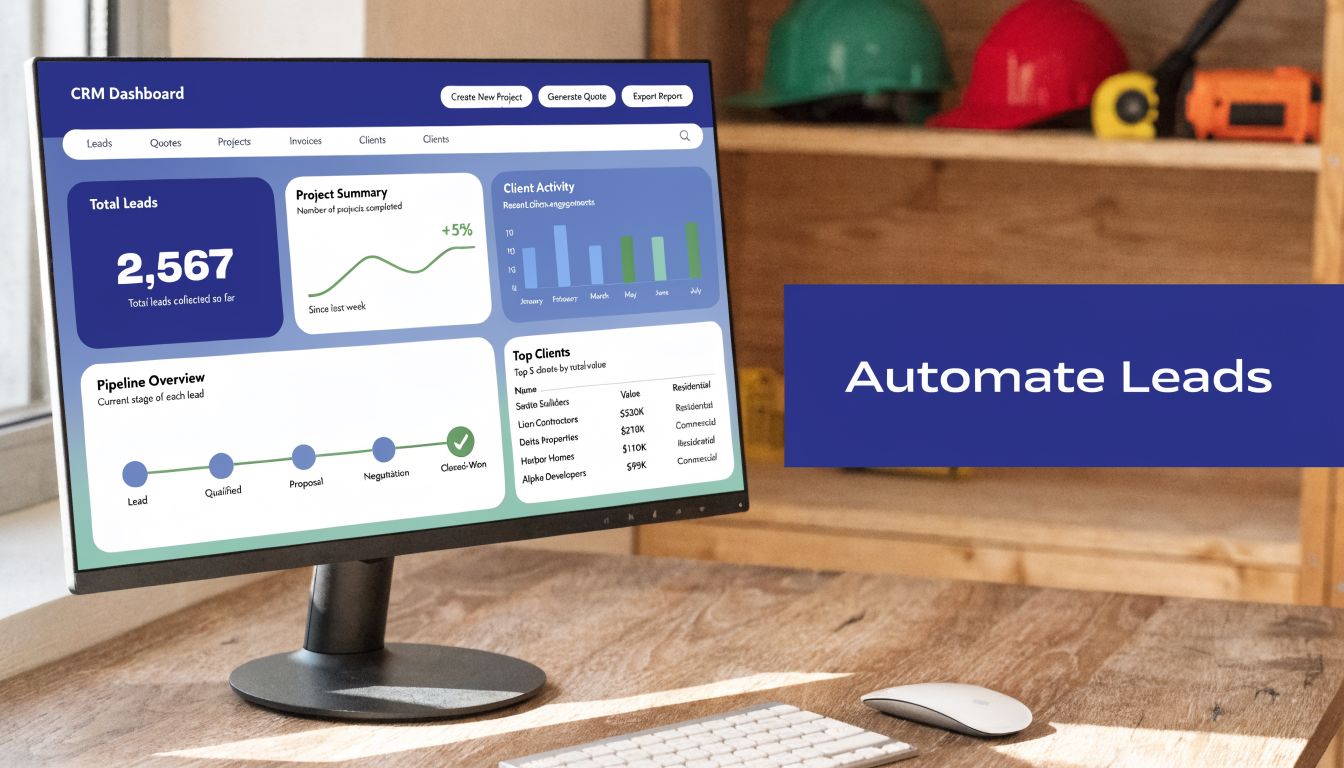
Integrated CRM and automation have become a real competitive edge. One source reports that 40% of contractors who adopted tools like GoHighLevel achieved a 2x increase in lead qualification, while adoption remains at 22% because many teams see setup as too complex (contractor CRM and automation trends).
Why GoHighLevel fits contractor workflows
GoHighLevel works well for contractors because it brings several moving parts into one place:
- Lead capture: Forms, calls, and messages feed into one pipeline.
- Pipeline management: You can track stages like new lead, contacted, estimate scheduled, proposal sent, won, and lost.
- Automated follow-up: Text and email sequences fire based on behavior.
- Review generation: Finished jobs can trigger review requests.
- Reactivation: Old leads can be brought back without manual chasing.
The key is not to overbuild it. Most contractors don't need a huge, custom monster. They need a lean setup that crews and office staff will use.
Four automations worth building first
Start with the highest-friction points in your sales process.
The missed call text-back
If a prospect calls while you're on site, driving, or in a meeting, that lead can cool off fast.
Set a workflow so that when a call is missed during business hours, the system immediately sends a text that says your team missed the call and asks how it can help. That doesn't close the deal by itself, but it keeps the conversation alive until someone can respond properly.
New lead speed-to-contact
Web leads go stale quickly when nobody replies.
When someone fills out a form, trigger:
- an immediate confirmation email
- a short text acknowledging the request
- a task for the estimator or office manager
- a pipeline stage update so nobody loses track of it
This keeps response time tight and gives the prospect confidence that your business is organized.
If a lead has to wonder whether you saw their request, your system already failed.
Appointment reminders
No-shows waste time on both sides.
A simple reminder sequence works well:
- confirmation when the appointment is booked
- reminder the day before
- reminder the morning of
- optional reschedule prompt if they don't confirm
This is especially helpful when your sales process includes site visits, showroom meetings, or estimate reviews.
Post-project review request
Reviews rarely happen because a contractor forgets to ask at the right time.
Build a trigger tied to project completion or final invoice status. Send a short thank-you message, then request a review through your preferred channel. Keep the ask simple. If the client had a good experience and the timing is right, response rates improve without awkward manual chasing.
Keep your pipeline visible and boring
That word matters. Boring is good.
A good CRM pipeline should be so clear that anyone on your team can answer these questions quickly:
| Pipeline question | What your CRM should show |
|---|---|
| Where did this lead come from | Google Ads, organic search, referral, social, partner, repeat customer |
| What stage is it in | New inquiry, contacted, estimate booked, proposal out, won, lost |
| Who owns the next action | Estimator, office manager, project manager, owner |
| What happens next | Call, site visit, follow-up message, proposal review, closeout |
If you need a practical implementation reference, this walkthrough on CRM implementation steps is a useful starting point for mapping fields, stages, automations, and ownership.
What to avoid when setting up automation
Automation is supposed to reduce friction, not make your company sound robotic.
Avoid these mistakes:
- Too many messages: Buyers don't want a drip campaign that feels like spam.
- No human handoff: Automation should support staff, not replace real conversations.
- Messy pipeline stages: If stages are vague, reporting becomes useless.
- No internal accountability: A CRM without ownership turns into a digital junk drawer.
The goal is simple. Every lead gets seen. Every next step gets assigned. Every customer interaction leaves a trail your team can act on.
Fueling Growth Smart Lead Generation and Partnerships
A contractor gets ten new inquiries in a week. Five are bad fits, three never answer the phone, one wants a price with no real timeline, and one turns into a solid job. If every lead source feeds into the same CRM, that week teaches you something useful. If it does not, it just feels busy.
Growth gets expensive when you add channels before you define what a good lead looks like. The goal here is to add demand in a controlled way. Each source should feed the same system, hit the same qualification steps, and give you a clear read on job quality, close rate, and speed to sale.
Paid search for high-intent demand
Google Ads works well when the search term signals a real project, not casual research.
A kitchen remodel campaign should target service-specific searches, send people to a page about kitchen remodels, show proof from similar jobs, and ask for one clear next step. That might be a site visit request, estimate request, or budget call. Loose keywords and generic landing pages burn money fast.
Paid search fits contractors who need demand now, know their margin by service line, and can respond quickly. It usually disappoints when the office is slow to answer, the ads are too broad, or every service gets dumped into one campaign.
Content that shortens the sales cycle
Organic content does not usually create the fastest lead flow. It does reduce friction in the sales process.
Good prospects show up better informed when they have already seen your work, your process, and the way you handle common problems. That means fewer early calls spent explaining basics and more conversations with buyers who understand the scope.
The content that helps most is practical:
- Project case studies: Scope, constraints, finish level, timeline, and why certain decisions changed cost
- Process pages: What happens before demolition, during construction, and at handoff
- FAQ pages: Budget ranges, allowances, permitting, lead times, and scheduling realities
- Short jobsite videos: Walkthroughs, problem-solving moments, and quality details buyers notice
Referral partnerships that act like a channel
Referrals are often treated as luck. Reliable referrals come from process.
Architects, designers, real estate agents, property managers, and specialty trades can all send work consistently when you define the fit, make introductions easy, and close the loop after every handoff. Partners want to know three things. What kind of project you want. Whether you will follow up fast. Whether sending you a client will make them look smart or careless.
A simple partnership system usually includes:
- a short definition of your ideal project
- one contact path for introductions
- a response standard for first follow-up
- status updates back to the partner
- occasional shared promotion or educational content
If you want a more structured model, this guide to a co-marketing strategy gives a useful framework.
The best referral relationships run on consistency, not goodwill alone.
Commercial outreach needs a different message
Developer, tenant improvement, and light commercial work should not be marketed like residential remodeling.
These buyers care about early budget clarity, schedule realism, documentation, and communication quality. A generic capability statement does not move the conversation. A clear offer does. Budget pricing before final drawings, pre-con support, fast review of plans, and realistic sequencing are stronger entry points because they match the buyer's immediate problem.
A workable campaign is straightforward:
- target a narrow service such as tenant improvements, build-outs, or pre-con estimating
- send traffic to a page written for commercial buyers
- offer a specific next step, such as a budget review call
- route every inquiry into your CRM with tags, owner assignment, and follow-up tasks
For contractors comparing outside help, this list of lead generation companies for contractors can help you evaluate different approaches to outreach and qualification. Outside support only works when your positioning, handoff, and follow-up process are already defined.
Where each growth lever fits
| Growth lever | Best fit | Common reason it fails |
|---|---|---|
| Google Ads | Service lines with clear local intent and healthy margins | Broad keywords, weak landing pages, slow response time |
| Content and SEO | Higher-trust jobs with a longer decision cycle | Generic topics, thin proof, inconsistent publishing |
| Referral partnerships | High-value projects where trust matters early | No partner process, no feedback loop, no reciprocity |
| Commercial outreach | Tenant improvement, build-outs, and pre-con conversations | Residential-style messaging, vague offer, poor follow-up |
Use fewer channels better.
A clean intake and follow-up system lets you test growth without creating chaos. That is the primary advantage of building marketing as a system. Every new lead source plugs into the same machine, and you can tell which inputs produce profitable work instead of more admin.
Measuring Your Blueprint and a 90-Day Action Plan
Monday starts with three leads in the inbox, two calls from last week that never got logged, and an estimator asking which jobs are worth chasing. That is what marketing looks like without a measurement system. Activity goes up, but confidence goes down.
Contractors need a scoreboard tied to revenue, job fit, and follow-up discipline. If GoHighLevel or any other CRM is your hub, measurement stops being a pile of disconnected reports and starts acting like job costing for lead generation. You can see which channels produce inquiries, which ones produce real opportunities, and which ones waste estimator time.
Skip vanity metrics. Track the numbers that help you decide where to spend, what to fix, and what to cut.
The three numbers to watch first
Start with a small dashboard your team will review.
| KPI | Formula | What it tells you |
|---|---|---|
| Cost Per Lead (CPL) | Total marketing spend ÷ total new leads | How much it costs to generate an inquiry |
| Lead-to-Customer Rate | (New customers ÷ total leads) × 100 | How well your sales process turns leads into jobs |
| Customer Acquisition Cost (CAC) | Total marketing and sales spend ÷ new customers | What it costs to win a customer |
These numbers work together.
A high CPL is not automatically a problem. Commercial remodel leads often cost more than small residential inquiries, but the economics can still work if those jobs fit your target scope and close at a healthy rate. On the other hand, cheap leads can drain the business if they are outside your service area, price range, or project type.
CAC usually exposes system issues fast. If acquisition cost keeps climbing, the problem is often one of four things. Weak targeting, slow response time, poor qualification, or a handoff breakdown between office staff and sales.
A lead has no real value until it becomes a qualified opportunity and then a job.
How to read the numbers like an operator
Marketing performance only makes sense in the context of the work you want to win.
A campaign that brings in ten kitchen remodel inquiries may look productive on paper. If your priority is larger additions or commercial tenant improvements, those ten leads can still be the wrong output. Another channel may send only three inquiries in a month, but if two turn into serious bids in your preferred service line, that channel deserves more budget.
This is why the CRM matters. GoHighLevel lets you tie source, stage movement, follow-up history, and final outcome together in one place. Without that system, teams tend to judge performance by whichever phone call felt promising last week.
Use a review rhythm that matches how contractors operate:
- Weekly: Review new leads, first response time, appointments set, and stalled opportunities
- Monthly: Compare lead quality by source, win rates, and acquisition cost
- Quarterly: Increase budget on proven channels, repair weak process points, and shut off distractions
Weekly reviews catch execution problems. Monthly reviews show channel quality. Quarterly reviews shape budget decisions.
A practical 90-day build plan
First 30 days. Foundation
Get control before you add volume.
- Audit lead flow: List every lead source, where it enters, who responds, and where tracking breaks.
- Define ideal work: Choose the project types, service area, budget range, and buyer profile you want more of.
- Tighten the message: Rewrite core website copy and outreach language around buyer concerns, proof, and next steps.
- Clean up your Google Business Profile: Fix categories, services, photos, reviews, and business description.
- Fix website friction: Improve mobile usability, contact paths, service pages, and trust signals.
Days 31 to 60. Systemization
Build the machine inside the CRM.
- Set up a simple pipeline: New lead, contacted, qualified, appointment scheduled, estimate sent, won, lost.
- Connect every intake point: Forms, calls, chat, and manual entries should all land in one system.
- Launch core automations: Missed call text-back, lead acknowledgment, appointment reminders, estimate follow-up, and review requests.
- Assign ownership: Decide who owns speed to lead, qualification, proposal follow-up, and pipeline updates.
- Create one operating dashboard: Show source, stage, job type, and outcome so decisions do not rely on memory.
Days 61 to 90. Growth
Add traffic after the intake and follow-up process is stable.
- Launch one primary acquisition channel: Usually Google Ads for immediate demand or local SEO for a priority service line.
- Publish proof assets: Add case studies, project photos, testimonials, and FAQs that answer real objections.
- Start referral outreach: Reconnect with architects, designers, real estate contacts, suppliers, and past customers.
- Review lead quality inside the CRM: Score each lead for fit, urgency, budget, and close potential.
- Shift budget based on job outcomes: Put more money into channels that produce the right work, not just more names.
Questions to ask yourself at the 90-day mark
Use these questions to pressure test the system:
- Can we identify the source of every lead
- Do we respond fast enough to every qualified inquiry
- Are we attracting the project types we want
- Does estimate follow-up happen through process, not memory
- Which channels produce profitable jobs
- Where do leads stall between first contact and signed contract
A contractor with clear answers to those questions can improve the system with intent. A contractor without those answers usually keeps spending, keeps guessing, and keeps blaming the wrong channel.
That is the true aim of measurement. Better visibility is part of it, but the bigger win is control. You get a marketing system that can be tuned, not a pile of tactics that create more admin.
If you want help diagnosing your current setup and building a more reliable lead generation machine, Machine Marketing can help. We focus on practical systems, from messaging and website improvements to GoHighLevel setup, CRM automation, and a workable 90-day roadmap that fits how your business runs.