Your website says one thing. Your sales team says another. Your brochures lean on features. Your outbound emails talk about service. Then the leads that come in are a poor fit, or worse, they’re price shoppers who never understood why you were different in the first place.
That usually isn’t a traffic problem. It’s a positioning problem.
For B2B manufacturers, this gets expensive fast. Technical buyers need clarity. Purchasing teams need confidence. Internal teams need one shared way to explain why your company matters. A marketing positioning statement template gives you that shared logic. Done right, it stops being a branding exercise and becomes a working asset for sales, CRM, website messaging, and campaign planning.
If you want broader context on the strategic side, Big Moves Marketing published a useful ultimate guide to B2B brand positioning. For a more systems-driven view of how positioning connects to execution, we also recommend this piece on engineering a B2B strategic brand positioning system.
Introduction
Most companies don’t struggle because they lack capability. They struggle because the market can’t quickly understand that capability.
A manufacturer might have stronger tolerances, better response times, deeper application knowledge, and more reliable delivery than competitors. But if the homepage says “advanced solutions,” the sales deck says “quality products,” and account managers each improvise their own explanation, buyers hear noise instead of a clear promise.
That’s where a positioning statement earns its keep.
A good one does three jobs at once. It names who you serve, defines the category you want to own in the buyer’s mind, and explains why your claim is believable. It also forces hard choices. You can’t target everyone, promise everything, and still sound credible.
A strong positioning statement doesn’t decorate your marketing. It diagnoses what your company is really trying to say, then gives every channel the same operating instructions.
For B2B manufacturers, that’s especially important because the sales cycle is longer, the stakeholders are mixed, and the consequences of vague messaging show up across the whole system. SEO underperforms. Sales calls wander. CRM notes become inconsistent. Campaigns generate attention without fit.
Why Your Current Messaging Fails in B2B
Generic messaging usually fails because it ignores how B2B buying works.
In manufacturing, one message often has to land with multiple people. Engineers care about fit, tolerances, risk, and application details. Operations leaders care about downtime and implementation. Procurement cares about commercial terms and supplier confidence. If your message is broad enough to “work for everyone,” it often works for no one.
The problem gets worse when companies rely on internal language. Teams describe what they make, how long they’ve been around, or how committed they are to quality. Buyers don’t make decisions from that alone. They need a clear connection between your offer and their specific operational problem.
The common failure pattern
Here’s what we see repeatedly in B2B companies:
- The website leads with company-first language instead of buyer-first outcomes.
- Sales calls start too wide and don’t anchor around a differentiated claim.
- Marketing campaigns chase channels before the core message is stable.
- CRM records capture activity but not the positioning logic behind the outreach.
- Teams talk about features without tying them to business impact or buying confidence.
That creates inconsistency. It also wastes budget.
Businesses using a standardized positioning statement template achieved 35% greater marketing ROI within the first year, and template-guided campaigns converted 28% more leads in B2B sectors like manufacturing, according to HubSpot’s data cited in its positioning statement template guide.
Questions worth asking right now
If your current messaging isn’t producing qualified opportunities, pressure-test it with questions like these:
- Who exactly are we speaking to? The design engineer, the plant manager, the purchasing lead, or the rep channel?
- What problem do we claim to solve first? Lead time risk, poor quality consistency, integration headaches, or low visibility into pipeline?
- What category are we asking buyers to place us in? Component supplier, automation partner, specialty fabricator, or growth consultancy?
- What proof makes our promise believable? Process, expertise, certifications, implementation model, or commercial structure?
- Can three people on our team explain us the same way? If not, the market won’t either.
Practical rule: If your message can be copied and pasted onto a competitor’s website without sounding wrong, it isn’t positioning. It’s filler.
There’s another layer now. Buyers don’t just discover you through search and referrals. They also encounter your brand through AI-generated summaries, assistant tools, and synthesized comparisons. That raises the cost of fuzzy messaging because vague positioning gives those systems nothing crisp to repeat. This article on how being cited by AI agents trumps digital visibility is worth reading if you’re thinking beyond old-school rankings.
The Anatomy of a High-Impact Positioning Statement
The classic positioning statement framework has stayed useful because it forces strategic clarity.
The concept traces back to Al Ries and Jack Trout’s 1981 book Positioning: The Battle for Your Mind, which established positioning as a communication strategy. The standard template they inspired, “For [target market], [brand] is the [category] that [benefit] because [reason to believe]”, has been adopted in over 90% of MBA marketing curricula globally, as noted in Zendesk’s overview of positioning statement examples.
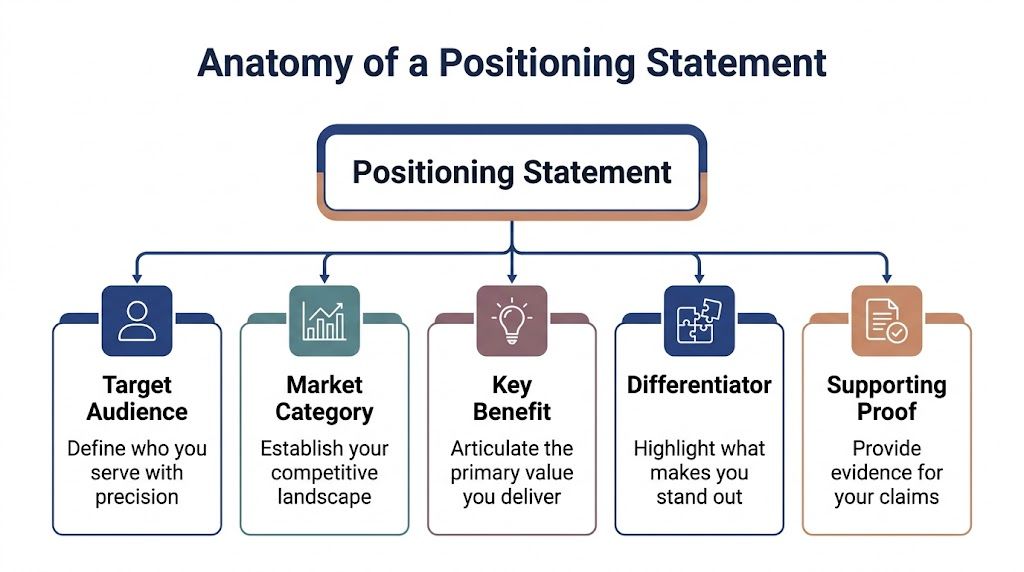
The five parts that matter
A positioning statement looks simple on paper. In practice, each part does a specific job.
| Component | What it does | What weak versions sound like |
|---|---|---|
| Target audience | Narrows the message to a defined buyer or segment | “Businesses of all sizes” |
| Market category | Tells buyers what kind of solution you are | “A leader in innovation” |
| Key benefit | States the primary outcome you create | “High-quality service” |
| Differentiator | Explains what sets you apart | “Customer-focused” |
| Supporting proof | Gives the claim credibility | “Trusted by many” |
A few practical notes matter here.
Target audience is not your total addressable market. It’s the segment that should recognize itself immediately. For a manufacturer, that might be OEM sourcing teams needing short-run precision components, or plant operators replacing fragmented vendors with one technically capable supplier.
Market category frames the buying context. If you define the category poorly, buyers compare you against the wrong alternatives. Calling yourself a “full-service solutions company” sounds expansive, but it rarely helps a prospect understand where you fit.
What each part needs to accomplish
The key benefit should express the outcome the buyer values most, not a list of features. If your team leads with “state-of-the-art equipment,” buyers still have to translate that into a business result. Better language points to reduced downtime, simplified sourcing, faster handoff, or more predictable execution.
The differentiator is where trade-offs become visible. You can’t be premium, low-cost, highly customized, fastest-moving, and easiest to scale all at once. Strong positioning chooses what matters most and accepts what it won’t claim.
The supporting proof is the reason your statement works. This is your process, your implementation model, your domain expertise, your validation steps, or your delivery system. Without it, the statement reads like ad copy.
A buyer will usually forgive a narrow claim. They won’t forgive an unsupported one.
If you want inspiration on how different companies express strategic distinction, this collection of brand strategy examples is useful. For a more operational messaging lens, this guide to a marketing messaging framework helps connect positioning to day-to-day execution.
A good statement versus a weak one
Compare these two examples.
Weak
For companies that need manufacturing support, Apex is a quality provider that delivers excellent service because we care about customer success.
Stronger
For OEM teams that need precision-machined components without supplier handoff delays, Apex is the manufacturing partner that simplifies sourcing and speeds production readiness because it combines engineering review, production coordination, and one accountable point of contact.
The second version isn’t flashy. It’s useful. It gives the buyer a role, a problem, a category, a benefit, and a reason to believe.
Forging Your Statement with B2B-Ready Templates
Most companies don’t need more brainstorming. They need a process that forces decisions.
A structured seven-step method works well for B2B manufacturers: Buyer Persona Development, Problem Identification, Competitive Mapping, Value Proposition Articulation, Differentiation and Reason to Believe, Template Assembly, and Validation and Iteration. Following that process can lead to 20-30% higher campaign ROI according to eCornell benchmarks cited by Crayon in its guide to positioning statements.
Start with the raw inputs
Before filling in a template, gather four things:
Buyer language
Pull phrases from sales calls, proposal notes, email replies, and CRM records. Don’t polish them yet. Use the words buyers already use to describe delays, risk, quality concerns, and approval friction.Decision context
Clarify who owns the problem, who signs off, and who blocks the decision. In B2B manufacturing, those are often different people.Competitive frame
Identify what buyers compare you against. It may be a direct competitor, an incumbent supplier, an internal team, or doing nothing.Operational proof
List the facts that support your claim. Think process discipline, engineering review, implementation support, responsiveness, or integration capability.
Three templates that work in practice
Use the version that matches your business model.
Template 1 for focused category positioning
For [specific buyer] who need [clear outcome or solved problem], [company] is the [market category] that [primary benefit] because [reason to believe].
Best for: manufacturers with a clear product line or a narrow service offer.
Template 2 for complex technical offers
For [buyer segment] facing [operational or commercial problem], [company] provides [category or solution type] that helps them [business outcome] through [distinct approach], backed by [proof].
Best for: automation firms, custom fabricators, industrial service providers, or firms with mixed technical and service delivery.
Template 3 for internal and external use
Internal version
For [segment], we are the [category] that delivers [benefit] because we uniquely combine [capability 1], [capability 2], and [proof].External version
We help [segment] achieve [outcome] without [common pain point].
Best for: teams that need one strategic statement for internal alignment and a shorter version for homepage copy, sales openers, and outbound email.
If your benefit language feels weak, tighten it before you finalize the statement. This guide on how to write a value proposition is helpful for that step.
A worked B2B manufacturing example
Take a hypothetical company: a custom CNC machine component manufacturer.
Here’s the weak version:
For manufacturers, Titan Components is a leading provider of precision solutions that offers quality and service for all your needs.
It fails for three reasons. The audience is too broad. The category is vague. The benefit is generic and unsupported.
Now the revised version:
For OEM engineering and sourcing teams that need custom CNC components delivered without repeated specification confusion, Titan Components is the precision manufacturing partner that improves handoff accuracy and production confidence because it combines design review, application-aware quoting, and accountable production communication.
Why this works:
- Audience is specific.
- Problem is real and familiar.
- Category is understandable.
- Benefit connects to workflow and risk.
- Proof is operational, not fluffy.
A practical build sequence
When we pressure-test statements, this sequence usually surfaces the right wording faster than trying to write the final line in one pass:
- Name the buyer first. Write one sentence that starts with a role, not an industry.
- Define the pain next. Choose the problem you want to be known for solving.
- Choose the category carefully. Pick the label that helps a buyer compare you correctly.
- State one main outcome. If you list three, the statement loses force.
- Add the proof. Explain why your claim is credible in practice.
Before and after comparison
| Version | Example | Problem or strength |
|---|---|---|
| Before | “We provide innovative manufacturing solutions with quality and service.” | Broad, forgettable, interchangeable |
| After | “We help OEM engineering and sourcing teams get custom CNC components into production with fewer handoff errors because our quoting and review process is built around application fit.” | Specific, buyer-centered, believable |
A strong marketing positioning statement template doesn’t write your strategy for you. It exposes whether you have one.
Validating Your Statement with a Pre-Flight Checklist
Most positioning statements don’t fail because the grammar is off. They fail because nobody stress-tested the claim before pushing it into campaigns, decks, and CRM workflows.
That’s avoidable. Use a checklist before rollout.
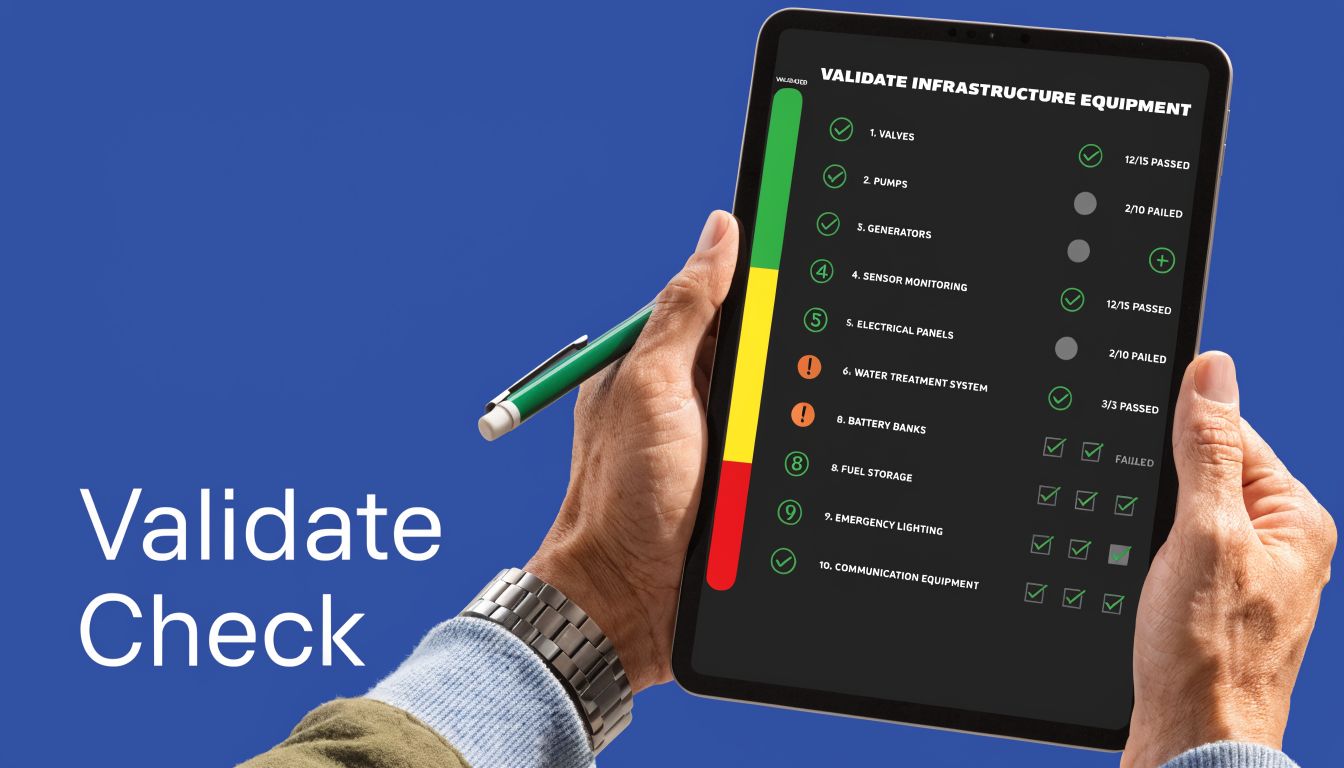
Product School notes two common failure points in its discussion of positioning statements: overly broad targeting dilutes impact in 65% of cases, and a weak Reason to Believe erodes trust in 55% of B2B scenarios. The same source also notes that high-ROI brands revise their statements quarterly through testing in its guide to product positioning statements.
The pre-flight checklist
Run your draft through these tests.
The focus test
Can one buyer segment clearly recognize itself? If the statement tries to address distributors, engineers, procurement, and operations all at once, narrow it.The category test
Does the category label help the buyer compare you correctly? If your statement uses language like “solutions provider,” rewrite it with a category buyers already understand.The benefit test
Is the promised outcome specific enough to matter? “Better service” won’t hold up. “Fewer production handoff errors” might.The proof test
Can your team support the claim immediately with process, expertise, or evidence? If not, the statement is still a wish.The competitor test
Could your top three competitors say the same thing and sound believable? If yes, your differentiator isn’t sharp enough.The hallway test
Can a sales rep, account manager, and owner all repeat the same core idea without reading from a slide? If not, simplify.
What weak statements usually get wrong
Here’s a useful comparison.
| Failure mode | What it sounds like | Fix |
|---|---|---|
| Too broad | “For businesses that need growth” | Name a segment and a real buying context |
| Too feature-heavy | “We use advanced equipment and modern systems” | Translate the feature into buyer value |
| No proof | “We deliver unmatched results” | Add the delivery method or operating logic |
| Too long | A paragraph full of qualifiers | Cut to one main claim and one proof |
| Internally written | Packed with company jargon | Replace with customer-recognizable language |
If a buyer asks “why should I believe that?” and your team hesitates, the statement isn’t ready.
A short review routine
A practical review loop doesn’t need to be complicated:
- Read the statement aloud in a sales context.
- Put it in front of someone outside leadership.
- Compare it against competitor homepage language.
- Test a shorter external version for website and email use.
- Revisit it on a regular schedule instead of treating it as permanent.
The point isn’t to make the line clever. The point is to make it durable under pressure.
Activating Your Statement for Lead Generation
A positioning statement sitting in a brand document won’t generate leads. It has to be wired into the systems your team already uses.

Many companies stop too early at this point. They approve the wording, then never operationalize it. The result is predictable. The website goes one direction, outbound sequences go another, and discovery calls drift into generic capability talk.
Positioning frameworks such as April Dunford’s have been shown to help firms integrating platforms like GoHighLevel reduce churn by 22%, with 90-day proof-of-concept models yielding 3x lead quality, according to the earlier HubSpot-cited data referenced above. That matters because clear positioning works best when it’s built directly into CRM and automation workflows, not left in a slide deck.
Put it inside your operating system
For B2B lead generation, your statement should show up in at least five places:
CRM master record
Add the approved positioning statement as a visible custom field or pinned note so sales and marketing use the same language.Website messaging brief
Use the core statement to shape homepage H1s, service-page intros, and industry pages.Outbound campaign setup
Build email and SMS campaigns around the same buyer, problem, and proof logic.Sales call opener
Turn the statement into the first short explanation a rep gives on a discovery call.Content planning
Use each component as a content pillar. Buyer, problem, category, benefit, and proof can each feed articles, videos, and case-focused posts.
A simple 90-day activation model
A straightforward rollout often works better than a full rewrite of everything at once.
First, align internal teams on the approved statement and a shorter external version.
Next, update the homepage, sales deck opening, and outbound templates.
Then, create one campaign per target segment using the same message architecture.
Finally, review call recordings, reply quality, and CRM notes to see whether the market is repeating your language back to you.
A short walkthrough can help if your team is implementing this inside existing campaigns and workflows:
The statement is internal strategy. The activation is external proof that your strategy can survive contact with real buyers.
What this looks like in practice
If your statement says you help OEM sourcing teams reduce handoff errors, that shouldn’t stay trapped in strategy docs.
It should become:
- the homepage promise,
- the subject line theme in outbound,
- the opening frame in a rep’s first call,
- the segmentation logic inside GHL,
- and the standard used to judge whether new content is on-message.
When that happens, your marketing positioning statement template stops being a sentence. It becomes a working control system for lead generation.
Conclusion
A weak message creates friction everywhere. Your team compensates with more calls, more content, more follow-up, and more explanation. A strong positioning statement removes that friction by giving buyers a faster path to understanding.
For B2B manufacturers, the value goes beyond branding. It sharpens website copy, improves sales consistency, strengthens CRM workflows, and gives your campaigns a clear center of gravity. It also forces a useful discipline. You have to choose who you serve, what problem you solve, and why your claim deserves belief.
If your current messaging feels scattered, start with the templates and checklist here. Write one version. Test it. Tighten it. Then activate it across the systems your team already uses.
If that process reveals bigger gaps in your strategy, market fit, or CRM setup, outside diagnosis can save a lot of wasted effort.
If you want help turning your positioning into a usable lead generation system, Machine Marketing can help you diagnose the problem, sharpen the message, and operationalize it across your website, CRM, GoHighLevel workflows, and 90-day marketing plan. If you’re stuck, book a discovery call with Karl or start with the 40-Question Marketing Review.