A marketing roadmap isn't just another document; it’s the high-level, visual timeline that turns your strategy into action. It aligns your team, clarifies priorities, and most importantly, connects your day-to-day work to your biggest business goals. Think of it as the blueprint for moving from random marketing activities to a focused, results-driven system.
Moving Beyond Random Acts of Marketing

Does your marketing feel like a series of disconnected efforts? A social media post here, an email blast there, with no real thread connecting them? We see business owners struggling with this constantly. The diagnosis is almost always the same: the problem isn't the quality of the individual tactics; it's the lack of a unifying roadmap to guide them.
Without a clear plan, marketing becomes reactive. You end up chasing trends and spending money without a clear idea of what's actually working. A marketing roadmap is the tool that changes this. It forces you to ask the hard questions upfront and build a system where every single action has a purpose.
The Shift to a Proactive System
A well-structured roadmap transforms marketing from an unpredictable cost center into a predictable growth engine. For manufacturers and SMBs, where every dollar has to count, this shift is critical. It ensures your resources are invested in activities directly tied to real business goals, not just hopeful experiments.
This is where a 90-day plan becomes your most powerful tool. A full year-long strategy is often too overwhelming and can become obsolete quickly. A 90-day sprint, however, gives you a manageable framework to:
- Align your big-picture vision with concrete, near-term actions.
- Test and iterate quickly based on real performance data.
- Secure early wins to build momentum and get stakeholder buy-in.
- Focus your team on the highest-impact priorities for the current quarter.
This approach brings an engineering mindset to your marketing—we diagnose the problem, build a solution for a specific timeframe, and rigorously measure the results.
Why a Documented Strategy Matters
The gap between businesses that plan and those that don't is huge. A staggering 47% of companies operate without a documented digital marketing strategy. This creates a massive opportunity for anyone willing to adopt a structured approach. A documented plan moves your strategy from a fuzzy idea in your head to a tangible guide your entire team can follow.
To get a better sense of how strategic frameworks drive results, check out the latest stats on the state of digital marketing strategy.
Before we dive into building your own, let's break down what a high-impact roadmap looks like. These are the non-negotiable components that turn a simple timeline into a powerful strategic tool.
Core Components of a High-Impact Marketing Roadmap
| Component | Purpose | Key Question It Answers |
|---|---|---|
| Business Goals & KPIs | Aligns marketing efforts with high-level company objectives. | "What specific business outcome are we trying to achieve?" |
| Marketing Initiatives | Breaks down large goals into strategic projects or campaigns. | "What major projects will get us to our goal?" |
| Timeline (e.g., 90-Day Plan) | Provides a clear, actionable timeframe for execution. | "What are we doing this quarter, and when?" |
| Channel & Tactics | Details the specific actions for each initiative (e.g., SEO, PPC). | "How and where will we execute our plan?" |
| Team Roles & Owners | Assigns clear responsibility for every task and outcome. | "Who is responsible for making this happen?" |
| Budget Allocation | Connects financial resources to strategic priorities. | "How much are we investing, and where?" |
| Review Cadence | Establishes a regular schedule for measuring progress and adapting. | "How will we track performance and stay on course?" |
Getting these components down on paper is what separates a wish list from a workable plan. It creates clarity and accountability across the board.
A roadmap isn’t about restricting creativity; it’s about directing it. It provides the guardrails that ensure every creative idea, every campaign, and every piece of content moves you closer to your ultimate business objectives.
Instead of your team asking, "What should we do this week?", they'll ask, "What's the next step on the roadmap to hit our quarterly lead goal?" That simple change in perspective is the key to unlocking consistent, measurable growth. It's how you build a marketing machine that works for you, not the other way around.
Building Your Foundational Marketing Strategy
A marketing roadmap template is only a tool; it's useless until you anchor it in a real strategy. This isn't just about filling in boxes. It's about making deliberate choices that tie every marketing dollar to a tangible business result. It starts by ditching vague desires like "we need more leads" and getting surgically precise about your objectives.
Before you even think about tactics, you have to define what success looks like in hard numbers. We build every client plan around SMART goals—that’s Specific, Measurable, Achievable, Relevant, and Time-bound. This framework isn't just business jargon; it's a filter that forces clarity and strips ambiguity out of your marketing.
Consider the difference. A vague goal is: "We want to grow our business."
A SMART goal is: "Increase qualified leads from our website by 20% in Q3 by optimizing our top five service pages."
The second goal gives you a clear target, a deadline, and a specific place to focus your energy. It turns marketing from a hopeful expense into a system engineered for a specific outcome.
Diagnosing Your Audience's Real Needs
Once your goals are locked in, the next step is to get crystal clear on who you're talking to. Most businesses have a general idea of their customer, but a roadmap that actually works requires a much deeper diagnosis. You need to understand their journey from being a stranger to becoming a loyal customer.
To do this, you have to ask questions that uncover their real-world problems, motivations, and buying triggers.
Questions to ask yourself about your ideal customer:
- What specific problem are they trying to solve when they start searching for a solution like ours?
- What are their biggest frustrations with the other options on the market?
- What information do they need to feel confident enough to make a purchase?
- Where do they go online for trusted advice—industry forums, trade publications, peer reviews?
Answering these questions stops you from guessing and ensures your messaging connects. If you want to go deeper, you can explore the questions we use with our own clients to build a comprehensive marketing plan that uncovers these critical insights.
Connecting Your Strategy to the Customer Journey
With clear goals and a deep understanding of your audience, you can map your marketing activities to their buying process. This is how you deliver the right message at the right time, guiding them from awareness to decision.
Let’s walk through a practical example for a B2B manufacturer trying to generate more project inquiries.
- Awareness Stage: The customer realizes they have a production bottleneck. Your strategy here could be creating blog content around topics like "Signs You've Outgrown Your Current Machining Process" that shows up in Google.
- Consideration Stage: Now they’re actively researching solutions. Your plan might involve a detailed case study or a downloadable guide comparing different manufacturing techniques, positioning your company as the expert.
- Decision Stage: The customer is ready to pick a partner. Your roadmap must include simple calls-to-action on your website, like "Request a Project Quote," making it frictionless to take the final step.
A foundational marketing strategy isn't just a list of tactics. It's a diagnostic system that aligns your business goals with your customer's needs. Every action in your roadmap becomes a purposeful step in a well-defined journey.
By connecting your goals, audience insights, and the customer journey, you build a strategic foundation that makes every other decision easier. This is what separates a roadmap that collects digital dust from one that actively drives business growth.
Structuring Your First 90-Day Action Plan
A massive, year-long marketing plan can feel like trying to boil the ocean. It's overwhelming and often becomes irrelevant before Q2. That’s why we anchor every strategy in a 90-day action plan. Think of it as a manageable, high-impact sprint that breaks your big-picture goals into focused, weekly tasks.
Breaking your roadmap into 90-day cycles forces you to prioritize what matters right now. Instead of getting bogged down by a giant to-do list, your team can concentrate on the few initiatives that will deliver the most significant results this quarter. This approach lets you test ideas, get real-world feedback, and score early wins that build momentum.
The process hinges on a simple idea: connect your high-level goals to what your audience needs, and then pick the right actions to bridge that gap.
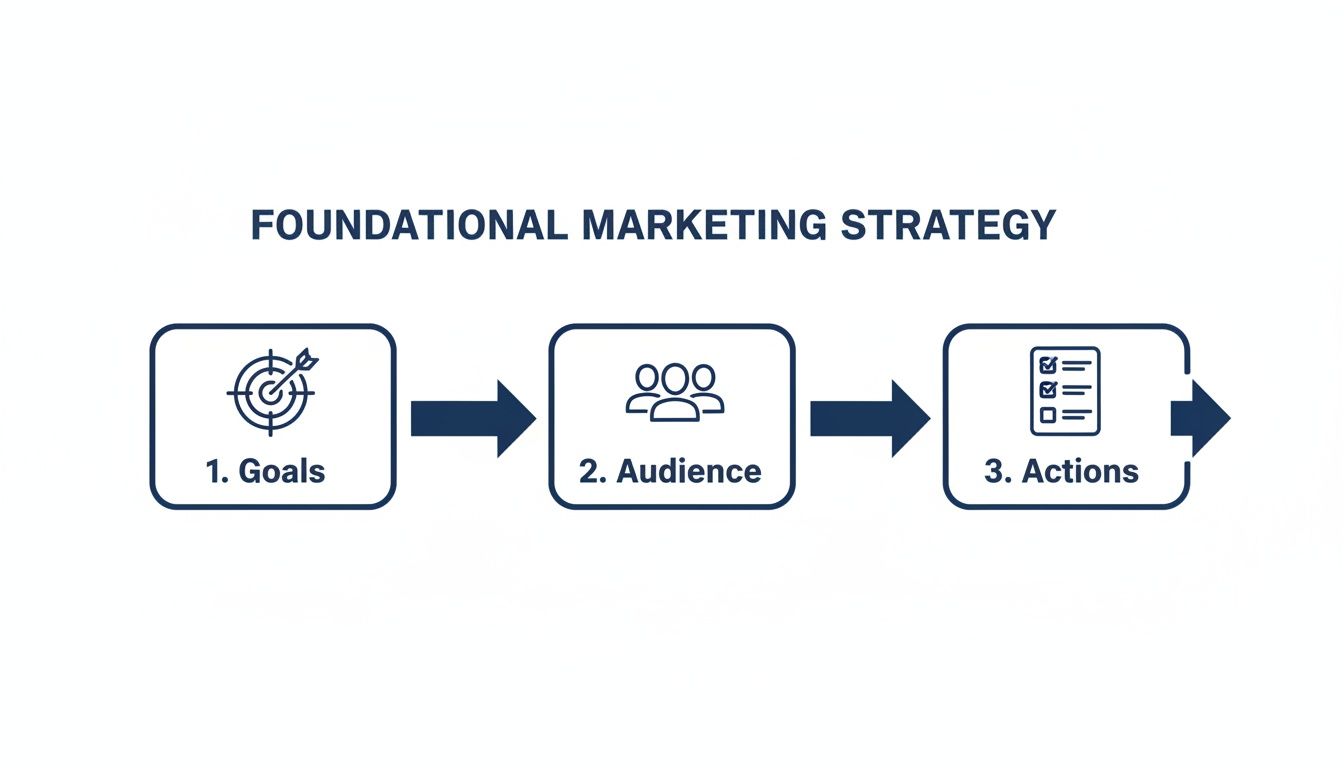
The flowchart above nails the core logic. Every action you plan must be a direct answer to a specific goal and a known audience need. Following this flow stops "random acts of marketing" and makes sure every dollar is invested wisely.
From Strategy to a Monthly Breakdown
Let's make this real. Imagine you run a B2B manufacturing company. Your big goal for the quarter is to increase qualified quote requests by 25%.
Your 90-day action plan isn't a vague wish list; it’s a specific, month-by-month game plan. Each month builds on the last, creating a logical sequence of activities aimed at hitting that one core objective.
Here’s how that might look inside your marketing roadmap template:
- Month 1: Foundational Setup & Quick Wins. The first 30 days are about fixing the leaks and building the systems for growth. You can’t build a house on a shaky foundation.
- Month 2: Audience Engagement & Nurturing. With a solid foundation, you can shift your focus to activating your audience and building trust with new prospects.
- Month 3: Authority Building & Lead Conversion. The final month is dedicated to leveraging your expertise to generate and convert high-quality leads.
A Practical 90-Day Plan Example
Now, let's slot specific tactics into each month for our B2B manufacturer. Notice how every task has a clear owner and a direct line back to that main goal of getting more quotes.
Month 1: Technical Foundations
The objective here is simple: get your digital storefront ready for traffic and ensure it can capture leads effectively.
- Website SEO & CRO Audit (Owner: Marketing Lead): First, we run a full technical SEO audit to find and fix anything hurting your search rankings. Simultaneously, we analyze how users behave on your key service pages to simplify the quote request process.
- GoHighLevel CRM Setup (Owner: Operations Manager): You can't manage what you don't measure. We'll configure your GHL account, import contacts, and build a simple pipeline to track new quote requests. This creates a single source of truth for all lead activity.
Month 2: Re-engagement and Content Development
With your systems tightened up, it’s time to warm up your audience.
- Email Reactivation Campaign (Owner: Marketing Lead): We’ll segment your list of past customers and cold leads. Then, we'll launch a three-part email sequence showcasing a recent success story to get back on their radar.
- Draft a High-Value Case Study (Owner: Sales Manager): Your sales team knows your biggest success stories. They'll work with marketing to outline a detailed case study about a tough project with impressive results, positioning you as the expert problem-solver.
Your 90-day plan is a diagnostic tool in action. It’s not just about doing more marketing; it’s about doing the right marketing in the right order. Month 1 fixes the system, Month 2 engages the audience, and Month 3 converts them.
Month 3: Promotion and Conversion
This is where the prep work pays off.
- Finalize and Promote Case Study (Owner: Marketing Lead): That case study gets a professional design and is published on the website as a downloadable PDF. We'll then promote it via email, social media, and a targeted ad campaign aimed at engineers in your key industries.
- Launch LinkedIn Outreach (Owner: Sales Manager): Armed with this new asset, the sales team can kick off a targeted outreach campaign on LinkedIn, sharing the case study with ideal prospects to start valuable conversations.
This structured, 90-day sprint turns an intimidating goal into a series of achievable steps. It creates clarity, drives accountability, and delivers measurable progress in a short time.
Integrating Your Roadmap with Marketing Technology
Your marketing roadmap is the strategic blueprint, but a plan is just a document until you plug it into the systems that bring it to life. Its success depends on the technology that automates tasks, tracks progress, and gives you real-time data. This is where your marketing technology (martech) stack becomes the engine driving your roadmap forward.
Without this connection, even the best plan falls flat. Your team ends up manually chasing leads, marketing and sales data live in separate silos, and you never get a clear picture of what's working. The goal is to make your technology an active participant in executing your strategy.
Translating Goals into Automated Workflows
So, how does a high-level goal from your roadmap become a real-world, automated process? This is where a tool like GoHighLevel acts as the bridge between your initiatives and daily execution.
Let’s take a common goal from a 90-day plan: “Increase qualified leads by 20%.” Here’s how you can engineer a system to achieve it:
- The Trigger: A prospect fills out a "Request a Quote" form on your website.
- Action 1 (Capture & Tag): GoHighLevel instantly creates a new contact and tags them as a "Hot Lead – Quote Request." No manual entry is needed.
- Action 2 (Internal Alert): An automated SMS and email are sent to the sales manager, enabling a response time of under five minutes.
- Action 3 (Nurturing): The contact is added to a "Welcome & Follow-Up" email sequence. They receive a confirmation, a relevant case study, and a prompt to book a call.
This simple workflow directly executes the roadmap's objective. It's a repeatable, measurable system that ensures no lead slips through the cracks. For a deeper dive, check out our guide on building a powerful marketing automation strategy.
Auditing Your Martech for a Single Source of Truth
Many businesses we work with suffer from "tech sprawl"—a messy collection of redundant tools that don’t talk to each other. An effective marketing roadmap demands a streamlined stack where every tool has a clear job.
A marketing roadmap isn't just about planning your activities; it's about designing the operational system that powers those activities. Your martech stack should be an asset that provides clarity, not a liability that creates confusion.
A quick tech audit is a critical first step. Lay out every marketing tool you pay for and ask these blunt questions:
- What specific function from our roadmap does this tool handle?
- Does another tool in our stack already do this job better?
- Can we consolidate this function into our main platform (like GoHighLevel)?
The objective is to create a single source of truth for your KPIs. When your CRM, email campaigns, and website analytics are integrated, you can confidently measure performance against your roadmap's goals without patching together data from five different dashboards.
The impact of this alignment is significant. B2B companies with a clear marketing technology roadmap are projected to reduce wasted spend by up to 26% by 2025. Furthermore, 70% of high-growth teams can now launch campaigns in under 30 days due to a well-oiled tech stack. These insights on building an efficient martech roadmap confirm that structured planning removes the friction caused by fragmented tools.
Creating a Cadence for Review and Optimization
A marketing roadmap is a powerful planning tool, but its real value is unlocked when you treat it as a living document. It's not something you create in January and blindly follow. To get results, you need to build a rhythm—a consistent cadence—for review, analysis, and adjustment.

This cadence is your feedback loop. It's the system that tells you what’s working, what isn't, and where you need to pivot. Without it, you’re just executing a plan in the dark.
Designing Your Review Rhythm
An effective review cadence doesn't have to be complicated. For most busy business owners, simpler is better. We've found a three-tiered system works best, aligning the right people with the right level of detail.
This approach ensures you’re making smart tactical adjustments week-to-week without losing sight of your bigger quarterly goals.
- Weekly Tactical Check-ins (15-30 minutes): A quick, stand-up style huddle focused purely on execution. The only goal is to keep the train on the tracks.
- Monthly Performance Reviews (60 minutes): Zoom out to review performance against your KPIs. This meeting is about bottom-line results, not individual tasks.
- Quarterly Strategic Resets (2-3 hours): At the end of each 90-day sprint, you’ll do a deep dive to celebrate wins, diagnose what went wrong, and map out the next 90-day action plan.
What to Cover in Each Meeting
Every meeting needs a distinct purpose and a clear agenda to keep conversations focused and productive.
Your Weekly Check-in Checklist:
This meeting is about progress and roadblocks.
- Top Priorities: What are the top 3-5 tasks from the roadmap we must complete this week?
- Progress Report: Where are we on last week’s priorities?
- Blockers: Is anything stopping the team from moving forward?
Your Monthly Review Agenda:
Time for a data-driven reality check.
- KPI Scorecard: How are we tracking against our monthly and quarterly KPIs (leads, conversion rates, traffic)?
- Channel Breakdown: Which marketing channels are driving the best results? Which are underperforming?
- Budget vs. Actuals: Are we on track with spending? Do we need to shift funds?
- Wins & Lessons: What was our biggest success this month? What was the biggest lesson we learned?
To truly understand your data, it helps to have a solid grasp of the fundamentals. Our guide on what is marketing analytics is a great place to start.
Your marketing roadmap is a hypothesis. Your review cadence is the experiment. Each cycle gives you new data to refine your approach, making your marketing smarter and more effective over time.
Build a Simple Dashboard for Clarity
To make these reviews fast and efficient, you need data at your fingertips. A simple dashboard, whether in a spreadsheet or your CRM like GoHighLevel, can provide all the clarity you need.
Your dashboard should be a visual snapshot of your roadmap’s most important KPIs. At a minimum, track:
- Top-Level Metrics: Leads Generated, MQLs (Marketing Qualified Leads), SQLs (Sales Qualified Leads), New Customers.
- Channel Metrics: Website Sessions, Email Open/Click Rates, Social Media Engagement.
- Conversion Metrics: Goal Completions (like form fills), Website Conversion Rate.
This dashboard becomes the centerpiece of your monthly and quarterly reviews. It replaces subjective opinions with objective data, allowing you to have honest, productive conversations about what’s really moving the needle.
Common Questions About Marketing Roadmaps
Even with the best template, you will have questions. That’s a good thing. Answering those questions head-on is how you build a plan with real clarity and confidence. Here are a few common hurdles we help business owners navigate.
How Often Should I Update My Marketing Roadmap?
Your marketing roadmap should be a living tool, not a static document. The best way to manage it is in layers, each with its own review rhythm.
We recommend a full strategic review quarterly. This is your big-picture moment to analyze the results of your last 90-day sprint and map out the major initiatives for the next one. This is not the time to tweak tactics; it’s when you confirm your high-level strategy is still sound.
Day-to-day tactics, however, demand more frequent check-ins.
- Monthly Performance Reviews: This is non-negotiable for measuring progress against KPIs. If a campaign is burning cash without results, you can reallocate that budget to a channel that’s working.
- Weekly Tactical Check-ins: These are quick huddles to track task completion and clear roadblocks. This agile approach keeps you nimble enough to react to real-time data.
What's the Difference Between a Marketing Plan and a Roadmap?
This is a common point of confusion, but the distinction is critical. Think of it this way: the marketing plan is the detailed architectural blueprint for a house. The roadmap is the high-level construction schedule the foreman uses on the job site.
A marketing plan is a dense document with exhaustive market research, competitor analysis, and SWOT analyses. It’s the foundational work that informs your strategy.
A marketing roadmap template is built for action. It’s a visual guide to the key initiatives, timelines, and goals on a single, easy-to-read document. It's the tool your team actually uses daily to guide their work. The roadmap comes from the plan, but it’s what keeps everyone moving in the same direction.
Does a Small Business Really Need a Formal Roadmap?
Yes. In fact, it’s more critical for a small business than a large corporation. When your time, budget, and team are limited, you cannot afford to waste a single resource on "random acts of marketing."
A roadmap forces you to be ruthlessly strategic. It provides the discipline to say "no" to shiny new distractions and focus your team’s energy only on the activities with the biggest impact. For an SMB, even a simple one-page roadmap for the next 90 days provides the clarity needed to compete.
For a small business, a marketing roadmap isn’t about creating more paperwork. It's about survival and efficiency. It ensures every dollar and every hour you invest is pushing you toward a specific, measurable goal.
How Can I Bring AI Into My Marketing Roadmap?
Integrating AI isn't about chasing trends. It's about strategically identifying where it can make you more efficient and improve results. The key is to map AI tools to specific goals, not just adopt tech for its own sake.
Start by looking at your current system and asking: where are our biggest bottlenecks or greatest opportunities?
Here’s a Practical Example:
Let's say a Q2 initiative on your roadmap is: "Reduce customer acquisition cost by 15%." Instead of just throwing money at ads, you could build specific AI tactics into that initiative:
- Awareness Stage: Use an AI-powered tool to speed up topic research and draft blog post outlines, cutting content creation time in half.
- Consideration Stage: Put an AI chatbot on your website to qualify leads 24/7, freeing up your sales team to focus on high-intent conversations.
- Conversion Stage: Use an AI-powered ad optimization tool (like Google's Performance Max) to automatically adjust bids and targeting for better campaign efficiency.
It's projected that 30% of marketing messages from large companies will be synth-generated by AI by 2025, a shift expected to slash customer acquisition costs. By treating AI as a specific tool to achieve a defined goal, you ensure it delivers real value instead of becoming another expense.
Ready to stop guessing and start building a marketing system that drives predictable growth? The team at Machine Marketing specializes in creating and executing marketing roadmaps that deliver real results for manufacturers and SMBs. We'll help you diagnose the gaps, build a clear 90-day plan, and integrate the technology to make it all happen.
Book a discovery call with us today and get your own actionable marketing roadmap template.