If your manufacturing firm is struggling with an unpredictable flow of leads, the problem isn't a lack of effort—it's likely a gap in your marketing system. A modern marketing strategy for manufacturers isn’t about random activities; it’s about building a predictable growth engine. In this guide, we'll show you how to diagnose common roadblocks and build a system that consistently attracts your ideal buyers.
Why Your Old Marketing Playbook No Longer Works
Let's be direct. Relying solely on word-of-mouth and a decade-old website no longer works. Your buyers—the engineers, procurement managers, and operations leaders you need to reach—have fundamentally changed how they research and purchase.
They expect to find technical specifications, detailed case studies, and supplier credentials online long before they consider picking up the phone.
The manufacturing sector is growing. Projections show the U.S. manufacturing sector is set to add $2.1 trillion in value in 2025, with revenue expected to climb by 4.2%. This growth isn't just an opportunity; it's a massive increase in competition. Right now, 63% of your competitors are using website content to educate buyers, and 88% use it for brand awareness.
The Shift from Reactive to Proactive Marketing
To capture this opportunity, you need a systematic approach. Instead of waiting for referrals to trickle in, a proactive strategy puts you in control of your lead flow. It’s about aligning your sales and marketing efforts to attract, engage, and convert the right kind of customers—consistently.
This guide provides the framework to make that critical shift. We’ll break down the essential components needed to build a robust, modern marketing system from the ground up.
Core Components Of A Modern Manufacturing Marketing System
Here is a summary of the essential pillars we will build in this guide, outlining the purpose and key outcome of each stage.
| Component | Purpose | Key Outcome |
|---|---|---|
| Diagnosis | Pinpoint your ideal customer and market position. | A crystal-clear understanding of who to target and how to stand out. |
| Foundation | Build a high-performance website and digital presence. | A professional online hub that converts visitors into leads. |
| Activation | Choose the right marketing channels to reach your buyers. | A multi-channel strategy that meets buyers where they are. |
| Systemization | Use a CRM to manage and nurture leads efficiently. | An automated system that prevents leads from falling through the cracks. |
| Execution | Launch a 90-day plan to prove the concept. | Measurable results and a clear ROI on your marketing investment. |
Each of these pieces builds on the last, creating a powerful engine for predictable growth.
A well-documented marketing plan acts as your operational blueprint. It defines the "why" behind your actions and provides a clear path to achieving predictable revenue growth, turning marketing from a cost center into a strategic asset. To get started, you can explore our detailed guide on how to build a marketing plan that aligns with your business goals.
Diagnosing Your Market To Pinpoint Your Ideal Customer
Before an engineer builds anything, they diagnose the problem and understand the landscape. Your marketing must start with that same engineering mindset.
Jumping into website development or ad campaigns without this diagnostic phase is like ordering materials for a factory before you have blueprints. It's an inefficient use of capital and is unlikely to produce the desired outcome.
This diagnosis phase is about gathering intelligence to build a powerful Ideal Customer Profile (ICP). This isn't a persona document you create once and forget; it's a strategic tool that will guide every marketing decision, ensuring you only attract profitable, long-term partners.
Start by Interviewing Your Internal Experts
Your sales team and customer service representatives hold invaluable, unfiltered insights into what your customers actually care about. Their knowledge is the fastest way to get to the truth, yet it’s a resource many companies overlook.
Set aside dedicated time to interview them. Your goal is to uncover patterns in customer behavior, their biggest challenges, and what triggers a purchase.
Here are the questions we always start with:
- Best Customers: Who are our top three most profitable, lowest-maintenance customers? What makes them so great to work with?
- Common Pains: What specific operational or business problem did they have that led them to us? Be specific.
- Buying Triggers: Was there an event—a failed audit, a new OEM contract, a production bottleneck—that forced them to look for a solution?
- Lost Deals: Why do we lose deals? When a competitor wins, what’s the reason given? When we lose to "no decision," what's the real holdup?
- Customer Language: What specific words, phrases, and technical terms do our best customers use to describe their challenges and our solution? Use their exact terminology.
These conversations provide the initial sketch of your ideal customer, grounded in business reality, not assumptions.
Uncover Truths from Customers and Prospects
Next, you need to validate what you learned internally by talking directly to the market. This means speaking with your best current customers and, if possible, prospects who chose a competitor. This step requires courage but delivers unmatched clarity.
For your best customers, you want to uncover the "before and after" story of working with you.
A question we love to ask is, "Walk me through the day you realized you had to find a new supplier. What was happening that made it an urgent priority?" This gets to the emotional and financial drivers behind a purchase, which is gold for your messaging.
For lost prospects, you can frame it as a no-pressure request for feedback to improve your process. You’d be surprised how many are willing to provide honest feedback on why they went elsewhere. It could be price, a missing feature, or a gap in your sales process you never knew existed.
Analyze How Your Competitors Sell
Finally, any effective marketing strategy for manufacturers requires a clear-eyed view of your competition. Don't just look at what they sell; diagnose how they sell it. This isn’t about copying them. It's about finding gaps and opportunities to position your company as the superior choice.
Create a simple spreadsheet and track this for your top 3-5 competitors:
- Core Messaging: What's the main promise they make on their homepage? Are they focused on speed, quality, price, or innovation?
- Target Audience: Look at their case studies, testimonials, and website images. Who are they clearly trying to attract?
- Content Strategy: What topics are they writing about on their blog? Are they producing technical guides, whitepapers, or webinars?
- Online Visibility: Where do they appear online? Are they active on LinkedIn, running Google Ads for certain keywords, or sponsoring industry events?
This diagnostic work is the bedrock of your entire marketing system. Once you translate this data into a clear ICP, you’ll have the focus needed to build a marketing foundation that attracts the right customers and repels the wrong ones.
Building Your Digital Foundation For Lead Generation
Let's discuss the foundation of your marketing system: your website and your Google Business Profile (GBP). A slow, confusing, or outdated website is like a bottleneck on your production line—it quietly loses money every day by turning away your ideal buyers.
Think of this section as your playbook for turning those digital assets into a lead-generation machine that works for you 24/7.
We're going to diagnose common problems we see on manufacturing websites and give you actionable steps to fix them. The mission is simple: make your digital presence work as hard as your team on the shop floor.
Your Website Is Your Digital Sales Rep
Engineers and procurement managers are researchers. Before they ever pick up the phone, they are on your website, qualifying you. Your site must provide the answers they need and build trust quickly.
If your website can't clearly communicate your capabilities, expertise, and professionalism in seconds, they're gone. They'll click back and move to the next competitor. A modern, high-performing website is non-negotiable in a serious marketing strategy for manufacturers.
Key Takeaway: Your website isn't an online brochure; it's your most important sales tool. It should be built with one primary goal: to make it incredibly easy for your ideal buyer to request a quote or start a conversation.
Essential Elements of a High-Converting Manufacturing Website
Let’s get practical. Use this as a checklist to run a quick diagnostic on your own site.
- Clear, Above-the-Fold Messaging: Can a new visitor understand exactly what you do and who you serve within three seconds, without scrolling? Your unique value proposition needs to be front and center.
- Prominent Calls-to-Action (CTAs): Are your "Request a Quote" or "Contact Us" buttons impossible to miss on every page? Don't make prospects hunt for the next step.
- Detailed Capabilities & Services Pages: Generic descriptions are insufficient. Detail your equipment, processes, materials, and tolerances. Your buyers are technical and look for substance, not marketing fluff.
- Trust-Building Case Studies & Photos: Show, don't just tell. High-quality photos of your facility, your team, and your finished products are critical. Case studies that outline a specific customer problem and how you engineered the solution are even better.
- Technical SEO Foundation: Your site must be discoverable by search engines. This means it needs to load quickly, work perfectly on a phone, and have a logical structure that Google can easily understand. You can learn more in our guide to SEO for manufacturing companies.
Do Not Overlook Your Google Business Profile
For many manufacturers, especially those serving a regional market, your Google Business Profile is as critical as your website. It's the listing that appears in Google Maps and local results when someone searches for "CNC machining near me" or "metal fabrication in [Your City]."
An optimized GBP is a powerful lead-generation tool. Make sure yours is dialed in:
- Accurate Information: Your company name, address, phone number, and website must be correct and consistent everywhere online.
- Specific Categories: Don't just list "Manufacturer." Use specific categories like "Machine Shop," "Metal Fabricator," or "Plastics Injection Molding."
- High-Quality Photos: Regularly upload photos of your shop, equipment, and finished projects.
- Customer Reviews: Actively ask satisfied customers to leave a review. This positive social proof is a huge trust signal.
The industrial buying process has moved online. Manufacturers are shifting budgets, with a projected 10% growth in digital spending by 2025. This isn't a trend; it's reality. A staggering 98% of manufacturing marketers now use paid content promotion to reach buyers.
A rock-solid website and a well-maintained GBP are your foundational assets. Once you diagnose and improve these core elements, you'll have a reliable platform to attract, educate, and convert your ideal customers.
Activating The Right Marketing Channels

With a solid digital foundation, it's time to bring your ideal customers to you. A common mistake is spreading your budget thin across every imaginable platform, hoping something sticks. This "spray and pray" approach is an inefficient way to use your marketing dollars.
A smarter marketing strategy for manufacturers means making focused, strategic choices. It’s about being present where your ICP—those engineers and procurement managers you identified—actually spend their time looking for solutions.
Let's focus on a potent mix of channels proven to work for B2B companies with long sales cycles.
Content Marketing That Answers Technical Questions
Content is the fuel for your marketing engine. For manufacturers, this means creating technical, educational content that solves your buyer’s problems and demonstrates your expertise. Your audience values substance over fluff.
The goal is to become their go-to resource long before they need a quote. When an engineer is researching a complex material selection issue, you want your content to be the answer they find on Google.
Here’s what this looks like in practice:
- Detailed Whitepapers: Go deep on a single technical topic, like the advantages of a specific alloy in high-stress applications or a practical guide to optimizing a part design for manufacturability.
- Comprehensive Case Studies: Don't just say you solved a problem—show it. Detail the customer's initial challenge, your engineering process, the solution you delivered, and the quantifiable results.
- Informative Blog Posts: Answer the exact questions your sales team gets every day. Articles like "Common Causes of Failure in Injection Molded Parts" or "How to Choose the Right Surface Finish for CNC Machined Components" build authority.
This type of content builds credibility and guides potential clients toward an informed decision. It's a long-term play that pays off in the quality of leads you attract.
Targeted LinkedIn Campaigns For B2B Precision
For reaching B2B decision-makers in manufacturing, LinkedIn is the most powerful platform available. Its targeting capabilities let you put your message directly in front of professionals with specific job titles, at specific companies, within your target industries.
This isn’t about just posting company updates; it’s about precision-targeted outreach and advertising.
We recently worked with a custom metal fabricator whose ICP was "Project Managers at architectural firms in the Northeast." We built a LinkedIn campaign showing these individuals case studies of complex architectural metalwork projects. The result was a direct pipeline of highly qualified, relevant leads.
An effective LinkedIn strategy has two parts:
- Organic Presence: Your key people (executives, engineers, sales leads) should share their expertise to build personal and company-level authority.
- Paid Advertising: Use LinkedIn Ads to promote your most valuable content—like a new whitepaper or case study—directly to your ICP to generate high-quality leads.
Email Automation To Nurture Long Sales Cycles
The manufacturing sales cycle can be long and complex. Email automation is your secret weapon for staying top-of-mind and nurturing leads without manual effort from your sales team.
When someone downloads a whitepaper, they shouldn't just disappear into a spreadsheet. They should automatically enter an email sequence that continues to provide value.
This could be a series of emails that:
- Shares a related case study a week later.
- Invites them to a webinar on a relevant topic two weeks after that.
- Introduces a key engineer from your team and highlights their expertise.
The goal isn't to bombard them with sales pitches. It’s to consistently demonstrate your expertise and build a relationship. When the time comes to issue an RFQ, your company is the first one they think of. This is how you turn a cold lead into a warm, educated prospect ready for a sales conversation.
By integrating these high-intent channels, you create a system where every part supports the others. Your content fuels your LinkedIn campaigns, which capture leads that are then nurtured by email automation. This is how you build a predictable growth engine.
Systemizing Your Process With A CRM
Generating leads is only half the battle. We've seen many manufacturers work hard to generate inquiries, only to watch them go cold due to a slow or disorganized follow-up process. A strong marketing strategy for manufacturers needs a rock-solid system to manage these opportunities.
This is where a Customer Relationship Management (CRM) system becomes the central nervous system for your growth engine. It’s the tool that ensures every lead is tracked, nurtured, and converted with precision. This is how you build a real Standard Operating Procedure (SOP) for sales and marketing.
Choosing The Right CRM For Your Manufacturing Business
The key is having a CRM that automates the repetitive tasks that slow down your team. While many options exist, we often implement platforms like GoHighLevel for our manufacturing clients because it integrates marketing automation, sales pipelines, and communication tools into one system.
An integrated platform ends the chaos of juggling leads from website forms, phone calls, and emails in spreadsheets. Every interaction is captured in one place, giving your team the intel they need to have smarter conversations and close more deals.
With a tool like GoHighLevel, you can visualize every lead's journey through your sales process.
This kind of dashboard provides a clean, at-a-glance picture of your entire sales pipeline, making it easy to spot bottlenecks and opportunities.
An Automated Workflow For A New Lead
What does this look like in practice? Let's walk through what happens when a new RFQ comes through your website. Instead of that lead sitting in an inbox, an automated system kicks into gear.
Here’s a simple but effective sequence you can build:
- Instant Capture & Notification: The second a prospect hits "submit," the CRM creates a new contact and a new deal in your sales pipeline. It also sends an instant notification to the right salesperson.
- Immediate Confirmation: The prospect immediately gets a professional email confirming you received their request. This message can set expectations—"You'll hear from our team within 24 hours"—and link to a relevant case study.
- Automated Follow-Up: If a salesperson hasn't updated the lead's status within 24 hours, the system can send them an internal reminder. This safety net ensures nothing falls through the cracks.
- Long-Term Nurturing: If a lead isn't ready to buy, they can be moved into a long-term nurturing campaign. This automated email sequence periodically sends useful content, keeping your company top-of-mind for when they are ready.
This automation frees your team from manual data entry and follow-up reminders, allowing them to focus on high-value conversations with qualified prospects.
What to Look For: A well-implemented CRM gives you a transparent, real-time view of your sales pipeline. You can finally answer critical questions like, "How many qualified leads did we generate this month?" and "What is our average lead-to-customer conversion rate?" This data is essential for proving your marketing ROI.
Systemizing your lead management creates a consistent, professional experience for your future customers. It shows them you're organized, responsive, and serious about earning their business. If you want to dig deeper, check out our guide on using a CRM for lead generation to see how these systems fuel growth.
Launching Your 90-Day Proof Of Concept Plan
A strategy document is just paper until you put it into action. Now we move from blueprint to build with a focused 90-day launch plan designed to prove its value quickly.
This isn’t about overhauling your entire business overnight. Think of it as a strategic sprint. The goal is to establish a Proof of Concept (POC) by testing your assumptions, gathering real-world data, and building momentum. We’ll focus on metrics that signal progress, not vanity numbers.
This disciplined approach allows you to make smart, data-backed decisions on where to invest for long-term growth.
Your First 30 Days: Technical Setup and Alignment
The first month is all about laying the foundation. Before launching a campaign, your systems must be ready to catch, track, and nurture every lead. Rushing this stage is a recipe for chaos.
Your priorities for this month are purely internal—no external campaigns yet.
- CRM Configuration: Build out your lead pipeline in your CRM. Set up automation rules, create reporting dashboards, and ensure every inquiry has a clear, automated path to the right salesperson.
- Website & SEO Fixes: Implement the critical technical fixes identified earlier. This could mean boosting site speed, fixing broken links, or optimizing key pages for your target keywords.
- Analytics & Tracking: Install, configure, and test all your analytics tools. From day one of your launch, you must be able to see where your leads are coming from.
Days 31-60: Content Creation and Campaign Launch
With a solid foundation in place, month two is go-time. This is when you activate the content and channels chosen based on your Ideal Customer Profile. The key is to start with one focused, high-impact campaign.
For example, your month two plan might look like this:
- Publish Core Content: Launch one high-value piece, like a detailed whitepaper or an in-depth case study showcasing a significant win.
- Activate One Channel: Promote that content on the one channel where your ICP spends most of their time. For example, run targeted LinkedIn Ads aimed at project engineers in a specific industry.
- Launch Nurture Sequence: Ensure everyone who downloads your content is automatically placed into a pre-built email nurture sequence that provides continued value.
Days 61-90: Analysis and Optimization
The final 30 days are for analyzing data and fine-tuning your approach. You now have real-world feedback on what’s working and what isn't. Instead of guessing, you can use the numbers to make intelligent adjustments to your marketing strategy for manufacturers.
This is where you start turning prospects into customers. The process is about moving them along a clear path.
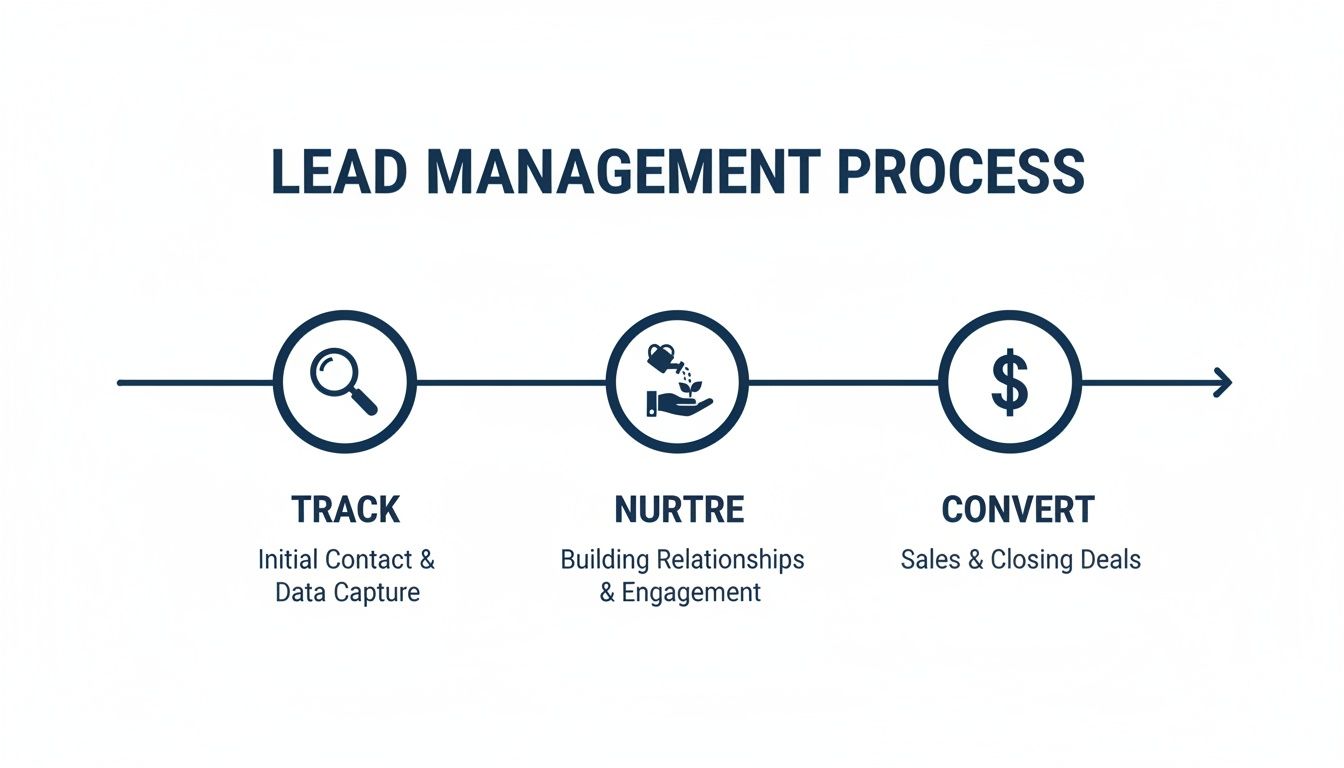
This simple flow—Track, Nurture, Convert—is the engine of your 90-day plan, powered by the systems you implemented in the first month.
This flexibility is crucial. In 2025, we're seeing divergent global manufacturing sentiments—contraction in the U.S. and Europe versus strong growth in India. A 90-day plan lets you quickly test messages for different regions. You can promote cost-efficiency in cautious markets while highlighting innovation in growth markets, allowing you to optimize on the fly. You can discover more insights about global manufacturing sentiments on opentext.com.
Key POC Metrics to Track
Forget getting lost in website traffic or social media likes. For this 90-day sprint, focus on the numbers that matter to your bottom line:
- Marketing Qualified Leads (MQLs): How many leads fit your ideal customer criteria?
- Cost Per MQL: What did it cost to acquire one qualified prospect?
- Sales Pipeline Growth: How much potential revenue did these marketing efforts add to your sales pipeline?
Answering Your Top Questions About Manufacturing Marketing
As you begin to build a modern marketing system, practical questions will come up. Based on our experience helping manufacturers make this shift, here are straight answers to the questions we hear most often.
These aren't theoretical—they address budget, priorities, and timelines, giving you a clear picture of what to expect.
How Much Should a Manufacturer Really Budget For Marketing?
There’s no single magic number, but a common benchmark for B2B companies is 5-10% of total revenue. However, for manufacturers just starting to build a digital presence, we advise against committing to a massive annual budget right away.
It's smarter to start with a project-based or 90-day proof-of-concept budget. This approach lets you test channels and messaging, measure the initial ROI, and gather data before committing to a larger investment. It’s a lower-risk way to prove the model works for your business.
What’s the Most Important First Step?
The single most critical first step is diagnosing your market and deeply understanding your ideal customer profile (ICP). We can't stress this enough.
Without clarity on who you're targeting, their specific pain points, and where they look for solutions, any money spent on SEO, paid ads, or content is a shot in the dark. It's like trying to build a complex machine without a blueprint.
How Long Until We See Real Results?
This depends on the channels you activate. A targeted paid advertising campaign on a platform like LinkedIn can start generating qualified leads within a few weeks of launch.
On the other hand, foundational strategies like SEO and content marketing are long-term assets. For those, you can expect to see meaningful growth in organic traffic and leads within 6-12 months. That's why our 90-day plan is designed to chase early indicators and quick wins—it builds momentum and proves the concept while the long-term engine warms up.
Building a predictable growth system is a powerful step toward securing your company's future. If you're ready to move from random acts of marketing to a cohesive strategy that delivers, Machine Marketing can build the blueprint and execute the plan with you.
Try this next step: Book a discovery call with Karl to diagnose your current marketing system and explore a tailored plan for sustainable growth. Learn more at machine-marketing.com.