If your marketing feels like a pile of unrelated jobs, you're not misreading the situation. A trade show gets booked. Someone updates the website. A few LinkedIn posts go out. Quotes come in sporadically. Then everything goes quiet again.
That pattern is common in small manufacturing companies because the problem usually isn't effort. It's the lack of a system that connects visibility, lead capture, follow-up, and sales handoff into one repeatable process. Small-business data points in that direction. In a 2026 survey, 55.6% of respondents said increasing sales was their top objective, while 19.2% prioritized lead generation and 12% focused on brand awareness. The same report found 69.2% use Facebook ads and 61.7% use direct mail, which shows many firms are still mixing channels rather than relying on one tactic alone, as noted in PostcardMania's small business marketing statistics guide.
For manufacturers, that matters even more. Your buyers don't move like consumer buyers. They evaluate, compare, involve multiple stakeholders, ask for technical proof, and often come back months later. Random acts of marketing don't support that process. Systems do.
Table of Contents
- Moving Beyond Random Acts of Marketing
- Phase 1 Diagnosis and Core Strategy
- Phase 2 Building Your Marketing Engine with a CRM
- Phase 3 Fueling the Engine with Lead Generation
- Phase 4 Nurturing and Reactivating Your Database
- Phase 5 Measuring and Scaling Your System
Moving Beyond Random Acts of Marketing
Most small manufacturers don't need more tactics. They need fewer disconnected activities and more control.
The usual pattern looks like this. Sales wants more leads. Marketing tries a few things. Nothing is documented well enough to repeat, improve, or shut off with confidence. A website form submission arrives, but nobody knows which message, page, or campaign produced it. Months later, the company decides marketing didn't work.
That's not a traffic problem. It's a systems problem.
A working marketing system has four connected parts:
- Attraction: Buyers find you through channels that match how they research.
- Capture: Your site, landing pages, and forms turn interest into identifiable contacts.
- Nurture: Follow-up keeps the conversation moving when the buying cycle slows down.
- Measurement: You can see which inputs create qualified opportunities and quotes.
Practical rule: If a lead can enter your business without being tracked, assigned, and followed up, you don't have a marketing system yet.
Manufacturers feel this gap faster than many other businesses because the sales cycle has more friction. Prospects ask for capabilities, certifications, tolerances, materials, process fit, and delivery confidence. They want reassurance before they ask for a meeting, and they often need internal consensus before they request a quote.
That means good marketing systems for small manufacturers don't act like a billboard. They act like a machine. Each part supports the next part. Messaging informs content. Content feeds capture. Capture triggers automation. Automation supports sales. Measurement tells you where to adjust.
What doesn't work is treating each channel as its own island.
Start with the right mindset
Think about your marketing the same way you'd think about production. You wouldn't run a shop with undocumented processes, vague ownership, and no inspection loop. Marketing deserves the same discipline.
Use this test:
- If one employee leaves, would your campaigns keep running?
- If a lead submits a form today, does someone know what happens in the next hour, next day, and next week?
- If you spend money on a channel, can you tie it to qualified conversations or quote activity?
- If results drop, do you know which part of the system broke?
If the answer is no to most of those, the fix isn't more activity. The fix is architecture.
Phase 1 Diagnosis and Core Strategy
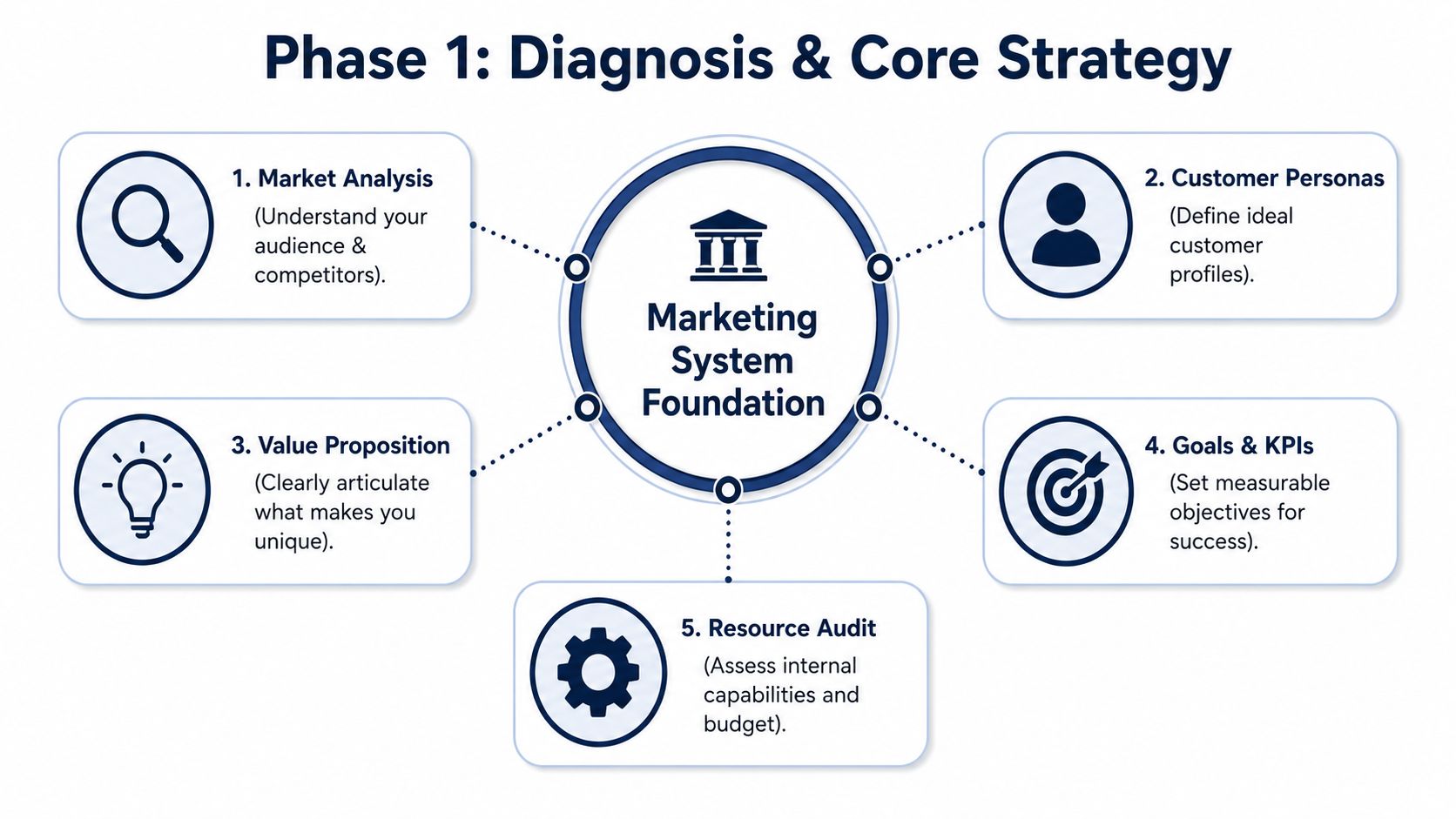
Small manufacturers usually want to jump straight to SEO, ads, email, or trade show support. That's understandable, but it's backward. If you don't know exactly who you're trying to reach and why they'd pick you, every later decision gets weaker.
A practical marketing system starts with market research and a defined buyer persona, and strategy breaks down when goals, timelines, responsibilities, and performance tracking aren't documented and enforced, according to the American Marketing Association's guidance on building an effective marketing strategy.
Start with the real buying process
Many shops describe their audience too broadly. "Engineers." "OEMs." "Procurement." That isn't enough to build messaging or campaigns.
You need to know which people show up in the buying process and what each one needs to move forward.
A useful diagnostic looks like this:
| Buyer role | What they usually care about | What your marketing should show |
|---|---|---|
| Design or manufacturing engineer | Fit, performance, tolerances, process capability | Technical content, application examples, specs |
| Purchasing or sourcing | Reliability, response time, commercial clarity | Clear RFQ process, lead times, communication |
| Operations or plant leadership | Risk reduction, supply continuity, execution confidence | Case studies, quality process, support model |
This exercise changes how you market. Instead of writing vague copy about being "quality-driven," you start writing around decision criteria buyers use.
Questions to ask yourselves:
- Which industries produce your best jobs? Not just the most inquiries, but the most profitable and repeatable work.
- What buying trigger starts the search? Supplier failure, capacity overflow, redesign, quality issues, new program launch.
- Where do deals stall? Approval delays, unanswered technical questions, slow quoting, unclear differentiation.
- What proof does the buyer need before speaking with sales? Drawings, tolerances, process detail, material experience, example applications.
The best strategy work often sounds simple after it's done. Before it's done, most teams realize they've been speaking in company language instead of buyer language.
Define a value proposition that helps buyers decide
Your unique value proposition isn't a slogan. It's a decision aid.
For small manufacturers, the strongest value propositions usually combine capability, fit, and business outcome. They answer a practical question: why is your shop the safer or smarter choice for this specific job?
Weak positioning sounds like this:
- Generic claims: Precision, quality, service, innovation
- Unsupported promises: Fast turnaround without process context
- Capability lists without relevance: Equipment names with no explanation of buyer benefit
Stronger positioning sounds like this:
- Process plus application: We machine close-tolerance components for demanding assemblies where repeatability matters.
- Capability plus risk reduction: We help OEM teams reduce quoting friction by pairing technical review with structured follow-up.
- Sector fit: We support buyers in regulated or high-spec environments who need documentation discipline as much as production capacity.
A practical core-strategy worksheet should include:
- Ideal customer profile
- Top buying triggers
- Common objections
- Primary value proposition
- Secondary proof points
- Clear handoff rules between marketing and sales
If this isn't written down, it usually isn't aligned.
Phase 2 Building Your Marketing Engine with a CRM
Once strategy is defined, you need a place where the whole system runs. That's the CRM.
For small manufacturers, the CRM isn't just a contact database. It's the operating hub where inquiries land, tasks get assigned, follow-up happens, and pipeline movement becomes visible.

Why a CRM becomes the operating hub
A lot of manufacturers still run lead handling through inboxes, spreadsheets, and memory. That works until lead volume rises, one salesperson gets busy, or follow-up depends on one person remembering to send the next email.
That's where a centralized system changes the game. HubSpot reports that 47% of marketers use automation to make processes more efficient, 93% use it for administrative tasks such as scheduling and documentation, and about 92% use it for data analysis and reporting in its marketing statistics report. In the same coverage, manufacturer-focused reporting cites that 98% of industrial manufacturers generate sales-qualified leads through digital marketing, while 69% use organic search traffic and 69% use social media.
Those numbers matter because they point to a bigger shift. Digital marketing isn't a side project anymore. It feeds real pipeline, and pipeline needs infrastructure.
For many smaller teams, an all-in-one platform such as GoHighLevel is practical because it combines contact records, pipeline stages, forms, automations, and campaign workflows in one place. That reduces tool sprawl. It also lowers the chance that a lead gets lost between systems.
If you're evaluating options, use a decision framework before you buy. Machine Marketing's guide on how to choose a CRM system is a useful reference for sorting out feature lists from operational needs.
What to configure first
Don't start by turning on every feature. Start with control.
Set up these pieces first:
- Pipeline stages: New lead, qualified, quoting, open opportunity, won, lost.
- Lead sources: Website form, RFQ form, referral, trade show, outbound, reactivation.
- Ownership rules: Who gets notified, who responds, who updates disposition.
- Basic automations: New inquiry acknowledgment, task creation, follow-up reminder, stale-lead alert.
A CRM setup fails when the workflow is too clever for the team to maintain. Keep it boring and usable.
Here's a good practical rule. If a salesperson opens the system and can't tell what to do next, your pipeline is cosmetic.
For a more tactical implementation checklist, Mr. Green Marketing's CRM implementation guide is worth reviewing before rollout.
A quick walkthrough helps make the setup concrete:
What a good CRM setup changes
Once the CRM is working, a lead doesn't just "come in." It enters a defined path.
That means:
- Sales sees context: Which page converted, what form was submitted, what content was downloaded.
- Marketing sees outcomes: Which channels create qualified conversations instead of raw volume.
- Management sees bottlenecks: Slow follow-up, stalled quote requests, neglected reactivation lists.
That's the difference between software ownership and system ownership. The first gives you a log-in. The second gives you a machine.
Phase 3 Fueling the Engine with Lead Generation
A CRM without lead generation is an empty container. Once the engine is in place, you need inputs that produce the right kind of inquiries.
For manufacturers, broad top-of-funnel content usually underperforms unless it's tied to a real technical question. The formats that tend to work best are application guides, case studies, white papers, and specification comparison tools, because they support evaluation by technical buyers, as outlined in Monday.com's manufacturing marketing strategy guide. That same guidance warns against weak segmentation and poor follow-up, which is where many campaigns stall.
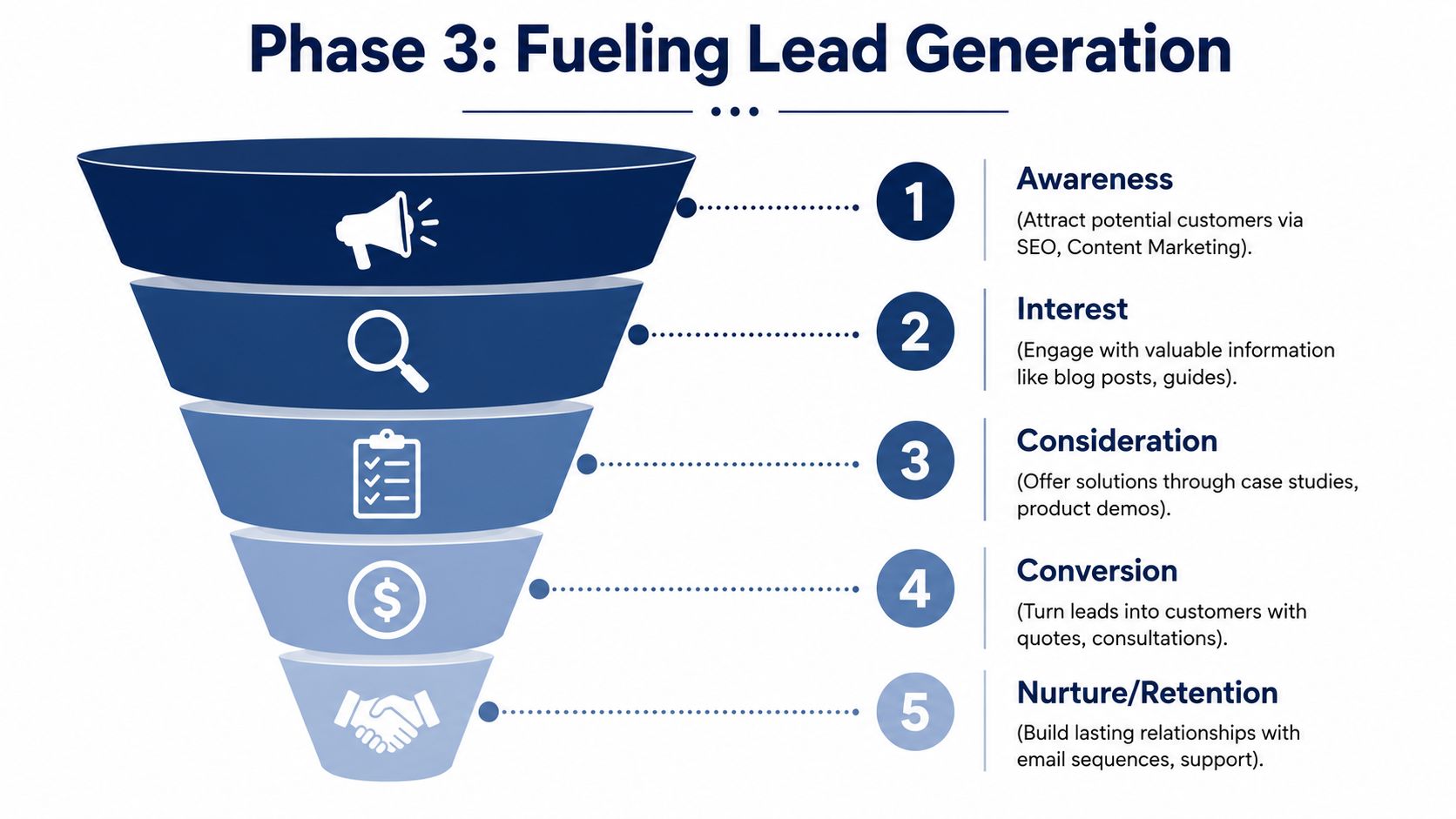
You don't need ten campaigns to start. You need two that match how industrial buyers behave.
If you want a broader framework for channel planning, this guide to lead generation for manufacturers pairs well with the templates below.
Template one gated technical resource
This works when buyers are early in the evaluation process and need substance before they talk to sales.
A strong version usually looks like one of these:
- Application guide: How to choose the right process or material for a specific use case
- Specification comparison tool: A side-by-side resource that helps buyers compare options
- Technical white paper: A deeper explanation of process fit, tolerances, failure points, or design considerations
The campaign flow is simple:
- Create a resource tied to a real buying question.
- Build a landing page with a direct headline and short form.
- Connect the form to the CRM.
- Trigger an automated follow-up sequence.
- Route higher-intent leads to sales based on form fields or behavior.
Example structure for the landing page:
| Page element | What to include |
|---|---|
| Headline | Name the exact problem solved by the resource |
| Intro copy | Explain who it's for and when it's useful |
| Form | Name, company, email, role, application interest |
| Proof | Brief note on shop capabilities or relevant experience |
| CTA | Download the guide |
What works: Content written for engineers and sourcing teams who are trying to make a decision.
What doesn't: Generic ebooks with abstract business advice.
The trade-off here is quality versus volume. A technical resource may produce fewer submissions than a broad offer, but the conversations are usually more relevant.
Template two request a quote optimization
This is the bottom-of-funnel campaign. It targets buyers who already know they need help.
Most RFQ pages are weaker than they should be. They ask for a few fields, dump the inquiry into email, and leave the rest to chance. A better RFQ setup qualifies, routes, and supports the buyer at the same time.
A stronger request-a-quote flow includes:
- Clear scope prompts: Material, quantity, tolerance range, timing, file upload
- Expectation setting: What happens after submission and who will respond
- Routing rules: Different workflows for new product opportunities, repeat work, and poor-fit inquiries
- Follow-up automation: Immediate acknowledgment plus internal tasking
Here's the difference in practice.
A weak RFQ form says, "Contact us."
A strong RFQ process says, "Upload your drawing, tell us the application, and we'll route your request to the right reviewer."
Buyers don't just want to send a message. They want confidence that your team can interpret the request correctly and respond with purpose.
Website and SEO fundamentals that support both campaigns
Before either template can perform, your website needs basic discipline:
- Service pages should match search intent. A page about CNC milling should speak to actual capabilities, tolerances, materials, and job fit.
- Navigation should reduce friction. Buyers should be able to find industries served, capabilities, quality information, and quote entry points quickly.
- Calls to action should match readiness. Some visitors want a guide. Others want an RFQ. Give them both.
Lead generation in industrial markets works best when the path matches the prospect's stage. Don't force every visitor into the same conversion.
Phase 4 Nurturing and Reactivating Your Database
Most manufacturers focus hard on getting the lead and then go strangely quiet. That's expensive.
A new contact who downloads a guide or submits an RFQ isn't ready on your schedule. They're ready on theirs. Good follow-up closes the gap between those two timelines without turning into spam.
A simple follow-up sequence for new leads
For a lead who downloads a technical resource, use a short sequence that educates, qualifies, and gives sales a signal when intent rises.
A practical five-touch sequence looks like this:
Immediate email
Deliver the resource. Thank them. Set expectations for future communication.Day two follow-up
Send a short note that highlights one key takeaway from the guide and links to a relevant capability or service page.Day four message
Share a practical use case. This can be a short application example, a process note, or a common mistake buyers make when specifying the part or project.Day seven touch
Ask a low-friction qualifying question. Example: are they evaluating suppliers, troubleshooting a current issue, or planning a future job?Day ten conversion prompt
Offer a next step such as a quote review, drawing review, or short technical conversation.
This sequence works because it respects buyer behavior. It doesn't demand a meeting in the first email. It gives the contact a reason to stay engaged while you learn more about fit.
For database strategy ideas beyond initial automation, this database email marketing guide is a practical next read.
A lead that isn't ready today isn't dead. It's only dead if nobody follows up in a way that matches the buying process.
How to reactivate old quotes and dormant contacts
Most small manufacturers are sitting on useful dormant data. Old quote requests. Past customers. Prospects who asked questions six months ago. Contacts from trade shows. People in spreadsheets that nobody has touched in years.
That list is often one of the fastest places to find opportunity because the relationship already exists in some form.
Start simple. Segment the database into groups:
- Past customers
- Unwon quotes
- Dormant prospects
- Old trade show or referral contacts
Then run a light-touch reactivation sequence.
A solid reactivation pattern:
- Email one: Quick check-in with a relevant question about current needs
- Email two: Useful update, such as a capability expansion, service focus, or process improvement
- Email three: Direct but low-pressure offer to reconnect or review upcoming work
Avoid the usual mistake of sending one generic "just checking in" blast to everyone. Segment first. Message second.
Where manufacturers go wrong with nurture
Three things usually break this process:
- No segmentation: Every contact gets the same message regardless of role or stage.
- No trigger logic: Downloads, form submissions, and quote requests don't launch different workflows.
- No sales visibility: Marketing automation runs, but sales never sees who engaged.
If your nurture system doesn't improve timing and relevance, it turns into noise. If it does, your database becomes an active business asset instead of a digital graveyard.
Phase 5 Measuring and Scaling Your System
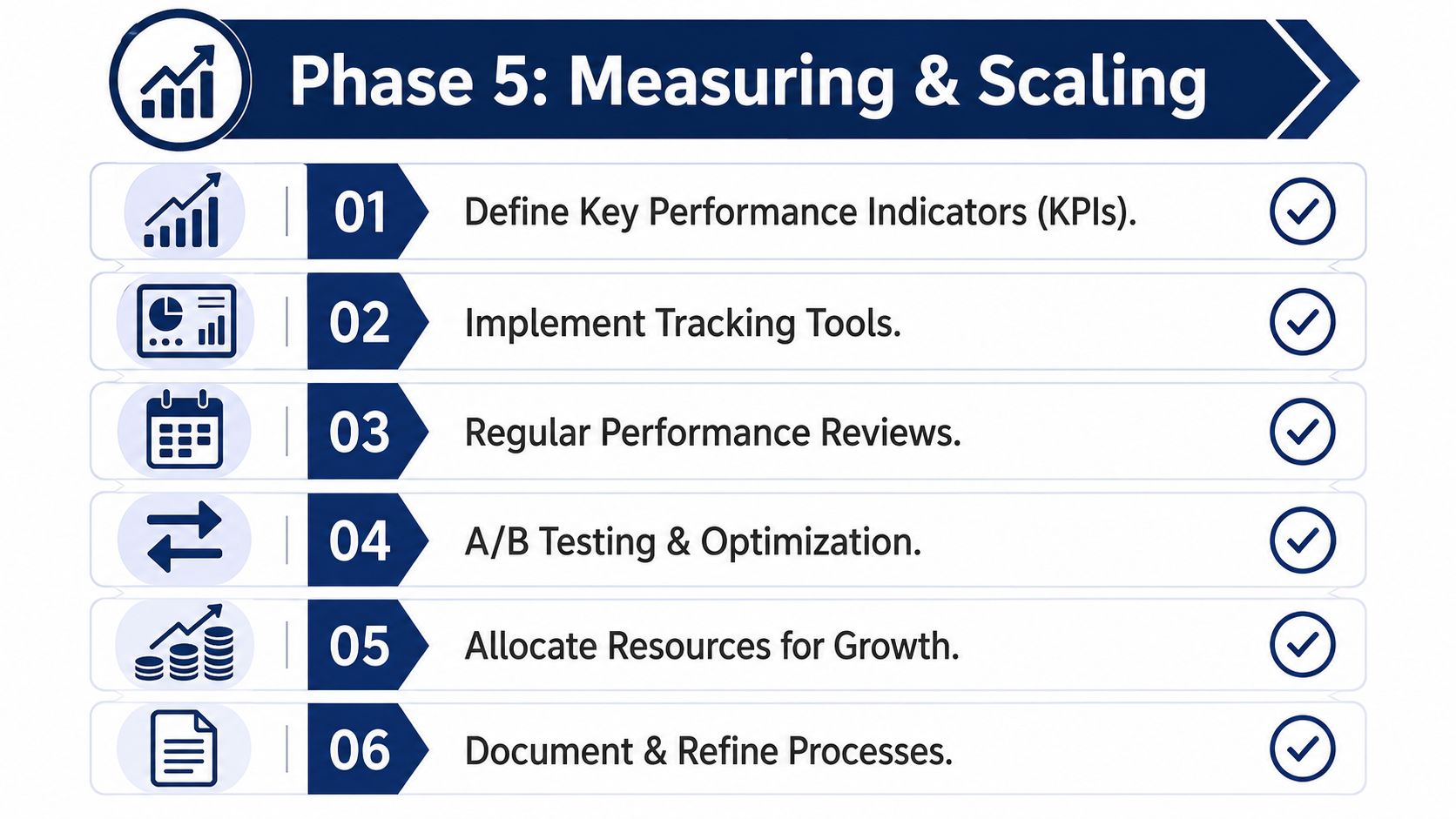
If you can't inspect the system, you can't improve it.
A lot of small manufacturers either overcomplicate everything or track almost nothing. Neither works. You don't need a massive dashboard. You need a short set of indicators tied to actual commercial progress.
What to track without overcomplicating it
For most small manufacturers, these are the core numbers to review consistently:
| KPI | Why it matters |
|---|---|
| Marketing qualified leads | Shows whether top-of-funnel campaigns are attracting the right interest |
| Sales qualified leads | Tells you whether lead quality is strong enough for sales engagement |
| Cost per lead | Helps compare channel efficiency |
| Quote request volume | Connects marketing activity to a key buying action |
| Pipeline stage movement | Reveals where opportunities slow down or die |
The point isn't to worship the dashboard. The point is to decide what to change.
If MQLs rise but SQLs don't, your targeting or offer may be too broad. If quote requests increase but opportunities stall, the issue may sit in qualification or response handling. If one campaign creates better-fit leads, move more effort there instead of spreading budget evenly across every channel.
A practical 30 60 90 day rollout
A manageable implementation schedule keeps this from turning into another unfinished initiative.
Days 1 to 30
- Define your ideal customer profile and value proposition
- Audit current channels, forms, and follow-up
- Choose and configure the CRM
- Document ownership, stages, and response rules
Days 31 to 60
- Launch one technical content offer or improve the RFQ path
- Connect forms, landing pages, and CRM workflows
- Train the team on pipeline usage
- Begin source tracking and qualification review
Days 61 to 90
- Build your nurture and reactivation sequences
- Review early lead quality and quote activity
- Tighten routing, messaging, and segmentation
- Document what stays, what changes, and what stops
Systems scale when teams document decisions, not when they keep adding tools.
The payoff of marketing systems for small manufacturers isn't just more activity. It's confidence. You know how leads enter, how they're handled, where they stall, and which parts of the machine deserve more investment.
If your company already has tools, contacts, and scattered marketing activity but no unified operating system, Machine Marketing helps manufacturers connect strategy, CRM, lead generation, and follow-up into a measurable growth system. The best next step is a diagnosis. Map your current process, find the breakpoints, and fix the system before you buy more tactics.