If you're a business owner struggling to find the right marketing software, you’re not alone. The market has exploded, and what was once a small pond of tools is now a massive, confusing ocean. We see this all the time—and the root cause is often hidden in plain sight. In this article, we'll show you how to diagnose the gaps in your marketing system and share practical steps to choose the right marketing technology companies to partner with.
Why Are There So Many Marketing Technology Companies?
Feeling lost among thousands of marketing tools is one of the most common issues we see with business owners. It’s a classic case of the paradox of choice—having more options actually makes it harder to find the right one. So, how did we get here?
The answer lies in the massive shift from analog to digital. As your customers moved their lives online, businesses had to follow. This created a huge demand for new tools to find, talk to, and support them, kicking off a technological gold rush for developers.
The Great MarTech Explosion
The sheer scale of this growth is staggering. A little over a decade ago, you could count the major players on one or two hands. Today, it's a completely different story.
The global marketing technology (MarTech) market has grown from just a few hundred solutions in 2011 to an incredible 15,384 solutions by 2025. That's a 100x increase, representing 10,156% growth in just 14 years. You can see the overwhelming scale for yourself by exploring the 2025 Marketing Technology Landscape Supergraphic, which now tracks 49 distinct categories.
This wasn't just about more tools; it was about creating tools for every specific job imaginable.
The Problem-Solver's Perspective: Don't think of it as one massive, confusing market. Instead, picture a city with specialized districts. Each district (or category) has tools built to solve one specific business problem—whether that’s managing customer data, automating emails, or analyzing website traffic.
This diagram offers a simplified look at how this huge ecosystem can be broken down into more manageable categories and the specific tools within them.
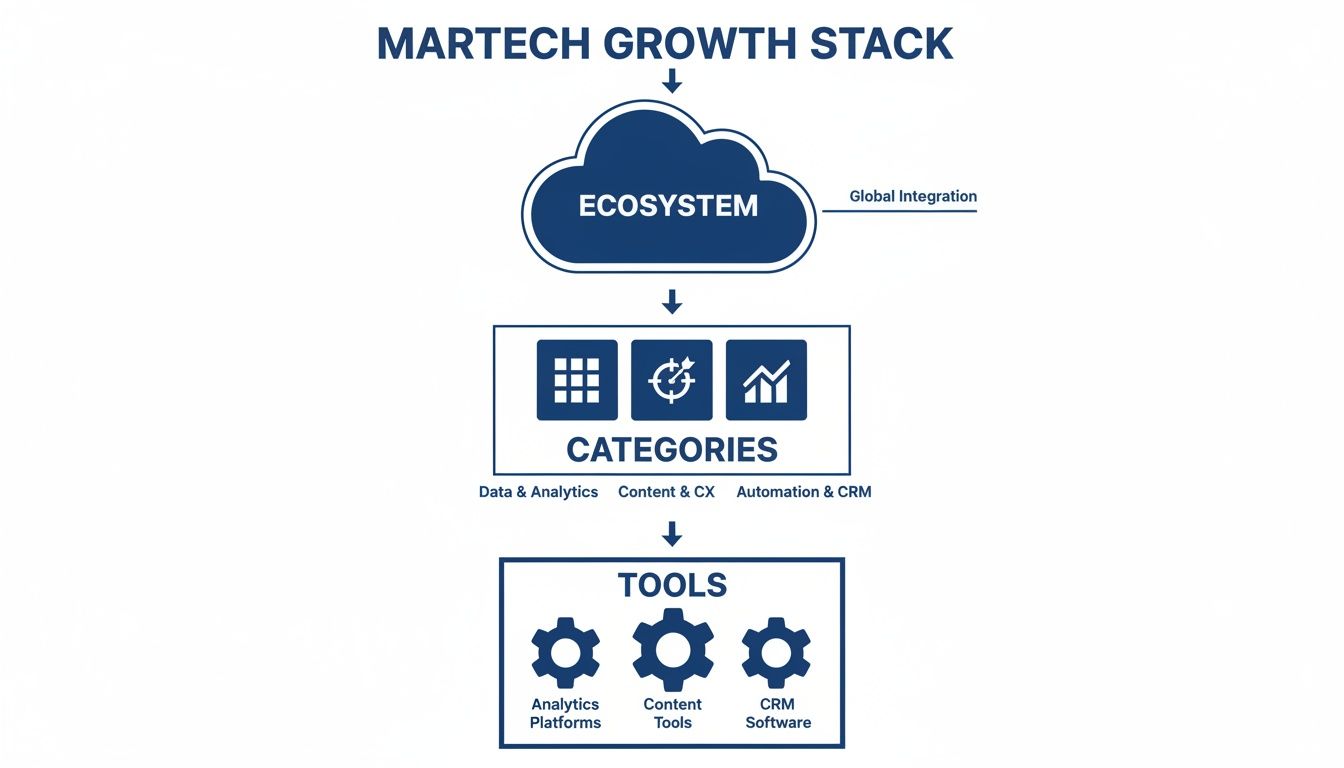
As you can see, the entire MarTech world is built in layers, starting from broad functions like data and automation and drilling down to the specific tools that get the work done.
The Modern MarTech Stack at a Glance
So, where do you start? To bring some clarity to the chaos, here’s a breakdown of the core categories and their primary function. Think of this as your diagnostic checklist to identify where your biggest pain points lie.
| Technology Category | Primary Business Function | Example Use Case for a Manufacturer |
|---|---|---|
| CRM | Manages all customer data, interactions, and relationships in one central place. | Tracking sales conversations with distributors and logging every touchpoint from initial inquiry to final order. |
| Marketing Automation | Automates repetitive marketing tasks like email sequences, social media posting, and lead nurturing. | Sending an automated email sequence to a new lead who downloaded a product spec sheet from your website. |
| Analytics & Data | Collects, processes, and visualizes data to measure performance and uncover insights. | Using website analytics to see which product pages get the most traffic and where visitors are coming from. |
| Content Management | Creates, manages, and publishes digital content on your website, blog, or resource center. | Updating your website with a new case study video showcasing how a customer uses your machinery. |
| GHL-Specific Integrations | Connects third-party tools directly into the GoHighLevel platform for a unified system. | Integrating a specialized quoting tool so that new quote requests in GHL automatically create a follow-up task. |
Each of these categories contains hundreds, if not thousands, of competing tools. The key is to find the right combination that works for you.
What This Means For Your Business
For any business owner, this flood of marketing technology companies is both a challenge and a massive opportunity. The challenge is obvious: how do you cut through the noise to find tools that actually fix your problems without wasting money?
But the opportunity is where the transformation begins. The right technology stack becomes a powerful, efficient engine for growth. It allows you to:
- Automate Repetitive Tasks: Free up your team from the grind of manual work like sending follow-up emails or scheduling social media posts.
- Gain Deeper Customer Insights: Finally understand who your best customers are, what they actually want, and how they behave online.
- Personalize Communication at Scale: Deliver the right message to the right person at exactly the right time, making your marketing hit home.
- Measure What Works: Stop guessing about your marketing ROI. Start making decisions based on cold, hard data.
Your goal isn't to collect every tool out there. It’s to strategically choose a handful that work together seamlessly and directly attack your biggest growth bottlenecks. This is the engineering mindset we bring to every client—diagnose the root problem before we even think about prescribing a solution.
The Core Platforms You Can't Ignore
Let's cut through the noise. The world of MarTech is crowded, with thousands of tools all claiming to be the next big thing. So, how do you choose?
You start by ignoring the hype and focusing on the handful of core platforms that solve real, tangible business problems. Instead of getting bogged down in feature lists, we’re going to focus on the only question that truly matters: What problem does this actually fix?

Here's our diagnosis of the essential platforms your business needs to consider.
Customer Relationship Management (CRM)
A CRM is your business’s central nervous system. It's the single, reliable database designed to organize every interaction you have with every prospect and customer.
Is your team currently juggling leads in spreadsheets, on sticky notes, or buried in their email inboxes? That's a system problem we call data chaos. A CRM ends that by creating a single source of truth for all your relationship data.
Imagine your sales rep talks to a distributor at a trade show. That conversation, their contact info, and any follow-up notes are logged directly into the CRM. Three months later, when someone else on your team needs to send a quote, they have the full context instantly. No more lost leads or missed opportunities.
Marketing Automation Platforms
If your CRM is the memory, a marketing automation platform is the hands and voice. It’s the tool that executes repetitive communication tasks for you, at scale.
Are you still manually sending individual emails to new leads or trying to remember to post on social media every day? Marketing automation takes over those tedious jobs so your team can focus on high-level strategy.
Here’s how it works in the real world: A potential client downloads a whitepaper from your website. The platform instantly sends them a thank-you email with the download, then follows up with a series of educational emails over the next two weeks to nurture their interest—all without you lifting a finger.
This allows you to maintain consistent, personal communication with hundreds or thousands of contacts at once. We dig into more specific examples in our guide to the top marketing automation platforms.
The Power of Integration: The real magic happens when your CRM and automation platform talk to each other. For example, when a lead in your CRM is marked as "ready to buy," it can automatically trigger a personalized email sequence from your automation tool. This is how you build a true marketing machine.
Analytics and Data Platforms
These are your command center’s diagnostic tools. Analytics platforms collect, process, and display data on your marketing performance, giving you a clear picture of what’s working and, just as importantly, what’s not.
If you can’t confidently answer the question, "Where are our best leads coming from?" you're flying blind. Analytics gives you the hard data you need to make informed decisions instead of just guessing.
For example, you might use Google Analytics and discover that while most of your website traffic comes from organic search, your highest-quality leads are actually coming from LinkedIn. That’s a powerful insight telling you exactly where to double down on your efforts.
The market for these tools is exploding, particularly with the rise of AI. North America is set to account for 33.8% of global MarTech revenue in 2025, an investment driven heavily by the demand for smarter analytics.
Content Management Systems (CMS)
A CMS is the workshop where you build and manage your most important digital asset: your website. It’s the platform that lets you create, edit, and publish content without needing to be a full-time developer.
Is your website a bottleneck? If you have to call a developer just to fix a typo or add a new case study, you’ve lost control. A CMS puts that power back in your hands.
For a manufacturer, this means you can log in to a CMS like WordPress, upload a new product spec sheet, add a video testimonial, and publish it for the world to see in minutes. It’s about agility.
As search evolves with Large Language Models (LLMs), modern CMS platforms are also integrating essential LLM monitoring tools. These tools are becoming critical for tracking how your content performs in an AI-driven search landscape, making them a non-negotiable part of a 2026 martech stack.
How AI Is Reshaping Marketing Technology
Artificial Intelligence isn't some far-off concept anymore; it's the engine running under the hood of the most effective marketing technology today. Many business owners we talk to are trying to diagnose if AI is just hype or something they can actually use. Let's cut through the noise and look at what it really does.
Think of AI as a brilliant, tireless assistant who can dig through mountains of data, spot patterns a human would miss, and execute tasks at a scale no team could ever dream of. It’s the difference between your marketing being a series of manual jobs and becoming an intelligent, self-improving system.
The investment flowing into this space tells the story. A recent analysis found that 71% of marketers plan to invest at least $10 million in AI over the next three years. It’s part of a bigger shift, where 75% of companies using AI are moving their people away from repetitive tasks and toward high-value strategic work. You can dig into these numbers and more in this digital marketing statistics report.
From Manual Guesswork to Predictive Power
So, what problems does AI actually solve for a busy owner? It really comes down to three things: personalization, prediction, and automation.
Instead of blasting the same generic message to every lead, AI helps you tailor your communication based on what each person actually does. It's the difference between a mass-produced flyer and a handwritten note—one gets tossed, the other gets read.
Here’s how that plays out in the real world:
- An AI-powered email system can look at a customer's past purchases and browsing history to suggest products they’ll genuinely want.
- It can change the content on your website in real-time to better match a visitor’s industry or past behavior.
- Chatbots can give instant, relevant answers 24/7, keeping customers happy without tying up your team.
This kind of one-on-one marketing used to be a luxury only giant corporations could afford. AI now puts it within reach for small and midsize businesses.
The Transformation: You go from broadcasting one message to thousands of people to having thousands of one-on-one conversations at the same time. This builds much stronger relationships and directly grows your bottom line.
Automating Content and Strategic Tasks
One of the most immediate wins with AI is its ability to handle content creation and other grunt work that eats up your team's day. This frees them up to focus on what humans do best: strategy, creative thinking, and building relationships.
For example, AI-driven SEO tools can analyze search trends and suggest blog topics that have a real shot at ranking. Other tools can write the first draft of an email series, a batch of social media posts, or even ad copy, slashing your content production time. The explosion of AI-powered short video tools like 2short.ai is a perfect example of how AI is making content creation faster and more efficient inside the martech world.
This isn’t about replacing your marketing team. It’s about giving them superpowers.
- Predictive Lead Scoring: AI analyzes what a lead does—which pages they visit, what emails they open—to predict who is most likely to buy. Your sales team can stop guessing and focus their energy on the hottest leads, closing more deals.
- Dynamic Ad Optimization: Forget manually A/B testing a few ad variations. AI can automatically test thousands of combinations of images, headlines, and copy, then shift your budget to the winners in real-time.
- Customer Churn Prediction: By looking at customer activity, AI can spot the subtle signs that a customer is about to leave. This gives you a heads-up so you can proactively reach out with support or a special offer to keep their business.
By building AI into their platforms, marketing technology companies aren't just selling tools anymore. They're providing intelligent systems that learn, adapt, and drive real growth for your business.
How to Choose the Right MarTech Partner
Navigating the world of marketing technology companies can feel like trying to pick a single tool from a hardware store the size of a city. With literally thousands of options, how do you find the right one without burning through time and money on a solution that just doesn't fit?
It’s a trap we see business owners walk into all the time. They get sold on a powerful, flashy tool but have no real process for measuring it against what their business actually needs. To get it right, you need a diagnostic framework. Think of it as a pre-flight checklist before you invest a single dollar.

Diagnose Your Core Problem First
Before you even look at a vendor’s website, you have to ask one brutally honest question: What is the single biggest bottleneck in our marketing or sales process right now?
You aren't shopping for features; you're shopping for a solution to your most painful problem. Being specific points you directly to the type of tool you should investigate first.
Here are some questions to ask yourself to start the diagnosis:
- Lead Management: Do we have a single, clear view of every interaction with a prospect, or are leads getting lost in spreadsheets and inboxes?
- Team Efficiency: What are the repetitive tasks that are eating up our team’s valuable time? Where could automation give us the biggest win back?
- Data and ROI: Can I confidently point to where our best customers come from? Can I prove the ROI on our marketing spend?
Your answers will narrow the field significantly, guiding you toward the right category of marketing technology company—whether that’s a CRM provider, an automation platform, or an analytics tool.
Your Vendor Evaluation Checklist
Once you’ve identified your core need and have a shortlist of potential vendors, it’s time to put them under the microscope. Use this checklist to ask the tough questions and compare your options on an even playing field. This is how you move past the sales pitch and determine if a tool is truly a good fit for your business’s unique system.
| Evaluation Criteria | Key Questions to Ask | Why It Matters |
|---|---|---|
| Integration | Does this tool connect easily with the software we already use? How deep is the integration? | A tool that doesn't "talk" to your other systems creates more manual work, not less. True integration means a new lead in your CRM automatically kicks off an email sequence in your marketing platform. |
| Scalability | Can this platform grow with our business? What are the limitations on contacts, users, or features as we scale? | You're not just buying for today; you're investing for the next 3-5 years. A tool that can't handle your future growth will become a major roadblock sooner than you think. |
| Support | What does your customer support actually look like? Is it email-only, or can I talk to a real person? What are your guaranteed response times? | When something breaks—and at some point, it will—you need fast, competent help. Poor support can bring your entire marketing operation to a grinding halt. |
| Usability | How steep is the learning curve? Can our team realistically adopt this without months of intensive training? | A powerful tool is completely useless if your team finds it too clunky or complicated to use. Look for an intuitive interface that fits into your existing daily workflows. |
This structured approach helps you diagnose the health of a potential partnership before you commit.
A Note on Transparency: Pay close attention to how a company answers these questions. If a vendor is cagey or unwilling to admit their platform’s limitations, that’s a major red flag. No single tool is perfect for everyone. A good partner will be honest about what their platform does well and where it might not be the best fit.
Ultimately, choosing the right marketing technology company isn’t about finding the "best" tool on the market. It’s about finding the right tool for you. By starting with a clear diagnosis of your problem and following a structured evaluation process, you can select a partner that actually solves your challenges instead of creating new ones.
Building an Integrated Marketing System
Buying a powerful tool from one of the many marketing technology companies is easy. The hard part—where most businesses get stuck—is making it work with everything else you already use. A shiny new platform can quickly become an expensive paperweight if it doesn’t connect to your existing systems.
The answer isn't to keep buying more tools; it's to build a cohesive, integrated marketing system instead of a messy pile of disconnected software.
From Silos to a Single Source of Truth
So, what's the difference between a system and a pile of tools? A collection of tools creates data silos. Your customer service team uses one platform, your sales team uses a CRM, and your marketing team uses another. Nobody has the full picture.
An integrated system does the exact opposite. It ensures every piece of software talks to every other piece, creating a single, unified view of your customer. We call this a "single source of truth." When everyone in your company is working from the same playbook with the same data, everything just works.
You can learn more about how these individual pieces come together in our guide to designing your marketing technology stack.
The Power of All-In-One Platforms
One of the most direct ways to build this system is with an all-in-one platform. Instead of trying to duct-tape a dozen different tools from a dozen different marketing technology companies, these platforms bundle the core functions you need into a single dashboard.
At Machine Marketing, we often build our clients' systems on a platform called GoHighLevel (GHL). We use it because it consolidates several critical functions that most businesses need, right out of the box:
- CRM: To track every single lead and customer interaction.
- Email & SMS Marketing: To communicate directly with your audience.
- Funnels & Landing Pages: To capture new leads effectively.
- Appointment Scheduling: To make it dead simple for prospects to book time with you.
By having these tools under one roof, you eliminate most of the integration headaches from day one.
The Engineering Mindset in Action: Think of it like building a high-performance engine. You wouldn't source pistons from one company, a crankshaft from another, and an engine block from a third without knowing they were designed to work together. An all-in-one platform is like buying a perfectly balanced, factory-tuned engine.
How We Build a Seamless Workflow
An all-in-one tool is a powerful start, but the real value is unlocked when you configure it to match your specific business process. We don't just hand you the software; we architect a workflow inside it.
Here’s a real-world example of how we set this up for a manufacturing client using GoHighLevel:
- Lead Capture: A potential distributor fills out a "Request a Quote" form on the client’s website, which we built inside GHL.
- Instantaneous CRM Entry: The moment they hit "submit," a new contact record is automatically created in the GHL CRM. All their form information is populated, and the lead is tagged as a "New Quote Request."
- Automated Sales Notification: The sales rep for that territory immediately gets an SMS and an email with the lead's details, enabling a rapid response.
- Nurture Sequence Activation: At the same time, the system adds the new lead to a "Quote Follow-Up" email sequence. This automatically sends a series of helpful emails over the next few weeks, keeping the client top-of-mind.
- Task Creation: A task is automatically created in the sales rep’s calendar to follow up by phone within 24 hours.
This entire process happens on its own, without anyone copying and pasting data or manually sending emails. This is the impact of a truly integrated system: it ensures nothing falls through the cracks and frees your team to focus on high-value conversations, not busywork. The result is a faster, more professional, and more effective sales process that closes more deals.
Your 90-Day MarTech Implementation Plan
All the theory in the world won't matter if you can't put the tech to work. The real challenge isn't buying software; it's making it profitable. This is where most businesses get stuck.
We're giving you the exact 90-day framework we use to get clients up and running. It’s a clear, actionable plan that turns a mountain of a project into manageable steps. Forget trying to do everything at once. This is about building a solid foundation that starts delivering a return.
Your next step? Day one.
Month 1: Diagnosis And Planning
The first 30 days are all about strategy. Before you log into a new platform, you have to get brutally honest about what’s broken in your current process and define what success actually looks like. Rushing this phase is the single biggest mistake we see.
Key Tasks for Month 1:
- Define Core KPIs: Pinpoint the 2-3 key metrics that will prove this was a good investment. Think "number of qualified leads" or "sales cycle length," not vanity metrics.
- Map Your Current Process: Get a whiteboard and map your entire lead-to-sale journey as it is right now. Where are the communication breakdowns and bottlenecks? Be ruthless.
- Select Your Platform: With your problems clearly defined, you can now finalize your platform choice. Our guide to the essential CRM implementation steps offers a solid framework.
- Assign Ownership: Put one person in charge. This project needs a single point of contact who is ultimately responsible for its success.
Month 2: Setup And Integration
With a clear plan in hand, month two is for building the machine. This is the technical part where you get your hands dirty configuring the software to fit the workflow you just mapped out.
Our Approach: Treat this like an engineering project. Build the core system, test it, get feedback from the team, and refine. You're not aiming for perfection on day one—you're aiming for a functional system that works.
Key Tasks for Month 2:
- Platform Configuration: Start setting up the essentials: user accounts, custom fields that match your business, and sales pipelines that mirror your process.
- Data Migration: Time to import your customer and lead data from old spreadsheets and systems. Crucially, clean your data before you import it. Bad data in means bad data out.
- Build Initial Automations: Don’t try to automate everything. Build one or two high-impact workflows to start, like a simple follow-up sequence for new leads.
- Team Training: Get your team in a room for a hands-on training session. They need to understand how this new tool makes their job easier, not harder.
Month 3: Execution And Optimization
The final 30 days are for launch. This is when you flip the switch, put the system to work, and begin the real-time cycle of optimization. This is where you start to see the ROI.
Key Tasks for Month 3:
- Go Live: Make the official switch. Your team now operates out of the new system for all new leads and customer interactions.
- Monitor KPIs: Watch those key metrics you defined in month one like a hawk. Are they trending in the right direction?
- Gather Feedback: Hold weekly check-ins with the team. What’s working? What’s clunky or confusing? The people using the tool every day have the best insights.
- Refine and Iterate: Based on the data and team feedback, make your first round of tweaks. The goal isn't to "set it and forget it," but to continuously improve the machine.
Frequently Asked Questions
As a business owner, you’re probably bombarded with pitches for the "next big thing" in marketing software. It’s a lot to sort through. Here are some of the honest answers to the questions we get asked all the time.
How Do I Know If I Need a Complex MarTech Stack or Just a Simple Tool?
Start by diagnosing the biggest fire you need to put out. What’s the one thing holding back your growth right now? If you’re drowning in leads and can’t keep track of them, a CRM is your next step. If no one can find you online, you should be focused on SEO and content tools first.
The goal isn't to collect shiny new tools. It's to solve your most urgent problem. For many small and medium-sized businesses, a powerful all-in-one platform like GoHighLevel is a much smarter first move than trying to duct-tape a dozen different systems together.
What Is the Biggest Mistake Companies Make When Adopting New Marketing Technology?
Hands down, the biggest mistake is buying a tool without a battle plan. A team gets excited about a platform's features, buys it, and then… nothing. No one knows who owns it, how to use it, or what "success" even looks like.
This is how you end up with expensive software that nobody uses. That’s why we kick off every client partnership with a structured onboarding and a clear 90-day plan. The system is what makes the software work.
A Note on Transparency: A successful rollout is less about the technology itself and more about the system you build around it. The plan is just as important as the platform.
Can I Manage My Own Marketing Technology or Do I Need an Agency?
You can absolutely manage your own tech, especially if your needs are simple. The real question is about opportunity cost. Every hour you spend trying to learn, integrate, and troubleshoot platforms is an hour you’re not spending running your business.
Think of an agency or consultant as your outsourced engineering department. We bring the expertise to build and run the system for you, so you can focus on what you do best while we make sure your technology is actually generating a return.
What's the Difference Between MarTech and AdTech?
It’s a common point of confusion, but the distinction is pretty simple.
- MarTech (Marketing Technology) is for engaging with people you already have a connection with. Think email lists, website visitors, and social followers. It’s all about nurturing the relationships you’ve started.
- AdTech (Advertising Technology) is for finding total strangers and introducing them to your brand, usually through paid ads. It’s about starting new relationships from scratch.
They often work together, but their core jobs are different: MarTech nurtures, and AdTech acquires.
Ready to build a marketing system that delivers real results? Machine Marketing specializes in diagnosing your business needs and implementing the right technology to drive sustainable growth. Book a discovery call today to see how we can build a tailored, scalable marketing system for you.