Your phone rings while you're quoting a job, walking the floor, meeting with a customer, or driving between sites. You don't answer. The caller hears silence, voicemail, or a generic greeting. In many businesses, that's where the lead dies.
A missed call text back system fixes the first failure point, but only if you treat it like an engineered process instead of a checkbox. The difference between “we turned on auto-text” and “we built a lead recovery machine” is timing, message design, routing, and follow-up discipline.
Table of Contents
- The Diagnosis Why Every Missed Call Is a Revenue Leak
- Building Your Automated Response System
- Crafting Messages That Get a Reply
- Timing Cadence and Advanced Strategy
- Staying Compliant and Measuring Success
- The Transformation From Missed Calls to Closed Deals
The Diagnosis Why Every Missed Call Is a Revenue Leak
You already know missed calls are frustrating. The bigger issue is that they expose a broken handoff in your lead capture system.
From an operations standpoint, a missed call is like a part falling off the conveyor before inspection. Marketing created demand. The prospect took action. Then the system failed at the exact moment contact was supposed to happen.
Businesses miss approximately 22% of the calls they receive on average, and 85% of callers refuse to try again after reaching voicemail or an unanswered call, according to Numa's business phone statistics summary. That's not a minor service issue. It's a direct leak in the pipeline.
Why this matters operationally
Most owners look at missed calls as a staffing problem. Sometimes it is. Often it's a systems problem.
A front desk can be busy. A sales rep can be driving. A shop owner can't stop a machine cycle to grab every ring. Those are real constraints. But if the process ends with “hopefully they call back,” you don't have a process. You have wishful thinking.
Practical rule: If inbound calls matter to revenue, every unanswered call needs an immediate next action that happens without human memory.
That's why missed call text back belongs in the same category as other operational safeguards. It's not there to replace people. It's there to catch failure before failure becomes loss.
Questions to ask inside your own business
Use these as a quick diagnosis checklist:
- Where do calls get missed most often: Front office, owner cell, shared line, after-hours line, or routed sales numbers?
- What happens after the miss: Voicemail only, no response, manual callback list, or automated text with routing?
- Who owns follow-up: Sales, admin, dispatcher, owner, or no one clearly?
- What gets tracked: Just call volume, or actual recovered conversations and booked work?
If you can't answer those quickly, your system probably has blind spots.
A lot of companies invest in websites, ads, SEO, and CRM licenses, then leave call handling under-engineered. That's backward. If your inbound response layer is weak, the rest of the funnel underperforms. This is the same logic behind stronger marketing automation systems for lead handling. Automation doesn't create demand by itself, but it does prevent preventable loss.
What to look for on the shop floor
Look for patterns, not anecdotes:
| Signal | What it usually means |
|---|---|
| Repeated voicemails with no text follow-up | No catch mechanism exists |
| Owner says “we get back to people when we can” | Follow-up depends on memory |
| Calls during lunch or after-hours disappear | Routing logic is missing |
| CRM has leads from forms but not missed calls | Phone activity isn't integrated |
Missed calls aren't random noise. They're measurable process failures. Once you treat them that way, the fix becomes obvious. You build a system that acknowledges the call immediately, gives the prospect a simple path to reply, and routes the conversation to a person who can close it.
Building Your Automated Response System
A usable system starts simple. One trigger. One business number. One clean message. One validation step. Then you layer in complexity only after the base flow works.
Start with the trigger and the number
In GoHighLevel and similar CRMs, the setup usually begins in phone settings. The practical pattern is to choose the main business number, enable the Missed Call Text Back toggle, and use merge fields such as [name] and [business] in the outgoing text. A key implementation detail from the setup walkthrough is to call your own number and verify the text arrives within about 15 seconds. That guidance comes from this GoHighLevel missed call text back setup video.
That basic architecture applies beyond GoHighLevel. If you use another CRM, VoIP platform, or shared inbox phone system, the logic is the same:
- Detect the unanswered call.
- Send an immediate text from the correct business number.
- Log the event in the contact record.
- Route any reply to a human owner.
Don't start with five branches, ten templates, and a complicated workflow map. Start with the line that matters most.
Write the first message for clarity, not cleverness
Teams often overcomplicate the opening text. They try to sound polished and end up sounding automated.
A strong first message does three jobs:
- Confirms receipt: The caller knows you saw the call.
- Sets context: You're unavailable now, not ignoring them.
- Prompts action: You ask a question they can answer quickly.
A simple template works well:
Hey, this is [name] at [business]. Sorry I missed your call. I'm tied up right now. What can I help you with?
That structure works because it feels like a person wrote it. It also creates a reply path.
If you're comparing platforms before implementation, focus on routing, CRM connection, and conversation ownership more than feature lists. This roundup of SMS marketing platform options is useful if you're sorting through what should live in your CRM versus what should stay in a dedicated texting tool.
Test it like a production line
A lot of businesses “set it up” and never validate the system. That's the same as installing a sensor and never checking whether it trips.
Use a short acceptance test:
- Call from a personal cell: Confirm the system recognizes a genuine missed call.
- Time the delivery: The text should appear fast enough to feel immediate.
- Reply to the message: Make sure the response lands in the right inbox or contact record.
- Check merge fields: Verify the name and business fields populate correctly.
- Review the log: Confirm the call, text, and reply are visible for the team.
If you haven't tested your own missed call text back from outside the system, you don't know if you have automation or decoration.
Later, when the base flow is stable, add branching. Separate daytime from after-hours. Split service inquiries from quote requests. Trigger internal alerts. But don't skip the foundation.
Here's a helpful walkthrough to visualize the setup sequence and how teams think through the workflow before adding advanced logic:
Common setup mistakes
| Mistake | Result |
|---|---|
| Using the wrong sending number | Replies go nowhere or create confusion |
| Sending a vague message | Caller reads it but doesn't respond |
| No one owns the inbox | Conversations stall |
| Skipping validation | Broken workflows stay hidden |
The first build doesn't need to be elegant. It needs to be reliable. Reliability is what turns automation into recovered opportunities.
Crafting Messages That Get a Reply
The text itself does more than acknowledge the missed call. It sets the tone for the conversation and decides whether the prospect replies, waits, or moves on.
Generic auto-replies fail because they sound like they came from a machine and they ask nothing useful in return. Good missed call text back messages sound human, explain the delay, and make the next step easy.
Scenario one the sales rep on the road
A rep is driving between appointments and misses a call from a buyer who wants to discuss availability, lead time, or a capability question. The wrong text says, “Sorry we missed your call.” That closes nothing.
Use this instead:
Hi, this is [name] from [business]. I'm on the road and missed your call. If you reply with what you need, I'll get back to you as soon as I'm clear. If it's urgent, send the best time to reach you.
Why this works:
- It explains the delay without sounding defensive.
- It invites a specific reply.
- It helps the rep call back prepared.
Scenario two the shop owner on the floor
In a machine shop or industrial environment, the prospect often expects some delay. What they won't tolerate is uncertainty.
A practical template:
Hey, this is [name] at [business]. Sorry I missed your call. I'm on the shop floor right now. Reply with your project details or the part you need help with, and we'll follow up.
This kind of message performs better because it reflects reality. The caller understands why you didn't answer, and they know exactly what to send next.
Short messages win when they lower effort for the buyer. The easier the reply, the faster the conversation starts.
Scenario three the general inquiry
Some calls aren't from warm buyers with technical questions. They're broad inquiries, referrals, or first-touch conversations. You still want a message that moves the exchange forward.
Use a general template like this:
Hi, this is [business]. Sorry we missed your call. We did get it. Reply here with what you need, and someone from our team will follow up.
If you want more examples to compare tone and wording, Double My Leads' missed call tips are worth reviewing because they show how slight changes in wording can make a message feel more conversational.
For teams building broader SMS workflows, these marketing message examples can help you keep your language consistent across text, email, and follow-up sequences.
What weak messages do wrong
Weak messages usually fail in one of four ways:
- They sound corporate: “Thank you for contacting our office” creates distance.
- They lack a next step: The caller gets acknowledgment but no prompt.
- They overpromise: “We'll call you right back” sets expectations your team may miss.
- They ignore context: A field service company, machine shop, and distributor shouldn't use the same voice.
A useful way to review your current template is to ask one question: would a real employee send this manually? If the answer is no, rewrite it.
A quick message review checklist
- Does it name a person or business clearly
- Does it explain why the call was missed in plain language
- Does it ask for a simple reply
- Does it match the way your team talks
- Does it avoid sounding like a compliance notice or chatbot
The best message isn't the most polished one. It's the one that starts a real conversation.
Timing Cadence and Advanced Strategy
Most businesses stop at one automatic text. That's better than nothing, but it leaves a lot of value on the table.
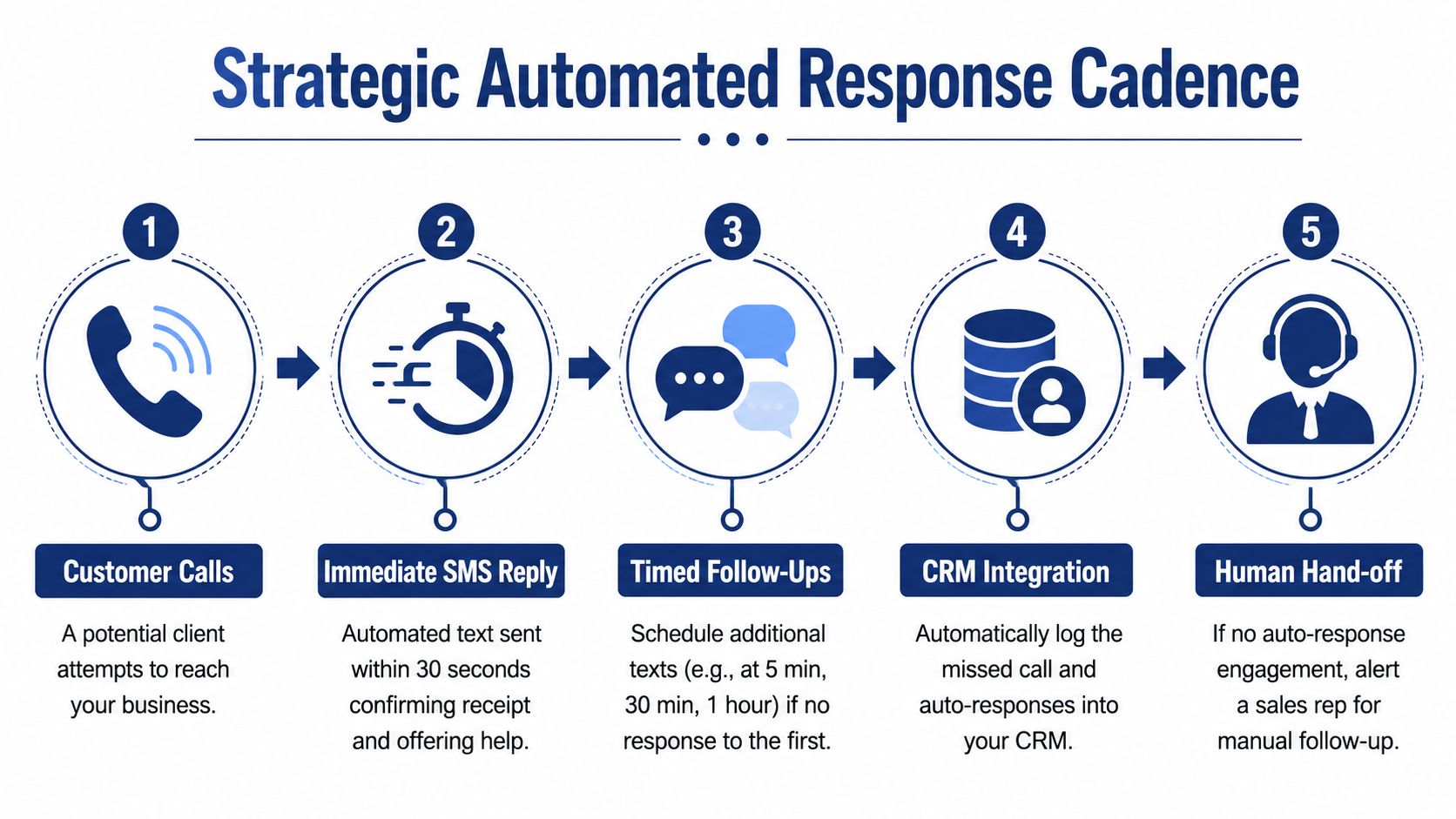
The primary advantage comes from combining fast response, contextual logic, and human intervention. That's where missed call text back becomes a system instead of a single event.
The timing issue matters because responding within 5 minutes can increase lead qualification by up to 400%, and SMS open rates average 98% with messages read within minutes, according to this missed call text back automation analysis.
Business hours and after-hours need different logic
A daytime missed call and an after-hours missed call are not the same event.
During business hours, the caller often expects quick engagement from a real person. After-hours, they usually need reassurance and a path forward. Your workflows should reflect that difference.
A practical split looks like this:
| Call context | Better response logic |
|---|---|
| During business hours | Acknowledge quickly and alert a team member |
| After-hours weekday | Confirm receipt and set expectation for next contact |
| Weekend | Offer a reply path and a booking or inquiry option |
| Known customer | Route to account owner when possible |
| New lead | Create a fresh record and notify sales |
The key is relevance. A static “sorry we missed you” text treats every situation the same. Buyers don't.
The human follow-up loop is the real system
The automation buys time. It doesn't close the opportunity.
One of the biggest implementation mistakes is assuming the first text is enough. It isn't. If a caller replies and nobody engages, the system becomes a dead-end with better branding.
That's why the strongest setups include an internal handoff such as:
- A task: Assign the conversation to a specific rep or admin
- An alert: Push a notification to email, Slack, or the CRM dashboard
- An ownership rule: Define who responds first and what happens if they don't
- A follow-up path: Use a booking link, qualifying question, or callback commitment when appropriate
Operational reality: Automation handles the first second. People still need to handle the next decision.
A practical cadence that doesn't annoy people
You don't need a long sequence. You need a short, sensible cadence that respects urgency.
A common structure is:
- Immediate acknowledgment
- If the caller replies, route to a person
- If there's no reply, send one context-appropriate follow-up
- If the lead appears high-intent, notify a human for direct outreach
That sequence works because it balances speed with restraint. The first text catches attention. The second can add clarity. The human step keeps the lead from stalling.
Use caution with extra messages. More automation isn't always better. If the message flow feels repetitive or disconnected from the original reason they called, response quality drops. The smartest cadence is the shortest one that reliably starts conversations.
Staying Compliant and Measuring Success
A missed call text back system that isn't governed properly creates risk. A system that isn't measured creates guesswork. Both problems are avoidable.

Compliance is an operating constraint
Businesses often treat compliance as legal fine print. In practice, it's an operating rule that should shape how your workflow behaves.
For a missed business call, a straightforward reply tied to that inbound contact is generally a different situation from adding someone to an ongoing promotional sequence. The first is about responding to a direct interaction. The second moves into a more sensitive territory and should be handled with clear consent practices and platform rules in mind.
That means your team should keep these boundaries clear:
- Transactional response: A direct acknowledgment of the missed call
- Conversation follow-up: Replies that continue the same help request
- Marketing sequence: Promotional texts or broader nurture campaigns
If your system blurs those categories, you create unnecessary exposure.
The safest automation is narrow, relevant, and tied to the reason the person contacted you.
Measure conversations, not just sends
A lot of dashboards stop at activity metrics. Texts sent. Calls missed. Notifications delivered. Those are operational logs, not business outcomes.
What matters is whether the system creates real conversations and whether those conversations produce quotes, appointments, or sales.
This distinction is visible in conversion behavior. LeadsOrbit's analysis of missed call text back performance notes that messages without a clear reply path or human response within 5 minutes convert at less than 12%, while conversational texts with human follow-up achieve 34% conversion.
That's why your reporting should focus on movement through stages:
| Metric type | Better question |
|---|---|
| Missed calls | How many needed recovery |
| Texts sent | How many were acknowledged |
| Replies received | How many became active conversations |
| Qualified opportunities | How many moved into the pipeline |
| Closed work | Which deals started as missed calls |
What to ask yourself every month
A monthly review doesn't need to be complicated. Ask:
- Did every missed call trigger the right response
- Did replies reach a human fast enough
- Did after-hours calls follow a different workflow
- Did any conversations stall because ownership was unclear
- Can we trace closed business back to recovered missed calls
If you can answer those with confidence, the system is becoming a measurable asset. If you can't, you still have an automation layer, but not yet an SOP your team can trust.
The Transformation From Missed Calls to Closed Deals
The common assumption is that missed call text back is a patch. You miss a call, send a text, and hopefully recover a few leads.
That's too small a view.
When you build this correctly, you're not just recovering missed calls. You're redesigning how your business handles inbound intent. You're creating a system that responds fast, captures context, routes ownership, and keeps opportunities moving even when your team is busy.
Stop thinking recovery only
Recovery is reactive. A stronger operating model is proactive.
The shift happens when you stop asking, “How do we text people after we miss them?” and start asking, “How do we make sure inbound demand never hits a dead end?” That question leads to better workflow design.
It changes how you think about:
- Phone coverage: Not just answering, but routing intelligently
- CRM usage: Not just storing contacts, but logging intent
- Sales follow-up: Not just callbacks, but conversation ownership
- Customer experience: Not just speed, but clarity
A simple notification can't do all that by itself. A designed system can.
What a stronger system looks like
A mature setup usually has a few clear characteristics.
First, the caller gets a fast, useful message that sounds like a person. Second, the conversation lands somewhere visible to the team. Third, someone owns the follow-up. Fourth, the business can look back and see which recovered calls turned into real pipeline.
That's the transformation. Less leakage. Better responsiveness. Fewer forgotten leads. More control.
Businesses that handle missed calls well don't rely on hustle. They rely on a repeatable process.
If your current setup is voicemail, sticky notes, and “I'll call them back later,” you don't need more effort. You need a better system. Start with the trigger. Write the message. Build the handoff. Then measure the conversations that result.
If you want a practical diagnosis of your inbound lead system, Machine Marketing can help you map the gaps between missed calls, CRM workflows, follow-up SOPs, and closed revenue. We work with manufacturers, industrial businesses, and growth-focused teams that need clearer systems, not more marketing noise.