The odds of getting a venture check are brutal. One widely cited estimate puts the chance of receiving an equity check from Andreessen Horowitz at 0.7%, while the chance that a funded startup ultimately succeeds is estimated at 8%. Combined, that implies an overall success rate of 0.05%, or about 1 in 2,000, according to this data-driven breakdown of VC pitch outcomes.
That reality changes how manufacturing and industrial founders should approach pitching to venture capitalists. Your pitch isn't a one-time performance. It's a high-volume conversion pipeline that begins with investor selection, moves through several filters, and ends with diligence, negotiation, and a term sheet. The founders who manage that system well spend less time polishing slides that no qualified investor will read and more time proving traction, margins, capacity economics, and capital efficiency.
Table of Contents
- What Pitching to Venture Capitalists Really Looks Like in 2026
- Building a Pitch Deck Built for a Three-Minute Skim
- Financials and Metrics Manufacturing Founders Need Ready
- Qualifying Investors and Running Targeted Outreach
- Meeting Prep and the Questions VCs Always Ask
- Term Sheet Basics and When VC Funding Is the Wrong Fit
- Your 90-Day VC Pitch Operating Plan
What Pitching to Venture Capitalists Really Looks Like in 2026
Pitching to venture capitalists starts with a diagnosis: you aren't trying to persuade every investor. You're trying to identify the small group whose mandate, stage, check size, geography, and industrial appetite match your company.
Across an outreach campaign, only about 1% to 3% of initial conversations convert into an actual investment, while seed rounds tend to run around 2% to 4%. Once you reach a qualified first meeting, conversion can improve to roughly 5% to 10% into a signed check, based on the investor pipeline calculator and benchmark methodology. Treat those figures as operating assumptions, not promises.
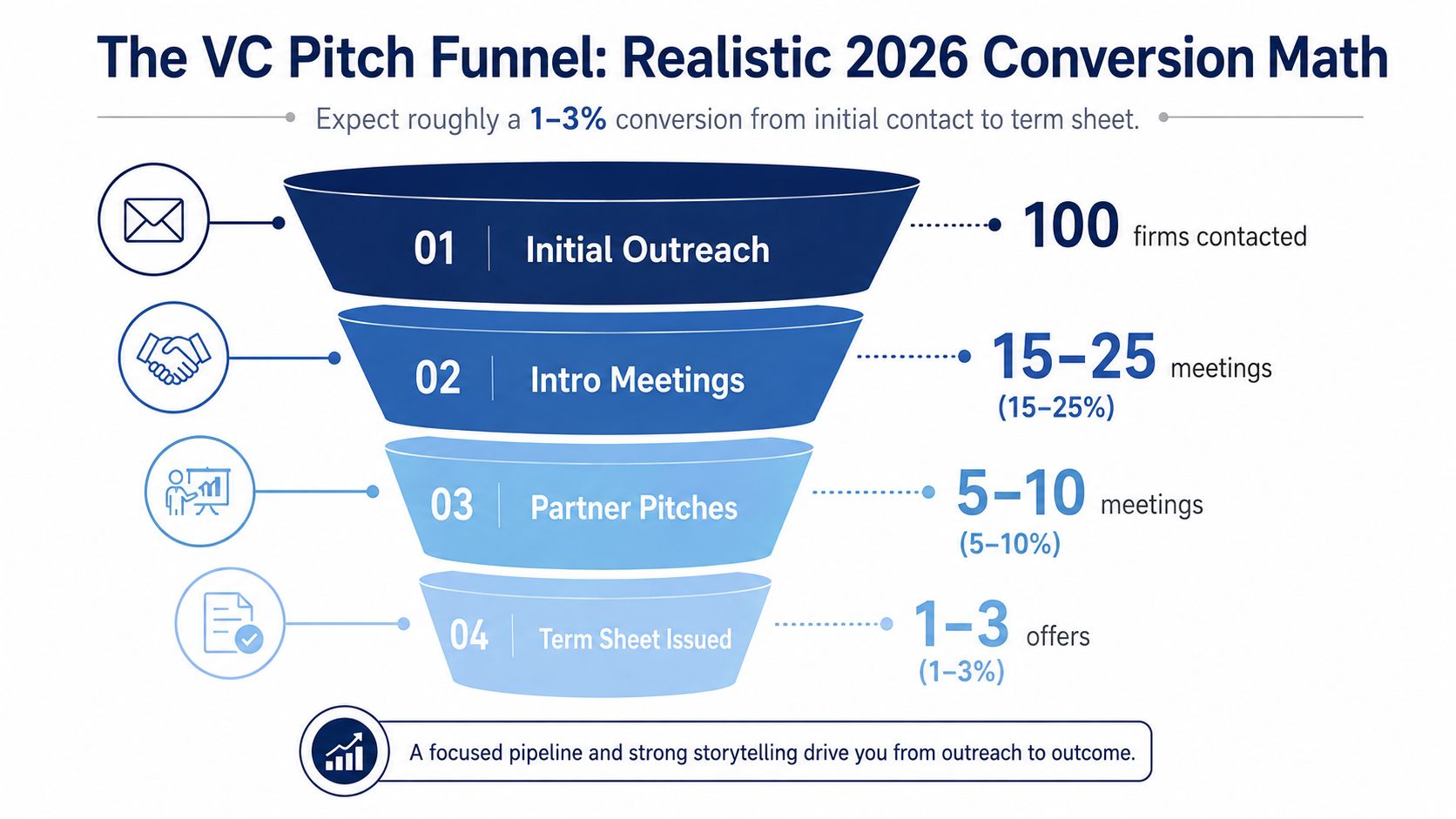
The pipeline has seven working stages
- Narrative framing: Explain the industrial problem, the economic consequence, and why your solution can scale.
- Deck construction: Build a short document that survives skim behavior and directs attention to proof.
- Metric readiness: Prepare the operating, financial, customer, and production data investors will test.
- Outreach qualification: Remove firms that lack sector, stage, geography, or check-size fit.
- Meeting execution: Adapt the conversation to the first call, partner meeting, and diligence process.
- Term sheet decisions: Evaluate control, dilution, preferences, governance, and strategic value.
- Ninety-day cadence: Run fundraising as a managed system with targets, owners, follow-up, and conversion tracking.
Most founders reverse this order. They spend weeks refining colors, animations, and product screenshots before confirming that their investor list contains suitable funds or that their numbers withstand basic underwriting.
The market has also become more concentrated. Recent venture data reports that U.S. funds raised $74.8 billion in the first half of 2026, while funds of $1 billion or more captured 68.3% of that capital and twelve firms accounted for three quarters of dollars raised, according to recent venture-market analysis. That concentration makes fit more important than broad exposure. An industrial founder needs to answer, quickly, why this investor, at this stage, for this capital-intensive business.
Practical rule: Don't optimize the pitch until you've diagnosed the investor pipeline. A beautiful deck sent to the wrong funds is still wasted effort.
Building a Pitch Deck Built for a Three-Minute Skim
Your deck has one job before the meeting: make the investor understand what you do, why it matters, and what evidence supports the opportunity. It doesn't need to tell your entire company history.
One 2026 analysis reports an average seed-deck review time of just 3 minutes and 44 seconds, with only 58% of decks read through to the final slide, as summarized in this pitch-deck statistics analysis. Another analysis reports that investors spend only 3.2 seconds per slide on average, which means your opening pages must carry the argument before the reader reaches the appendix.
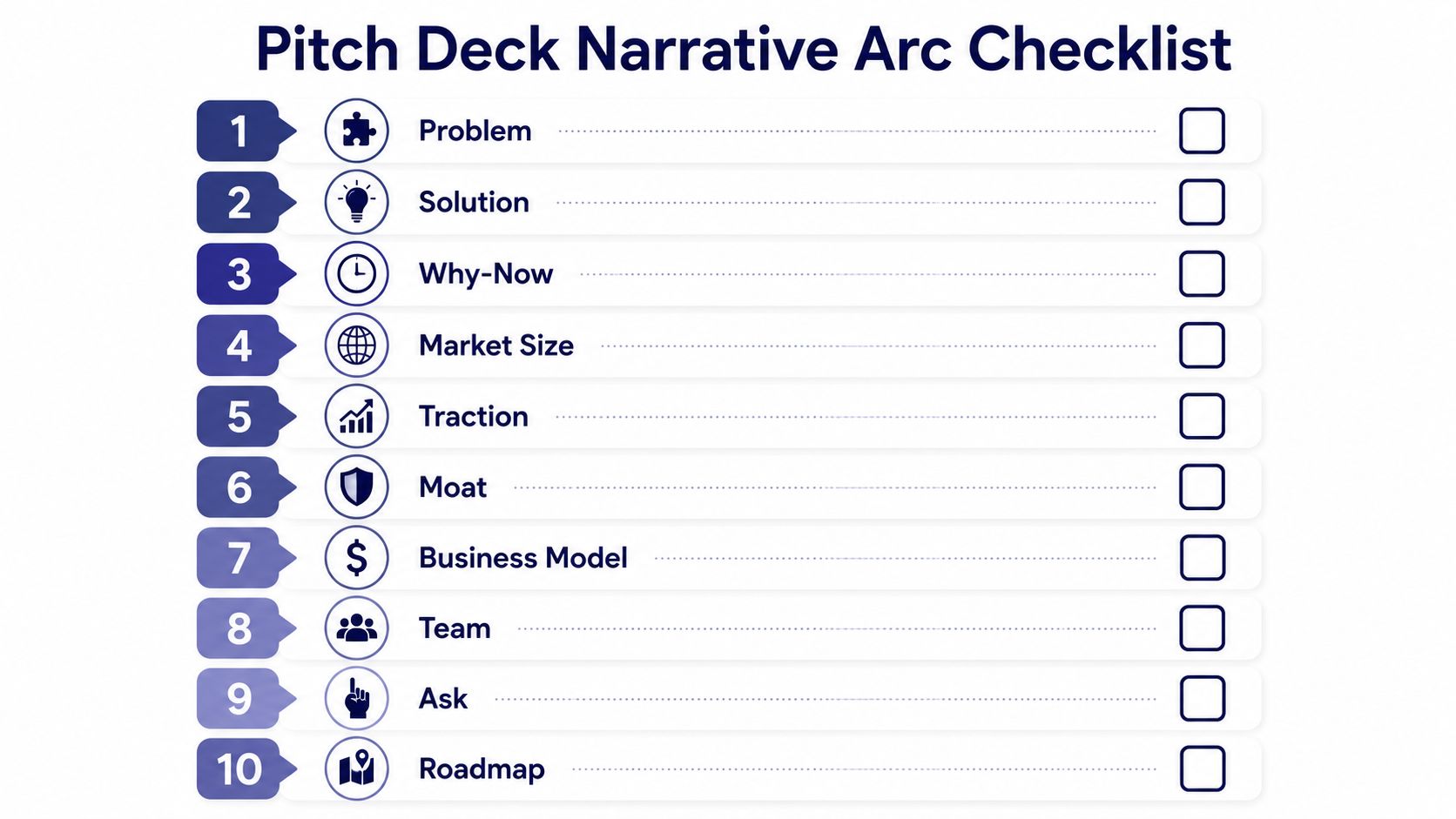
Use a manufacturer-friendly narrative arc:
- Problem: Identify the operational failure, cost, delay, risk, or compliance burden.
- Solution: Show the product or process in terms a buyer and investor can understand.
- Why now: Connect the opportunity to a visible shift in regulation, supply chains, technology, or customer requirements.
- Market size: Define the reachable market without hiding behind an inflated top-down category.
- Traction: Show paid demand, repeat orders, deployments, qualified pipeline, or another defensible proof point.
- Moat: Explain what gets harder for competitors to copy, such as process knowledge, qualification history, proprietary tooling, data, or supplier relationships.
- Business model: Show who pays, what they pay for, and how production costs affect contribution.
- Team: Link each founder's experience to the technical, commercial, and operational risks.
- Ask: State the amount sought, the intended use of funds, and the milestones that capital should support.
- Roadmap: Show the sequence from current capability to the next production, revenue, or market milestone.
Design for evidence, not decoration
Guy Kawasaki's widely used structure includes title, problem, value proposition, underlying technology, business model, go-to-market, competition, team, projections, and current status. His presentation guidance also recommends a maximum pitch length of 20 minutes and a minimum font size of 30 points, as explained in his pitch presentation guidance.
For an industrial deck, keep the structure tight and use one main chart or diagram per slide. A defensible manufacturing-process diagram is usually more persuasive than a page of product features. Show the critical steps, the bottleneck, the quality-control point, and the part of the process competitors can't easily reproduce.
Your unit-economics slide should show production cost per unit, selling price, gross-margin contribution, labor assumptions, scrap or yield considerations, and the effect of volume. Don't use a gross-margin figure that excludes the costs investors know will appear later.
A capital-efficiency slide should answer a practical question: what does each dollar of funding enable? Connect capital to tooling, equipment, inventory, hiring, certification, or working capital, then connect those inputs to capacity, revenue, and the next financing milestone.
Keep detailed customer lists, test results, technical specifications, sensitivity cases, and long operating models in the appendix. The main deck should point to them, not force a time-constrained reader to excavate them. If your value proposition still sounds broad, use this guide on how to write a value proposition to sharpen the customer outcome before you revise the slides.
Financials and Metrics Manufacturing Founders Need Ready
Industrial investors underwrite operating risk differently from software investors. They want to know whether demand converts into profitable production, whether growth consumes cash, and whether one customer or one facility determines the company's survival.
Before outreach begins, stage these metrics in a clean data room:
- Monthly recurring revenue: Useful for recurring service, consumables, software, or maintenance revenue attached to the hardware.
- Gross margin: Separate product, service, and software contribution where possible.
- Customer acquisition cost: Show how sales and marketing costs translate into qualified industrial accounts.
- Payback period: Explain how long it takes to recover acquisition cost from contribution.
- Production cost per unit: Include material, direct labor, outside processing, freight, scrap, and other production-linked costs.
- Capacity utilization: Show current output against practical capacity, not an optimistic theoretical maximum.
- Working capital cycle: Explain payment terms, inventory days, deposits, receivables, and supplier obligations.
- Customer concentration percentage: Identify how much revenue depends on the largest accounts and how that exposure changes over time.
The first three numbers a VC is likely to seek are traction, gross-margin contribution, and capital efficiency. Put them in the main deck. Detailed SKU economics, inventory schedules, customer-by-customer analysis, and scenario models belong in the appendix or data room.
| Metric | What It Is | Why VC Cares | Target Range |
|---|---|---|---|
| Monthly recurring revenue | Contracted or repeatable monthly revenue | Indicates revenue durability where recurring sales apply | Show the trend and contract quality |
| Gross margin | Revenue left after production costs | Tests whether growth can create contribution | Demonstrate improvement and explain drivers |
| Customer acquisition cost | Cost to acquire a customer | Reveals commercial efficiency | Tie it to payback and account value |
| Payback period | Time required to recover acquisition cost | Shows how quickly growth replenishes cash | Make assumptions explicit |
| Production cost per unit | Direct cost to build and deliver a unit | Exposes manufacturing scalability | Show cost reduction path |
| Capacity utilization | Actual output relative to practical capacity | Clarifies fixed-cost absorption | Explain the next capacity constraint |
| Working capital cycle | Timing of cash in and cash out | Hardware growth can consume cash | Model inventory and payment terms |
| Customer concentration | Revenue share tied to key accounts | Measures durability and customer risk | Show diversification plan |
Use a practical pitch proof finances guide to organize the financial evidence investors expect, then connect those figures to your marketing investment decisions with this resource on how to measure marketing ROI.
Don't manufacture a benchmark range to make weak economics look normal. If your margin is thin, capacity is constrained, or working capital is heavy, state the problem and show the operating intervention that can change it.
Qualifying Investors and Running Targeted Outreach
A qualified investor list is more valuable than a large investor list. Start broad enough to discover relevant funds, then remove every firm that can't realistically lead or participate in your round.
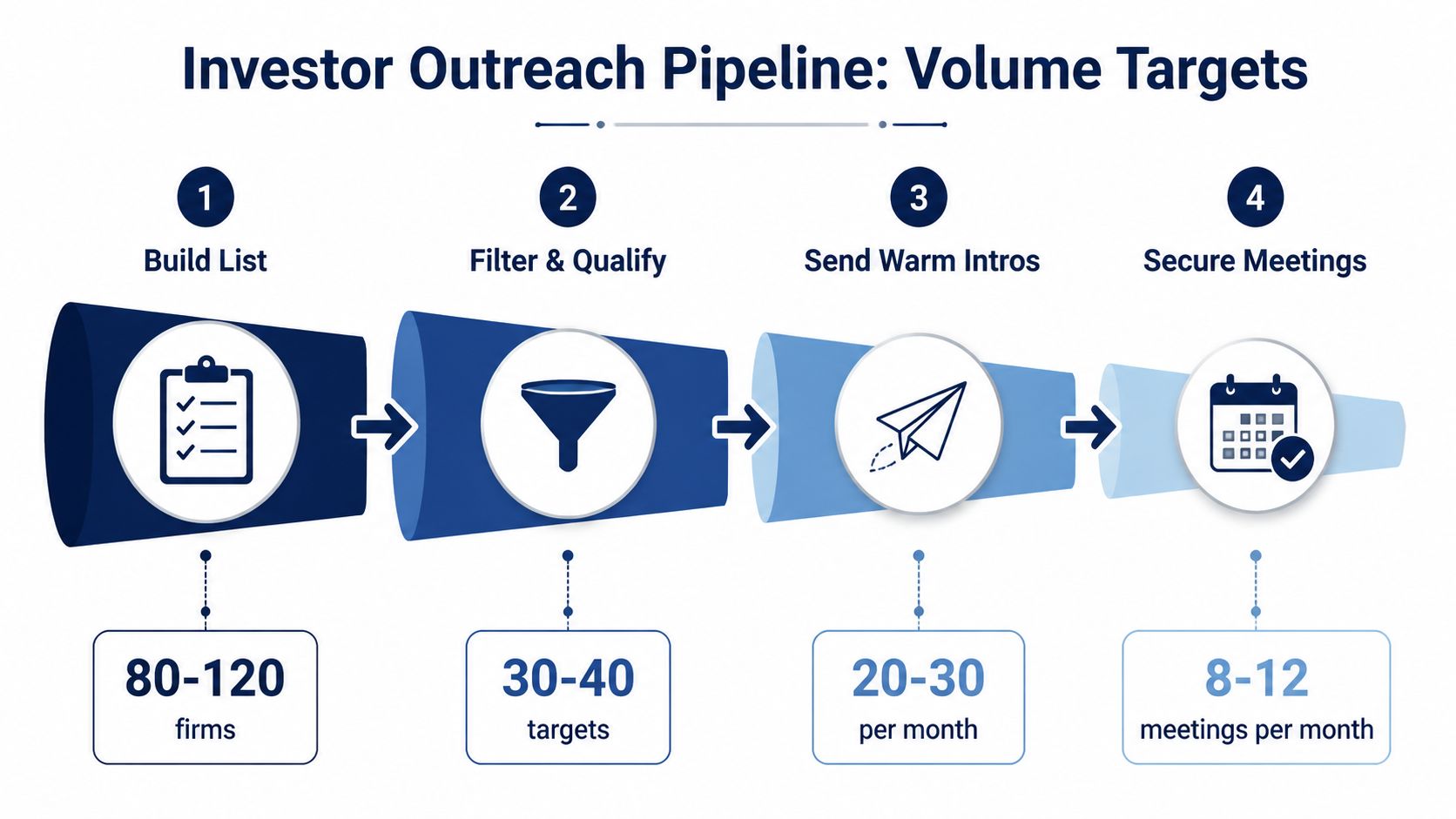
A workable outreach funnel uses these operating targets:
- Build a list of 80 to 120 firms. Search fund websites, portfolio pages, sector databases, accelerator networks, customer referrals, and industry relationships.
- Filter to 30 to 40 qualified targets. Match stage, check size, industrial thesis, geography, and recent portfolio activity.
- Send 20 to 30 warm introductions per month. Ask for specific introductions, not generic forwarding.
- Convert 8 to 12 first meetings. Track the result as a conversion metric, not a measure of personal worth.
Qualification is a research task
Check whether the fund invests at your stage, whether its check size aligns with your round, and whether its portfolio includes industrial technology, advanced manufacturing, climate hardware, supply chain systems, or adjacent categories. Review portfolio pages, podcast appearances, partner writing, and recent LinkedIn posts. You're looking for evidence of current interest, not a vague sector label on an outdated website.
Build a one-line hook for every qualified target. For example: “Your investments in production software and supply-chain resilience align with our process that reduces a specific manufacturing bottleneck.” The hook should explain the fit before you ask for time.
Warm paths often come from accelerators, customers, suppliers, equipment partners, advisors, and other founders. If you must contact someone cold, keep the email short:
- Context: Explain why you selected that investor.
- Problem: State the industrial pain in one sentence.
- Proof: Include the strongest current evidence.
- Ask: Request a brief fit conversation, not an immediate investment decision.
Don't promise a reply rate above 5%. The available pipeline benchmarks cited earlier point to roughly 8% to 12% email replies as a healthy range under their methodology, but your audience, relationship quality, and message relevance will change the result. Track reply rate, first-meeting rate, second-meeting rate, partner-meeting rate, and term-sheet rate in a CRM.
A best US venture capital firms list can help expand your initial research universe, but don't treat a directory as qualification. For execution, use LinkedIn for sales to identify credible connection paths and relevant investor activity.
Meeting Prep and the Questions VCs Always Ask
A first call isn't a compressed partner meeting. Prepare each interaction for its purpose.
The 30-minute first call should establish problem, product, traction, team, round, and fit. Keep the room small and assign one person to own the narrative. The 90-minute partner meeting needs deeper operating evidence, a clear use-of-funds plan, and direct answers from technical, commercial, and finance owners. The four-hour partner meeting plus site visit tests whether your reported economics match the physical operation.
Manufacturing VCs usually press on the areas founders try to soften:
- What are the unit economics by SKU?
- How is gross margin changing?
- Which customers generate the most revenue?
- What does the capex roadmap require?
- How long is the working capital cycle?
- What regulatory approvals or certifications remain?
- Which incumbent could copy the product?
- What part of the process is defensible?
- How does production scale without quality failure?
- What happens if a key supplier fails?
- Which exit comparables make sense?
- What must be true for the next round?
Bring a one-page leave-behind with the problem, product, traction, economics, team, raise, use of funds, and top risks. Don't hide the weaknesses that a site visit will expose. Put them in a founder self-audit and prepare a direct response for each one.
Use rehearsals to remove avoidable risk
Run three rehearsals with operators who understand the plant, production flow, and customer consequences. Run one rehearsal with an investor or experienced finance professional. Record every session, review interruptions and unclear answers, and force the founder to answer the top three risk questions cold in under 60 seconds each.
A diligence checklist can help you organize contracts, financial records, ownership documents, customer evidence, and compliance materials. This financial due-diligence checklist is useful because it turns an informal document collection exercise into a defined preparation task.
Investors don't expect a risk-free factory. They expect you to know where risk lives, how you measure it, and what capital changes.
Term Sheet Basics and When VC Funding Is the Wrong Fit
A term sheet is not just a valuation document. It defines who gets paid first, who controls important decisions, who can invest later, and how ownership changes under pressure.
Start with the terms that affect industrial founders most:
- Liquidation preference: Preferred investors are paid before common shareholders if the company is sold, liquidated, or otherwise fails. A common structure is 1x, meaning investors recover their original investment before others participate, as explained in this overview of liquidation preference provisions.
- Participating preferred: Investors recover their preference and then share in remaining proceeds. Non-participating preferred generally requires investors to choose between the preference and conversion into common shares. The precise outcome depends on the deal terms, as outlined in this guide to venture capital term sheets.
- Anti-dilution: Protects investors if a later round prices the company lower. Broad-based weighted-average protection is typically more balanced than a full-ratchet provision.
- Option pool shuffle: Determines who bears dilution when an employee option pool is created or expanded before the financing.
- Board composition: Establishes who can influence hiring, budgets, acquisitions, and strategic direction.
- Pro-rata rights: Allow an investor to maintain ownership in later rounds.
- Vesting acceleration: Defines what happens to founder equity if the company is sold or a founder is removed after an acquisition.
The founder-friendly default is usually non-participating preference, balanced anti-dilution, a fair option-pool calculation, a board that preserves operational competence, and limited acceleration tied to a change of control. The aggressive ask may include multiple liquidation preferences, participating preferred, strong veto rights, or a full-ratchet adjustment. The realistic middle ground depends on investor influence, company risk, and competing financing options. Have counsel model the actual outcomes instead of relying on labels.
Compare capital before you accept it
VC isn't automatically the best source for a factory, tooling program, or inventory build. Consider the purpose of the money:
| Funding Source | Typical Round Size | Dilution / Cost | Time to Close | Best Fit |
|---|---|---|---|---|
| Venture capital | Aligned to a high-growth equity round | Equity dilution and governance rights | Multi-stage process with diligence | Scalable companies with strong growth potential |
| Venture debt | Tied to receivables, inventory, or other lending criteria | Interest and covenants rather than equity dilution | Depends on lender diligence | Companies with predictable cash generation |
| SBIR or DOE grants | Defined by program and eligibility | No conventional equity dilution, but application obligations | Grant-cycle dependent | Hardware R&D and technical validation |
| Strategic capital | Negotiated with a corporate or customer | May involve commercial rights, pricing, or equity | Depends on strategic approval | Capital-intensive products with clear industrial partners |
If the raise is below $3 million, gross margin is under 40%, capex dominates the economics, or founder control is central, evaluate alternatives before defaulting to VC. These are decision filters, not universal laws. Score each instrument against capital need, repayment ability, dilution tolerance, control requirements, strategic access, and timeline. Choose the funding source that solves the constraint without creating a larger one.
Your 90-Day VC Pitch Operating Plan
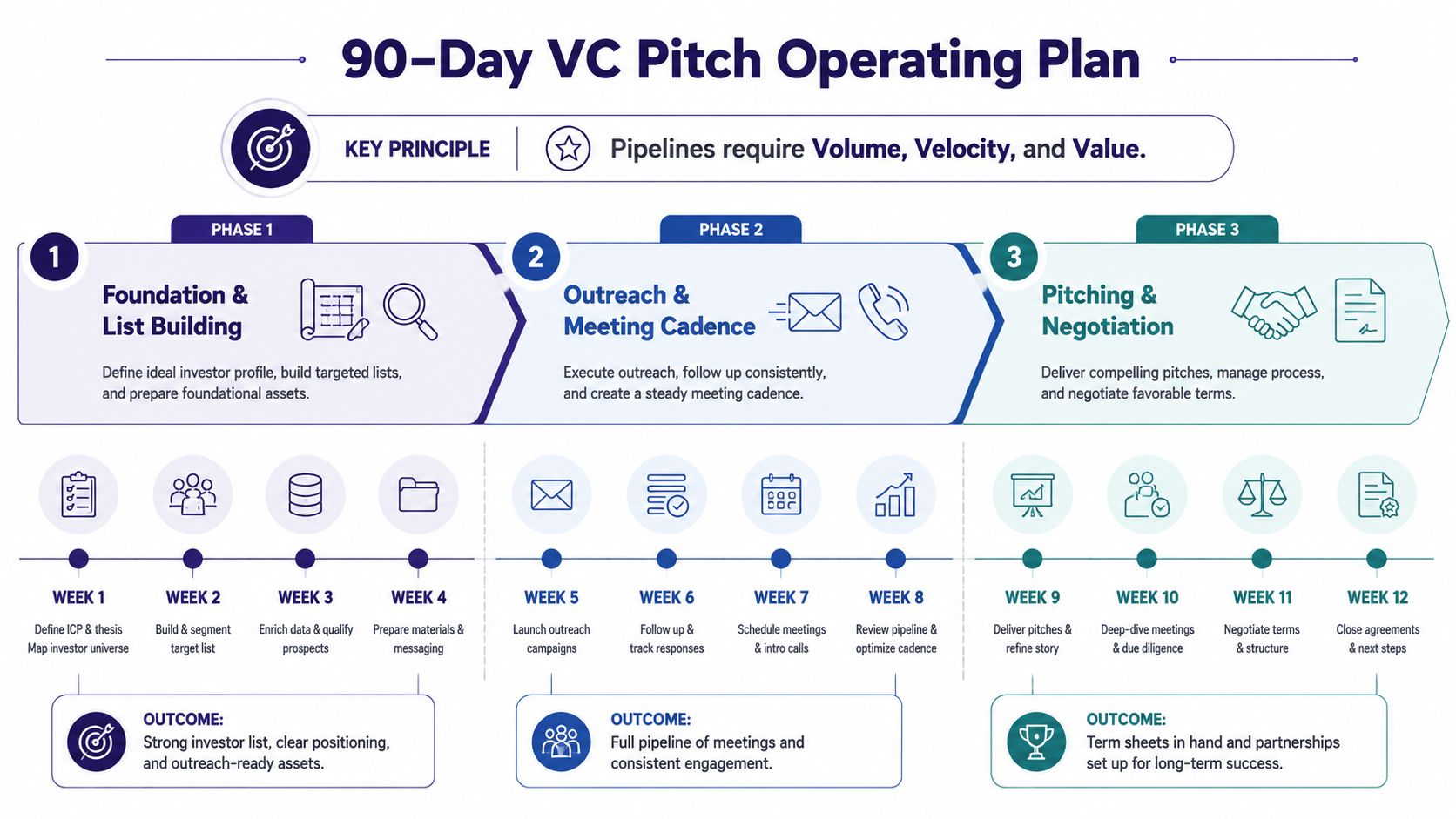
Fundraising requires volume, velocity, and conversion tracking. A founder who records every contact, response, objection, meeting outcome, and next step can improve the process. A founder who relies on memory will confuse activity with progress.
Weeks 1 through 3 establish the system
Finish the core deck by Day 7. It should contain the problem, solution, why now, market, traction, moat, business model, team, ask, and roadmap. At the same time, create the data room with financial statements, customer evidence, production data, ownership records, contracts, regulatory materials, and the operating model.
Build a qualified list of 60 to 80 investors, filtered by stage, sector, check size, geography, and recent activity. Don't wait until outreach begins to discover that a firm doesn't invest in industrial companies or can't support the size of your round.
By Day 21, book the first meeting. If you haven't, diagnose the failure point. Is the list weak, is the introduction path missing, is the opening email unclear, or does the deck fail to show proof quickly?
Weeks 4 through 8 create meeting velocity
Send 8 to 10 personalized emails per week, prioritizing warm introductions and clear investor fit. Log every reply, meeting, objection, referral, and follow-up date. Aim for 12 to 20 first meetings during this phase, then revise the narrative based on repeated questions rather than isolated opinions.
Use an objection log with columns for question, current answer, missing evidence, deck location, and owner. If multiple investors ask about capacity, working capital, or customer concentration, treat that pattern as a diagnostic signal.
Weeks 9 through 13 convert interest
Run partner meetings, open the data room to serious prospects, request term sheets, and negotiate in parallel where possible. Reach a partner meeting by Day 56 and a funding decision point by Day 90.
Your next action is simple: within the next 24 hours, create a spreadsheet with investor name, stage, sector fit, check-size fit, introduction path, status, last contact, next step, and objection notes. Then add the first qualified targets and assign a date to every follow-up.
Machine Marketing helps manufacturers and industrial businesses turn disconnected marketing, sales, CRM, and content activity into a measurable growth system. Visit Machine Marketing to get a practical diagnosis of your lead-generation process and build a clearer operating plan for consistent B2B growth.