If you're managing a growing business, this scenario is familiar. Your website needs work. Your CRM is half-configured. Leads come in, but follow-up is inconsistent. Sales says marketing sends weak opportunities. Marketing says sales doesn't respond fast enough. Everyone is busy, and nobody can clearly show what's working.
That's usually the moment owners start looking for a sales and marketing agency. Not because they want more meetings or more dashboards, but because they want a system. They want a repeatable way to attract the right buyers, capture demand, follow up properly, and turn attention into revenue.
A good agency helps. The right agency does something more valuable. It connects strategy, tools, messaging, and execution into one operating system for growth.
Is Your Marketing a System or a Series of Guesses
Most companies don't have a marketing problem first. They have a systems problem.
They run SEO without a lead handling process. They launch email campaigns without a clean CRM. They post on LinkedIn without a clear offer. They rebuild pages without talking to sales. Each activity looks reasonable on its own, but the whole machine doesn't produce dependable output.
That creates the worst kind of business drag. You're spending money and time, yet you still can't answer basic questions with confidence. Which channels bring qualified leads? What message gets meetings? Where do prospects stall? What should happen after a form fill?
What guessing looks like in practice
When we diagnose messy growth systems, the same patterns show up:
- Leads land in too many places: Forms, inboxes, spreadsheets, and text messages all hold fragments of the same customer record.
- Follow-up depends on memory: Reps respond when they remember, not when the system triggers the next step.
- Reporting is disconnected: Website traffic sits in one tool, pipeline in another, and nobody trusts the numbers.
- Marketing is judged by volume alone: Teams celebrate activity, but sales still questions lead quality.
- Old contacts go untouched: Past customers and dormant leads sit in the database with no reactivation plan.
This is why many businesses outgrow freelancers and one-off vendors. They don't need more isolated tasks. They need orchestration.
The market has moved in that direction. The number of marketing agencies in the United States reached 7,761 in 2022, a 17.4% increase from 2021, reflecting rising demand for specialized support in a more complex digital environment, according to marketing agency industry statistics.
A healthy growth system should let you answer, without scrambling, where leads came from, who followed up, what happened next, and what to improve this month.
What a system changes
A real sales and marketing agency should reduce uncertainty. It should document your funnel, centralize your customer data, tighten your message, and create clear handoffs between marketing and sales.
That doesn't mean every channel has to be complex. It means each part has a job. Your website should qualify and convert. Your CRM should track and automate. Your email and SMS workflows should nurture and reactivate. Your sales process should reflect how buyers make decisions.
If that system isn't in place, you're not scaling. You're improvising.
What a Modern Sales and Marketing Agency Actually Does
The old model was simple. One shop handled branding. Another ran ads. Somebody else built the website. Sales worked separately and complained later.
That model breaks under pressure because growth doesn't happen in separate departments. It happens when positioning, lead capture, follow-up, qualification, and pipeline management work together.
A modern sales and marketing agency functions more like an engine builder than a car detailer. A detailer can make the vehicle look sharp. An engine builder makes it run with power, reliability, and control.
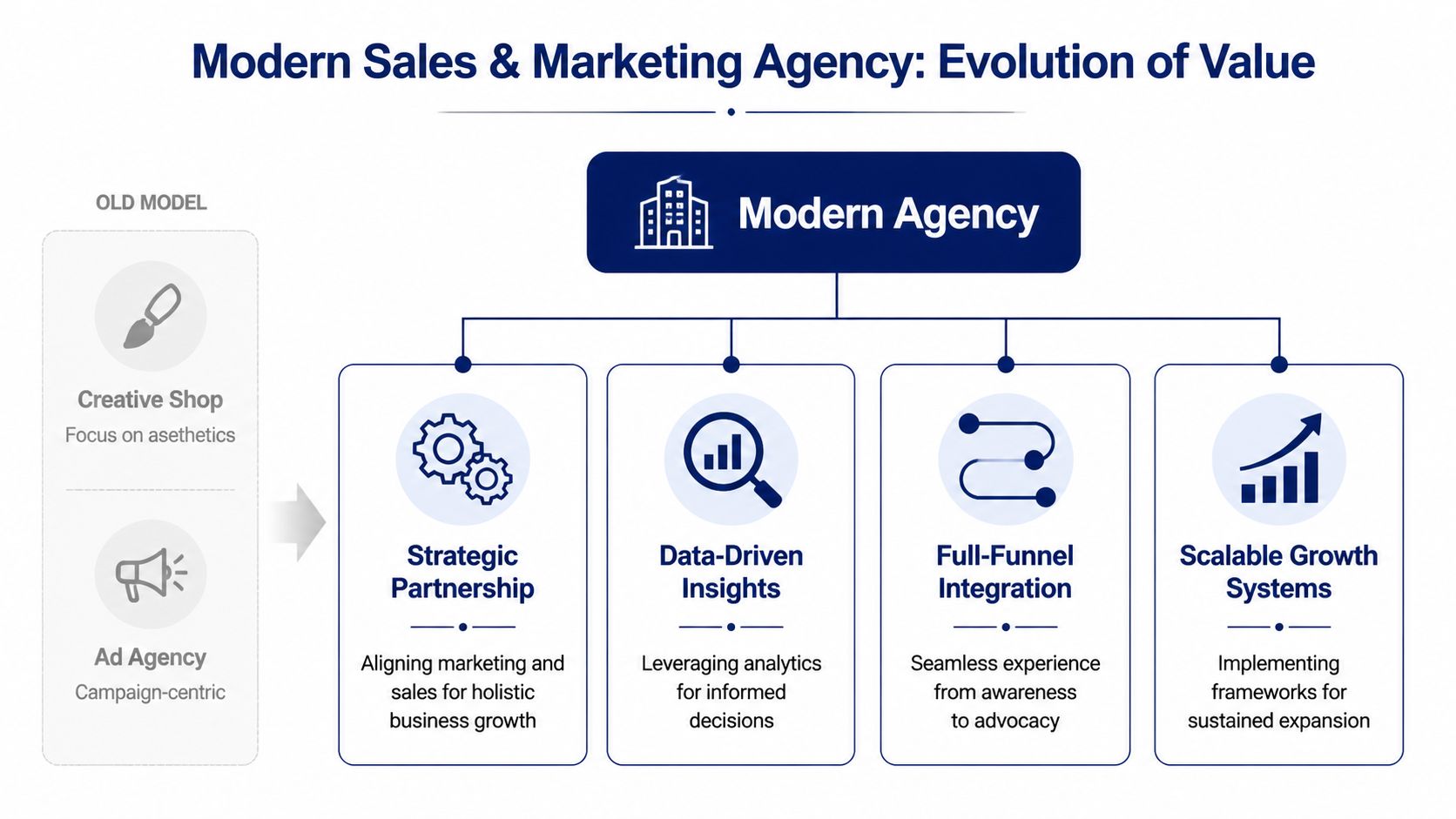
The shift from campaigns to integration
A modern agency doesn't just ask, "What campaign should we run?"
It asks sharper questions.
- Where does demand start: Search, referral, outbound, social, or reactivation?
- How is it captured: Contact form, booking flow, chat, phone, lead magnet, or inbound reply?
- Where is it tracked: In a real CRM, or buried in email threads?
- What qualifies a lead: Job title, company fit, urgency, engagement, budget, or buying stage?
- What happens next: Immediate assignment, nurture workflow, reminder sequence, or direct sales call?
That approach is why alignment matters so much. 78% of salespeople view their CRM as effective for aligning sales and marketing, and 83% of sales teams using AI report growth, according to Salesforce marketing statistics.
What the agency is really building
Think in layers, not deliverables.
The first layer is strategy. That includes audience definition, offer clarity, positioning, channel choice, and funnel design.
The second layer is infrastructure. This is the CRM, automation platform, reporting setup, forms, pipeline stages, and handoff rules. If you want a practical example of how agencies operationalize this work, this guide on marketing automation for agencies is useful.
The third layer is execution. Content, SEO, landing pages, email, SMS, paid distribution, sales enablement, and follow-up processes all live here.
The fourth layer is capacity. Many companies need support without overhiring. That's where operational help matters. For firms handling lead routing, inbox management, CRM cleanup, or bilingual customer communication, using Bilingual VAs can be a practical extension of the system.
Practical rule: If an agency can only describe outputs, not handoffs, dependencies, and operating logic, you're not talking to a systems partner.
What this means for owners
You shouldn't hire a sales and marketing agency to "do some marketing."
You should hire one to help answer three business questions:
- How do we create consistent demand?
- How do we make sure qualified opportunities aren't dropped?
- How do we build a process that still works when people get busy?
That's the essential work. The best agencies don't add noise. They remove friction.
Core Services That Build Your Growth Engine
Once you treat growth like a system, services stop looking like random menu items. They become parts of one machine.
For manufacturers, B2B operators, and service businesses, the strongest agency work usually sits in a few core areas. The value isn't the activity itself. The value is the business outcome each service creates.

CRM and GoHighLevel implementation
Many firms either gain control or stay scattered at this point.
A CRM build is not just software setup. It's the creation of a single source of truth for contacts, opportunities, activity history, and next actions. In platforms like GoHighLevel, that usually means custom pipelines, lead source tracking, automated reminders, form routing, nurture workflows, and reporting tied to actual sales stages.
Business outcome: your team stops guessing who owns the next step.
What works:
- Clear pipeline stages: Stages should mirror your real buying process, not generic labels copied from a template.
- Automated task triggers: New inquiry, missed call, estimate request, or dormant lead should trigger a defined action.
- Clean data rules: If nobody owns naming conventions, tags, and duplicate management, reporting becomes fiction.
What doesn't work:
- Overbuilding on day one: Too many fields, too many automations, too many edge cases.
- Tool-first thinking: Buying GoHighLevel or another CRM doesn't fix a broken process by itself.
Website redevelopment and SEO
Your website should do more than look current. It should help visitors self-qualify, understand your offer quickly, and take the next step with confidence.
For B2B companies, especially manufacturers, this often means rewriting service pages around buyer questions, improving technical trust signals, simplifying conversion paths, and organizing content around search intent. SEO then builds discoverability around that structure.
Business outcome: better-fit inbound opportunities and fewer dead-end visits.
A strong site usually includes:
- Offer clarity above the fold: Visitors should know who you serve, what problem you solve, and what action to take.
- Conversion architecture: Contact forms, booking prompts, quote requests, downloadable assets, and proof elements need intentional placement.
- Sales-informed content: Product and service pages should reflect objections real buyers raise during calls.
Content writing and thought leadership
Content is often wasted because companies publish topics they find interesting rather than topics buyers use to evaluate risk.
Good agency content shortens the trust gap. It answers technical questions, clarifies process, addresses objections, and supports search visibility. For engineering-led businesses, this can be especially useful because expertise often exists internally but hasn't been translated into buyer-friendly language.
Business outcome: your sales team gets warmer conversations because buyers arrive pre-educated.
Buyers don't need more content. They need the right explanation at the right stage of the buying process.
Email and SMS reactivation
This is one of the most overlooked profit centers in many businesses.
You already paid to acquire past leads, former customers, stale estimates, and inactive accounts. A reactivation campaign gives those contacts a reason to respond now. That might be a service reminder, a simple check-in, a new capability announcement, or a targeted follow-up tied to past interest.
Business outcome: revenue from contacts you already own, plus cleaner insight into who is still in-market.
The trade-off is straightforward. Reactivation works best when the CRM is organized and the message is relevant. If your list is messy and your offer is vague, you'll create noise instead of momentum.
How to Diagnose and Choose Your Agency Partner
Most companies choose the wrong agency for predictable reasons. They buy the best presentation. They respond to a polished proposal. They chase whoever promises the fastest lead flow.
That approach creates expensive confusion.
The better way is to evaluate an agency like you'd evaluate a technical partner. Look at diagnosis, process, documentation, and fit. Fast-growing small manufacturers and B2B operators need partners that segment by need, not just by vertical label, and that can support capabilities like scalable CRM automation and lead reactivation, as discussed in Bain's perspective on underserved small business segments.
Start with the questions most owners skip
Many buyers ask about price before they ask about method. That's backwards.
Ask questions that expose how the agency thinks:
- How do you diagnose the current system before recommending tactics?
- What does onboarding look like for a business with our sales cycle and team structure?
- How do you define a qualified lead in operational terms?
- What should happen in the first 30, 60, and 90 days?
- How do you document workflows so we're not dependent on one account manager?
- What data will live in the CRM, and who is responsible for hygiene?
- How do you handle reactivation of old leads and customers?
- What do you do when sales and marketing disagree about lead quality?
If you want a useful outside perspective on how agencies think about pipeline and client acquisition on their own side, this guide for landing agency clients is worth reviewing. It can help you spot whether an agency actually practices the discipline it sells.
Use a real diagnostic checklist
Before hiring anyone, compare what you're hearing against a simple decision table.
| Attribute | Ideal Partner (Green Flag) | Typical Vendor (Red Flag) |
|---|---|---|
| Discovery process | Starts with questions about goals, sales process, CRM, current funnel, and constraints | Jumps to channels and deliverables before understanding the business |
| Recommendations | Ties strategy to your growth stage and operational capacity | Sells the same package to every company |
| CRM thinking | Treats CRM as core infrastructure for lead handling and reporting | Treats CRM as optional admin work |
| Measurement | Defines leading and lagging indicators early | Reports mainly on activity and surface metrics |
| Documentation | Builds SOPs, naming rules, and process maps | Keeps process inside the agency's head |
| Sales alignment | Wants input from owners, reps, and customer-facing staff | Works only with the marketing contact |
| Change management | Acknowledges trade-offs, training needs, and adoption friction | Assumes tools alone will fix behavior |
| Expectations | Talks about testing, iteration, and proof of concept | Promises immediate results and certainty |
Red flags you should take seriously
Some warning signs are obvious. Others are subtle.
Watch for these:
- Guaranteed outcomes: Real agencies don't guarantee results they don't directly control.
- Platform obsession: If the entire pitch is one tool, the strategy is probably thin.
- No mention of handoffs: Lead generation without sales process design creates waste.
- No audit mindset: If they don't want to inspect your current funnel, they may be selling a template.
- Weak language around measurement: If success sounds vague, reporting will be vague too.
A structured marketing audit should feel normal, not optional. If an agency resists diagnosis, it's often because their delivery model doesn't hold up under scrutiny.
Choose the partner who asks better questions, not the one who talks the most.
Decoding Engagement Models and Typical Pricing
Pricing creates confusion because many owners are comparing different things under the same label.
One agency quotes a monthly retainer and includes strategy, execution, reporting, and CRM management. Another quotes a project fee for a website only. A third mixes a setup fee with ongoing optimization. None of those are directly interchangeable.
Retainer, project, and hybrid models
A monthly retainer is closest to renting a fractional growth team. This model fits companies that need ongoing management across strategy, content, CRM, automation, SEO, and reporting.
Pros:
- Continuous iteration: The team can improve the system as data comes in.
- Broader ownership: Messaging, funnel issues, and follow-up gaps can be addressed together.
- Operational continuity: Nothing stalls after launch.
Cons:
- Requires commitment: You need patience for implementation and adoption.
- Needs accountability: Without clear priorities, retainers can drift into activity without progress.
A project-based engagement is best when the problem has a clear endpoint. Website redevelopment, CRM rebuilds, automation overhauls, and messaging workshops fit here.
Pros:
- Defined scope: Easier to budget and approve.
- Focused build: Good for foundational work that must be completed before optimization.
Cons:
- Limited follow-through: A project can end before the team fully uses what was built.
- Can create handoff risk: If nobody owns adoption after launch, value leaks out quickly.
A hybrid or performance-linked model combines setup work with ongoing management or ties part of compensation to outcomes. These can work, but the terms need to be clear. If you're considering one, it's worth understanding the trade-offs in SEO pay for performance, because incentive structures can change behavior on both sides.
What to evaluate beyond the fee
Instead of asking only "What's the monthly number?" ask:
- What functions are included: Strategy, execution, reporting, CRM admin, content, automation, meetings?
- Who does the work: Senior strategist, junior coordinator, contractors, or a blended team?
- What gets documented: SOPs, dashboards, workflows, message architecture?
- What dependencies sit on our side: Approvals, sales input, access, subject matter expertise?
- What happens if priorities change: Is the scope rigid or adaptive?
A practical way to think about investment
The cheapest option usually appears cheap because it excludes infrastructure, process, or follow-up. Then the owner becomes the integrator by accident.
The more useful question is whether the model matches your current problem. If you need a system built, a project may make sense first. If you need a machine maintained and improved, a retainer is often the better fit.
Price matters. Fit matters more.
The First 90 Days A Framework for Proof of Concept
The first 90 days shouldn't feel like waiting for magic. They should function as a proof of concept.
A serious sales and marketing agency uses that period to establish baseline data, tighten the operating model, launch early campaigns, and confirm whether lead quality and sales response are moving in the right direction. For these efforts, discipline is key.
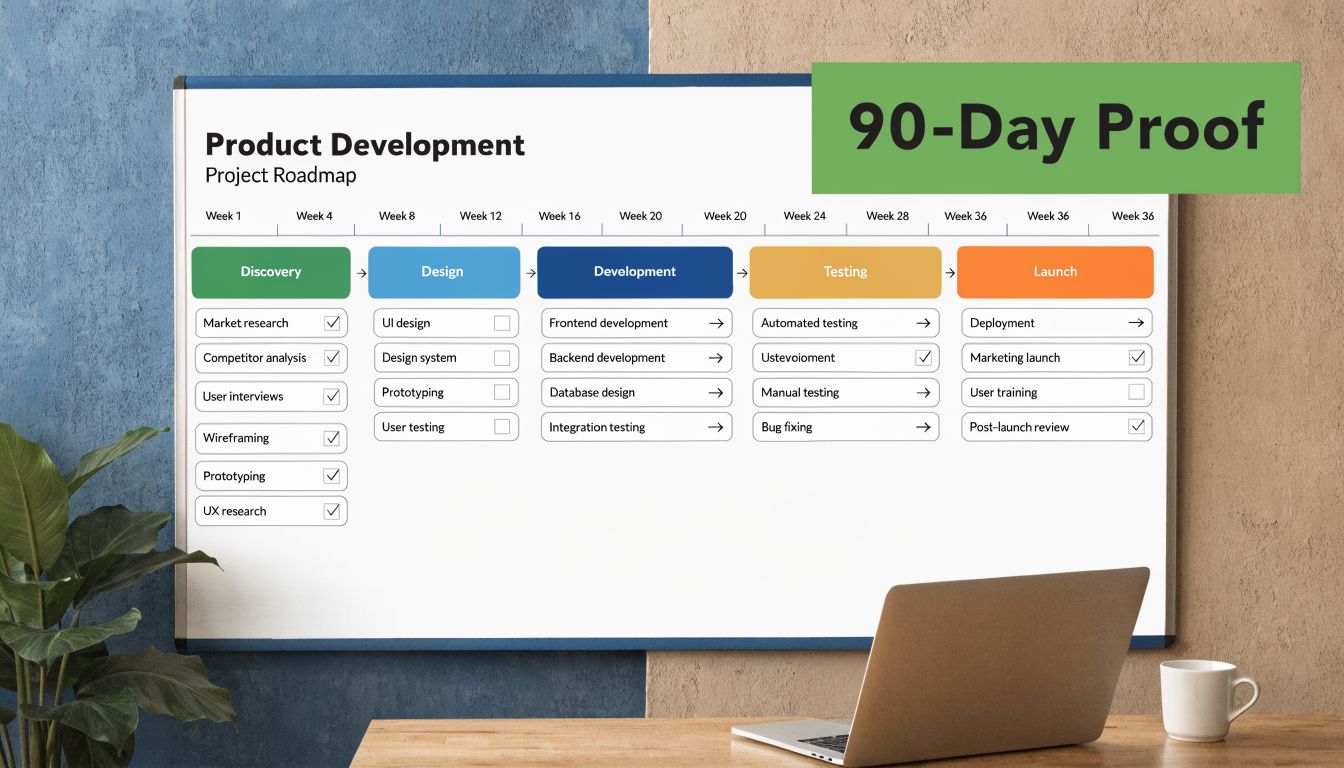
Days one through 30
The first month is about diagnosis and infrastructure.
For many firms, this starts with a deep review of goals, market position, offer clarity, current channels, sales process, and existing tech stack. If you're using a structured intake such as a detailed marketing review, hidden bottlenecks usually surface. Old forms may route nowhere. Leads may be untagged. Sales stages may not reflect reality. Website messaging may speak in company language instead of buyer language.
The early build often includes:
- CRM configuration: Pipeline stages, ownership rules, core automations, source tracking
- Tracking cleanup: Forms, calls, booking flows, and inquiry routing
- Message alignment: Sharpening the language used on site, in outreach, and in nurture sequences
- Baseline reporting: Establishing what will be measured weekly and monthly
Days 31 through 60
The second phase is controlled activation.
Initial campaigns begin running. That may include SEO-driven page improvements, core email workflows, reactivation sequences, landing page adjustments, content production, or a sales follow-up process tied to new lead sources.
What matters here is not volume for its own sake. It is signal quality.
One of the most useful technical measures is the MQL-to-SQL conversion rate. According to Netsuite's overview of marketing agency KPIs, for B2B manufacturers, a rate below 20% signals a systemic problem. In plain terms, marketing may be passing poor-fit leads, sales may be rejecting good ones, or the qualification model is flawed.
Engineering mindset: Don't judge the system by how much activity it produces. Judge it by whether the output is accepted by the next stage.
Days 61 through 90
By this point, the team should be able to see where friction lives.
Maybe the website is generating inquiries, but sales follow-up is slow. Maybe reactivation is producing conversations, but the offer needs refinement. Maybe organic traffic is improving, but lead forms ask the wrong questions. The purpose of the 90-day window is to identify those gaps early and tighten the machine.
A practical 90-day review should answer:
- Are leads being captured and routed correctly?
- Are the right prospects entering the pipeline?
- Is sales accepting and progressing those opportunities?
- Which workflows need simplification or retraining?
- What should be scaled next, and what should be cut?
What good early proof actually looks like
It doesn't have to mean dramatic results immediately. It should mean you now have control.
Signs of a good first 90 days include:
- Clearer visibility: You can trace inquiries from source to next action.
- Faster response discipline: Follow-up no longer depends on memory.
- Better qualification: Sales trusts the lead flow more than before.
- Documented process: Core actions are repeatable, not personality-driven.
That's the difference between activity and proof.
Seeing the System in Action Real World Examples
Abstract strategy is useful up to a point. Owners usually need to see what this looks like when the business is messy, busy, and short on internal bandwidth.
Here are two representative examples based on common field conditions.

Example one with a machine manufacturer
The diagnosis was straightforward. The company had a dated website, fragmented product messaging, and inconsistent lead follow-up. Sales relied heavily on memory and inbox search. Marketing activity existed, but there was no clean system connecting inbound interest to qualified pipeline.
The solution wasn't flashy. The team reworked the site structure around buyer questions, clarified service and capability pages, connected forms to the CRM, and built a lead nurture sequence inside GoHighLevel. Sales got a cleaner handoff process and a visible pipeline.
The transformation showed up in operational clarity first. Inquiries stopped disappearing. The team could see which messages generated better conversations. Sales spent less time reconstructing context before calls.
Example two with a local service business
This business had decent customer history but weak digital follow-through. Their Google Business Profile wasn't fully optimized, past customers weren't being re-engaged, and social activity had no real tie to booked work.
The solution centered on channel attribution and reactivation. The CRM was configured to track qualified leads from local search and social responses, then route them into follow-up workflows. An SMS and email reactivation sequence gave past customers a simple reason to re-engage.
For businesses like this, ROI proof can't stop at clicks or visibility. It has to connect channel activity to qualified leads and revenue inside the CRM, which aligns with ZenABM's point about tracking ROI for underserved audiences.
The strongest turnaround often comes from fixing what happens after interest appears, not just generating more attention at the top of the funnel.
What both examples have in common
Different industries. Same operating principle.
- Diagnosis came before tactics
- CRM became the control center
- Messaging matched buyer reality
- Follow-up was documented and automated where appropriate
- Success was measured through lead quality and progression, not vanity metrics
That's what a capable sales and marketing agency should bring. Not random activity. A working system.
Your Next Step from Overwhelmed to Optimized
If your current marketing feels scattered, that's not a small issue. It's usually a sign that your growth engine was never built as one system.
The good news is that this is fixable. You don't need every channel. You don't need more software for the sake of it. You don't need another round of disconnected campaigns.
You need a clear diagnosis, a documented process, the right infrastructure, and an agency partner that understands how sales and marketing should work together in practice.
Ask yourself these questions today
- Do we know exactly how a new lead moves from first touch to closed deal?
- Can we see where leads are coming from and whether sales accepts them?
- Are old leads and customers sitting idle in our database?
- Does our website help buyers act, or just describe our business?
- Are we buying activity, or building a repeatable system?
If those answers feel fuzzy, that's your next step. Not more guessing. Diagnosis.
A strong sales and marketing agency should help you simplify the machine, not complicate it. It should make your business easier to run by reducing dropped leads, tightening handoffs, and creating a growth process your team can sustain.
The shift from overwhelmed to optimized starts when you stop treating marketing as a set of isolated tasks and start treating it like an engineered system.
If you want help diagnosing where your sales and marketing system is breaking down, Machine Marketing can help you map the gaps, build the right infrastructure, and create a practical growth plan you can run. Book a discovery call and start with a clear diagnosis.