If your business feels invisible online, you're not just imagining it. It’s a common frustration, and the root cause is often a gap in your marketing system. So, what is the meaning of search marketing? It's the entire process you build to get found by customers who are actively looking for the solutions you offer.
The goal is to become the most visible, helpful answer at the exact moment a potential customer has a problem you can solve. In this article, we’ll diagnose the core components of search marketing and give you a clear, step-by-step process to build a system that drives measurable growth.
What Is Search Marketing and Why Does It Matter?

Think of search marketing as the bridge connecting a customer's question directly to your company's solution. Every time a prospect types a query into Google, they are signaling a specific need. Your job is to ensure your website shows up at the top, ready to meet that need.
This isn't about luck. It’s a structured approach to increasing visibility on search engines. For busy business owners—especially in B2B or manufacturing—this is your most powerful tool for generating leads. Why? Because you aren't interrupting people with ads they ignore. You're providing answers to prospects who are already raising their hands for help.
The Problem It Solves
The core problem search marketing fixes is digital invisibility. If potential customers can't find you when they search for a solution, you effectively don't exist in their buying process. This leads directly to a weak sales pipeline, unpredictable lead flow, and leaving revenue on the table.
A well-engineered search marketing strategy transforms your website from a passive digital brochure into a proactive, 24/7 lead generation engine. This system works tirelessly in the background to attract, engage, and convert your ideal customers.
The Bottom Line: Search marketing isn't just another expense; it’s a high-return investment. It positions your business as the go-to authority, making you the obvious choice for qualified buyers.
The Power of Search in Numbers
Why does this matter so much? The financial impact is undeniable. It's a multi-billion-dollar powerhouse for a simple reason: it works. By 2026, U.S. paid search spending alone is projected to blast past $130 billion, with search advertising dominating over 40% of the entire digital ad market.
This massive investment is driven by a powerful return. With an average ROI of 200% ($2 earned for every $1 spent), it's a critical system for generating qualified leads and measurable business growth. As reported by platforms like Salesforce, these numbers consistently prove the value of meeting customers where they are.
What Does Search Marketing Include?
So, what are the actual components? Search marketing is an umbrella term covering two primary disciplines. To build a complete strategy, you must understand both. Let's diagnose each one.
Search Marketing at a Glance
| Component | What It Is | Primary Goal | Time to Results |
|---|---|---|---|
| SEO (Organic Search) | Earning unpaid rankings on search engines through optimization and valuable content. | Build long-term authority and a sustainable source of "free" traffic. | Months to a year or more. |
| SEM (Paid Search) | Paying for ad placements at the top of search results pages (e.g., Google Ads). | Drive immediate, targeted traffic and leads for specific keywords. | Days to weeks. |
These two pillars—one for long-term growth and one for immediate impact—create a powerful, comprehensive system. Let's break them down.
Search Engine Optimization (SEO): This is the craft of earning visibility in the organic (unpaid) search results. It involves a deep process of optimizing your website and creating content that search engines see as credible, relevant, and authoritative. To start building this long-term asset, you need to know how to increase your organic traffic.
Paid Search / Search Engine Marketing (SEM): This is where you pay for advertisements, like Google Ads, that appear at the top of search results. It provides instant visibility and is incredibly effective for targeting specific keywords, locations, and customer profiles.
When used together, you get the best of both worlds. You gain immediate traction and leads from paid ads while simultaneously building a durable, long-term foundation with SEO that will pay dividends for years.
The Two Pillars: SEO and Paid Search
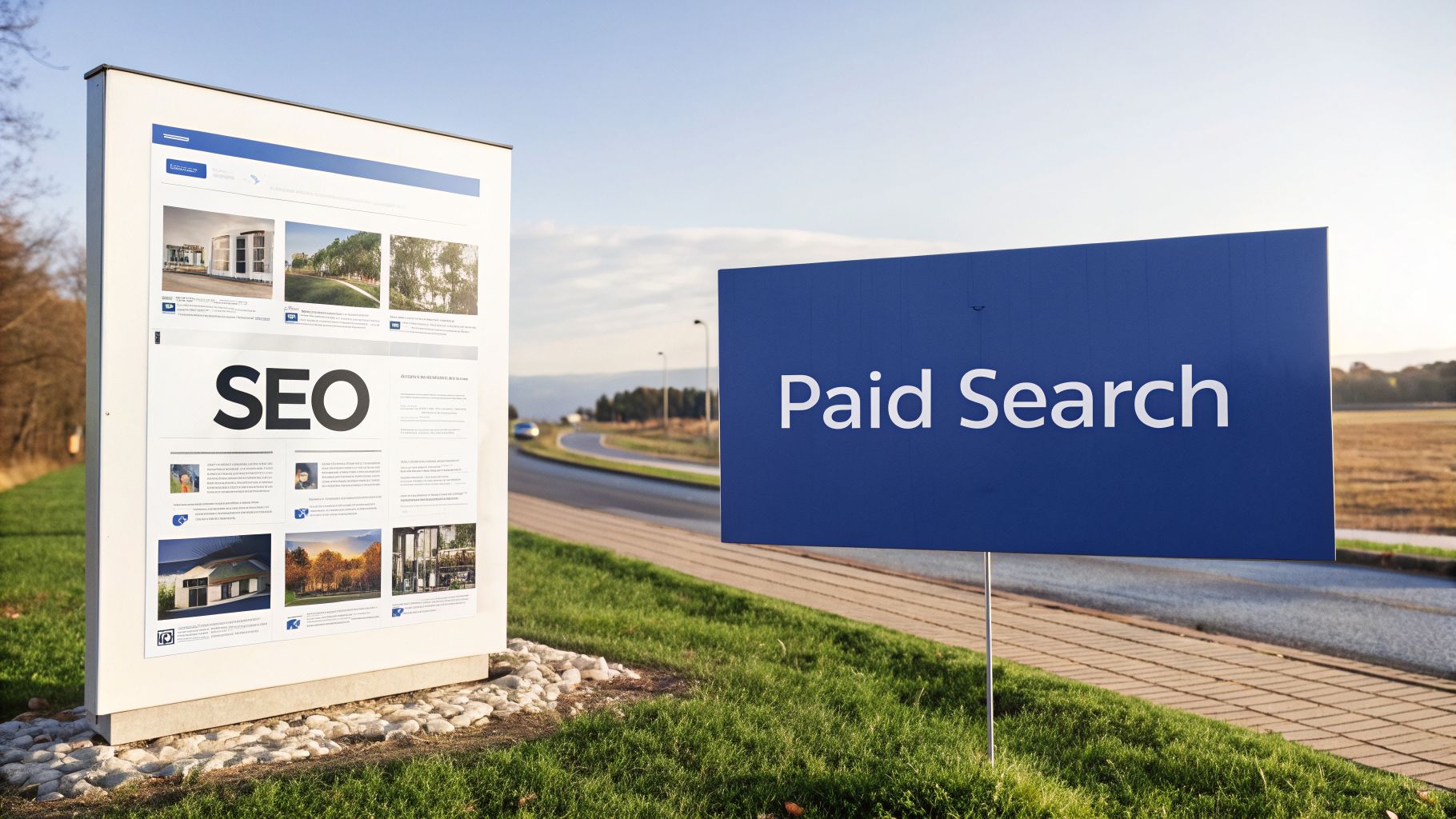
Search marketing isn't a single tactic. It's a strategic approach built on two powerful, complementary pillars. For any business owner looking to invest their budget wisely, understanding how each works—and when to deploy it—is the first critical step.
Think of it this way: you have two engines you can fire up. One is designed for long-term, sustainable growth, and the other delivers immediate, targeted impact. These engines are Search Engine Optimization (SEO) and Paid Search (often called SEM).
Once you grasp the search marketing meaning as a system built on these two pillars, you can stop guessing and start building a predictable machine for generating leads. Let's diagnose each one from an engineering perspective.
The First Pillar: Search Engine Optimization (SEO)
What exactly is SEO? At its core, SEO is the process of earning visibility in the unpaid, organic search results on platforms like Google. It’s the long-game strategy, focused on building your website into the most credible, authoritative, and helpful resource for the problems your ideal customers are trying to solve.
Imagine your website is a piece of digital real estate. SEO is the work you put in to develop that property—building a solid foundation, adding valuable structures, and methodically improving its reputation. It doesn't deliver overnight results, but the value it creates is durable. Over time, it generates a steady stream of "free" traffic from highly motivated prospects.
The SEO Transformation: A consistent SEO effort turns your website from a simple online brochure into a valuable business asset that works for you 24/7, attracting qualified leads without you paying for every single click.
Key activities in a serious SEO strategy always include:
- Technical Optimization: Ensuring your site is fast, secure, and easy for search engines to crawl. For a deeper dive, explore our guide to technical content SEO.
- Content Creation: Publishing high-quality articles, guides, and resources that directly answer your customer's most pressing questions.
- On-Page SEO: Optimizing individual page elements like titles, headings, and images to signal relevance to search engines.
- Off-Page SEO: Building authority through backlinks from other reputable websites, which act as powerful votes of confidence in your expertise.
The Second Pillar: Paid Search (SEM)
What about Paid Search? This is your on-demand approach to visibility. It involves paying for ad placements that appear right at the top of search engine results pages (SERPs), usually marked with "Sponsored" or "Ad." The most common platform here is Google Ads.
If SEO is owning your digital real estate, then paid search is like renting a high-visibility billboard on the busiest digital highway. You pay for placement, and your message is instantly seen. The moment you turn off the budget, the billboard comes down. It's incredibly effective for getting immediate traffic, validating new offers, and targeting specific keywords or demographics.
Key benefits of a Paid Search strategy include:
- Speed: You can launch a campaign and start seeing traffic—and leads—within hours, not months.
- Control: You have precise, granular control over your budget, the exact keywords you target, and the audience you want to reach.
- Testing: It allows you to quickly A/B test messaging and landing pages to see what converts best before committing those insights to your long-term SEO efforts.
The real power emerges when you stop seeing these two pillars as an "either/or" choice. Instead, view them as a connected system. The data from paid search shows which keywords convert into customers, giving you a proven roadmap for your long-term SEO content strategy.
Connecting Search Intent to Your Customer Journey
Great search marketing isn't about throwing money at ads and hoping for the best. It's about understanding the 'why' behind every search. To make it work, you have to connect your strategy to search intent—the real reason a person is typing something into Google.
Think of it as a conversation that's already happening. A potential customer has a question, and your job is to show up with the perfect answer, right when they need it. When you get this right, you become the trusted guide they need to solve their problem.
Diagnosing the Stages of Search Intent
Every buyer follows a predictable path. We can map this journey by breaking search intent into three main stages. For any business, especially in B2B, matching your content to these stages is what turns a simple website into a lead generation machine.
Here's a look at each stage.
Informational Intent (The "What Is" Stage): Your potential customer is in research mode. They're looking for answers and education, not a sales pitch. They’re trying to understand a problem or a new concept.
- Example Queries: "what is a CNC machine," "how does industrial automation work," "benefits of a CRM for small business"
Commercial Intent (The "Which Is Best" Stage): Now, they understand the problem and are actively comparing options. They’re weighing different brands, features, and solutions to see which one fits their needs.
- Example Queries: "best CNC machine for small shops," "[Brand A] vs [Brand B] CRM comparison," "top 5-axis milling machine reviews"
Transactional Intent (The "I Want To" Stage): This is the finish line. The person has made a decision and is ready to act. They want to buy, get a quote, or book a demo. Their searches become very specific and signal they're ready to convert.
- Example Queries: "buy [Brand] CNC machine," "get a quote for custom metal fabrication," "[Your Company Name] pricing"
Before you can target these stages, you need to know your audience inside and out. Techniques like data-driven niche identification on YouTube can uncover what people are actually searching for, giving you a goldmine of insights for your content strategy.
Aligning Your Content for Maximum Impact
Once you know the intent, the next step is straightforward: create content that provides the perfect answer. This is how you build a system that captures interest at every stage of the buying journey.
The goal isn't just to be found; it's to be the most helpful resource at each step, building trust that naturally leads to a sale.
Here’s how to map your content directly to what people are looking for:
- For Informational Queries: Build authority with educational blog posts, comprehensive guides, and "how-to" articles. A manufacturer could publish a post like, "A Business Owner's Guide to Industrial Robotics." These assets attract top-of-funnel traffic and establish your expertise.
- For Commercial Queries: Help buyers make a decision with comparison guides, detailed case studies, and product reviews. A software company might create a checklist titled, "Choosing the Right ERP System for Your Manufacturing Plant."
- For Transactional Queries: Your service pages, product pages, and contact forms must be flawless. Ensure they have crystal-clear calls to action, pricing details (if applicable), and a simple way for them to get in touch.
When you nail this alignment, the results speak for themselves. Paid search, on average, delivers a stunning 200% ROI—that's $2 back for every $1 spent. For 49% of small businesses, organic search brings in the best return, especially when supported by blogs that can boost rankings by a massive 434%.
With average conversion rates for search ads hitting 7.04%, aligning your strategy with user intent is the key to capturing these qualified leads efficiently. You can read more on these digital marketing statistics to see the full picture.
How to Build Your Search Marketing System
Knowing the theory is one thing. Building a repeatable system that generates leads is something else entirely. If you feel stuck, it’s almost always because there isn't a clear, step-by-step process in place. A strong search marketing system doesn’t run on guesswork; it’s engineered from the ground up with diagnosis, a structured setup, and constant measurement.
This is your roadmap. We'll walk through the foundational steps to take you from feeling invisible online to having a clear, scalable process for attracting and converting leads through search.
Step 1: Diagnose Your Position
Before you build anything, you need a blueprint. This first step is all about asking the right questions to figure out where you stand and where your biggest opportunities are. Rushing past this is like pouring a foundation without surveying the land—it’s guaranteed to cause problems.
Start by getting clear answers to these diagnostic questions:
- Who is your ideal customer? Get specific. What industry are they in? What’s their job title? What are the real-world pain points your solution solves?
- What problems do you solve? Frame this from the customer's point of view. They aren't searching for your product name; they're searching for solutions.
- Who are your digital competitors? Go to Google and search for your target terms. The companies that show up are your digital competitors, and they might be different from your direct business rivals.
This initial diagnosis gives you the raw material for your entire strategy. It defines your targets, sharpens your message, and shows you exactly what you’re up against.
Step 2: Lay the Technical Foundation
With your diagnosis done, it’s time to set up the tools that will measure everything. Without data, you’re flying blind. These free tools from Google are non-negotiable for any serious search marketing effort.
Your foundational setup must include these three:
- Google Search Console: This is your direct line to Google. It tells you which keywords are driving clicks, flags technical errors, and gives you a report card on your site's health in Google's eyes.
- Google Analytics 4 (GA4): Think of this as your user behavior dashboard. It shows you where traffic comes from, what pages people care about, and how they move through your site on their way to becoming a lead.
- Google Business Profile (GBP): For any business with a physical location or service area, this is absolutely critical. An optimized Google Business Profile is often the first thing a local customer sees in Google Search and Maps.
Getting these set up correctly from the start ensures that every piece of data is captured. You’ll need it to measure what’s working and, more importantly, what isn’t.
Step 3: Conduct Initial Keyword and Content Research
Now we connect your customer’s problems to the actual words they type into a search engine. This is where you identify the core keywords that will guide both your content and your paid ad campaigns.
Think back to the three stages of search intent we covered: informational, commercial, and transactional. This is how you should map your content strategy to that journey.
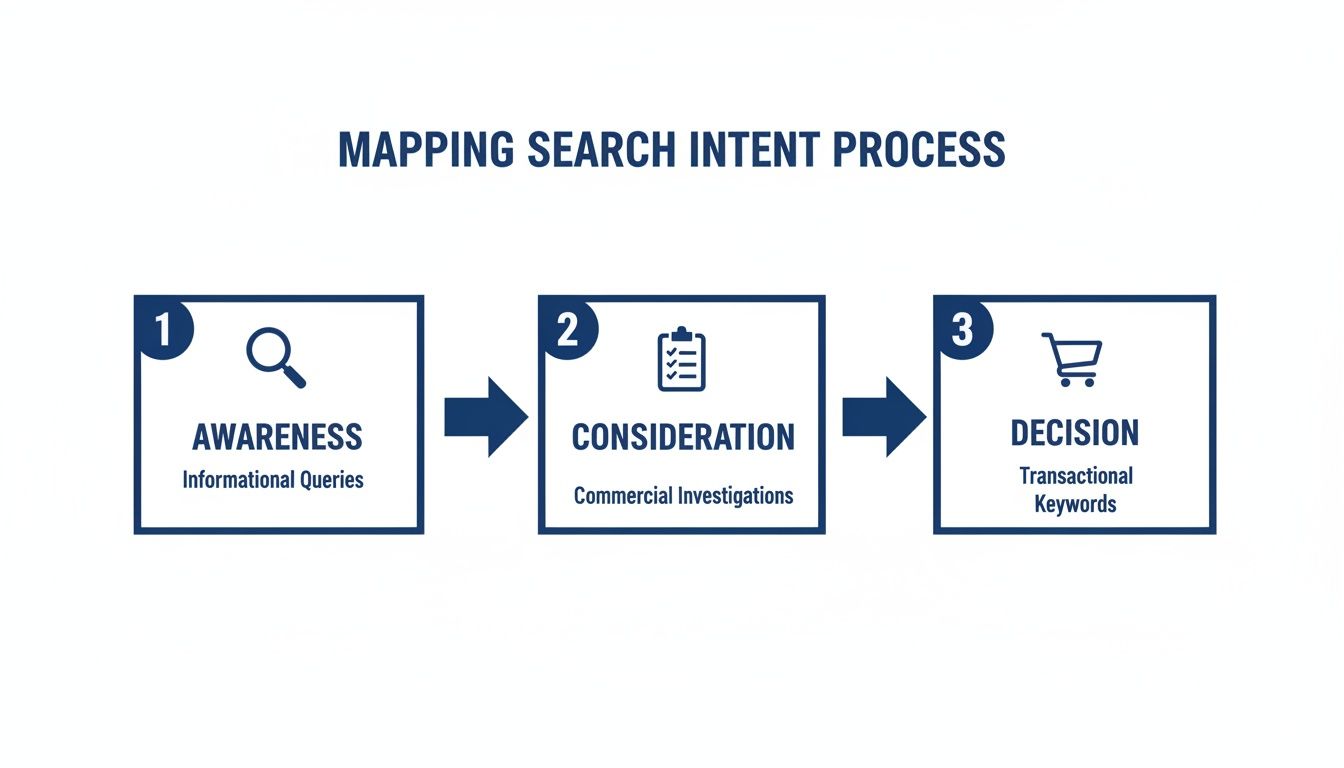
Following this process ensures you create content that meets your audience exactly where they are, guiding them from initial curiosity to a final decision. Your goal is to build a list of target topics and keywords for each stage. Use this list to plan out your blog posts, build your service pages, and inform the structure of your website.
Key Takeaway: Your keyword strategy is your content roadmap. It should directly reflect the customer problems you diagnosed in Step 1, ensuring every piece of content you create has a clear purpose and audience.
Step 4: Integrate with a CRM System
Finally, all the hard work you put into attracting visitors is wasted if you don’t have a system to capture, nurture, and track every lead. This is where a Customer Relationship Management (CRM) platform becomes essential.
Integrating your website with a CRM like GoHighLevel ensures no lead ever falls through the cracks.
When a visitor fills out a form on your site, the CRM should automatically:
- Create a new contact record.
- Notify your sales team instantly.
- Trigger a follow-up email sequence to begin nurturing the relationship.
This simple integration closes the loop between marketing and sales, turning your website traffic into measurable revenue. It transforms your marketing from a cost center into a predictable growth engine.
How AI Is Changing the Future of Search
The ground is shifting in the world of search, and artificial intelligence is the force moving everything. As a business owner, you’re probably asking two big questions: “Is my website traffic about to disappear?” and “Do I have to throw out my entire search marketing strategy?”
The short answer is that while things are changing, this isn't a time for panic—it's a time to adapt. The core of search marketing hasn't changed. It’s still about connecting with your customers when they need you. What is changing is how we make that connection.
To get a handle on this, you first need to understand the main goal of generative AI. Its purpose is to take complex questions and provide a single, direct answer. This is exactly what’s happening with features like Google’s AI Overviews, which try to end the user's search right on the results page.
The Rise of the Zero-Click Search
This push for direct answers has given rise to the "zero-click search." Before, a user would search, scan a list of blue links, and click to find what they needed. Now, an AI-powered summary often gives them the answer without them ever having to leave Google.
Don't underestimate this change. AI search traffic has exploded by 527% year-over-year. As AI summaries get better at answering questions on the spot, some analysts predict that over 60% of all searches might eventually result in zero clicks to any website.
But this isn't a death sentence for your website. It’s a realignment. In fact, 70% of businesses report a higher ROI when they weave AI into their SEO, and 92% of marketers are already optimizing for both AI and traditional search. Adapting isn’t just about survival—it’s about finding a smarter way to win.
How to Adapt Your Strategy for an AI World
So, if AI is the one giving the answers, how do you make sure your business is the one being quoted? The game is no longer about just ranking for a keyword. It’s about becoming the undisputed authority behind the AI’s answer.
You need to create content so clear, expert-driven, and well-organized that AI systems have no choice but to use you as a source.
Here’s how to start adapting your approach today:
- Build Topical Authority: Stop chasing single keywords. Instead, build out clusters of content that cover a core topic from every possible angle. Your goal is to answer every question a potential customer could have on that subject.
- Double Down on E-E-A-T: Google’s guidelines for Experience, Expertise, Authoritativeness, and Trustworthiness are now your bible. You have to prove you’re a reliable source with author bios, real-world case studies, and credible citations.
- Optimize for How People Talk: Users are asking AI longer, more conversational questions. Focus on long-tail keywords that sound like a real person asking for help (e.g., “what are the best durable flooring options for a high-traffic machine shop?”).
- Structure Your Content for Machines: An AI doesn't read; it parses data. Use clean H2/H3 headings, bullet points, and lists to break your content into logical chunks. A well-structured page is a key part of any modern marketing technology stack.
The New Reality: In the age of AI search, you win by becoming an essential source of truth. The goal isn’t just getting the click anymore. It’s about getting your brand featured and cited in the AI-generated answer, cementing your position as the expert.
By making these adjustments, you're not fighting against AI. You're playing by the new rules to get ahead. This puts your business in a position to not just survive the next wave of change, but to lead the pack.
Where to Go From Here: Your First Steps in Search Marketing
Knowing the meaning of search marketing is one thing. Putting it to work to generate revenue is the real goal. You now have the framework: a powerful system resting on two pillars—long-term SEO and immediate paid search—that must align with how your customers think and buy.
So, what should you do right now?
We want to give you clarity and confidence, not a confusing to-do list. We’ve boiled it down to three direct actions you can take this week. Think of it as your initial diagnostic—a quick test to see where you stand and get momentum.
Start Your 3-Step Diagnostic
Before you can move forward, you need a clear picture of your starting point. This simple process will give you that baseline and instantly reveal your most obvious opportunities.
Run a Brand Search: Open a private browser window and Google your company’s name. Do you own the entire first page? Your website needs to be #1, followed by your Google Business Profile and your main social media accounts. If competitors or negative results show up, that’s your first fire to put out.
Search Your #1 Problem: Think about the single biggest problem your product or service solves. Now, search for it exactly as a customer would (e.g., “how to reduce scrap in metal stamping” or “find a reliable CNC machine shop”). Are you on the first page? If not, you’re invisible to customers when they need you most.
Audit Your Top Service Page: Go to the most important product or service page on your website. Does the headline clearly state the solution you provide? Is there an unmissable call to action, like a "Request a Quote" button, right at the top? If a visitor has to hunt for what to do next, you're losing leads.
This quick audit isn't about passing a test. It’s about identifying the biggest gaps in your current approach. A ‘no’ to any of these questions points directly to a high-priority fix.
Build Your Scalable Lead System
Finding these gaps is just the first move. The next step is building a system that patches them for good and creates a predictable flow of leads for your business. This is how you shift from being reactive to taking control of your own growth.
A real search marketing system connects your marketing spend directly to your sales pipeline. It ensures every visitor you attract with SEO or paid ads is captured, nurtured, and tracked, turning online visibility into measurable revenue.
Ready to stop guessing and start building a real system? The next move is a personalized diagnosis of your entire marketing and sales process. We can help you draw the map for a scalable lead generation engine that fits your specific business goals.
Book a discovery call with us today to get started.
Frequently Asked Questions About Search Marketing
Once you understand the basics of search marketing, the real questions start to surface. Business owners want to know how this applies on the ground, to their operations. We get it. We hear the same practical questions all the time, so let's get straight to the answers.
How Long Does It Take to See Results from Search Marketing?
This is always the first question, and for good reason. The answer comes down to which pillar of search marketing you’re focused on, because the timelines for paid search and organic SEO are completely different.
- Paid Search (SEM): With a platform like Google Ads, results can be almost immediate. You can have ads live and driving traffic within hours of launching a campaign. It’s the fastest way to get in front of potential buyers.
- Organic SEO: This is a long-term investment in building a valuable digital asset for your company. You can expect to see significant, sustainable results within 4 to 12 months. Think of SEO as planting a tree; it requires consistent care, but the payoff is a durable, long-lasting source of high-quality leads.
A smart strategy uses both. Paid search delivers quick wins and invaluable data, while your SEO efforts build the foundation for cost-effective growth down the road.
Is Search Marketing Expensive for a Small Business?
It doesn't have to be. One of the best things about search marketing is that the cost is entirely flexible and scales with your budget and goals. You have complete control.
You can kick off a paid search campaign with a modest daily budget and expand as you prove the ROI. The key is to get specific. Focus on long-tail keywords—those longer, more descriptive search phrases—where competition is lower and the buyer’s intent is much higher.
For organic SEO, the primary investment is often time, especially if you have the expertise to create valuable content yourself. For most businesses, a balanced approach is most efficient: run a targeted paid campaign for immediate leads while you steadily build your long-term SEO authority.
Our Recommendation: Start small and prove the model. Pick a specific service or product line, generate a positive ROI, and then reinvest those profits to scale your efforts. This approach minimizes risk and builds powerful momentum.
Can I Do Search Marketing Myself or Do I Need an Agency?
You can absolutely get started on your own, and we encourage it. Foundational tasks like setting up your Google Business Profile and writing articles on topics you know inside and out are fantastic first steps. Being hands-on is a great way to learn.
However, the world of search marketing is incredibly complex and changes constantly. Partnering with an expert gives you instant access to specialized tools, years of hard-won experience, and a proven system for getting results. An agency helps you sidestep common, costly mistakes, accelerate your growth, and frees you up to do what you do best—run your business.
The right first step is to assess where your biggest opportunities lie. Once you know that, you can decide if a partnership makes sense to help you capture them.
Ready to move beyond definitions and start building a system that generates real revenue? Machine Marketing specializes in creating scalable lead generation engines for B2B businesses. We'll diagnose your current system, identify your biggest growth levers, and build a clear roadmap for success.
Book your discovery call with us today to see how we can help.