If your manufacturing website isn't generating qualified leads, you're not alone. We see this all the time—and the root cause is often a disconnect between your on-the-floor expertise and how buyers find solutions online. In this guide, we’ll show you how to diagnose the gaps in your digital system and share the exact steps to turn your website into a predictable lead-generation engine.
This is about translating your real-world technical capabilities into digital authority. It’s how you get found for the specific problems you solve, whether that’s "5-axis CNC machining" or "AS9100 certified fabrication."
Why Your Website Isn't Generating Qualified Leads

Does your website feel more like a cost center than a sales tool? You have world-class capabilities on the shop floor, but online, you're practically invisible. The problem isn't your expertise; it's how you communicate it.
This disconnect typically shows up in a few familiar ways:
- Low Website Traffic: Your visitor count is flat, and you rarely see new users discovering your site through a Google search.
- Irrelevant Inquiries: The few contact forms you do get are from hobbyists or companies that are a terrible fit, wasting your sales team’s valuable time.
- Losing Ground to Competitors: You've noticed competitors—even smaller shops—showing up for valuable search terms while your site is buried on page two or three.
Diagnosis: What's the Core Problem?
The core issue is a failure to communicate your expertise in a way that search engines—and more importantly, your ideal customers—can understand. A smart SEO strategy is one of the most effective industrial marketing strategies to fuel your success because it directly bridges this gap.
Question to ask yourself:
Are we targeting the specific, technical search terms our buyers use? Or are we using broad, generic language that gets lost in the noise?
For example, a potential customer isn't just searching for "metal parts." They're searching for "precision metal CNC machining for the aerospace industry." Optimizing for the latter is what brings qualified, high-value leads to your door.
The Transformation: What's the Opportunity Cost of Inaction?
Ignoring SEO isn't an option anymore. When manufacturing companies get this right, the results are transformative. One control solutions provider, Shini USA, saw a 632% increase in monthly traffic from search engines and a 129% jump in online leads after implementing a focused SEO plan.
With 84% of B2B buyers starting their purchasing journey online, being absent from search results means you're handing business to your competitors. Without a system to capture this intent, you are letting your most valuable prospects walk away.
Laying a Rock-Solid Technical SEO Foundation
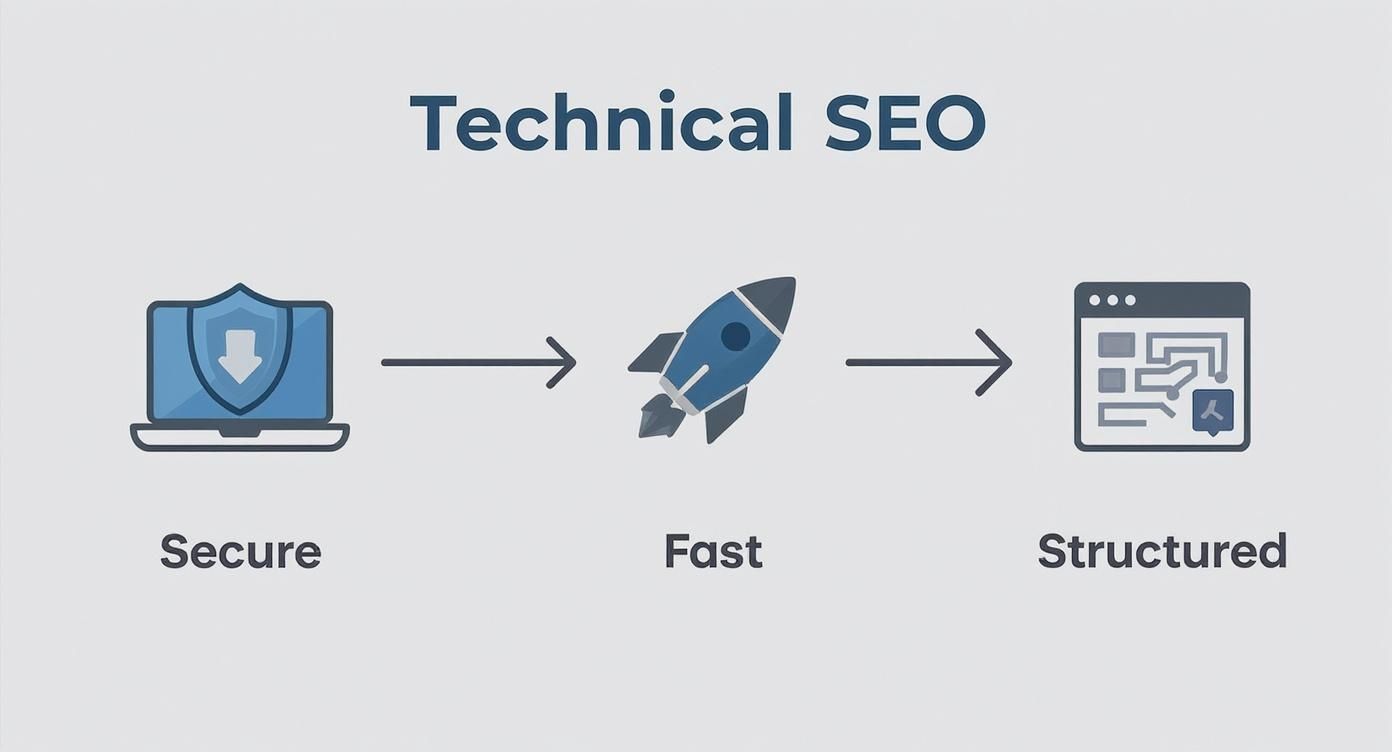
Before you can build content, you need a solid foundation. Think of technical SEO as optimizing your digital shop floor—it makes everything run smoother and more efficiently.
If your site is slow, clunky, or insecure, those busy engineers and buyers you're trying to attract will leave. They'll click away in a heartbeat, and Google will notice. This isn't about gaming algorithms; it's about creating a seamless user experience that builds instant trust.
Your Technical SEO Diagnostic Checklist
From an engineering perspective, every system needs a solid foundation. For your website, that foundation is built on these non-negotiable technical elements. It's time for a quick diagnostic.
- Is Your Site Secure with HTTPS? Look at your site's address bar. Do you see a padlock icon and "https://"? If not, your site is being flagged as "not secure"—a massive red flag for visitors and a deal-breaker for Google.
- How Fast Does It Load? A one-second delay in page speed can cut conversions by 7%. Use a free tool like Google's PageSpeed Insights to get a score. A slow site torpedoes your ability to rank.
- Is It Mobile-Friendly? More than half of all web traffic now comes from mobile devices. Because of this, Google uses mobile-first indexing, meaning your site’s performance on a phone is more important for ranking than how it looks on a desktop.
The Solution: Implementing Essential Fixes
Once you've spotted the gaps, it's time to implement the solution. These aren't just "nice-to-haves"—they are mission-critical fixes that enable all your other SEO efforts to work.
Schema Markup: The Language of Search Engines
Schema markup is specialized code you add to your website to help search engines understand your content. For a manufacturing company, this is a game-changer.
Think of it like this: Without schema, Google sees "AISI 304 Stainless Steel." With schema, you can tell Google, "This is a product, its material is AISI 304 Stainless Steel, and here are its material properties and food-grade certifications."
This clarity helps you earn more detailed search results, called rich snippets, which can show certifications or key specs right on the results page, making you stand out.
XML Sitemaps and Crawlability
An XML sitemap is a detailed map of your website that you hand directly to Google. It lists all your important pages, making it easy for search engine crawlers to discover and index your technical product and capability pages. A clean, updated sitemap is non-negotiable.
Fixing Broken Links and Redirects
Broken links (404 errors) are dead ends for visitors and search engine crawlers. They signal that your site is poorly maintained. Regularly running a site crawl with a tool like Screaming Frog helps you find and fix these issues. Think of it as clearing debris from your production line.
Uncovering the Keywords Industrial Buyers Actually Use
Generic keywords like “metal fabrication” attract generic, low-quality traffic. To get in front of real decision-makers like engineers and procurement managers, you have to speak their language.
This is where the real work of SEO for manufacturing companies begins. It’s not a guessing game; it’s a diagnostic process.
Effective keyword research decodes intent. A search for "injection molding" could be a student. But a search for “custom PEEK injection molding for medical devices”? That’s almost certainly a qualified buyer with a specific, high-value problem to solve.
Diagnosis: Think Like Your Buyer
Before you open a keyword tool, ask yourself these questions to diagnose your current approach. The answers will become the bedrock of your entire digital strategy.
- What to look for in Materials? What specific materials do you specialize in? (e.g.,
6061 aluminum,AISI 316 stainless steel) - What to look for in Processes? What are your core processes? (e.g.,
5-axis CNC milling,wire EDM services) - What to look for in Compliance? What standards can you meet? (e.g.,
AS9100 certified,ITAR registered) - What to look for in Applications? What are your niche industries? (e.g.,
custom parts for aerospace,components for food processing equipment)
This diagnosis helps you build a vocabulary that mirrors how your ideal customers search for solutions.
This process ensures that when a potential buyer lands on your site from a specific search, their experience is seamless and reinforces your credibility.
The Solution: From Broad Concepts to High-Intent Keywords
Once you’ve defined your core vocabulary, the next step is combining these terms into long-tail keywords. These longer, more specific phrases signal true commercial intent.
This precision is critical. By 2025, over 70% of industrial buyers are expected to start their purchasing journey on a search engine. Manufacturers who master intent-driven keywords will see far better conversion rates.
Key Takeaway: The goal isn't just to rank for keywords. It's to rank for the right keywords that attract buyers who are ready to have a conversation.
Let's look at an example. A company specializing in high-tolerance machining for aerospace gets little value from "machining services." Instead, their strategy should focus on clusters of specific terms. You can find more on this in our guide to SEO content writing.
This table shows exactly how that shift in thinking plays out.
Keyword Intent for Manufacturing Buyers
| Low-Intent Generic Keyword | High-Intent Specific Keyword | Who Is Searching? |
|---|---|---|
| "cnc machining" | "AS9100 certified 5-axis titanium machining" | An aerospace engineer with a specific component design. |
| "plastic molding" | "ISO 13485 medical grade silicone injection molding" | A medical device procurement manager sourcing a new supplier. |
| "sheet metal" | "high-volume stainless steel enclosure fabrication" | An OEM project manager looking for a production partner. |
| "welding services" | "NADCAP certified TIG welding for inconel" | A defense contractor needing a compliant welding service. |
See the difference? The high-intent keywords immediately filter out the noise.
Organize your keyword list into logical clusters:
- Process + Material: "5-axis CNC machining titanium," "high-speed aluminum milling services"
- Standard + Application: "AS9100 certified aerospace parts," "ITAR compliant machining"
- Problem + Solution: "complex geometry machining for satellites," "tight tolerance manufacturing"
The Transformation: Building a Keyword Blueprint
Each keyword cluster should map directly to a specific capability you offer. This creates a blueprint that guides your entire content strategy, from service pages to technical blog posts. This systematic approach ensures every piece of content you create is engineered to attract, engage, and convert a specific segment of your target audience.
Creating Content That Builds Trust with Technical Buyers

Let’s be direct: your audience—engineers, procurement managers, and technical buyers—is allergic to marketing fluff. They don't want vague promises. They need hard data and detailed technical specifications.
The goal is to transform your website from a digital brochure into an indispensable technical resource. When you provide the nitty-gritty details your buyers need, you build trust and showcase your expertise long before they pick up the phone.
This requires a shift in mindset. Move away from sales-focused copy and toward educational, solution-oriented information that answers their questions and validates your expertise.
Beyond the Homepage: The Content Your Buyers Actually Need
Every page on your website is an opportunity to rank for a specific, high-intent query. An effective content strategy for a manufacturer must include several core components, each engineered for a different stage of the buyer's journey.
Detailed Capability and Service Pages
Think of these pages as your digital shop floor. For each capability—like "5-axis CNC machining"—your page should be a comprehensive guide.
- Explain the Process: Briefly break down the technology. What makes your approach unique? What are your tolerances? Get specific.
- List Materials: Clearly state the materials you work with (e.g., aluminum, titanium, Inconel, PEEK). This is crucial for ranking.
- Showcase Applications: Show real examples of parts you've made for aerospace, medical, or automotive clients.
- Include High-Quality Visuals: Use sharp photos and videos of your machines running and the finished parts.
Key Insight: A well-optimized service page doesn't just sell a service; it educates the buyer on the technical nuances, positioning you as an expert. This is a core principle of a successful technical content SEO strategy that drives conversions.
Answering Specific Questions with Niche Content
Once your core capability pages are solid, build authority by creating content that answers highly specific questions. This captures valuable long-tail keyword traffic from buyers deep in their research.
Material-Specific Guides
Create dedicated pages for the materials you specialize in. For example, a guide to "Machining 6061 vs. 7075 Aluminum" can attract engineers weighing their options. These guides should cover material properties, applications, and your capabilities.
Industry Application Spotlights
Develop case studies or detailed pages for the industries you serve. A page on "AS9100 Certified Machining for Aerospace" speaks directly to a buyer's non-negotiable compliance needs. This content should highlight your experience and relevant project examples.
Turning Visitors into Leads with Downloadable Resources
Technical buyers value tangible, useful information. Offering downloadable resources in exchange for an email address is a powerful way to generate qualified leads.
These resources should provide immediate value and showcase your technical knowledge.
- Spec Sheets & Data Sheets: Offer detailed specifications for materials or processes.
- CAD Files: Provide downloadable files for common components.
- Design Guides: Create a practical guide on "Design for Manufacturability (DFM)" for a process you offer.
- Checklists: A "Supplier Vetting Checklist for Aerospace Components" is an invaluable tool for a busy procurement manager.
This approach positions your company as a generous, helpful authority. When an engineer downloads your DFM guide, you become a trusted advisor, not just another supplier.
Building Authority with Links and Local Signals
Content and technical fixes get you in the game, but authority wins it. In SEO, authority is a measure of trust. Google measures this trust through backlinks—links from other reputable sites pointing to yours.
Think of them as digital referrals. When a major industry publication links to one of your technical articles, they're vouching for your expertise. That’s a powerful signal to Google that you belong at the top of the search results.
Earning the Links That Actually Matter
Forget about shady link-buying schemes. The path to valuable links is through genuine relationship-building and creating content that others want to reference.
Here are a few strategies that consistently work for manufacturing companies:
- Trade & Industry Associations: Make sure your member directory profile is complete with a link back to your site. Many also look for guest articles for their blog or newsletter.
- Supplier & Distributor Networks: Get listed where your buyers are already looking. Platforms like Thomasnet or GlobalSpec's Engineering360 are packed with engineers and procurement managers.
- Contribute to Trade Pubs: Pitch an article that solves a common engineering problem to online journals and industry magazines. Your author bio is prime real estate for a link.
- Tap Your Partners & Distributors: Ask your partners to add a link to your site on their partners page. It’s a simple, mutually beneficial win.
One high-quality link from a respected source like Manufacturing.net carries more weight than a hundred links from generic blogs. Quality always beats quantity.
Don't Forget Your Own Backyard: The Power of Local SEO
Even if you ship globally, a surprising amount of business comes from your region. Local SEO ensures that when a buyer in your area searches for a solution you provide, you are the first one they see.
A purchasing manager looking for "custom injection molding in Chicago" is often doing so for logistical reasons. You have to be visible in those moments. The foundation of local search is your Google Business Profile (GBP).
Turning Your Google Business Profile into a Lead Gen Machine
A neglected GBP is a massive missed opportunity. Run through this checklist to get yours dialed in.
- Claim & Verify It: First, go claim your listing to prove ownership and gain control.
- Get Your Categories Right: Be specific. Use categories like "Machine Shop" and "Metal Fabricator," not just "Manufacturer." Add every category that applies.
- Fill Out Everything: Don't skip a single field. Add service areas, hours, phone number, and a detailed, keyword-rich business description.
- Show, Don't Just Tell: Upload high-quality photos and videos of your facility, your machines running, your team, and your finished products.
- Get Reviews (and Respond to Them): Positive reviews are a huge trust signal. Ask satisfied customers for a review and respond professionally to every single one—good or bad.
This two-pronged attack—building broad industry authority with backlinks while cementing your local dominance—ensures you're found by the right buyers, wherever they are.
Measuring SEO Performance That Ties to Revenue
You can't improve what you don't measure. The most critical piece of any SEO system is a dashboard that connects your marketing efforts directly to your bottom line.
For manufacturers, clicks and impressions are nice, but they don't pay the bills. The real questions are: How many qualified leads did we get from search? Which keywords are driving RFQ submissions? How many of those leads became customers?
Moving Beyond Vanity Metrics
First, let's diagnose your current tracking. If your reports are filled with metrics like "website traffic" without any connection to sales activity, your system is broken. Those numbers are indicators, not outcomes.
We have to shift the focus to KPIs that matter to your P&L. Here are the core metrics you should actually be tracking:
- Organic Lead Volume: The total number of form submissions, quote requests, and phone calls coming from non-paid search.
- RFQ Conversion Rate: What percentage of organic visitors completes a "Request for Quote" form?
- High-Intent Keyword Performance: Your ranking for bottom-of-funnel keywords like "AS9100 certified CNC machining" shows your visibility to buyers who are ready to act.
Your Essential SEO Measurement Toolkit
You don’t need to spend a fortune on software. Two free tools from Google will give you the foundational data you need.
- Google Search Console (GSC): Think of GSC as your direct line to Google. It tells you which search queries bring people to your site and flags any technical issues.
- Google Analytics 4 (GA4): This is where you track what people do on your site. With GA4, you can set up "conversion events" to measure every RFQ form submission, spec sheet download, or phone call.
By setting up goal completions in GA4 for every RFQ form, you can see precisely which pages and keywords are driving the most valuable actions on your website. This moves you from guessing to knowing.
Closing the Loop with CRM Integration
Here’s how you transform SEO from a marketing expense into a predictable growth engine. The most sophisticated systems connect your website analytics directly to your Customer Relationship Management (CRM) platform, like Salesforce or HubSpot.
This closed-loop reporting system lets you see the entire customer journey—from the initial Google search to the final closed-won deal.
This integration is the ultimate proof of ROI. It lets you walk into any meeting and say, "Our content on '5-axis titanium machining' generated $250,000 in new business last quarter." This data justifies investment and turns your website into one of your most valuable sales assets.
Common Questions We Hear About SEO for Manufacturers
Stepping into a new marketing system always brings up questions. When we sit down with manufacturers, a few common concerns almost always surface about SEO for manufacturing companies. Let's get right to them.
How Long Does It Take to See Results?
This is always the first—and most important—question. The honest answer: it depends, but you should expect to see meaningful momentum within 4 to 6 months. SEO isn’t a light switch; it’s like building a new production line.
You can see improvements in site health almost immediately after initial technical fixes. But seeing a real impact on your bottom line—ranking for valuable keywords and getting more RFQs—takes consistent effort. The first few months lay the foundation. After that, returns compound as your content and authority grow.
Do We Really Need a Blog?
Many manufacturers ask if a blog is really necessary. The answer is yes, but stop thinking of it as a "blog." Think of it as your "Resource Center" or "Technical Library" instead.
This is your space to answer the hyper-specific, technical questions your buyers and their engineering teams are asking.
- Solve their problems: Create content around topics like "Choosing the Right Material for High-Temperature Applications."
- Prove your expertise: Publish detailed case studies that show your products in action.
- Compare processes: Write guides like "CNC Machining vs. 3D Printing for Functional Prototypes."
A blog isn't about company news. It's about creating valuable assets that attract engineers when they're deep in the research phase, looking for a partner who knows their stuff.
How Can We Justify the Investment?
Justifying the investment in SEO comes down to one thing: tying your effort directly to revenue. Organic search is the dominant force in lead generation for manufacturers, with data showing that 67% of all clicks go to the top five search results. If you're not on the first page, you're invisible.
For most industrial businesses, organic search is responsible for over half of all website traffic. You can discover additional insights on manufacturer SEO for 2025 to see how search trends are shaping the industry.
The key to proving ROI is connecting your website analytics directly to your CRM. This lets you track a lead from their initial Google search all the way to a closed deal, giving you a crystal-clear picture of exactly how much revenue your SEO efforts are generating.
Ready to turn your website into a predictable lead-generation engine? At Machine Marketing, we build marketing systems that deliver measurable results. Let's start with a discovery call to diagnose your current system and build a roadmap for growth. https://machine-marketing.com
Article created using Outrank