Most advice on social media for manufacturing companies is too soft to be useful. It tells you to “build awareness,” post a few shop photos, and stay active on LinkedIn. That's not a strategy. It's activity without an output.
A manufacturing company doesn't need more random posting. You need a system that turns attention into identifiable interest, routes that interest into your CRM, and gives sales a way to follow up over a long buying cycle. If social isn't helping you create RFQs, reopen stalled opportunities, support distributors, or strengthen target-account visibility, it's being run like a side project instead of a business function.
The good news is that this is fixable. The same way you'd diagnose waste in production, you can diagnose waste in social. Start with the output, define the workflow, and track what moves through it.
Table of Contents
- Diagnosis: Why Social Media for Manufacturers Is a Pipeline Tool
- Your Foundational Blueprint: Choosing Platforms and Defining Your Audience
- The Content Engine: What to Post to Build Credibility and Trust
- Systematizing Lead Capture: Connecting Social to Your CRM
- Fueling the Engine: A Practical Paid Social Strategy
- Measuring What Matters: KPIs for Manufacturing Marketers
- Your 30-60-90 Day Implementation Plan
Diagnosis: Why Social Media for Manufacturers Is a Pipeline Tool
Manufacturers lose money on social when they treat it like a branding side project. The post gets published, a few employees react to it, and nothing enters the sales process. No contact record. No follow-up. No attribution. No impact on RFQs or pipeline coverage.
Industrial buying does not happen in one click. Engineers, plant leaders, procurement teams, and distributors watch over time, compare options, validate technical fit, and loop in other stakeholders before they raise a hand. Social has value inside that process because it creates repeated exposure and gives buyers proof that your team knows the work.
The mistake is stopping there.
Social starts paying off when it is built as a pipeline input. That means every campaign, post, comment thread, and click has a defined path into lead capture, CRM tracking, and nurture. If your team is using social to start conversations but not to create or enrich records in a system like GoHighLevel, HubSpot, or another CRM, the channel is underbuilt.
The real problem is system design
I see the same pattern across manufacturing clients. The content is rarely the main issue. The operating model is.
A weak setup usually includes:
- No commercial target. Marketing is asked to “stay active,” but sales cannot tie activity to meetings, opportunities, or quote requests.
- No clear buyer path. A prospect clicks from LinkedIn or YouTube, scans a page, and leaves without hitting a form, scheduler, chat flow, or tracked CTA.
- No CRM connection. Engagement lives inside the platform instead of being pushed into contact records, deal stages, and follow-up sequences.
- No owner with process discipline. Social gets handed to whoever has a few spare hours, so posting cadence, response time, and reporting break down fast.
That setup produces activity, not momentum.
A better standard is simple. Before anything goes live, the team should know what business event it is meant to influence. A form fill from a target account. A booked discovery call. A dormant opportunity re-engaged through retargeting. A contact added to a nurture workflow after downloading a spec sheet. If the answer is vague, the post probably is too.
Goal clarity separates busy teams from useful teams
Manufacturing companies already understand process control in production, quality, and quoting. Marketing needs the same discipline. A social program with no objective drifts into random plant photos, trade show recaps, and company news that never reaches a buyer at the right moment.
Clear goals create better decisions. They tell you what content deserves budget, what offers need landing pages, what CTAs belong on which platform, and what should be pushed into the CRM for sales follow-up. A practical B2B social strategy for lead generation and pipeline growth works because it connects channel activity to stages, owners, and next actions instead of treating posting as the finish line.
Useful goals for manufacturers usually look like this:
- Generate RFQs from priority industries or product lines
- Create engagement from named accounts sales is already pursuing
- Re-engage old leads through retargeting and automated follow-up
- Give sales proof assets they can send during long buying cycles
- Support recruiting for skilled operators, technicians, and engineers
That is a narrower and more profitable use of social than “build awareness.”
If you need a broader baseline on why companies invest in the channel at all, this overview of social media for businesses covers the general case. For manufacturers, the standard should be higher. Social earns budget when it feeds a measurable sales process, captures intent, and gives the team more qualified conversations to work.
Your Foundational Blueprint: Choosing Platforms and Defining Your Audience
A lot of manufacturing teams spread themselves too thin here. They open four or five social accounts, repost the same update everywhere, and call that a strategy. It creates activity, not pipeline.
The better approach is narrower. Pick channels based on buying behavior, sales motion, and whether you can route responses into a CRM with clear follow-up. If a platform cannot realistically help you start conversations, capture intent, or support deal progression, it does not need attention yet.

Pick platforms by job, not trend
For industrial companies, each platform should have a defined job inside the commercial process.
| Platform | Best use in manufacturing | Weak use case |
|---|---|---|
| Reaching buyers, engineers, procurement, reps, and partners. Good for account-based visibility and sales follow-up. | Broad consumer-style awareness campaigns | |
| YouTube | Demos, process walkthroughs, installation explainers, troubleshooting, and proof of capability that sales can reuse late in the buying cycle | Short-lived announcement posts with no search value |
| Culture, hiring, local visibility, event support, and community trust | Technical lead generation for complex industrial sales | |
| X / Twitter | Industry commentary and event participation if someone on the team will actually engage | Set-and-forget posting with no real interaction |
LinkedIn usually earns the first investment because it maps well to B2B buying committees and outbound sales activity. YouTube is often second because technical buyers search for proof before they submit an inquiry. Facebook can matter for recruiting and local employer brand. X only makes sense if your team has a real reason to participate in industry conversations.
That platform choice should also match your CRM workflow. A practical B2B social strategy for pipeline-focused channel planning assigns each platform a role, a CTA, an owner, and a handoff into sales or nurture instead of treating every post as isolated brand activity.
Define the real audience inside the account
“Manufacturing buyers” is too broad to guide content or offers.
Industrial deals usually involve a small committee with different risks to manage, different questions, and different triggers for action. Social content performs better when it speaks to one role at a time and gives that person a reason to move closer to a conversation.
Start with the core roles:
- Specifying engineer. Cares about tolerances, process capability, material choices, design guidance, and whether your team understands the application.
- Procurement manager. Cares about responsiveness, supplier stability, documentation, quality systems, and commercial clarity.
- Operations or plant leader. Cares about uptime, throughput, implementation effort, and whether your process creates headaches downstream.
- Executive owner or GM. Cares about supplier risk, margin protection, delivery confidence, and strategic fit.
Weak social programs often encounter their breaking point. One generic post tries to speak to everyone, so it gives no one a strong reason to respond.
One example of audience mapping
Take a custom fabrication company selling into OEM accounts.
An engineer may respond to a post that shows how the team solved a manufacturability problem without adding cost or reducing performance. Procurement may care more about revision control, documentation discipline, and repeat-order consistency. A plant manager may pay attention to packaging methods, lead-time communication, or how secondary operations are coordinated to reduce handling issues on arrival.
The core capability is the same. The framing changes.
- Engineering angle. Design-for-manufacture tips, tolerance trade-offs, material selection, or process limits
- Commercial angle. Supplier onboarding, quoting clarity, document control, repeatability, and risk reduction
- Operational angle. Workflow, inspection, packaging, delivery coordination, and implementation detail
That mapping also makes CRM setup easier. If someone engages with engineering-focused content, the follow-up should not be the same as someone who clicked a supplier onboarding checklist. Different interest signals should trigger different tags, sequences, and sales context.
Social media for manufacturing companies works better when content is written for a buying role, then connected to the next sales action.
Don't ignore recruiting overlap
Recruiting and commercial credibility overlap more than many manufacturers admit.
A clean cell, a disciplined setup, a sharp supervisor, or a short training clip can help hiring. It also tells a prospect the operation is organized, stable, and serious about quality. In industrial markets, buyers notice those signals.
The trade-off is focus. A feed filled with internal celebrations and culture posts can drift away from customer relevance. The fix is simple. Keep recruiting content, but frame part of it as operational proof. Show the people, standards, and habits that support both hiring and buyer confidence.
The Content Engine: What to Post to Build Credibility and Trust
Most manufacturing teams don't have a content problem. They have a packaging problem. The expertise is already inside the business, but it's trapped in sales calls, plant meetings, application notes, and engineer inboxes.
The fix is to build a repeatable engine around a few content pillars instead of inventing topics from scratch every week.
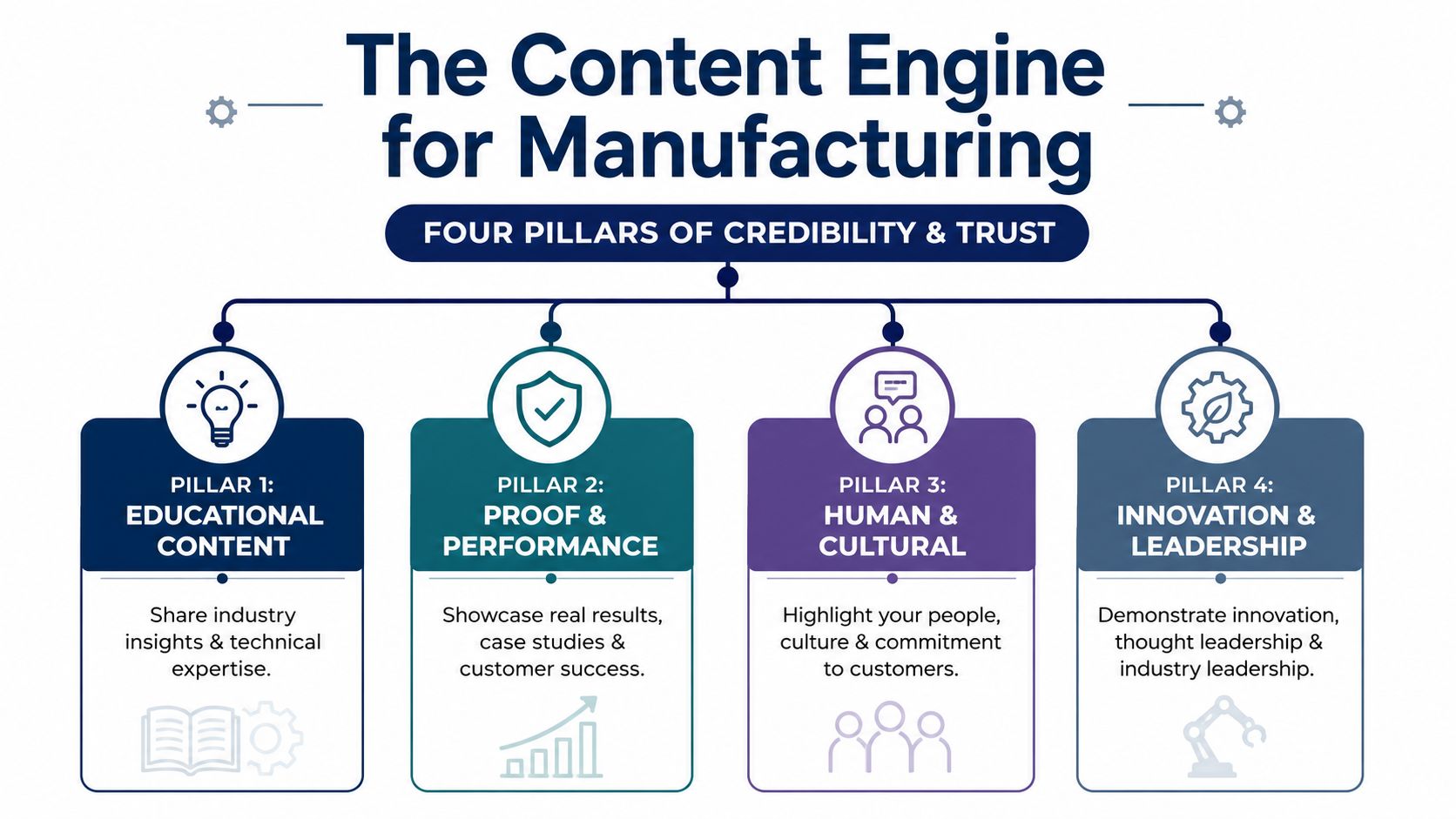
Four content pillars that work in industrial markets
Behind-the-scenes proof
This is often underused, even though it tends to connect well. One industrial source notes that the highest-engagement content on industrial company pages is often human content such as employee spotlights and behind-the-scenes culture, and it also points to employee advocacy as a major missed opportunity because buyers research suppliers through professional networks where individual expertise often carries more weight than a company page, based on this manufacturing content strategy article.
For a CNC shop or fabricator, useful posts include:
- Shop-floor snapshots. Show a setup, inspection routine, fixture, or material handling process with a short explanation of why it matters.
- Employee spotlights. Feature a programmer, machinist, quality lead, or estimator and explain what they solve for customers.
- Process clips. Share a short look at forming, welding, machining, finishing, or assembly with context, not just footage.
Human content works because buyers aren't only evaluating machines. They're evaluating whether your people look capable, organized, and credible.
Technical expertise
This content should help the audience do their job better without giving away proprietary know-how.
Examples:
- A short post on common drawing issues that delay quoting
- A video explaining when a tolerance creates avoidable cost
- A simple checklist for preparing files before sending an RFQ
This kind of content tells engineers and buyers, “These people understand the work.” That matters more than polished brand copy.
Capability and project showcase
Many manufacturers go wrong by posting finished parts with no context. That doesn't help a buyer much.
A stronger capability post answers one or more of these questions:
- What was difficult about the job?
- What process did your team use?
- What requirement did you help satisfy?
- What should a buyer understand before requesting something similar?
For example, a custom fabricator could publish:
- A before-and-after workflow showing how a part moved from raw material to finished assembly
- A short demo video of a machine or process in action
- A project recap focused on the production challenge, not confidential client details
Buyers don't need more polished claims. They need evidence that your team can handle real-world complexity.
Culture and recruiting content
This isn't fluff when it's done right. It reassures prospects that the business is stable and staffed by people who care about the work.
Good examples include:
- A new hire onboarding snapshot
- A post from a team training day
- A quick clip from a safety or quality meeting
- A supervisor explaining how operators advance skills over time
Employee advocacy is the multiplier
Company pages matter, but they usually won't create enough reach on their own. The people inside your business carry more trust, especially in industrial niches where reputation travels through networks.
A practical employee advocacy setup looks like this:
- Choose participants carefully. Start with sales engineers, technical managers, plant leaders, and owners who already communicate well.
- Create simple guardrails. Define what can be shared, what needs review, and what must stay internal.
- Make posting easy. Give employees draft copy, image options, and approved talking points.
- Track participation. Watch who posts consistently and which themes create useful conversations.
What doesn't work is telling the team, “Everyone should post more on LinkedIn,” with no workflow behind it. That creates hesitation, not advocacy.
Systematizing Lead Capture: Connecting Social to Your CRM
At this point, social stops being a marketing expense and starts acting like commercial infrastructure.
A lot of manufacturing teams publish strong content, get some clicks, maybe even a few comments, and then lose the trail. No landing page. No form logic. No CRM tagging. No follow-up sequence. The interest exists, but the system doesn't.
One of the clearest gaps in industrial social guidance is that many teams stop at awareness, while the bigger opportunity is tying social to RFQs, distributor relationships, and stale lead reactivation through CRM and automation, and evaluating social as pipeline influence over long buying cycles, as discussed in this article on social and manufacturing operations.
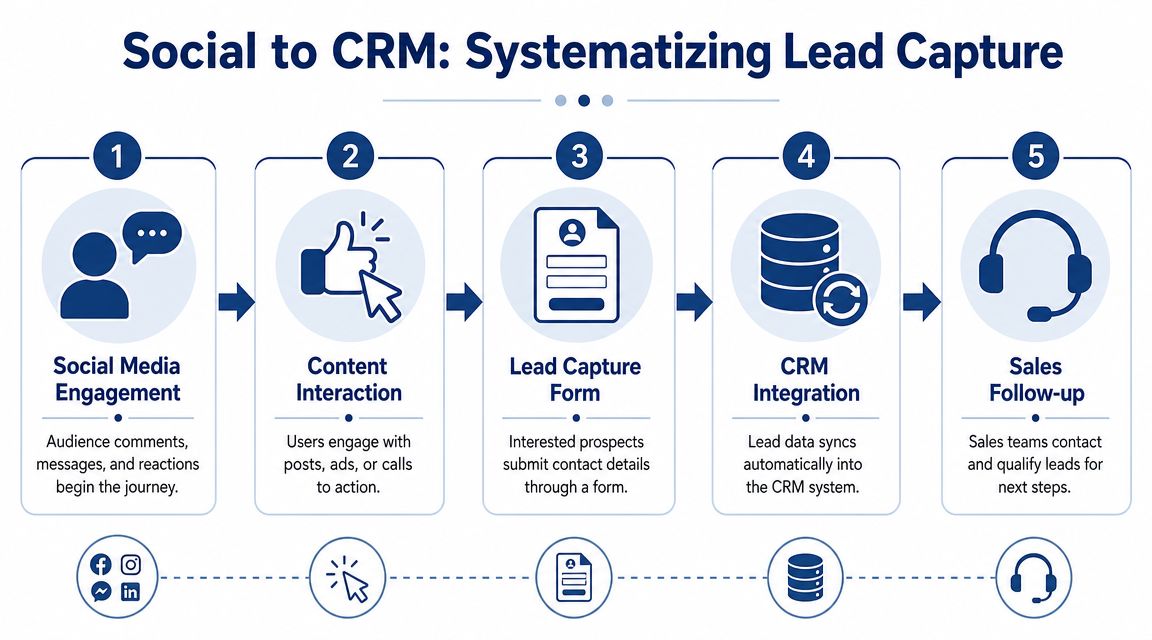
Build the conversion path backward
Start with the commercial event you want to create, then work backward.
If the goal is more qualified quoting conversations, your path might look like this:
- Publish a social post about a technical issue, process, or capability.
- Link to a focused landing page with one clear next step.
- Offer a useful asset such as a spec checklist, capabilities sheet, CAD resource, webinar registration, or consultation form.
- Capture form data with tags based on source, topic, and interest.
- Push the lead into your CRM for routing and automated follow-up.
- Notify sales if the lead matches target criteria.
That's the difference between “someone liked our post” and “someone entered our system.”
Use if-this-then-that logic
Social-to-CRM workflows should be boring, predictable, and documented.
Here's a practical model:
- If someone clicks a LinkedIn post about tighter-tolerance machining, then send them to a page offering a design-for-manufacture checklist.
- If they complete the form, then add a tag for machining interest and source channel.
- If they're from a target industry or named account, then assign the contact for sales review.
- If they don't respond after the first email, then place them into a nurture sequence with related proof content.
- If they revisit a pricing, capability, or RFQ page, then trigger a follow-up task.
For manufacturers using automation platforms, systems like GoHighLevel can be useful. Machine Marketing also works in this area by helping industrial companies connect lead capture, CRM workflows, and nurture automation into one operating system rather than a set of disconnected tools.
If you want a non-promotional walkthrough of the operational side, this guide for SMBs on CRM integration is worth reviewing. For a manufacturing-specific application of pipeline design, this resource on CRM for lead generation fits well.
A social post should have a destination, a capture mechanism, and a follow-up rule. If one of those is missing, you've built attention without a handoff.
What to send people to
Manufacturers often overcomplicate lead magnets. You don't need a glossy ebook.
Stronger options are usually more practical:
- Pre-RFQ checklists that help buyers submit cleaner information
- Capabilities sheets segmented by process or industry
- Application-specific guides for engineers
- Short webinar registrations tied to common technical questions
- Contact forms framed around a specific problem, not a generic “learn more”
The point isn't to gate everything. The point is to create intentional moments where interest becomes identifiable and trackable.
Fueling the Engine: A Practical Paid Social Strategy
Organic posting alone is usually too passive for industrial companies with a defined growth target. Your best content may never reach the right plant manager, engineer, or procurement lead unless you put budget behind it.
That doesn't mean spraying ads across the internet. It means using paid social with precision.
Paid social works when the audience is narrow
Manufacturers usually get better results from targeted amplification than from broad awareness campaigns. If you sell custom automation, precision machining, fabricated assemblies, or OEM components, the relevant audience is limited. That's a strength, not a weakness.
A practical example is promoting a capability case study to a finite account list on LinkedIn. Instead of hoping the right people find the post organically, you place it in front of selected companies, job functions, and industries. Sales gets air cover. Marketing gets observable engagement from the accounts that matter.
What to promote
Don't put budget behind every post. Put budget behind assets with a clear commercial role.
Good paid-social candidates include:
- Case-study style proof that supports a known vertical
- Technical checklists tied to quoting or specification quality
- Webinar or event invitations for niche audiences
- Retargeting ads for visitors who already viewed service or RFQ pages
- Recruiting campaigns for hard-to-fill technical roles in a local market
Weak candidates are generic company updates, holiday posts, and content with no next action.
Boosting isn't the same as campaign design
A boosted post can be useful for simple visibility. It's easy, quick, and sometimes enough for event support or culture content.
But if you want leads, retargeting, or account-based reach, build an actual campaign. That means defined audience filters, purpose-built landing pages, conversion tracking, and follow-up workflows inside your CRM.
Here's the trade-off in plain terms:
| Approach | Best use | Limitation |
|---|---|---|
| Boosted post | Simple awareness or extending reach on a strong organic post | Weak control over deeper conversion strategy |
| Campaign-based ad | Lead capture, retargeting, account targeting, RFQ support | Takes more setup and better tracking discipline |
Start small, but don't stay casual
A small paid budget can outperform months of unfocused organic effort if the targeting is tight and the offer is relevant. What fails is the half-committed version where a team spends money without a landing page, CRM tracking, or sales follow-up.
Paid social should make your existing system more efficient. It shouldn't be a substitute for having one.
Measuring What Matters: KPIs for Manufacturing Marketers
Manufacturers lose patience with social when they're shown the wrong numbers. Impressions, likes, and follower totals can be directionally useful, but they don't tell you whether social is helping revenue.
Industrial guidance is more practical than that. Effective manufacturing social strategy is measurement-driven, with emphasis on engagement rate, conversion rate, and sentiment analysis over vanity metrics, and it recommends a consistent cadence such as 2 to 3 posts per week on LinkedIn so teams can track performance over time while extending the reach of channels like trade shows and ISO certifications, according to this manufacturing social media guide from Venveo.
A weekly dashboard that's actually useful
If you run social media for manufacturing companies, these are the numbers worth reviewing each week:
- Engagement rate on strategic posts. Not every post. Focus on posts tied to target industries, technical topics, recruiting, or offers.
- Follower growth quality. Look at who followed you. Are they buyers, engineers, reps, distributors, applicants, or irrelevant accounts?
- Click-throughs to owned pages. Measure whether content moves people off-platform to pages you control.
- Landing page conversion rate. Track whether visitors complete the form, register, or request the next step.
- Lead source and pipeline notes in CRM. Review whether social-created contacts became conversations, RFQs, or influenced open opportunities.
- Sentiment and comment quality. In industrial markets, a thoughtful comment from the right person can matter more than broad shallow engagement.
Vanity metrics versus pipeline metrics
This is the distinction that clears up most reporting confusion.
| Vanity metric | Better operational question |
|---|---|
| Likes | Did the post attract the right role or account? |
| Impressions | Did people click through to a relevant page? |
| Follower count | Are followers aligned with our target market? |
| Video views | Did the video lead to deeper engagement or inquiry? |
The right KPI isn't “did this post perform?” It's “did this post move someone closer to a commercial conversation?”
Use metrics to make decisions
Metrics should trigger action, not decorate a report.
If technical posts get clicks but poor form completion, the landing page may be weak. If employee posts create strong engagement from target accounts, expand that format. If case-study ads generate traffic but no sales follow-up happens, the problem sits in handoff, not content.
That's the practical standard. Measure what your team can act on next week.
Your 30-60-90 Day Implementation Plan
A good plan for social media for manufacturing companies should feel operational, not inspirational. You're building a system, so the first quarter should focus on setup, controlled execution, and feedback loops.
Here's a workable cadence.
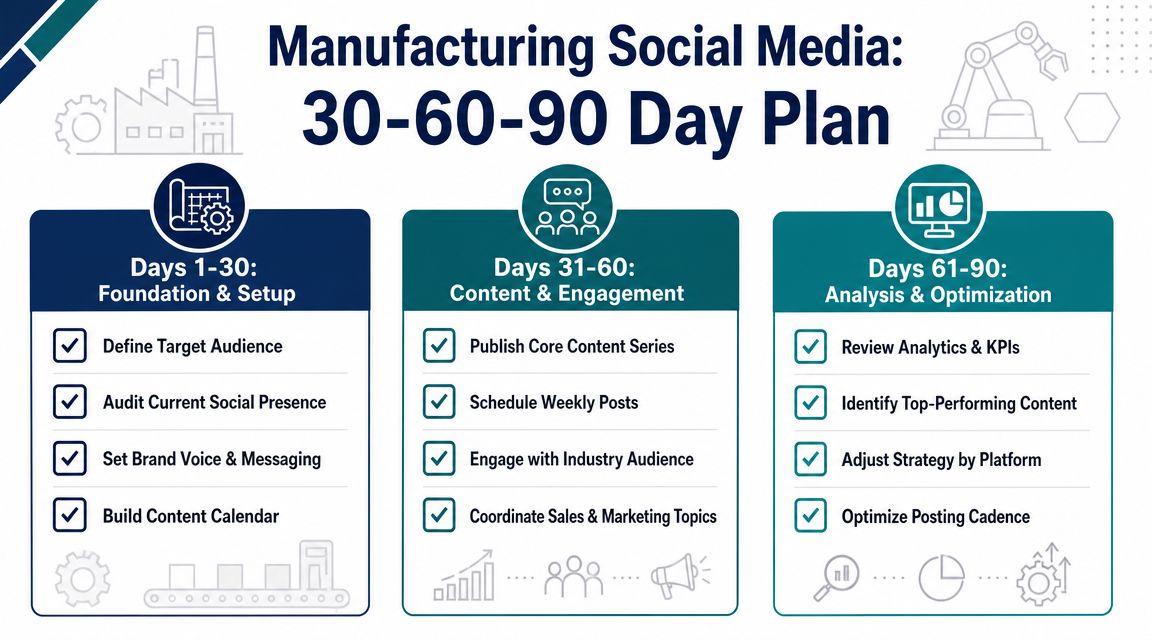
Days 1 to 30
- Define the output. Choose the main business goal. RFQs, target-account visibility, recruiting, distributor support, or stale lead reactivation.
- Audit your profiles. Tighten company descriptions, banners, service language, contact paths, and page links.
- Map the audience. List the buying roles you need to influence and what each one cares about.
- Set tracking rules. Decide how links, forms, CRM tags, and lead sources will be labeled.
- Build a simple calendar. If you need a starting point, use a social media posting schedule template to keep cadence consistent.
Here's a useful walkthrough to pair with that first sprint.
Days 31 to 60
- Launch the four content pillars. Publish behind-the-scenes proof, technical education, capability content, and culture posts.
- Pilot employee advocacy. Recruit a small internal group and give them approved post drafts and guardrails.
- Create one conversion asset. Build a focused landing page with one offer such as a checklist, capability sheet, or consultation form.
- Connect the form to CRM. Route submissions to the right owner and trigger follow-up emails or tasks.
Days 61 to 90
- Review content by business value. Identify which themes created clicks, conversations, or useful account engagement.
- Launch one paid campaign. Promote your strongest proof asset to a tightly defined audience.
- Refine handoff rules. Adjust who gets notified, how leads are tagged, and what follow-up sequence they enter.
- Document the SOP. Capture the posting workflow, approval path, employee advocacy rules, and reporting cadence.
- Hold a monthly review. Put marketing and sales in the same room and review pipeline influence, not just platform performance.
By the end of this cycle, you should have more than a social presence. You should have a working operating model.
If you want help diagnosing your current setup, Machine Marketing works with manufacturers to connect content, CRM, and automation into a clearer lead generation system. If your team already has tools in place but social still isn't influencing pipeline, that's usually a strategy and workflow problem, not a posting problem.