Is your social media a time-consuming chore that delivers zero leads? If you're posting sporadically without a clear plan, you're not alone. We see this all the time—the root cause is a lack of a repeatable system. In this guide, we'll show you how to diagnose your current approach and build a social media posting schedule that turns your efforts into a predictable, results-driven marketing engine.
Why Your Current Social Media Efforts Are Falling Flat
If you're putting time into social media but not seeing real results—like qualified leads or booked calls—the diagnosis is almost always the same: a lack of a systematic approach. You feel the pressure to "be on social," so you post when you find a spare moment. The problem is, it feels like shouting into the void.
This reactive, sporadic posting makes it impossible to build momentum. Algorithms on platforms like LinkedIn and Facebook reward one thing above all else: consistency. When your posting is erratic, the algorithm never learns when your audience is paying attention, and your content gets buried.
The Symptoms of a Broken System
Ask yourself: does any of this sound familiar?
- Inconsistent Posting: You post five times one week, then go silent for the next two. This creates an unreliable presence and confuses your audience.
- No Clear Goals: Each post is an island. There's no strategy connecting your content back to business objectives, like driving traffic or booking demos.
- Audience Mismatch: You're posting content you find interesting, but it isn’t solving a real problem for your ideal customer. The result? Low engagement, or likes only from your mom and a few old colleagues.
The problem isn't that you're not trying hard enough; it's the lack of a repeatable process. Without a schedule, you’re stuck in an endless loop of guessing what to post next, which drains your time and delivers zero measurable ROI.
Transformation: From Chore to Channel
A well-structured social media posting schedule is the tool that transforms your social channels from a time-sucking chore into a reliable lead generation machine. It forces you to get strategic about your content pillars, your audience's pain points, and what you want them to do after seeing your post.
This isn't about plugging content into a calendar to check a box. It's about building a system where every post has a purpose. To see how this systematic approach drives business, check out our guide on using social media for lead generation. A solid schedule ensures your brand stays top-of-mind, builds authority, and consistently captures the right attention, turning your social profiles into assets that work for you.
Building a Sustainable Posting System From Scratch
Let's build your social media system from the ground up. This is an engineering-style approach for busy business owners who need a process that works. The goal is to create a repeatable schedule where every post has a clear purpose.
When you post whenever you feel like it, you fall into a predictable cycle of failure: sporadic posts lead to zero momentum, which ultimately means no leads.
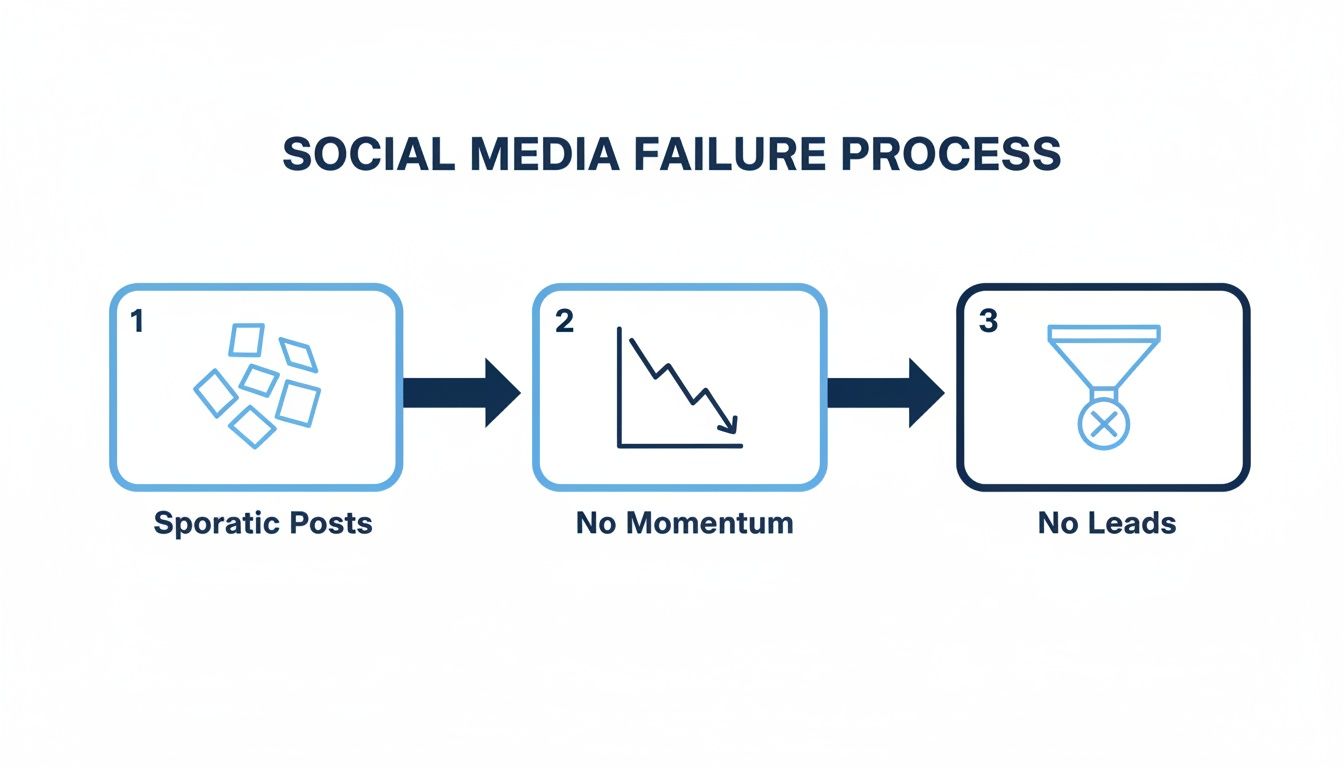
This process makes it clear: inconsistency is the killer. It prevents you from building the audience trust and algorithmic favor needed for results. To break out of this loop, you need a solid framework.
Step 1: Define Your Primary Goal
Before writing a single post, answer this critical question: what is the single most important business outcome you want from social media right now? Trying to do everything at once is a guaranteed way to achieve nothing.
Pick one objective to focus on for the next 90 days.
- Brand Awareness: Do you need to get your company name in front of more of the right people? Success is measured in reach and impressions.
- Website Traffic: Do you need to drive qualified visitors to a specific landing page or blog post? Success is all about your click-through rates (CTR).
- Direct Leads: Is the goal to get users to book a consultation or download a guide? Success is measured in conversions.
Your goal dictates your entire strategy. If you're chasing leads, every post needs a clear call to action. If it's awareness, your content must be genuinely valuable and shareable.
Step 2: Know Your Audience and Platforms
Who are you trying to reach? Go deeper than "manufacturers." What are their specific job titles? What problems keep them up at night? Where do they spend their time online? For most B2B businesses, the answer is LinkedIn.
Don't spread yourself thin across five different platforms. You will get far better results by dominating one or two channels where your ideal customers are truly active. A focused LinkedIn strategy will always beat a scattered presence across Instagram, X, and Facebook for a service-based business targeting decision-makers.
Step 3: Set Your Core Content Pillars
Your content pillars are the 3-5 core themes you'll talk about repeatedly. These topics should live at the intersection of your expertise and your customer’s biggest problems. They are the foundation of your entire posting schedule.
For example, a machine shop's content pillars might be:
- Precision Machining Techniques
- Material Selection Guides
- Behind-the-Scenes Project Showcases
- Industry Technology Updates
With pillars, you're never left wondering what to post. You simply pull ideas from these pre-approved topics, ensuring your content is always on-brand and reinforcing your authority. For a deeper dive into organizing these pillars, our guide on how to create a content calendar is the perfect next step.
Finally, lock in your posting frequency. The key isn't to bombard your audience; it's strategic consistency.
Platform and Cadence Recommendations for B2B Businesses
| Platform | Primary Audience | Recommended Frequency | Content Focus Example |
|---|---|---|---|
| C-Suite, Directors, Engineers | 3-5 times per week | Case studies, industry analysis, company news, technical tips | |
| X (Twitter) | Industry Influencers, Tech-focused Roles | 2-3 times per day | Quick insights, event updates, links to long-form content |
| Varies (often for community building) | 3-5 times per week | Team culture, behind-the-scenes, community engagement | |
| YouTube | Engineers, Technicians, Buyers | 1-2 times per month | Product demos, facility tours, how-to tutorials |
Ultimately, a consistent schedule of 2-5 quality posts per week is the sweet spot for most businesses. It keeps you visible without causing audience fatigue. To streamline this, understanding how to schedule a social media post to multiple platforms is a game-changer. This framework—goals, audience, and pillars—creates a powerful system that saves you hours and guarantees every post moves you closer to your business objectives.
Finding the Best Times to Post for Maximum Impact
Posting brilliant content at the wrong time is like hosting a seminar in an empty room. You’ve put in the work, but if no one's there to see it, the effort is wasted. It’s time to get your message in front of decision-makers when they're actually paying attention.
Your social media schedule isn't just about what you post—it's about when. The right timing can be the difference between a post that generates leads and one that disappears.

Uncovering Your B2B Engagement Goldmine
Let's be direct. For most B2B businesses, your audience isn't scrolling LinkedIn on a Saturday night. They’re active during the workweek, especially when they first get to their desks or take a mid-morning break. This is your window of opportunity.
As a general rule, the best time to post across platforms is between 9 AM and noon on Mondays, Tuesdays, and Wednesdays. This is when professionals are most active during their commutes and early work breaks.
Specifically for LinkedIn—a crucial channel for B2B—we see that Tuesday through Thursday mornings around 9 AM to 11 AM can generate up to 2x more shares and comments. These windows are your starting point, a data-backed hypothesis for building your schedule. To really nail this down, understanding the best day for social media posts is a key piece of the puzzle.
Diagnose Your Own Peak Times
While industry benchmarks are a fantastic starting point, your specific audience has unique habits. Treat these recommended times as a baseline, then test, measure, and refine based on your own performance data. A schedule should never be static; it has to evolve.
The most effective social media posting schedule is one built on industry best practices but perfected with your own audience data. Don't just set it and forget it—diagnose what works and double down.
Start by digging into the native analytics on your chosen platforms. Most social media business accounts give you a direct look at when your followers are most active online.
- LinkedIn Analytics: Go to your Company Page, click "Analytics," and select "Followers." While you won't get a "peak times" chart, you can cross-reference the performance of individual posts to find patterns. Look at your top-performing content—when did you post it?
- Facebook Page Insights: Go to your Page's "Insights" tab and look under "Posts." You’ll find a graph showing the days and times your fans are most often online.
Use these insights to tweak your posting times. Watch what happens. Do clicks, shares, and comments improve? This cycle of continuous refinement transforms a good schedule into a great one.
Putting Your Schedule on Autopilot with GoHighLevel
A perfectly mapped-out social media schedule is useless if you don't have time to execute it. This is where you stop being a content publisher and start being a systems builder. Automation is what turns your strategy into a hands-off machine, freeing you up to run your business.
We use GoHighLevel for a critical reason: it pipes everything directly into our CRM. That connection is a game-changer. It’s what transforms a simple "like" or comment from a vanity metric into a real, trackable lead in your pipeline. You're not just scheduling posts; you're creating a system that ties social interactions back to tangible business results.
Getting Your Schedule Loaded into GoHighLevel
First, connect your social media accounts—like LinkedIn and Facebook—inside the GoHighLevel dashboard. Once linked, head over to the social media planner. This is your command center. Here, you bring the calendar you just built to life by uploading your approved content for the next week or month in one go.
This is what the GoHighLevel social planner looks like. It gives you a bird's-eye calendar view of everything queued up.
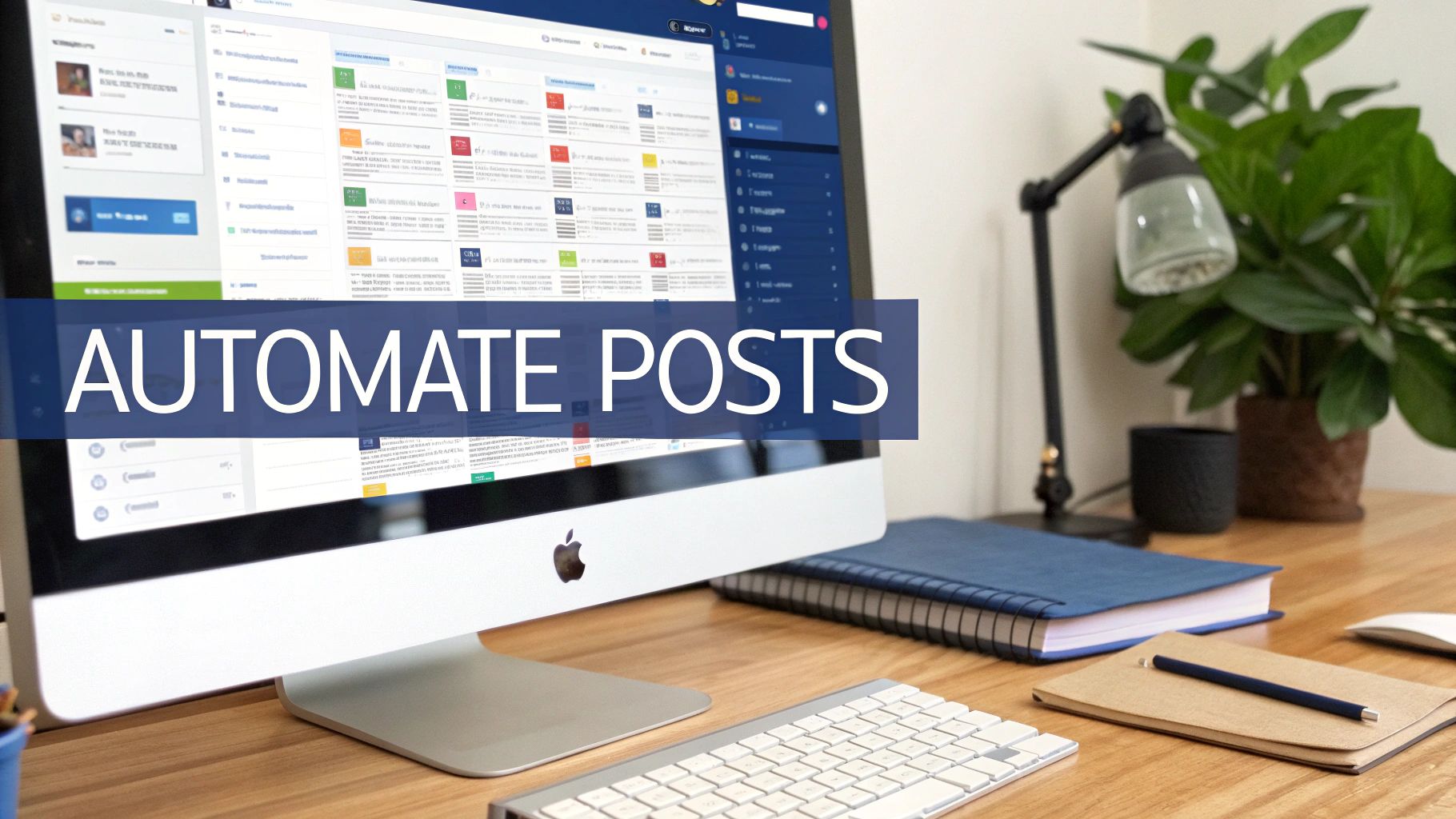
The visual layout makes it easy to spot gaps in your content pillars and ensure a healthy mix of topics. No more accidental "all sales posts, all the time" weeks. For every piece of content, pick the exact date and time for it to go live, matching it with your peak engagement windows.
The real power here is in batching. Block out one or two hours, load up an entire month's worth of content, hit schedule, and let the system do the heavy lifting. This is how you get your time back.
Tying Social Activity Directly to Your CRM
The biggest win of using an all-in-one tool like GoHighLevel is what happens after your content goes live. When someone interacts with a post, that action can trigger automated workflows inside the CRM.
- Smart Lead Capture: Someone comments on a post about a specific service? They can be automatically tagged and added to a "warm leads" list.
- Instant Follow-Up: A workflow can send a personalized DM to every new follower automatically.
- Trackable ROI: When a prospect clicks a link, lands on your site, and fills out a form, GoHighLevel connects those dots. You get a crystal-clear picture of the ROI from your social media.
This is how you elevate social media to a core component of your inbound marketing funnel. By automating your social media posting schedule, you’re building an intelligent, interconnected system that actively finds and nurtures leads.
Measuring What Matters to Continuously Improve
Your social media posting schedule is not a "set it and forget it" document. Think of it as a living system that needs regular check-ups to remain effective. But how do you know if it's working?
The key is to cut through the noise. Likes and follower counts are nice for the ego, but they don't pay the bills. The real diagnosis comes from tracking Key Performance Indicators (KPIs) that connect directly to your business goals. If you’re trying to generate leads, you need to obsess over click-through rates (CTR) and lead conversions.
Conducting Your Monthly Performance Review
Block out one hour every month to review your social media performance. This is a focused mission to figure out what’s connecting with your audience and what's falling flat. The goal is to make small, smart adjustments that snowball into big results.
During this review, ask these diagnostic questions:
- Which posts drove the most website clicks? Look for patterns in the topic, format (video vs. image), or call to action.
- What day and time got the highest engagement? Your own data is the ultimate truth, trumping industry benchmarks.
- Which content pillars are performing best? This tells you what your audience values and where to invest more creative energy.
- Did any posts lead to direct sales conversations? Hunt those down and diagnose what made them so effective.
This review cycle separates a sharp strategy from a sloppy one. Data consistently shows timing has a huge impact. For instance, recent data points to Wednesday as a powerhouse for B2B engagement. LinkedIn activity often peaks between 8-10 AM on Tuesdays and Wednesdays, leading to a 60% lift in CTR. While benchmarks like these are a great starting point, your analytics will tell you if these trends apply to your audience. You can dig into more data-driven insights about posting times to guide your initial tests.
A schedule without review is just guesswork. A schedule refined by data becomes a predictable lead generation system. Treat each month's performance as a new set of clues to guide your next moves.
Your Top Social Media Scheduling Questions, Answered
Even with a solid plan, questions come up. Let's tackle the most common hurdles we see business owners face when implementing a new social media posting schedule.
Our goal is to give you the clarity to move forward with confidence.
How long until a new schedule shows results?
This is the most common question, and the transparent answer is: it takes patience. While you might see a quick bump in reach or likes in the first few weeks, you need a good 60 to 90 days of consistent data to see what’s truly working.
Meaningful trends—like increased website traffic or qualified leads—need a longer runway. During this initial phase, your number one job is unwavering consistency. Stick to the plan, even if results aren't immediate. That consistency builds trust with both the algorithm and your audience.
What if I don't have enough content to post every day?
Feeling like you'll run out of things to say is a normal fear. The solution isn't creating more; it's working smarter with what you have. The fix is a simple combination of content pillars and aggressive repurposing. You don't need a brilliant new idea every single day.
This isn't a content creation problem; it's a content packaging problem. One solid idea can easily fuel your social media for an entire week.
Here’s a practical system:
- Create One Core Asset: Once a month, create one larger piece of content for each of your content pillars. This could be a blog post, a short video, or a case study.
- Break It Down: Systematically dismantle that core asset. Pull out key quotes for text posts. Turn stats into simple graphics. Convert bullet points into an Instagram carousel. Chop up video clips for Reels or Shorts.
Suddenly, you have a sustainable content engine where one big effort creates a massive ripple effect, filling your calendar without forcing you to start from scratch.
Should my posting schedule be the same on every platform?
No. This is a common mistake. Applying the same schedule across every platform is a surefire way to waste your effort. Each social network has its own user habits and peak activity times. Acknowledging these trade-offs is critical.
For example, your B2B audience on LinkedIn is most active during weekday business hours—perfect for sharing professional insights. But if you use a Facebook group for community building, you might find that early mornings or evenings drive more engagement.
Always tailor your timing, content format, and tone to fit the platform. Meet your audience where they are and how they want to be met.
Building and maintaining an effective social media schedule is a system. It requires initial setup, but the payoff in consistent, predictable leads is worth it. At Machine Marketing, we specialize in building and running marketing systems that get results.
If you’re ready to transform your social media from a daily chore into a reliable growth engine, the next step is to get a professional diagnosis. Book a discovery call on our website today.