Is your B2B company constantly fighting on price or struggling to get noticed? If so, the root cause is almost always a weak or undefined brand position. It's the answer to a brutal question every prospect asks: “Why should I choose you over everyone else?”
We see this all the time—great companies with superior services whose message just vanishes into market noise. It feels like shouting into the void.
In this guide, we’ll show you how to diagnose the gaps in your current positioning. We'll give you a proven, step-by-step framework to engineer a strategic brand positioning that attracts high-value clients and makes your sales process easier.
Diagnosing Your Brand Positioning Problem
Stop thinking of strategic brand positioning as a fluffy marketing concept. Instead, see it as the engineering blueprint for how your market perceives you. It’s the system that dictates who you attract, what they’re willing to pay, and how easily they say “yes.” When that system is broken, the symptoms are impossible to ignore.
Symptoms of a Broken Positioning System
Does any of this sound familiar? You likely have a positioning problem if you're dealing with:
- Poor Lead Quality: Your pipeline is clogged with prospects who nickel-and-dime you on price, don't understand your value, or just aren't a good fit for what you actually do best.
- Painfully Long Sales Cycles: Your sales team spends most of its time explaining what makes you different instead of closing deals. Prospects get confused, and decisions drag on forever.
- Marketing That Doesn't Move the Needle: You’re pouring money into ads and content, but the ROI is flat-out disappointing. Your message isn't connecting with the right people.
- Constant Pressure to Lower Prices: You feel forced to compete on price because customers see you as just another commodity in a sea of look-alikes.
When your brand has no clear position, your best customers can't separate your signal from the noise. You become a commodity, and commodities always compete on price.
This isn't just a marketing headache; it’s a bottleneck choking your company's growth. The global brand positioning strategy market is on track to hit $17.3 billion by 2033. This tells you one thing: businesses are realizing that differentiation is the key driver of success. As research from HTF Market Insights shows, a defined strategy isn't a luxury anymore—it's essential for survival.
Our goal here is to help you diagnose the cracks in your current approach. Once you understand the symptoms, you’ll see why a systematic framework is the only reliable way to attract clients who will pay for the value you truly offer.
Building Your Positioning Blueprint: A 3-Part Diagnosis
A strong brand position isn’t born from a gut feeling. It’s engineered from hard data and real-world insights. Before you can claim a defensible spot in the market, you need to draw up the blueprint. This process is about gathering the raw materials that will shape your entire strategy.
Trying to build a brand without this research is like flying blind. You end up wasting marketing dollars on messages that fall flat or chasing customers who will never see your true value.
When positioning is weak, it creates a predictable chain reaction of failure. We see it all the time.
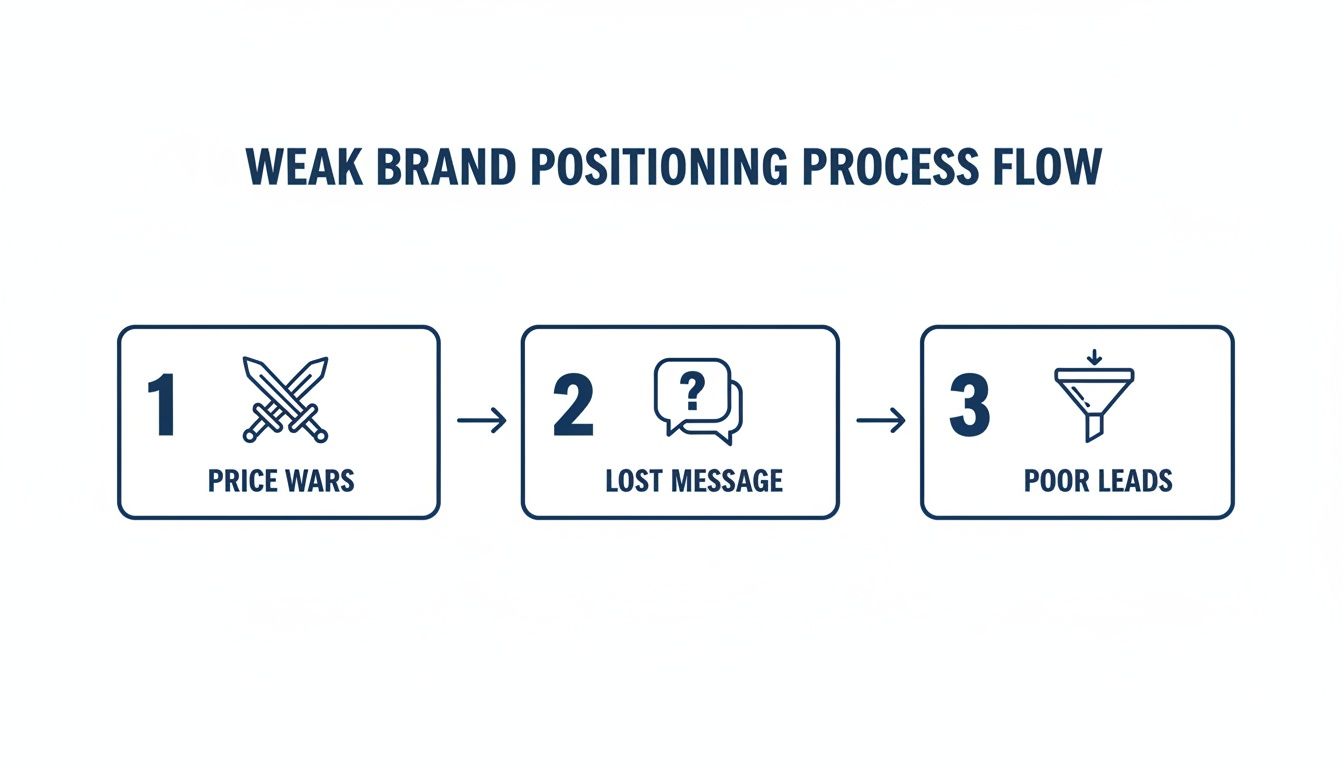
A muddled message forces you to compete on price, which inevitably attracts low-quality leads. This traps your business in a frustrating cycle of low-margin work that’s impossible to scale. To avoid that, you need to gather intelligence from three critical sources.
Here’s a quick overview of the framework we use to gather the essential data.
Positioning Discovery Framework
A structured approach to gathering the essential data needed to define your brand positioning, breaking down each area of investigation.
| Focus Area | Key Questions to Ask | Data Sources & Methods |
|---|---|---|
| Internal Reality | What do we believe makes us unique? Where do we consistently win/lose deals? Who is our real ideal customer vs. who we think it is? | Interviews with your sales, customer service, and leadership teams. Review your CRM data and sales reports. |
| Customer Truths | Why did they choose us over alternatives? How do they describe our value in their own words? What problem did we really solve for them? | In-depth phone interviews with your best, most profitable customers. Review testimonials and online reviews. |
| Competitive Landscape | Who do our competitors target? What is their core promise? Where are the gaps in their messaging and service that we can exploit? | Website analysis, social media review, content audits, and mystery shopping of key competitors. |
This process gives you a complete, 360-degree view of the market, ensuring the position you ultimately choose is relevant, differentiated, and believable.
Start With Your Internal Reality
Your journey into strategic brand positioning begins inside your own company. Your sales and customer service teams are sitting on a goldmine of unfiltered market feedback. They hear firsthand what messages connect and which ones miss the mark.
Pull your sales team aside and ask them some pointed questions:
- "Which competitors do we consistently lose to, and why are we losing?"
- "What are the top three objections you hear from prospects on a regular basis?"
- "Walk me through the last deal we closed with a perfect-fit customer. What made them so ideal?"
These conversations almost always expose a gap between what leadership thinks the brand stands for and how the market actually sees it. The goal is to get an honest snapshot of your current position before you try to change it.
Uncover What Your Customers Really Think
Next, it’s time to talk to your best customers—the ones who are profitable, a joy to work with, and truly get your value. These are the people who already see what makes you special. Your job is to bottle that perception and scale it.
Your ideal customers have already positioned you in their minds. The most powerful brand positioning strategy often involves simply understanding that position and amplifying it to the rest of the market.
Don’t just send out a generic survey. Get on the phone. Have real, human conversations. Ask questions like:
- "Before you brought us on, what was the single biggest challenge you were wrestling with?"
- "What other options or competitors did you look at before deciding to go with us?"
- "If you had to explain to a colleague what we do for you, what would you say?"
Pay close attention to the exact words they use. Their language is the most powerful marketing copy you'll ever find. These answers become the building blocks for your messaging and a razor-sharp customer profile. To go deeper on this, check out our guide on how to identify your target audience.
Analyze the Competitive Landscape
With a firm grip on your internal reality and customer perspective, it's time to size up the competition. The point isn't to copy what they're doing; it's to find the openings they've left for you. You need to analyze their messaging, not just their product features.
Dig into their websites, social media, and case studies. Ask yourself:
- Who are they talking to? Is their target audience a specific industry, company size, or job title?
- What's their core promise? Are they positioning themselves as the cheapest, the fastest, or the most premium?
- What's their tone of voice? Do they sound buttoned-up and corporate, or casual and modern?
Mapping out where your competitors play allows you to find a space where you can be different and better. This analysis is key to finding an angle that’s valuable to your audience and distinct from everyone else. To learn more about building a solid foundation, these effective brand positioning strategies offer a deeper dive.
Crafting Your Core Message and Value Proposition
You've done the diagnosis. Now it's time to forge those raw insights into a message that cuts through the noise. This is where you translate customer truths and competitor weaknesses into your Unique Value Proposition (UVP)—the single most important reason a prospect should choose you.
A powerful UVP isn’t a fluffy, generic statement like "we offer quality service." A sharp UVP speaks directly to a specific problem for a specific audience and promises a tangible outcome. It becomes the engine of your entire brand positioning strategy.

This core message becomes the DNA for every piece of marketing you create. When it’s consistent, the financial impact is real. Brands that maintain a consistent image can see revenue jump by 10% to 20%. This boils down to trust—a staggering 81% of consumers say they need to trust a brand before they'll even consider buying from it.
Building Your Unique Value Proposition
Think of your UVP as your elevator pitch, stripped down to its essential parts. It's a clear, concise statement of the real-world value you deliver. To build one, you must answer three critical questions from your research.
- Who is your ideal customer? Get specific. "Manufacturers" is too broad. "CNC machine shops with 10-50 employees" is much better.
- What is their biggest pain point? What’s the one problem that keeps them up at night that you are uniquely equipped to solve?
- What is your unique promise? How do you solve that problem in a way your competitors can't or won't?
Answering these questions forces you to take a stand. It prevents you from creating a generic message and makes you declare who you’re for—and just as importantly, who you’re not for.
From UVP to Positioning Statement
Once you have your UVP, formalize it into a positioning statement. This isn't public-facing copy; it's your internal compass. It's the source code that guides your marketing, sales, and service teams, ensuring everyone tells the same story.
Your positioning statement is the North Star for your entire organization. It’s a simple declaration of who you serve, what you do, and why you’re the only logical choice.
Here’s a simple but effective template we use with clients to distill their positioning into a single, focused statement:
For [Your Ideal Customer], who struggles with [Primary Pain Point], our [Product/Service Name] is a [Category of Service] that provides [Key Benefit/Unique Promise]. Unlike [Primary Competitor/Alternative], we [Your Key Differentiator].
This structure forces absolute clarity. It prevents you from falling back on industry jargon and connects what you do directly to the customer's world.
Real-World B2B Positioning Examples
Let's see this framework in action for a B2B manufacturer.
-
Weak Positioning: "We provide high-quality custom metal fabrication services for various industries."
- Diagnosis: It's generic and instantly forgettable. Who is it for? What problem does it really solve? It sounds like hundreds of other shops.
-
Strong Positioning: "For aerospace engineers who struggle with sourcing components that meet strict AS9100 tolerances, our CNC machining service is a precision manufacturing partner that guarantees compliance and on-time delivery. Unlike generalist machine shops, we dedicate 100% of our production line to certified aerospace parts."
- Why It Works: This is sharp, specific, and speaks directly to a high-value audience. It names the customer, their critical pain point, and delivers a unique, provable differentiator.
The difference is night and day. The first example forces the sales team to do all the heavy lifting. The second presells the company’s value before a conversation even starts. This is the power of a well-crafted message, and we dive deeper into this in our guide to creating a powerful marketing messaging framework.
Putting Your Brand Strategy into Action
A brilliant positioning statement is useless if it just lives in a slide deck. The real test is whether it changes how your company acts, speaks, and sells every day. Now it’s time to translate that core message into tangible assets and operational habits across every customer touchpoint.
The goal is to embed your new positioning so deeply into your operations that it becomes second nature. This isn't about a one-time marketing campaign; it's about building a system that makes your strategy a living part of your business.
Translate Your Positioning into Website Copy
Your website is your digital storefront. For most B2B buyers, it's their first real interaction with your brand, so your positioning must be front and center.
The hero section—the very first thing a visitor sees—needs to immediately answer three questions rooted in your positioning:
- What do you do? (Your service category)
- Who do you do it for? (Your ideal customer)
- How do you do it differently? (Your key differentiator)
For instance, a generic headline like "Leading Manufacturing Solutions" becomes something sharp: "Precision CNC Machining for Aerospace Engineers Who Can't Afford Delays." That one sentence immediately pulls in the right visitor and pushes away the wrong one.
From there, this message must cascade through your entire site. Your service pages should reinforce how your unique process benefits that ideal customer. Your case studies should provide concrete proof.
Your website isn’t just a brochure; it’s the primary tool for operationalizing your brand position. Every word and call-to-action should be a direct reflection of your core message.
This consistency builds trust. To ensure this new digital presence gets discovered, especially by AI-driven search, it's smart to use advanced AI SEO tools for dominating search.
Arm Your Sales Team with the Right Message
If your sales team isn't using the new positioning, it might as well not exist. The whole point is to make their jobs easier by giving them clear, compelling language that resonates with your ideal buyers.
Start by translating your positioning statement into practical sales assets:
- Updated Sales Decks: The first three slides must hammer home your UVP, the specific problems you solve, and for whom you solve them.
- Revised Sales Scripts: Refine your opening pitch and objection-handling responses to align with your new focus. If a prospect's pain point doesn't match what you're targeting, your script should help the salesperson qualify them out quickly.
- Battle Cards: Create one-pagers that summarize your key differentiators against your top competitors. This gives your team instant confidence when a prospect asks, "How are you different from Company X?"
This isn’t about forcing a rigid script. It’s about arming them with a consistent framework so that everyone is telling the same powerful story.
Ensure Consistency Across Your Tech Stack
Inconsistent messaging kills brands. A prospect sees one message on a social ad, a different one on your website, and hears a third version from a sales rep. That confusion undermines trust.
Your tech stack is key to enforcing consistency at scale. Whether you're using HubSpot, Salesforce, or another CRM, your positioning needs to be hardwired into your systems.
Where to Implement Your Core Message:
- Email Automation: Every email sequence—from lead nurturing to customer onboarding—should use language pulled directly from your positioning statement.
- CRM Contact Properties: Customize your CRM to track leads based on your ideal customer profile. Add fields that help you segment prospects who fit your new strategic focus.
- Social Media Profiles: Your LinkedIn company page, X (formerly Twitter) bio, and all other profiles need a consistent one-sentence description that mirrors your UVP.
- Chatbot Scripts: If you use a chatbot, make sure its opening questions are designed to qualify visitors based on your positioning.
By embedding your message directly into the tools your team uses every day, consistency becomes an automated part of your process. This operational discipline is what separates brands that simply have a strategy from brands that are a strategy.
How to Know If Your Positioning Is Actually Working
You've done the hard work of research and messaging. But how do you know if it's working? It’s time to connect your positioning strategy to real business growth.
Go Beyond Vanity Metrics—Focus on Business KPIs
Forget about chasing vanity metrics like website traffic or social media likes. They don't tell you if your strategic brand positioning is attracting better customers or making it easier to close deals. To measure success, you need to tie your marketing activities directly to business outcomes.
Here are the key performance indicators (KPIs) that truly matter:
- Improved Lead Quality: Are you getting more inquiries from your ideal customers? Measure the conversion rate from a marketing-qualified lead (MQL) to a sales-qualified lead (SQL). If that percentage is climbing, your message is hitting home.
- Shorter Sales Cycles: When your positioning is sharp, prospects "get it" faster. They show up already understanding your value, which should shorten the time it takes to get to a signed contract. Track your average sales cycle length in your CRM.
- Higher Customer Lifetime Value (CLV): Better-fit customers don't just buy once; they stick around longer and are more profitable. If you're reeling in clients who genuinely value what you do, you should see your average CLV tick upward.
Setting up a simple dashboard to watch these KPIs is a must. A basic spreadsheet or a custom report in your CRM is all you need to make smart, data-backed decisions. For a deeper dive, our guide on how to measure marketing ROI gives you a practical framework.
You can't improve what you don't measure. Treating your brand positioning as a strategic asset means holding it accountable to real business metrics, not just marketing activity.
This is what separates market leaders from everyone else. In 2024, the value of the top 5,000 global brands shot up from $11 trillion to over $13 trillion—a 20% jump. This shows how powerful brand management has become in driving enterprise value.
Brand Positioning KPI Dashboard
Here's a look at the key metrics you should track to connect your positioning efforts to tangible business outcomes. This dashboard helps you see the real-world impact of your brand strategy.
| Metric Category | Primary KPI | How to Measure It | What It Tells You |
|---|---|---|---|
| Lead Generation | MQL to SQL Conversion Rate | (Total SQLs / Total MQLs) * 100 | Is your message attracting prospects who are a good fit for sales? |
| Sales Efficiency | Average Sales Cycle Length | Track the average time from first contact to closed-won in your CRM. | Is your positioning making it easier and faster to close deals? |
| Customer Value | Customer Lifetime Value (CLV) | (Avg. Purchase Value) x (Avg. Purchase Frequency) x (Avg. Customer Lifespan) | Are you attracting loyal, high-value customers who stick around? |
| Market Perception | Share of Voice (SOV) | Use brand monitoring tools to track mentions vs. competitors. | How visible and relevant is your brand in your target market? |
| Profitability | Customer Acquisition Cost (CAC) | Total Sales & Marketing Spend / Number of New Customers Acquired | Is your positioning making it more cost-effective to win new business? |
This dashboard isn't just about tracking numbers; it's about understanding the story they tell. When these metrics move in the right direction, you have concrete proof that your strategic positioning is delivering a strong return on investment.
Create a Powerful Feedback Loop
Data tells you what is happening, but your team can tell you why. The real insights are often found on the front lines with the people talking to customers every single day. A consistent feedback loop between your marketing, sales, and customer service teams is non-negotiable.
This system keeps your positioning from going stale. Markets shift, competitors make moves, and customer needs change. This feedback loop is your early warning system.
How to Build Your Feedback System:
- Schedule Monthly Check-ins: Get marketing and sales in the same room once a month. The only agenda item? Lead quality and messaging resonance.
- Ask Diagnostic Questions: Use these meetings to dig for qualitative insights. Ask pointed questions like, "What specific phrases from our new messaging are really landing with prospects?" or "Are we still hearing the same old objections?"
- Share Customer Service Insights: Your customer service team knows if you're actually delivering on your brand promise. Ask them, "What are the most common points of confusion for new clients?" This can instantly highlight gaps between the position you're selling and the experience you're delivering.
When you combine hard data from your KPI dashboard with real-world insights from your team, you get a full view of your brand's performance. This allows you to make intelligent tweaks over time, ensuring your strategic brand positioning stays sharp, relevant, and profitable.
Your 90-Day Brand Positioning Action Plan
A brilliant strategy is worthless if it sits on a shelf. To make this stick, you need disciplined execution. This is your operating system for making consistent, measurable progress on your strategic brand positioning without getting bogged down.
This is your go-to-market roadmap for transforming your brand’s impact.
Phase 1: The First 30 Days (Weeks 1-4) – Diagnosis & Discovery
The first month is all about gathering intel. Your goal is to get the raw materials to build a positioning strategy grounded in reality, not just what you think is true. Don't rush this part.
- Week 1: Internal Audit. Schedule time with your sales, customer service, and leadership teams. Diagnose where your messaging is falling flat and who your ideal customer really is.
- Weeks 2-3: Customer Interviews. Get on the phone with 5-7 of your best clients—the ones you wish you could clone. Record these calls and pull out the exact phrasing they use.
- Week 4: Competitive Analysis. Map out your top three competitors. What are they saying? Who are they talking to? Find the gaps where you can plant your flag.
Phase 2: The Next 30 Days (Weeks 5-8) – Creation & Crafting
Now you switch from research to creation. With your insights in hand, you’re ready to build the core assets that will guide every marketing and sales conversation.
- Week 5: Draft Your UVP & Positioning Statement. Use the templates we provided. This document becomes your internal North Star.
- Weeks 6-7: Rewrite Core Marketing Assets. Start with your website’s homepage hero section, your LinkedIn company bio, and the first few slides of your primary sales deck.
- Week 8: Build Sales Enablement Tools. Create simple competitor battle cards that arm your sales team with smart talking points. Update key email templates in your CRM to reflect the new messaging.
Phase 3: The Final 30 Days (Weeks 9-12) – Implementation & Momentum
This last phase is about rolling out the new positioning and building momentum. You’ll launch the updated messaging and create the feedback loops needed to keep refining it.
- Weeks 9-10: Train the Team. Hold a workshop with sales and marketing to walk them through the new positioning, the updated sales deck, and the messaging framework.
- Week 11: Go Live. Push all the updated website copy and social media profiles live. Start using the new messaging in every outbound communication.
- Week 12: Build Your Measurement System. Establish your KPI dashboard and schedule the first monthly feedback meeting. Make measurement and iteration a core operational habit.
Questions We Hear from Business Owners
Even with a solid plan, you'll have questions. Here are a few of the most common ones we field from B2B leaders when they start dialing in their strategic brand positioning.
How Long Until We See Real Results?
You'll likely see some quick wins in the first 90 days, like better engagement or more qualified conversations. That's just the start.
The real, bottom-line impact on lead quality and sales velocity typically shows up between 6 and 12 months. Brand positioning isn't a campaign; it's a capital investment in your company's reputation. Consistency is what makes that asset grow.
How Do We Position a Technical Product Without Being Boring?
This is a classic challenge for B2B tech and manufacturing companies. The key is to translate your technical superiority into a tangible business outcome your customer cares about.
Instead of leading with "our machine has a faster processor," shift the conversation to "our machine reduces production downtime by 30%." Always anchor your message in the problem you solve, not just the tool you built to solve it.
Can We Reposition Without an Expensive Rebrand?
Absolutely, and in most cases, you should. A strategic repositioning is about your message, your focus, and the market you claim—not your logo.
You can create a massive shift just by clarifying your value proposition, zeroing in on your ideal customer, and overhauling the copy on your website and sales materials. A visual rebrand should only come later, and only if your current look actively contradicts your new direction.
Ready to stop blending in and start building a brand that attracts your best-fit customers? At Machine Marketing, we help B2B businesses diagnose their positioning gaps and build the marketing systems that drive predictable, profitable growth.
Book a discovery call with us, and let's get started.