If your last product launch felt like a high-stakes gamble instead of a predictable system, you’re not alone. The problem isn’t your product; it's the lack of an engineered process designed to generate qualified, sales-ready leads from day one.
In this guide, we’ll show you how to diagnose your market's real needs before you write a single press release. You'll learn how to build a repeatable launch system that prevents costly mistakes and delivers measurable results.
Why Most B2B Product Launches Underperform

Does this sound familiar? You've poured resources into developing an excellent product, but when it hits the market, all you hear are crickets. We see this all the time, especially in manufacturing and industrial sectors. The root cause is rarely the product itself—it's the absence of a system-driven launch strategy.
Many launches fail because they are treated as one-off marketing events: a flurry of activity around a specific date. This approach completely misses the deep, diagnostic work required for success. A staggering 20% of product launches fail outright, often due to thin market research and fuzzy customer targeting. This isn't just a minor setback; it's a massive resource drain. You can read the full analysis on product launch statistics to see just how common this is.
The Core Problem an Engineering Mindset Solves
The disconnect happens when companies build a marketing plan around their product's features instead of their customer's problems. The result? A generic, checklist-driven launch that fails to connect with the people who actually sign the checks.
An "engineering mindset" flips this script. It treats a launch not as a creative campaign but as a system designed for one purpose: generating qualified leads. It starts by diagnosing the core problem before you build the solution.
Your launch strategy shouldn't begin with, "What channels should we use?" It must start with, "What specific problem are we solving for a clearly defined audience, and how do we prove it at every touchpoint?"
Most launch plans are reactive, built on assumptions. An engineered approach is proactive, built on diagnosis and data. This table breaks down the transformation.
Common Launch Mistakes vs An Engineered Solution
| Common Failure Point | The Engineering Mindset Solution | Transformation (The Impact on Your Business) |
|---|---|---|
| "Inside-Out" Thinking | "Outside-In" Diagnosis | Messaging resonates with real customer pain points, not internal jargon. |
| Vague Audience Targeting | Hyper-Specific ICP & Personas | Marketing spend is focused on high-potential buyers, improving ROI. |
| Generic Messaging | Problem-Centric Value Prop | The product is positioned as the obvious solution to a known problem. |
| Launch Day "Big Bang" | Phased Rollout with Feedback Loops | The launch adapts to real-world feedback, reducing the risk of total failure. |
| Sales & Marketing Silos | Integrated Revenue Team | Leads are qualified, nurtured, and handed off smoothly, increasing close rates. |
Recognizing these failure points is the first step toward building a system that prevents costly mistakes before they happen.
Where Traditional Launch Plans Go Wrong
Most underperforming launches share common flaws. Ask yourself if any of these sound familiar:
- Incomplete Market Research: Does your team operate on assumptions about the customer instead of fresh, validated data? This kills more products than bad engineering.
- Fuzzy Go-to-Market Plan: Is there a clear, documented strategy for reaching, engaging, and converting your target audience? Hope is not a strategy.
- "Build It and They Will Come" Mentality: Do you expect a great product to sell itself without a deliberate plan to create demand and educate the market?
- Misaligned Sales and Marketing: Does your sales team get leads they can't close, while marketing metrics fail to tie back to revenue?
Knowing who you're selling to is the bedrock of any successful launch. To nail this critical first step, you can check out our guide on how to identify your target audience.
This guide provides a practical framework to move from theory to execution, preventing these pitfalls from the start.
Laying the Groundwork with a Diagnostic Blueprint
A product launch is won or lost long before you write a single ad. The most successful launches we’ve engineered for our B2B and manufacturing clients are built on a solid foundation of deep, diagnostic research.
This isn't about guesswork. It's about systematically uncovering the truth of the market you're about to enter. This pre-launch phase is where you shift from assumption to evidence, proving that a real, urgent problem exists and that your product is the best solution.
Uncovering Your Ideal Customer's Real Problems
Your ideal customer is more than a job title and company size. They are a person dealing with specific problems that cost them time and money. Your first job is to understand those problems even better than they do.
To get there, you must go beyond surface-level surveys. We recommend conducting direct, open-ended interviews with a handful of people who fit your ideal customer profile (ICP). This isn't a sales pitch; it’s a fact-finding mission.
Questions to ask in your diagnostic interviews:
- What's the most frustrating part of your workflow right now?
- What "workarounds" have you created to solve problem X?
- If you had a magic wand, what one thing would you change about your process?
- What are the real business consequences of not solving this?
The answers you get are gold. You’ll hear the exact language they use to describe their pain, which is precisely what you need for your future messaging.
Pinpointing Your Unique Position in the Market
Once you understand the customer's problem, it's time to diagnose the competitive landscape. Your product doesn't exist in a vacuum. Your prospects are already using something to solve their problem—even if it’s a clunky spreadsheet.
This is where competitive analysis comes in. Don't just list features. Analyze competitors' weaknesses through the lens of the customer problems you’ve uncovered. Where are they falling short? Is their solution too complex, expensive, or incomplete?
This process reveals your unique value proposition (UVP)—the specific, measurable benefit that only you can deliver. It’s a clear statement that positions your product as the only logical choice.
A strong UVP answers three critical questions for the buyer: What problem does this solve for me? Why is it better than the alternatives? What tangible result can I expect?
This deep diagnostic work pays off. Research shows that firms dedicating time to intensive market research are 30% more likely to achieve a successful launch. They are better at spotting trends and exploiting competitor weaknesses. You can discover more insights on new product launch strategies to see the full impact.
Translating Insights into Powerful Core Messaging
With a validated customer problem and a clear UVP, you can now build your core messaging. This is the central story you'll tell across every channel—your website, sales decks, and emails.
Your messaging must be consistent but also tailored to different people on the buying committee. An engineer cares about technical specs, while a purchasing manager focuses on ROI. Your core messaging should have pillars that speak directly to each stakeholder.
This diagnostic blueprint ensures every piece of your launch is aligned and purposeful. To map out these crucial first steps, use our free marketing roadmap template to keep your strategy on track.
Building Your Go-to-Market Engine and Timeline
You’ve completed the diagnostic blueprint. You know your customer, their problem, and how your product is the perfect solution. Now it’s time to build the engine that will deliver that message to the right people at the right time.
A product launch isn't a single event; it's a carefully orchestrated campaign built in phases to generate momentum and minimize risk. Trying to do everything at once is a recipe for chaos.
Instead, we engineer every launch across three distinct phases: pre-launch, launch, and post-launch. This approach creates a predictable, repeatable process. The research, definition, and messaging you’ve already done are the foundation for this entire timeline.
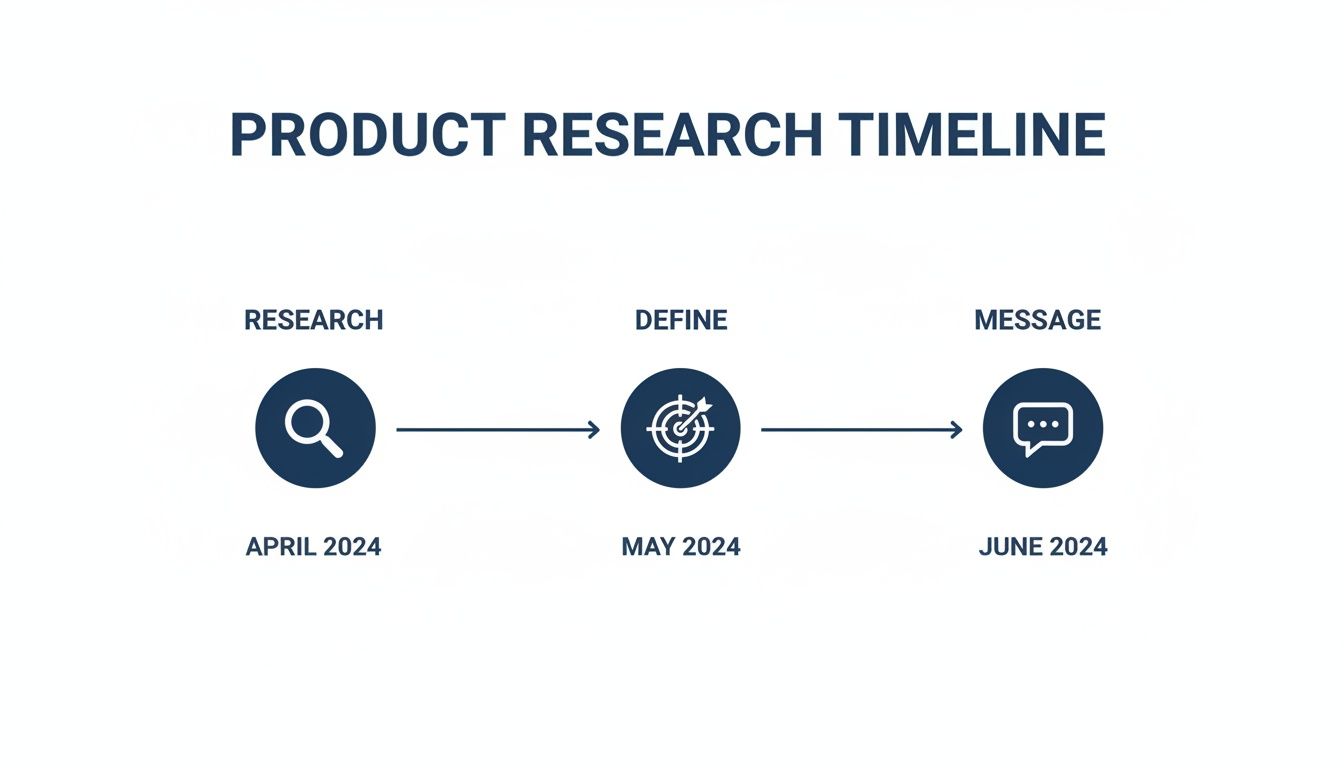
As you can see, a solid launch is sequential. Each phase builds directly on the validated insights from the one before it.
Mapping Your 90-Day Launch Sequence
A disciplined 90-day timeline is key to a controlled, high-impact rollout. It turns your strategy into a clear, day-by-day plan. We break this down by focusing on one primary goal for each 30-day block.
The table below provides a practical framework that breaks a massive project into manageable chunks.
| Phase | Key Activities | Primary Goal |
|---|---|---|
| Pre-Launch (Days -90 to -31) | Build the landing page, create sales collateral (one-pagers, spec sheets), set up CRM and automation workflows, schedule social media teasers. | Build foundational assets, configure the tech stack, and start warming up the audience. |
| Launch (Day 0) | Publish the product landing page, send the official launch email blast, activate paid ad campaigns, notify the sales team. | Execute the main announcement across all channels and drive initial traffic and leads. |
| Post-Launch (Days 1 to 30+) | Monitor lead quality and conversion rates, collect early customer feedback, A/B test landing page headlines and emails, optimize ad campaigns. | Analyze initial data, gather feedback, and fine-tune the system for long-term, sustainable growth. |
This timeline isn’t just about checking boxes; it’s about creating a smooth ramp-up to launch day and having a clear plan for what comes next. As you build this out, make sure it all ties back to your overarching product launch strategy to ensure every action aligns with your business objectives.
Automating Your Launch with GoHighLevel
Your timeline is only as good as the system that powers it. A well-configured marketing automation platform like GoHighLevel (GHL) becomes the engine that ensures no lead falls through the cracks. It’s the connective tissue between your marketing campaigns and your sales process.
For B2B and manufacturing companies, this is non-negotiable. You need a system that not only captures a lead but also equips your sales team with the intelligence to close the deal.
One of the most common failure points we diagnose is the gap between marketing generating a lead and sales knowing what to do with it. Marketing automation closes that gap by providing context and triggering the right actions at the right time.
Here’s a practical example of a GHL workflow we build for nearly every product launch:
- Step 1: Lead Capture: A prospect fills out the "Request a Demo" form on your new product landing page.
- Step 2: Instant Tagging: GHL immediately tags that contact as "Product-Launch-Lead" and "Demo-Request" in the CRM.
- Step 3: Automated Nurture: The system instantly sends a confirmation email and enrolls them in a 3-part nurture sequence highlighting key use cases.
- Step 4: Sales Notification: At the same time, GHL notifies the assigned sales rep via email or SMS with the lead's details and activity history.
- Step 5: CRM Update: An "Opportunity" is automatically created in the GHL sales pipeline, making it simple to track the deal's progress.
This automated system guarantees a consistent and immediate response, dramatically improving your odds of converting a new lead. It transforms your launch from a series of manual tasks into a smooth, efficient machine.
If you want to go deeper, you can learn more about implementing marketing automation for B2B and see how these systems drive real results.
You Need a Phased Market Entry, Not a Big-Bang Launch
Going all-in and launching your new B2B product everywhere at once is a high-risk gamble. It feels decisive, but it’s often a fast track to burning through your budget with little to show for it. A much smarter approach is a phased market entry.
Think of it as a methodical, step-by-step rollout that protects your resources, validates your assumptions, and builds momentum. It treats your launch like a calculated engineering problem, not a single, explosive event. The goal is to learn and adapt on a small scale before you commit to a full deployment.
First, Nail Your Proof-of-Concept Market
Before you think about a national or global launch, you need to establish a beachhead. This is your proof-of-concept (PoC) market—a small, specific segment where you can test your entire go-to-market system. This could be a single geographic region, a niche industry vertical, or even a group within your existing customer base.
The PoC market is where you get answers to your most critical questions with real-world data:
- Does our core messaging actually connect with this audience?
- Are the marketing channels we picked reaching these buyers effectively?
- Is our sales process working, and are we getting the right feedback from early conversations?
By focusing your initial efforts here, you create a controlled environment. If something breaks—a confusing message or a poor channel choice—you can fix it quickly and affordably. Success here gives you the validated data and confidence needed to expand.
A phased rollout isn't about being timid; it's about being strategic. You're using a smaller launch to de-risk your larger investment, ensuring that by the time you scale, you're operating with a proven playbook, not just a hopeful theory.
This measured approach is catching on for good reason. New products often drive over 25% of company revenues, but more than 40% of them fail. A recent Harvard Business Review analysis shows how step-by-step launches in key markets slash risks while building momentum. You can read the full analysis on designing a global product rollout to see the data for yourself.
Picking the Right Channels for Your B2B Audience
Once you’ve defined your PoC market, you have to figure out the best way to reach them. A common mistake is spreading your budget thinly across every platform. Don't do that. Instead, diagnose where your ideal customers actually spend their time and what kind of information they trust.
For most B2B and manufacturing audiences, a few channels consistently deliver results.
High-Impact B2B Launch Channels
Targeted LinkedIn Campaigns: Go beyond just posting on your company page. Use Sales Navigator and targeted ads to get in front of specific job titles at key accounts in your PoC market. Share technical insights and case studies, not just generic announcements.
Industry Publications & Niche Media: Find out which trade journals, blogs, and podcasts your ideal customers read. Getting a product feature or contributing a guest article can provide a massive credibility boost that paid ads can't buy.
SEO-Driven Content: Build a cluster of content around the core problem your product solves. Create "how-to" guides, troubleshooting articles, and comparison pages that answer the exact questions your prospects are typing into Google. This is a long-term asset that pays dividends for years.
Email & SMS Reactivation: Your existing database is a goldmine. A reactivation campaign announcing the new product can be one of the highest-ROI activities you perform, since you're communicating with a warm audience that already knows you.
The key is to pick two or three primary channels for this initial phase, master them, and measure their performance obsessively. Once you have a working system that generates predictable results in your PoC market, you can confidently scale your strategy.
Measuring Performance and Optimizing for Growth

Here’s a hard truth: your product going live isn't the finish line. It’s the starting gun. What comes next is the most critical phase for long-term success—growth optimization.
Many businesses celebrate on launch day and then immediately pivot to the next project. This is a massive mistake. You're leaving incredible value on the table because those first few weeks provide a flood of real-world data on what’s actually working.
Ignoring that data is like building a precision machine and then never calibrating it. A successful launch isn’t just about making a big splash; it’s about building a sustainable system that keeps generating leads and revenue.
Focus on KPIs That Actually Drive Revenue
The first step is to measure what matters. It's easy to get distracted by vanity metrics like website traffic or social media likes. They might look good in a report, but they don't tell you if your launch is making you money.
For a B2B product launch, you must track key performance indicators (KPIs) that are directly tied to your sales pipeline. These are the numbers that give you a clear, honest diagnosis of your launch’s health.
We recommend building your primary dashboard around these three core metrics:
- Marketing Qualified Leads (MQLs): A true MQL is a lead that fits your ideal customer profile and has shown real intent, like requesting a demo.
- Sales Cycle Velocity: How long does it take for a new lead from your launch campaign to become a closed deal? If it's dragging on, you have friction in your process.
- Customer Acquisition Cost (CAC): Add up the total cost of your launch campaign and divide it by the number of new customers you signed. This tells you exactly how efficient your launch engine is.
Tracking these KPIs in a platform like GoHighLevel is straightforward. You can create custom dashboards that pull data directly from your marketing and sales pipeline, giving you a real-time view of what’s happening.
Diagnosing Funnel Bottlenecks with Your CRM
Your CRM is more than a digital rolodex; it's a powerful diagnostic tool. When you see a significant drop-off at a specific stage in your sales pipeline, that’s a flashing red light telling you something is wrong.
Are MQLs getting stuck and never converting into Sales Qualified Leads (SQLs)? This could mean your marketing is attracting the wrong audience, or your sales team lacks the right collateral to qualify them effectively.
Or perhaps deals are stalling right before the proposal stage. This might point to a pricing issue, a missing case study, or a feature gap.
By analyzing the flow of leads through your GoHighLevel pipeline, you can pinpoint the exact points of friction. This data-driven approach allows you to stop guessing and start making targeted improvements that have a real impact on your close rate.
Conducting a Post-Launch Debrief
About 30 to 45 days after your launch, get your marketing, sales, and product teams together for a post-launch debrief. This isn't about pointing fingers. It's a structured analysis to get smarter for next time.
Use this simple checklist to guide the conversation.
Post-Launch Debrief Checklist
- Performance vs. Goals: How did our actual KPIs (MQLs, CAC, Sales Velocity) compare to our goals? Where did we win, and where did we fall short?
- Lead Quality Analysis: What was the unfiltered feedback from the sales team? Were the leads a good fit? Did they understand the product’s value?
- Channel Effectiveness: Which marketing channels drove the highest-quality leads? Which ones were a waste of budget?
- Messaging Resonance: What feedback did we get from prospects and early customers? Did our core messaging land, or did it confuse people?
- Internal Process Review: Were there hiccups in the handoff from marketing to sales? Did everyone have the right tools and information?
Documenting the answers turns every launch into a playbook of lessons learned. This is how you build a repeatable process for growth.
Common Product Launch Questions, Answered
Even the best-engineered launch plan runs into questions. As problem-solvers, we believe in tackling those questions head-on. Here are the straight, field-tested answers to the questions we hear most often from B2B leaders.
How far in advance should I plan my product launch?
For most technical B2B products, you need a minimum 90-day planning cycle. This timeline provides enough room for critical diagnostic work—market research, defining your audience, and building your messaging—without cutting corners.
Frankly, a 6-month timeline is even better, especially if you need to build significant pre-launch buzz or produce heavy technical content. The biggest reason launches fail is a rushed timeline that forces teams to skip the foundational diagnostic phase.
Think of it this way: a disciplined timeline isn't red tape. It’s about ensuring every part of your launch system is calibrated for peak performance. Rushing the pre-launch is like skipping a final quality check on a critical component—it’s guaranteed to fail when you need it most.
What are the most important KPIs for a B2B launch?
Focus on the numbers that tie directly to revenue. Forget vanity metrics like social media impressions; they are often misleading and don't pay the bills.
Here are the top three KPIs to track:
- Marketing Qualified Leads (MQLs) Generated: How many people matching your ideal customer profile took a high-value action, like a demo request or a spec sheet download?
- Sales Qualified Leads (SQLs): Of those MQLs, how many did your sales team accept as real, near-term opportunities? This tests your marketing and sales alignment. A low number indicates a major disconnect.
- Sales Cycle Velocity: How fast are new leads moving from first touch to a closed deal? A slow velocity often signals friction in your sales process or that your messaging is missing the mark.
Tracking these KPIs in a system like GoHighLevel gives you an honest, real-time picture of your launch's business impact. It lets you spot problems early and make adjustments before it's too late.
Can I launch a product successfully on a small budget?
Absolutely. A great launch depends on a smart strategy, not a massive spend. In fact, a smaller budget often forces the discipline and focus that lead to better results.
Instead of burning cash on expensive trade shows, zero in on high-ROI activities. A lean but powerful launch strategy should be built on:
- SEO-Focused Content: Create helpful articles, guides, and technical docs that answer the questions your customers are already Googling.
- Email & SMS Reactivation: Your existing database of past customers and old leads is a goldmine. Tapping into it is the definition of low-hanging fruit.
- Targeted Outreach: Use platforms like LinkedIn to connect directly with key decision-makers at the exact companies you want to sell to.
This is where an automation system becomes a force multiplier for a lean team. It helps you nurture leads at scale without adding headcount. The key is to replace dollars with disciplined execution.
What is the single biggest mistake to avoid?
The biggest mistake is assuming you already know your customer without validating those assumptions with fresh research. Markets shift, priorities change, and pain points evolve. Operating on old data is a recipe for launching a product nobody wants.
Too many companies fall into the trap of building something cool and then scrambling to find an audience for it. A successful launch flips that model. It starts by obsessively understanding a specific audience's problem. From there, you position your product as the undeniable solution. Skipping this diagnostic work is like building a machine on an unstable foundation—it doesn't matter how great the product is; the whole thing is destined to fail.
Ready to engineer a product launch that generates predictable, high-quality leads? The team at Machine Marketing specializes in building the strategic systems that B2B and manufacturing companies need to grow. We'll help you diagnose the market, build your go-to-market engine, and execute a launch that delivers real results.
Book a no-obligation discovery call with us today to start building a better launch system.