If you're publishing solid technical content and still hearing that deals keep stalling, the problem usually isn't accuracy. It's audience coverage. Your engineer may love the article, spec sheet, or white paper, but the plant manager wants implementation risk reduced, procurement wants a cleaner comparison, and the CFO wants a business case they can defend internally.
That gap matters because content isn't just an awareness tool anymore. A 2026 Omnibound analysis of B2B content marketing statistics says companies with active blogs generate 67% more leads monthly than those without. In technical markets, that only pays off when your content helps the whole committee move toward a decision, not when it impresses one role and leaves everyone else unconvinced.
Table of Contents
- Diagnosis Why Your Technical Content Isnt Closing Deals
- Phase 1 Map the Entire Buying Committees Pains
- Phase 2 Engineer Topics for Each Stakeholder
- Phase 3 Choose the Right Content Format to Deliver Proof
- Phase 4 Streamline Production and Distribution Workflows
- Phase 5 Measure What Matters and Iterate Your System
Diagnosis Why Your Technical Content Isnt Closing Deals
Most industrial companies assume technical depth is the answer. It isn't. Technical depth is necessary, but by itself it only serves one slice of the buying process.
The common failure pattern looks like this. Marketing publishes detailed articles, application notes, and product pages. Sales shares them with prospects. Engineers engage. Then the opportunity slows down because nobody has created content for the people asking very different questions inside the account.
A useful way to frame technical content marketing B2B is this: content has to reduce risk for every stakeholder involved in approval. If your library only answers, "Will this machine work?" but not, "Will this disrupt production?", "Can we justify the spend?", or "How hard will this be to source and compare?", your content isn't closing deals. It's only starting conversations.
Technical content that serves one evaluator often creates friction for the rest of the committee.
We see this a lot in manufacturing and industrial sales. Teams produce content that reads like an engineering resource center, but not like a buying system. That distinction matters. A resource center informs. A buying system helps each stakeholder take the next internal step.
There's also a strategic blind spot in how many teams think about B2B tech marketing. They optimize for the user, not the committee. If that sounds familiar, it's worth reviewing how a broader B2B tech marketing strategy connects content, positioning, sales enablement, and decision-maker alignment.
Stop building around a single persona
When one persona dominates the strategy, the content gets skewed toward specs, tolerances, integrations, and process detail. Those assets are important. They just aren't enough.
The people who slow or approve deals often care about different forms of proof:
- Engineering wants technical fit and performance clarity.
- Operations wants minimal disruption and smoother execution.
- Finance wants a defendable reason to invest.
- Procurement wants cleaner evaluation and lower vendor risk.
Map motivations fears and proof requirements
If a deal keeps stalling after technical validation, ask sharper questions:
- Where does the conversation slow down? After demo, after quote, or during internal review?
- Who asks for follow-up materials? Engineering, ops, finance, or sourcing?
- What objections repeat? Cost, downtime, implementation burden, compliance, comparability?
- What proof is missing? Business case, rollout plan, references, application detail?
When you diagnose content this way, the problem gets clearer fast. You don't have a content volume problem. You have a committee persuasion problem.
Phase 1 Map the Entire Buying Committees Pains
A lot of B2B content advice says "know your audience," then treats the audience like one person. That breaks down in technical sales. A Sikich roadmap for B2B marketing in technical industries points to a persistent gap: guidance rarely answers the practical question of what content persuades operations leaders, procurement, finance, and plant managers differently.
Start with a buying committee map, not a buyer persona card.
Stop building around a single persona
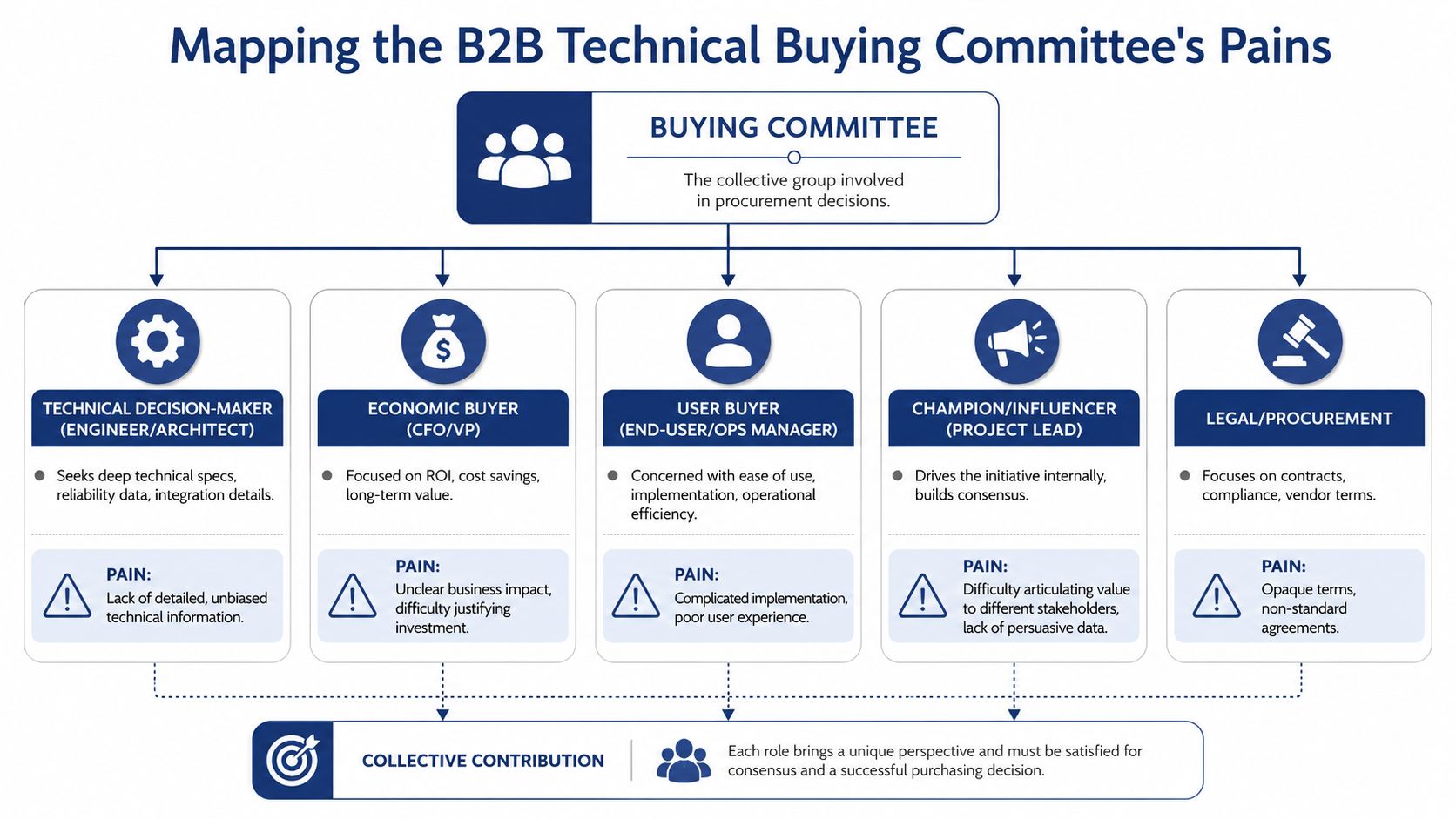
In industrial accounts, the "buyer" is usually a working group with uneven influence. One person may discover the solution, another may validate it, and someone else may block it late.
A practical committee map usually includes these roles:
| Role | What they care about | What usually worries them |
|---|---|---|
| Engineer or technical evaluator | Fit, performance, tolerances, compatibility | Missing specs, vague claims, unsupported performance language |
| Plant manager or operations lead | Implementation, uptime, training, workflow impact | Downtime, rework, slow ramp-up |
| CFO, owner, or finance lead | Payback logic, cost control, capital priority | Weak business case, unclear savings, hard-to-defend purchase |
| Procurement or sourcing | Vendor comparability, terms, standardization | Opaque process, inconsistent information, approval friction |
| Internal champion | Getting consensus and moving the project forward | Lack of shareable proof for other stakeholders |
This map should sit inside your content planning process, not in a branding deck nobody opens.
Map motivations fears and proof requirements
The easiest way to build the map is to interview people who already hear the objections. Sales hears where deals stall. Customer service hears what new customers struggle with. Applications engineers hear what prospects don't trust yet.
Use questions like these:
- For engineering: What technical question appears before a serious quote request?
- For operations: What implementation concern keeps getting raised late?
- For finance: What cost question gets asked after interest is already high?
- For procurement: What document do they ask for to compare vendors quickly?
- For champions: What do they need to forward internally without extra explanation?
Practical rule: If a salesperson has to rewrite your content into role-specific emails, your content isn't mapped tightly enough.
Then document each role with three fields only:
Decision pressure
What are they responsible for if this goes wrong?Required proof
What evidence makes them comfortable moving forward?Preferred asset
What format do they use? Long technical PDF, one-page summary, webinar replay, checklist, ROI worksheet?
Keep this lean. Teams often overbuild persona documents and underuse them. One good page per role is enough if it includes real objections and real proof requirements.
A strong buying committee map changes your editorial decisions quickly. You stop asking, "What should we publish this month?" and start asking, "Which stakeholder is still under-supported in live opportunities?"
Phase 2 Engineer Topics for Each Stakeholder
Once the committee map is done, topic planning gets easier. One product should create several topic paths because each stakeholder searches, reads, and evaluates through a different lens.
If you sell a CNC machine, an automation cell, an industrial software platform, or a precision manufacturing service, the topic spread shouldn't revolve around product pride. It should revolve around buying intent.
Turn one offer into multiple topic tracks
Take one offer and break it into stakeholder-specific angles.
For a CNC-related offer, the topics might look like this:
Engineering track
Tolerance capability, material compatibility, integration requirements, maintenance intervals, software compatibility.Operations track
Setup workflow, changeover considerations, training requirements, floor space planning, implementation checklist.Finance track
Cost justification, replacement timing, internal business case template, capital planning discussion points.Procurement track
Vendor comparison criteria, spec checklist, bid-ready requirement sheet, questions to standardize evaluation.Champion track
Internal summary deck, cross-functional FAQ, objection-handling one-pager, shortlist justification memo.
That's what a working topic architecture looks like in technical content marketing B2B. One solution. Multiple entry points. Multiple proof paths.
Use search intent not product pride
Many content calendars are built backward. The team starts with what it wants to say, not what each stakeholder needs to confirm.
A better method is to pair each role with likely intent:
| Stakeholder | Early intent | Mid-stage intent | Late-stage intent |
|---|---|---|---|
| Engineer | Understand capability | Compare fit | Validate details |
| Operations | Assess disruption | Review rollout | Reduce implementation risk |
| Finance | Understand value | Build case | Justify investment |
| Procurement | Gather requirements | Compare vendors | Simplify approval |
That intent map should drive your keyword research, page briefs, and offer design. It also sharpens SEO. Instead of chasing one broad phrase, you create a cluster of pages that mirror how a real committee researches.
If you're tightening both search visibility and conversion paths, a conversion-centric approach to technical content SEO becomes useful. The point isn't just ranking. The point is ranking with pages that help different stakeholders move.
A page can rank well and still fail commercially if it attracts the wrong role at the wrong stage.
One more trade-off worth stating clearly. Stakeholder-specific content often means narrower topics. Some teams resist that because niche pages can feel small. In practice, those pages are often more valuable because they match higher-intent questions and support real sales conversations.
When in doubt, build the topic that helps an actual opportunity move this quarter. That's usually a better editorial choice than another generic awareness article.
Phase 3 Choose the Right Content Format to Deliver Proof
Format choice is where many technical teams lose efficiency. They make everything a blog post, or everything a PDF, then wonder why buyers don't engage the same way. Format should follow the proof requirement.
A ZoomInfo roundup of B2B content marketing statistics reports that the most used formats are social media posts (94%), case studies (73%), videos (72%), and ebooks or white papers (71%). In technical markets, that matters because white papers and case studies are often the assets buyers use when they need evidence, not just awareness.
Different stakeholders trust different assets
An engineer usually won't make a serious recommendation from a lightweight promo page. A CFO usually won't read a long technical article unless someone translates it into financial relevance. Procurement rarely wants to sift through narrative copy to compare vendors.
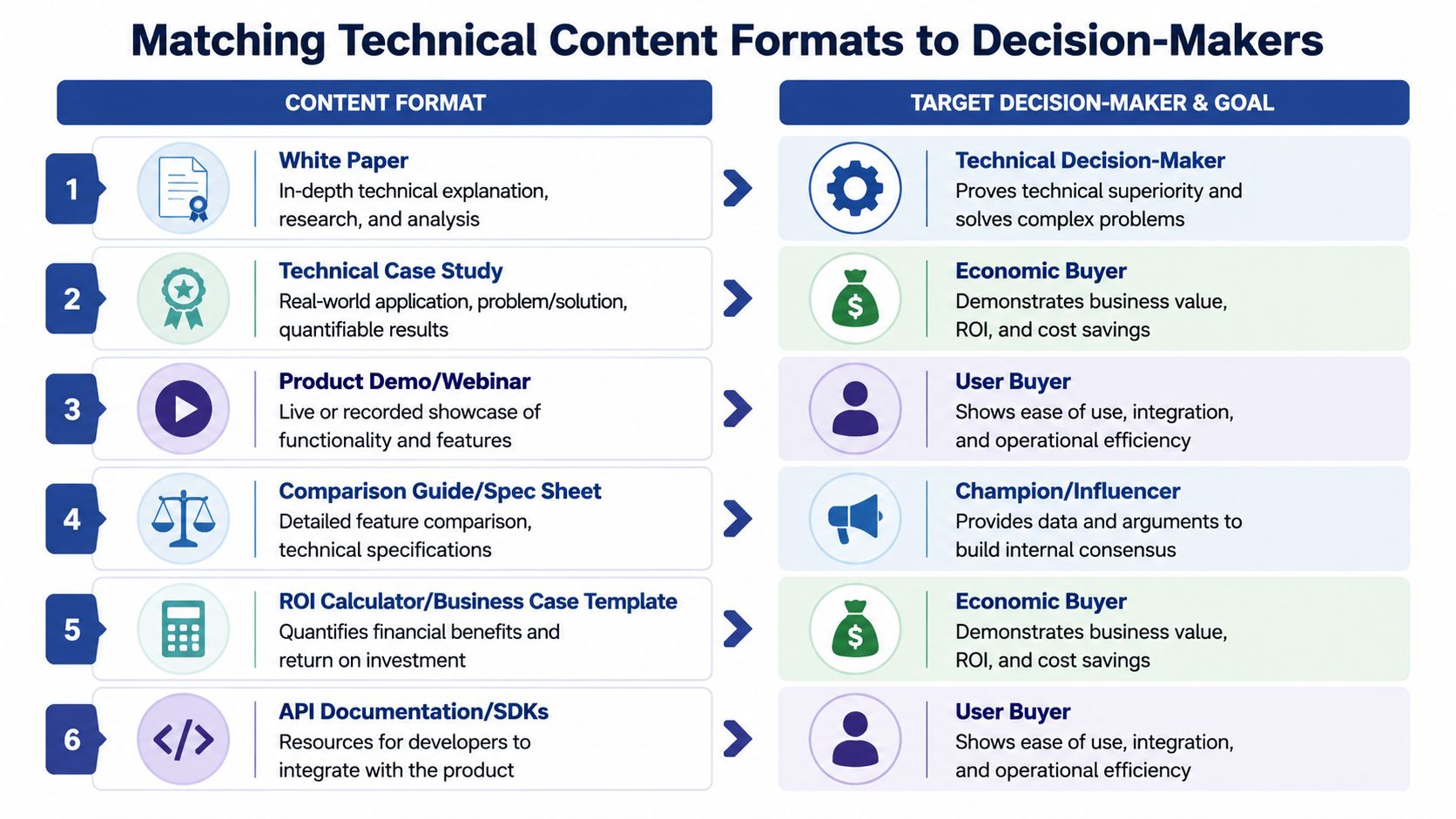
Use the asset that matches the decision:
- White paper for deep technical explanation and structured analysis.
- Technical case study for operational proof in a real application.
- Spec sheet or comparison guide for quick evaluation.
- ROI calculator or business case template for finance review.
- Webinar or demo for showing workflow, process, and usability.
- Developer or integration documentation when implementation confidence matters.
A practical format matching table
| Format | Best for | Why it works | Where teams misuse it |
|---|---|---|---|
| White paper | Engineer, technical evaluator | Creates depth and credibility | Too much jargon, not enough decision context |
| Case study | Plant manager, champion, sales | Shows applied proof | Written like a testimonial instead of an operational story |
| One-page spec sheet | Procurement, engineer | Speeds comparison | Stuffed with marketing language |
| ROI tool or business case worksheet | CFO, owner | Helps internal approval | Built with assumptions nobody can defend |
| Webinar or demo | Operations, champion | Shows process and usability | Too feature-heavy, too little scenario relevance |
Here's the practical rule. If the stakeholder needs to defend the purchase to someone else, give them a transferable asset. That's usually a one-pager, comparison table, case study, or finance-ready worksheet. If the stakeholder needs to validate truth, give them technical depth.
What doesn't work well in industrial B2B is one oversized "ultimate guide" trying to persuade everybody at once. It usually becomes too shallow for engineering and too dense for executives.
The best content asset isn't the most detailed one. It's the one that gives a specific stakeholder enough proof to say yes to the next step.
A strong content system reuses core material across formats. One SME interview can become a white paper section, a plant-manager case story, a procurement checklist, and webinar talking points. That reduces production drag and keeps the message consistent.
Phase 4 Streamline Production and Distribution Workflows
A familiar scene in industrial B2B looks like this. Marketing requests a blog post from engineering. Engineering ignores it for two weeks. Sales asks for a case study to help a live deal, but the draft is still stuck in review because no one agreed on who the asset is for or what proof it needs. The problem is rarely effort. The problem is workflow.
A Future B2B guide to content marketing for tech marketers points to the right order of operations: segment the audience, define one objective per asset, build around evidence, then distribute through the channels those buyers already use. That sequence matters in technical content marketing because a buying committee does not consume proof the same way. The engineer wants accuracy. The manager wants implementation clarity. The CFO wants a defensible business case. Production has to reflect that reality from the start.
Start with a system your experts and revenue team can repeat.
Build a workflow your experts will support
Subject-matter experts usually do not hate content. They hate vague requests, long review loops, and drafts that flatten technical nuance into marketing copy.
If you ask an engineer to "write a blog," it stalls. If you ask for a 25-minute interview tied to one buyer question and one sales objective, you usually get usable material fast.
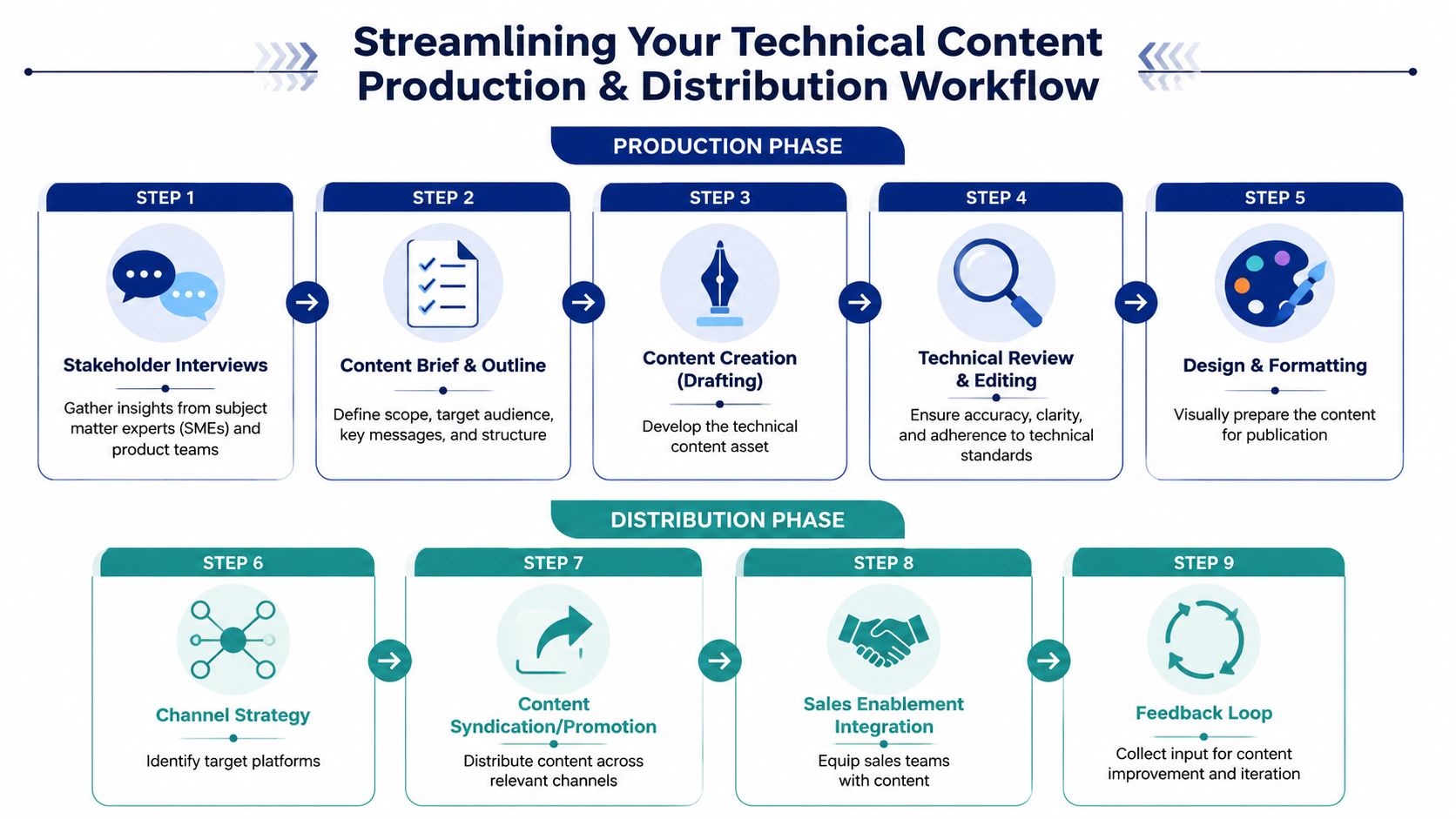
Use a production workflow like this:
Pick one committee member and one sales outcome
Example: operations manager, reduce rollout risk before a second meeting.
Another example: CFO, justify payback and implementation cost before budget review.Write a short brief before anyone gets pulled in
Include target role, deal stage, core objection, proof required, CTA, distribution plan, and the internal owner. If the asset needs to help a champion sell the project internally, say that in the brief.Interview the right people, not just the loudest expert
One SME gives technical truth. One salesperson or solutions engineer adds the objections buyers raise in real calls. For committee-stage content, I often add one product or implementation lead so the draft covers deployment reality, not just product capability.Build the draft around evidence and decision friction
Start with process details, failure points, buying objections, and decision criteria. Then shape the story for the target reader. An engineer needs specs, constraints, and performance context. A manager needs operational impact. A CFO needs cost logic, timeline, and risk reduction.Run a role-based review cycle
Technical reviewers confirm accuracy. Commercial reviewers confirm whether the piece helps move a deal. Marketing owns clarity, structure, and consistency. That split prevents endless line edits from people reviewing the wrong thing.Create controlled derivatives from the core asset
Turn one source interview into a sales follow-up email, a procurement one-pager, a short LinkedIn post, a webinar outline, and talking points for account reps. Reuse lowers production time and keeps claims consistent across channels.
Here, content teams either gain speed or lose a month.
The review process needs boundaries. Engineering should not spend time rewriting headlines. Marketing should not alter technical claims without sign-off. Sales should not approve a piece just because it sounds persuasive if it still leaves obvious buyer objections unanswered.
For teams trying to tighten reporting and workflow discipline, a clear marketing analytics framework for content and channel performance helps assign ownership and spot where production is slowing down.
AI also belongs in the workflow, but in a narrow role. Use it to clean transcripts, structure outlines, draft role-specific variants, and refine metadata. Do not use it to generate proof, invent customer outcomes, or fill in technical gaps the team has not verified. In industrial markets, one unsupported claim can create legal risk, credibility loss, and a harder conversation with procurement later.
Here's a practical walkthrough of content workflow thinking in action:
Distribute through the channels buyers already use
Distribution works best when it follows the buying motion, not the publishing calendar.
The same asset should not be pushed the same way to every stakeholder. A technical evaluator may find the piece through search or a resource hub. A plant manager may receive it from sales after a discovery call. A CFO may only see a distilled version in a follow-up email or approval packet. If distribution ignores those differences, good content still underperforms.
A practical mix in industrial B2B often includes:
- Email nurture for role-specific follow-up after form fills, trade show scans, or inbound inquiries
- Blogs and resource hubs for search capture and easy retrieval by sales
- LinkedIn for short proof points, remarketing support, and executive visibility
- Webinars for solutions that require cross-functional explanation
- Sales sequences in GoHighLevel or CRM workflows for timed delivery of the right asset to the right contact
The strongest teams package distribution around committee needs. One topic may produce a technical article for engineering, a rollout checklist for operations, and a finance-ready summary for budget approval. That shortens the sales cycle because the internal champion does not need to translate your message from scratch for the next stakeholder.
A pillar-and-cluster structure also helps here. One central page can frame the problem space. Supporting pages can answer narrower questions by role, use case, or objection. Sales then sends the exact asset that fits the conversation instead of dropping prospects into a generic library and hoping they find what matters.
When in doubt, prioritize the asset that helps a current opportunity move this quarter. That discipline keeps production tied to revenue, not just output.
Phase 5 Measure What Matters and Iterate Your System
A content program looks healthy on paper right up until the quarterly review. Marketing reports traffic. Sales says prospects still ask basic questions late in the deal. The CFO stalls approval because no one sent a financial case they could defend internally.
That gap is a measurement problem.
Page views, impressions, and average time on page do not show whether content helped an engineer validate fit, gave an operations manager confidence in rollout, or helped finance approve spend faster. In technical B2B, content succeeds when it reduces friction across the buying committee, not when it attracts attention.
Vanity metrics hide weak content systems
A high-traffic article can produce zero sales impact if it only answers early technical questions. A low-traffic ROI brief or implementation checklist may influence real revenue because it helps a manager or CFO say yes.
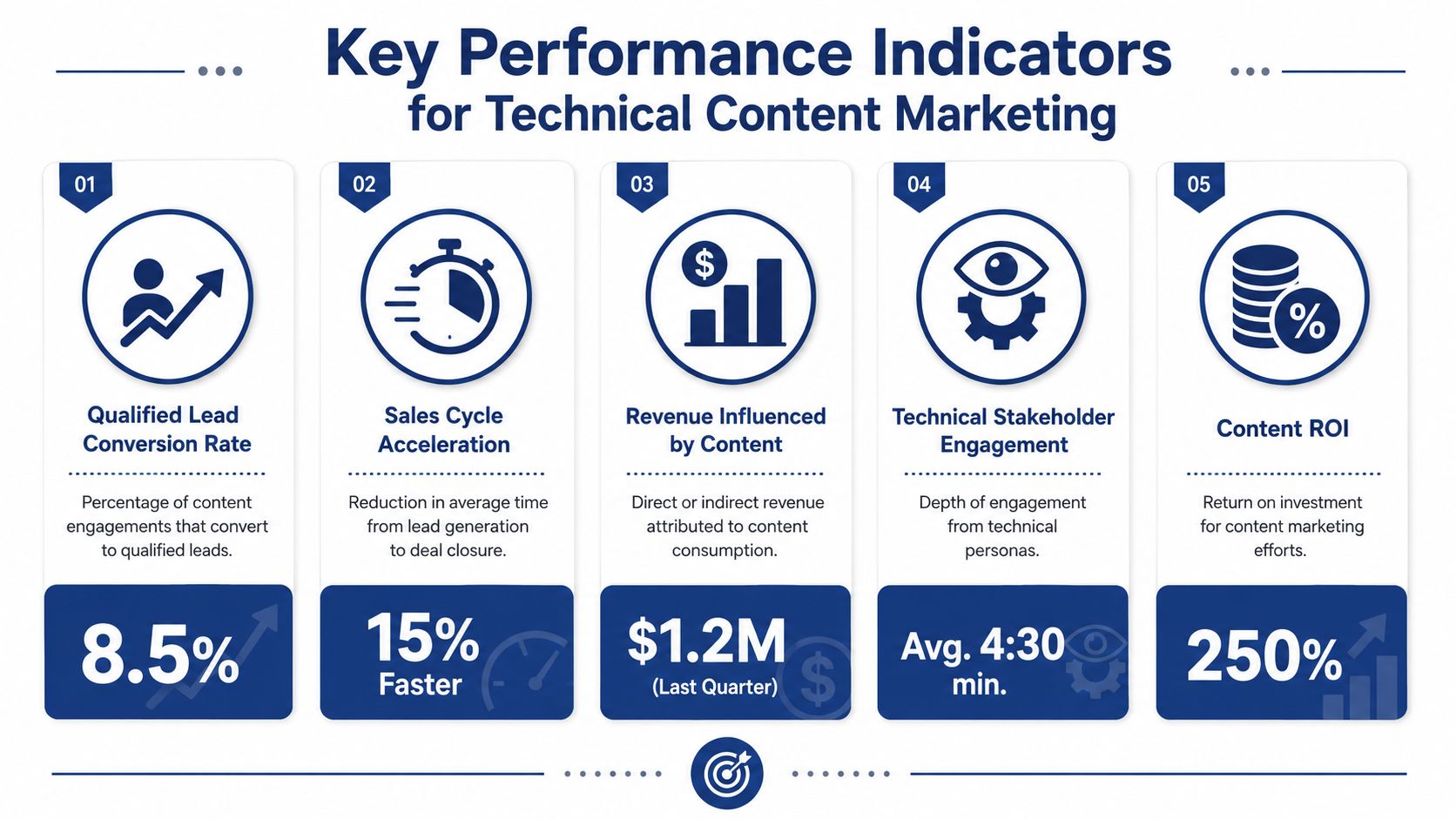
Measure content by committee contribution:
Asset consumption by role
Track which contacts engage with which assets. Separate engineers, plant managers, procurement, and finance where possible.Sales adoption
Review which assets reps send during live opportunities, and which ones they ignore.Stage movement after engagement
Look for a clear pattern between asset views, downloads, webinar attendance, or follow-up emails and the next sales stage.Conversation lift
Identify which pieces generate replies, stakeholder introductions, technical reviews, budget discussions, or meeting requests.Coverage gaps by stakeholder
Audit repeated objections against your current library. If finance keeps slowing deals and you have no total-cost or payback content, that is the issue.
If reporting cannot answer, "Which content helps a manager and CFO get comfortable enough to approve the project?" the team is still measuring publishing activity.
Build a dashboard leadership will respect
Leadership teams do not need another reporting layer full of vanity charts. They need a short view of whether content is helping deals progress.
Start with a monthly dashboard built around five questions:
| Question | What to track |
|---|---|
| Are we covering the full committee? | Assets published by stakeholder and buying stage |
| Are the right people engaging? | Views, downloads, attendance, and replies by role and asset |
| Is sales using the content? | Asset sends, shares, and mentions in active opportunities |
| Is content affecting pipeline movement? | Stage progression, follow-up meetings, and objection resolution in CRM notes |
| Where are deals getting stuck? | Repeated missing proof points by persona, objection, or stage |
A practical measurement setup matters more than a complex attribution model. Teams that need a cleaner framework should start with a plain-English guide to marketing analytics for decision-making, then build dashboards around pipeline questions instead of channel metrics.
Run a quarterly iteration review
The review process should be simple and repeatable. Pull a sample of won deals, stalled deals, and lost deals from the quarter. Then review them with sales, not in isolation.
Ask four questions:
- Which stakeholder slowed the deal?
- What evidence or reassurance did that person still need?
- Was the problem topic, format, or timing?
- Did the rep have the right asset and use it at the right moment?
This is where technical content programs improve fast. An engineer may need deeper validation. A manager may need a rollout checklist. A CFO may need a one-page business case with cost, risk, and payback spelled out in plain language. Those are different content jobs, and the measurement system has to surface which one is missing.
The teams that improve conversion rates do not publish more for the sake of output. They close the specific gap that delayed the last deal, then check whether the next set of opportunities moves faster.
That is the system. Measure by stakeholder influence. Review deal movement. Fix the missing proof. Repeat.