You're probably looking at a pricing sheet that still starts with cost, markup, and a gut feel about what the market will bear. That works until your machines, service contracts, or process improvements create real economic upside for the customer, and you realize you've been leaving money on the table on every quote. A value based pricing strategy fixes that by tying price to the outcome you create, not just the cost you incur, and the best modern guidance now treats it as a disciplined operating system built around segmentation, willingness-to-pay research, and controlled testing, not a one-time pricing exercise Improvado's overview of value-based pricing.
For manufacturers, the pressure point is usually simple. Two quotes can look similar on paper, yet one customer will pay more because your solution cuts changeover time, reduces scrap, lowers inventory risk, or protects uptime. If you're pricing every deal off a standard margin, you're treating those outcomes like free extras instead of monetizable value.
Table of Contents
- Introduction to Value Based Pricing Strategy
- Diagnose Pricing Fit and Customer Value Drivers
- Estimate Customer Willingness to Pay
- Build Your Pricing Architecture and Governance
- Pilot Pricing Model and Enable Sales
- Measure Outcomes and Refine Your Model
- Action Plan and Next Steps
Introduction to Value Based Pricing Strategy
A specialty machine shop can build two machines at the same cost and still earn very different contract values. One buyer cares about uptime guarantees, another wants shorter changeovers, and a third will pay more to avoid defect-related downtime that disrupts the whole line. If your price only tracks labor and material, you are pricing the machine, not the risk it removes or the profit it helps create.
That is why value-based pricing has become the right direction for many manufacturers moving away from cost-plus thinking and toward pricing tied to customer-perceived outcomes. In practice, the discipline is not “charge as much as possible.” It is “identify the economic value, test what buyers will accept, and capture a fair share of it.”
Practical rule: if a customer can clearly explain why your offer saves them money, time, or risk, you probably have enough value to price above cost-plus.
A useful starting point is Nexist's guide to value pricing, because it reinforces the shift from internal cost thinking to customer outcome thinking. The important work, though, happens inside your own sales process, where you have to diagnose fit, map value drivers, estimate willingness to pay, build guardrails, pilot the model, and then measure whether the system is working. The point is to turn operational gains into a price model buyers can defend. If a machine reduces scrap by 3%, cuts unplanned stoppages, or lowers rework on a critical line, you should be able to translate that into a premium that reflects avoided loss, not just saved build cost. A pricing team might separate the base machine price from an uptime or quality-performance add-on, then tie that add-on to the buyer's expected cost avoidance.
For industrial buyers, this matters even more when the benefit is not a direct revenue lift. If your product cuts defects, lowers inventory risk, or reduces downtime, the value exists even when it is operational rather than financial on the surface. The question is whether you have translated that value into a pricing model buyers can understand and finance can defend, using a clear value proposition framework from how to write a value proposition.
Diagnose Pricing Fit and Customer Value Drivers
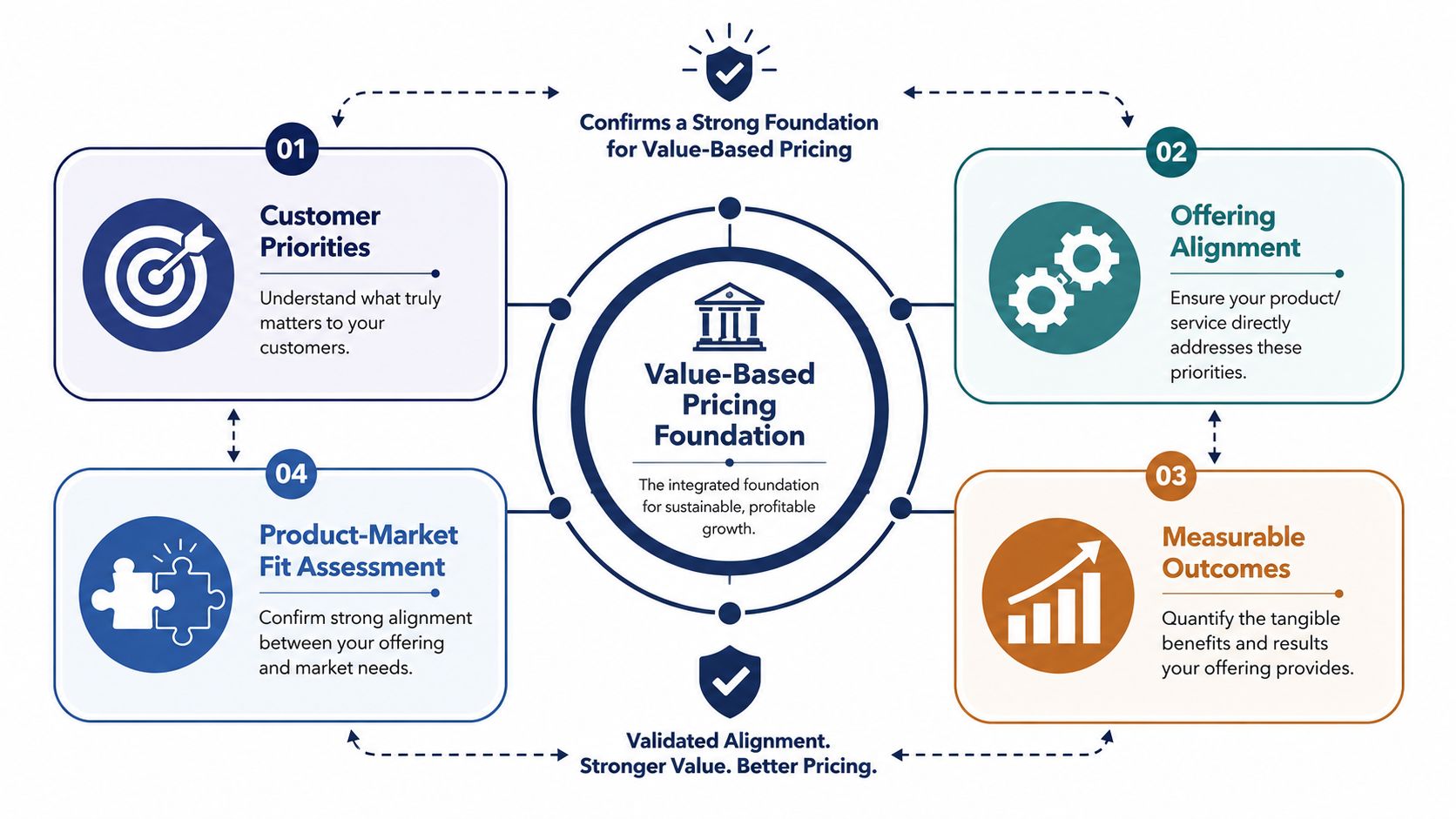
Pricing fit starts with a blunt question. Are you selling a product that customers see as interchangeable, or are you solving a problem that has measurable economic weight? If you can't answer that clearly, no pricing model will rescue the deal.
What to map before you quote
A strong value model begins with customer priorities, then checks whether your offer aligns with them. Peer-reviewed work on value-based pricing recommends three prerequisite analyses before pricing decisions, economic value analysis, CVP analysis, and a value-conversation or value-pool step to estimate demand at specific price points The pricing framework paper. That sequence matters because it keeps you from jumping straight to a price before you've defined the value.
For manufacturers, the most useful lens is often operational loss avoidance. In many industrial cases, the right starting question is not “what is the product worth?” It's “what economic loss does this eliminate for this segment?” That framing helps you separate direct gains from avoided costs, which is exactly where a lot of industrial value hides Hinterhuber on value-based pricing for operational and risk-reducing benefits.
Use this diagnostic checklist on your current offer:
- Customer priorities: What does this segment care about most, uptime, scrap reduction, throughput, compliance, or labor relief?
- Offering alignment: Which part of your product directly addresses that priority?
- Measurable outcomes: What can be counted, observed, or audited after implementation?
- Product-market fit: Would the buyer feel pain if your offer disappeared tomorrow?
Ten questions to audit pricing fit
- Which customer segment gets the clearest economic benefit from us?
- What problem do we solve better than the next-best alternative?
- Do customers describe the value in operational terms or financial terms?
- Can a buyer connect our offer to a measurable outcome within one sales cycle?
- Are we pricing by product complexity instead of customer impact?
- Where do we see the strongest retention or repeat purchase behavior?
- Which segment is most sensitive to delay, downtime, or quality risk?
- What's the cost of not solving the problem for that segment?
- Are our reps explaining value consistently, or each one is improvising?
- Would a pilot customer pay more if we tied pricing to the outcome they care about most?
If you need help sharpening the customer-side language before you quantify it, use this value proposition framework to separate features from outcomes. That distinction is important, because features get compared, while outcomes get funded.
Estimate Customer Willingness to Pay
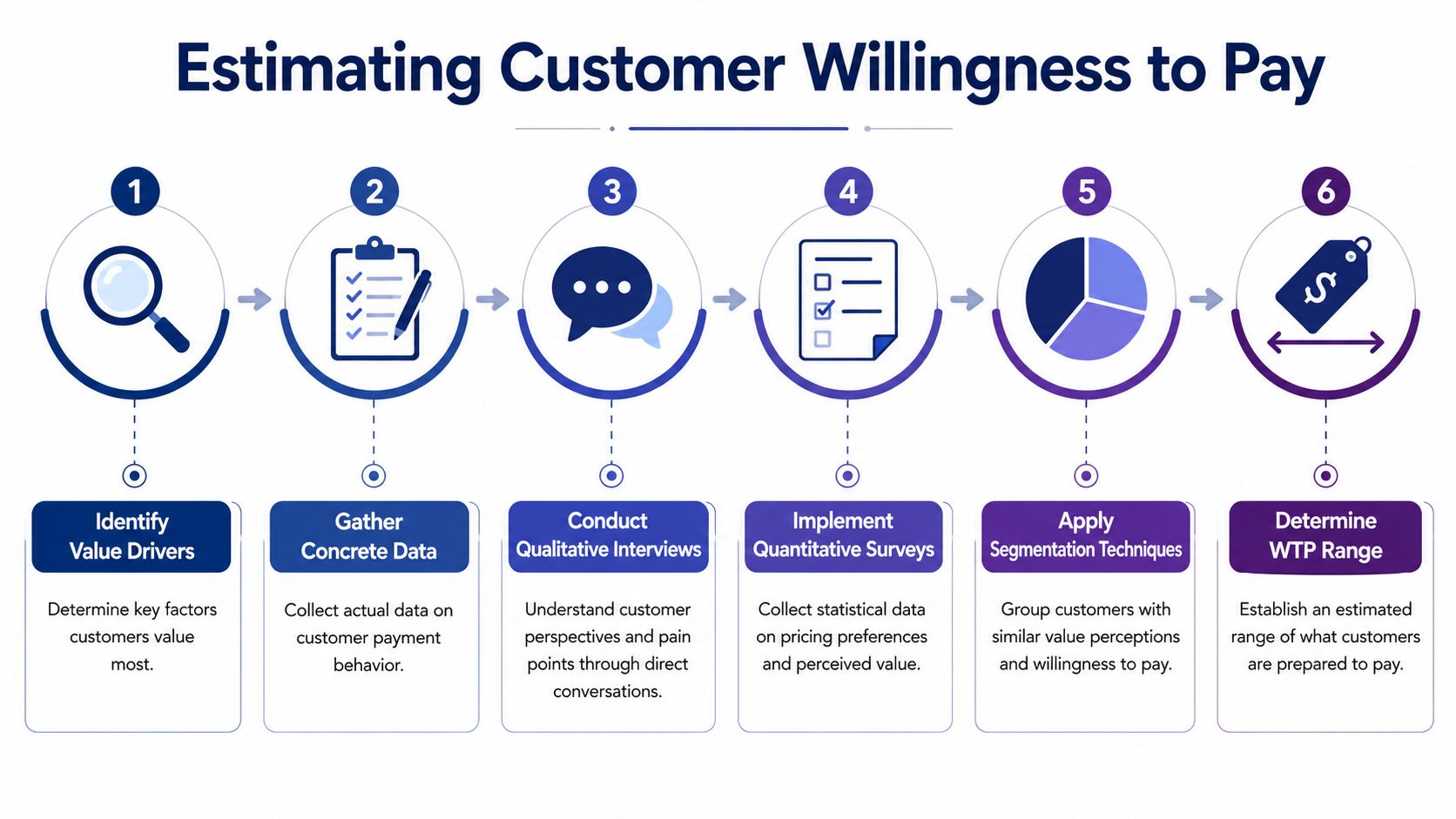
You can't price on value if you don't know what buyers will pay for that value. That's where the research starts, and it needs to be segment-specific, because willingness to pay is rarely uniform across plant size, use case, or urgency.
Use interviews and surveys to separate signal from noise
A practical enterprise workflow is to segment buyers by use case or willingness to pay, then use qualitative interviews and quantitative surveys to estimate willingness-to-pay, build personas, and run a soft rollout or A/B test before full launch Salesforce CPQ's value-based pricing guide. That's the right sequence because interviews tell you why people buy, while surveys help you see patterns across the segment.
A good interview isn't a generic satisfaction chat. Ask questions like:
- What problem were you trying to avoid when you bought this?
- Which result would make this purchase a clear win for your team?
- What would feel expensive, and what would feel cheap, for that outcome?
- What alternative would you choose if our offer didn't exist?
A well-run survey should force trade-offs. If every option looks attractive, you're not measuring willingness to pay, you're collecting compliments. For manufacturing buyers, it also helps to ask about operational consequences, not just feature preferences, because reliability, rework reduction, and throughput stability often drive the primary budget decision.
Buy the answer you can defend, not the answer that flatters your product.
If you work in adjacent sectors and want a demand-side analogy, AI demand forecasting for food and beverage is a useful reference point for how operational data can support decisions that look qualitative on the surface. The logic is similar. Better inputs produce better commercial decisions.
Run a soft test before you scale
The goal of the pilot isn't to prove you're right. It's to find out where the price breaks. Use a small set of customers, present the new offer, and compare reactions against your current pricing logic. Then track whether the segment accepts the framing, objects to the metric, or only responds when the outcome is made concrete.
A useful companion resource here is market research focus groups, especially if your buyers struggle to articulate the value until they hear alternatives side by side. That's often the case in industrial markets, where customers know what hurts but don't always know how to price relief.
Build Your Pricing Architecture and Governance
Once you know what customers value and roughly what they'll pay, the next step is to turn that insight into a pricing structure your team can run. Many companies stumble during this process. They get the concept right, then lose the value through discounting, inconsistent quoting, or a price list that's impossible to explain.
Choose a value metric people can understand
A benchmark-level framework recommends estimating economic value created and then capturing a share of it, with list prices often set at roughly 20% to 40% of economic value to customer using guardrails like discount bands and approval levels Umbrex value-based pricing framework. The exact level depends on segment economics, competitive pressure, and the credibility of your outcome proof, but the logic is steady, capture a share, don't try to take all of it.
The best value metrics are simple enough for sales to explain and finance to forecast. Common choices include:
- Usage-based metrics when value rises with consumption
- Outcome-based metrics when the buyer cares about a result
- Tiered metrics when value grows with capability or service depth
- Capacity-based metrics when scale itself creates value
In industrial settings, a good metric usually mirrors how the customer experiences the benefit. If your system reduces downtime, pricing by line, site, or asset class may make more sense than pricing by feature count. If you reduce inventory risk, pricing tied to throughput or replenishment support can be easier to defend than a flat package fee.
Add guardrails before the first quote goes out
A pricing architecture is only as good as the rules around it. If reps can discount freely, your value story leaks out of the deal before it reaches the customer's signature. Build these controls into your process:
- Discount bands: Define the range where normal selling authority applies.
- Approval levels: Route bigger concessions to a manager or finance owner.
- Deal scoring: Flag high-value, high-risk, or unusually discounted opportunities.
- Quote workflows: Make sure the CRM prompts reps to justify exceptions.
Practical rule: if a discount can't be explained in the CRM, it's probably a margin leak, not a strategy.
A clear architecture also helps you build tiers that match buyer size and complexity. Small accounts usually need simpler offers, while larger accounts need more specific service, stronger governance, and clearer boundaries around implementation effort. That's not about making the price look complex, it's about making the economics predictable.
If your team needs to tighten the commercial side, sales enablement best practices can help you turn pricing rules into rep behavior without forcing every seller to improvise.
Pilot Pricing Model and Enable Sales
A new price model should never go straight from spreadsheet to full rollout. That's how teams create avoidable friction, confuse reps, and lose deals they would've won with a better rollout plan. A controlled pilot lets you see where the message lands, where it doesn't, and which objections are really about price versus risk.
Test the model in two or three segments first
The cleanest pilot is a comparison between your current approach and the new value-based quote structure. Start with two or three segments where the value signal is strongest, then vary one or two price elements at a time so you can see what changes buying behavior. That usually means testing the metric, the tier, or the framing, not everything at once.
You can structure the test around:
- Contract length: Shorter commitments reduce buyer risk and make acceptance easier.
- Performance guarantees: Useful when the buyer wants proof that outcomes matter.
- Pricing increments: Small adjustments help you see the threshold where acceptance drops.
- Control groups: Keep a cost-plus or legacy quote group for comparison.
A practical pilot plan should also include post-quote feedback. Ask customers what felt fair, what felt unclear, and what would have made the offer easier to approve internally. Those answers are more useful than a generic win-loss report because they tell you whether the issue is value communication, risk perception, or the metric itself.
Train the sales team on the value story
Your reps need a script that links the price to the outcome, not a generic defense of premium pricing. If they only know how to say “this is better,” they'll default to discounting when a buyer pushes back. If they can explain the business consequence, they'll have a chance to hold the line.
A simple rep enablement checklist should cover:
- Value-driver language: Which operational benefit matters to each segment?
- Objection handling: What do we say when a buyer asks why this costs more?
- Proof points: Which data or customer examples support the claim?
- Quote discipline: When do we hold price, and when do we escalate?
Sales doesn't need more slogans. It needs a sharper reason to keep the price tied to the outcome.
The pilot also gives you a place to test internal alignment. Finance, sales, and operations should all be able to explain why the new structure exists. If one team can't defend it, the market will find the gap quickly.
Measure Outcomes and Refine Your Model
A value based pricing strategy only becomes durable when you measure whether it is producing the commercial result you expected. In practice, that means tracking churn, CLV:CAC, net revenue retention, and segment-level conversion so pricing stays tied to realized value. Baremetrics' guidance on value-based pricing metrics gives a useful starting point for that review.
Watch the metrics that tell you if price and value still match
The strongest signals are the ones that connect pricing to customer behavior. If conversion falls in one industrial segment, the price may be out of step with the value proof you gave that buyer group. If retention stays steady but expansion slows, the model may be undercharging for higher-value accounts or missing a tier that fits heavier usage, higher uptime gains, or lower defect risk.
Use this dashboard logic:
| Metric | What it tells you | What to look for |
|---|---|---|
| Churn | Whether buyers still believe the value is real | Rising churn can signal weak onboarding or poor value fit |
| CLV:CAC | Whether the customer economics support the price model | The benchmark cited in practitioner guidance is 3:1 |
| Net revenue retention | Whether expansion is happening after the sale | Flat or declining retention suggests the model is not scaling value |
| Segment-level conversion | Whether the price is too high for a specific buyer group | Weak conversion in one segment points to a mismatch, not always a bad product |
Use the data to decide whether to scale or revise
If a pilot segment accepts the new pricing and the downstream metrics stay healthy, the model is ready for a broader rollout. If the results are mixed, do not rush to change pricing before checking whether the underlying issue is segmentation, value proof, or sales execution. Those are different problems, and each one needs a different fix.
A helpful benchmark from the same practitioner guidance is churn in the 5% to 7% range, used as a signpost for whether the pricing model is behaving as expected. Do not treat that as a universal target for every manufacturing business, but do treat it as a reminder that pricing should be judged by recurring commercial results, not only by closed deals.
Action Plan and Next Steps
If you want to make this real in the next 90 days, start with a narrow, disciplined rollout. First, pick one offer where the value is easy to explain, then map the customer outcomes, estimate what buyers might pay, and build a simple pricing architecture with clear guardrails. That sequence keeps you from overengineering the model before you know whether the market will respond.
A practical checklist looks like this:
- Diagnose one segment: Pick the buyer group with the clearest operational pain.
- Map value drivers: Separate direct revenue gains from avoided losses.
- Interview customers: Use real conversations, not assumptions.
- Test willingness to pay: Run a soft pilot before full rollout.
- Lock governance: Add approval rules so discounts don't erase value.
- Track outcomes: Review conversion, retention, and revenue quality after launch.
The biggest mistakes are usually predictable. Teams skip customer interviews, price to internal cost, or let discounting eat the premium they worked hard to earn. If you avoid those traps, you'll have a pricing system that reflects what you deliver, not just what it costs to build.
A CTA for Machine Marketing.