If you’ve looked at a competitor’s website and thought, “We do better work than they do, so why are they above us?”, the answer often sits outside your website.
It sits in the rest of the web’s opinion of your business.
That’s what a backlink profile is. It’s the record of which sites link to you, what those links look like, where they come from, and whether they signal trust or risk. For B2B manufacturers and SMBs, this matters because buyers often discover vendors long before they fill out a form. They search, compare, validate, and narrow the list before sales ever hears from them.
When we diagnose search visibility, we don’t treat rankings like luck. We treat them like a system. A backlink profile is one of the clearest system readings you can inspect.
Why Your Competitor Might Be Winning Online
A common scenario looks like this. You sell industrial services, custom parts, fabrication, machining, or a specialized business service. Your site explains what you do. Your team has experience. Your pricing is competitive. Yet a competitor keeps showing up first.
That usually means Google sees stronger off-page trust signals on their side.
For B2B manufacturers and businesses, the gap is blunt. 95% of all web pages have zero backlinks, yet 92.3% of top 100 ranking websites have at least one backlink, according to Capterra’s backlink profile research. That tells you two things. First, most pages never build authority. Second, even a modest number of real links can separate a serious player from the invisible majority.
What this looks like in practice
A competitor may not have a better homepage. They may have:
- Trade mentions: An industry publication linked to one of their process pages.
- Directory coverage: They’re listed in supplier directories buyers already trust.
- Useful technical content: Their guides attract citations from partners, distributors, or niche blogs.
- Consistent authority growth: Their site has accumulated references over time instead of sitting static.
Search engines read that as a reputation trail.
A backlink profile is less like advertising and more like references on a bid package. The quality of the references changes how your company is perceived before anyone contacts you.
If you want to understand why traffic stalls, start there. Your website may have a design problem, a content problem, or a conversion problem. But it may also have an authority problem. If you need a broader visibility diagnosis beyond links, this guide on how to increase organic traffic is a useful companion.
Diagnosing Your Website's Authority
The simplest answer to what is backlink profile is this. It’s the full collection of websites and pages linking to your site.
That definition is accurate, but it’s not enough to be useful. A better way to think about it is as your website’s professional reputation file. Every backlink is a reference. Some references come from respected industry sources. Some come from weak, irrelevant, or suspicious sources. Search engines compare the whole mix.
Think like a buyer, not just an algorithm
If a respected trade publication links to your CNC capabilities page, that feels credible. If a random low-quality directory links to the same page with stuffed keyword anchor text, that feels manipulative.
Google makes a similar judgment.
A backlink profile includes more than link count. It includes the sites linking to you, the pages they point at, the words used in the link, whether the links are dofollow or nofollow, and whether the overall pattern looks natural.
What a healthy profile tends to look like
A healthy profile usually doesn’t look perfect. It looks believable.
According to Morningscore’s backlink profile benchmarks, a healthy profile often maintains a 60-40 dofollow-to-nofollow ratio, with 20-30% branded anchor text and 10-20% exact-match anchor text, plus steady growth over time. The same source notes that profiles with over 30% low-quality links correlate with ranking drops of 15-50 positions.
That matters because many businesses still chase the wrong target. They buy cheap links, submit to junk directories, or overuse exact-match keywords because it feels like progress. It isn’t. It’s often the SEO equivalent of wiring a machine with the wrong voltage. It may turn on briefly, but it creates downstream failure.
Practical rule: If your link profile grows in a way that doesn’t match how a real business earns attention, treat it as a warning sign.
Questions to ask during diagnosis
Before you try to build more links, ask:
- Who is linking to us now? Are these real businesses, publishers, associations, and partners?
- What pages attract links? Your homepage, service pages, blog posts, or dead pages?
- Do the anchors sound natural? Brand names and descriptive phrases are usually safer than repeated keyword stuffing.
- Is growth steady or erratic? Sudden spikes deserve scrutiny.
Tools like Ahrefs, SEMrush, and Google Search Console help surface these patterns. The tools don’t make the decision for you. They give you the readings. You still need judgment.
The 8 Key Components of a Backlink Profile
A backlink profile is a system, not a single score. If you only look at total links, you’ll miss the fault. The better approach is to inspect the main components one by one.
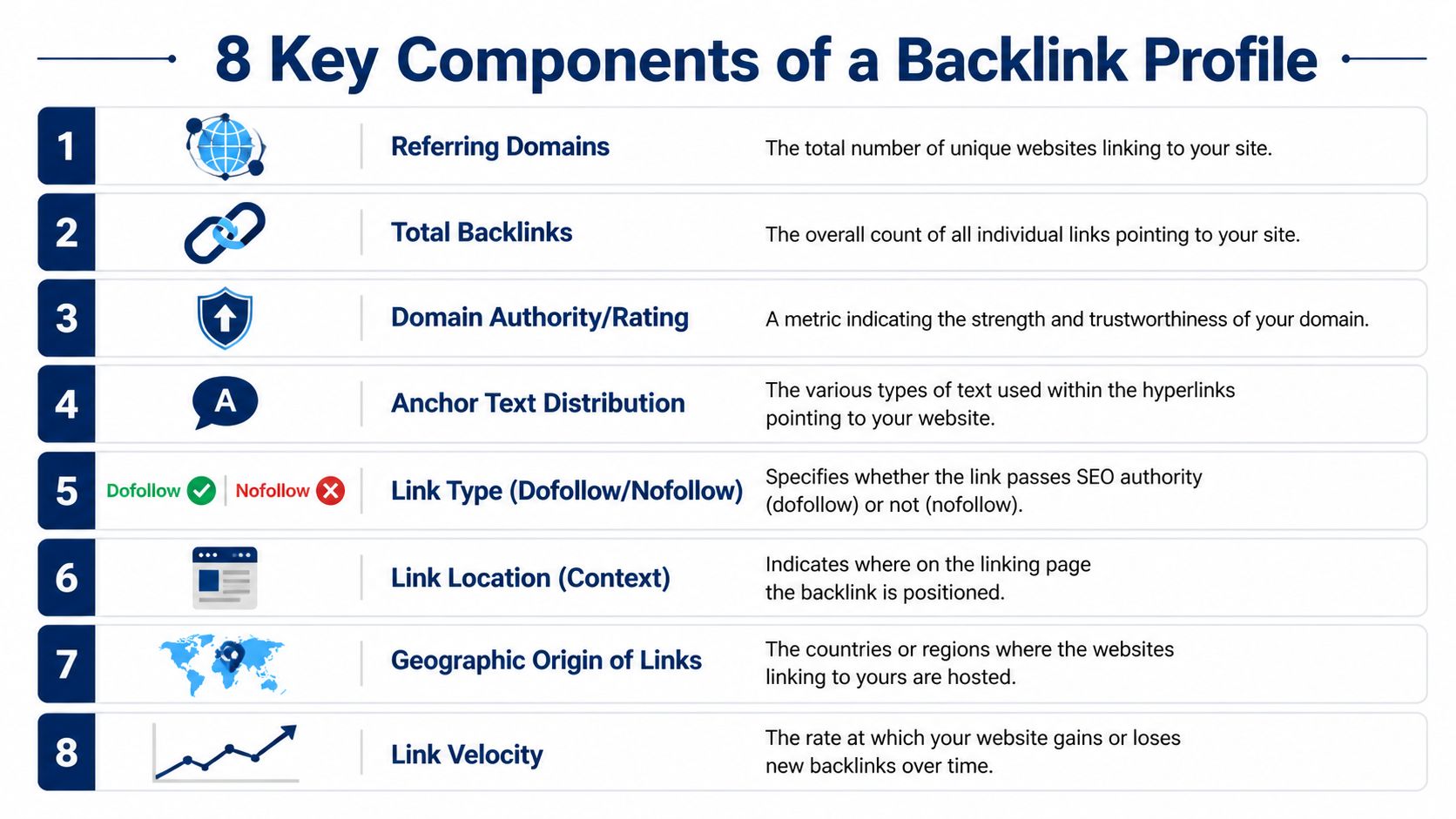
Referring domains
This is the number of unique websites linking to you.
Ten links from one domain don’t carry the same diagnostic value as links from ten separate domains. For most businesses, diversity of sources is a stronger signal than repeated links from the same site. In practice, this tells you whether your authority is broad or concentrated.
Total backlinks
This is the full count of all inbound links.
A high total can be useful, but only in context. Sitewide footer links, repeated directory links, or boilerplate links can inflate this number without improving trust. Treat it like total machine runtime. It matters, but it doesn’t tell you whether the system is healthy.
Domain authority or rating
Most SEO tools estimate site strength using a proprietary score.
These scores are not Google’s score, but they are useful for comparison. When you review potential backlinks, they help you judge whether the linking site is established or weak. If you want a deeper read on how these authority metrics help with predicting website ranking potential, that resource explains the concept well.
Anchor text distribution
Anchor text is the clickable text in the link.
Healthy anchor text usually includes brand names, page titles, plain URLs, and natural descriptive phrases. Trouble starts when too many links use the same commercial keyword. That pattern often signals forced SEO instead of earned citations.
Link type
Links can be dofollow or nofollow.
Dofollow links generally pass authority signals. Nofollow links often don’t in the same way, but they still matter for brand visibility, referral traffic, and profile naturalness. If every link in your profile is one type, the profile can look manufactured.
Link location and context
A link inside relevant editorial content is usually stronger than a link buried in a footer, sidebar, author bio, or random directory page.
Context matters because relevance matters. A link from an engineering article discussing tolerances, materials, or manufacturing processes carries a very different meaning than a link surrounded by unrelated content.
Geographic origin of links
This matters most when your market is regional, national, or tied to specific buyer locations.
If you sell to North American manufacturers but most links come from unrelated foreign sites with no business connection to your market, that’s a diagnostic red flag. Geographic mismatch doesn’t automatically mean spam, but it deserves inspection.
Link velocity
This is the pace at which you gain or lose links.
Steady growth is easier to trust. Sudden spikes can be legitimate, especially after a product launch, media mention, or useful content release. They can also signal low-quality campaigns. The pattern matters more than the raw burst.
A healthy backlink profile usually looks boring in the best possible way. It grows the way a real company earns attention.
A quick warning checklist
If you review your profile and see these patterns, slow down and inspect further:
- Heavy repetition: The same anchor text appears again and again.
- Weak source quality: Many links come from thin, irrelevant, or suspicious sites.
- Bad distribution: Nearly all links point only to the homepage.
- Erratic acquisition: Large bursts appear without any corresponding campaign or publicity event.
Why Your Profile Drives B2B Lead Generation
Backlinks matter because rankings matter. Rankings matter because buyers still search before they contact.
That chain sounds obvious, but many companies stop at “SEO.” They treat backlinks as a technical metric instead of a lead generation asset. For B2B, that’s a mistake.
Better authority puts you in front of active buyers
When a buyer searches for a manufacturing capability, service category, or technical solution, Google has to decide which companies look credible enough to show first. Backlinks help shape that decision.
According to Fire Us Marketing’s backlink statistics roundup, pages ranking first have an average of 3,800 backlinks, while pages ranking 2-10 average 1,000 backlinks. The same source notes that for B2B, websites with 30-35 high-quality backlinks can generate over 10,500 visits monthly on average.
Those aren’t vanity numbers. They’re evidence that authority and visibility tend to travel together.
Relevance is what turns visibility into pipeline
For a manufacturer, a link from a trade publication, supplier directory, certification body, or industry association does more than help rankings. It pre-validates your business.
A procurement manager, plant manager, engineer, or operations lead may discover you in search, then see your company referenced elsewhere. That second signal matters. It reduces friction.
Here’s the business logic:
- Search visibility creates first contact
- Relevant links reinforce credibility
- Credibility improves inquiry quality
- Better inquiry quality supports sales efficiency
That’s why backlink work belongs in the same conversation as content strategy, website UX, CRM follow-up, and sales qualification. If your lead system is thin, strengthening authority can improve the top of the funnel. If you need to tighten the rest of the process too, this guide on how to generate B2B leads helps connect traffic to actual pipeline thinking.
What works and what doesn’t
What works is targeted authority. A handful of links from sources your buyers recognize can outperform a pile of irrelevant mentions.
What doesn’t work is chasing volume without fit. Links that never send qualified traffic, never support trust, and never align with your market may pad a report, but they don’t improve the sales conversation.
The best backlink in B2B is the one a buyer would actually respect if they saw it.
Your Step-by-Step Backlink Analysis Workflow
You don’t need a full enterprise SEO stack to do a useful first-pass audit. You need a repeatable workflow and enough discipline to look at the right readings.

Step 1 Choose your tool
Start with one of these:
- Google Search Console: Best for seeing backlinks Google reports directly.
- Ahrefs: Strong for backlink discovery and competitor comparison.
- SEMrush: Useful if you also want audit and toxicity-style reporting.
If you also want a sharper process for evaluating what competitors are doing before you chase links, Sight AI's competitor research is worth reviewing. It helps frame backlink analysis in the larger context of competitor SEO patterns.
Step 2 Pull the base reports
Run these reports first:
- Referring domains report
- Top linked pages report
- Anchor text report
- New and lost links report
Don’t overcomplicate this stage. You’re trying to answer four diagnostic questions. Who links to us? What do they link to? How do they describe us? Has the pattern changed?
Step 3 Run a 15-minute diagnosis
A useful fast audit checks only a few things first.
Check source quality
Scan the top linking domains manually. Are they real businesses, associations, trade sites, local organizations, directories, or media sources? Or do they look autogenerated, irrelevant, or thin?
Check page distribution
See which pages receive links. If all links point only to the homepage, your content and service pages may not be earning trust on their own. That limits how much authority reaches the parts of your site that generate leads.
Check anchors
Look for overuse of exact-match commercial phrases. Natural profiles usually include brand names, URLs, and descriptive variants. Forced repetition is a warning sign.
Key backlink profile metrics to track
| Metric | What to Look For | Why It Matters |
|---|---|---|
| Referring Domains | Real, relevant websites from credible sources | Shows breadth of trust across the web |
| Total Backlinks | Reasonable volume without obvious inflation | Helps you spot scale, repetition, and noise |
| Anchor Text | Mostly branded and natural phrasing | Reduces over-optimization risk |
| Top Linked Pages | Links reaching service, resource, and core commercial pages | Indicates whether authority supports lead generation |
| New and Lost Links | Steady change, not unexplained swings | Reveals momentum and potential problems |
| Link Type | A believable mix of dofollow and nofollow | Supports a natural-looking profile |
Step 4 Compare against one competitor
Don’t compare yourself to giant publishers. Compare yourself to the businesses that take your deals.
Review:
- Which domains link to them but not to you
- Which content assets attract their links
- Whether they earn links from trade organizations or niche directories
- How their strongest linked pages map to commercial intent
Often, hidden opportunities reveal themselves. A competitor often has links from sources you could realistically earn too. The issue usually isn’t access. It’s that no one has run the diagnosis.
A good walkthrough can help if this is your first audit pass.
Step 5 Mark quick wins and red flags
Quick wins include unlinked mentions, outdated directory listings, partner pages without links, and strong content pages that deserve outreach.
Red flags include suspicious domains, repeated keyword anchors, and pages attracting the wrong kind of attention.
If you’re busy, this is enough for one session. A basic audit does not need to be glamorous. It needs to be repeatable.
Actionable Improvement Strategies for Your Business
Most backlink advice fails because it’s too generic. “Get high-quality links” isn’t a strategy. It’s an outcome.
The better question is where your business can earn links that make sense for your market.
According to Linkbuilder.io’s backlink profile analysis, B2B sites with 40%+ niche-relevant backlinks rank 2.3x higher for competitive keywords, yet only 15% of manufacturer sites currently have such profiles. That matters because it shifts the goal away from broad authority and toward relevant authority.

If you’re a B2B manufacturer
Manufacturers usually have more real-world link opportunities than they think. They just don’t package them as assets.
Try these:
- Supplier and industry directories: Get listed where buyers research vendors. Prioritize credible vertical directories and association sites.
- Trade publications: Contribute practical articles on process design, materials, tolerances, compliance, maintenance, or sourcing.
- Partner collaboration: Co-host a webinar or technical resource with a complementary vendor, distributor, or integrator.
- Project and capability pages: Build pages worth citing, not just thin service blurbs.
- Certifications and memberships: Make sure every association, certification body, and partner profile links back to the right page.
A lot of backlink success in manufacturing comes from translating internal expertise into linkable technical content. This is where content depth matters. If you want a stronger framework for turning expertise into assets buyers and publishers will reference, this guide to conversion-centric technical content SEO is a strong next step.
If you’re a local SMB or service business
Local businesses need relevance and trust, not national-scale link counts.
Start with:
- Chamber and business associations: These are basic but still valuable when legitimate.
- Community sponsorships: Events, nonprofits, and local programs often maintain sponsor pages.
- Vendor and partner pages: Ask existing partners to link to your company where the relationship is public and real.
- Local press and niche blogs: Pitch useful expertise, not self-promotion.
- Resource pages: Build location or service resources that local organizations would cite.
What to avoid
Some tactics create more cleanup than value.
Avoid:
- Cheap bulk link packages
- Irrelevant guest posting on unrelated sites
- Exact-match anchor campaigns
- Junk directories that exist only for SEO
- Any tactic you’d be embarrassed to explain to a customer
Good link building usually looks like good business development with better packaging.
A simple monthly operating rhythm
If you want consistent improvement, keep the process small and disciplined:
- Audit new links
- Review competitor gains
- Publish one useful asset worth citing
- Request links from real relationships
- Clean up obvious low-quality noise
That cadence is generally manageable. It also keeps authority growth tied to actual business activity.
From Diagnosis to Dominance Your Next Steps
A backlink profile isn’t mysterious once you stop treating it like an abstract SEO score.
It’s a system reading. It shows how the web evaluates your business, which sources trust you enough to reference you, and whether your authority is growing in a believable way. For B2B manufacturers and SMBs, that system affects visibility, credibility, and lead flow.
The practical takeaway is simple. Don’t chase random links. Diagnose the profile you have, compare it to the competitors winning the market, and improve the parts that influence trust. That means better sources, better content assets, better distribution across key pages, and fewer low-quality distractions.
If you haven’t reviewed your backlink profile recently, run the 15-minute audit outlined above. Check the domains, anchors, linked pages, and recent changes. That one pass will usually show you whether the problem is authority, content, or both.
Then act on what you find.
If you want a second set of eyes on your visibility system, Machine Marketing can help you diagnose where authority, content, CRM follow-up, and lead generation are breaking down. A focused review can show you what to fix first, what to ignore, and how to build a more reliable growth engine.