If your lead follow-up feels manual and inconsistent, you’re dealing with a system problem. So, what is a drip email campaign? It's your automated communication system—a pre-built sequence of emails sent to prospects over time. It works 24/7 to nurture relationships and guide potential customers toward a decision, all without you lifting a finger.
This guide will show you how to diagnose your current follow-up process and build a drip campaign that turns inconsistent effort into a reliable growth engine.
What is an automated drip email campaign?
Many business owners we work with struggle with the same challenge: inconsistent lead follow-up. A promising inquiry comes in, gets one or two manual emails, and then falls through the cracks as the chaos of daily operations takes over. A drip campaign is the system that fixes this.
Instead of sending one-off "email blasts" to your entire list, a drip campaign delivers a series of targeted messages to one person over a set period. The process is kicked off by a specific user action—the trigger—like downloading a brochure, signing up for your newsletter, or requesting a quote.
A System for Consistent Follow-up
The entire point of a drip campaign is to deliver the right message at the right time to move a prospect from interested to ready-to-buy. Each email "drips" out valuable information, building trust and keeping your business top-of-mind without any manual effort. This approach is the bedrock of effective B2B marketing automation, turning random contact into a strategic, ongoing conversation.
A drip campaign transforms your marketing from a series of isolated announcements into a purposeful, guided journey for each potential customer. It’s the difference between shouting with a megaphone and having a thoughtful, one-on-one conversation.
This visual captures the fundamental difference between a targeted drip sequence and a generic email blast.
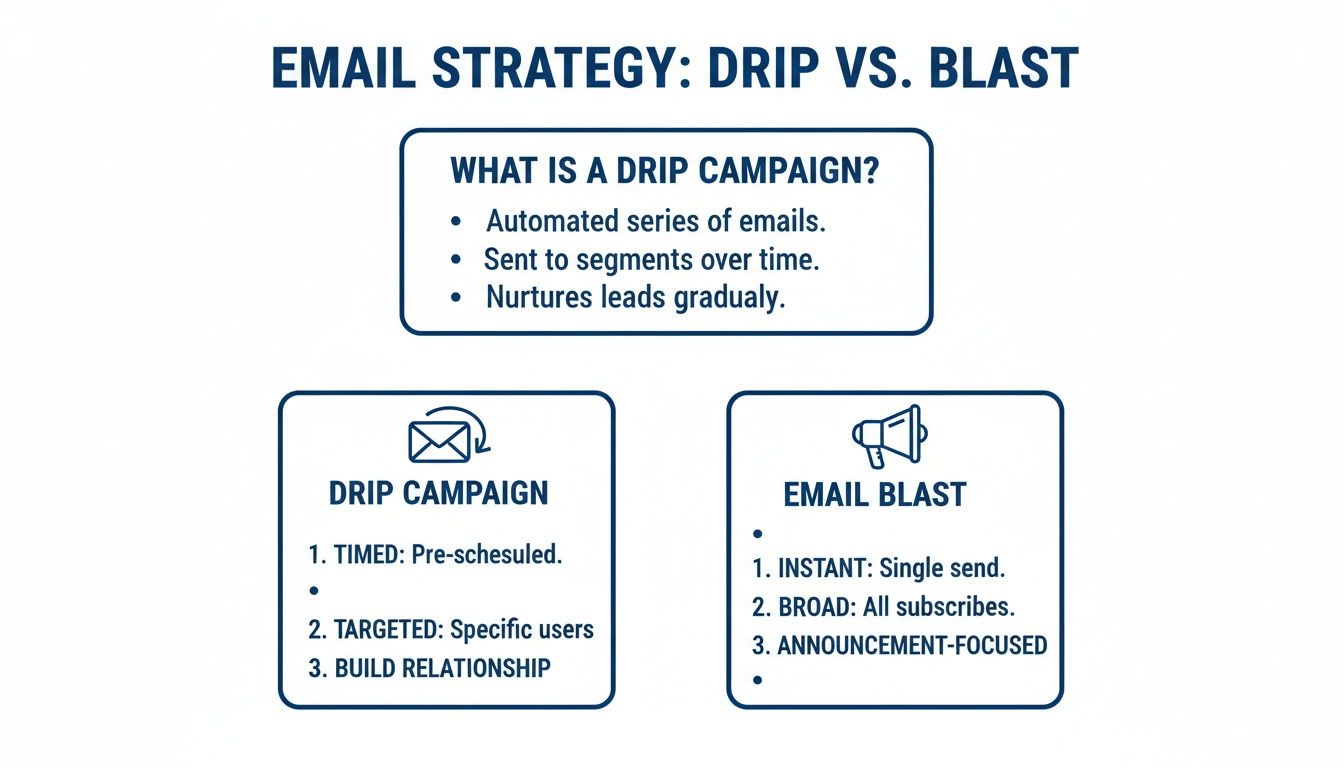
The key takeaway is simple: drip campaigns are about personalization and timing, while blasts are about mass communication.
Drip Campaign vs. Standard Email Blast at a Glance
To make the distinction even clearer, let's break down the core differences in a quick comparison.
| Feature | Drip Email Campaign | Standard Email Blast |
|---|---|---|
| Purpose | Nurture leads over time, educate, build relationships. | Announce news, promotions, or updates to a large audience at once. |
| Trigger | Automated by a specific user action (e.g., form submission). | Sent manually to a broad list at a scheduled time. |
| Timing | Personalized, based on when the user joins the sequence. | One-size-fits-all; everyone gets it at the same time. |
| Content | A series of connected, sequential emails. | A single, standalone email. |
| Audience | Highly segmented, often focused on individuals. | Broad, often sent to an entire email list. |
| Goal | Guide a prospect through the sales funnel. | Drive immediate, mass action (e.g., website clicks, event sign-ups). |
As you can see, these two tactics serve very different strategic purposes. One is a conversation, and the other is an announcement.
The results of this strategic approach are substantial. Industry data shows that drip campaigns can generate roughly 80% higher open rates and up to three times the conversion rate compared to standard bulk emails. Why? Because the systematic nature of these campaigns ensures no lead is ever forgotten, maximizing every opportunity to turn interest into revenue.
Do You Need a Drip Campaign System?
Are your most promising leads going cold? Does it feel like your team is stuck in an endless loop of manual follow-ups instead of closing deals? If that sounds familiar, these are classic symptoms of a broken or nonexistent lead nurturing system.
From an engineering perspective, the problem isn't a lack of leads—it's a failure in the system that's supposed to handle them. When your communication is inconsistent, you create gaps where interested buyers lose momentum and find a competitor who stays top of mind. This manual, reactive approach simply can't scale.
Questions to Ask Yourself
To diagnose the weak points in your current follow-up process, ask your team these questions. The answers will show you exactly where an automated system could make an immediate difference.
- How many times do we contact a new lead before giving up? If the answer is "one or two," or "it depends on how busy we are," you have a major consistency problem.
- Is our messaging consistent for every lead? Manual follow-ups are notorious for this. Different salespeople send different, often off-brand messages, creating a disjointed experience for the prospect.
- Can we track where every lead is in our sales process? Without a system, it's impossible. You don't know who needs a follow-up email, who could use educational content, or who is ready for a sales call.
- What happens to leads who aren't ready to buy right now? Many businesses just let them go cold. A drip campaign keeps your brand in front of these "not right now" leads—a potential goldmine—until the timing is perfect.
If you can't answer these questions with a clear, repeatable process, you're almost certainly losing sales opportunities every week. The goal is to move from guesswork to a reliable, proactive growth engine.
Answering these questions honestly gets to the root of the problem. You aren't just looking for another marketing tactic; you're looking for a system to fix a fundamental weakness in your operations. This is the first step toward building a machine that nurtures leads for you, 24/7.
The Core Components of an Effective Drip Campaign
A great drip campaign isn’t just a random volley of emails; it's a precisely engineered system where every piece has a job. From our experience building these for clients, the campaigns that deliver results are always built on three foundational pillars.
Get these right, and you're not just sending messages—you're creating a guided journey for your prospects.

Think of it like an assembly line: you need something to start the machine (the trigger), the steps in the process (the sequence), and a finished product at the end (the goal).
Component 1: Triggers
A trigger is the specific action a user takes that starts your drip sequence. It’s the "if this happens, then that" part of the automation. Without a trigger, the engine never starts.
The key is to connect the trigger to the user's intent. That way, the emails that follow feel relevant from the very first message.
Common triggers we help clients set up include:
- New Subscriber: Someone signs up for your newsletter or blog updates.
- Resource Download: A user fills out a form to get a whitepaper, case study, or spec sheet.
- Website Behavior: A prospect visits a high-value page, like your pricing or services page.
- Cart Abandonment: A potential customer adds an item to their cart but doesn’t complete the purchase.
Choosing the right trigger ensures your sequence is timely and contextual, which is critical for getting people to open and read your emails.
Component 2: The Sequence
The sequence is the heart of the operation—it's the series of pre-written emails that go out over a set period. This isn't the time to just blast a sales pitch over and over.
Instead, each email should build on the last. Your job is to deliver value, anticipate questions, and gently move the prospect forward.
The single biggest mistake we see is making the entire sequence about "us." A winning sequence is all about "you"—the customer. It addresses their problems, offers real insights, and proves you understand their world long before you ask for the sale.
A well-planned sequence has a natural rhythm. The first email might be a simple welcome that confirms their action. The second could offer a helpful tip related to what they downloaded. Later emails can introduce case studies or a special offer. It’s a slow build of trust.
Component 3: Clear Goals
Finally, every drip campaign needs one measurable goal. What is the single action you want the recipient to take by the end of the sequence? If you don’t have a clear goal, your campaign is just noise.
Your goal is the finish line. It dictates the purpose of every email and, more importantly, it's how you'll measure whether the campaign is actually working.
Examples of clear goals include:
- Booking a demo or consultation call.
- Making a first-time purchase.
- Signing up for a free trial.
- Upgrading from a basic to a premium plan.
When you define this goal upfront, you can engineer the entire campaign—from the trigger to the final call to action—to achieve that one specific outcome.
Common Types of Drip Campaigns for Business Growth
A drip email campaign isn't a single tactic—it's a versatile problem-solving tool. Different sequences can be engineered to solve different business challenges, whether you're trying to make a strong first impression or win back customers who've gone quiet. The key is to match the right campaign type to a specific business goal.

This adaptability is why drip campaigns have become standard in any modern marketing toolkit. By 2025, around 67% of marketers are expected to use automation for their drip and nurturing campaigns. You can dive deeper into email marketing statistics to see just how common this approach has become.
Welcome Sequences
Think of a welcome sequence as your best chance to make a good first impression. This campaign kicks off the moment someone subscribes to your list, setting the tone for the entire relationship.
- The Problem: New subscribers are highly engaged, but that initial interest can fade quickly without immediate follow-up.
- A Sample Flow:
- Email 1 (Immediate): Send a warm welcome, confirm their subscription, and tell them what to expect from you.
- Email 2 (Day 2): Introduce your company’s story or share your most popular resources to build credibility.
- Email 3 (Day 4): Offer a valuable piece of advice or a helpful tip related to why they signed up.
Your welcome sequence isn't about selling. It’s about validating their decision to connect with you. It proves you’re a valuable resource from day one, which builds the trust you need to eventually make a sale.
Lead Nurturing Campaigns
When a prospect downloads a technical guide, they're interested—but probably not ready to buy. A lead nurturing campaign is designed to bridge that gap by educating them over time. This type of campaign systematically builds your case, answers common objections, and positions your company as the expert solution, gently guiding the prospect toward a sales conversation.
Re-Engagement Campaigns
Over time, some subscribers will go quiet. A re-engagement campaign (or win-back campaign) is your targeted effort to wake up these dormant contacts before you remove them from your list.
- The Problem: It costs far more to acquire a new customer than to retain an existing one. This sequence is designed to bring inactive subscribers back into the fold.
- A Sample Flow:
- Email 1: A simple "we miss you" email with a link to your best-performing content.
- Email 2: A special offer or an exclusive insight to remind them of the value you provide.
- Email 3: A final, transparent email asking if they still want to hear from you, with a clear button to unsubscribe.
Post-Purchase Sequences
The conversation shouldn't stop once the invoice is paid. A post-purchase sequence is critical for reducing buyer's remorse, encouraging repeat business, and turning happy customers into advocates. This sequence can include thank-you notes, tips for using the product, and requests for reviews—all of which build deeper customer loyalty.
How to Measure Drip Campaign Success
An automated system is only as good as the results it generates. If you aren't measuring your drip campaigns, you’re flying blind. To know what's working, you need to look past surface-level numbers and focus on the metrics that directly impact your bottom line.
Tracking only open rates is a vanity metric. It feels good, but it doesn't tell you if your campaign is moving prospects closer to a sale. An effective drip email campaign must be measured against the specific business goal you set from the beginning.
Key Performance Indicators That Matter
To get a clear picture of what’s working, track these key performance indicators (KPIs). These numbers tell a story about engagement and whether your messaging is hitting the mark.
- Conversion Rate: This is the most important metric. It tells you the percentage of people who completed your campaign’s goal, like booking a demo. A high open rate with a low conversion rate is a red flag, signaling a disconnect between your email content and your call to action.
- Click-Through Rate (CTR): This shows the percentage of recipients who clicked on a link in your email. It's a direct measure of how compelling your content and calls to action are. A low CTR often means your message isn't resonating.
- Unsubscribe Rate: This tracks how many people opted out. A few unsubscribes are normal, but a sudden spike is a clear sign that something’s wrong. It could mean you’re emailing too often or the content isn't relevant.
Think of these metrics as diagnostic tools for your marketing engine. A low conversion rate is like a check engine light—it tells you something is wrong under the hood, prompting you to investigate your messaging, offer, or audience targeting.
Advanced Metrics for Deeper Insights
Once you have the basics down, a few other data points can provide a more complete diagnosis of your campaign's impact on your sales pipeline.
- Lead Quality Score: If your system supports it, watch how engaged leads become. Are they opening multiple emails or visiting your pricing page? This is gold for your sales team, helping them prioritize the hottest leads.
- Revenue Per Email: For e-commerce or direct sales, this calculates the average revenue generated from each email sent. It draws a straight line from your marketing effort to revenue, making it easy to prove ROI.
By regularly monitoring these KPIs, you can move from a "set it and forget it" mentality to one of continuous, data-driven improvement. This transforms a simple automation tool into a powerful system for predictable growth.
Proven Best Practices and Common Mistakes to Avoid
Anyone can set up an automated drip campaign. The challenge is engineering one that actually works—one that connects with prospects instead of just adding to the noise. Knowing what works, and what drives people to hit "unsubscribe," is the line between generating qualified leads and annoying your entire list.

The best campaigns feel like a helpful, one-on-one conversation. The worst feel robotic and pushy. Let's start by diagnosing the common failures.
Diagnosing Common Campaign Failures
Most drip campaigns that fall flat do so for predictable reasons. It usually boils down to prioritizing the automation tool over the human on the receiving end. Before you launch, audit your sequence for these classic mistakes.
- Mistake 1: Overwhelming Subscribers: Sending emails too frequently is the fastest way to burn out your list. A sequence needs a natural rhythm, not a constant barrage. Give people time to digest the information between emails.
- Mistake 2: Using Generic Sales Language: Cliches like "game-changing solution" are instant red flags for serious buyers. Use clear, direct language that gets straight to their problems and how you can help.
- Mistake 3: Failing to Segment Your Audience: Blasting the same sequence to a new subscriber and a long-term prospect who just downloaded a technical spec sheet is a recipe for disaster. Segmentation ensures your content is relevant to where they are in their buying journey.
Best Practices for Campaigns That Convert
Successful campaigns aren't built on secrets. They're built on core principles that foster trust. For a deeper dive, explore our complete guide on email campaign best practices.
A great drip campaign never feels like a sales pitch. It feels like a helpful conversation where you consistently provide value and prove you understand the recipient's challenges.
Here are the non-negotiables for your next campaign:
- Hyper-Personalize Your Content: Go beyond the
[First Name]tag. Reference the specific action they took—the guide they downloaded or the webinar they attended. This proves the email is intentional, not just another automated blast. - Provide Genuine Help, Not a Hard Sell: Each email should offer something valuable on its own, like a practical tip, a relevant case study, or a link to a helpful resource. Earn their trust by being useful before you ask for the sale.
- Use a Single, Clear Call to Action (CTA): Every email needs one primary goal. Don't ask subscribers to "read our blog, follow us on LinkedIn, and book a demo" all at once. Give them one clear, logical next step.
Common Questions About Drip Campaigns
Even with a solid plan, you might have questions about how this works in the real world. Here are the answers to what we get asked most often.
How Many Emails Should Be in a Drip Campaign?
There's no magic number. Most effective drip campaigns we build fall between 4 and 10 emails, but the honest answer is: it depends entirely on your goal and the complexity of your sales cycle.
A simple welcome series might only need 3-4 emails. A long-term nurturing sequence for a high-ticket B2B sale could involve 8-10 emails spaced out over several weeks. Start with your goal and work backward.
What's the Difference Between Drip Campaigns and Newsletters?
This is an important distinction. They serve completely different purposes.
A drip campaign is an automated, pre-written series of emails sent to one person at a time, triggered by something they did. A newsletter is a one-off broadcast you send to your entire list (or a large segment) all at once.
Think of it this way: a drip campaign is a private, ongoing conversation with an individual. A newsletter is a public announcement to a crowd.
Drip campaigns are for targeted nurturing. Newsletters are for general updates.
What Is the Best Software for Drip Campaigns?
You have many great options. Platforms like GoHighLevel, ActiveCampaign, HubSpot, and Mailchimp are all popular because they get the job done well.
The "best" one for you depends on your budget, technical comfort, and how sophisticated you want your automations to be. When you're comparing tools, look for these key features: a visual workflow builder, solid analytics, and the ability to segment your audience based on their actions. This is the toolkit you need to build a powerful and manageable system.
If you're ready to stop chasing inconsistent leads and start building a reliable system for growth, we can help. Machine Marketing specializes in implementing marketing systems, including powerful drip campaigns in GoHighLevel, that B2B companies use to achieve predictable results.
Book a discovery call with us and we'll help you diagnose your current system and identify your next steps.