If you run a manufacturing business, this probably sounds familiar. Your sales team has a list of companies that look like a fit. The reps call, email, follow up, and maybe get a polite response. But the timing is wrong, the project already closed, or the person on the other end has nothing to do with the buying decision.
That's not just a prospecting problem. It's a signal problem.
Intent data helps you stop guessing which companies might buy and start focusing on the ones actively researching solutions like yours right now. For manufacturers, that matters because rep time is expensive, long sales cycles punish wasted effort, and the right conversation often depends on reaching the right engineer, buyer, or operations leader at the right moment. If your targeting still relies mostly on industry, revenue, and company size, you're missing the “when” that drives action.
Table of Contents
- Stop Guessing Who Wants to Buy Your Product
- Diagnosing Your Lead Signals with Intent Data
- The Three Types of Intent Data You Need to Know
- From Account Surges to Actual Sales Calls
- Practical Intent Data Plays for B2B Sellers
- Building Your Intent Data System in 5 Steps
- Choosing Your Tools and Staying Compliant
Stop Guessing Who Wants to Buy Your Product
Most manufacturers already have some version of a target list. It may be pulled from a CRM, a trade show spreadsheet, a purchased database, or a set of named accounts the sales team wants to break into. The problem is that fit alone doesn't tell you whether anyone is buying now.
A company can match your ideal customer profile perfectly and still be months away from action. Another can be deep in research this week and invisible to your team because nobody filled out a form. That gap is where prospecting effort gets burned.
When people ask what is intent data, the simple answer is this. It's a way to identify which companies are showing buying behavior, not just which companies look like they should buy someday. That shift changes how you assign rep time, prioritize follow-up, and decide where marketing should support sales.
What to look at first
Before you add another tool, ask three questions:
- Who are you targeting now: Are you working from a clean definition of your market, or are reps filling gaps with guesswork? If your foundation is shaky, start by tightening your target audience definition for B2B growth.
- What signals trigger action: Does your team know which behaviors deserve immediate attention, or does every inquiry get treated the same?
- Where does outreach break down: Is the issue low response, wrong timing, weak messaging, or poor contact selection inside the account?
Practical rule: If your reps are doing high-effort outreach to accounts with no recent buying signals, you're asking sales to solve a marketing diagnosis problem.
Manufacturing sales teams don't need more names. They need a better way to sort urgency from background noise. That's what intent data does when it's implemented as a system instead of treated like a magic list.
Diagnosing Your Lead Signals with Intent Data
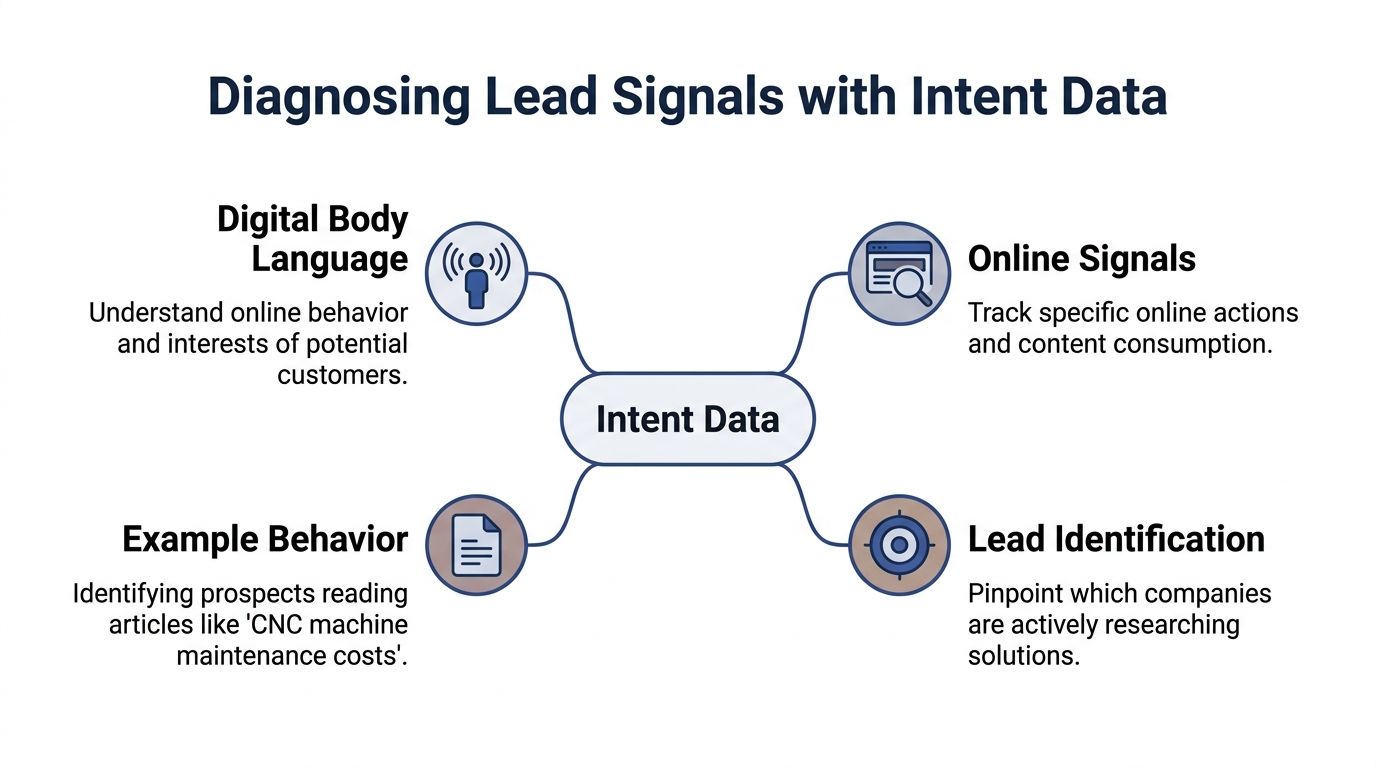
Intent data is best understood as digital body language. Buyers show interest long before they contact you. They read technical articles, visit product pages, compare vendors, search category terms, and revisit topics tied to a project they're trying to solve.
According to Infuse's definition of intent data, intent data is behavioral information that reveals a prospect's likelihood to purchase a solution by aggregating digital signals such as content consumption, search activity, and website visits, which are then matched to accounts to prioritize "in-market" companies.
What intent data actually tells you
Traditional firmographic data answers who a company is. Intent data answers when attention is building.
That distinction matters. A plant manager at a company in your target vertical may be a strong fit on paper, but if that business isn't researching automation, maintenance reduction, quality control systems, or supplier alternatives, the chance of productive outreach is low. Intent data gives your team timing context.
In practice, that can include signals such as:
- Content research: Accounts consuming articles, guides, or category content related to your solution
- Search patterns: Activity that suggests a problem is being defined or vendors are being evaluated
- Website behavior: Visits to key pages such as pricing, demos, technical documentation, or comparison pages
Buyers rarely announce they're entering a buying cycle. Their research behavior announces it first.
If you want a broader perspective on how teams are optimizing buying signals with AI, that framework is useful because it pushes the conversation beyond raw traffic and toward signal quality.
How providers turn activity into a usable signal
Intent platforms don't just collect clicks and stop there. Demandbase describes a four-step process: collecting content consumption events, deanonymizing the data, analyzing viewed content for relevance, and identifying behavioral patterns that predict buying intent. You can review that process in Demandbase's overview of how intent data works.
For a manufacturer, the practical takeaway is simple. A useful signal isn't “someone somewhere visited a page.” A useful signal is “this account is showing above-baseline research around topics that map to a real offering.”
That's why intent data works best as a prioritization layer. It helps your team decide where to focus now, instead of spreading effort across every company that matches a broad customer profile.
The Three Types of Intent Data You Need to Know
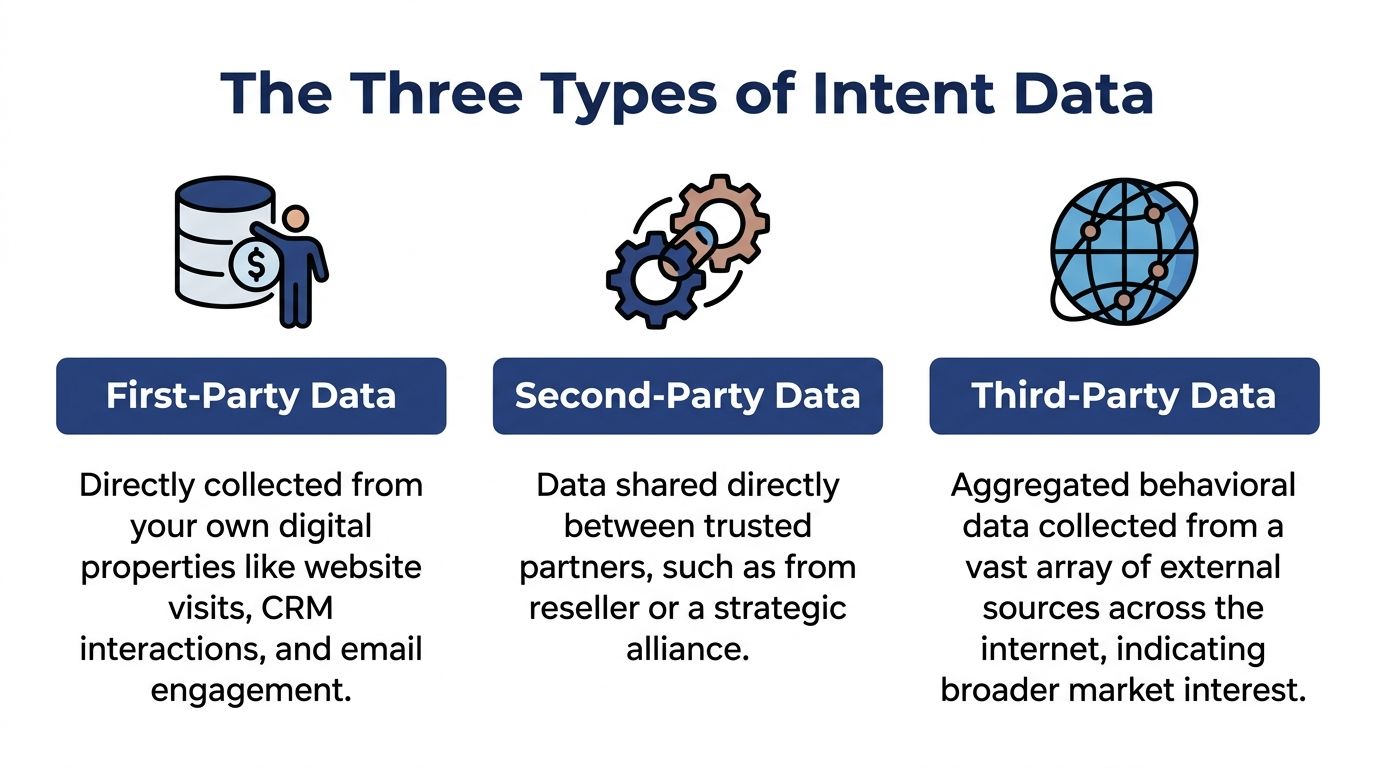
Not all intent data is equal. Source matters because source affects trust, timing, cost, and what your team can do with the signal. If you lump everything together, you'll either overreact to weak data or underuse valuable data.
A practical comparison
| Type | Where it comes from | Strength | Limitation |
|---|---|---|---|
| First-party | Your website, email, CRM, forms, and owned channels | Highest control and direct relevance to your business | Limited to accounts already touching your brand |
| Second-party | Another company's first-party data shared through a partnership | Can add context from trusted channel partners or publishers | Usually narrower and relationship-dependent |
| Third-party | External providers tracking research across broader web activity | Expands visibility beyond your own audience | Often needs validation before sales acts |
The cleanest definition of first-party and third-party appears in Apollo's explanation of intent data for prospecting. Their framing is useful because it treats intent data as a prioritization layer, not a replacement for basic targeting.
What usually works best for manufacturers
For most industrial companies, first-party data is gold because it reflects direct engagement with your specific offers. If an account is on your site reviewing a solution page, opening technical emails, or returning to a quote-related asset, that's actionable.
But first-party data is incomplete. It misses the companies researching the category before they ever discover you.
That's where third-party data earns its place. It helps surface broader market activity, especially when buyers are reading industry content, comparing suppliers, or researching problem-specific topics outside your owned channels.
A sensible operating model usually looks like this:
- Use first-party data for confidence: It's the strongest indicator that interest is tied to your brand.
- Use third-party data for discovery: It expands your field of view.
- Use second-party data when you have the right partner: This can be useful with distributors, associations, media partners, or strategic channel relationships.
What doesn't work is choosing one source and pretending it tells the whole story. Broad data without validation creates noise. Owned data without outside visibility leaves you late to the buying cycle.
From Account Surges to Actual Sales Calls
Many intent programs break down at this stage. A dashboard says an account is surging on a topic you care about. Sales gets excited, opens the record, and then hits the fundamental question. Who exactly should call whom?

Why account level alerts often stall out
For industrial sellers, account-level insight is only half the job. The harder half is contact-level execution.
NC Squared puts the problem clearly in its analysis of the industrial B2B intent gap: the critical gap in industrial B2B is between "aggregate account intent" and "specific contact-level execution." With 60-70% of third-party intent signals being account-level aggregates, outreach can be wasted on non-stakeholders without a strategy to pinpoint the exact engineer or buyer.
That's a serious issue in manufacturing. A company may be researching robotic welding, custom automation, or machine maintenance systems, but the person researching may not be the person authorizing vendor conversations. If your rep emails the wrong operations contact, the signal gets wasted.
Account intent tells you where heat exists. It doesn't tell you which person is carrying the project.
How to turn a surge into a real outreach plan
Manufacturers need a bridging process between account activity and human contact selection. That process usually includes both marketing and sales operations.
A practical workflow looks like this:
Confirm the account fit
Check industry, plant profile, likely use case, and whether the topic maps to one of your offers.Overlay first-party activity
Look for website visits, email engagement, form history, webinar attendance, or prior quote activity tied to that account.Map likely stakeholders
Identify the functions most likely to care. Depending on the product, that could be engineering, maintenance, operations, procurement, or plant leadership.Use account-based air cover
Before direct outreach, run tightly focused ads or content touches to the account. This can help draw known contacts into your ecosystem. If you're building this motion, an account-based marketing system for B2B manufacturers is the right operating model.Give reps context, not just alerts
“This account surged” isn't enough. Reps need the topics, likely buying stage, related pages visited, and recommended messaging angle.
What doesn't work is blasting five contacts at the same company with a generic note. What works is using the surge as a trigger, then validating the person, problem, and timing before sales reaches out.
Practical Intent Data Plays for B2B Sellers
A manufacturer sees a target account surge on topics related to controls upgrades, predictive maintenance, or a competing product line. Sales gets the alert, but the rep still has to answer the hard question: who should I call first? That gap between account interest and contact selection is where intent programs either produce pipeline or stall inside a dashboard.
The best plays solve for that gap. They connect account-level research to a specific person, message, and next action the sales team can execute this week.
Competitive displacement play
Diagnosis
Your team keeps entering deals after the shortlist is already forming. By then, the plant engineer may have reviewed two vendors, procurement may already be asking for pricing structure, and your rep is trying to restart an evaluation that is already in motion.
Solution
Track intent around competitor names, replacement terms, comparison language, and problem-specific topics that usually appear before a switch. Then pair that account signal with contact evidence inside your own systems. Look for repeat visits to spec pages, downloads of retrofit content, prior quote requests, or email clicks from engineering or sourcing contacts. Bombora's guidance on using intent data for prospecting and competitive targeting gives a useful outside view of this approach.
A workable execution path looks like this:
- Build competitor and replacement topic clusters: Include direct competitor names, “alternative to” phrases, upgrade terms, and process issues that often trigger vendor review.
- Match the likely contact to the topic: If the research centers on compatibility, start with engineering. If it centers on lead times, total cost, or supplier risk, bring in procurement or operations.
- Give reps proof they can use in a call: Application notes, migration guides, side-by-side capability sheets, and references from similar plants work better than broad brand claims.
- Set a contact rule: No outreach goes out until the account surge is paired with at least one plausible stakeholder or a first-party engagement signal.
Transformation
Sales stops treating every surge as a green light to email five people at once. The rep reaches out to one or two relevant contacts with a point of view tied to an active evaluation.
ABM Tier 1 acceleration play
Named accounts need timing, not more attention. Many manufacturers already know which accounts matter. The problem is knowing when a dormant target has shifted into an active buying cycle, and which function inside the account is driving it.
Solution
Monitor your Tier 1 account list for increases in research around your priority solutions, then route the signal into a coordinated account plan. Marketing adjusts ads, email sequencing, and content by topic. Sales chooses contacts based on role relevance and evidence of engagement, not title alone. If you need the operating discipline around that handoff, this strategic framework for lead generation is a good reference because it ties signal handling to CRM process instead of treating intent as a media tactic.
Use a simple checklist:
- Prioritize the active buying role: A maintenance surge should not trigger the same outreach list as a capital equipment research spike.
- Change message by plant problem: Talk about downtime, scrap, throughput, compliance, or integration based on the topic the account is researching.
- Set a response window: If an account surges and nobody acts for a week, the signal has little value.
- Review account movement in one meeting: Sales, marketing, and operations should look at the same account list and agree on next actions.
Transformation
Your ABM program becomes more precise. Instead of increasing touches across the whole account, the team focuses pressure on the people most likely to move the opportunity forward. That usually means better meetings and fewer wasted sequences.
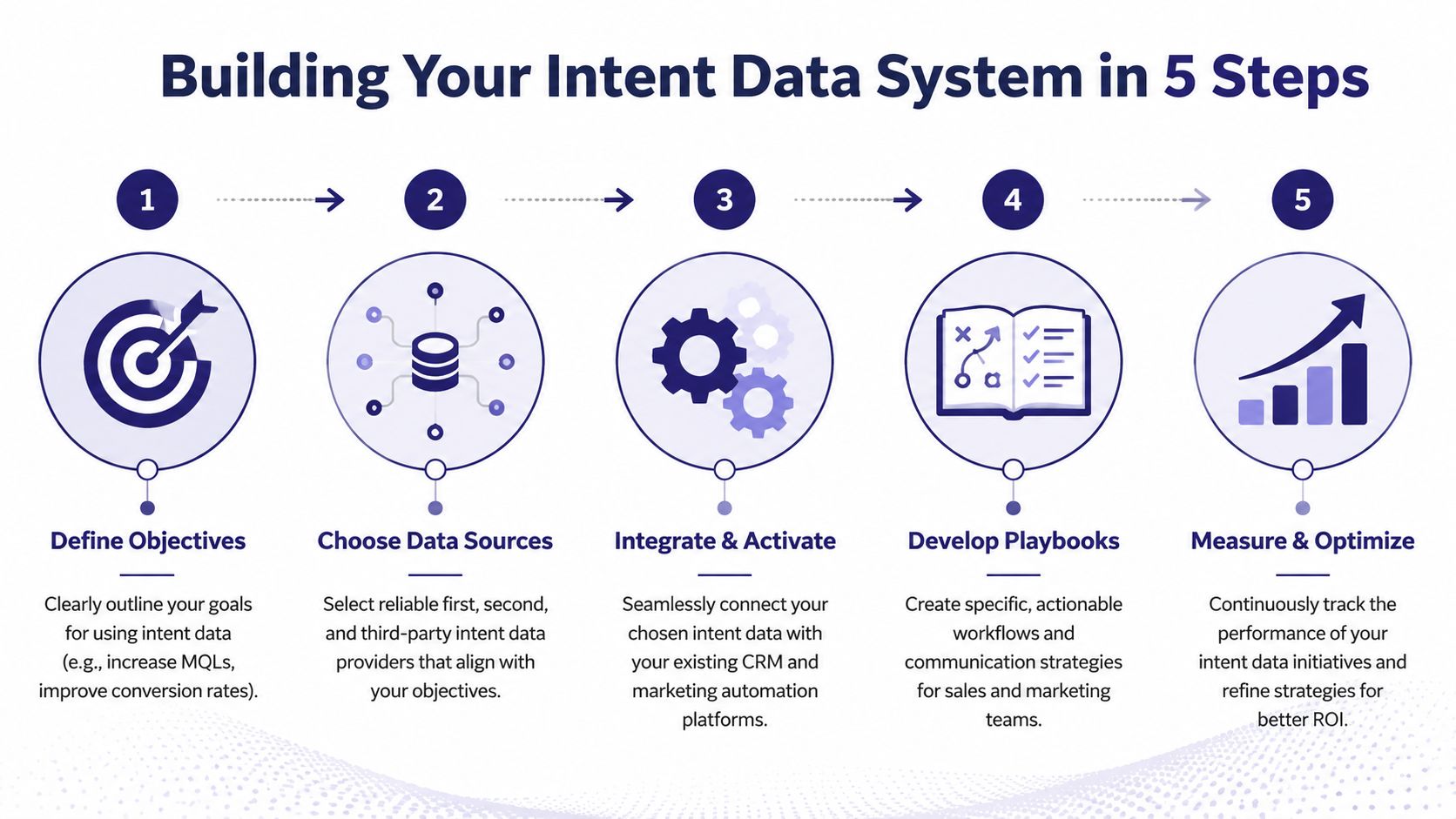
Building Your Intent Data System in 5 Steps
Tools matter, but systems matter more. If you buy intent software without deciding how sales and marketing will use it, you'll end up with one more dashboard and no operating discipline.
The video below gives a useful visual walkthrough before you formalize your workflow.
Step 1 through Step 3
1. Identify your data sources
Start with the sources you control. Website behavior, email engagement, CRM history, quote requests, webinar registrations, and sales activity are usually the cleanest inputs. Then layer in external data where it expands visibility.
If you need a broader operational view, this strategic framework for lead generation is a useful companion because it reinforces that signal quality only matters when it feeds a working lead management process.
2. Define your intent topics
Map topics to real buying conversations. Don't build a topic list around jargon your team likes. Build it around the problems buyers research before they contact you.
For a manufacturer, that might include:
- Problem topics: Downtime reduction, quality issues, labor shortages, maintenance burden
- Solution topics: Robotics integration, automation cells, machine upgrades, inspection systems
- Evaluation topics: Vendor comparisons, pricing-related research, implementation questions
3. Set surge thresholds
Not every signal deserves a rep's immediate attention. You need a score threshold that separates background activity from active interest.
According to Hockeystack's guidance on intent thresholds, effective intent strategies use explicit thresholds, typically set at 70 or higher on most platforms, to automatically flag high-priority accounts.
That doesn't mean every account above that mark goes straight to sales. It means your team now has a common line for escalation.
Step 4 and Step 5
4. Activate the data in your CRM
Many teams fail when signals remain confined within the intent platform instead of flowing into the tools reps already use.
Build clear actions tied to signal states:
- Hot account alert: Sales gets notified with topic detail and account context
- Known contact engagement: Marketing triggers a relevant nurture sequence
- Anonymous account surge: Account-based ads or retargeting start before direct outreach
- Strategic account activity: The AE or owner gets a task with a short summary, not just raw score data
5. Measure what matters
Don't judge the system by MQL volume alone. Measure whether signals are helping your team move from interest to conversation more efficiently.
Look at:
- Signal-to-meeting velocity: How quickly a strong signal turns into a booked conversation
- Sales follow-up quality: Whether reps are using the signal context in their outreach
- Pipeline relevance: Whether the accounts surfacing are within your market and solution fit
Field note: If sales can't explain why an account was flagged, the system isn't operational yet. It's just software.
A good intent data system does three things well. It narrows focus, improves timing, and gives both marketing and sales a shared definition of priority.
Choosing Your Tools and Staying Compliant
A manufacturer can see a target account researching servo drives, machine vision, or a competing control system and still have no clear next move. That is the tool selection problem in plain terms. The platform matters less than whether it helps your team turn company-level interest into a usable contact path for the right engineer, plant leader, or sourcing contact.
That gap shows up fast in vendor demos. Plenty of tools can identify account surges. Fewer can help sales answer the practical question that matters on Monday morning: who at this company should we contact, and what do we say based on the signal?
Questions to ask before you sign
Start with the operating model, not the dashboard. Ask providers these questions:
- Where does the data come from: Ask for source transparency. “Broad coverage” is not enough if the vendor cannot explain how signals are collected, normalized, and mapped to accounts.
- How much of the output is account-level versus person-level: This matters for manufacturers with long buying groups. An account spike is useful for prioritization, but reps still need a path to the maintenance manager, design engineer, procurement lead, or operations executive who can advance the deal.
- Can we customize topic taxonomies: Niche industrial products rarely fit a generic topic library. If you sell precision components, OEM subassemblies, or specialized automation systems, your topics need to reflect how buyers search, compare, and specify.
- Can the platform separate early research from active vendor evaluation: According to Default's explanation of high-quality intent data, stronger intent datasets show not just that a prospect is researching, but also the topics, competitor sites, and product categories involved. That distinction helps teams tell broad education apart from buying-stage evaluation.
- How does the data reach our team: If alerts do not flow into your CRM, sales tasks, or marketing automation, reps will ignore them. Your platform should fit your existing marketing technology stack for B2B growth, not create another tab nobody checks.
- What match logic connects account signals to contacts: Ask whether the system can tie surging accounts to known contacts, recent site visitors, form fills, email engagement, prior opportunities, or enrichment data. Without this capability, many manufacturing teams frequently lose momentum.
Vendor choice also affects trust. The 2024 State of Martech report from Chiefmartec and MartechTribe found that 56.6% of organizations cite data quality as their biggest challenge with martech. That matters here because low-confidence intent data does not just create reporting noise. It sends reps after the wrong accounts and leaves real buyers untouched.
Compliance is part of the system
Compliance should be checked before procurement, not after rollout.
Ask how consent is handled, which regions the provider supports, how long data is retained, and whether person-level records are derived from sources your team is willing to use. If the answers are vague, the risk is operational as much as legal. Sales will hesitate to act on records they do not trust, and larger buying organizations often review data practices during vendor onboarding.
For manufacturers selling into enterprise accounts, this gets practical fast. A plant engineer may show interest at the account level, but outreach often goes to a buyer, category manager, or technical approver. If your provider cannot explain how contact records are sourced and refreshed, your team ends up with the worst combination possible: broad account intent and weak contact accuracy.
Choose the vendor whose data your team can explain, verify, and act on. Clear sourcing, industry-fit topics, usable CRM workflows, and defensible compliance practices beat a flashy dashboard every time.
If you want help diagnosing whether intent data fits your sales process, Machine Marketing works with manufacturers and industrial businesses to connect strategy, CRM workflows, content, and account-based systems into a practical growth engine. If your team already has tools but not a clear operating model, that's the right place to start.