Let's get straight to the point. You're spending money on marketing to generate leads, but a shocking number of them go cold and never convert. This isn't a lead quality problem; it’s a system problem.
Lead nurturing is the process of building relationships with potential customers by guiding them with helpful information until they are ready for a sales conversation. Think of it as an automated system that turns a flicker of interest into measurable revenue. In this guide, we'll diagnose why your leads are fizzling out and show you how to build a system to fix it.
Why Your Paid Leads Are Going Cold
If you’re pouring money into marketing but the ROI isn't there, the issue probably isn’t your leads. The real breakdown happens in the gap—that critical space between a prospect's initial curiosity and their decision to buy.
We see this all the time. A business pays for clicks and form fills. The sales team jumps on the phone, only to find the lead is "just looking." The opportunity dies, and the investment is wasted. This is a system failure, not a lead failure.
This is where understanding lead nurturing becomes a game-changer. It’s the deliberate process of engaging prospects with timely, relevant content that solves their immediate problems. Instead of one premature sales call, nurturing creates a guided path of helpful communication.

From Tactic to Essential System
For B2B companies, especially in complex fields like manufacturing, trust and education are everything. A prospect needs to understand detailed specifications and feel confident in your expertise long before they’re ready for a quote.
Lead nurturing isn't just another marketing 'tactic.' It’s an engineering solution for a broken sales funnel. It’s how you stop losing the valuable opportunities you already paid for.
The results are significant. Companies that excel at lead nurturing generate 50% more sales-ready leads at a 33% lower cost. Without it, a staggering 80% of new leads never convert into sales. That's a massive amount of revenue left on the table.
This isn't about sending a few random emails. It's about systematically squeezing every drop of value from your marketing budget. By building a solid nurturing system, you effectively manage and lower the overall cost of a lead while dramatically increasing its lifetime value.
Core Components of a Lead Nurturing System
A proper system isn't just a collection of tools; it's an integrated machine. Before you start, ask yourself: do we have the right components in place?
| Component | What It Does | Question to Ask Yourself |
|---|---|---|
| CRM & Automation Platform | Acts as the central hub to store lead data, track interactions, and automate communication workflows. | "Is all our lead data in one place where both marketing and sales can see it?" |
| Segmentation Strategy | Divides your audience into smaller groups based on criteria like industry, job title, or behavior. | "Are we sending the same message to everyone, or are we personalizing it based on who they are and what they need?" |
| High-Value Content | The fuel for your nurturing engine. This includes case studies, whitepapers, webinars, and educational blog posts. | "Do we have content that answers our prospects' questions at each stage of their buying journey?" |
| Multi-Channel Delivery | Uses a mix of channels—like email, SMS, and targeted ads—to reach leads where they are most active. | "Are we relying only on email, or are we meeting our prospects on the channels they actually use?" |
| Lead Scoring & Routing | Assigns points to leads based on their actions to identify who is most sales-ready and sends them to sales. | "Does our sales team know exactly which leads to prioritize, or are they guessing?" |
Putting these pillars in place transforms lead generation from a leaky bucket into a fine-tuned engine for growth.
Mapping the Journey From Prospect to Partner
Lead nurturing isn't a generic email blast. It's a strategic conversation that mirrors how your buyer actually makes decisions. The goal is to meet prospects where they are, giving them the right information at the right time.
When you get this right, your sales team stops jumping the gun with a cold prospect or, worse, showing up after a competitor has already built the relationship.
Think of it like a roadmap. You wouldn't hand someone directions to their final destination before they've even decided what kind of car to drive. Likewise, you shouldn't send a detailed quote to someone who is still trying to understand their core problem.
The Awareness Stage: What Problem Do I Have?
At the top of the funnel (ToFu), your prospect has a pain point but might not have a name for it yet. They're searching for answers to broad questions and looking for content that educates them. Your job here isn't to sell—it's to help.
For example, a manufacturing operations manager might be Googling, "Why is our production line downtime increasing?" They aren't looking for your specific CNC machine yet; they're just diagnosing the symptoms.
Your content needs to be educational and genuinely helpful. Great options for this stage include:
- Blog Posts: Articles that break down common industry problems.
- Whitepapers: In-depth reports exploring industry trends or challenges.
- Checklists: Simple tools that let them self-assess their operational gaps.
The Consideration Stage: What Are My Options?
Once a prospect moves into the middle of the funnel (MoFu), they’ve named their problem and are actively researching solutions. They start comparing different approaches, methods, and vendors. This is your chance to step in as a credible expert.
Our manufacturing manager now knows they have a "CNC machine efficiency problem." They're digging into different types of equipment and looking at automation software. They want to see how other companies have solved this exact issue.
Here, your content should guide their evaluation. This is the time for:
- Case Studies: Real-world stories showing how you solved a similar problem.
- Webinars: Educational sessions that demonstrate how you tackle their specific challenge.
- Comparison Guides: Objective content that helps them weigh different technologies.
The Decision Stage: Who Can Solve This for Me?
At the bottom of the funnel (BoFu), the prospect is ready to pick a partner. They’ve narrowed their list and are looking for validation that you are the right choice. Their questions become specific, focusing on implementation, cost, and ROI. Nailing this final stage requires a full grasp of the B2B marketing funnel.
This is the moment where the trust you've built converts into a business relationship. Your content must remove any last-minute friction and make the decision to work with you feel logical and safe.
The manufacturing manager is now asking, "What is the ROI of this machine?" or "Can we see a live demo?" Your content has to deliver that final nudge.
- Free Trials or Demos: Give them a hands-on look at your solution.
- ROI Calculators: Provide tools that help them build the business case internally.
- Consultations: Offer direct access to your experts to discuss their unique needs.
By mapping your content to each stage, you create a smooth, value-driven path that takes someone from being vaguely aware of a problem to confidently signing a contract.
Choosing Your Nurturing Channels and Tactics
Once you’ve mapped the buyer's journey, it’s time to choose your communication channels. This isn’t about being everywhere; it’s about meeting your leads where they are and communicating in a way that builds trust, not noise.
The goal isn't to blast your message from every rooftop. For most B2B companies, success comes from mastering a core set of proven tactics that can be automated for consistency and scale.
Mastering Email Automation Sequences
There’s a reason email remains the workhorse of B2B lead nurturing: it works. It gives you a direct line to your prospects, allowing you to deliver targeted, educational content over time.
We're not talking about a generic monthly newsletter. This is about creating automated drip campaigns—a series of pre-written emails triggered by a specific action, like a whitepaper download. To sharpen your approach, dive into our guide on email campaign best practices.
This visual shows how your content should align with where a prospect is in their buying journey.
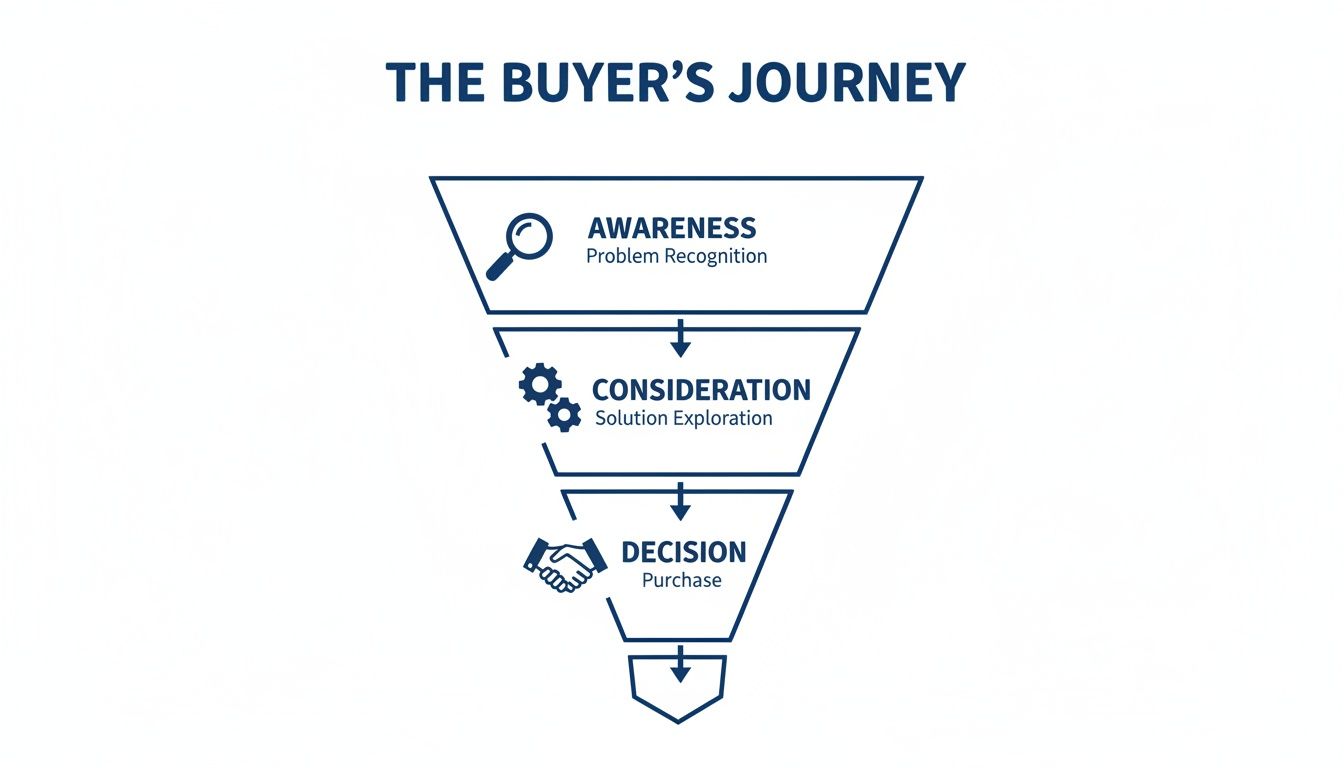
As you can see, your tactics must evolve. You can't send the same content to someone who's just identifying a problem as you would to someone actively choosing a solution provider.
Leveraging CRM Workflows and SMS
Your CRM is more than a digital address book; it’s the engine that powers your nurturing system. Platforms like GoHighLevel let you build sophisticated workflows that automate touchpoints based on lead behavior.
A lead isn't just a contact; it's a collection of data points telling you a story. Workflows are how you listen to that story and respond in a relevant, timely way.
For instance, you can build a workflow that automatically sends a case study to a prospect who has visited your pricing page three times. This is how you move from simple email sequences into true, behavior-driven personalization.
While email is your foundation, SMS (text messaging) is your high-impact channel for specific, time-sensitive messages. It's powerful for moments like these:
- High-Value Alerts: Let a lead know their quote is ready.
- Event Reminders: Send a quick text an hour before a scheduled webinar or demo.
- Immediate Follow-Ups: Trigger a message right after a lead submits a "Contact Us" form to confirm receipt.
Used strategically, SMS cuts through the clutter. The key is to reserve it for moments where speed matters, ensuring it remains a powerful tool in your nurturing arsenal.
How to Build Your First Nurturing System
Theory is great, but now it's time to build the machine.
Setting up your first automated lead nurturing system is about creating a simple, repeatable process that turns your passive CRM into a proactive growth engine. This framework covers the foundational steps using a platform like GoHighLevel.
Start with Diagnosis Before You Build
Before you touch any software, you need a clear map of your sales process. Automation only works when it mirrors a path that already leads to a conversion. Rushing this step is like building an engine without a blueprint.
Grab a whiteboard and answer these critical questions. Your answers will become the logic for your first workflow.
- Lead Sources: Where do your best leads come from? A website contact form, a trade show list, or webinar sign-ups?
- Initial Triage: What is the very first thing that happens after a new lead comes in? Do you send a welcome email? Does a sales rep call them?
- Key Milestones: What are the 2-3 critical steps a lead must take to become a customer? (e.g., downloading a spec sheet, requesting a demo, getting a quote).
- Common Drop-Off Points: Where do you lose most people in your current process? This is often the most high-impact place to start nurturing.
Thinking through these questions gives you a clear diagnosis of what's already happening. It shines a light on the exact moments where a timely, automated touchpoint can prevent a valuable lead from going cold.
The Foundational Four-Step Build
With your process mapped out, you can translate that logic into a simple, automated workflow. Here’s a step-by-step approach.
Connect Your Lead Source: Ensure leads flow directly into your system. In a tool like GoHighLevel, this means connecting your website forms so every new submission automatically creates a contact and adds them to a specific list (e.g., "New Whitepaper Downloads").
Segment Your Audience: Not all leads are created equal. Use tags to segment them based on where they came from or what they’re interested in. A lead from a "Request a Quote" form should be tagged differently than one who downloaded an industry report.
Create Your First Workflow: Now, build your automated sequence. Start with a simple "Welcome and Educate" workflow for one of your most common lead sources. A practical marketing automation strategy always begins with a single, high-impact campaign.
Define Your Goal: What is the one action you want a lead to take when this sequence is over? Every workflow needs a clear destination, whether it's booking a call or visiting a pricing page. Your system's entire job is to guide them toward that single next step.
Measuring the Success of Your Nurturing Efforts
You can’t improve what you don’t measure. When it comes to lead nurturing, it's easy to get lost in metrics that don’t tell you what’s working. Let's cut through the noise and focus on the KPIs that truly define success.
This isn't about tracking numbers to fill a report; it’s about diagnosing the health of your nurturing system. Think of your metrics as a dashboard, telling you where your process is strong and where it needs a tune-up.
Core Engagement and Conversion Metrics
To get started, track how leads are interacting with your content and moving through your funnel. These numbers offer the most important clues into your system's performance.
Look past vanity metrics like email opens, which can be misleading. Instead, focus on these actionable data points:
- Click-Through Rate (CTR): What percentage of people clicked a link in your email? A high open rate with a low CTR is a clear diagnostic signal: your subject lines work, but your content isn't compelling them to act.
- Conversion Rate Between Stages: How many leads are successfully moving from "Awareness" to "Consideration"? Tracking this tells you if your content is doing its job of pushing them deeper into the buying journey.
- Sales Cycle Length: How long does it take for a new lead to become a paying customer? A well-oiled nurturing system should shorten this cycle by delivering the right information at the right time.
Remember, the point of lead nurturing is to create better customers. The data proves it: nurtured leads make 47% larger purchases than non-nurtured ones. For B2B manufacturers, that’s the difference between a small trial order and a game-changing partnership. You can dive deeper into these results and see nine essential B2B lead nurturing strategies for 2026 on headleymedia.com.
Advanced Health Indicator: Pipeline Velocity
While the metrics above track individual parts, pipeline velocity measures the overall health and speed of your entire sales process. Think of it as your revenue engine's RPM.
It calculates how quickly deals are moving through your pipeline and how much value they represent. The formula might look intimidating, but the concept is straightforward:
Pipeline Velocity = (Number of Qualified Leads x Average Deal Value x Win Rate) / Sales Cycle Length
A higher velocity means more revenue, faster. If this number drops, you can use your other KPIs to diagnose the problem. Is it because you have fewer qualified leads? Is your win rate down? This one metric gives you a powerful, high-level view to prove your ROI.
Your 90-Day Lead Nurturing Launch Plan
Feeling overwhelmed? Don't be. Let’s break this down into a manageable, 90-day launch plan. This isn’t about building the perfect system overnight. It's about taking focused, practical steps to build a solid foundation.
This roadmap is designed to get you from diagnosis to launch without getting stuck. We’re going to turn dormant leads into a reliable source of revenue, one month at a time.
Month 1: Diagnosis and Strategy (Days 1-30)
The first 30 days are for mapping the battlefield. Before you write a single email, you need a blueprint based on how your team already successfully sells.
- Step 1: Define Your Goal. What’s the one action that moves a lead closer to a sale? For most B2B companies, this is booking a demo or requesting a consultation. Nail this down first.
- Step 2: Map the Sales Process. Grab a whiteboard and draw the steps a lead takes from first contact to signed contract. Where do they get stuck? What questions do they always ask? Your nurturing will fill these gaps.
- Step 3: Identify Your First Audience. Don’t try to boil the ocean. Pick one high-value segment to start with, like anyone who has downloaded a specific whitepaper. They've shown clear intent—now guide them.
Month 2: Building Foundational Assets (Days 31-60)
With your strategy locked in, month two is about creating the core components. Think of this as forging the tools for your first automated campaign.
- Step 1: Create a Content Offer. You need something genuinely valuable. Develop a detailed case study, a technical guide, or a cheat sheet that solves a real problem for the audience you defined in Month 1.
- Step 2: Write Your Email Sequence. Keep it simple. Draft a 3-5 email follow-up sequence. The goal is to educate, build trust, and gently guide leads toward the single goal you set. Each email should offer value and end with a clear call to action.
Month 3: Launch and Optimization (Days 61-90)
In the final month, it’s time to flip the switch and start learning from real-world data. The objective isn't perfection; it's getting a working system live so you can start improving it.
- Step 1: Build the Workflow. Get into your CRM (like GoHighLevel) and build the automation. This is where you connect your audience, emails, and goal into a single flow.
- Step 2: Launch and Test. Go live. It won’t be perfect, and that’s okay. Start monitoring initial engagement metrics. Are people opening the emails? Are they clicking the links?
- Step 3: Gather Feedback. This is the step most people skip. Talk to your sales team. Ask them if the leads coming through this new sequence are better informed. Their feedback is gold.
Your Top Lead Nurturing Questions, Answered
Getting started can bring up a lot of questions. Let's tackle some of the most common ones we hear from business owners.
How long should a lead nurturing sequence be?
There's no magic number—it depends on your sales cycle. Acknowledge this limitation: what works for one business may not work for yours.
For a straightforward B2B service, a 5-7 email sequence over two to four weeks might be enough. But if you're selling high-ticket manufacturing equipment, that journey could last 6-12 months, involving a mix of emails, content, and personal check-ins.
Actionable Tip: Start with a 5-email sequence that hits on a major pain point and guides leads toward your defined goal. Watch the engagement, and add more value if needed.
What's the difference between lead nurturing and email marketing?
Think of it this way: email marketing is the channel, but lead nurturing is the strategy.
Blasting a one-off promotional email to your entire list is email marketing. It's a broad announcement sent to everyone at once.
Lead nurturing, however, uses email (and other channels) to deliver a series of automated, targeted messages based on what a specific lead has done or who they are. It’s a personalized conversation that unfolds over time, not a single shout into the void.
Can lead nurturing actually work for a small business on a tight budget?
Absolutely. In fact, it's one of the highest-ROI activities a small business can undertake. You’re not paying for new, cold leads; you're maximizing the value of the contacts you already have.
This approach isn't right for everyone. If your business relies on a single, high-volume, transactional sale, a complex nurturing system may be overkill. But for any company with a considered purchase process, it's essential.
Actionable Tip: Modern platforms make it affordable to start. A simple follow-up sequence for anyone who downloads a guide from your website is a perfect first step.
Ready to stop wasting leads and start building a system that drives predictable revenue? We specialize in diagnosing broken sales funnels and implementing automated nurturing workflows that get results. Book a discovery call with Karl to get started.