If you're spending money on marketing but can’t pinpoint what’s working, you're not alone. That uncertainty doesn't come from a lack of effort; it comes from a lack of clarity. So, what is the fix?
What is marketing analytics? Think of it as the diagnostic system for your company's growth engine. It’s the process of measuring, managing, and analyzing marketing performance to maximize its effectiveness and optimize your return on investment (ROI). It transforms a mountain of raw data into clear, actionable insights that tell you exactly where to put your time and money.
Stop Guessing and Start Knowing
Marketing analytics moves your decisions from guesswork to data-backed confidence. You stop counting superficial metrics like clicks and start answering the real questions that push your business forward.
Key Questions Analytics Can Answer
- Which marketing channels bring us the most valuable customers? Not just the most leads, but the ones who actually spend money and stick around.
- How much does it really cost us to acquire a new customer? Knowing your Customer Acquisition Cost (CAC) helps you set realistic budgets and determine if your campaigns are truly profitable.
- Where are people dropping off in our sales process? By spotting these friction points, you can make targeted fixes to get more prospects across the finish line.
This is the shift from reacting to reports to proactively diagnosing your marketing system. You get the complete story of how a prospect becomes a customer, which allows you to double down on what works and cut what doesn't. No more wasted resources.
Marketing analytics isn't about getting lost in spreadsheets. It's about building a reliable feedback loop that translates your activities—from an ad click to a final sale—into a clear story about what drives revenue.
This is no longer a "nice-to-have." Businesses rely on data for a competitive edge, and the trend is exploding. The global marketing analytics market is projected to hit USD 11.53 billion by 2029, growing at a powerful 16.8% each year. You can read the full research about marketing analytics growth to see just how critical this is becoming. This isn’t just for giant corporations; it’s an essential tool for any business serious about sustainable growth.
Here’s a breakdown to make the concept even clearer.
Marketing Analytics at a Glance
| Core Function | What It Means for You | Example Question It Answers |
|---|---|---|
| Measurement | Tracking the raw numbers behind your marketing efforts. | "How many people clicked our latest ad?" |
| Analysis | Connecting the dots between different data points to find patterns. | "Why did our website traffic from LinkedIn convert better than traffic from Facebook?" |
| Optimization | Using insights from your analysis to make smarter decisions and improve results. | "Should we invest more in LinkedIn ads or improve our Facebook landing page?" |
| Reporting | Communicating performance and showing the value of your marketing spend. | "What was our overall return on investment for the Q2 marketing budget?" |
This table shows how analytics moves you from seeing numbers to understanding them and, most importantly, acting on them to grow your business.
Diagnosing Your Marketing with Core Analytics Components
A strong marketing analytics setup isn’t a single tool; it’s an interconnected system. Think of it like a car's diagnostic system—different sensors and processors, each with a specific job, working together. To get a real sense of your marketing's health, you have to understand how all the pieces fit.
An effective system follows a simple, logical flow: it measures what’s happening, analyzes the results, and guides your actions to drive growth. This framework keeps you from getting lost in a sea of disconnected metrics.
This whole process can be boiled down to three core ideas: Measure, Analyze, and Grow.
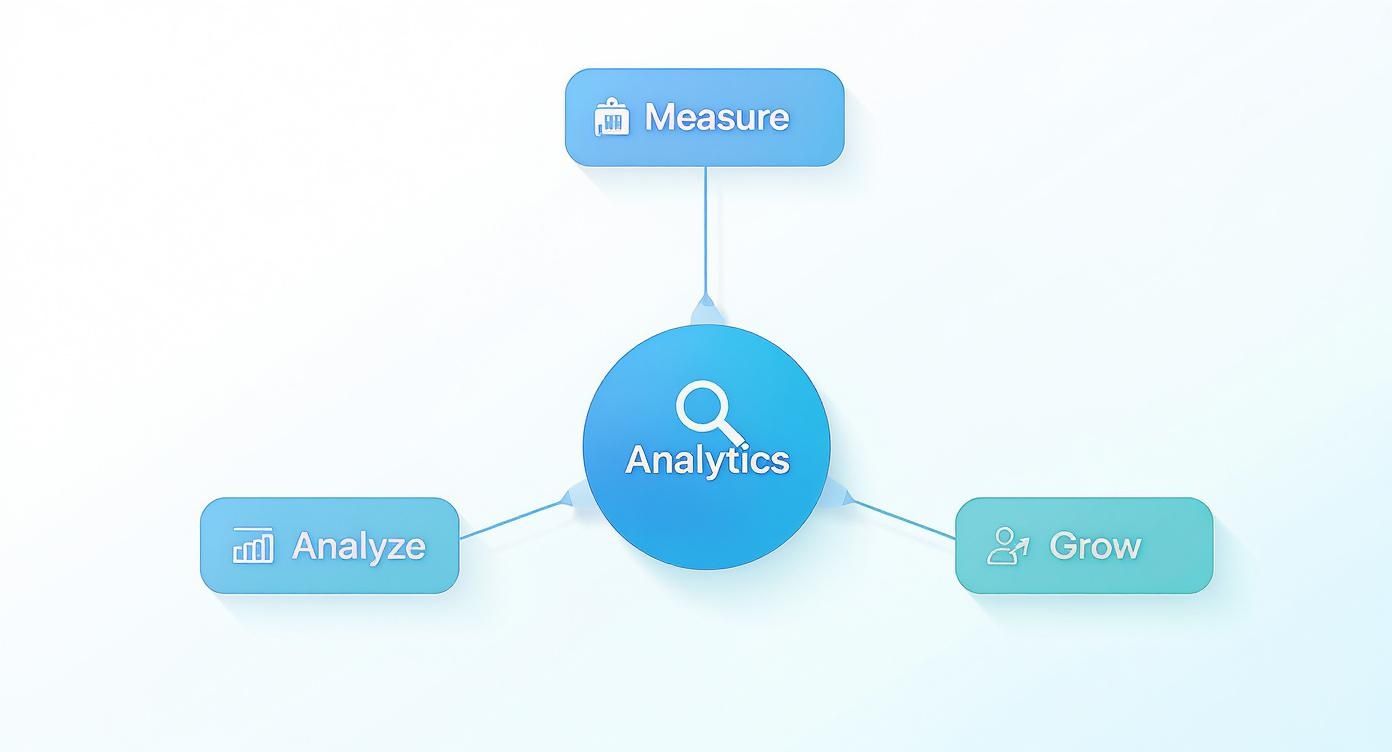
Each step feeds directly into the next, creating a cycle of continuous improvement. Let's break down the four essential components that make this system work.
1. Data Sources: The Fuel
Your data sources are the raw fuel your entire system runs on. They pull information from every touchpoint a customer has with your business. If you start with unreliable data, any analysis you do later will be worthless.
Common data sources include:
- Website and App Analytics: Tools like Google Analytics 4 track user behavior, page views, and on-site conversions.
- CRM Systems: Your customer relationship management platform (like GoHighLevel or Salesforce) holds the gold—data on leads, deals, and customer history.
- Advertising Platforms: Information from Google Ads, Meta Ads, and LinkedIn Ads tells you how your campaigns are performing and what you're spending.
- Offline Data: This often-overlooked category includes insights from sales calls or trade show sign-ups that are manually added to your system.
2. Data Collection and Storage: The Engine's Sensors
Next, you need a way to gather and store all this information. Data collection is like the network of sensors in an engine, capturing signals from every source. This process must be consistent and automated to give you a complete picture over time.
This data is then funneled into a central hub, like a data warehouse or your CRM, where it’s organized for analysis. A fragmented approach here is where most businesses fail; you need one unified view.
3. Analysis and Visualization: The Dashboard
Once your data is collected, it’s time for analysis and visualization. This is your car's dashboard—it takes complex signals from the engine and translates them into simple gauges and alerts you can understand at a glance. This is where raw numbers become actionable insights.
This component answers the critical “why” questions. Instead of just knowing how many leads you generated, you finally learn why one channel produced more valuable leads than another.
Tools like Google Looker Studio or built-in CRM dashboards help you create reports that visualize trends, patterns, and performance against your goals.
4. Action and Optimization: The Steering Wheel
Finally, we have action and optimization. This is where insights lead to real-world improvements. This is you, the driver, using the information on the dashboard to turn the steering wheel.
Based on what you’ve learned, you might reallocate your ad budget, tweak a landing page, or refine your email nurture sequences. This final step closes the loop, turning your diagnostic system into a true growth engine.
Focusing on Marketing Metrics That Actually Matter
It’s easy to get lost in a sea of data. You open your analytics dashboard and see hundreds of numbers, but most of them are noise. We call them vanity metrics—they look good on a report but don’t help you make smart decisions.
To get real value from your marketing analytics, you must cut through the clutter and zero in on the Key Performance Indicators (KPIs) that signal business health.
Think of it like a pilot's cockpit. There are dozens of gauges, but only a handful are critical for a safe flight—altitude, speed, and fuel. Your marketing dashboard should operate the same way. We break these critical metrics into three groups: how you get customers, what they do, and what they're worth.

Before we dive into specific KPIs, you need to know the difference between a metric that drives decisions and one that just inflates egos.
Actionable KPIs vs. Vanity Metrics
This table breaks down how to distinguish between metrics that genuinely guide your strategy and those that are superficial noise.
| Metric Category | Actionable KPI (What to Track) | Vanity Metric (What to Ignore) | Why It Matters |
|---|---|---|---|
| Traffic & Reach | Conversion Rate by Source | Total Page Views | Knowing where your best customers come from is far more valuable than knowing how many people visited your site. |
| Lead Generation | Cost Per Lead (CPL) | Number of Leads | A low CPL means you're acquiring leads efficiently. A high lead count with a sky-high CPL is a recipe for burning cash. |
| Social Media | Engagement Rate (Comments, Shares) | Follower Count | A million followers who don't care about your content is useless. A few thousand engaged fans can build a business. |
| Business Health | Customer Lifetime Value (CLV) | Total Revenue | CLV reveals the long-term health of your customer relationships. Revenue is just a snapshot in time. |
Focusing on the "Actionable KPI" column is how you turn data into profit. Now, let's look at how these KPIs fit into our three core groups.
Customer Acquisition Metrics
These metrics are the diagnostic tools for your lead generation engine. They tell you exactly how efficiently you’re attracting potential customers.
- Customer Acquisition Cost (CAC): Your total sales and marketing spend divided by the number of new customers acquired. This is the single most important number for determining if your marketing is profitable.
- Cost Per Lead (CPL): Calculates how much it costs to generate one lead from a specific campaign or channel. Tracking CPL helps you find your most cost-effective channels.
Customer Behavior Metrics
You’ve got a lead. Now what? These metrics measure how effectively you guide prospects through your sales process.
- Conversion Rate: The percentage of people who take a specific action you want them to take—like filling out a form or requesting a quote. A low conversion rate is a flashing red light signaling a problem in your process.
- Sales Cycle Length: The average time it takes to turn a new lead into a paying customer. If your sales cycle is getting longer, it could indicate issues with your process or lead quality.
Tracking both acquisition and behavior metrics gives you the full picture. It’s not just about getting leads cheaply; it’s about getting the right leads that convert efficiently.
Customer Value Metrics
Finally, these metrics reveal the long-term financial impact of your customers. They help you understand the total revenue you can expect from a customer relationship.
- Customer Lifetime Value (CLV): A projection of the total revenue your business will earn from a single customer. When your CLV is significantly higher than your CAC—a 3:1 ratio is a good benchmark—you have a healthy, sustainable business model.
- Return on Ad Spend (ROAS): Measures the gross revenue you generate for every dollar you spend on advertising. It gives you a direct, channel-by-channel look at how profitable your campaigns are.
Seeing Marketing Analytics in Action with Real Examples
Theory is useful, but seeing analytics solve real-world business problems makes the concept click. When you connect data directly to dollars and cents, its power becomes undeniable.
Here are two common scenarios that show how this works. Think of them as blueprints you can use for your own challenges, demonstrating how data diagnoses the root cause of a problem and leads to measurable improvements.
Example 1: The B2B Service Provider with Poor Lead Quality
A service company is getting plenty of leads, but the sales team is frustrated. They complain they're wasting time on prospects who are a poor fit for their services.
-
The Diagnosis: The marketing team was treating every lead as equal, regardless of its source. They tracked the total number of leads but had no visibility into which channels produced prospects that actually became customers. The system lacked the ability to measure lead quality.
-
The Solution: Using marketing analytics, they began tracking leads by their original source—Google Ads, LinkedIn, organic search, etc. By connecting their ad platforms to their CRM, they could follow a lead's entire journey from the first click to a signed contract. This unlocked Customer Acquisition Cost (CAC) for each channel. The data quickly showed that while Google Ads generated more leads, leads from LinkedIn cost 30% less to acquire and closed twice as fast.
-
The Transformation: Armed with this insight, they shifted a significant portion of their Google Ads budget to LinkedIn. In just one quarter, their overall CAC dropped by 22%. The sales team also reported a major jump in lead quality, helping them close more deals in less time.
Example 2: The E-Commerce Store with High Cart Abandonment
An e-commerce store has high website traffic but disappointing sales. Visitors add products to their carts but leave before completing the purchase.
-
The Diagnosis: The owner knew people were bouncing but had no idea why or where in the checkout process it was happening. Their revenue was leaking, but they couldn't find the hole.
-
The Solution: They implemented conversion funnel tracking in Google Analytics. This created a visual map of the customer's path from the product page to the final "thank you" screen, pinpointing the exact drop-off point. The data was glaring: a staggering 70% of users abandoned their carts at the shipping information stage. This immediately told them the issue was in their checkout process, where they discovered unexpectedly high shipping costs were the culprit.
If you're dealing with a similar conversion issue, our guide on how to improve website conversion rates offers practical steps to find and fix these critical drop-off points.
- The Transformation: The store implemented a simple flat-rate shipping fee and displayed it clearly on all product pages. In the first month after making that one change, cart abandonment fell by 40%, and overall revenue shot up by 15%—all without spending a single extra dollar on advertising.
How to Build Your Marketing Analytics Foundation
Jumping into marketing analytics isn't about launching a massive, complicated project overnight. The most effective systems are built intentionally, one piece at a time. We guide our clients through a "crawl, walk, run" approach that locks in early wins and builds momentum.
This is about taking small, achievable steps today. It doesn’t matter what your technical expertise or budget looks like. It all starts by asking the right questions to ensure your foundation is built to last.
Step 1: Start with Your Business Goals
Before you consider software, define what you're trying to achieve. Don't start with data; start with your business objectives. A clear goal is your North Star—it ensures every metric you track has a purpose.
The goal isn’t to collect data. The goal is to answer critical business questions. A proper analytics setup is simply the system you build to get those answers reliably and repeatedly.
This initial step prevents you from drowning in information later. By tying analytics directly to your bottom line from day one, you guarantee the insights you generate will be valuable.
Questions to Ask Yourself Before You Begin
Take a moment to diagnose your current situation. Your answers here will form the blueprint for your entire analytics foundation.
- What is the single most important action a visitor can take on our website? Is it requesting a quote? Buying a product? Booking a demo?
- What are our top 2-3 marketing channels right now? Where are we currently spending our time and money?
- What does a "qualified lead" actually look like for our sales team? Get specific. What criteria separate great leads from tire-kickers?
- What is our biggest blind spot? What is the one piece of information that, if you had it, would make the biggest impact on your decisions?
Step 2: Identify Your Foundational Tools
With your goals mapped out, you can pick the core tools to start collecting data. For most businesses, this means starting with two essential platforms that will serve as the bedrock of your system.
- Web Analytics Platform: For nearly everyone, this is Google Analytics 4 (GA4). It’s free, powerful, and the industry standard for understanding website traffic and user behavior.
- Customer Relationship Management (CRM): This is your command center for all lead and customer data. A well-integrated CRM like GoHighLevel is crucial for connecting your marketing activities to actual sales outcomes.
For many B2B companies, getting these two tools to communicate is a game-changer. You can learn more about how we implement this kind of system in our guide to B2B marketing automation. Getting these platforms talking is the most important part of your initial "crawl" stage.
The world of analytics is also shifting, with AI becoming a key player. In fact, 63% of marketers already use generative AI to process data and personalize experiences, a market projected to hit USD 22 billion by 2032. This trend, highlighted in Salesforce's recent marketing insights, reinforces the need for a solid data foundation you can build upon later.
Choosing the Right Analytics Tools for Your Business
With a sea of analytics tools on the market, it’s easy to get overwhelmed. The trick is to stop chasing flashy features and start focusing on what each tool is built to do. Don't think of it as finding one platform to rule them all. Instead, think of it like building a specialized toolkit where every piece has a distinct, critical job.
Most businesses only need tools that fall into three core categories. This simple framework will help you choose a tech stack that supports your growth—instead of creating more complexity.
Core Analytics Tool Categories
- Web Analytics: This is your window into what’s happening on your website. Tools like Google Analytics 4 are non-negotiable for understanding user behavior, traffic sources, and on-site conversions.
- Customer Data Management: This is the central nervous system for all lead and customer information. A CRM is a must-have for connecting marketing activities to sales outcomes.
- Data Visualization: These tools transform raw data into dashboards you can understand at a glance. Platforms like Looker Studio help you spot trends and report on performance without getting lost in spreadsheets.
When you're ready to dig into your options, our guide on how to choose a CRM system offers a clear, step-by-step roadmap.
How to Evaluate Your Options
Once you know which categories you need to fill, run each potential tool through these four critical questions to make a smart decision:
- Ease of Use: Can my team actually use this without weeks of training? A powerful tool is useless if no one can operate it.
- Integration: Does it play nicely with our existing tools, especially our CRM and ad platforms? A disconnected system creates frustrating data silos.
- Scalability: Will this tool grow with us? You want a solution that can handle more data and complexity as your business expands, not one you'll outgrow in a year.
- Cost: Does the price align with the value it delivers? Look for transparent pricing that fits your budget today and won't break the bank down the road.
The market for these tools is global, but not everyone is adopting them at the same pace. North America currently leads, thanks to early tech adoption and the concentration of major vendors. You can discover more insights about the marketing analytics market to get a better sense of these global trends.
Your Marketing Analytics Questions, Answered
If you're like most business owners, you don't have time for jargon. You have practical questions. Let's get straight to the no-nonsense answers we give our clients every day.
How Is Marketing Analytics Different from Market Research?
That’s a great question, and an easy way to think about it is with a car analogy.
Market research is like looking out the front windshield. You're scanning the road ahead—spotting trends, potential opportunities, and the competitive landscape. It's strategic and forward-looking, all about what could be.
Marketing analytics, on the other hand, is your dashboard and rearview mirror. It’s telling you what’s happening right now and what just happened. How fast are we going? Is the engine running hot? It’s operational, giving you hard data to optimize your current performance.
Do I Need to Be a Data Scientist to Use Marketing Analytics?
Absolutely not. That’s a common myth that holds too many businesses back. Modern analytics tools are built for business owners, not statisticians. They feature user-friendly dashboards that turn complex data into clear, visual reports.
You don’t need to be a technical wizard to get started. The key is to start with clear business questions, not by trying to master complex algorithms. Focus on the core metrics that impact your bottom line and let the tools do the heavy lifting.
What Is the Biggest Mistake Businesses Make with Analytics?
By far, the most common mistake we see is collecting tons of data without a clear purpose. This leads to "analysis paralysis," where you're drowning in numbers but have no idea what to do with them. Many businesses track dozens of metrics without knowing which ones actually predict revenue.
The fix is simple: start with your business goals first. Ask a question like, “Which marketing channel brings us our most valuable customers?” Then, work backward to find the specific data you need to answer it. This approach transforms data from a source of noise into a powerful tool for making smart decisions.
Ready to build a marketing system that gives you clarity instead of complexity? The team at Machine Marketing specializes in diagnosing your current setup and implementing the tools and strategies that drive real growth. Book a discovery call with Karl to get started.