If your marketing feels chaotic and disconnected from real business results, you're not alone. We see this all the time—the root cause is often hidden in plain sight. It’s not your creative ideas or your team's hustle; it’s the absence of a solid operational backbone. This is where Marketing Operations, or MOps, comes in.
MOps is the engineering that drives your marketing machine. It’s less about what you're marketing and more about how you do it efficiently, consistently, and, most importantly, measurably. In this article, we’ll show you how to diagnose the gaps in your marketing system and share practical steps you can take today to see results.
Understanding Marketing Operations
Think of marketing operations as the central nervous system for your entire marketing department. While your creative teams are busy crafting brilliant campaigns and compelling messages, the MOps team is building the infrastructure that makes all that work possible. They're the ones behind the curtain, connecting your people, processes, and technology to deliver predictable growth.
So, what does it look like when MOps is missing? You see the all-too-common symptoms: disconnected tools that don't talk to each other, messy campaign launches, and that sinking feeling when your CEO asks which marketing dollars are actually driving revenue—and you don't have a clear answer.
With it, you build a well-oiled system where every marketing action is planned, executed, measured, and optimized.
The Shift From Support To Strategy
Not too long ago, marketing ops was seen as a backend support role. They were the folks who managed the email software or pulled reports when asked. That view is officially a relic of the past.
Today, MOps has become a strategic powerhouse that directly links marketing activity to tangible business outcomes. A recent Salesforce report even found that 74% of high-performing marketing teams point to strong operations as critical to their success. You can see more on this trend in the full 2026 marketing operations guide.
This evolution means MOps is now responsible for answering the tough questions every business owner should be asking:
- Is our tech stack actually working for us? MOps designs and manages the entire suite of marketing tools, making sure data flows seamlessly between your CRM, email platform, and analytics dashboards.
- How do we get campaigns out the door faster without sacrificing quality? They build the repeatable processes, templates, and workflows that crush bottlenecks and minimize human error.
- What's the real ROI on our marketing spend? By ensuring data integrity and proper tracking, MOps delivers the clean, reliable analytics needed to make smart budget decisions. If you want to dive deeper into this, check out our guide on what is marketing analytics.
In simple terms, marketing operations transforms marketing from a cost center into a predictable revenue driver. It’s the engineering mindset applied to marketing, focusing on building systems that deliver consistent, scalable results for your business.
So, what is marketing operations at its core? It's the strategic function that makes sure your marketing isn't just busywork, but a powerful machine contributing directly to your bottom line.
Marketing vs Marketing Operations At a Glance
It's easy to confuse the roles of traditional marketing and marketing operations, but they serve distinct and complementary functions. This table breaks down the key differences to help you diagnose where your own team might have gaps.
| Focus Area | Traditional Marketing (The 'What') | Marketing Operations (The 'How') |
|---|---|---|
| Primary Goal | Generate brand awareness, leads, and customer engagement. | Build efficient, scalable, and measurable systems to achieve marketing goals. |
| Core Activities | Campaign creative, content creation, brand messaging, social media management. | Tech stack management, process automation, data analysis, lead management. |
| Key Questions | "What message will resonate with our audience?" | "What is the most efficient process to deliver this message and measure its impact?" |
| Measures of Success | Brand sentiment, engagement rates, lead volume, creative awards. | Campaign ROI, lead conversion rates, database health, marketing-influenced revenue. |
Understanding this distinction is the first step toward building a truly data-driven and effective marketing department. While the creative side brings the vision, the operations side provides the framework to make that vision a reality.
The Four Pillars of a Strong MOps Framework
Building a solid Marketing Operations function isn't about buying a single piece of software or hiring one "ops person." It’s about constructing a high-performance engine with four essential components working together. Think of it like a race car—it needs a powerful engine, a skilled driver, a robust chassis, and a set of rules to keep it on the track.
Get one of these pillars wrong, and you'll feel it. You'll hit bottlenecks, waste spend, and suffer a frustrating disconnect between your marketing efforts and actual business growth. But when you get them right, you create a system that predictably drives results.
A strong MOps framework rests on the successful integration of Technology, People, and Process.
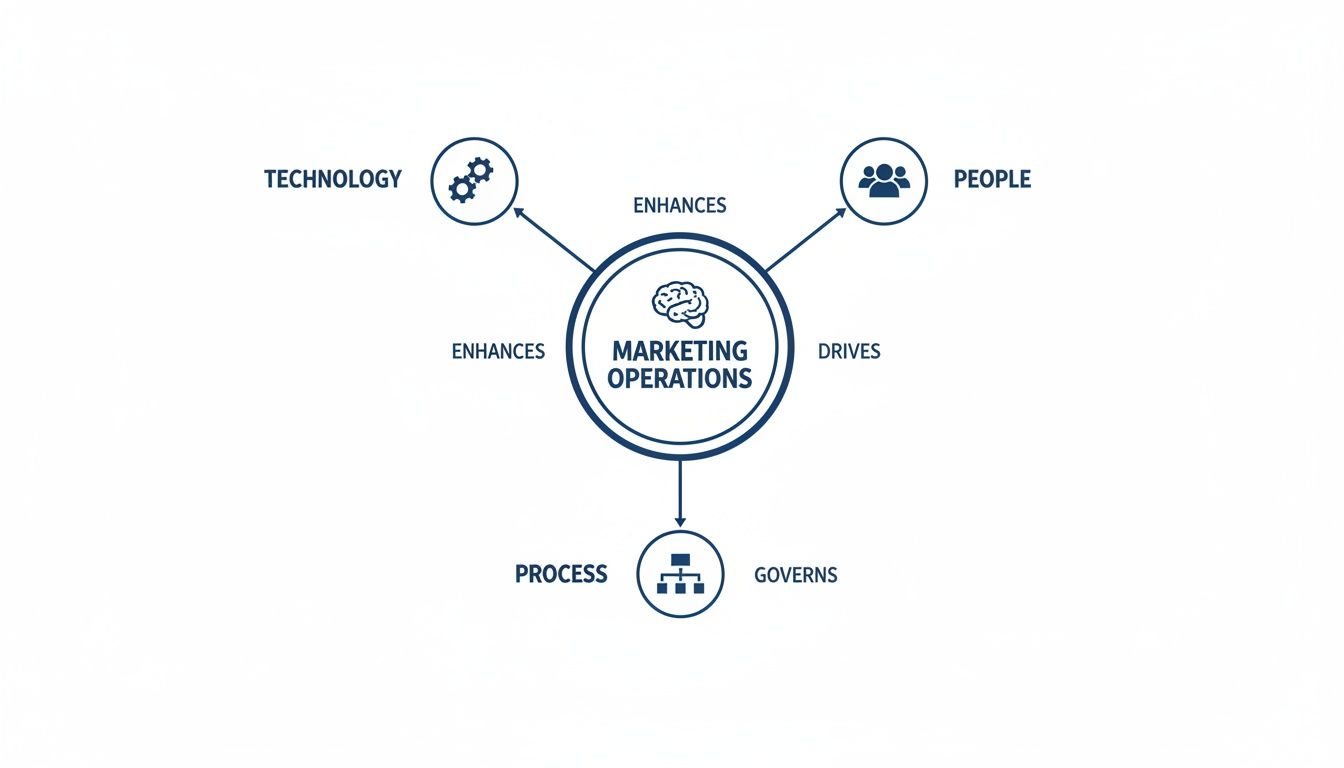
This visual really nails how interconnected these elements are, with MOps acting as the strategic brain coordinating everything. Let's break down each of the four pillars you need to build.
Pillar 1: Technology Management
Your technology is the central nervous system of your entire marketing operation. Managed correctly, it becomes the single source of truth for all your customer and campaign data. Managed poorly, it turns into a tangled mess of disconnected tools that create data silos and massive headaches.
The goal is to build an integrated system where information flows freely and automatically. Your CRM, email platform, analytics tools, and other software should talk to each other seamlessly. If you're looking to map this out, you can explore our deep dive into building a powerful marketing technology stack to guide your choices.
Questions to Ask Yourself:
- Is our CRM the undisputed hub for all customer data?
- Do our key marketing tools (like website forms and email platforms) automatically sync with our CRM?
- Are we paying for redundant tools that basically do the same thing?
Pillar 2: Process Optimization
A killer tech stack is useless without well-defined processes that show your team how to use it. Process optimization is all about mapping out your marketing workflows—from campaign ideation to launch and analysis—and systematically hunting down and eliminating friction.
This is where you build the standard operating procedures (SOPs) that ensure every campaign is launched with the same level of quality and consistency. For example, what exactly happens when a new lead fills out a form on your website? A documented process ensures that lead is qualified, assigned, and nurtured without ever falling through the cracks.
Common processes to optimize include:
- Lead Management: Defining the entire lifecycle of a lead, from the first touchpoint to sales handoff and long-term nurturing.
- Campaign Execution: Creating a repeatable checklist for launching campaigns, covering everything from creative requests to final analytics reporting.
- Content Creation: Establishing a clear workflow for producing, reviewing, approving, and publishing content to keep your brand message tight and consistent.
Pillar 3: Data and Analytics
Data is the fuel for your MOps engine, but raw data is just noise. This pillar is about turning that noise into actionable insights that prove marketing’s value and inform your next move. It’s about ditching vanity metrics and tracking what really matters to the business.
Your goal here is to build dashboards that draw a straight line from marketing activities to revenue. Instead of just reporting on email open rates, you should be tracking metrics like marketing-influenced pipeline and customer acquisition cost (CAC). This is how you finally answer the C-suite’s favorite question: "What are we getting for our marketing spend?"
The Transformation: Effective data and analytics move the conversation from, "We got 1,000 website clicks," to, "This campaign generated $50,000 in new sales opportunities." This change is fundamental to positioning marketing as a revenue center, not a cost center.
Pillar 4: Governance and Compliance
The final pillar, governance, provides the essential guardrails that keep your operations secure, compliant, and consistent. This involves setting the rules of the road for how data is managed, how your brand is presented, and how you comply with regulations like GDPR or CCPA.
Governance isn’t about creating restrictive red tape; it’s about managing risk and maintaining quality as you scale. It ensures everyone on the team uses the same naming conventions for campaigns, that customer data is handled securely, and that your brand voice stays consistent. Without it, your clean data and smooth processes can quickly spiral into chaos as your team grows.
By diagnosing and strengthening each of these four pillars, you can methodically transform your marketing function from a chaotic cost center into a predictable, scalable growth engine.
Key Roles on a Marketing Operations Team

You don't need a massive team to get started with marketing operations, but you absolutely need the right skills. The smartest approach is to find your biggest point of failure first and then hire the person who can fix it. This isn't about filling seats; it's about making strategic hires that deliver immediate value.
Whether you're bringing on your first specialist or scaling up a full team, knowing the core roles is the first step. Understanding who does what helps you pinpoint exactly what your business needs to build a more powerful and scalable marketing system.
The Marketing Operations Manager
The Marketing Operations Manager is the architect of your entire marketing engine. This person designs the systems, processes, and workflows that keep your marketing department from descending into chaos. They're the strategic thinker connecting the dots between your tech, your processes, and your people.
Think of them as the general contractor building your marketing house. They oversee the whole project, making sure the plumbers (technologists) and the electricians (data analysts) are working in sync. Their job is to ensure the final structure is solid, secure, and built to last by eliminating bottlenecks and creating repeatable, efficient processes.
Key responsibilities include:
- Process Design and Documentation: Mapping out every critical workflow, from lead management and campaign execution to budget tracking.
- Project Management: Making sure campaigns launch on schedule and within budget by coordinating across different teams.
- Vendor and Budget Management: Owning the martech budget and managing relationships with all your software vendors.
The Marketing Technologist
While the MOps Manager designs the blueprint, the Marketing Technologist is the specialist who actually wires the house. This is a deeply technical role focused entirely on managing, integrating, and optimizing your marketing technology stack. They live and breathe your CRM, marketing automation platform, and all the tools that stitch them together.
A great technologist is the person who prevents data silos from crippling your team. They make sure data flows seamlessly between systems. They're the problem-solvers who troubleshoot tricky integrations, build complex automation sequences, and configure your tech stack to support your goals, not get in the way of them.
A Marketing Technologist transforms a pile of expensive software subscriptions into a single, powerful system. They’re the one who ensures your GoHighLevel or other CRM is more than a fancy address book—it’s the true brain of your marketing intelligence.
The Data Analyst
The Data Analyst is your team's storyteller, translating raw numbers into clear, actionable insights. Their entire job is to dive deep into campaign performance, customer behavior, and marketing attribution to answer the single most important question: "What's actually working?"
This person builds the dashboards and reports that reveal the true ROI of your marketing spend. They shift the conversation away from vanity metrics like clicks and impressions and toward business-critical KPIs like customer acquisition cost (CAC) and marketing-influenced revenue. Without a skilled data analyst, you're just flying blind, making big decisions based on gut feelings instead of hard evidence.
Which Role Should You Hire First?
Your first MOps hire should directly address your most painful operational weakness. Don't just hire for a title; hire to solve a specific, nagging problem.
- Is your biggest problem chaos and inefficiency? Campaigns are always late, leads are falling through the cracks, and nobody knows who owns what. You need a Marketing Operations Manager to bring order and build your foundational processes.
- Is your biggest problem a broken tech stack? Your CRM is a disaster, your tools don't talk to each other, and your team is drowning in manual data entry. You need a Marketing Technologist to get your systems working together.
- Is your biggest problem a lack of insight? You're spending money on marketing but have zero idea what the ROI is. You need a Data Analyst to connect your marketing activities directly to revenue.
By starting with a clear diagnosis of your problem, you ensure that your first investment in marketing operations delivers an immediate and measurable impact, paving the way for future growth.
How MOps Drives Growth in B2B Companies
Theory is great, but let's talk about how this actually works for a manufacturing or B2B service company. Marketing operations is the bridge between a good idea and a profitable, repeatable system that actually grows the business.
For a busy owner, this is where the investment in MOps really pays off. It’s the difference between running a series of disjointed marketing activities and building a predictable engine that generates qualified leads and measurable revenue. Let's walk through a real-world scenario.
Diagnosis: A Machine Manufacturer With Leaky Leads
Imagine a manufacturer of high-value industrial equipment. Their marketing team is generating leads through the website's contact form, but the sales process feels completely random. Some leads get a call, others get lost in an inbox, and nobody really knows who the serious buyers are.
The core problem is a total lack of a system. Leads are coming in, but they're leaking out just as fast because the follow-up process is chaotic and manual. This is a classic marketing operations problem we see all the time.
A MOps pro would start diagnosing this with a few key questions:
- Where are all website leads being stored? Is there a central system, like a CRM?
- What is the standard process for following up with a new lead? Who owns it?
- How do you separate high-priority leads from people who are just browsing?
- How do you track what happens to a lead after that first contact?
The diagnosis quickly reveals there's no documented process, leads are just sitting in an email inbox, and the sales team is guessing which ones to call first. This isn't a sales problem; it's an operational failure.
Solution: Building an Automated Lead Management System
Once the problem is clear, the MOps solution is to build a robust, automated system to capture, qualify, and nurture every single lead. A platform like GoHighLevel (GHL), which combines a CRM with marketing automation, is perfect for this job.
The fix involves a few critical steps:
-
Centralize All Leads: First, we make sure every website form submission is automatically captured in the GHL CRM. This immediately stops leads from getting lost in inboxes and creates a single source of truth for the entire team.
-
Implement Lead Scoring: Next, we set up a lead scoring system. A prospect who visits the pricing page and downloads a technical spec sheet gets more points than someone who just glances at the homepage. This automatically pushes the hottest, most sales-ready leads to the top of the pile for immediate follow-up.
-
Automate Nurturing: For the cooler leads (those with a low score), we build an automated email and SMS nurture sequence. This sequence delivers helpful content—case studies, technical guides, video demos—over several weeks to keep the manufacturer top-of-mind and build trust until the prospect is ready to talk business.
For engineers or sales reps in manufacturing, this could mean deploying specific email and SMS campaigns through GHL to re-engage past customers. This kind of data-driven personalization can lift reactivation rates by 15-20%.
Transformation: Predictable Growth and Clear ROI
The transformation is profound. The company goes from a chaotic, manual process to a streamlined system that delivers predictable results and crystal-clear data.
The sales team is no longer guessing; they're working from a prioritized list of hot leads that are delivered to them automatically. Cooler leads are being nurtured systematically, making sure no opportunity is ever wasted.
Most importantly, we can build a dashboard that tracks the entire journey, answering critical business questions:
- What is our lead-to-qualified-opportunity conversion rate?
- Which marketing channels are driving the highest-quality leads?
- What is the exact ROI on our digital marketing spend?
Accurate data is the lifeblood of MOps. That’s why understanding technical nuances, like digging into why GA4 under-reports ChatGPT traffic, is so vital for getting reliable insights. This operational mindset is what turns marketing from a mysterious expense into a measurable and scalable investment.
Essential Tools for Your MOps Tech Stack

Think of your marketing technology as the toolbox you use to build your company's growth engine. Choosing the right tools is important, but making them work together seamlessly is what really matters. That’s a core job of marketing operations.
A well-built tech stack gets rid of soul-crushing manual work, gives you crystal-clear data, and empowers your team to run campaigns that actually scale.
For most B2B businesses, a solid MOps foundation rests on a few key types of software. Get these right, and you're building an efficient system. Get them wrong, and you’re stuck managing everything in spreadsheets, hoping nothing falls through the cracks.
The Core Components of Your Stack
Building a tech stack doesn't have to be a massive, complex project. The smart move is to start with the essentials and only add new tools when you have a specific problem that needs solving. These three categories are your non-negotiable building blocks.
-
Customer Relationship Management (CRM): This is the heart of your entire operation. Your CRM needs to be the single source of truth for every scrap of customer and prospect data. It’s where every interaction, conversation, and detail lives, giving you a 360-degree view of every relationship.
-
Marketing Automation Platform: This is the engine that drives your communication. This software handles things like email marketing, lead nurturing sequences, and automated workflows. It’s what allows you to send the right message to the right person at exactly the right time—without having to do it all by hand.
-
Analytics and Reporting Tools: This is your command center. These tools connect to your other platforms to show you what’s working and what’s not. A good analytics setup helps you track your most important metrics and prove the real return on investment (ROI) from your marketing spend.
The real power isn't in any single tool, but in how they all connect. Truly effective marketing automation integrations are the digital glue holding your go-to-market strategy together, making sure data flows smoothly from one system to the next.
To help you visualize this, here's a simple breakdown of the essential software categories you'll need to consider as you build or refine your marketing tech stack.
Core Marketing Operations Tool Categories
| Tool Category | Primary Function | Example Tools |
|---|---|---|
| CRM | Manages all customer, lead, and prospect data. Serves as the central database. | HubSpot, Salesforce, GoHighLevel |
| Marketing Automation | Automates repetitive marketing tasks like email campaigns, lead nurturing, and social posts. | Marketo, Pardot, GoHighLevel |
| Analytics & Reporting | Tracks campaign performance, website traffic, and key business metrics. Visualizes data. | Google Analytics, Looker Studio |
| Content Management System (CMS) | Creates, manages, and publishes digital content for your website and blog. | WordPress, Webflow, HubSpot CMS |
| Project Management | Organizes tasks, timelines, and team collaboration for marketing projects and campaigns. | Asana, Trello, Monday.com |
Each category solves a distinct problem, but they deliver maximum value when they communicate with each other effectively.
The All-in-One Advantage with GoHighLevel
For many small and mid-sized businesses, trying to manage—and pay for—separate tools for each of these functions gets expensive and messy, fast. This is where an all-in-one platform like GoHighLevel (GHL) can be a total game-changer.
GHL bundles a powerful CRM with marketing automation and reporting capabilities into a single, cohesive system.
This integrated approach immediately solves a few common headaches. You don't have to worry about frustrating integrations because all the pieces were designed to work together from day one. This kills data silos—where customer info gets trapped in one system—and often lowers the total cost of your tech stack.
Of course, picking the right CRM is a huge decision; it's the foundation for your entire customer-facing operation. If you could use some guidance, our team put together a detailed guide on how to choose a CRM system that walks you through exactly what to look for.
How to Start Building Your MOps Function Today
Getting your marketing operations off the ground doesn't mean you need a massive budget or a complete organizational teardown overnight. It starts with a shift in mindset—thinking like a diagnostician—and taking a few focused, intentional steps.
You can start putting core MOps principles to work right now by chasing a few quick wins that build momentum. It’s all about finding the biggest point of friction and fixing that first.
A 3-Step Quick Start Plan
Ready to go from theory to action? Here’s a simple, three-step plan to get your MOps function rolling. We designed this to give you a tangible result fast, showing you and your team the real-world value of operational thinking.
-
Run a Simple Process Audit: Grab a whiteboard and physically map out your current lead-to-sale process. Trace every single touchpoint, from the second a lead fills out a form to the moment a salesperson closes the deal. The goal is to find the single biggest bottleneck—that one spot where leads get stuck, go cold, or just fall through the cracks. This is your ground zero.
-
Define 3-5 Critical KPIs: It's time to stop tracking vanity metrics. Work backward from your revenue goals and define 3-5 key performance indicators (KPIs) that directly measure business impact. Good examples include Customer Acquisition Cost (CAC), Lead-to-Opportunity Conversion Rate, and Marketing-Influenced Revenue. These are the numbers that actually matter to your bottom line.
-
Automate One High-Value Process: Look at the bottlenecks you found in your audit and pick one repetitive, high-impact task to automate. A perfect first choice is setting up instant lead notifications. When a new lead comes in, an automated alert should immediately fire off to the right salesperson with all the context they need to act.
This small win accomplishes two big things: it plugs a critical leak in your sales funnel and provides a clear, immediate demonstration of how automation improves efficiency and results.
By zeroing in on one bottleneck, defining what success looks like, and implementing a single automation, you're laying the very first foundational stone for a scalable, data-driven marketing engine that will drive predictable growth for your business.
Common Questions About Marketing Operations
If you're wondering where MOps fits into the bigger picture, you're not alone. Let's clear up some of the most common questions business owners have about marketing operations.
Is Marketing Operations Just Another Name For Marketing Management?
Not at all—they're two sides of the same coin.
Marketing management is all about strategy. It answers the big questions: what markets should we target, what message will resonate, and why are we running this campaign?
Marketing operations, on the other hand, handles the execution. It's the "how." MOps builds the infrastructure—the processes, tech, and workflows—that brings the marketing strategy to life efficiently and measurably. A marketing manager decides on the destination; the MOps team builds the high-speed railway to get there.
How Is MOps Different From Sales Operations?
They're close cousins, both focused on efficiency, but they own different parts of the customer journey.
Sales Operations (Sales Ops) is dedicated to making the sales team more effective. They live inside the CRM, fine-tuning sales processes, managing territories, and building sales forecasts. Their world starts when a lead is ready to talk to a salesperson.
MOps owns the top of the funnel. It manages everything from initial lead generation right up to the point where a qualified lead is handed off to sales. For a seamless customer experience, these two teams have to be in lockstep, especially at that critical handoff.
Do I Really Need a Dedicated MOps Person?
The answer really depends on how much friction you're feeling in your marketing. If leads are falling through the cracks, you have no idea what your ROI is, and your marketing tools feel like a jumbled mess, it's a huge sign you need dedicated operational help.
A smaller business might start by giving MOps duties to a marketer who's good with tech. But as you scale, a dedicated Marketing Operations Manager becomes non-negotiable if you want to build a true growth engine.
The time to hire for a dedicated MOps role is when operational chaos becomes a bigger roadblock to growth than a lack of new marketing ideas.
Can We Just Outsource Marketing Operations?
Absolutely. Outsourcing MOps to a specialist agency is a smart move for companies that need high-level expertise without the cost of a full-time hire. You get immediate access to proven best practices and advanced technical skills from day one.
An outsourced partner can audit your current setup, build the foundational systems you're missing, and manage your tech stack. This frees up your in-house team to do what they do best—focus on creative strategy and campaign ideas—while the operational backbone is handled by experts.
If your marketing efforts feel disconnected from your business results, the problem is almost always operational, not creative. Machine Marketing specializes in finding and fixing those gaps. We build the systems that create predictable, measurable growth.
We can help you implement GoHighLevel, automate your workflows, and finally get a crystal-clear view of your marketing ROI. Book a discovery call with us and let's start building your marketing machine.