Are your company’s emails generating real business, or just cluttering inboxes? For most businesses, the root cause of an underperforming email strategy is simple: they’re sending the wrong message at the wrong time.
The good news is that the solution is straightforward. Every email your business sends can be diagnosed and sorted into one of two primary categories: transactional or marketing. Understanding this distinction is the first step to engineering a communication system that builds trust and drives results.
Your Blueprint for Every Email You Can Send
When you don’t have a clear framework, email marketing feels like guesswork. You send a promo here, a newsletter there, and hope for the best. This reactive approach erodes trust and kills momentum. It's time to stop guessing and start engineering a solution.
Think of your email types as specialized tools. You wouldn't use a sledgehammer to turn a tiny screw. In the same way, you shouldn't use a promotional email (the sledgehammer) for a password reset (the screw). The key is to diagnose the job at hand and select the right tool—the right email type—every single time. This ensures your messages are relevant, expected, and effective.
This diagram shows how all email types stem from these two foundational branches.
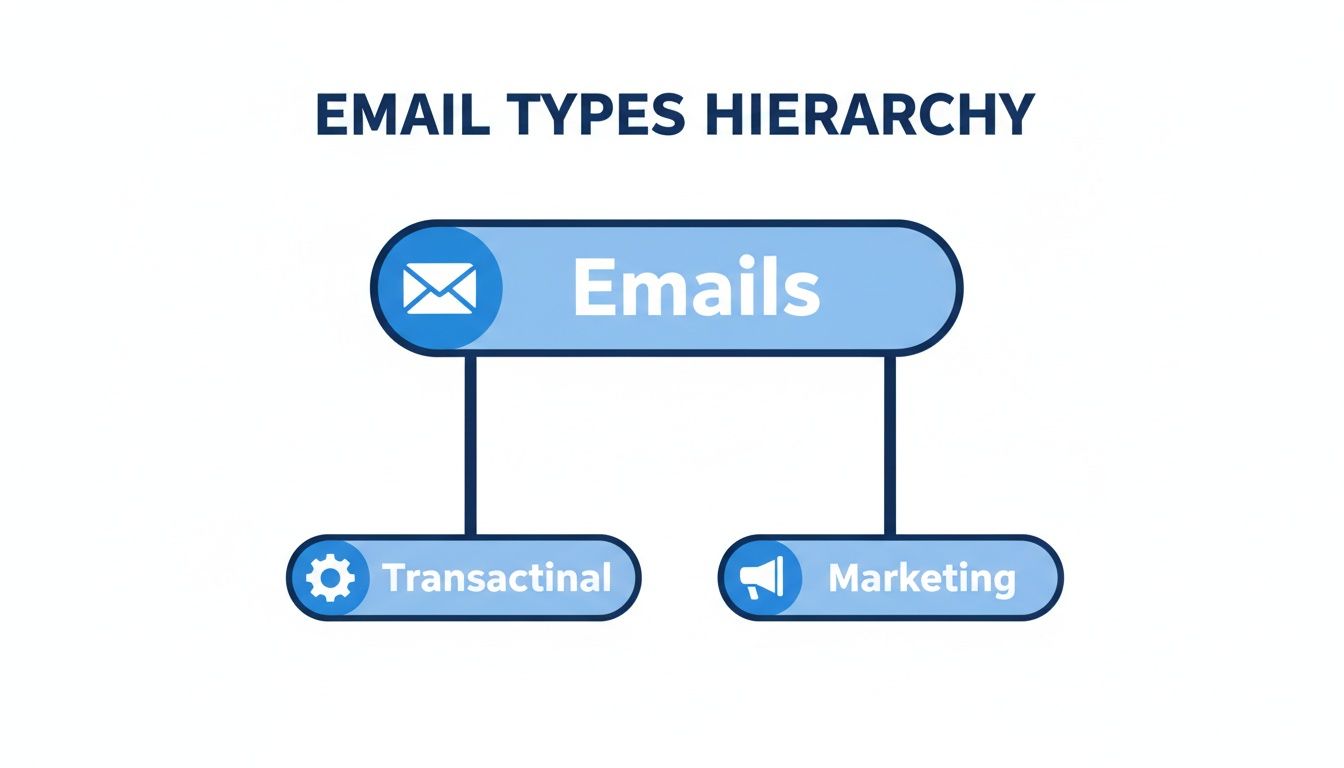
As you can see, every email has a specific job, originating from either a functional need (transactional) or a persuasive one (marketing).
To help you build your own system, here's a quick reference table breaking down the most common email types, their purpose, and what you should be measuring.
Quick Guide to Business Email Types
| Email Type | Primary Purpose | Key KPIs to Track |
|---|---|---|
| Transactional | Confirm an action or provide essential info | Open Rate, Click-Through Rate (for links) |
| Marketing / Promotional | Drive sales, announce offers, generate leads | Conversion Rate, Click-Through Rate, Revenue |
| Newsletter | Build relationships, share value, maintain top-of-mind awareness | Open Rate, Click-Through Rate, Unsubscribe Rate |
| Automated Sequences | Nurture leads or customers at key journey stages | Open Rate, Click-Through Rate, Conversion Rate |
| Cold Outreach | Initiate a new business relationship | Reply Rate, Open Rate |
| Internal / Operational | Communicate with your internal team | N/A (focus on clarity and action) |
This table serves as your high-level map. Now, let’s diagnose how each type plays a unique role in your system for business growth and customer retention.
Building Your Communication Framework
To build your own email blueprint, start by diagnosing every touchpoint a customer has with your business. For each interaction, ask this question: "What is the primary job of this communication?"
- Is it to confirm an action they just took? That’s a transactional email.
- Is it to build a relationship or drive a future sale? That’s a marketing email.
The most successful email strategies don't just send emails; they deliver the right information at the exact moment a person needs it. This builds trust and transforms your email list into a reliable business asset.
As you develop your blueprint, don't forget to layer in loyalty-building strategies like learning How to Write Birthday Emails That Delight Customers. The format of the message also matters. You can explore this further in our guide to email formats like HTML vs. plain text.
Understanding Transactional vs. Marketing Emails
Every email you send has a job, but not all jobs are the same. They fall into two distinct camps: transactional or marketing.
Getting this difference right isn't just about best practices—it’s fundamental to legal compliance, customer trust, and the overall effectiveness of your communication. Confusing the two is a fast way to alienate your audience and damage your sender reputation.
Think of it this way: a transactional email is like a receipt. It confirms an action that just happened. A marketing email is like a catalog, designed to encourage a future action.
What Are Transactional Emails
At its core, a transactional email is an automated, one-to-one message triggered by something a user did. Its primary purpose is functional: to deliver critical information and confirm that a process is complete.
Because people are actively expecting these emails, they see incredible engagement. Open rates are often well over 80%, far surpassing most marketing emails. We dive deeper into the nuts and bolts of what transactional emails are in another guide, but the core concept is simple.
You see these all the time:
- Order and shipping confirmations right after you buy something.
- Password reset instructions when you’ve been locked out of an account.
- Welcome emails with new account details the moment you sign up.
For a B2B manufacturer, a transactional email might be an automated confirmation that a "Quote Request Was Received" or an email delivering "Invoice #1234." The goal is always to facilitate an administrative or transactional step.
The rule is simple: if the user’s action prompted the email, it's transactional. Keep promotional content out of these messages. Stuffing a "20% off" coupon into a password reset email is a classic mistake. It feels out of place and can harm your sender reputation.
What Are Marketing Emails
Marketing emails are proactive, one-to-many communications sent to build relationships, nurture leads, and drive sales. Unlike their reactive, transactional cousins, these are sent on your schedule to a specific segment of your audience. Their job is to persuade.
Crucially, these emails require explicit consent, or an opt-in, from your contacts. This is where you build your brand, demonstrate your expertise, and ultimately generate revenue from your email list.
Key types of marketing emails include:
- Promotional offers announcing a new product, service, or sale.
- Informational newsletters that share valuable industry insights and company updates.
- Lead nurturing sequences designed to guide a prospect from initial interest to a purchase decision.
For a B2B service provider, a marketing email could be a case study showcasing results for a similar client or an invitation to an exclusive webinar. The goal is to build authority and nudge the prospect toward the next step in your sales cycle.
If transactional emails are the receipts and shipping notifications of the business world, marketing emails are the engine driving your growth. This is where you actively persuade, build authority, and guide potential customers toward a sale.
But just "sending marketing emails" isn't a strategy. Firing off the same message to your entire list is like trying to sell a 5-axis CNC machine to a coffee shop—it just won’t connect. The real power comes from sending the right kind of marketing email to the right person.
Promotional Emails
Think of promotional emails as your digital sales force. They have one clear goal: to spark an immediate action, like a purchase, quote request, or booked consultation. But for B2B, this isn't about "50% Off!" blowouts.
For a manufacturer or service provider, a "promo" should be strategic, not just cheap. The goal is to create a timely, valuable opportunity for the exact client you want to attract.
Actionable B2B Promotional Email Examples:
- A machine shop announces limited-time introductory pricing on a brand-new laser cutting service.
- An engineering firm offers a complimentary initial consultation for projects booked before the end of the quarter.
- A parts supplier runs a promotion to clear out last year's inventory of a specific component.
The key is tying the promotion to genuine business value. You aren't trying to be the lowest bidder; you're creating a smart incentive.
Informational Newsletters
This is your long game. Informational newsletters are all about building relationships and proving your expertise. Their main job isn't to get a sale today, but to build so much trust that when a prospect is ready to buy, you’re the only name on their list.
A newsletter is your opportunity to have a regular, value-added conversation with your audience. It proves you understand their world, building the trust needed for a long B2B sales cycle.
Skip the self-serving company updates. Instead, focus entirely on your audience's pain points and interests.
B2B Newsletter Content That Works:
- A custom fabricator shares a case study on how they solved a complex logistics challenge for a major client.
- A manufacturer publishes a practical guide: "How to Choose the Right Alloy for High-Stress Applications."
- A B2B service firm sends a summary of key trends from the industry's biggest trade show.
This approach positions you as a helpful expert, not just another vendor. To get the most from this, you must send the right content to the right people. Our guide on how to segment email lists shows you how to do this.
Lead Nurturing Emails
Here’s where you turn mild interest into a sales-qualified lead. Lead nurturing emails are an automated series, triggered the moment someone takes an action like downloading a whitepaper. They exist to bridge the gap between that first touchpoint and a real sales conversation.
Unlike a one-off newsletter, lead nurturing is intensely personal. If someone downloads your guide on a specific manufacturing process, the follow-up emails shouldn't be about your company's history. They should offer more in-depth content related to that exact process.
It’s a systematic, automated way to ensure no interested lead ever goes cold.
Putting Your Revenue on Autopilot with Email Automation
If you think of marketing emails as your sales force, then automated emails are the operational system that keeps your business running 24/7. This is where you stop chasing down every lead by hand and start building a machine that nurtures relationships and drives revenue on its own.
An automated email sequence is a series of pre-written emails sent automatically when a contact takes a specific action—or doesn't. For B2B manufacturers with long sales cycles, this is a game-changer. It ensures every prospect gets a consistent, high-value experience without you lifting a finger.
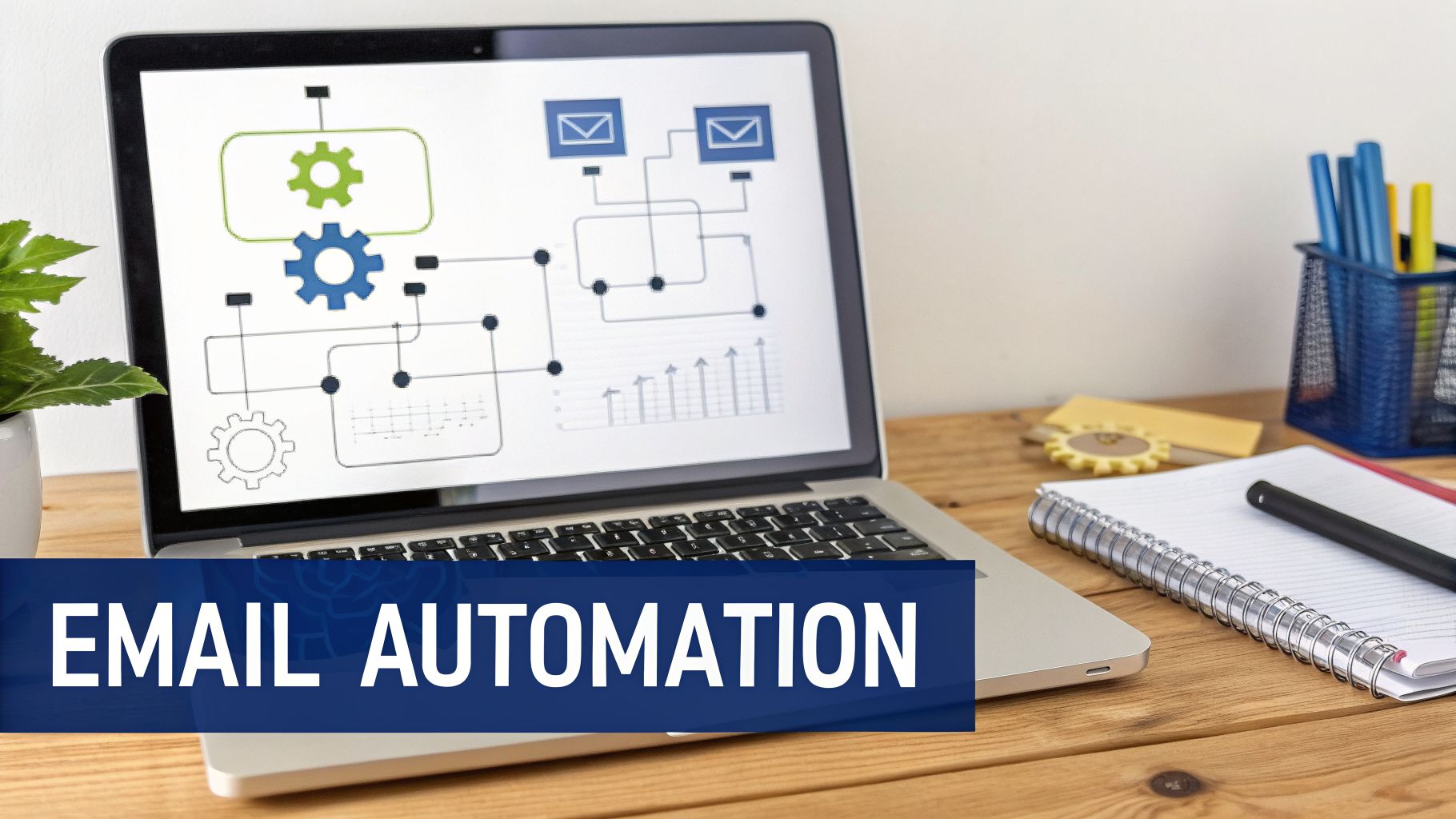
The power here is efficiency. Automated emails might only make up about 2% of all emails you send, but they can be responsible for an incredible 41% of all email orders. The performance metrics speak for themselves, with average open rates hitting 42.1% and conversion rates at 1.9%. You can see how top brands use these sequences by checking out the latest email marketing statistics from Wix.
The Welcome Series
Question to ask yourself: What happens right after someone subscribes to your list or downloads a CAD file? If the answer is "nothing," you have a major gap in your system. A welcome series is your automated onboarding process, built to make a killer first impression and guide new contacts toward understanding your true value.
This isn't just one "thanks for subscribing" email. A smart B2B welcome series could look like this:
- Email 1 (Immediate): Delivers the promised file and confirms their subscription. Direct and to the point.
- Email 2 (2 days later): Introduces a common problem your business solves, supported by a quick customer quote.
- Email 3 (4 days later): Answers a frequently asked question and invites them to follow you on LinkedIn for more industry insights.
- Email 4 (7 days later): Presents a soft call to action, like scheduling a no-pressure discovery call with a technical expert.
Setting this sequence up in a platform like GoHighLevel guarantees every new lead gets this perfectly timed experience.
Re-Engagement Campaigns
It's inevitable: some contacts will go dark. A re-engagement campaign is an automated sequence that triggers when a contact hasn't opened an email in a while (say, 90 days). The goal is simple: either win them back or clean your list.
It's far more cost-effective to reactivate an old lead than to acquire a new one. A re-engagement campaign is your system for finding hidden revenue in your existing database.
A simple re-engagement flow might be:
- An email asking, "Are we still a good fit?" Include options for them to update their preferences.
- A follow-up offering your single most valuable resource—like a powerful whitepaper—to remind them why they signed up.
- A final, transparent email letting them know you'll be removing them from the active list unless they click to stay subscribed.
This process keeps your list healthy, your deliverability high, and your engagement rates strong. If you’re looking for more ways to put your marketing on autopilot, read our deep dive on marketing automation for B2B businesses.
Building Your High-Performing B2B Email Strategy
Knowing the different types of emails is step one. But real growth happens when you weave them into a smart, cohesive strategy. Firing off random email blasts feels like junk mail because it is junk mail. It's missing context and respect for your recipient's time.
A high-performing strategy is what transforms your email from a nuisance into a welcome, valuable touchpoint. You don't need to master every single email type to succeed. Instead, focus on three core pillars: segmentation, personalization, and cadence. Get these right, and you can turn a contact list into a predictable revenue engine.
Pillar 1: Segmentation That Drives Results
Segmentation is simply dividing your email list into smaller groups based on what they have in common. For a B2B company, basic demographic data won't cut it. You have to segment your list using business data that signals what your contacts actually need.
Think of it like organizing your workshop. You wouldn't throw all your tools into one giant bin. You need to separate your prospects from your customers, and your engineers from your procurement managers.
Actionable B2B Segmentation Categories:
- Job Title: An engineer wants technical specs. A CEO wants to see the ROI.
- Industry: A lead from the aerospace sector has different compliance needs than one from the automotive world.
- Past Behavior: Did they download a specific whitepaper? Request a quote for a particular service? These actions tell you what they're interested in.
- Purchase History: Separate your one-time buyers from repeat customers. Those loyal customers might be perfect for a new loyalty program.
Sorting your contacts this way is the foundation for sending relevant emails.
Pillar 2: Personalization That Connects
Personalization is what you do with those segments. It’s about using what you know about a contact to tailor your message directly to their challenges and goals. This goes way beyond just dropping a [First Name] tag into your subject line.
The impact here is massive. Our research shows 58% of all email revenue is generated from segmented and targeted campaigns. When the experience feels personal, 80% of business leaders report that consumers spend 34% more. But get it wrong, and 63% of consumers will stop buying from brands with personalization that misses the mark. Today, 63% of marketers use AI to dial this in. You can discover more insights about email personalization on theloopmarketing.com to see the full picture.
Personalization is the difference between an email for an engineer and an email that sounds like it was written by an engineer. It proves you understand their world.
For example, you could send a case study about your work with a medical device company specifically to everyone in your "Medical Device Industry" segment. This targeted approach instantly proves your relevance and builds immediate credibility.
Pillar 3: Cadence That Builds Trust
Cadence is the frequency and timing of your emails. Send too many, and you’ll get a wave of unsubscribes. Send too few, and your hard-won leads will go cold. The right cadence keeps you top-of-mind without being annoying.
Questions to Ask Yourself to Define Your Cadence:
- What is our typical sales cycle length? For long cycles of 6-12 months, a monthly newsletter and a quarterly check-in might be the perfect rhythm.
- What is the value of this email? High-value content, like a new case study, can be sent more often than a simple promotional offer.
- What stage is the contact in? A brand-new lead in a welcome sequence should hear from you more frequently than an established, long-term customer.
Start with a clear plan—maybe a bi-weekly newsletter and one monthly promotional email—and watch your numbers. If open rates are high and unsubscribes are low, you’ve found a good rhythm. If unsubscribes start to spike, it’s a clear signal to pull back.
Your Questions Answered: Getting Smart About Email
As you start engineering your email strategy, questions will come up. That’s a good sign. It means you're shifting from just "sending emails" to building a system that gets results. We hear these questions all the time from business owners, so let's provide some clear answers.
How Many Types of Emails Should My Business Really Be Sending?
You don't need to send every type, especially at first. For most B2B businesses, the best approach is to start with a core set that delivers immediate value. This builds a solid foundation you can expand on later.
Focus on these three to begin:
- Essential Transactional Emails: These are non-negotiable. At a minimum, you need confirmations for critical actions like quote requests or contact form submissions.
- An Informational Newsletter: A regular newsletter is your best tool for building authority and staying top-of-mind with your entire audience.
- One Automated Welcome Sequence: This is your digital handshake for new contacts. A well-crafted welcome series ensures every new lead gets a consistent, high-value introduction.
Once that foundation is running like a well-oiled machine, you can layer in promotional emails or advanced automation like re-engagement sequences. The key is to master a few types first, then expand.
What’s the Difference Between a Newsletter and a Lead Nurturing Email?
This is a critical distinction, and getting it right directly impacts your results. While they're both marketing emails, they have completely different jobs.
A newsletter is like a broadcast. It goes out to a broad segment of your audience—like all customers or all prospects—on a regular schedule. The main goal is to build your brand and share useful insights. It's a one-to-many conversation.
A lead nurturing email is a one-to-one conversation, scaled. It’s triggered by a specific person’s action and is designed to guide them, and only them, to the next logical step.
A lead nurturing email, on the other hand, is part of a targeted, automated series sent to one person based on their specific behavior. Its goal is direct: move that single lead further down the path to a sale.
For example, a newsletter might feature a general company update that goes to everyone. A nurturing email would send a specific case study about CNC machining only to a lead who just downloaded your whitepaper on that exact topic.
Can I Use GoHighLevel to Manage All These Email Types?
Absolutely. A platform like GoHighLevel is designed for this exact purpose, which is why we build our clients' marketing systems on it. It’s an all-in-one platform that solves the common headache of having your customer data in one place and your email tools in another.
You can use it to send one-off marketing campaigns and newsletters to segmented lists. But its real power is in the automation builder. This is where you can map out sophisticated workflows for all your transactional messages and automated sequences, from a simple welcome series to complex re-engagement campaigns.
Because it has a powerful CRM built right in, you can trigger emails based on almost any behavior a contact takes. This gives you the ability to create the deep segmentation and personalization that an effective B2B email strategy demands.
Ready to stop guessing and start building a predictable lead generation system? The team at Machine Marketing specializes in implementing these email strategies using powerful tools like GoHighLevel. We build the systems that help manufacturers and B2B businesses get found and get leads.
Book a discovery call with Karl today to get a clear diagnosis and roadmap for your marketing.