Is your lead flow stuck in a feast-or-famine cycle? If you’re a business owner struggling to get consistent, qualified leads, the root cause is often a broken system. Many businesses still rely on outdated outbound tactics like cold calls that simply don't connect with today's buyers.
In this guide, we'll diagnose the gaps in your current marketing and give you a step-by-step blueprint to build a B2B inbound marketing machine that delivers predictable results.
Why Your Old B2B Playbook Is Broken
The problem with relying on old tactics is that the way engineers, purchasing managers, and other B2B decision-makers buy has completely changed. They don’t wait for a sales rep to call. They go online to diagnose their own problems and find solutions on their terms. In fact, nearly 77% of B2B buyers conduct thorough research online before they even think about speaking to a salesperson.

Shifting From Interruption To Attraction
This is where B2B inbound marketing provides the solution. Instead of pushing your message out (interruption), you pull potential customers in by creating helpful, expert content that directly addresses their questions and challenges. This approach builds trust from the very first interaction.
A properly engineered inbound system doesn't just drive random traffic; it builds a predictable pipeline of qualified leads because it aligns with how people actually buy today. The data proves it:
- Inbound methods generate 54% more leads than traditional outbound tactics.
- B2B marketers who consistently blog are 13x more likely to see a positive ROI.
- Leads generated through SEO close at a rate seven times higher than outbound leads.
You can explore more of the data in these inbound marketing statistics and findings.
Inbound vs. Outbound: A Quick Diagnosis
To see the difference clearly, here’s a quick breakdown. This table shows why "pulling" customers in is so much more effective than "pushing" your message out.
| Attribute | Inbound Marketing (The Pull Method) | Outbound Marketing (The Push Method) |
|---|---|---|
| Approach | Attracts customers with helpful, relevant content. | Pushes messages to a broad, often uninterested audience. |
| Communication | Two-way dialogue; focused on solving problems. | One-way monologue; focused on selling the product. |
| Customer Mindset | Seeker; actively looking for a solution. | Target; often interrupted and unreceptive. |
| Key Tactics | SEO, blogging, content marketing, social media. | Cold calls, trade shows, print ads, email blasts. |
| ROI | Higher, more measurable, and builds long-term assets. | Lower, harder to track, and often yields diminishing returns. |
The key takeaway is that inbound marketing builds a foundation for sustainable growth by earning attention, while outbound marketing merely rents it.
Questions to Ask Yourself
Take a moment to diagnose your current marketing efforts:
- Do you know exactly where your best leads are coming from?
- Are you consistently creating content that answers your customers' most urgent questions?
- Does your website actively work to convert visitors into leads?
If you answered "no" to any of these, it’s a clear sign your system has gaps. This guide is your blueprint for building a B2B inbound marketing machine that brings qualified buyers straight to you, using a tool like GoHighLevel to create a predictable pipeline.
Step 1: Diagnose Your Audience and Sharpen Your Message
Great marketing doesn't start with a clever campaign. It starts with a diagnosis. Before you write a single blog post, you must know exactly who you’re talking to and what problem you solve for them. If your message is generic, your leads will be, too.
This isn’t about creating fluffy personas. It’s about building a data-backed Ideal Customer Profile (ICP) that defines the real-world goals, buying triggers, and technical headaches of the people you need to reach—whether that’s a plant manager, a design engineer, or a purchasing agent.
A well-defined ICP is the foundation for your entire inbound system. It ensures every piece of content you create is a magnet for high-quality leads, not just a shot in the dark.
How to Build a Working ICP
Many business owners think they know their customers, but this knowledge is often based on assumptions. To build an ICP that actually works, you need to ask the right questions and talk to the people on the front lines. Your sales team, customer service reps, and field technicians are goldmines of information.
Start by sitting down with your internal teams and asking these diagnostic questions:
- Pain Points: What was the biggest operational headache our best customers had before they found us? What specific problem were they trying to solve?
- Triggers: What event usually kicks off their search for a solution like ours? Was it a failed audit, a new project spec, or a critical machine breakdown?
- Goals: What does a "win" look like for them? Are they trying to boost throughput, cut downtime by 15%, or meet a new compliance standard?
- Watering Holes: Where do they go for information? Do they read specific trade publications, attend certain industry events, or participate in niche LinkedIn groups?
This initial diagnosis gets internal knowledge on paper. For a more detailed walkthrough, our guide on how to create buyer personas provides a step-by-step framework.
How to Craft a Razor-Sharp Message
Once you have a clear picture of your ICP, you can sharpen your core message to speak directly to their pains and goals. This is the difference between saying, "We sell high-quality CNC machines," and saying, "We help machine shops slash setup times by 30% with our 5-axis machining centers." One is a feature; the other is a solution.
An effective message has three parts:
- It identifies the problem. This shows the customer you understand their world.
- It presents your solution. This clearly explains how your product makes that problem go away.
- It shows the transformation. This paints a clear picture of the successful outcome they'll achieve.
A crucial part of your message is defining your brand voice. This ensures your communication feels consistent and recognizable, whether your voice is technical and precise or straightforward and practical.
Let's look at a real-world example from a machine shop specializing in tight-tolerance parts for the aerospace industry:
- Problem (Diagnosis): Aerospace engineers struggle with suppliers who can't consistently meet AS9100 standards, leading to expensive project delays.
- Solution: We deliver certified, tight-tolerance machining with documented quality control at every stage.
- Transformation: You get reliable, compliant parts on schedule, keeping your projects on track and meeting regulatory requirements without a single hiccup.
This benefit-first message becomes the theme for all your marketing. You'll weave it into your homepage, your emails, and every piece of content you create. This is how you ensure your marketing is a direct answer to your ideal customer's biggest problem.
Step 2: Build Your Content Engine with SEO Topic Clusters

You've diagnosed your audience and sharpened your message. Now it's time to build the engine that brings them to you. In B2B marketing, that engine is your content, powered by a smart SEO strategy. Forget chasing random keywords; the goal is to build authority around entire subjects.
This is where the topic cluster model comes in. It’s a strategic way of organizing your content that tells search engines you’re an expert. The transformation? Better rankings, qualified traffic, and a website experience that builds trust.
The Engineering Behind Topic Clusters
The structure is simple: you start with a central "pillar" topic—a core area of your expertise. Then, you create a series of "cluster" articles that dive deep into related subtopics. Finally, you connect them all with internal links.
Here’s how the system works:
- Pillar Page: This is your comprehensive guide on a broad subject like "CNC Machine Maintenance." It’s the hub of the wheel.
- Cluster Content: These are shorter, focused articles that answer specific questions related to your pillar, such as "Troubleshooting CNC Spindle Issues" or "Best Coolants for Aluminum Machining."
- Internal Links: This is the glue. Every cluster article must link back to the main pillar page. This sends a powerful signal to search engines that your pillar page is the definitive resource.
This structure also creates a seamless journey for your prospects. An engineer searching for coolant info can easily find their way to your main maintenance guide, discovering the depth of your expertise. To get this mapping right, explore effective keyword clustering techniques to structure these relationships logically.
How to Map Your First Topic Cluster
Where do you start? Go back to your ICP diagnosis. What are the biggest problems your ideal customers are trying to solve? Those are your pillar pages.
Here's an example for a company selling industrial automation solutions:
- Identify a Core Problem (Diagnosis): Their ideal customers constantly battle production line inefficiency. Your pillar topic becomes "Improving Manufacturing Throughput."
- Brainstorm Cluster Topics (Solution): Based on that pillar, what specific questions are they typing into Google?
- How to calculate Overall Equipment Effectiveness (OEE)?
- Best practices for preventative maintenance scheduling.
- Implementing robotic arms for pick-and-place tasks.
- Reducing changeover times on packaging lines.
- Create the Content: Now you have a content roadmap. Build the comprehensive pillar page and then write detailed, expert articles for each cluster topic.
What to look for: The goal is to own a topic, not just rank for a keyword. When a prospect searches for any question related to your core expertise, your content should be there with the answer.
This is fundamental to how we approach SEO for manufacturing companies because it builds lasting authority. By creating technical content that engineers and buyers trust, you become their go-to resource long before a sales call is even on the table.
Step 3: Wire Up Your Lead Capture System
Getting high-value traffic to your site is a massive win, but it's just the start. That traffic is useless if you don't have a system to turn visitors into leads and guide them until they're ready for a sales conversation. This is where we stop being content creators and start being system engineers.
For this, we recommend GoHighLevel. It’s an all-in-one platform for B2B businesses, letting you build the entire lead capture and nurturing process under one roof.
How to Build Effective Lead Capture Forms
The form is the bridge between an anonymous visitor and a known contact. The goal is to make the value exchange frictionless.
- Keep it minimal. For a top-of-funnel resource like a PDF guide, only ask for what you absolutely need: name and email are usually enough. Every extra field is another reason for them to leave.
- Set clear expectations. Tell them exactly what happens next, such as, "Enter your email, and we'll send the guide straight to your inbox."
- Embed it directly. Put the form on the landing page for your resource. Don't make people click another button to get to it.
How to Design High-Converting Landing Pages
A landing page has one job: to convince the visitor that your resource is worth their contact information. It’s a dedicated conversion tool.
GoHighLevel’s page builder makes this easy. Here’s what your page must have:
- A Benefit-Driven Headline: Don't just state what the resource is. State the outcome. Instead of "Download Our CNC Maintenance Guide," try "Your Guide to Slashing CNC Downtime and Boosting Throughput."
- Clear, Scannable Copy: Use bullet points to spell out exactly what they'll learn or what problems the resource solves.
- A Visual of the Offer: Show them what they're getting. A mockup of the e-book cover or a preview of a checklist makes the offer feel more tangible.
What to do next: Treat your landing page like a focused sales pitch for a single piece of content. That means stripping away all distractions—no main navigation menu, no footer links, just one clear path to conversion.
How to Automate Your Email Nurturing Sequence
This is where your inbound system truly comes alive. The second someone fills out a form, an automated workflow should kick in. This isn't about spamming them; it's about delivering value and building trust.
The data is clear: for every $1 you spend on email marketing, you can expect an average return of $36. More importantly, automating lead management has been shown to boost revenue by 10% in just a few months. On top of that, 80% of business decision-makers prefer to get information via email rather than from an ad. You can dig into more of these B2B marketing stats on dbswebsite.com.
Here’s a simple but effective 3-email sequence you can build in GoHighLevel:
- Instant Delivery (Email 1): The moment they hit submit, this email delivers the resource they requested and says thanks.
- Problem & Solution Follow-Up (Email 2): A few days later, send a follow-up that digs deeper into the problem your resource solves. Share a quick tip or a relevant case study.
- Introduce Another Resource (Email 3): After another few days, offer them another piece of related content. If they downloaded a guide on CNC maintenance, offer a checklist for troubleshooting spindle issues.
By automating this flow, you ensure every new lead gets a consistent, valuable experience that positions you as the expert. For a deeper look at how these systems work, check out our guide on marketing automation for B2B. This methodical approach is how you turn anonymous traffic into a pipeline of qualified opportunities.
Step 4: Execute a 90-Day Inbound Marketing Launch Plan
A great strategy is useless without action. The gap between planning and doing is where many B2B inbound marketing efforts fail. To bridge that gap, you need a tangible, week-by-week roadmap that turns your ideas into a live, lead-generating system.
This is a practical, 90-day launch plan designed to build momentum and deliver early wins. We'll break down exactly what to focus on each month to build your foundation, launch your system, and start optimizing.
Days 1-30: The Foundation Phase
Your first 30 days are about engineering the core infrastructure. Rushing this is like building a factory on a weak foundation—it will cause problems later. The focus here is clarity, technical setup, and creating your first major content asset.
Your checklist for this phase:
- Finalize Your ICP and Messaging: Get final sign-off from sales and leadership on your Ideal Customer Profile. This document is your North Star.
- Set Up Your CRM/Automation: We recommend GoHighLevel (GHL). Configure your account by importing contacts, setting up sales pipeline stages, and integrating it with your website.
- Draft Your Pillar Page: Start writing the comprehensive pillar page for your first topic cluster. This piece should be the most detailed resource on the topic you want to own.
- Run a Technical SEO Audit: Do a basic audit of your website to fix any glaring technical issues, like slow page speed or broken links, that could hurt your content's performance.
The goal by day 30 is to have a functional system and a foundational piece of content ready to go.
Days 31-60: The Activation Phase
With your foundation in place, month two is when you flip the switch. You'll publish your first content, launch your lead magnet, and start attracting the right visitors.
Key actions for this period:
- Publish the Pillar Page: Get your pillar content live on your website, formatted for readability with subheadings, images, and internal links.
- Write and Publish Cluster Content: Produce the first two or three supporting articles that link back to your pillar page to start building its authority.
- Launch Your First Lead Magnet: Create and launch a simple lead magnet, like a checklist or guide pulled from your pillar content. Build the landing and "thank you" pages in GHL.
- Build Your Nurture Sequence: Implement the initial 3-email automated nurture sequence in GHL, triggered when someone downloads your lead magnet.
This flow is the heart of your lead capture machine.
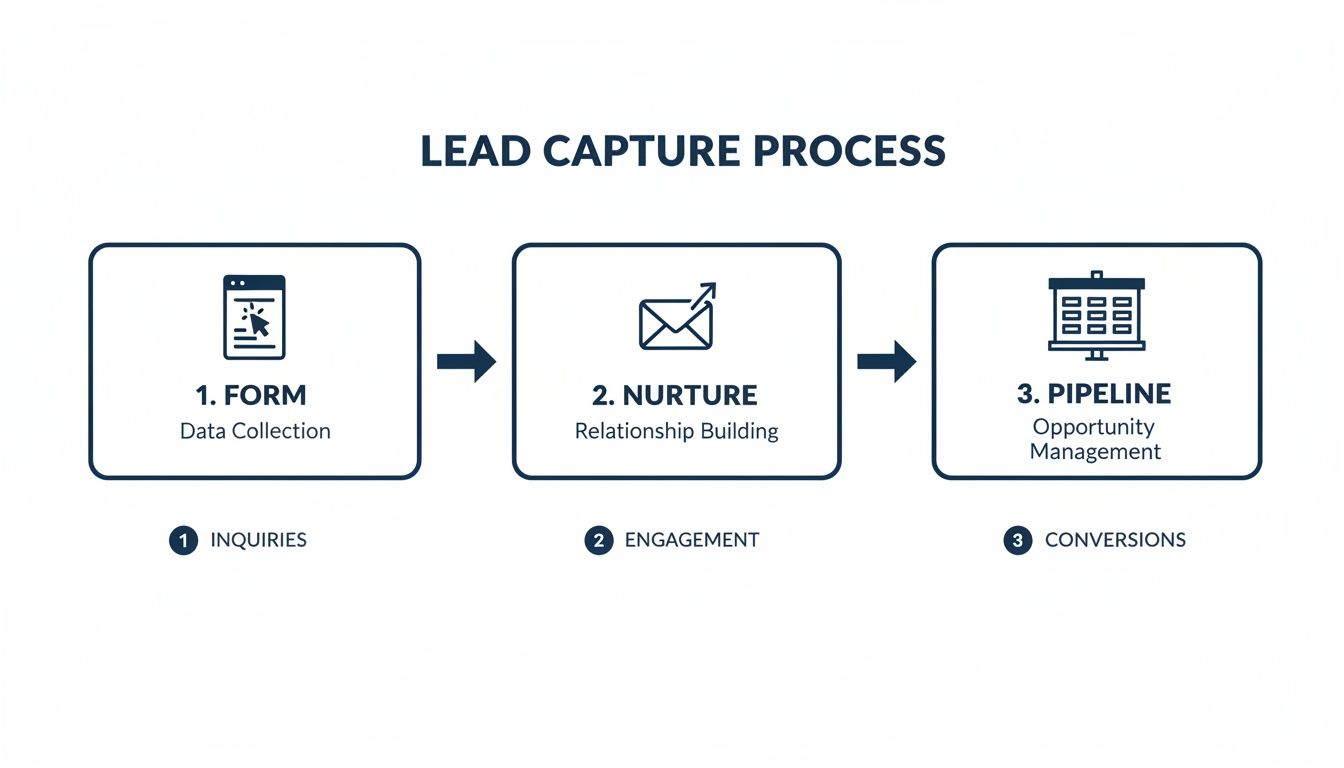
This process transforms your system from a simple blog into a true lead generation engine, managing contacts from their first download to a real opportunity in your pipeline.
Days 61-90: The Optimization Phase
The final 30 days are about analysis and refinement. Now that you have data coming in—traffic, downloads, email open rates—it’s time to diagnose what's working and make smart adjustments.
Focus on these actions:
- Analyze Early Traffic: Use Google Analytics and your GHL dashboard to see which content is getting traffic. Are people finding your pillar page?
- Review Lead Quality: Look at the leads coming through your first lead magnet. Do they match your ICP? If not, you may need to adjust the offer or messaging.
- Optimize Email Performance: Check open and click-through rates on your nurture sequence. Try A/B testing a new subject line for an email that isn't performing well.
- Plan Your Next Cluster: Based on what you've learned, start planning your second topic cluster to continue building authority and attracting more qualified traffic.
Your 90-Day B2B Inbound Launch Checklist
Use this table as your quick-glance guide to stay on track.
| Phase | Days 1-30 (Foundation) | Days 31-60 (Activation) | Days 61-90 (Optimization) |
|---|---|---|---|
| Strategy & Setup | Finalize ICP & Messaging | Launch Lead Magnet & Nurture Sequence | Analyze Lead Quality & ICP Fit |
| Content | Draft & Finalize Pillar Page | Publish Pillar & First Cluster Articles | Plan Next Topic Cluster |
| Technical | Configure GoHighLevel & Website Integration | Monitor Website Performance | A/B Test Landing Pages & Emails |
| Measurement | Set Up Analytics & Reporting Dashboards | Track Initial Traffic & Conversions | Review & Refine Key Metrics |
By the end of 90 days, you won't just have a strategy—you'll have a functioning, data-producing marketing system. This provides the proof of concept needed to justify continued investment and sets the stage for long-term, predictable growth.
Step 5: Measure Performance and Prove Inbound ROI
How do you know if your inbound marketing is actually working? If you can’t draw a straight line from your efforts to revenue, you’re flying blind. It's time to cut through vanity metrics—like website traffic—and focus on what truly impacts your bottom line.
Proving your return on investment (ROI) isn’t just about justifying your budget. It’s about making smarter, data-backed decisions that tell you what’s working, what isn’t, and where to double down.
Key Performance Indicators That Actually Matter
To get a true picture of your inbound performance, we focus on a handful of powerful Key Performance Indicators (KPIs). These are the vital signs of your system's financial health.
Here are the three most important metrics to track:
- Cost Per Lead (CPL): Your total marketing campaign cost divided by the total number of new leads. It tells you exactly how much you're spending to get a potential customer to raise their hand.
- Lead-to-Customer Conversion Rate: The percentage of leads that become paying customers. This KPI is the final exam for both your lead quality and your sales process.
- Customer Lifetime Value (CLV): The total revenue you can expect from a single customer over your entire relationship. Knowing your CLV tells you how much you can afford to spend to acquire a new customer and still be profitable.
When you track these metrics, you change the conversation from, "we got more traffic this month," to, "we generated $50,000 in new sales pipeline from a $5,000 investment." That’s a language every business owner understands.
How to Build Your ROI Dashboard
The good news is you don't need complex software to watch these numbers. You can build a straightforward dashboard right inside GoHighLevel to track everything.
First, configure your sales pipeline to mirror your actual deal stages (e.g., "New Lead," "Proposal Sent," "Closed-Won"). By assigning a dollar value to every deal, GoHighLevel's reporting dashboard can automatically calculate your conversion rates and pipeline value.
Our Pro Tip: Set up a dedicated "Inbound Leads" pipeline. This lets you isolate leads from your content, SEO, and email campaigns, giving you a crystal-clear view of your inbound ROI, separate from other channels.
For a typical manufacturing business, a lead-to-customer conversion rate between 2-5% is a solid benchmark. The key is to establish your own baseline and then work to improve it. This data is your diagnostic tool. A low conversion rate might mean you need higher-quality leads (a content problem) or a more efficient follow-up process (a sales problem). The numbers will point you in the right direction.
Your B2B Inbound Marketing Questions, Answered
Here are the most common questions we hear from business owners launching their inbound marketing engine for the first time.
How long until we see real results?
This is the big one. While you can expect to see early indicators like increased traffic within 90 days, inbound is a long-term strategy. A predictable stream of qualified leads typically starts flowing around the 6 to 12-month mark. The key is consistency. Paid ads work while you pay, but every piece of content you create is an asset that works for you 24/7, compounding in value over time.
Be warned: many companies get discouraged after three months and pull the plug right before the real growth kicks in. The significant gains in authority and organic traffic really take off after the six-month mark.
Our sales cycle is long. How does inbound help?
Inbound marketing is perfectly suited for long, complex sales cycles. It’s not about a single touchpoint. It’s about using automated nurturing to build trust and stay top-of-mind over weeks or months. When an engineer downloads a technical guide, your system can automatically follow up with a relevant case study two weeks later and a webinar invitation a month after that. When they're finally ready to talk to sales, you're the obvious choice.
Do we need a big team to do this?
Not anymore. With modern automation platforms like GoHighLevel, a small team can run a powerful inbound strategy. The goal isn't to add more people; it's to build a smarter system. By automating lead capture, email follow-ups, and reporting, you free up your team to focus on what matters most:
- Creating genuinely helpful, expert-level content.
- Having meaningful conversations with sales-qualified leads.
It’s about working smarter, not harder.
What to Do Next
Ready to build a predictable lead generation system that actually works? At Machine Marketing, we specialize in implementing B2B inbound marketing systems that get results. We'll diagnose your current process and build a clear roadmap for growth.
Book a discovery call with Karl today to get started.