Are your sales conversations constantly circling back to price? If so, you don't have a sales problem—you have a positioning problem.
Branding and positioning are the systems you build to define why a customer should choose you over anyone else. For B2B manufacturers and service-based businesses, branding is a strategic asset, not marketing fluff. It’s the system that pulls in your ideal clients while pushing away poor-fit prospects before they waste your sales team’s time.
Diagnosis: Why a Weak Brand Creates a Competitive Disadvantage
We see a common symptom all the time. A business owner invests heavily in lead generation—ads, trade shows, outreach—only to find their pipeline is clogged with prospects who are just price-shopping or a plain bad fit. This forces their team into a defensive crouch, constantly justifying costs instead of demonstrating value.
The root cause isn't the lead source; it's a weak or undefined brand position.
Without a clear position, your business becomes a commodity. You’re just another vendor in a crowded market, forced to compete on features and price. That’s an exhausting, low-margin race to the bottom.
Shifting from Commodity to Authority
Effective branding and positioning are about engineering a new reality. It’s the deliberate process of shaping how your market sees your company. When you get it right, you move from being an option to being the only logical choice for a specific customer with a specific problem.
This transformation happens when you build your brand as a system that achieves three critical goals:
- Clarity: It clearly articulates who you serve, what problem you solve, and why you are uniquely equipped to solve it.
- Consistency: It ensures every touchpoint—from your website copy to your sales proposals—reinforces the same core message.
- Differentiation: It carves out a defensible space in the market that your competitors can't easily copy.
Your brand isn't just your logo. It's the gut feeling a customer has about your business. A strong positioning strategy ensures that feeling is one of trust, expertise, and value.
This guide is built from an engineering mindset. We won't talk about abstract concepts. Instead, we'll walk through a practical framework to diagnose your current position, engineer a powerful value proposition, and roll it out systematically across your business to stop competing on price and start winning on value.
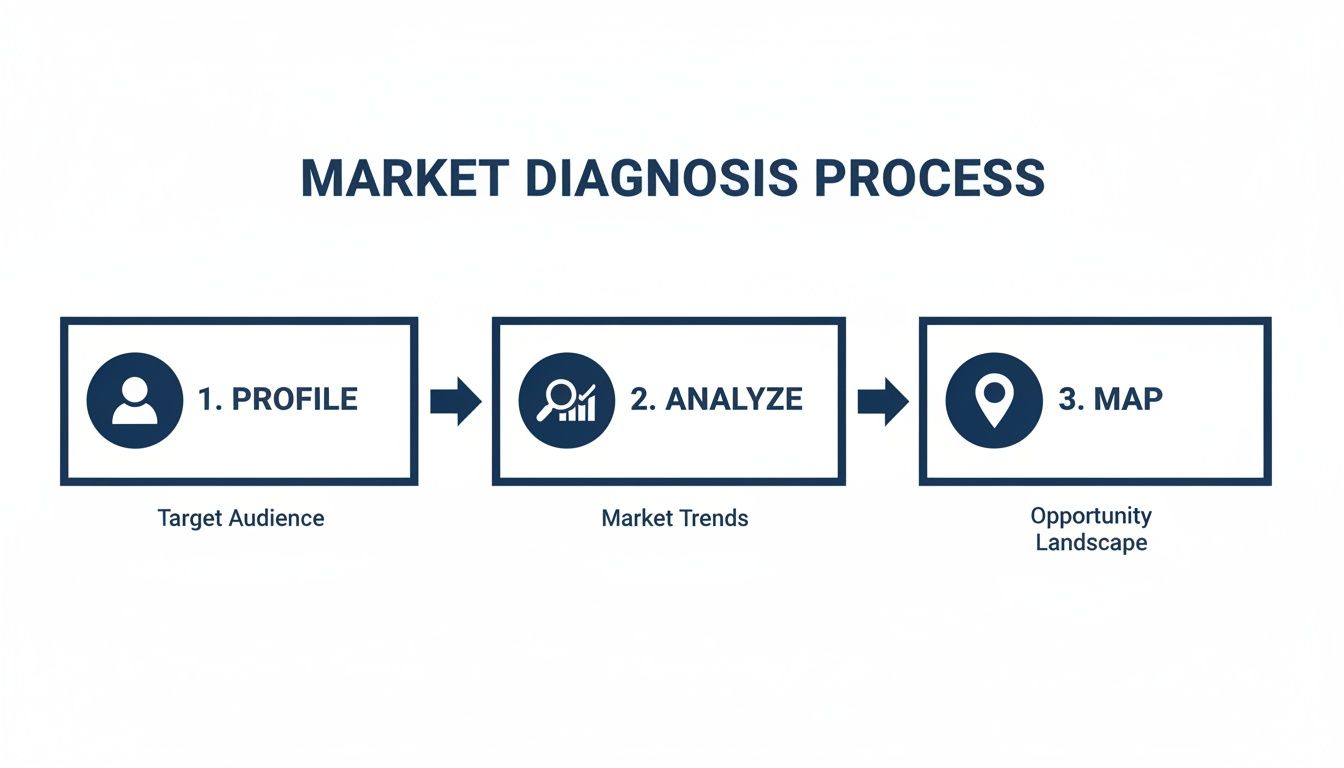
How to Accurately Diagnose Your Current Market Position
Before you can build a stronger brand, you need an honest assessment of where you stand today. Too many businesses operate on gut feelings and old assumptions about their market position. That's like trying to build a precision machine with a blurry blueprint.
This diagnostic phase is about swapping guesswork for clarity. We're going to walk through how to analyze your brand from the outside in, giving you the data needed to make your next move with confidence.
Start with an Internal Diagnostic
First, look inward. How can you understand how the market perceives you if your own team isn't clear on the business?
We use a 40-Question Marketing Review with new clients to get everyone on the same page. It forces the difficult but necessary conversations that unlock real growth.
Get your leadership, sales, and operations teams in a room and ask these questions:
- Who is our absolute best customer? Who is most profitable, easiest to work with, and sends the most referrals?
- What specific, high-value problem do we solve for them? Get past generic answers. What does your quality actually enable for your customer—less downtime, higher output, easier regulatory compliance?
- If we disappeared tomorrow, what would our best customers miss most? This cuts through the noise and reveals your true value.
- Who do we lose deals to, and why? Be ruthlessly honest. Is it price? Features? A longer-standing relationship?
These conversations help you define your Ideal Customer Profile (ICP), the bedrock of all effective branding and positioning strategies. Your ICP isn't just a demographic; it’s a detailed sketch of the businesses you are built to serve.
If you need a more structured approach, learn how to create buyer personas in our detailed guide.
Map the Competitive Landscape
With a clearer internal picture, turn your focus outward. The goal isn’t just to list competitor features; it's to understand how they are positioned in the minds of the customers you want.
A powerful tool for this is the positioning map. This visual charts competitors on a two-axis grid based on key attributes your customers care about.
For a B2B manufacturer, these axes might be:
- Price: (Premium vs. Economy)
- Service Level: (High-Touch/Custom vs. Standardized/Off-the-Shelf)
- Innovation: (Cutting-Edge Technology vs. Proven/Reliable)
- Scale: (Niche Specialist vs. Broadline Supplier)
Pro Tip: Don't choose attributes where everyone clusters together (like "quality"). The most insightful maps use attributes where there is clear differentiation, revealing both crowded spaces and potential market gaps.
Imagine a custom machine parts manufacturer. They could map their competition on an X-axis of "Speed of Delivery" and a Y-axis of "Level of Customization."
This exercise instantly visualizes the competitive environment. You might find a cluster of competitors fighting over low-cost, standard parts and another group offering slow, bespoke solutions.
Where's the gap? It could be the company that can deliver complex custom parts with industry-leading speed. That unoccupied space is a potential strategic position waiting to be claimed.
To get this right, you need the right intelligence. This table breaks down what to look for and where to find it.
Key Areas for Market Position Diagnosis
A checklist to guide your internal audit and competitor analysis, helping you gather the essential data for effective positioning.
| Diagnostic Area | Key Questions to Ask | Data Source or Method |
|---|---|---|
| Internal Perception | What is our mission? Who is our best customer (ICP)? What core problem do we solve better than anyone? | Internal stakeholder interviews, 40-Question Marketing Review, sales team feedback. |
| Competitor Messaging | What value propositions do competitors claim on their homepage? What language do they use? Who do they target? | Competitor website analysis, content audits (blogs, whitepapers), social media monitoring. |
| Product/Service Gaps | Where do our offerings overlap with competitors? Where are we stronger or weaker? Are there unmet needs? | Feature-by-feature comparison matrix, G2/Capterra reviews, customer win/loss analysis. |
| Pricing & Value | How does our pricing model compare? Are we positioned as a premium, value, or economy option? | Public pricing pages, requesting quotes (if possible), industry reports, customer feedback. |
| Customer Perception | What do customers say about us vs. competitors? What are our perceived strengths and weaknesses? | Customer interviews, online reviews, survey data (NPS), social media listening tools. |
This diagnostic work provides the objective evidence you need. It moves your strategy from a vague ambition to a specific, defensible plan built on a clear market opportunity.
Solution: How to Engineer a Defensible Value Proposition
You’ve diagnosed the market. Now, it's time to engineer your core message.
Your value proposition isn't a tagline. It's the foundation of your sales and marketing system. It must give your ideal customer a clear answer to one question: "Why should I buy from you and not your competitors?"
If you can't answer that, they won't be able to either. This is where many B2B companies stumble. They describe what they do instead of articulating the tangible value they deliver.
From Features to Benefits: The Only Shift That Matters
Your customers don’t buy machine parts or services. They buy outcomes. They buy less downtime, higher throughput, reduced waste, or easier compliance. Your first job is to translate your technical specs into business benefits.
Here’s how to think about it:
- Feature: "We use Grade 5 titanium in our custom components." (This is what you do).
- Advantage: "This makes our components 40% lighter and more corrosion-resistant." (This is why it's better).
- Benefit: "That means your machinery will have a longer operational life and lower maintenance costs, saving you an average of $50,000 per year." (This is the problem you solve for them).
The benefit gets the deal signed. It connects your technical expertise directly to a business result that a plant manager or VP of Operations cares about. Stop selling the tool; start selling the solution.
Building your value proposition on real data—not just internal assumptions—is what separates effective brands from the rest.
Nailing Your Positioning Statement
Once you’ve locked in your core benefits, distill them into a formal positioning statement. Think of this as an internal compass that guides everything from website copy to sales scripts.
Here’s a simple template we use:
For [Your Ideal Customer Profile] who [has this specific pain point], we provide [your solution] that [delivers this key benefit]. Unlike [your main competitors], we are the only ones who [your unique differentiator].
Let's apply this to a custom CNC machining shop:
- ICP: Aerospace engineers needing complex, low-volume prototypes.
- Pain Point: Long lead times from other shops are killing their R&D cycles.
- Solution: A proprietary, automated quoting and production scheduling system.
- Benefit: They get precision prototypes in days, not weeks.
- Differentiator: Their automated system and dedicated prototyping cell.
The result is a clear and defensible position:
"For aerospace R&D engineers who are slowed down by long prototype lead times, we provide rapid CNC machining that delivers complex parts in under 5 days. Unlike traditional machine shops, we are the only ones who use an automated quoting and production system to accelerate your innovation cycle."
This statement tells you exactly who they help, what problem they solve, and why they’re the only choice. To go deeper, check out our guide on building a complete marketing messaging framework.
Building Your Key Messaging Pillars
Your positioning statement is the anchor, but you need messaging pillars to support it across all your marketing channels. These are the substance behind the slogan.
For our CNC shop, the pillars might be:
- Speed without Compromise: We deliver prototypes at industry-leading speeds without sacrificing precision.
- Engineered for Innovators: Our process is built to support the rapid, iterative needs of R&D and engineering teams.
- Transparent and Frictionless: From instant quotes to real-time project tracking, we make the entire process easy.
These pillars become the raw material for your website copy, blog posts, and sales decks. They ensure every piece of content is consistent and reinforces your unique spot in the market. That consistency is how you go from being just another vendor to the only one they’ll consider.
Building Your Go-To-Market and Channel Strategy
A powerful value proposition is useless until it reaches the right people. This is where we turn strategy into a concrete go-to-market playbook—a repeatable system for delivering your message with precision.
For B2B manufacturers and industrial companies, this means resisting the urge to be everywhere. Your ideal buyers—engineers, procurement managers, and decision-makers—don't scroll through every social media platform. Your job is to figure out where they do spend their time and go deep, not wide.
You're not broadcasting your message into the void; you're narrowcasting it directly into the channels where it will have the biggest impact.
Choosing Your High-Impact Channels
Ask yourself: Where do my ideal customers go when they need to solve a problem? That’s where you have to be.
For a technical B2B audience, the most effective channels are usually a focused list:
- Targeted SEO: Your buyers don't just google “CNC machining services.” They search for specific, technical queries like “AS9100 certified 5-axis machining for aerospace prototypes.” Your content strategy must answer these exact questions.
- LinkedIn: This is non-negotiable for B2B. You can connect directly with decision-makers, share technical case studies, and join industry-specific groups. This is about demonstrating expertise, not posting fluffy updates.
- Niche Industry Forums & Communities: An engineering subreddit, a trade publication’s online forum, or a specialized Slack community are the digital watering holes for your ideal clients. Being a helpful voice builds trust.
- Account-Based Marketing (ABM): Instead of casting a wide net, ABM flips the model. You focus all your energy on a hand-picked list of high-value target accounts, tailoring your outreach to solve their specific challenges.
A great go-to-market strategy isn't about being on every channel. It's about dominating the few that matter most to your ideal customer. It’s a game of depth, not breadth.
Aligning Content with the Buyer’s Journey
Once you’ve selected your channels, you need the right ammunition. Your content—case studies, white papers, spec sheets—must align with where your buyer is in their decision-making process.
- Awareness Stage: The buyer is feeling a pain point but might not have a name for it. Your content here should be educational. Example: A blog post titled, “5 Common Causes of Production Bottlenecks in Metal Stamping.”
- Consideration Stage: The buyer is actively researching solutions. Your content should showcase your expertise. Example: A case study showing how you helped a similar company increase throughput by 30%.
- Decision Stage: The buyer is comparing final vendors. Your content must make a clear case for why you are the best choice. Example: A downloadable spec sheet or an offer for a one-on-one consultation with an application engineer.
To make this work, adopt a cohesive modern B2B demand generation strategy that integrates all these content types into a unified system.
Your 90-Day Go-To-Market Sprint
Trying to implement a new positioning strategy all at once is overwhelming. Break it down into a manageable sprint. A 90-day plan lets you test your messaging and channels with minimal risk, gathering data to fine-tune your approach.
Here’s a simple framework:
- Month 1 (Days 1-30): Foundation & Content. Update your website’s homepage and key service pages with the new messaging. Create two foundational content pieces that align with the buyer's journey (e.g., one educational blog post and one detailed case study).
- Month 2 (Days 31-60): Channel Activation. Pick your top two channels (e.g., LinkedIn and targeted SEO). Begin consistently sharing your new content on LinkedIn and optimizing your core web pages for your most important technical keywords.
- Month 3 (Days 61-90): Measure & Iterate. Look at the initial data. Are you seeing an uptick in rankings? Is the engagement on LinkedIn coming from your ICP? Use this early feedback to make small, informed adjustments.
This iterative approach transforms your go-to-market strategy from a static document into a living system that continually improves.
Transformation: Using Your CRM to Implement and Automate Your Strategy
A brilliant positioning strategy is worthless if it lives in a slide deck. The real impact happens when you embed it into the systems that run your business. Your Customer Relationship Management (CRM) system is how you bring the plan to life.

Think of your CRM—whether it's GoHighLevel or another platform—as the central nervous system for your brand. It’s the tool that ensures your new message gets delivered consistently at every customer touchpoint.
From Messaging to Automated Workflows
First, translate your messaging pillars into automated actions. How can your CRM deliver the right message to the right person at the right time? By building automated workflows, or "campaigns."
Let’s say one of your messaging pillars is "Engineered for Innovators." You can build a workflow that triggers when a prospect downloads a technical whitepaper.
- Trigger: A contact downloads your guide on "Advanced Materials for Aerospace Prototyping."
- Action 1: The system automatically tags them as "Interest_Aerospace."
- Action 2 (Wait 24 hours): An email goes out from your head engineer, highlighting a case study on a similar aerospace project.
- Action 3 (Wait 3 days): A second email follows up, showcasing your rapid prototyping capabilities.
- Action 4: A task is automatically created for a sales rep to make a personal call.
This simple system ensures every interested lead gets a perfectly sequenced set of messages that reinforce your unique position. We have a deeper dive into setting up effective campaigns in your CRM if you want to explore this further.
Using Tags to Track and Segment
CRM tags are your best friend. They let you segment your audience based on your Ideal Customer Profile (ICP) criteria and track how different segments engage with your core messages.
Here are a few practical tags you could set up:
- Industry-Specific:
Industry_Manufacturing,Industry_MedicalDevice - Pain Point-Based:
Pain_LeadTime,Pain_QualityControl - Engagement Level:
Engaged_CaseStudy,Engaged_Webinar
By tagging contacts automatically based on their behavior, you can see which messaging pillars resonate most with which ICPs. Your CRM data provides a direct feedback loop to keep refining your strategy.
Re-Engaging Dormant Contacts with a New Story
What about all those past customers and old leads sitting in your database? Your new positioning is the perfect excuse to re-engage them.
Your existing contact list is one of your most undervalued assets. A strategic re-engagement campaign can reactivate old relationships and generate new revenue faster and cheaper than acquiring new customers.
Build a simple, three-part email sequence that tells your refreshed brand story.
- Email 1: The Re-Introduction. Announce your renewed focus. "You may remember us for X, but today we're focused on solving Y for companies just like yours."
- Email 2: The Proof. Back it up. Share a powerful case study or testimonial that shows your new value proposition in action.
- Email 3: The Offer. Give them a clear, low-friction call to action, like a "15-minute strategy call" to discuss their specific challenges.
This approach respects their time while re-establishing your relevance now. Systemizing your strategy inside a CRM turns your brand from a static idea into a dynamic, automated growth engine.
How to Measure and Refine Your Positioning for Growth
Great positioning isn't a "set it and forget it" task. Your market is always shifting, your competitors are adapting, and your customers' needs will change. The final piece of your strategy is building a system to measure what's working and ruthlessly cut what isn't.
We need to move past vanity metrics like website traffic and zero in on the Key Performance Indicators (KPIs) that prove your positioning is actually making an impact on your business.
Moving Beyond Vanity Metrics
Only a handful of metrics truly reflect whether your positioning is hitting the mark. Are you attracting the right kind of customers? Is your sales process getting smoother?
Here are the KPIs to track on a dedicated dashboard:
- Lead Quality Score: Are the leads coming in a better fit for your Ideal Customer Profile (ICP)? If the average score is climbing, your messaging is working.
- Sales Cycle Length: A powerful brand position builds trust and answers questions upfront. You should see your sales cycle shorten as you start conversations with higher-intent buyers.
- Customer Lifetime Value (CLV): Perfect-fit customers stick around longer, buy more, and are more profitable. A rising CLV is a huge indicator that your positioning is resonating.
- Win Rate: This is the ultimate gut check. As you dial in your messaging and attract better leads, your sales team's closing ratio should improve.
Creating a System for Iteration
Data is only useful if you act on it. A simple quarterly review process is the best way to assess performance and make smart adjustments. Keep it focused and actionable.
Your brand should be a living system, not a static document. Consistent, data-informed refinement is what separates companies that survive from those that dominate their niche.
During each review, ask your team these questions:
- What's the data telling us? Which KPIs are moving in the right direction? Which are stuck?
- What are we hearing from the front lines? What feedback are the sales and customer service teams getting from the market?
- What’s the one thing we can test next quarter? Based on the data, what’s our next small bet? Maybe it's tweaking a headline or changing the focus of your next case study.
This iterative loop ensures your brand never gets stale. It's also critical to sidestep the common branding mistakes that can sabotage your hard work. By measuring, learning, and refining, you're not just building a brand—you're building an engine for sustainable growth.
Your Questions About B2B Branding, Answered
We talk to B2B owners all the time, and the same questions about branding and positioning come up again and again. Here are our straight-up answers to the most common questions we get.
How Long Does It Take to See Results?
You'll likely see initial progress within the first 90 days, often as better quality leads or higher engagement.
But for the big shifts—like shortening your sales cycle or changing how the market sees you—think in terms of 6-12 months. Branding is a long-term investment in your company's value. Consistency is what creates lasting transformation.
Can We Rebrand Without a Massive Budget?
Absolutely. This is the biggest misconception out there.
Effective positioning isn't about outspending your competitors; it's about out-thinking them. The most crucial work—diagnosing your market, defining your ideal customer, and nailing your core message—is about strategic thinking, not a fat checkbook.
The heaviest lifting in a rebrand is intellectual, not financial. Getting your message right is the most valuable part.
Is It Too Late to Change Our Brand Position?
Never. If you're an established company, you're sitting on years of expertise and deep customer relationships. That's a huge advantage.
The challenge isn't starting from scratch; it's reframing that legacy for today's market. You have to connect your history to the problems your customers are facing right now. A smart repositioning can breathe new life into your brand and unlock growth.