If you’re an industrial business owner struggling to generate high-quality leads, the root cause is often hidden in plain sight: a marketing playbook built for a world that no longer exists. The industrial buying process has fundamentally changed, and your marketing must evolve with it.
In this guide, we'll show you how to diagnose the gaps in your current marketing system. More importantly, we'll provide a proven, step-by-step framework to build a predictable lead generation machine that meets your buyers where they are—online.
Diagnosis: Why Your Old Marketing Playbook Is Broken

Does this sound familiar? Your sales team is working harder than ever, but lead quality is slipping and growth has stalled. The real problem isn't your team; it's a marketing strategy built for an era when buyers waited for a sales call or the next trade show. That world is gone.
Today, your most valuable customers—the engineers, procurement managers, and plant operators—don't wait for you to find them. They find you. They are deep into their own research, diagnosing problems and evaluating solutions online long before they ever consider speaking to a salesperson. This isn't a trend; it's a seismic shift.
The Modern Industrial Buyer's Journey
The buying cycle is no longer a straight line. It's a self-directed, information-gathering mission. What are your prospects doing before you know they exist?
- Googling Technical Problems: They use specific, technical keywords to diagnose operational challenges and find solutions.
- Comparing Specifications: They bounce between your site and your competitors', downloading spec sheets, CAD files, and white papers.
- Reading Reviews and Case Studies: They hunt for social proof to see if your claims hold up under real-world pressure.
- Watching Product Demos: They’re on YouTube, looking for visual confirmation of your equipment's capabilities in action.
The new reality is that 57% of industrial buyers make purchase decisions before ever speaking to a salesperson. If your digital presence is weak, you're invisible for more than half of their journey.
The Shift From Traditional to Digital Industrial Marketing
The difference between the old way and the new system is stark. It’s a move from broadcasting to engaging, from hoping for leads to engineering a predictable system. This table breaks it down.
| Marketing Function | Traditional Approach (The Old Way) | Digital Approach (The New System) |
|---|---|---|
| Lead Generation | Trade shows, cold calls, print ads | SEO, content marketing, targeted PPC |
| Reach | Geographically limited, event-based | Global, 24/7 online presence |
| Buyer Interaction | Face-to-face, salesperson-led | Self-directed research, online resources |
| Measurement | Difficult to track ROI, anecdotal | Data-driven, precise KPI tracking |
| Content | Printed catalogs, brochures | Downloadable spec sheets, case studies, video demos |
| Sales Cycle | Long, relationship-dependent | Faster, information-driven |
This shift isn't about abandoning relationships. It’s about starting them much earlier in the process, at the exact moment your prospects are searching for answers online.
The Data Tells the Story
This isn’t just a hunch. The numbers are clear. In the hyper-competitive industrial manufacturing space, 98% of manufacturers are now generating sales-qualified leads through digital channels. Your competitors are almost certainly using digital marketing to get ahead. You can explore more statistics on industrial marketing trends to see the full picture.
If your strategy still revolves around a physical presence and outbound calls, you're fighting for a shrinking slice of your audience's attention. This guide is your system for changing that.
Building Your Foundation on Buyer Intelligence
Effective digital marketing isn't about having the slickest website or the biggest ad budget. It starts with a deep, almost forensic, understanding of who you're selling to. Before you build the machine, you need the blueprints.
Without this groundwork, you’re just throwing money at the wall. You'll create content nobody reads and run ads that don't convert. Getting this right from the start ensures every dollar you invest later hits the mark.
Pinpointing Your Ideal Customer Profile
Your first job is to define your Ideal Customer Profile (ICP)—a crystal-clear description of the perfect-fit company for your products or services. This sets the coordinates for your entire marketing and sales system.
Questions to Ask Yourself to Define Your ICP:
- Industry: Which specific sectors feel the most impact from what you do? (e.g., aerospace manufacturing, food processing). Get specific.
- Company Size: Where’s the sweet spot for annual revenue or employee count?
- Geography: Are you serving a local region, the entire country, or a global market?
- Technology: Do they use certain machinery, software, or operational systems that make them a perfect fit?
Answering these questions gives you a powerful filter. It focuses your marketing efforts on attracting companies that are genuinely a great fit, saving your sales team from chasing ghosts.
From Companies to People with Buyer Personas
Once you know the type of company, you need to understand the people making the decisions. This is where buyer personas come in. These are detailed sketches of the key players involved in a purchase.
In the industrial space, you’re rarely selling to just one person. The decision involves a mix of technical experts, financial gatekeepers, and daily users.
A common mistake we see is creating a single, generic "customer" persona. The reality is, the Plant Manager who lives and dies by uptime has entirely different concerns than the Procurement Specialist focused on unit cost.
You have to build separate personas for each role. Here are three you’ll encounter constantly:
- The Engineer: This person is all about technical details. They need specs, material compatibility data, CAD files, and performance charts. Their biggest fear is choosing a component that fails.
- The Plant Manager: Their world revolves around operational efficiency, uptime, and safety. They want to know how your solution will cut downtime, boost output, or simplify maintenance.
- The Procurement Specialist: This buyer is driven by numbers—budget, lead times, and supplier reliability. They're looking for transparent pricing and a partner who delivers on time.
To nail this, check out our in-depth guide on how to create buyer personas that drive results. This foundational work is the single most critical input for your messaging, content, and ad targeting.
Turning Your Website Into a Lead Generation Hub
Let's be direct: your website's primary job is not to be a digital catalog. It should be your best salesperson—one that works 24/7 to attract, educate, and convert prospects into qualified leads.
If your site isn't consistently generating quote requests, demo bookings, or spec sheet downloads, it’s a passive asset. It’s time to transform it into a high-performance lead generation machine, starting by giving your technical buyers exactly what they need.
The Non-Negotiables for an Industrial Website
Engineers and procurement managers are short on time and focused on solving a problem. They have zero patience for confusing navigation or missing information. Your website must be built for their workflow.
Here are the absolute must-haves:
- Effortless Navigation: Can a visitor find the exact product they need in three clicks or less? If not, you’re creating friction.
- Detailed Product Pages: This is where deals are won or lost. Go beyond marketing fluff and deliver hard data: downloadable spec sheets, material compatibility, performance charts, and high-resolution images or videos.
- Clear Calls-to-Action (CTAs): Don't make people guess what to do next. Every page should guide them toward a specific action tailored to their journey.
For an engineer deep in research, a "Download CAD File" button is far more valuable than a generic "Contact Us." A procurement specialist comparing vendors? They're looking for a prominent "Request a Quote" button.
Optimizing Your Site for Search Engines
A great website is useless if your ideal customers can't find it. This is where Search Engine Optimization (SEO) becomes a critical gear in your marketing machine. SEO is the process of making your website more visible to search engines like Google by focusing on the specific, technical terms your buyers use every day.
A Practical Approach to Industrial SEO
SEO can feel overwhelming, but you can make huge strides by focusing on three core areas. This isn't about chasing algorithms; it's about aligning your website with what your buyers are actually searching for.
- Keyword Research with an Engineering Mindset: What specific part numbers, technical problems, or industry standards are they typing into Google?
- Get Specific: Forget a broad term like "CNC machining." Target a long-tail keyword like "5-axis CNC machining for aerospace components." That's a search with buying intent.
- Use Your Expertise: Ask your sales reps and engineers what questions they answer all day. Those questions are your keywords.
- Strategic Site Structure: A well-organized site is easier for both people and search engines to understand. Group related products into logical categories (e.g., "Hydraulic Pumps" with sub-pages for "Gear Pumps," "Piston Pumps," etc.). This signals to Google that you're an authority.
- Building Authority with Relevant Backlinks: A backlink is a link from another website to yours. Search engines see them as votes of confidence. In the industrial space, quality crushes quantity. A single link from a respected trade publication is worth more than a hundred irrelevant links.
By systemically improving these areas, you transform your website from a passive brochure into an active engine that pulls in highly qualified prospects when they search for a solution you provide.
Building Your Sales Engine with GoHighLevel
Let's be honest: high-quality leads are worthless if they fall through the cracks. If your current "system" is a jumble of spreadsheets and random emails, you don't have a system. You have a recipe for lost revenue, especially in industrial sales where cycles are long and involve multiple decision-makers.
This is where a centralized sales engine comes in. We build ours using GoHighLevel, which becomes the command center for all marketing and sales activity. It combines a Customer Relationship Management (CRM) system with powerful automation, giving you a single source of truth for every lead and customer interaction. No more guessing.
Getting Your System Set Up
The first step is to build a clean, organized foundation. A little thoughtful organization upfront pays off massively in efficiency down the road.
Here are your first practical steps inside GoHighLevel:
- Import Your Contacts: Gather all those scattered lists—from your email client, old trade show sign-ups, and accounting software—into one central location.
- Create Custom Fields: Make the CRM yours. Don't settle for "Name" and "Email." Track the data that actually matters to your sales team.
- Build Your Sales Pipeline: Visualize your sales process. Create the actual stages a lead moves through, from first contact to a closed deal.
What to Track with Custom Fields
For an industrial company, generic fields don't cut it. Your sales team needs immediate context for a meaningful conversation.
Examples of Essential Custom Fields:
- Equipment Type: What machinery are they currently running?
- Project Specs: What are the key technical details of their application?
- Lead Source: How did they find you? (e.g., "Website Quote Request," "LinkedIn Ad").
- Industry/Vertical: What specific market segment are they in?
Setting up these fields correctly is a crucial diagnostic step. If a contact record immediately reveals a prospect's technical needs, your sales team is positioned for a much more effective conversation.
Automating Your Follow-Up and Nurturing
Once your data is organized, you can build simple, powerful automations that work for you 24/7. This frees up your team to focus on high-value conversations instead of tedious manual follow-ups and is a core piece of a scalable digital marketing for industrial companies system.
Think of these automations as your digital standard operating procedures (SOPs). They ensure consistency and prevent leads from going cold. You can see how these automations fit into a bigger picture by understanding the steps of a successful inbound marketing funnel.
Two Simple Automations to Build Today
You don't need a complex workflow to see an immediate impact. Start with these two foundational automations.
The Instant Quote Request Follow-Up
- Trigger: A prospect submits your "Request a Quote" form.
- Action 1 (Instant Email): An email immediately goes to the prospect, thanking them and confirming receipt. Include a link to a relevant case study to keep them engaged.
- Action 2 (Internal Notification): An alert is sent straight to your sales team with the lead's details, prompting a personal follow-up call.
The "Downloaded a Spec Sheet" Nurture Sequence
- Trigger: A user downloads a technical spec sheet—a strong buying signal.
- Action 1 (Wait 1 Day): The system waits 24 hours. You don't want to seem desperate.
- Action 2 (Follow-Up Email): An automated email goes out with a subject like, "Questions about the [Product Name] spec sheet?" Offer to connect them with an application engineer.
- Action 3 (Wait 3 Days): The system waits another three days.
- Action 4 (Case Study Email): A second email is sent, showcasing a case study of how another company used that exact product to solve a problem.
These simple workflows ensure no lead is ignored and your sales team has the intelligence they need to close deals more efficiently.
Fueling Growth with Content and Paid Ads
You've built an optimized website and a sales engine. Now, it's time to pour in the fuel. This means actively attracting qualified buyers by creating genuinely useful content and running laser-focused ad campaigns. The goal isn't just clicks; it's about starting valuable conversations with the right people.
For industrial companies, this means creating content that solves real-world technical problems. At the same time, pay-per-click (PPC) advertising lets you get your message in front of key decision-makers with surgical precision.
Create Content Your Technical Audience Actually Needs
Let's be blunt: engineers, plant managers, and procurement specialists don't care about marketing fluff. They're searching for data and practical solutions. Your content strategy must serve these needs.
Here are the content types that consistently get results in the industrial world:
- Detailed Case Studies: Prove your equipment works. Detail a customer's initial challenge, the exact solution you provided, and the measurable outcomes (e.g., a 15% reduction in downtime).
- Data-Rich White Papers: Unpack a complex industry problem or explain the technical advantages of your process. A well-researched white paper positions you as a leading expert.
- Product Comparison Guides: Your prospects are already weighing your products against the competition. Help them. Create an honest guide comparing specs and performance data. This transparency builds massive trust.
- Video Demonstrations: Show, don't just tell. A quick video demonstrating your equipment in action is often far more compelling than a ten-page brochure.
Target Decision-Makers with Precision PPC
While content builds long-term authority, PPC advertising gives you immediate visibility. It's how you place your message directly in front of your ideal customer profile on platforms like Google Ads and LinkedIn Ads.
Think of PPC as a heat-seeking missile. You can target a plant manager at a specific manufacturing company in Ohio who has shown interest in CNC machining. That level of focus is impossible with traditional advertising.
The key is ad copy that speaks your audience's language. An ad targeting an engineer should highlight technical specifications. One for a procurement manager should focus on ROI and reliability.
Using Social Media for B2B Engagement
Social media isn't just for B2C brands. It has become a powerhouse for industrial B2B, with 76% of users reporting that social content influences their purchasing decisions. For manufacturing, LinkedIn is the undisputed king for sharing case studies and videos that grab the attention of plant managers and executives.
To make an impact, you need to diversify your content. It might even be worth learning how to create Instagram Reels for your brand to reach new audiences with short, engaging visual content.
When you combine a strong content strategy with targeted paid advertising, you create a complete system for attracting and engaging qualified buyers. Explore our other resources for more details on executing effective content marketing best practices.
Putting It All Together: Your 90-Day Action Plan
A strategy is just an idea until you put it into action. We’ve covered the diagnosis and the solution. Now, it's time to build momentum with a tangible, 90-day roadmap.
This is an actionable blueprint to take you from a standstill to generating measurable results, fast. We’ll break it down into three 30-day phases, each building on the last.
Month 1: The Foundation Phase (Days 1-30)
The first 30 days are about laying the strategic bedrock. Skipping this is like building a factory on sand. This is where you gain the clarity needed to make every dollar you spend later more effective.
Your Month 1 Checklist:
- Weeks 1-2: Market & Buyer Intelligence. Conduct internal interviews and competitor analysis. The goal is to produce documented Ideal Customer Profiles (ICPs) and at least two detailed buyer personas (e.g., "Eric the Engineer" and "Pat the Plant Manager").
- Week 3: Core Messaging Framework. Based on your personas, map out your key value propositions. How do you solve their specific problems using their language?
- Week 4: Initial GoHighLevel Setup. Get your CRM running. Import current contacts, set up your sales pipeline stages, and create crucial custom fields like "Equipment Type" or "Project Specs."
This first month is the most critical part of building a system that works.
Month 2: The Asset Building Phase (Days 31-60)
With your strategy locked in, Month 2 is about building the core digital assets. This is where you turn buyer intelligence into a tangible online presence that speaks their language.
Your Month 2 Checklist:
- Weeks 5-6: Key Website Page Optimization. You don't need to rebuild your site overnight. Focus on the pages that matter most: the homepage, your main services pages, and your top 2-3 product pages. Ensure they have clear CTAs and are loaded with technical details.
- Week 7: Technical SEO Implementation. Handle foundational SEO. Optimize page titles and meta descriptions for target keywords, ensure the site is mobile-friendly, and submit your sitemap to Google Search Console.
- Week 8: Create Your First Lead Magnet. Develop one piece of high-value content to trade for an email address. Think of a detailed spec sheet, a technical guide, or a product comparison chart.
This timeline shows how everything connects—valuable assets fuel your ad campaigns and drive sustainable growth.
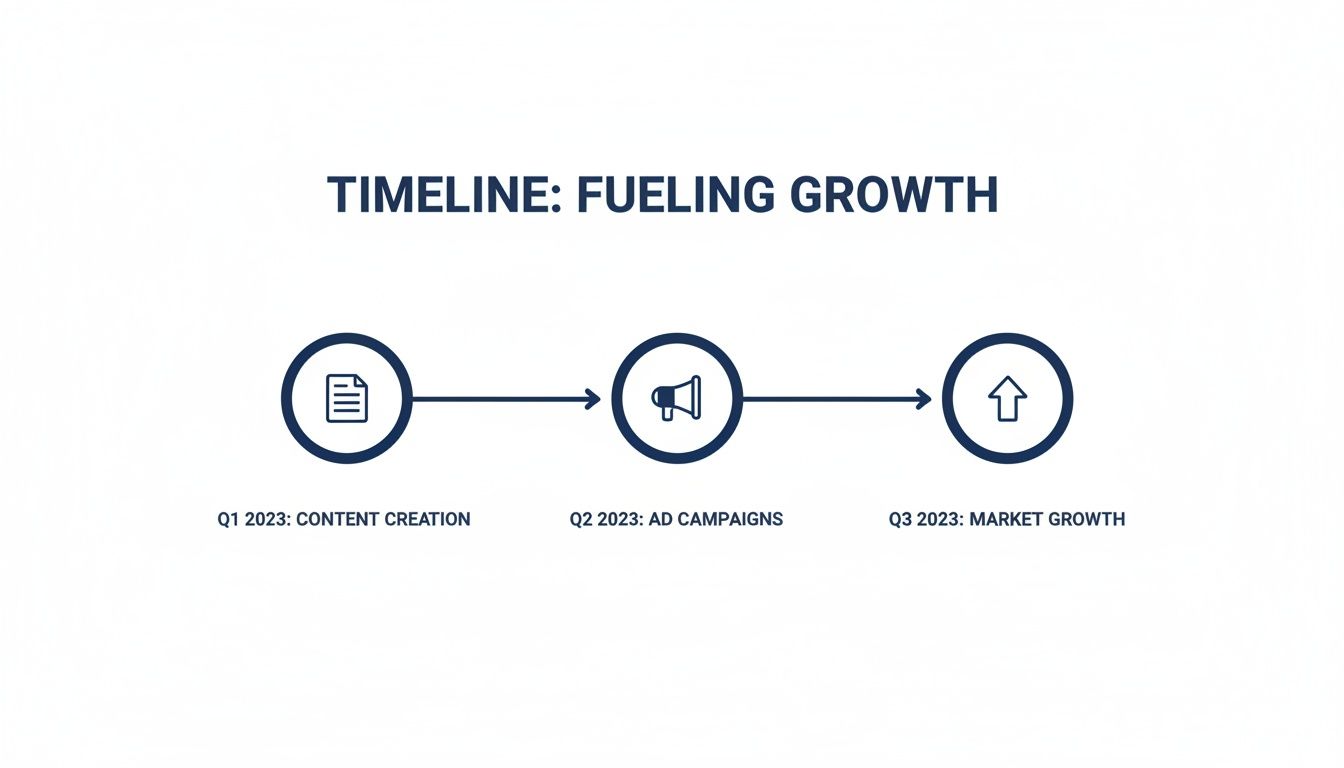
As you can see, it’s a clear progression. Consistent, valuable content is the fuel required to make the entire growth engine run.
Month 3: The Activation Phase (Days 61-90)
The foundation is set and assets are built. It’s time to flip the switch. Month 3 is about activating the system to drive targeted traffic and start nurturing leads.
Your Month 3 Checklist:
- Week 9: Launch Your First PPC Campaign. Start small and focused on Google Ads or LinkedIn Ads. Pick a handful of high-intent keywords or a very specific audience based on job titles. The goal is to test messaging and generate your first few digital leads.
- Weeks 10-11: Publish Foundational Content & Automate. Publish your first in-depth case study or technical blog post. At the same time, build the lead nurturing automations in GoHighLevel for your new lead magnet and quote request form.
- Week 12: Review & Plan the Next 90 Days. Look at the early data. Which ads are getting clicks? Use these initial insights to plan your next quarter.
This 90-day plan is your launchpad, not the destination. The point is to build momentum, get real-world data, and create a repeatable process you can scale.
As you move from planning to execution, this guide on how to launch a winning digital marketing campaign offers great tactical advice.
Sample 90-Day Digital Marketing Launch Plan
To make this even clearer, here is a simplified checklist outlining the key tasks for your first three months.
| Phase | Month 1 (Days 1-30) | Month 2 (Days 31-60) | Month 3 (Days 61-90) |
|---|---|---|---|
| Strategy & Setup | • Conduct internal/competitor research • Define ICP & Buyer Personas • Develop core messaging • Configure GoHighLevel CRM |
||
| Asset Creation | • Optimize key website pages • Implement technical SEO • Create first lead magnet (e.g., spec sheet) |
||
| Activation & Growth | • Launch initial PPC campaign • Publish first blog/case study • Build lead nurture automations • Analyze data & plan next quarter |
Stick to this roadmap, and by the end of 90 days, you'll have a functioning lead generation machine. Your next step? Contact us for a full diagnosis of your current marketing system.