If you’re a business owner in a B2B industry, you know generating high-quality leads is a constant challenge. We see it all the time—the root cause is often a lack of authority. Your ideal prospects are skeptical, short on time, and tired of generic content.
In this guide, we’ll show you how to diagnose this problem and build a white paper—a powerful asset designed to cut through the noise, build trust, and attract qualified leads who are already convinced of your expertise.
Why White Papers Are Your Secret B2B Lead Generation Weapon

If your B2B lead flow feels unpredictable, the problem isn't a lack of effort—it’s a gap in your authority. You’re trying to reach prospects who are busy, discerning, and drowning in surface-level blog posts. A well-engineered white paper is designed to cut right through that noise.
This isn't just another piece of content. Think of it as a diagnostic tool. It educates high-value prospects, answers their most pressing questions, and proves you understand their world better than anyone else.
Moving from Chasing to Attracting Prospects
The biggest shift a white paper creates is in your sales dynamic. You stop chasing down cold leads and start attracting qualified buyers who already see you as the go-to expert. Why does this work so well?
- It proves you know your stuff. A white paper digs deep, providing a detailed analysis of a complex problem, all backed by solid data and research. No fluff, just substance.
- It builds immediate trust. When you generously offer a valuable solution without a hard sales pitch, you earn credibility. Prospects remember that.
- It pre-qualifies your leads. The only people who will trade their email for a deep-dive document are those genuinely interested in solving that specific problem. The leads you get are already warm.
B2B data backs this up. White papers can drive 65% more leads than ebooks, with a solid 23% average conversion rate from download to a sales conversation. For a manufacturing business looking for consistent lead flow, a single great white paper can establish you as a thought leader and plug directly into your CRM for automated follow-up.
We see this all the time: a single, well-researched white paper becomes the cornerstone of an entire marketing system. It's the high-value asset that fuels email campaigns, empowers sales conversations, and solidifies your market position.
White Paper vs. Blog Post: Choosing the Right Tool
So, when should you invest in the depth of a white paper versus the speed of a blog post? It’s a common question. This table breaks down how to choose the right tool for the job.
| Attribute | White Paper (The Diagnostic Tool) | Blog Post (The Quick Tip) |
|---|---|---|
| Purpose | Solve a complex problem, build authority, and generate high-quality leads. | Answer a specific question, drive traffic, and engage your current audience. |
| Depth | 5-15 pages of in-depth research, data, and original analysis. | 800-2,000 words of focused, actionable advice. Quick and to the point. |
| Audience | Decision-makers in the research and evaluation stage of the buyer's journey. | Anyone seeking quick answers or exploring a topic at a surface level. |
| Tone | Authoritative, objective, and professional. Data-driven and formal. | Conversational, helpful, and direct. Can be more personal. |
| Best For | Establishing thought leadership, capturing MQLs for complex B2B sales. | SEO, social media engagement, and building a consistent content rhythm. |
Ultimately, it’s not an either/or decision. A strong content system uses both: blog posts attract a wide audience, and white papers convert the most serious prospects into leads.
An Asset That Works for You Long-Term
View your white paper not as a one-and-done campaign, but as a durable marketing asset. Once created, you can promote it for months—or even years—and it will keep generating leads.
To maximize its ROI, plug it into a broader system. Exploring different content repurposing strategies lets you turn one asset into many. You can slice up key insights into blog posts, social media graphics, webinar topics, or even sales team battle cards. This approach ensures your initial investment pays dividends across multiple channels.
Pinpointing Your Audience and a High-Impact Topic
A brilliant white paper can fail for one simple reason: it speaks to everyone and no one. Before writing a word, you must diagnose precisely who you are trying to influence.
If you want your white paper to generate actual business, you need to get surgical with your targeting. You're not just aiming for a job title; you're connecting with a real person who has specific pressures, goals, and challenges that keep them up at night.
A technical-minded engineer wants hard data and performance benchmarks. A plant manager is obsessed with uptime and efficiency metrics. The CEO? They’re chasing ROI and market share. Each one needs a different conversation.
Diagnosing Your Ideal Reader
To dial in your audience, you have to ask the right questions. Talk to your sales team—they're on the front lines. Interview a few of your best customers. Dig into the real-world problems your audience is grappling with.
Here are the questions we always start with to build a clear picture:
- What's their primary role and responsibility? Are they a hands-on operator, a strategic decision-maker, or an influencer who advises the final buyer?
- What specific problem really bothers them? Get past vague goals like "reducing costs." Is it "fighting unplanned downtime on the Series 3 production line that costs us $10,000 an hour"? That’s the diagnosis you need.
- What solutions have they already tried? Often, your biggest competitor is the status quo or a solution that failed them. Knowing this helps you frame your approach as the smarter alternative.
- What kind of information do they trust? Do they lean on peer-reviewed studies, case studies from similar companies, or hard data from independent testing?
This process helps you build a detailed reader profile. For a more formal framework, you can check out our guide on how to create buyer personas.
Finding the Intersection of Expertise and Urgency
Once you have a crystal-clear image of your reader, picking a topic gets much easier. The sweet spot for a killer white paper topic lives at the intersection of two things: your unique expertise and your audience's most urgent problems.
You're not just looking for a topic you can write about. You're searching for a problem that your business is uniquely qualified to solve—a problem so pressing that your ideal reader will gladly trade their contact information for the solution.
The goal isn't just to be interesting; it's to be indispensable. Your topic should address a high-stakes challenge that, if solved, delivers a measurable transformation for your reader's business.
Brainstorming and Validating Your Topic
Get your team in a room—sales, product, and marketing. Kick things off by listing the top 10 questions prospects ask during sales calls. What are the most common objections or points of confusion?
This exercise almost always uncovers a goldmine of topic ideas. Once you have a shortlist, run each one through this simple validation checklist.
Questions to Ask Yourself:
- Is this problem urgent and expensive for our ideal reader? A topic about a minor inconvenience won't get anyone to click "download."
- Do we have unique data or a proprietary process to share? Your white paper has to offer something they can't find with a quick Google search. If not, why should they care?
- Does this topic naturally lead to our product or service as the solution? The paper must educate first, but it should logically connect the dots between the problem and the solution you sell.
For example, a machine manufacturer might discover that prospects constantly struggle with calculating the ROI of new equipment. A white paper titled "The Plant Manager's Framework for Calculating CapEx ROI" would be a home run. It solves a real pain point, showcases expertise, and naturally tees up a conversation about their machinery.
Structuring Your White Paper for Maximum Impact
You’ve locked down your audience and a high-impact topic. Now, how do you build a document that a busy, skeptical reader will actually finish?
The secret is structure. A disorganized white paper gets skimmed and forgotten. A well-structured one guides the reader from problem to solution, building your case step-by-step and proving you know what you’re talking about. Think of this structure as the schematic for a persuasive argument.
The Blueprint for a Persuasive White Paper
For technical audiences like engineers or plant managers, clarity and logic are everything. They need to see a clear path from the problem they’re wrestling with to the solution you're presenting. This isn’t about creative flair; it’s about engineering a compelling narrative.
Here’s a breakdown of the essential components that should form the skeleton of your document.
- Compelling Title: Your title is your first—and sometimes only—chance to get a click. It must state the problem and promise a valuable solution. A title like "An Engineer’s Guide to Reducing CNC Machine Downtime by 30%" is infinitely better than "The Future of Manufacturing."
- Executive Summary: This is your one-page pitch. Assume your reader is busy and might only read this section. Summarize the core problem, your proposed solution, and the key takeaways. Give them the "why" and "how" upfront to prove the rest is worth their time.
- Introduction (The Problem): Set the stage. Clearly define the problem your audience faces, using data and real-world scenarios to show how urgent and costly it is. Prove you understand their world.
- The Body (The Solution): This is the core of your argument. Build a logical case for your solution step-by-step, using data, research, and examples to back up every claim. Break complex ideas into digestible sections with clear subheadings. Remember to educate, not sell.
- Conclusion: Bring it all home. Succinctly summarize the key points and reiterate the main takeaway. Your conclusion should reinforce the value of the solution and give the reader a clear sense of what to do next.
- About Us & CTA: Briefly introduce your company and explain why you're the expert on this topic. Finish with a clear, low-friction call to action (CTA), like scheduling a consultation or requesting a demo.
Finding the Right Length and Depth
One of the most common questions we get is, "How long should a white paper be?" The honest answer: as long as it needs to be to solve the problem, and not a single word longer. You must balance providing enough detail with respecting your reader’s time.
Most technical white papers land in the 4,000-6,000 word range, which is about 6-12 pages. Research shows an average of 4,038 words keeps readers engaged without being overwhelming. This length allows for real depth on complex topics, like GoHighLevel integrations or SEO for manufacturers, where being too brief feels superficial.
The most critical factor isn’t word count, but value density. A 10-page paper packed with actionable insights is far more valuable than a 20-page document filled with fluff. Make every sentence earn its place.
Using Formatting to Guide the Reader
Great structure isn't just about the order of your sections. How you visually format the content plays a massive role in readability, especially for a technical audience that values scanning for key information.
Think like a designer to make the important stuff pop.
- Headings and Subheadings: Use a clear hierarchy (H2, H3) to break up the text. This creates a scannable outline that readers can follow at a glance.
- Callout Boxes: Pull key statistics, quotes, or important takeaways into visually distinct boxes. This is a magnet for the reader's eye.
- Charts and Graphs: Don't just tell them; show them. Visualizing data makes complex information easier to digest and remember.
- Bulleted and Numbered Lists: Use lists to break down processes, steps, or features into simple, easy-to-follow chunks.
By thoughtfully planning your structure and using formatting to your advantage, you transform a simple document into a powerful tool for persuasion and education.
From Research to Polished Draft: Bringing Your White Paper to Life
Your outline is locked in. Now it’s time to transform that skeleton into a persuasive, trust-building narrative that solves a real problem for your reader.
This isn’t about just filling pages. It’s about building an undeniable case, piece by piece, with credible, compelling information. That requires a smart system for gathering evidence and translating complex ideas into clear, authoritative prose.
Gathering Your Raw Materials
Before you type a sentence, you need to collect the ingredients that will give your white paper substance. Any argument is only as strong as the evidence backing it up. If you make generic claims, a sharp technical audience will see right through it.
We recommend focusing on three types of proof:
- Credible Research: Hunt down academic studies, industry benchmark reports, and reputable government data. This objective, third-party information builds an immediate foundation of trust.
- Internal Data: What unique information can you bring to the table that no one else has? This could be proprietary research, anonymized customer success metrics, or internal performance data. Original data instantly positions you as a thought leader.
- Expert Insights: Talk to your own subject matter experts. Interview your engineers, product managers, or senior leadership. Their firsthand experience adds a layer of authenticity you can't fake.
A white paper's authority comes from its evidence. When you blend external research with your own unique data and expert commentary, you create something that isn't just informative—it's uniquely valuable.
Adopting the Right Tone
Writing a great white paper is a balancing act. You need to sound knowledgeable without being arrogant or getting lost in academic jargon. Your reader is smart but busy. Don't make them work too hard with dense corporate-speak.
The voice to aim for is that of a helpful, confident expert. Picture yourself walking a valued client through a complex problem, explaining the nuances clearly and calmly.
- Be direct and precise. Use plain English to explain complex ideas.
- Focus on their problem. Use "you" and "your" to keep the spotlight on the reader's challenges and goals.
- Stay objective. Let the data make your points for you. The tone should feel more educational than salesy.
For business owners new to this kind of writing, exploring content marketing best practices can give you a better feel for maintaining this tone across all your marketing.
Translating Complexity into Clarity
One of the biggest hurdles in writing for technical audiences is explaining intricate concepts without getting lost in the weeds. Your job is to be a translator, turning dense technical specs and complex processes into clear business benefits. The best tools for this are analogies and real-world examples.
An analogy can make an abstract concept tangible. For instance, you could compare a new data processing method to a more efficient sorting system in a warehouse—something a plant manager can immediately visualize.
Even better are real-world scenarios and mini-case studies. Instead of just saying your solution improves efficiency, walk the reader through a short story that proves it.
Here’s a quick example:
A mid-sized fabrication shop was struggling with production bottlenecks, with changeover times averaging 45 minutes. After implementing our streamlined workflow, which re-sequences tooling and pre-stages materials, they cut that changeover time to just 15 minutes. That single change unlocked an additional 10 hours of production capacity every week.
That short, specific story is far more persuasive than a generic claim. It makes the benefit real and shows you understand the pressures your audience is dealing with.
From First Draft to Polished Product
Your first draft is never your final draft. Its only job is to get all your research, ideas, and arguments out of your head and onto the page. Don't agonize over every word. Just write.
Once that's done, the real work of polishing begins. Editing is where you sharpen your arguments, clarify your language, and ensure the entire document flows logically from problem to solution.
Your Editing Checklist:
- Check for Clarity: Is every sentence crystal clear? Read your draft aloud to catch awkward phrasing.
- Verify Your Claims: Go back and double-check every single statistic, data point, and source. Accuracy is non-negotiable.
- Strengthen Your Argument: Does each section build logically on the last one? Is the path from problem to solution seamless?
- Cut the Fluff: Be ruthless. Remove any unnecessary words or sentences that don't directly support your core message.
This rigorous process is what turns a simple document into a powerful asset that generates leads and builds genuine trust with your ideal customers.
Designing and Promoting Your White Paper for Lead Capture
A brilliantly written white paper is only half the battle. If it's poorly designed or sits on your server collecting digital dust, your investment is wasted. Now we shift from creation to execution—building the system that turns your document into a reliable lead-capture machine.
The process starts with professional design that reinforces your brand's authority. From there, we'll build a high-converting landing page, gate the content, and hook it into your CRM. Finally, we’ll outline a promotion plan to get your white paper in front of the right people.
Professional Design Principles That Build Trust
First impressions are everything. A cluttered, amateurish design signals that the content might be low-quality. We’ve seen readers abandon a document before reading a single word if it looks unprofessional.
Your design isn't just decoration; it's a critical part of the user experience. The key is to prioritize clarity and readability.
- Clean Branding: Your white paper should feel like it comes from your company. Use your brand's colors, fonts, and logo, but keep it subtle.
- Whitespace is Your Friend: Don't cram the page full of text. Generous margins and spacing make the document feel less intimidating and easier to scan.
- High-Quality Visuals: Use relevant charts, graphs, and diagrams to break up text and make complex points easier to understand. Ditch generic stock photos; custom graphics have a much bigger impact.
Think of your design as the packaging for your expertise. A clean, professional layout communicates authority and tells the reader that the information inside is valuable and worth their attention.
Below is a simple flowchart that visualizes the core process we've covered, from initial research to polished draft.
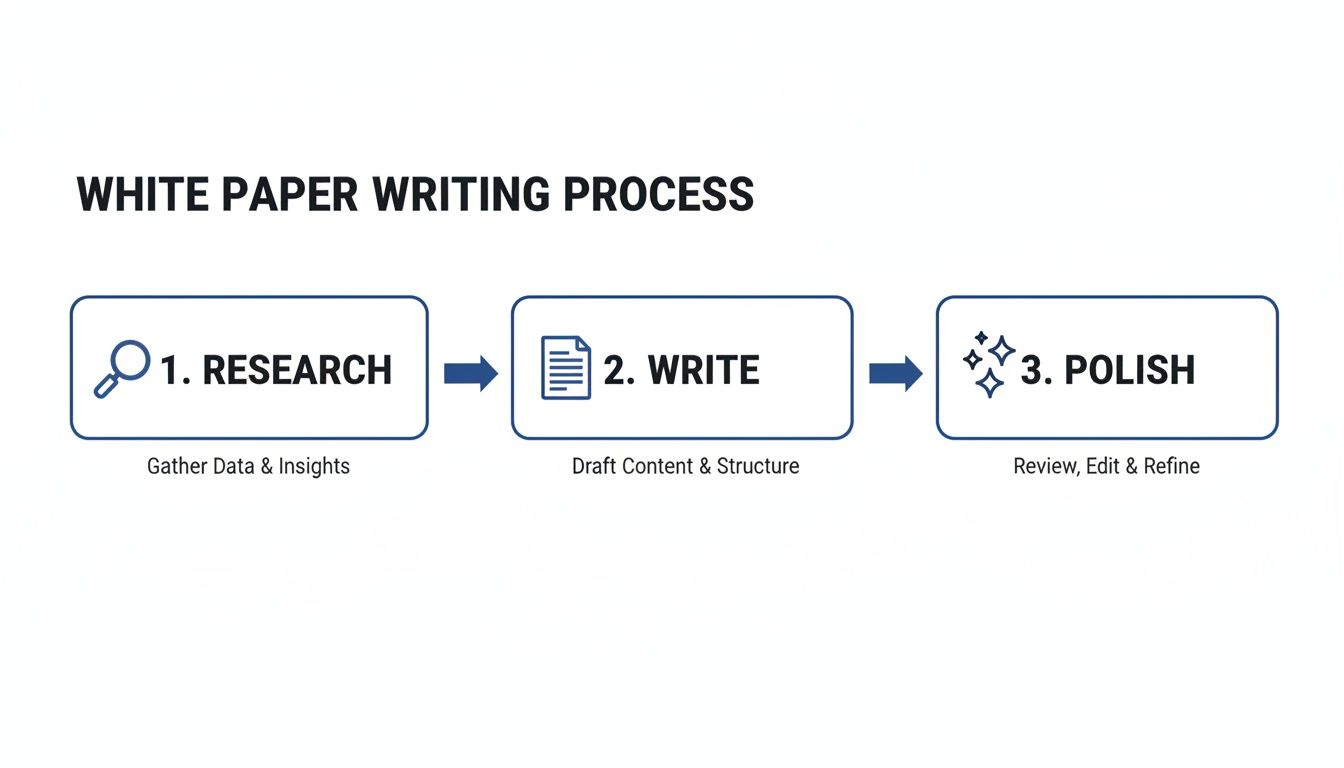
This workflow reinforces that writing a great white paper is a systematic process, not a burst of creative energy. Each step builds on the last to ensure a high-quality final product.
Building Your Lead Capture System
Your white paper needs a home—a dedicated landing page with a single goal: getting visitors to trade their contact info for your content. This is the most critical control point in your lead gen system. Any friction here will tank your conversion rates.
To get the most downloads, your landing page needs to be clear, compelling, and direct. Get straight to the point.
Essential Components of a High-Converting Landing Page
| Component | Why It Matters | Quick Tip |
|---|---|---|
| Compelling Headline | It's the first thing people see. It needs to match the promise of your ads and clearly state the value. | Mirror the white paper's title or main benefit. For example, "Your Guide to [Achieving X]." |
| Benefit-Oriented Bullets | Visitors scan, they don't read. Bullets quickly communicate the key takeaways and solve the "What's in it for me?" question. | Use 3-5 bullets focusing on outcomes. Instead of "Includes data," say "Discover the 3 key industry trends." |
| Simple, Visible Form | Every extra field you ask for creates friction and reduces conversions. Make it easy for them to say yes. | Stick to the basics: Name and Email. Place it "above the fold" so they don't have to scroll to find it. |
| Clear Call to Action (CTA) | The button tells them exactly what to do next. Vague words like "Submit" are weak. | Use action-oriented text. "Download Your Free Guide" or "Get the White Paper Now" works much better. |
Each of these components works together to create a seamless experience. For a deeper dive, check out our guide on how to improve website conversion rates.
Connecting Your Form to Your CRM
So what happens after a prospect fills out the form? The process can't stop there. This is where automation tools like GoHighLevel come in. Integrating your landing page form with your CRM is non-negotiable for any serious B2B marketer.
This simple connection lets you instantly:
- Deliver the white paper with an automated email. No manual work required.
- Tag the new contact based on the white paper's topic, which is gold for future segmentation.
- Trigger a follow-up sequence to nurture that lead over the next few days or weeks.
This automated system ensures no lead falls through the cracks. Every person who downloads your content gets a timely, relevant follow-up, moving them down the sales funnel.
Promoting Your White Paper Across Channels
With your design polished and your lead capture system ready, it’s time to drive targeted traffic. You can't just publish the landing page and hope people find it. You have to proactively promote it where your ideal customers already are.
- Email Marketing: Your existing email list is your warmest audience. Announce the new white paper to them first—they're the most likely to download and share it.
- Social Media: Pull out key insights, statistics, or quotes from the paper and share them on platforms like LinkedIn. Always link back to the landing page.
- Paid Advertising: Use targeted ads on LinkedIn or Google to reach a specific audience based on job title, industry, or company size. Effective promotion is vital; explore strategies for Mastering Lead Gen for PPC Campaigns to maximize its reach.
- Your Website: Add CTAs for the white paper on relevant blog posts and service pages to capture visitors who are already engaged with your content.
A multi-channel promotion strategy is what turns your hard work into a consistent, predictable source of high-quality B2B leads.
Your Top Questions About White Papers, Answered
Even with a solid plan, you probably still have a few questions. That's normal. We get asked about the nuts and bolts of white papers all the time—from budget and timelines to proving they actually work. Let’s get you some clear answers.
How Much Should a White Paper Cost?
This is always the first question, and the honest answer is: it depends. The price is tied directly to complexity. A simple, 5-page paper built on your existing knowledge is a different project than a 15-page document requiring original research, expert interviews, and custom charts.
As a general benchmark for professional work, expect to invest $3,000 to $7,000+.
- The Lower End ($3,000 – $4,500): This usually covers a shorter paper where you provide the raw material and expertise. The writer's job is to shape it, write it, and polish it.
- The Higher End ($5,000 – $7,000+): In this range, the writer or agency does the heavy lifting: conducting interviews, digging up external research, and managing the project from idea to final design.
Our Takeaway: Don't think of this as a one-off expense. See it as an investment in a long-term asset. A single, well-crafted white paper can fuel your marketing for a year or more, making that upfront cost highly efficient.
How Long Does It Take to Create One?
Just like the cost, the timeline hinges on complexity. Rushing the process almost always ends in a mediocre product. A valuable white paper needs time for proper research, thoughtful writing, and careful review.
A realistic timeline, from kickoff to launch, is typically 4 to 8 weeks.
Here’s a rough idea of how that time gets spent:
- Weeks 1-2: Strategy and research. This includes stakeholder interviews and data gathering.
- Weeks 3-4: Building the outline and writing the first draft.
- Weeks 5-6: The feedback loop—internal reviews, revisions, and refining the copy.
- Weeks 7-8: Professional design, final proofreading, and preparing for launch.
Giving the project this space is what allows you to create content that genuinely reflects your brand's authority.
How Do We Measure the ROI?
This is where the rubber meets the road. Measuring the success of a white paper isn’t just about counting downloads. You have to connect that download to a real business outcome. For that, connecting your landing page to a CRM is non-negotiable.
Here are the key metrics you should be tracking:
- Lead Generation: How many new contacts did the white paper generate?
- Lead-to-Customer Conversion Rate: What percentage of people who downloaded the paper eventually became paying customers?
- Sales Cycle Velocity: Did leads who read the white paper close faster? An educated prospect is often a faster-moving prospect.
- Influence on Revenue: Your CRM should be able to tell you exactly how much closed-deal revenue can be traced back to the leads your white paper brought in.
When you track these metrics, you move past vanity numbers and can calculate the real, tangible return on your investment.
Ready to build a marketing asset that generates qualified leads for your business? We specialize in creating data-driven content systems that deliver measurable results. Book a discovery call with Karl to diagnose your current marketing and build a roadmap for growth.