If your sales process feels like you're constantly chasing low-quality leads, the problem might be hidden in plain sight. The solution isn't more calls—it's better conversations. A discovery call, when done right, is the single most powerful tool for filtering out bad-fit prospects and focusing your energy on deals you can actually win.
This is not a sales pitch. It’s a two-way diagnostic session. In this guide, we'll diagnose why most discovery calls fail and give you a step-by-step framework to turn them into your most valuable business growth asset.
What Is a Discovery Call, Really?
So, what is a discovery call? It’s a structured conversation designed to diagnose a prospect's challenges, get crystal clear on their goals, and determine if your services are the right solution. For business owners, it’s the critical filter that saves you countless hours by weeding out prospects you can't genuinely help.

The entire point is to transform your role from "vendor" to "strategic partner." That transformation starts here. You don’t show up to talk at them about your services; you show up to ask smart questions and listen.
The True Purpose: Diagnosis Before Prescription
Have you ever been to a doctor who handed you a prescription without asking about your symptoms? You’d never trust their advice. The same logic applies to business.
A discovery call is built on one core principle: diagnosis before prescription. It's your opportunity to get under the hood of your prospect's business and understand what's actually broken.
During this diagnosis, you are hunting for specific information:
- The Problem: What specific pain point or bottleneck are they struggling with right now?
- The Impact: How is this problem costing them in time, money, or stalled growth?
- The Desired Outcome: If you could solve this, what does success look like for them?
- Mutual Fit: Do you have the capability to solve their problem? And are they ready and willing to invest in a real solution?
What a Discovery Call Is NOT
It’s just as important to define what this call isn’t. A discovery call is not a demo, though a great one often earns you the right to schedule one. It's definitely not a closing call where you push for a signature. Pitching your solution before a prospect feels understood is the fastest way to kill a deal.
The data shows that in winning deals, sales reps talk for only 57% of the call time, compared to 62% in lost deals. The focus must be on the prospect.
To clarify where a discovery call fits into your process, here’s how it compares to other sales interactions.
Discovery Call vs. Other Sales Conversations
| Interaction Type | Primary Goal | Typical Length | Who It's For |
|---|---|---|---|
| Discovery Call | Diagnose pain points & qualify fit | 20-30 minutes | Qualified leads who show interest |
| Cold Call | Generate initial interest & book a meeting | 2-5 minutes | Unqualified prospects |
| Sales Demo | Showcase how your solution works | 45-60 minutes | Highly qualified, problem-aware leads |
| Closing Call | Discuss terms & secure commitment | 30-45 minutes | Decision-makers ready to buy |
As you can see, each conversation has a distinct purpose. Trying to do everything in one call is a recipe for failure. Your conversion rate from discovery call to the next step—which should be between 10-30%—is a key health metric for your sales system. If you're falling below that, it's time to diagnose your targeting or questioning technique. The team at Prospeo has great insights on these benchmarks.
How to Prepare for a Winning Discovery Call
Walking into a discovery call unprepared is the most common and damaging mistake you can make. It immediately signals to a prospect that you don't value their time and kills your credibility before you even start.
The bar for preparation is surprisingly low, which creates a huge opportunity for you. Research shows that only 18% of buyers feel sellers are prepared for the first meeting. Doing your homework is what elevates the conversation from a generic pitch to a high-value consultation. You can see the full breakdown by reading more on these discovery call findings.
Your Pre-Call Diagnostic Checklist
Effective preparation isn’t about memorizing a script. It’s about building a foundational understanding of the person and the business so you can ask better questions. Think of it as creating a "pre-call hypothesis" about their challenges to guide the conversation with intent.
Here’s how to spend 10-15 minutes preparing:
Run a Company Diagnosis: Look beyond the homepage. Are there recent press releases, new hires, or industry shifts creating pressure? This shows you've done the work.
Review the Individual’s Profile: Check their LinkedIn. What is their role and tenure? What are they posting or sharing? This reveals their priorities.
Analyze Their First Contact: Go back to their initial inquiry or contact form. What specific words did they use to describe their problem? That’s your starting point.
Form a Hypothesis: Based on your research, what do you suspect are their top one or two challenges? For example: "I see they just hired a new sales team, but their website looks five years old. My hypothesis is they're struggling to generate enough qualified leads for their new reps."
The goal of preparation is not to have all the answers, but to know which questions to ask. Arriving with a hypothesis makes your questions more insightful and relevant.
This simple process transforms a weak opening like, "So, tell me about your business…" to a powerful one: "I noticed you've recently expanded the sales team. How is your current lead flow keeping up with that growth?" This small shift makes a massive difference. To get even clearer on who you're targeting, check out our guide on how to create buyer personas.
The Anatomy of a High-Impact Discovery Call
A great discovery call feels like a natural conversation, but it should never be improvised. The best ones follow a clear, strategic framework that ensures you get the information you need while building trust.
Think of it as a repeatable, five-part system. This isn't a rigid script. It's a flexible guide that helps you steer the conversation, diagnose the real problems, and secure the next steps. Once you master this structure, every call becomes a powerful diagnostic session.
Stage 1: Setting the Stage (First 2 Minutes)
The first two minutes are make-or-break. This is where you establish credibility and take control by setting a clear agenda and showing you respect their time.
Start with a quick introduction, then immediately frame the call. For example: "Thanks for making time today. I’ve blocked out 25 minutes for us. My goal is to learn more about your goals, diagnose your current challenges, and see if we can help. If it looks like a good fit, we can define the next step. Sound good?"
This simple opening builds confidence and sets a professional, no-fluff tone.
Stage 2: Diagnosing the Pain
Once the stage is set, you flip into diagnostic mode. Hand the microphone to the prospect. Your job is to ask insightful, open-ended questions that get them talking about their real-world challenges.
Use prompts that start with "Walk me through…", "Tell me about…", or "What happens when…". You want to get past surface-level complaints to uncover the root cause. Let them do 80% of the talking here. You are just listening and guiding with sharp follow-up questions.
Stage 3: Quantifying the Impact
A problem isn't a real problem until you can attach a number to it. In this stage, you guide the prospect to connect their frustrations to tangible business consequences. Is this issue costing them time, money, or opportunities?
The goal here is to transform a vague complaint like "our marketing feels slow" into a concrete business problem like "it takes our team 15 hours a week to manage, and we're still missing out on qualified leads."
Ask direct questions that prompt them to think in terms of metrics:
- "What's the financial impact of that issue?"
- "How much time is your team sinking into that each week?"
- "What is the opportunity cost if this doesn't get solved?"
This step is critical for building the business case for your solution. The insights you gather here are essential for effectively qualifying sales leads and ensuring they are ready to invest.
Stage 4: Casting the Vision
After you've diagnosed the problem and its impact, pivot toward the future. This is where you help the prospect imagine what their business could look like if their biggest challenge vanished.
Ask them, "If this problem was gone tomorrow, what would that unlock for your business?" This question powerfully shifts the conversation from pain to possibility. You are not pitching your service. You are co-creating a vision for a better future, with you as the partner who can help them get there.
Stage 5: Establishing Clear Next Steps
Every successful discovery call ends with a firm, agreed-upon plan. Vague endings like "I'll send over some info" are deal-killers that destroy all momentum.
If they are a good fit, define the next logical step. This could be scheduling a proposal review, booking a technical demo, or setting up a follow-up with other decision-makers.
Be specific: "Based on what we covered, the next step is for me to build a focused proposal. I can have that ready to review together this Thursday. How does 10 AM look on your end?" This locks in a commitment and keeps the process moving.
The 20 Best Discovery Questions to Ask
A great discovery call is a conversation, not an interrogation. It's a common mistake to think more questions get you more answers. Bombarding a prospect just makes them shut down. The real goal is to guide the conversation with a few smart, well-placed questions.
Top-performing sales reps average just 15-16 questions per call, while lost deals often involved 20 or more. That tells you everything: fewer, better questions win. It's about depth, not volume. You can dig into the data in this Prospeo analysis.
To help you get this right, here are 20 of our go-to discovery questions, broken into four categories. Each serves a specific purpose in building a complete picture of your prospect’s world.
This flow shows how your questions map to the five stages of a call, moving from diagnosis to a clear next step.
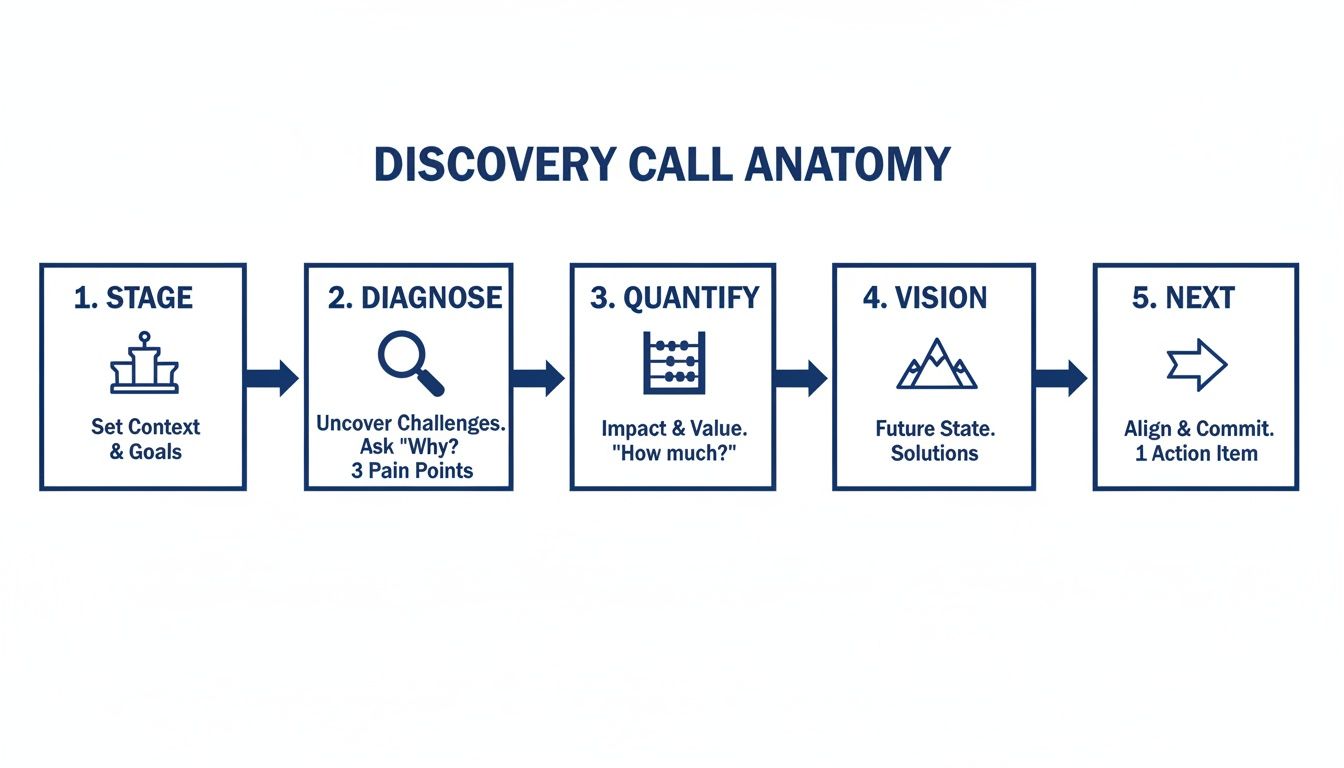
This structured approach—diagnosing the problem, quantifying its impact, and building a vision—naturally leads to a concrete, agreed-upon action.
Questions to Understand the Current State (Diagnosis)
Your first job is to map their current reality—their processes, tools, and daily challenges. You are simply listening and learning.
- Can you walk me through how you currently handle [the specific process]?
- What tools or systems are you using for that right now?
- What’s working well with your current approach? What isn't?
- When was the last time you tried to solve this? What happened?
- Who on your team is most affected by this process?
Questions to Identify Pain and Consequences (Impact)
Now, find the friction. These questions help both you and the prospect connect an operational headache to a real business consequence, like wasted time or lost money.
- What is the biggest frustration with the way things work today?
- What is the business impact of that problem? (Think time, cost, or risk)
- How much time is your team spending on this each week?
- What happens if you do nothing and this problem continues for another year?
- On a scale of 1-10, how high a priority is solving this for the business?
Questions to Explore the Desired Future (Vision)
After exploring the pain, pivot to the solution. These questions get the prospect to imagine a better future and define their ideal outcome, creating the "gap" your solution is built to fill.
- If this problem was completely solved tomorrow, what would that unlock for you?
- What does success look like for this project six months from now?
- What would you be able to do that you can't do today?
- How would solving this impact your team’s day-to-day work?
- What is the single most important outcome you need from this?
Questions to Uncover Budget and Decision-Making (Qualification)
Finally, get practical. These questions help you qualify the opportunity by gently probing for budget, decision-makers, and the evaluation process.
- Have you invested in a solution for this type of problem before?
- Is there a budget set aside for this initiative?
- Besides yourself, who else is involved in making a decision like this?
- What does your typical evaluation process for a new partner look like?
- Based on what we've discussed, what information do you need to move forward?
For more ideas on how to frame these conversations, check out these common Lead Qualification Questions To Ask.
Common Mistakes and Red Flags to Avoid

Even with a great plan, a discovery call can go sideways. Knowing how to spot common mistakes can get a conversation back on track—or tell you when to disqualify a prospect and move on. Think of this as your field guide for spotting deal-killing pitfalls.
The biggest mistake we see is pitching too early. The moment you list features before you’ve diagnosed their pain, you stop being a problem-solver and become just another salesperson. Remember, this call is about diagnosis, not a demo.
Another classic error is the monologue. If you catch yourself talking for more than a minute straight, hit the brakes. A discovery call must be a dialogue. You are there to guide the conversation with sharp questions, not deliver a lecture.
How to Correct Course in Real Time
Spotting a mistake is the first step; correcting it is what separates top performers. If you catch yourself pitching or talking too much, you can pivot without missing a beat.
A simple phrase can reset the dynamic: "You know, I'm getting ahead of myself. Let me pause and ask—based on what you’ve shared, what’s the single biggest roadblock you're hitting with X?" This puts the focus back on them and shows you're self-aware.
Along those same lines, never accept a vague answer. When a prospect says, "Our process isn't working," don't just nod.
Vague problems lead to vague solutions. Your job is to dig for specifics. Ask, "When you say it's 'not working,' can you walk me through an example?"
Critical Red Flags to Watch For
Beyond your own missteps, listen for signals that a prospect isn't a good fit. Recognizing these red flags early saves you from chasing a deal that was never going to close.
Questions to Ask Yourself: Is this a red flag?
- Can they name a clear pain point? If a prospect can’t explain a specific problem or its business impact, they lack the urgency to invest in a solution.
- Are they avoiding the budget conversation? A flat-out refusal to discuss investment is a huge red flag. It often means they are just "tire-kicking" or have no authority.
- Are they asking for a proposal prematurely? A prospect who says "Just send me a proposal" before you’ve finished discovery sees you as a commodity, not a partner.
Today, prospects complete around 70% of their research before ever talking to a salesperson. They expect an informed point of view. Failing to lock down clear next steps at the end of the call can crater your close rate by as much as 71%. You can learn more about how discovery calls are evolving on AskCommit.com. Spotting these red flags protects your most valuable asset: your time.
Integrating Discovery into Your Sales System
A great discovery call is a waste if its insights get lost in a notebook. This conversation cannot be an isolated event; it must be the central hub connecting your marketing efforts to your sales operations. The goal is to build a system around your calls that creates a single source of truth for every prospect interaction.
Use tools to automate booking and capture intake information before the call. Afterward, it’s essential to log detailed notes, pain points, and agreed-upon outcomes directly into your Customer Relationship Management (CRM) system. This integration is how you track conversion rates, spot bottlenecks, and ensure no qualified prospect slips through the cracks. For a deeper dive, read our guide on how to build a sales pipeline.
Creating a Single Source of Truth for Your Team
This systematic approach turns one-off conversations into actionable data. For deals over $50K, engaging multiple contacts (multi-threading) can boost win rates by 130%. Successful deals often involve twice as many contacts as failed ones. Logging every interaction in your CRM creates a complete picture of the buying committee, which is critical for complex sales. You can find more data on this in Prospeo's discovery call analysis.
At our agency, the discovery call is the launchpad for our entire partnership. The insights we gather feed directly into our diagnostic review and the 90-day action plan we build to drive measurable growth.
For deeper insights and continuous improvement, consider adding a conversation intelligence platform like Gong to your sales system. It records and analyzes your calls, helping your team refine their questioning techniques and replicate what works. This transforms every discovery call into a learning opportunity, building a more effective sales engine.
Frequently Asked Discovery Call Questions
Let's get straight to the point. We hear the same questions about discovery calls from business owners all the time. Here are the direct answers based on what actually works.
How Long Should a Discovery Call Be?
Keep it to 20-30 minutes. Any longer, and it's a sign the seller is talking too much and not listening enough. Our team finds this is more than enough time to diagnose the problem and determine fit. The goal is efficient diagnosis, not filling the calendar.
What Is the Real Goal of a Discovery Call?
The real goal is mutual qualification. You are a diagnostician. Your job is to uncover their business challenges, define their goals, and determine if you are genuinely the right partner to help them.
A successful discovery call is an information-gathering mission that ends with a clear “yes” or “no” on whether moving forward makes sense for both you and the prospect. It saves everyone time.
Should I Discuss Price on the First Call?
It depends, but you must be prepared for the question. If a prospect asks about price, giving a general range is a great way to qualify their budget early and avoid wasting weeks on a deal that was never going to happen.
What you shouldn't do is provide a line-item quote before you've established the value you're providing. A good response sounds like this: "A solution for a business like yours is typically in the X to Y range. To give you a precise number, I'd need to understand a few more details about your goals."
This approach anchors their expectations without making the conversation about price. It reframes the discussion from a transaction into a consultation.
Ready to stop wasting time on unqualified leads and build a predictable marketing system? The team at Machine Marketing specializes in diagnosing growth bottlenecks and implementing strategies that drive real results. Book your discovery call with us to get a diagnosis for your business.