If your marketing budget feels more like a slot machine than a strategic investment, the root cause is often hidden in plain sight. Most marketing misses the mark because it only answers half the equation. You might know your customer's demographics (the 'who'), but you're likely guessing at their psychographics (the 'why').
Demographics give you the outline of your customer. Psychographics color it in, revealing the motivations, frustrations, and ambitions that actually drive their decisions. Without both, you’re flying blind. This guide provides the system to fix that.
Why Your Marketing Keeps Missing the Mark
Are you still using the "spray and pray" method? Many businesses, especially in the B2B world, cast a massive net and hope to catch a few leads. We see it all the time—it’s an expensive habit that rarely delivers a positive ROI.
The problem isn't a lack of effort; it's a lack of precision. When you don't truly understand who you're talking to and, more importantly, why they should care, your message just becomes more noise.
The diagnosis is simple: Generic marketing fails because it speaks to everyone and connects with no one. The only cure is a targeting system built on real data, not just assumptions.
This is exactly where a deep dive into demographics and psychographics becomes your most powerful tool. These two data sets work together to turn your marketing from expensive guesswork into a predictable growth engine.

What This Guide Will Do for You
This guide gives you a repeatable system for defining your ideal customer with surgical precision. Forget vague theories—we're focused on practical steps.
We’ll show you how to:
- Diagnose targeting gaps by understanding the crucial difference between the 'who' and the 'why'.
- Go beyond surface-level data like job titles and company size to uncover the core professional goals and pain points that matter.
- Build campaigns that actually convert by aligning your message with the deep-seated motivations of your ideal buyer.
By the end, you’ll have a framework to stop wasting your budget and start creating marketing that resonates, builds trust, and drives measurable results. This is the first step toward building a marketing system that works for you, not against you.
Understanding Demographics: The Who of Your Customer
To build a marketing system that produces predictable results, you must start with a solid foundation. Demographics are that foundation—the hard, objective facts that tell you exactly who your customers are. Think of it as drawing up the architectural blueprint for your ideal buyer.
This isn't about a vague sketch. It’s about using concrete, statistical traits to define your audience with precision. This data is your first, most critical layer of targeting. It lets you focus your resources where they’ll actually make an impact instead of throwing your budget at an audience that will never buy from you.
Demographics are the framework of your customer profile. They answer the essential questions: Who are they? Where are they? What is their professional role? Without this data, you're just guessing.
Key B2B Demographic Attributes
For any B2B company, some demographic points are far more critical than others. This information gives you a clear picture of the professional world your buyers inhabit.
Questions to ask yourself:
- Job Title & Role: Are we trying to reach engineers, purchasing managers, or C-suite executives? Each has different priorities and buying power.
- Company Size: How do the needs of a 10-person shop differ from those of a 500-employee corporation?
- Industry: Are we targeting a specific niche like aerospace manufacturing? This lets us tune our language and solutions to their unique challenges.
- Geographic Location: Where are our customers clustered? This helps focus ad spend, select trade shows, and understand regional market trends.
- Age & Education: What do these factors suggest about their professional experience, comfort with technology, and communication preferences?
This isn't just a list of dry facts; it's a set of strategic coordinates. For instance, market research shows that key decision-makers in manufacturing are often between 35 and 54 and hold degrees in engineering or business. In small and midsize businesses, 60% of owners are between 45-64 years old and tend to be concentrated in industrial hubs like the Midwest U.S.
This kind of information is immediately actionable. You can explore it further with in-depth market analysis, but even at a glance, knowing these specifics helps you place your advertising budget with surgical precision.
Understanding Psychographics: The Why Behind the Buy
If demographics tell you who your customer is, psychographics uncover why they actually make a purchase. Here, we move past surface-level data—job titles, company sizes, revenue—to get at the heart of the matter: their professional goals, deep-seated frustrations, and personal aspirations.
This is where you start diagnosing the real reasons behind a buying decision. For a B2B buyer, this isn’t about their weekend hobbies. It’s about their burning desire to improve operational efficiency, their frustration with clunky, outdated systems, or a personal drive to be recognized as an innovator in their organization.
Psychographics answer the question: What keeps your ideal customer up at night? Understanding their professional pains and aspirations is the most direct path to earning their trust and their business.
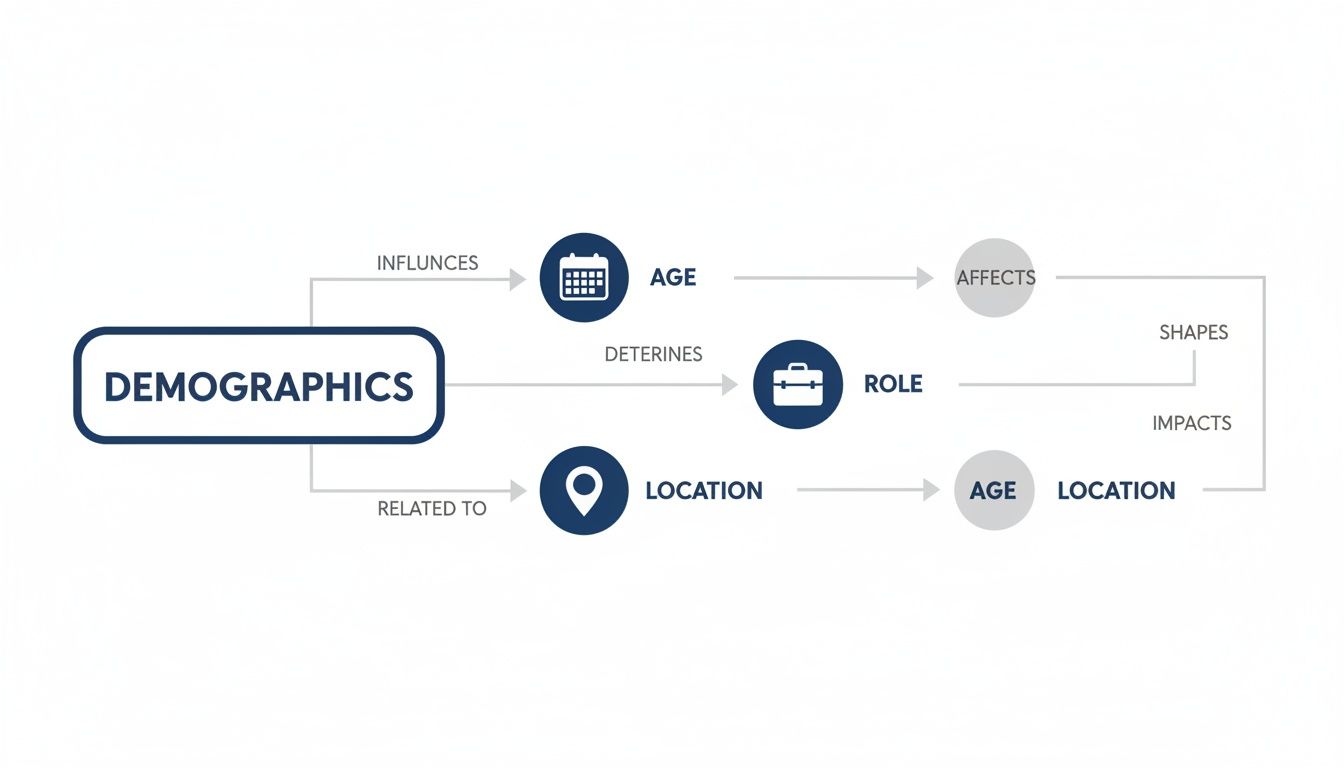
Think of demographics as the blueprint; it gives you the structural facts like age, role, and location. Psychographics bring that blueprint to life, filling in the critical details that make the person real.
From Data Points to Human Drivers
You need both demographics and psychographics to build a complete picture of your buyer. Relying on one without the other leaves you with massive blind spots. For instance, knowing that 65% of B2B decision-makers are aged 35-54 is a decent starting point.
But what really moves the needle is the psychographic insight: 72% of SMB owners in that same age bracket value ‘efficiency and reliability’ far more than a low price.
That’s a game-changing distinction. It means they’re not just looking for a vendor; they’re actively seeking a partner who can prove their worth with solid ROI and proven results. In fact, current research shows that 58% of engineers and sales reps self-identify as 'innovators' on the hunt for automation tools. You can explore more B2B tech trends in this 2026 report.
This is the kind of insight that transforms your messaging. You stop selling features and start selling solutions to their biggest headaches and highest ambitions.
What Psychographics Look Like for B2B
So, what specific psychographic traits should you be hunting for? It's not as abstract as it sounds. Here are the key areas to investigate:
- Professional Goals: Are they trying to boost team productivity? Slash operational costs? Position themselves as an industry thought leader?
- Core Frustrations: What daily bottlenecks, inefficient workflows, or technology gaps are holding their team back?
- Values and Beliefs: Do they prioritize being on the cutting edge? Or do they value stability, security, and proven, low-risk solutions?
- Information Sources: Where do they go for trusted advice? Is it industry publications, peer recommendations on LinkedIn, or data-heavy white papers?
Answering these questions lets you tap directly into your customer’s internal monologue. This is how you stop being just another vendor and become an essential partner—a transformation that can dramatically shorten your sales cycle.
How to Gather Actionable Customer Data
Great customer profiles aren't built on guesswork; they're built on good data. But you don’t need a six-figure research budget to get started. The key is to build a repeatable system to gather both the numbers (demographics) and the stories (psychographics).
This process is about blending two types of information: quantitative data (the 'what') with qualitative insights (the 'why'). By weaving together different methods, including comprehensive market research, you stop making assumptions and start building a crystal-clear picture of your ideal customer.
Practical Data Gathering Methods
Your most powerful insights are often hiding in plain sight. Instead of relying on third-party reports, tap into the resources you already have.
- Targeted Customer Interviews: Forget mass email surveys. Instead, book a few 15-minute calls with your best, most loyal customers. This is where you strike gold and uncover the real "why" behind their decision to buy from you.
- Sales Team Feedback Sessions: Your sales team is on the front lines every day. They hear the raw, unfiltered objections, questions, and aspirations of your prospects. Set up regular meetings to mine this invaluable psychographic data.
- Website & Social Media Analytics: Tools like Google Analytics do more than just track traffic. They show you what content people are reading and what problems they're actively trying to solve. That behavior is a direct signal of their needs.
Asking the Right Questions
The quality of your data depends on the quality of your questions. You need to dig past surface-level answers to find the motivations, frustrations, and goals that truly drive your customers.
The most powerful question you can ask is "Why?" When a customer says they need a new machine, ask why. Is it to boost output? Reduce costly downtime? Or is it to land a bigger contract? The answer to "why" reveals their true objective.
Here are a few diagnostic questions that cut straight to the core insights:
- "What was the specific challenge that led you to look for a solution like ours?" This pinpoints their initial pain and the trigger for their search.
- "What does success look like for you after implementing a solution?" This clarifies their ultimate goal and what a "win" means to them professionally.
- "What frustrates you most about your current process or tools?" This highlights the specific, tangible frustrations you can frame your solution around.
Finally, validate what you've learned. Look for patterns across all your data sources. When five customers mention the same frustration and your web analytics show a surge in traffic to a blog post on that topic, you’ve found a validated insight. That's the foundation you can confidently build a marketing strategy on.
For a deeper dive into this process, check out our guide on how to identify your target audience.
Building Your Ideal Customer Persona
You've gathered the demographic and psychographic data. Now what? All that information is just a pile of facts until you shape it into your single most powerful marketing tool: the Ideal Customer Persona (ICP).
This isn't a fluffy creative writing project. Your ICP is the master blueprint for your entire marketing and sales system. It’s how you get out of the business of guessing and into the business of connecting.
Think of it as creating a detailed profile of your perfect customer. You're combining the hard facts (the 'who' of demographics) with the motivations and goals (the 'why' of psychographics). The goal is to build a character so real that your entire team feels like they know them personally.

When you have this level of clarity, you stop spraying generic messages and start crafting ads, emails, and sales calls that hit the mark every time. It ensures every dollar you spend is aimed squarely at the person most likely to become a loyal customer.
From Data to a Usable Blueprint
An effective persona is built on reality, not assumptions. As you piece your data together, a clear story should emerge about one specific individual who represents your best-fit customer.
Structure your persona with these core building blocks:
- Demographics: Nail down the basics—job title, age range, industry, company size, and location. This sets the professional stage.
- Psychographics: This is where the persona comes to life. What are their primary goals? What keeps them up at night? Do they value innovation over stability? Where do they go for trusted advice?
- Responsibilities & Metrics: What are their key job duties? More importantly, how is their performance measured? This tells you exactly what they are held accountable for.
- A "Day in the Life": Sketch a brief narrative of their typical workday. This simple step adds a human element and makes the persona feel less like a collection of data points.
A well-built persona is a diagnostic tool. Before you write an email or launch an ad, ask, "Would this message resonate with [Persona's Name]?" If the answer is no, it's time to go back to the drawing board.
Questions to Ask When Building Your Persona
To ensure your persona is actionable, challenge every assumption with critical questions. Your answers must come from the data you've gathered, not your own gut feelings.
- What is their #1 professional goal right now? Be specific. "Grow the business" is a vague platitude. "Increase production line efficiency by 15%" is an actionable goal you can sell a solution for.
- What is the single biggest obstacle standing in their way? This obstacle is the problem. Your product or service needs to be the solution.
- How do they define a "win"? Is it hitting a specific KPI? Getting a promotion? Or simply reducing the day-to-day stress of their job?
Building out these profiles is a non-negotiable step. For a deeper dive, check out our complete guide on how to create buyer personas. You can also use social media demographic reports to sharpen the demographic side of your persona.
Activating Your Personas in Your Marketing System
A well-defined persona is a powerful tool, but it's useless until you put it to work. This is where the action begins—plugging those insights into your CRM and marketing automation platform, like GoHighLevel.
This is how you turn abstract research into a growth engine. By implementing your demographic and psychographic segments directly into your systems, you're building a machine designed for precision. Using tags, custom fields, and automated workflows, you can start delivering hyper-personalized messages that speak directly to the unique needs of each buyer.
From Persona to Personalized Campaigns
Think about the power this gives you. You can now build entirely separate email sequences for different psychographic profiles. A risk-averse decision-maker who values stability needs a completely different message than an early adopter who gets excited by innovation.
Your system can now automatically deliver the right message to the right person at the right time. This is how you build trust and shorten the sales cycle at scale.
Here’s how to translate your persona data into your marketing system:
- Create Custom Fields: Go beyond name and email. Add custom fields for psychographic traits like “Primary Goal” (e.g., “Efficiency,” “Growth”) or “Key Pain Point” (e.g., “Outdated Tech,” “Low ROI”).
- Apply Tags Strategically: Use tags to segment contacts based on a mix of demographics and psychographics. For instance, a contact could have both a
Engineer_Midwesttag and aValues_Innovationtag. - Build Automated Workflows: This is where "if-then" logic comes alive. If a contact is tagged
Risk_Averse, enroll them in a workflow that sends case studies and testimonials. If they’re taggedEarly_Adopter, send them a webinar invitation showcasing new features.
This is the engineering mindset in action. You're building a system that diagnoses a contact's profile and automatically prescribes the correct communication sequence. That alignment is what drives results. Research shows that B2B firms that blend demographics with psychographics see a 3x higher ROI. For more details, you can read the full research about marketing segmentation.
The Transformation to Measurable ROI
This is the ultimate transformation for your marketing. You stop shouting generic messages into a void and start having precise, automated conversations with your ideal buyers.
Now, you can target ads specifically to engineers in a certain region who have expressed frustration with outdated technology. You can send a special offer to purchasing managers who are tagged as Values_Reliability.
Every action becomes intentional, measurable, and designed to move a specific persona further down the sales funnel. This is how you turn demographic and psychographic insights into automated campaigns that deliver predictable, measurable ROI. To dive deeper, check out our guide on creating a powerful marketing messaging framework.
Answering Your Top Segmentation Questions
Even the best system will spark questions. Here are a few common hurdles business owners face when they first dive into demographics and psychographics, and our direct answers.
How often should we update our personas?
This isn't a one-and-done project. Your market isn't static, and neither are your customers.
We tell our clients to review their personas at least once a year. You should also revisit them anytime there's a major business shift, like a new product launch or a push into a new market. A quick annual check-in is all it takes to keep your marketing sharp.
Where do we start if we have no data?
Starting from a blank slate? Don't panic. The easiest and most powerful first step is to talk to the customers you already have.
Schedule a few 15-minute calls with 3-5 of your best clients. Ask about their goals, their pain points, and what drove them to you. This qualitative data is pure gold and gives you a rock-solid foundation for building out your profiles.
The most direct path to understanding your audience is to ask them. A few focused conversations will always outperform months of guesswork.
Is this only for B2B marketing?
Not at all. While the examples in this guide lean toward B2B, the principles are universal.
Think about a consumer brand selling running shoes. They might target by age and location (demographics), but their messaging will connect with a person's identity as a competitive marathoner versus a casual weekend jogger (psychographics). It’s the same method, just a different playing field. The key is to acknowledge that this strategy isn't right for everyone; it works best when your customers' motivations significantly influence their buying behavior.
Ready to stop guessing and start building a marketing system that delivers predictable results? At Machine Marketing, we specialize in diagnosing your audience gaps and building the automated systems to reach them. Book a discovery call today to get your personalized 90-day growth plan.