If you're leading a manufacturing company, this situation is probably familiar. You’ve invested in a website, published a few blog posts, maybe posted on LinkedIn when someone had time, and still the sales team says the same thing: “Marketing isn’t producing qualified opportunities.”
That usually isn't a content problem. It’s a system problem.
Most content marketing for manufacturing companies fails because the pieces don’t connect. The messaging is too broad. The content doesn’t match the relevant buying committee. Sales doesn’t use the assets. And no one can prove which article, video, or download helped move a deal forward. When that happens, content becomes overhead instead of infrastructure.
A better approach is to treat content the way you’d treat a production system. Start with diagnosis. Define the inputs. Build a repeatable workflow. Connect it to downstream outcomes. Then measure the output in pipeline terms, not vanity terms.
The Blueprint First Diagnosing Your Audience and Goals
Monday morning. Sales says the leads from the website are weak. Marketing points to rising traffic. Leadership sees activity, but not a clear link to revenue. That gap usually starts here, before a single article gets written.
Manufacturers need a blueprint that connects content to the buying process, the CRM, and the sales follow-up that turns interest into pipeline. If those pieces are disconnected, content becomes another line item nobody can defend.

A content program without clear audience definitions works like a production line with loose tolerances. Output keeps moving, but quality drifts, scrap goes up, and the finished product misses spec. In marketing, the equivalent is blog posts, videos, and PDFs that generate clicks but never help a rep open or advance an opportunity.
The first job is diagnosis.
Many manufacturing teams say they know their customer because they know the industry. That is not enough. A buyer group in this market usually includes engineering, operations, procurement, finance, and sometimes ownership. Each role enters the process with a different risk calculation. Engineers look for technical fit and failure points. Procurement wants supplier stability and lead-time confidence. Finance wants payback logic. Operations wants to know how painful implementation will be.
Content aimed at all of them at once usually reads like a watered-down brochure.
For a quick refresher on what content marketing is, the useful definition is simple. It is information that helps a buyer make a decision. In manufacturing, that only produces revenue when the information matches a specific role, problem, and stage in the buying cycle, then gets tracked inside your CRM so sales can act on it.
Start with the buying committee
Document your audience by role and buying job, not by broad firmographics alone. “Mid-sized industrial company” does not help anyone write a useful page. “Maintenance manager trying to reduce unplanned downtime on an aging line” does.
A good starting point is a documented set of buyer personas for industrial sales and marketing built from real customer conversations, not assumptions from the conference room.
Ask sales, applications engineers, and account managers the same set of questions:
- Who starts the search? Engineering, operations, procurement, plant leadership, or a channel partner?
- Who can stall the deal late? The person asking for validation, budget approval, compliance review, or integration details.
- What proof does each role need? Test data, ROI logic, implementation plan, service response, case studies, or certifications.
- What triggers urgency? Downtime, missed throughput targets, labor shortages, quality issues, customer pressure, or regulatory requirements.
- What causes hesitation? Switching cost, installation risk, training burden, capital approval, or fear of disruption.
If the answers are fuzzy, pull them from call recordings, proposal notes, lost-deal reviews, and customer interviews. I trust that input far more than workshop guesses because it reflects how deals move.
A useful persona record should include:
- Role and responsibility: What this person owns and how success is measured
- Operational pain: Downtime, scrap, throughput, staffing, compliance, or integration problems
- Decision criteria: Reliability, lead time, total cost, support quality, compatibility, and ROI
- Questions they ask early: Process, fit, timing, implementation, and vendor credibility
- Questions they ask late: Risk, switching effort, service coverage, proof, and budget justification
- Preferred asset type: Technical article, video, spec sheet, case study, comparison guide, or calculator
- CRM signal: What action indicates real interest, such as repeat visits to a solution page, a quote request, or downloading a technical guide
If sales cannot recognize the persona in one sentence, the persona is too vague.
Set goals that sales will respect
Once the audience is clear, define goals in business terms. Traffic can matter, but traffic by itself does not deserve executive attention. A plant manager reading a retrofit guide is useful. A student reading a generic article is not.
The better approach is to connect each content goal to a sales outcome and a measurement method inside your systems. That means deciding, before publishing, what should happen next. Should the visitor request a quote, book a discovery call, download a spec sheet, or enter a nurture sequence in GoHighLevel tied to a tagged contact record in your CRM?
Use a structure like this:
| Goal type | Weak version | Stronger version |
|---|---|---|
| Lead generation | Get more leads | Increase quote requests from operations and engineering contacts |
| Sales enablement | Help sales | Give reps objection-handling assets for follow-up by buyer role |
| Pipeline movement | Improve marketing results | Track which content is viewed before an opportunity reaches proposal or closes won |
| Website performance | Increase traffic | Increase visits to high-intent solution and application pages from target industries |
That last point matters. The content system should show which topics attract the right accounts, which contacts engage, and whether those contacts later become opportunities. If your CRM and GoHighLevel are set up correctly, you can tag source, log asset engagement, trigger follow-up sequences, and report on influenced pipeline instead of arguing about pageviews.
That is the standard.
Questions to answer before you publish anything
Use this diagnostic before building a calendar:
- Can you name the top three roles involved in a typical buying decision?
- Can sales list the common objections for each role?
- Does each priority page target one buyer problem and one next step?
- Do you know which assets should be open access and which should require a form?
- Can your team explain how content should create, accelerate, or rescue pipeline?
- Can your CRM show which contacts consumed which assets before a meeting, quote, or closed deal?
If those answers are mostly no, stop there and fix the blueprint first. More production will only create more noise.
Choosing Your Tools The Right Content for the Job
A plant manager is trying to solve a scrap problem. An engineer wants proof your process will hold tolerance. Procurement wants to compare suppliers without sitting through a sales pitch. If all three people land on the same generic brochure, content has already failed.
Format choice is not a creative decision first. It is a sales system decision.
Each asset should do one of three jobs. Create demand, help an active deal move, or help sales recover a stalled opportunity. If you cannot tie a content format to one of those outcomes in your CRM or GoHighLevel, it is probably just publishing activity.
Top of funnel tools
Early-stage buyers are still defining the problem. They are asking what is going wrong, what options exist, and what mistakes to avoid. Good top-of-funnel content lowers confusion and earns enough trust for a second visit.
Useful formats here include:
- Educational blog posts: Answer real operating, design, compliance, or sourcing questions in plain language.
- Short process videos: Show a method, production step, or failure point faster than text can.
- Industry explainers: Clarify technical terms, standards, material choices, and process differences.
- Visual summaries: Diagrams, flowcharts, and annotated graphics help mixed buying groups get aligned.
This is also where search intent matters. A page targeting broad research terms should teach first, then point to the next step. For teams working on SEO for manufacturing companies, that usually means building educational pages around application questions, process comparisons, and recurring engineering problems.
The common mistake is pushing product too early. Technical buyers leave fast when an article answers a serious question with marketing copy.
Middle of funnel tools
Middle-of-funnel content helps a buyer compare paths and reduce risk. They know the problem is real. Now they need enough evidence to shortlist an approach and justify more internal discussion.
Gated assets can be effective, but only if the value is high enough to earn the form fill. A weak PDF behind a form will hurt conversion rates and give sales low-quality leads. A strong asset, tied to a clear follow-up sequence in your CRM or GoHighLevel, can identify buying committees and trigger useful sales outreach.
Useful MOFU assets include:
- Whitepapers: Best for technical or strategic evaluation where the reader needs a structured case
- eBooks: Good for broader education if they are specific and practical, not padded
- Case studies: Strong when they match the visitor’s industry, process, production volume, or compliance environment
- Gated datasheets: Effective for buyers already checking fit, specs, and implementation constraints
- Comparison pages: Useful when buyers are evaluating options and want honest trade-offs before they speak with sales
A whitepaper should answer, “Why should we take this route?” A datasheet should answer, “Will this work in our plant, line, or system?”
Those are different jobs.
Bottom of funnel tools
Late-stage buyers need evidence they can use internally. They want to see the product, understand implementation, estimate payback, and reduce the risk of choosing wrong. This is the stage where many manufacturing content programs get thin. They publish plenty of awareness content and then ask sales to handle the hard questions one call at a time.
That creates friction and slows deals.
Strong BOFU assets include:
| Asset | Best use | Common failure |
|---|---|---|
| Product demo video | Show process, workflow, and usability | Too polished, not specific enough |
| ROI calculator | Help buyers build an internal case | No CRM tracking, so usage data gets lost |
| Customer case study | Reduce perceived risk | Written too generically |
| Sales deck or one-pager | Support rep follow-up | Built for the company, not the buyer role |
Video often matters here because manufacturing buyers need to see the thing. They want to understand sequence, footprint, controls, operator interaction, and output. Written content starts the evaluation. A clear walkthrough often helps the deal move.
The trade-off is production time. A decent application video can outperform a polished brand reel, but it still needs planning, a technical reviewer, and a clear call to action. If the team cannot produce video consistently, start with screen-recorded walkthroughs, narrated slide videos, or simple phone-shot demos from the plant floor. Accuracy matters more than polish.
Choose by buyer question, not by trend
The practical way to choose format is to match it to the next question in the deal.
- “What is causing this problem?” needs educational content.
- “What approaches are available?” needs a guide, explainer, or whitepaper.
- “Will your solution fit our environment?” needs a demo, case study, spec sheet, or technical walkthrough.
- “How do I defend this purchase internally?” needs ROI support, implementation details, and proof from similar customers.
That mapping should also show up in your systems. If a contact downloads a comparison guide, watches a demo video, and then requests pricing, sales should see that history in the CRM. If GoHighLevel triggers the follow-up and your CRM records the opportunity stage, you can connect content usage to pipeline movement instead of guessing which assets worked.
The right asset removes the next decision bottleneck. That is the standard for content selection. Not trend chasing, not volume, and not publishing for its own sake.
Building the Machine Production and SEO Workflows
Most manufacturers don’t have a content quality problem. They have a workflow problem.
The marketing lead is waiting on engineering for technical input. Engineering is waiting on sales for customer questions. Sales is waiting on leadership for approval. Then the article gets published three weeks late, with no clear keyword target, no internal links, and no plan for reuse. That’s not a strategy. That’s improvisation.
A content system needs an SOP.
Build a repeatable production line
A simple production workflow usually works better than a complicated one. You don’t need a newsroom. You need clear ownership, predictable handoffs, and a publishing standard.
A practical workflow looks like this:
Topic intake
- Pull ideas from sales calls, search queries, service tickets, proposal objections, and customer emails.
- Rank ideas by buyer intent, sales relevance, and search potential.
Keyword and intent check
- Define the primary search intent before drafting.
- Separate problem-aware topics from solution-aware topics so the article matches reader expectations.
Outline before writing
- Build the structure first.
- Confirm the piece answers one clear buyer question and supports one stage of the funnel.
SME review
- Ask a subject matter expert to validate accuracy, not rewrite the article from scratch.
- Give them specific questions to review so feedback stays focused.
SEO and conversion pass
- Add title tags, headers, internal links, calls to action, and metadata.
- Make sure the page supports the next step, whether that’s a download, form fill, or contact request.
Publish and distribute
- Move the asset into email, sales follow-up, LinkedIn, and relevant solution pages.
Research topics like an engineer
Manufacturing SEO works best when you stop chasing broad vanity keywords and start targeting real buyer problems. “Automation” is too broad. “How to reduce downtime in a packaging line” is much more useful. So is “robotic palletizing vs manual palletizing” if that reflects actual buyer evaluation.
The key is intent.
Use topic clusters around:
- Problems: downtime, scrap, changeover delays, throughput limits
- Solutions: software integrations, machine upgrades, process automation
- Comparisons: in-house vs outsourced, retrofit vs replacement, one process vs another
- Implementation questions: timelines, compatibility, training, maintenance
For manufacturers that want to tighten this side of the process, a focused guide to SEO for manufacturing companies can help align content topics with actual search behavior and commercial intent.
Standardize the calendar without making it rigid
Your content calendar should create consistency, not bureaucracy.
Use a lightweight structure with:
- One core topic per month: tied to a strategic service, product line, or buyer problem
- One supporting article: expands on a sub-question
- One sales enablement asset: case study, one-pager, or follow-up email content
- One repurposed format: short video, graphic, or email summary
That gives your team enough rhythm to execute without flooding the pipeline with half-finished ideas.
Don’t ask, “What should we post this week?” Ask, “What buyer question are we building around this month?”
What good manufacturing content operations look like
You’ll know the system is getting healthier when:
| Signal | Healthy pattern | Unhealthy pattern |
|---|---|---|
| Topic selection | Based on sales conversations and intent | Based on random inspiration |
| Reviews | Focused and time-bound | Endless stakeholder edits |
| SEO | Built into the workflow | Added at the end, if at all |
| Publishing | Consistent cadence | Sporadic bursts |
| Reuse | One asset becomes many | Every asset starts from zero |
The goal isn’t volume. The goal is dependable output that compounds over time.
The Distribution System Activating Your Sales Team
A plant manager reads your article on reducing scrap, forwards it to engineering, and then asks your sales rep a practical question two days later. If the rep cannot see that activity, does not know which asset to send next, and follows up with a generic email, the content did its job and your system still failed.
That is the distribution problem in manufacturing.

Distribution means getting content into live deals, not just publishing it on company channels. In a long sales cycle, the job is to move a prospect from interest to internal discussion to sales conversation, then give reps the context to respond based on what that prospect consumed.
LinkedIn still has value for reach and credibility, especially in B2B manufacturing. But social posting is only one input. A comprehensive system combines email, sales follow-up, retargeting, CRM activity, and automation rules. If you already use GoHighLevel or a similar platform for marketing automation, the platform then begins to prove its worth. It should route content based on behavior, alert reps when intent is rising, and trigger the next message instead of leaving follow-up to memory.
Build distribution around selling moments
Sales reps do not ask for "content." They ask for help with a specific point in the deal.
Organize your assets by the moment they support:
- Early interest: educational articles, short explainer videos, buyer guides
- Post-discovery: case studies, application notes, implementation summaries
- Technical review: specs, integration details, process diagrams, FAQ documents
- Internal buy-in: one-pagers, ROI support, comparison sheets, executive summaries
- Late-stage friction: objection-handling emails, proof points, rollout plans
That structure sounds simple, but it changes behavior. Reps can find what they need quickly. Marketing stops producing orphaned assets. Leadership can see whether content is helping deals progress instead of sitting in a folder.
Give sales clear rules for when to use each asset
A content library without usage rules turns into digital clutter.
For every core asset, define four things:
- Trigger: what buyer action or sales-stage event should prompt it
- Audience: who should receive it
- Purpose: what question or objection it addresses
- Next step: what the rep asks after the prospect reviews it
That last part is where many teams lose momentum. Content should create the next conversation, not replace it.
A few examples:
- Send a process explainer after a first call, then ask which part of the workflow feels hardest to change internally.
- Send a case study after technical validation starts, then ask which operating conditions are closest to the prospect's environment.
- Send ROI support before budget review, then ask who owns the financial sign-off and what assumptions they will challenge.
A short walkthrough can help teams think more clearly about sales-facing content and communication flow:
Map distribution by stakeholder, not just funnel stage
Manufacturing deals rarely move in a clean sequence. Engineering may engage first. Procurement may appear late. Finance may only get involved when the deal looks real. Distribution has to reflect that.
| Stakeholder | Useful content | Delivery method |
|---|---|---|
| Engineer | Technical article, demo, spec overview | Rep follow-up or targeted email |
| Procurement | Comparison sheet, implementation summary | Email and proposal support |
| Finance | ROI support, cost-justification asset | Rep-led follow-up |
| Operations | Case study, process walkthrough | Meeting recap or nurture sequence |
This is where CRM discipline matters. If a contact visits a solution page three times, downloads a guide, or watches a demo, that behavior should update the record, trigger a task, and shape the next outreach. Good systems connect content engagement to rep action. Weak systems leave marketing activity disconnected from pipeline.
Use your CRM as the handoff point between marketing and sales
I usually see one of two failure modes.
In the first, marketing publishes useful content and sales never sees the engagement data. In the second, sales gets flooded with low-intent alerts and stops trusting the system. Both are fixable, but only if you set clear thresholds.
A practical setup looks like this:
- Score meaningful actions, such as form fills, repeat visits to commercial pages, or multiple views of technical content
- Route high-intent contacts to a rep with context on what they engaged with
- Keep low-intent contacts in nurture until they show stronger buying signals
- Log every touch in the CRM so you can tie content use to meetings, opportunities, and revenue
That is how content becomes part of the sales system instead of a parallel marketing project. If you want a better framework for connecting these touchpoints to revenue, use a clear marketing ROI measurement framework that ties engagement, lead progression, and closed business together.
Closing the Loop Nurture Measurement and Proving ROI
Manufacturing leaders don’t need another dashboard full of activity metrics. They need to know whether content influenced revenue.
That’s the weak point in most programs. Teams can tell you page views went up or a video got engagement, but they can’t explain whether those interactions affected opportunity creation, deal progression, or sales cycle movement. In manufacturing, where deals can stretch across a long evaluation period, that disconnect makes content budgets hard to defend.
Stop measuring content in isolation
A blog post is not valuable because people read it. It’s valuable if the right people read it and then take a step that matters.
That means your measurement model has to connect four layers:
- Content engagement
- Lead capture
- CRM stage movement
- Revenue outcome
According to Mantec’s review of content marketing in manufacturing, many guides focus on trust-building but don’t explain how to connect content engagement, such as use of an on-site calculator, with CRM data to track influence on deal size, close rate, or sales cycle compression across a 12+ month buying journey.
That’s the core issue. Trust matters, but trust alone isn’t a reporting framework.
What to track instead of vanity metrics
Page views still have diagnostic value. So do video plays and download counts. But they aren’t enough on their own.
Track content with pipeline questions in mind:
- Which assets generate qualified form submissions
- Which assets are viewed before a lead becomes an opportunity
- Which assets show up repeatedly in won deals
- Which sequences increase reply rates or meeting bookings
- Which buyer roles engage with which content
- Which pages attract leads that fit your ICP
A useful measurement table can keep the team honest:
| Layer | Metric | Why it matters |
|---|---|---|
| Engagement | Scroll depth, downloads, video views | Shows whether the asset is actually consumed |
| Conversion | Form submissions, CTA clicks, booked calls | Indicates action, not just attention |
| Pipeline | Opportunity creation, stage movement | Connects marketing to sales progress |
| Revenue | Closed-won influence, deal velocity | Shows business impact |
If content isn’t tied to stage movement in the CRM, you’re measuring publishing, not performance.
Use nurture sequences to make content useful over time
Manufacturing buyers often need time. They may download one asset, disappear for weeks, then come back when an internal project gains traction. That’s why nurture matters.
A good nurture system doesn’t just drip generic emails. It sequences relevant assets based on buyer role, interest area, and sales stage. Someone researching machine integration shouldn’t get the same follow-up as someone comparing vendors near purchase.
If you’re evaluating how automated follow-up fits into your process, this overview of marketing automation is a useful primer on the mechanics behind triggered communication and workflow design.
For practical implementation, your CRM should record:
- page visits to key solution content
- form fills by asset type
- video engagement where possible
- sales emails that include specific content
- lead source and campaign path
- opportunity stage changes after content interactions
A structured framework for measuring marketing ROI helps turn that raw data into reporting that leadership can use.
A closed-loop model for manufacturing teams
The most effective systems usually follow this pattern:
- Attract: educational search content, role-specific pages, targeted distribution
- Capture: forms, gated assets, contact requests, demo inquiries
- Nurture: automated and rep-assisted follow-up tied to interest and role
- Measure: influence on opportunity creation, progression, and revenue
- Refine: create more of what sales uses and buyers act on
That’s what closes the loop. Content stops being a cost center when the business can see its influence on pipeline movement.
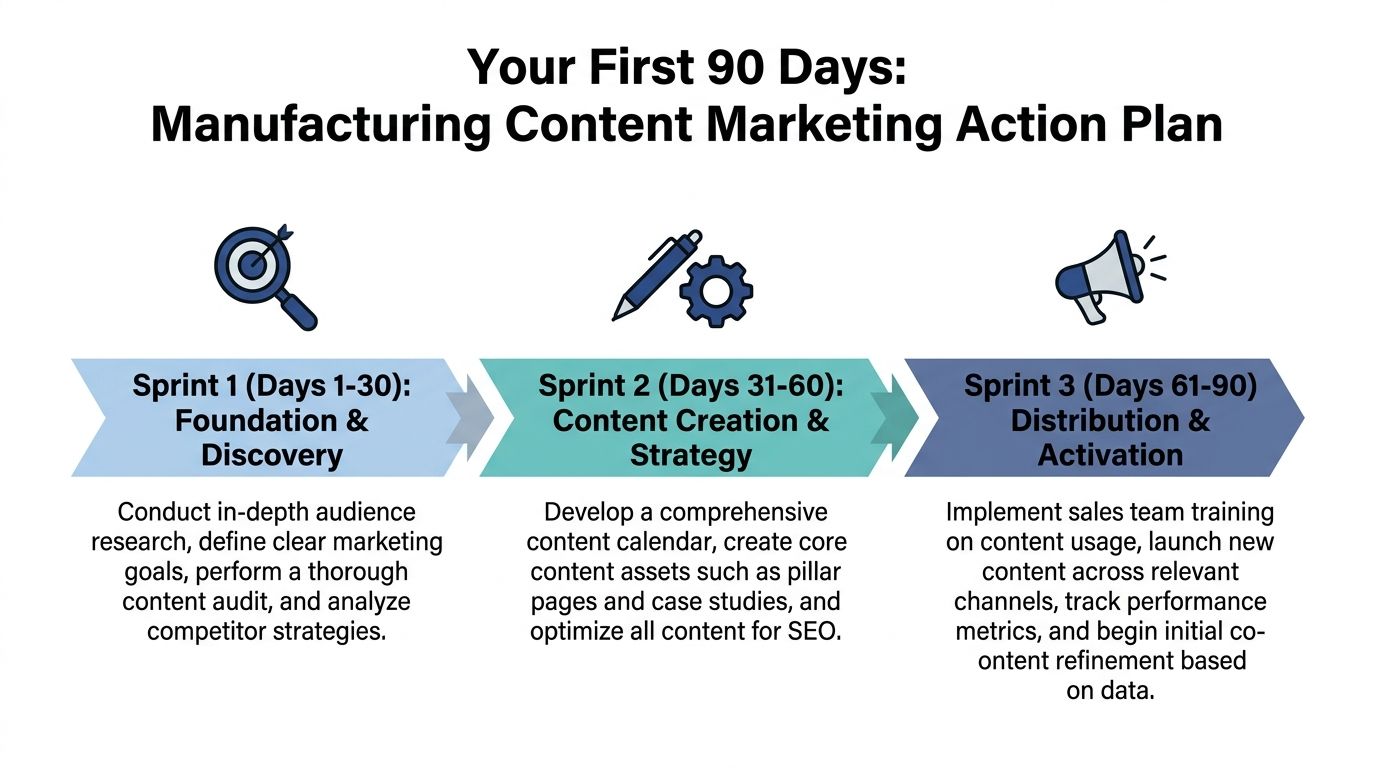
Your First 90 Days A Practical Execution Plan
Most manufacturers don’t need a massive content operation to start. They need proof that the system works.
A ninety-day plan is long enough to build the foundations, launch useful assets, and create early feedback loops with sales. It’s short enough to keep momentum and force prioritization. That matters, because the biggest risk in content marketing for manufacturing companies isn’t usually bad strategy. It’s delay.
Days 1 to 30 foundation and discovery
The first month is about diagnosis, alignment, and instrumentation. Don’t start by publishing three articles just to feel productive. First, make sure the system knows what it’s trying to do.
Your priorities in this sprint should be:
- Interview sales and customer-facing staff: collect objections, questions, stalled-deal patterns, and role-specific concerns.
- Define buyer personas: not broad market segments, but actual decision participants.
- Audit current content: identify what still supports sales, what is outdated, and what gaps exist by role and stage.
- Review core pages: your homepage, service pages, product pages, and contact paths should align with the right audience.
- Set up tracking: make sure form submissions, lead sources, key pages, and asset downloads are measurable inside your CRM and analytics stack.
Use this month to answer a few hard questions:
- Which buyer role do we most want to attract first?
- What proof does that buyer need before contacting sales?
- Where are leads dropping out now?
- Which assets would sales use next week if you created them?
A common mistake here is trying to define every persona and every product line at once. Start narrower. Pick one strategic audience segment and build a clean proof of concept.
Days 31 to 60 content creation and system build
The second month is where the first assets get produced. Resist the urge to create a dozen pieces. Build fewer things, but make them useful.
A practical sprint often includes:
- One cornerstone awareness asset: a technical or educational article tied to a real buyer problem
- One middle-funnel offer: a whitepaper, guide, or gated resource that earns a form submission
- One bottom-funnel sales asset: a case study, comparison sheet, or demo support piece
- One basic nurture sequence: a short set of follow-up emails tied to the gated offer or inquiry type
This is also the time to lock in your workflow. Decide:
- who owns drafting
- who reviews technical accuracy
- who publishes
- who adds SEO elements
- who alerts sales when a new asset is ready
Keep approvals tight. If every asset needs six people to sign off, your system will stall.
A short build checklist helps:
- Keyword target chosen: each page answers a clear search question
- Persona assigned: every asset serves a defined stakeholder
- CTA selected: the next step is obvious
- CRM tag applied: form fills and interactions are traceable
- Sales note added: reps know when and how to use the asset
Early content should solve one real buyer problem well. It doesn’t need to impress everyone.
There’s also a strong business case for including gated content in this sprint. According to Big Marketing’s manufacturing content analysis, gated content strategies can increase lead generation by 54% among manufacturers, and case studies show significant ROI potential, including 3M achieving a 200% return on investment from leads generated via content downloads.
That doesn’t mean you should gate everything. It means valuable mid-funnel assets can be worth protecting when they’re tied to a clear follow-up system.
Days 61 to 90 distribution and activation
The third month is where most plans either become a system or collapse back into one-off marketing.
Once the assets are live, activate them deliberately.
Sales activation should include:
- Asset walkthroughs for reps: show what exists, who it is for, and when to send it
- Suggested follow-up language: make rep adoption easier
- Role-based distribution: match assets to engineer, procurement, operations, or finance contacts
- CRM triggers: route leads into the right follow-up based on what they downloaded or viewed
Marketing distribution should include:
- Website placement: link assets from relevant solution and service pages
- Email deployment: use nurture sequences and segmented outreach
- LinkedIn promotion: distribute insights from the asset, not just the link
- Retargeting or remarketing where appropriate: support return visits from engaged prospects
At this point, you’re not looking for perfect attribution yet. You’re looking for pattern detection.
Watch for signals like:
- which content sales sends
- which assets generate replies
- which pages produce qualified inquiries
- which downloads correlate with follow-up meetings
- which stakeholders engage most often
A simple review cadence works well here. Hold a short meeting every two weeks and review:
- what was published
- how sales used it
- what engagement looked like
- what pipeline movement followed
- what needs adjustment
What success looks like after ninety days
A good first ninety days won’t solve everything. It should do something more useful. It should prove that content can operate as part of your lead generation and sales system.
By the end of this phase, you should have:
- a documented audience focus
- a working production workflow
- a small set of sales-usable assets
- a basic nurture sequence
- CRM visibility into content engagement
- an early view of which topics and formats create qualified movement
That is enough to make better decisions in the next quarter.
The companies that win with content usually aren’t the ones that publish the most. They’re the ones that build a system that sales trusts, buyers use, and leadership can measure.
If you want help building that system, Machine Marketing helps manufacturers turn scattered marketing activity into a practical lead-generation engine. We can help you diagnose the gaps, map content to your buying process, connect it to CRM and GoHighLevel workflows, and build a ninety-day plan that shows real traction instead of vague marketing activity.