If you’re trying to improve SEO and someone told you to “add LSI keywords,” that advice is outdated.
The problem isn’t that related language is bad. The problem is the system behind the advice. Too many businesses still treat SEO like a word-insertion exercise, when modern search is much closer to topic understanding, intent matching, and content quality. That old playbook sends teams into spreadsheets full of synonyms instead of building pages that help buyers make decisions.
What is latent semantic indexing then? It’s a real information retrieval technique from an earlier era of search. It mattered. It helped machines move beyond exact keyword matching. But it is not the thing you should optimize for in Google today.
What still matters is the core lesson LSI pointed toward: meaning beats repetition. If your content strategy is built around isolated keywords instead of subject coverage, internal structure, and buyer questions, you’re solving the wrong problem.
Your Problem Isn't Keywords It's Your System
Most weak SEO programs don’t fail because the team missed a few terms. They fail because the content system is broken.
A broken system usually looks like this. You pick one target keyword, generate a list of “LSI keywords,” force them into headings and paragraphs, publish the page, then wait for rankings that never really stick. Even when a page does rank, it often doesn’t convert because it was written for a tool instead of for a buyer.
That’s why the “LSI keyword” myth hangs on. It offers a shortcut. Business owners under pressure want a clean checklist, and keyword lists feel concrete. But concrete doesn’t always mean correct.
What this bad system usually produces
- Thin pages: One page tries to rank for one phrase without answering the follow-up questions buyers have.
- Awkward writing: Copy starts sounding robotic because the writer is trying to satisfy a spreadsheet.
- Weak internal structure: Related pages don’t support each other, so the site never builds topic depth.
- Poor qualification: The content attracts broad traffic but doesn’t help engineers, buyers, or managers move closer to a decision.
Practical rule: If your content brief starts with “how many related keywords should we add?” you’re probably diagnosing the wrong issue.
The better question is this: Does your site show clear expertise on a topic your buyer cares about?
For a manufacturer, that might mean building a real body of content around machining tolerances, materials, maintenance, throughput, lead times, compliance, or process selection. For a service business, it could mean covering scope, pricing logic, timelines, common mistakes, and buying criteria. Search engines can work with that. Buyers can too.
Questions to ask yourself
- Are we publishing isolated pages or connected topic clusters?
- Do our pages answer the next logical buyer question?
- Would this content still be useful if rankings disappeared tomorrow?
- Can a prospect tell what we know from reading three pages on our site?
If the answer to those questions is shaky, chasing keyword lists won’t fix it. You need a stronger content architecture.
Understanding How LSI Actually Works
LSI was a major step forward because it helped computers infer relationships between terms instead of relying only on exact matches.
A simple way to think about it is a librarian. A basic keyword system only knows whether a book contains the word “engine.” A better librarian notices that books discussing pistons, transmissions, fuel systems, and automobiles probably belong in a related conceptual neighborhood even when they don’t all use the same exact wording.

The core mechanics
At a technical level, LSI builds a term-document matrix. Rows represent terms, columns represent documents, and the cells capture how terms appear across documents. Then it applies singular value decomposition, or SVD, to reduce that huge sparse matrix into a lower-dimensional semantic space.
That matters because raw language data is messy. People use synonyms. They omit obvious words. They use one term in one industry and another term in another. LSI tried to cut through that noise by identifying hidden co-occurrence patterns.
According to Oncrawl’s explanation of latent semantic indexing, LSI uses SVD on a term-document matrix to create a low-rank approximation, often keeping 100-300 dimensions to capture core semantic structure. That process improved query-document matching, and early TREC benchmarks showed precision@10 improvements of 20-30% over standard vector space models.
Why that was a breakthrough
Before approaches like LSI, search systems were far more literal. If a query used one phrase and the best document used a different but related phrase, retrieval quality suffered.
LSI improved this by projecting both documents and queries into a reduced semantic space. In practice, that meant a system had a better chance of recognizing conceptual similarity, not just word overlap.
Here’s the simplified flow:
- Collect documents
- Build the term-document matrix
- Remove noise such as common stop words
- Apply SVD
- Compare documents and queries in the reduced semantic space
Where marketers can still learn from it
LSI still teaches an important principle. Related terms matter because they help define a topic’s semantic neighborhood. That’s useful for content planning, even if you’re not optimizing for LSI itself.
If you publish a page about industrial pumps, for example, it should naturally discuss flow rate, pressure, cavitation, seals, maintenance intervals, materials, and operating conditions if those topics matter to the buyer. That isn’t “using LSI keywords.” It’s writing with topical completeness.
For a broader search marketing context, this is the part many teams miss when they focus only on surface-level keyword research. A stronger process starts with topic relationships, not word stuffing. That’s also why search strategy has to connect content, site structure, and buyer intent, not just on-page copy. This broader lens shows up across search marketing topics and practical strategy discussions.
LSI was smart for its time because it helped machines infer meaning from patterns. Its weakness was that language moves faster than static matrix math.
Debunking the 'LSI Keyword' Myth in Modern SEO
The phrase “LSI keywords” has done more damage than the actual concept of LSI ever did.
It sounds technical, which makes it persuasive. It also gives marketers something easy to sell: lists of related phrases that supposedly achieve rankings. But in modern SEO, that framing is wrong.

What’s actually false about the myth
The myth says Google wants you to manually find “LSI keywords” and sprinkle them through your page.
The situation is simpler. Related language can help because thorough writing reflects topic understanding. But that is not the same as Google using LSI as a ranking mechanism.
HubSpot’s write-up on latent semantic indexing and SEO states that there is no evidence of Google using LSI directly since at least 2013, and that Google moved to more advanced models like BERT and MUM. The same analysis says chasing “LSI keywords” is 25-40% less effective for rankings than focusing on true semantic intent with modern tools.
That should reset the conversation for most businesses.
What still works and what doesn’t
| Approach | What happens in practice |
|---|---|
| Stuffing related terms | Content gets bloated, repetitive, and less helpful |
| Writing naturally around a topic | Pages cover context, subtopics, and buyer questions |
| Buying “LSI keyword” lists | Teams spend time on a false precision exercise |
| Building topical authority | The site becomes easier for users and search systems to understand |
The same confusion shows up in adjacent tactics too. A lot of businesses still chase outdated SEO tricks in content promotion, syndication, and announcement pages. If you’re evaluating off-page support for content distribution, Press Release Zen's SEO guide is a useful example of how to think about search visibility in a more grounded way, without leaning on keyword gimmicks.
Why the myth survives
Three reasons keep it alive:
- Old articles still rank: Many were written when semantic SEO was poorly explained.
- Tools need categories: “LSI keywords” is a convenient label, even when it’s technically wrong.
- Marketers like checklists: It feels easier to add words than to build expertise.
A better standard is this: if a term belongs on the page because it helps explain the subject, use it. If it’s there only because a tool suggested it, question it.
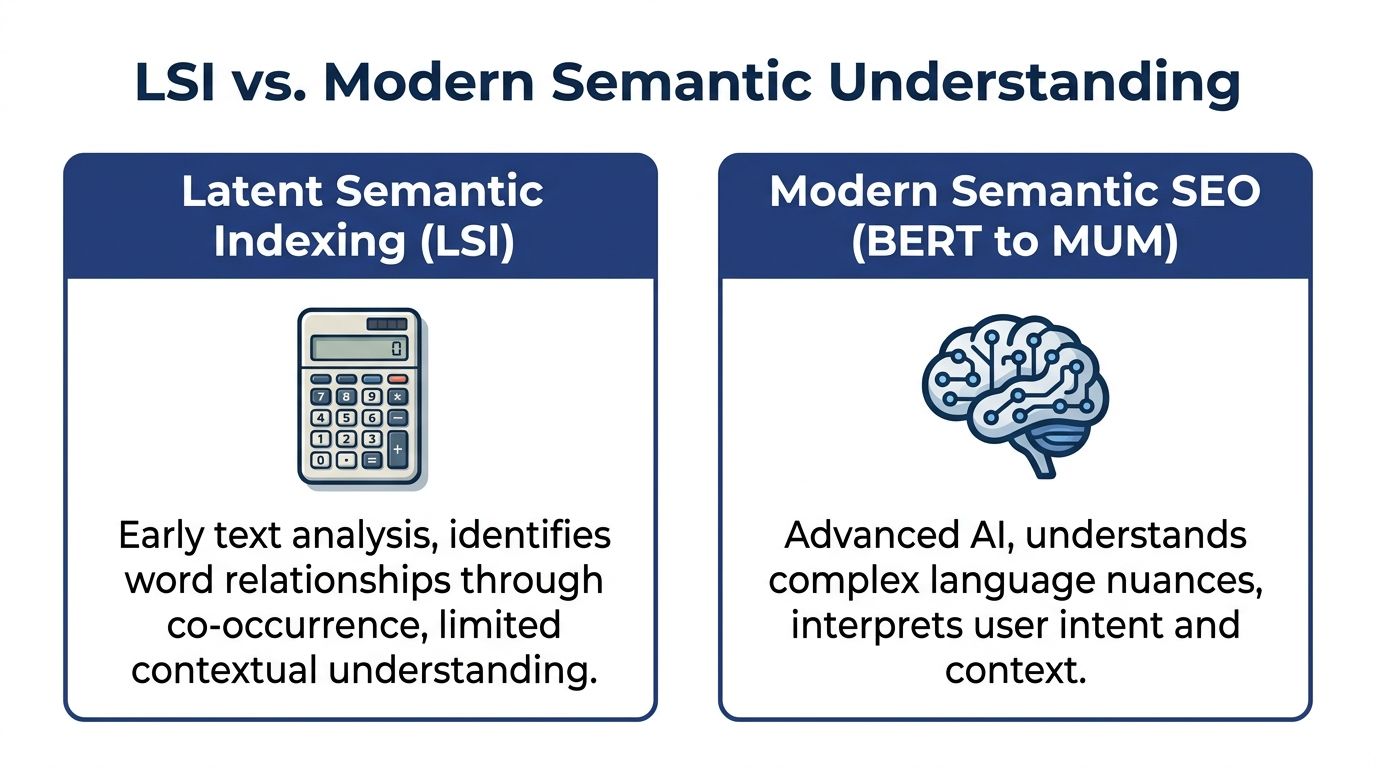
Here’s a quick visual that reinforces the point.
Stop asking, “Did we include enough LSI keywords?” Start asking, “Did we fully solve the searcher’s problem?”
That change sounds small. It changes everything about briefing, writing, reviewing, and measuring SEO content.
LSI vs Modern Semantics From BERT to MUM
LSI deserves respect. It helped move information retrieval beyond exact-match search. But if you want to understand modern SEO, you need a clean distinction between early semantic approximation and modern contextual language understanding.
Deerwester’s foundational research on latent semantic analysis is the right place to anchor that history. The work traces LSI to researchers at Bellcore and showed average precision up to 30% better than standard keyword vector methods. It also showed a 16% improvement in retrieval tasks when queries and relevant documents shared few words. Those results mattered because they proved statistically derived vectors could capture meaning better than isolated terms.
LSI in plain English
LSI looks at patterns of term co-occurrence across many documents. It reduces those patterns into a smaller mathematical representation. That helps the system infer that some terms are related even if they aren’t identical.
That was a major improvement over pure lexical matching. But it still had real limitations.
Where LSI runs into trouble
The classic failure case is polysemy, when one word has multiple meanings.
If someone searches for “bank,” an older semantic method can struggle because the term may connect to finance, rivers, regulation, lending, geography, or construction depending on context. LSI can detect broad associations, but it doesn’t read a sentence the way modern contextual systems do.
It also has a practical weakness. Traditional LSI works on a matrix built from a corpus at a given point in time. The web doesn’t sit still. New terms, new products, new entities, and new contexts appear constantly.
How modern systems differ
BERT and later models analyze language in context. Instead of asking only which words tend to appear together across documents, they evaluate how words relate to one another inside the query and the page.
That changes the whole game:
- Context matters more than co-occurrence
- Sentence structure matters
- Intent matters
- Nuance matters
- Small function words can matter too
A phrase like “software for machine shops” and “software used by machine shops to quote complex jobs” may live in the same broad topic area, but they don’t signal exactly the same need. Contextual systems are much better at handling that difference.
A side-by-side view
| Dimension | LSI | Modern semantic systems |
|---|---|---|
| Core method | Matrix factorization with SVD | Contextual neural language modeling |
| Strength | Finds hidden term relationships | Interprets language in context |
| Weakness | Struggles with ambiguity and changing corpora | More complex, less transparent to non-specialists |
| Best historical role | Foundational retrieval improvement | Current large-scale semantic understanding |
Decision test: If your SEO tactic depends on adding a prescribed list of related words, it’s probably based on an outdated model of search.
For marketers, the practical takeaway is not “ignore related vocabulary.” The takeaway is “stop pretending vocabulary lists are strategy.”
Modern optimization is about relevance at the page level and authority at the site level. Your headings, examples, entities, internal links, media, schema, and supporting pages all help search systems understand whether you’re a credible result for a query family. That’s far closer to how contemporary search behaves than any “LSI keyword” checklist.
An Actionable Framework for Modern Semantic SEO
Once you stop chasing “LSI keywords,” the replacement isn’t mysterious. You need a topic authority system.
That system should help your site answer a set of buyer questions better than competitors do. For B2B firms, that means building structured coverage around problems, use cases, terminology, comparison points, and decision criteria.

Step 1 Start with a pillar topic
Pick one commercial topic that matters to revenue. Not a vanity term. Not the broadest possible word. A topic tied to a real service, product, or buyer problem.
Examples:
- Manufacturer: precision machining for aerospace parts
- Industrial service firm: preventive maintenance for hydraulic systems
- B2B software company: CRM setup for field sales teams
Your pillar page should define the space clearly and thoroughly. It’s the page that says, “We understand this category.”
Step 2 Build the cluster from buyer questions
Don’t brainstorm synonyms first. Brainstorm decisions, objections, and operational questions.
Useful cluster content usually falls into a few categories:
- How-it-works content: Process explanations, workflows, methods
- Decision content: Comparisons, selection criteria, implementation concerns
- Risk content: Common mistakes, failure points, compliance issues
- Outcome content: ROI logic, efficiency trade-offs, operational impacts
Semantic breadth happens naturally. When you answer real questions, related terms appear because they belong there.
Step 3 Engineer the page structure
Your content has to be readable by humans and interpretable by search systems.
That means:
- Clear headings that reflect actual subtopics
- Internal links connecting supporting pages to the main topic
- Consistent terminology without robotic repetition
- Schema where appropriate
- Helpful media, especially for technical products and services
A lot of businesses still get the basics wrong at the heading level. If your page structure is messy, fix that before worrying about advanced semantic strategy. This practical guide to using an H1 tag correctly is a good place to tighten the on-page foundation.
Step 4 Use internal linking like an engineer
Internal linking isn’t decoration. It’s part of the semantic system.
Link cluster pages back to the pillar page. Link related cluster pages to each other when the relationship is useful. Use anchor text that reflects the destination naturally. Keep it readable.
This helps users move through a topic and helps search systems understand your site architecture.
Step 5 Review for completeness, not density
When editing, ask:
- Did we answer the main query clearly?
- Did we cover the obvious follow-up questions?
- Did we include the terms an expert would naturally use?
- Does the page sound like a practitioner wrote it?
At this point, many teams relapse into old habits. They stop editing for accuracy and usefulness, then start editing for term inclusion. That’s the wrong direction.
Why this approach scales
LSI itself remains important in information retrieval history partly because dimensionality reduction made large collections more manageable. The Stanford IR book’s explanation of latent semantic indexing notes that this kind of reduction can cut storage by over 99% and significantly reduce computation time for similarity checks in large datasets. For marketers, the lesson isn’t to run old LSI models for Google rankings. It’s to think in systems. Organize large topic sets well, reduce noise, and make your content architecture easier to process.
A strong semantic SEO program feels less like copywriting theater and more like building a clean knowledge base around customer demand.
Putting It All Together A B2B Manufacturing Example
Take a company that sells CNC milling machines.
The old approach targets a single phrase like “5-axis CNC machine,” then writes one sales page and forces in a list of related phrases. The result usually reads like a brochure. It might mention tolerances, spindle speed, and automation, but it doesn’t really help an engineer, operations manager, or procurement lead move toward a decision.
The better approach starts with a topic, not a phrase. In this case, that topic could be precision manufacturing with 5-axis CNC machining.
What the content system looks like
The pillar page might be a deep resource on 5-axis machining. It explains what it is, when it makes sense, where it reduces setups, what materials it handles well, and what production teams should evaluate before buying.
Then the cluster expands around buyer needs:
- Selection content: machine size, tolerances, work envelope, spindle considerations
- Process content: fixturing, programming complexity, coolant strategy, toolpath planning
- Business content: throughput, labor trade-offs, maintenance planning, ROI framing
- Support content: operator training, preventive maintenance, common failure points
Each page links back to the central guide. The central guide links out to the supporting pages where deeper detail is needed.
How that changes lead quality
A buyer who reads several of these pages gets a stronger signal than someone who only lands on a generic product page.
That visitor now sees:
- You understand the production environment
- You know the terminology buyers use
- You can explain trade-offs clearly
- You’re able to educate before the sales call
That’s a key value of semantic SEO. It doesn’t just increase discoverability. It improves pre-sale trust.
If you work in industrial markets, a specialized strategy matters because search behavior is different from broad consumer SEO. The queries are narrower, the potential impact is greater, and the buying cycle is longer. This is why a focused resource on SEO for manufacturing companies can be more useful than generic SEO advice.
What to look for on your own site
If you’re a manufacturer, audit your content with these questions:
| Check | What good looks like |
|---|---|
| Topic coverage | Multiple pages support one commercial topic |
| Internal links | Related articles connect logically |
| Buyer alignment | Content helps technical and commercial stakeholders |
| Conversion path | Educational pages lead naturally to inquiry pages |
You don’t need to publish everything at once. You do need a system where each new page strengthens the rest of the topic cluster.
Your Next Move Stop Chasing Keywords Start Owning Topics
LSI was an important step in search history. It helped prove that meaning matters more than exact keyword overlap.
What trips marketers up is turning that historical idea into a modern ranking tactic. That’s where the “LSI keywords” myth keeps wasting time. The useful takeaway isn’t “find more synonym lists.” It’s “build content that demonstrates real subject understanding.”
Start with one core service or product line. Then list the top questions your buyers ask before they contact sales. Turn those questions into a pillar page and supporting cluster pages. Connect them with clear internal links. Edit for clarity, accuracy, and completeness.
If your content can teach a buyer how to think about the problem, you’re much closer to owning the topic than if you simply repeat the right terms.
That’s the shift. Stop optimizing pages like isolated assets. Start building a structured knowledge system around the problems you solve.
Frequently Asked Questions About Semantic Search
Do related terms still matter if LSI keywords are a myth
Yes. Related terms matter because buyers use varied language and strong content naturally reflects the language of the topic.
The mistake is calling those terms “LSI keywords” and treating them like a formula. If the page thoroughly covers the subject, related vocabulary will show up on its own. That’s different from forcing in phrases to satisfy a tool.
How do we find semantic topics without relying on outdated LSI tools
Use a mix of sources that reflect real demand:
- Search results: Look at headings, People Also Ask questions, and related searches
- Sales conversations: Pull recurring objections and qualification questions from your team
- Customer service logs: Review what people ask after they buy
- Competitor pages: Not to copy them, but to spot topic gaps
- Your own site search and CRM notes: These often expose language real buyers use
This approach is less glamorous than buying a keyword list, but it’s usually far more useful.
How do we measure whether a topic cluster is working
Don’t judge it by one ranking alone. Look at the whole system.
Useful indicators include:
- Coverage quality: Are the core buyer questions answered?
- Internal movement: Do visitors move from educational pages to commercial pages?
- Lead relevance: Are inbound inquiries better aligned with your offer?
- Search visibility across the topic: Are multiple pages appearing for related queries?
A strong cluster often creates compounding value because one page supports another.
Is LSI still useful for anything
Yes. It still matters as a foundational concept in information retrieval and as a way to understand how early semantic systems tried to separate signal from noise.
Ding’s statistical analysis of LSI found that the statistical significance of LSI dimensions follows a Zipf-law distribution, which is a pattern seen in natural information structures such as words and cities. That work also showed that dimensions with small eigenvalues tend to represent noise. For practitioners, the practical lesson is clear: useful systems preserve core concepts and suppress clutter.
Should small businesses care about BERT and MUM if they’re not technical
Yes, but only at the strategy level.
You don’t need to build language models. You do need to understand that search engines are better at interpreting context than they used to be. That means your job is to create clear, complete, credible content tied to real user intent.
What’s the fastest first step if our content is thin
Pick one money-making topic and map these items:
- Main buyer question
- Decision criteria
- Common objections
- Operational details
- Next-step conversion page
That gives you the skeleton of a topical authority cluster. From there, publish in sequence and link the pages intentionally.
If you want help diagnosing your current content system and building a practical semantic SEO plan, talk with Machine Marketing. We help businesses turn scattered content into structured topic authority that supports visibility, trust, and qualified lead generation.