You know you need marketing help. What you probably don’t know yet is what kind of help will fix the problem.
Most owners start by asking for tactics. SEO. Ads. A website refresh. Some social media posts. Maybe email. Then they hire someone who does one of those things well, only to find out the issue wasn’t a missing tactic. It was a broken system. Leads weren’t tracked, follow-up was inconsistent, the offer was muddy, and no one could say which channel was driving revenue.
That’s why hiring small business digital marketing consultants should feel less like shopping for a vendor and more like diagnosing a production issue. If you treat it like an engineering problem, you make better decisions. You define the failure point, identify constraints, test the plan, and measure outputs. That mindset saves money and a lot of frustration.
Your Marketing Problem Might Not Be What You Think It Is
A lot of businesses say, “We need more leads,” when the actual issue is one layer deeper.
Sometimes traffic is fine, but the website doesn’t convert. Sometimes leads come in, but no one follows up quickly. Sometimes the sales team says the leads are bad, but the targeting was never clear in the first place. Sometimes the business has run several campaigns and still can’t tell what worked because tracking was weak from day one.
The confusion is common. 47% of small businesses name marketing as their primary growth strategy, yet 73% aren’t sure if their current marketing is working, according to small business marketing data from Sixth City Marketing. That gap is exactly where good consultants earn their keep.
Start with diagnosis, not channels
Before you talk to any consultant, answer a few uncomfortable questions:
- What outcome do you need? More form fills isn’t the same as more qualified sales conversations.
- Where does revenue come from now? Existing customers, referrals, local search, outbound sales, distributors, repeat buyers.
- What breaks most often? Lead quality, response time, messaging, website conversion, pipeline visibility, or follow-up.
- What can your team realistically support? A strategy that depends on daily content won’t work if nobody owns it internally.
If you can’t answer these clearly, that’s not a failure. It’s useful information. It tells you the first hire should be someone who can diagnose and build structure, not just execute tasks.
Practical rule: If a consultant jumps straight to tactics before understanding your sales process, they’re guessing.
Run a quick self-audit
Use this short self-audit before your first call:
- List your top business goal for the next operating cycle.
- Identify your best-fit customer by industry, size, buying trigger, and urgency.
- Write down every lead source you currently have.
- Check whether each source is measured in a way that ties to sales, not attention.
- Note the handoff from marketing inquiry to sales follow-up.
- Mark the bottleneck that most often causes delay, waste, or missed opportunity.
A consultant can help refine those answers. They shouldn’t have to invent them from scratch without your input.
The right hire won’t just “do marketing.” They’ll help you build a system that connects visibility, lead capture, follow-up, and reporting. That’s the difference between activity and progress.
Define Your Mission Before You Search
If your brief is vague, your results will be vague too.
A consultant can’t build a strong plan around “we want more business.” That’s not a mission. It’s a wish. Good hiring starts with a sharper definition of what success looks like, who you want to reach, and what your current baseline tells you.

Turn vague goals into operating targets
Strong consultants anchor strategy in SMART goals and measurable KPIs such as cost per lead, because a structured approach typically delivers 2 to 3 times higher ROI than campaigns launched without clear objectives, based on ChoiceLocal’s discussion of strategy and KPI discipline.
That doesn’t mean you need a giant dashboard on day one. It means you need definitions.
Instead of this:
- Bad brief: We need better marketing.
- Better brief: We need more qualified inbound opportunities from businesses that match our service model.
- Best brief: We need a consultant to improve qualified lead flow from our website and outbound nurture process, while giving us clear reporting on which channels produce sales conversations.
Questions that define the mission
A serious consultant will ask versions of these. You should answer them before you hire.
- What does a win look like? More booked calls, better-quality leads, stronger local visibility, a cleaner sales pipeline, or reactivation of old contacts.
- Who is the ideal buyer? Not “anyone who needs us.” Be specific about fit, urgency, budget, and buying process.
- What are buyers comparing you against? Local competitors, lower-cost providers, in-house teams, or no decision at all.
- What does your offer promise? Faster turnaround, lower risk, technical expertise, better service, specialized industry knowledge.
- What proof already exists? Testimonials, repeat customers, case examples, niche expertise, long-standing accounts.
If your company hasn’t clarified these fundamentals, tighten them before you spend on campaigns. A useful starting point is this guide on how to write a mission statement for business, because mission drift often shows up as marketing drift.
Know what capabilities matter
Not every consultant needs deep expertise in every platform, but modern small business digital marketing consultants should understand how core functions connect.
Here’s what matters most:
- Strategy and positioning: Can they translate business goals into channel priorities and messaging?
- SEO and search visibility: Can they improve discovery for buyers already looking for your service?
- Paid media: Can they control spend, test offers, and avoid waste?
- CRM and automation: Can they capture inquiries, route leads, trigger follow-up, and keep the pipeline clean?
- Reporting: Can they show performance in business terms, not just clicks and impressions?
The consultant you want can explain why each tactic exists, what it should produce, and how you’ll know if it’s working.
A weak brief attracts task-doers. A clear mission attracts people who can build systems.
Evaluate a Consultant's Technical Toolkit
A modern consultant isn’t just a strategist. They’re a systems integrator.
That matters because most small businesses don’t fail from a lack of tools. They fail from disconnected tools. The website form doesn’t feed the CRM correctly. Ad leads sit in an inbox. Email follow-up is manual. Sales notes live in someone’s head. Reporting lives in three platforms that don’t agree with each other.
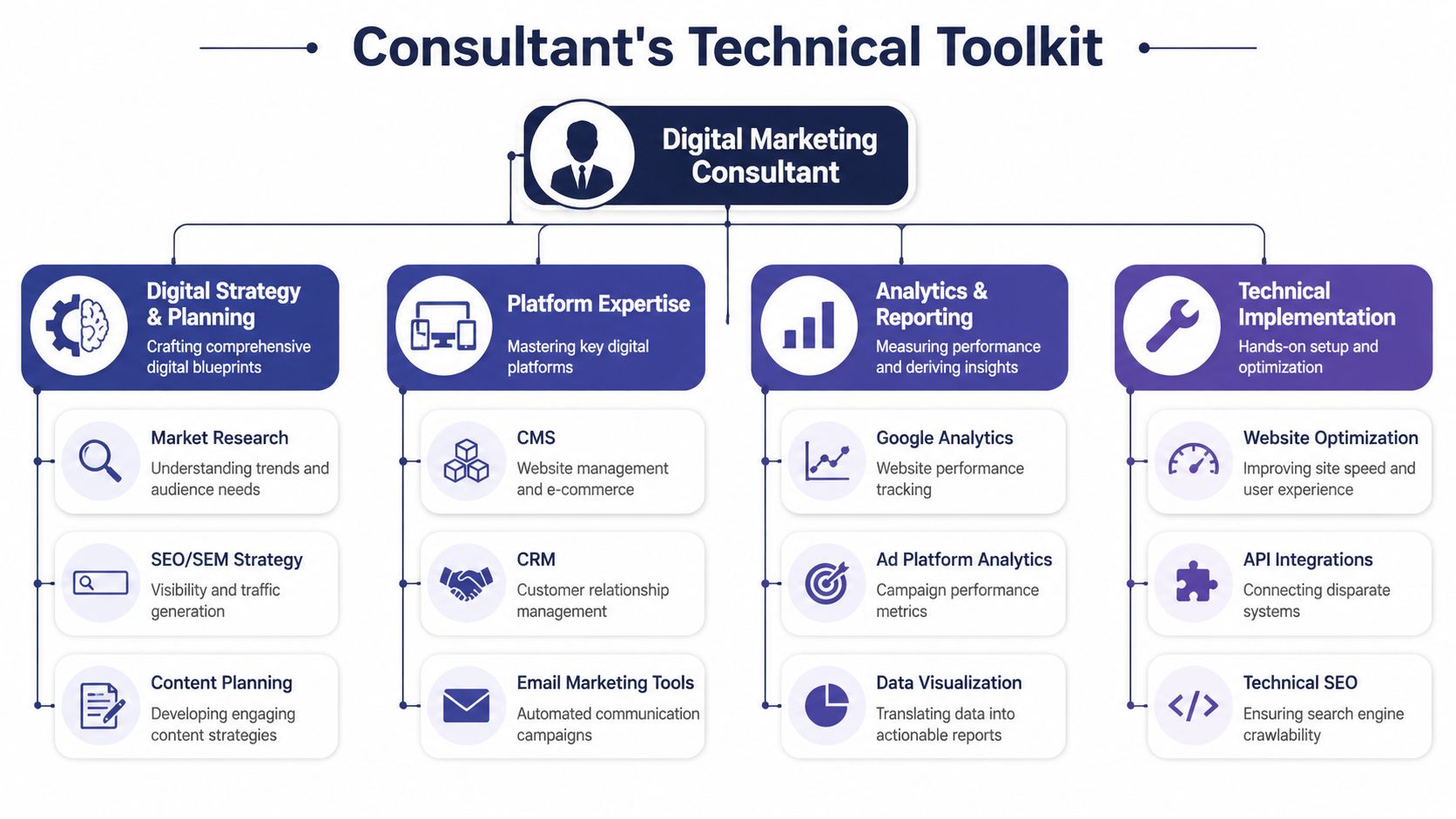
What good technical depth looks like
Many agencies still sell channels one by one. That’s part of the gap. There’s a real need for consultants who can execute campaigns and also build integrated automation systems such as GoHighLevel for lead nurturing, especially for smaller firms with tight budgets, as noted in this review of small business agency gaps.
When you evaluate technical capability, look for practical competence in areas like:
- CRM configuration: Lead stages, deal pipelines, assignment rules, reminders, and follow-up tasks.
- Automation workflows: Email and SMS sequences, reactivation campaigns, missed-call text-back, internal alerts.
- Website conversion setup: Forms, landing pages, call tracking, thank-you page logic, booking flows.
- SEO foundations: Site structure, page intent, internal linking, metadata, service pages, and local profile alignment.
- Paid media mechanics: Audience setup, offer testing, conversion tracking, campaign structure, and budget control.
A consultant doesn’t need to push one tool on every client. But they should be able to explain why a tool belongs in the system and what problem it solves.
Ask how the stack connects
The strongest interview question here is simple: “Show me how inquiry data moves from first click to closed sale.”
If they can map that clearly, they probably understand operations, not just promotion.
Ask follow-ups like:
- Where does lead data land first?
- How are duplicate records handled?
- What triggers follow-up automatically?
- How does sales feedback get back into campaign optimization?
- What happens when a lead goes cold?
Many polished pitches break down at this point.
If a consultant can’t explain the handoff between marketing and sales, they’re not building a growth system. They’re renting you activity.
Analytics skill is part of the toolkit
You also want someone who respects data hygiene. Not “more reports.” Better reporting inputs.
If you want a useful outside perspective on how agencies use analytics to improve campaigns, this article can help you understand agency analytics optimization. It’s worth reading before interviews because it sharpens your questions around tracking discipline, tagging, and reporting accuracy.
A consultant’s technical toolkit should reduce friction. That’s the point. Better follow-up, cleaner data, less manual work, clearer attribution.
Not more software for its own sake.
The Interview Checklist And Critical Red Flags
Most consultant interviews are too passive. The owner listens to a pitch, asks about experience, and leaves with a proposal full of deliverables.
That’s backwards.
You need to inspect how the consultant thinks. Their diagnosis process matters more than their slide deck. In practice, one of the clearest positive signals is whether they focus on measurable business outcomes early. 80% of small businesses neglect proper tracking and focus on vanity metrics, which can lead to 40% of ad spend being wasted on untracked efforts, according to Allegiant Digital’s review of common small business marketing mistakes.
Questions that reveal real competence
Use questions that force the consultant to reason in public.
- Walk us through your diagnosis process. Listen for business goals, audience, offer, current funnel, tracking, and constraints.
- How would you audit our current lead flow? Good answers include forms, calls, CRM status, follow-up timing, and sales feedback.
- Which KPIs would you track first? Strong consultants choose a small set tied to commercial outcomes.
- How do you decide what not to do? Prioritization matters. Small businesses don’t need every tactic at once.
- What would the first month look like? You want a plan, not a promise.
- Who does the work? Ask whether execution is in-house, outsourced, or split across contractors.
- How do you report results? Watch for clarity. Reports should support decisions, not perform success.
If they answer every question with jargon, broad claims, or “it depends” without structure, keep looking.
Consultant Vetting Red Flags vs. Green Flags
| Red Flag 🚩 (Warning Signs) | Green Flag ✅ (Positive Indicators) |
|---|---|
| Promises rankings, leads, or growth without first auditing your business | Starts with discovery, baseline review, and constraints |
| Talks mainly about reach, impressions, or followers | Talks about qualified inquiries, pipeline movement, and revenue-linked KPIs |
| Pushes one tactic for every business | Explains channel choice based on buyer behavior and business model |
| Can’t describe the handoff from lead capture to sales follow-up | Maps the process from click to CRM to next action |
| Avoids questions about tracking setup | Brings up attribution, tagging, and reporting early |
| Recommends more tools before fixing process | Simplifies the stack and removes friction |
| Sends a generic proposal fast | Builds a scoped recommendation around your actual bottlenecks |
| Doesn’t ask who owns approvals and implementation | Clarifies roles, decision-makers, and response times |
Hiring shortcut: If the consultant asks sharper questions than you expected, that’s usually a good sign.
Compare pricing models before you agree
Pricing changes behavior. It affects scope, urgency, communication, and accountability.
Here’s the practical view:
| Model | Best fit | Upside | Trade-off |
|---|---|---|---|
| Hourly | Short advisory work, audits, troubleshooting | Flexible and simple | Can reward discussion more than implementation |
| Project | Website rebuilds, CRM setup, launch plans | Clear deliverables and defined scope | Momentum can stall after delivery if no ongoing management exists |
| Retainer | Ongoing SEO, paid media, reporting, optimization | Best for continuous improvement | Needs a clear scope so it doesn’t become vague “marketing support” |
None of these models is universally better. The right one depends on whether you need diagnosis, implementation, or repeated optimization.
If your consultant will also manage paid campaigns, it helps to understand how specialized tools support workflow, review cycles, and creative testing. This overview of AdStellar AI for consultants is useful background before those conversations.
Decoding Pricing and Engagement Models
Pricing shouldn’t be mysterious. It should reflect the shape of the work.
That matters more now because marketing budgets face more scrutiny. Global digital ad spending is projected to reach $700 billion in 2026, according to Creed Infotech’s digital marketing outlook. When businesses shift more money into digital channels, every engagement model needs to answer the same question: how will this investment produce measurable progress?

How to choose the right model
Use the model that fits the problem.
- Hourly engagements work when you need expert diagnosis, a second opinion, or help making a specific decision. They’re useful when the internal team can execute but needs direction.
- Project-based work fits contained outcomes like a site rebuild, CRM setup, landing page package, or analytics cleanup. Scope should be written tightly.
- Monthly retainers make sense when performance depends on ongoing testing, optimization, reporting, and iteration across channels.
If you want a broader industry view before negotiating, this 2026 agency pricing guide offers a helpful framework for comparing structures and expectations.
What the agreement should include
A good agreement doesn’t just list services. It defines operating rules.
Look for:
- Scope boundaries: What is and isn’t included.
- Deliverables: Audits, dashboards, campaigns, landing pages, workflows, reports.
- Access requirements: Platform logins, approvals, brand files, CRM permissions.
- Review cadence: Weekly, bi-weekly, or monthly decision points.
- Exit terms: What happens to assets, ad accounts, automations, and data if the engagement ends.
For website-related projects, a formal brief prevents a lot of confusion. This RFP for website planning is a useful model if your engagement includes web redevelopment or conversion-focused landing pages.
A fair contract protects both sides. It gives you accountability and gives the consultant enough clarity to do serious work.
A practical first 90-day commercial structure
Whatever pricing model you choose, ask the consultant to map it to the first operating cycle:
- Discovery and audit period with access setup and baseline review.
- Implementation period with agreed deliverables and launch checkpoints.
- Optimization period with reporting, findings, and scope recommendations.
If they can’t translate fees into milestones, you’re buying effort without a management system.
The First 90 Days What A Real Plan Looks Like
The contract is signed. Now the test starts.
A good consultant should lower uncertainty quickly. Not by claiming instant wins, but by making the system visible. You should know what’s being audited, what’s being built, what’s launching, and what decisions are coming next.
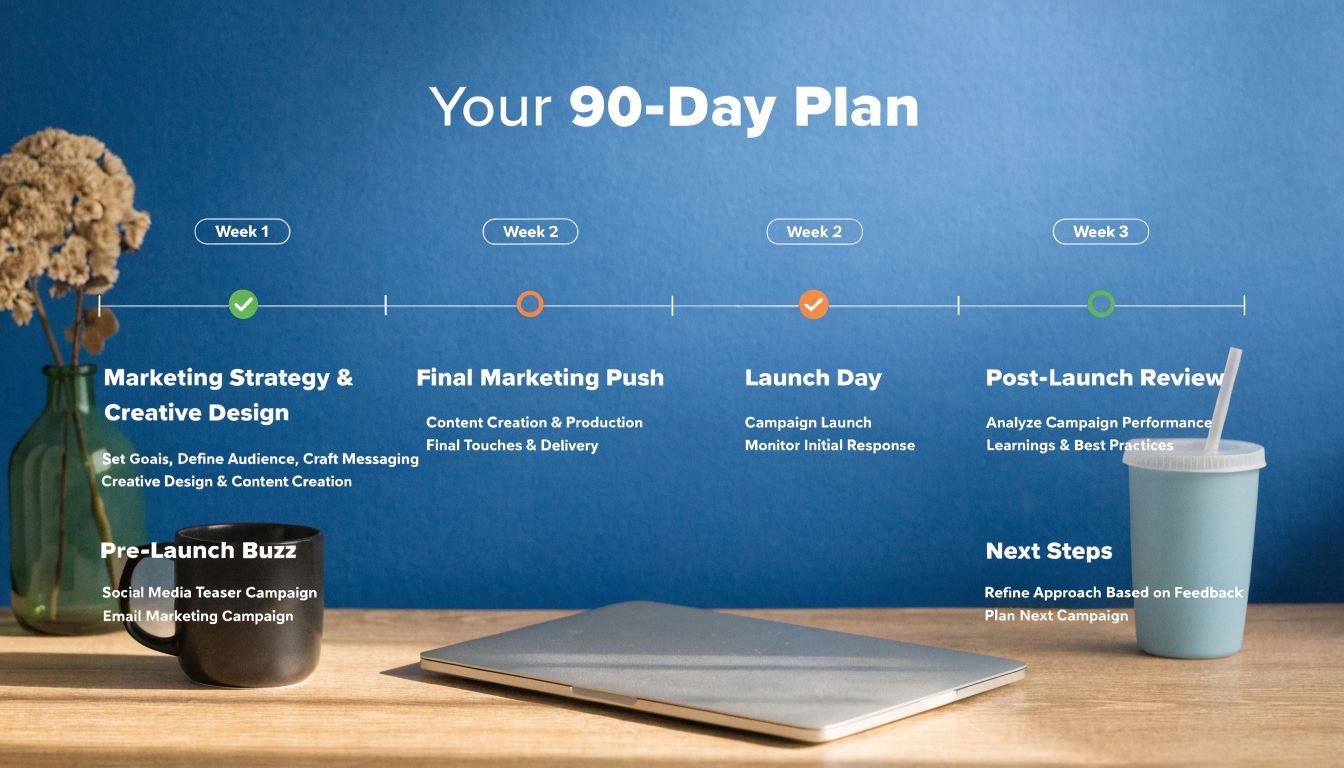
Days 1 to 30
The first month should focus on orientation and truth-finding.
Expect platform access, stakeholder interviews, message review, funnel inspection, tracking checks, CRM cleanup, and a baseline report. Good consultants usually identify a few quick wins too, such as fixing broken forms, tightening lead routing, or improving key service pages.
Days 31 to 60
This is build-and-launch time.
Campaigns go live. Automations are configured. Landing pages or website updates are deployed. Sales follow-up steps get clearer. The consultant should also define how feedback moves back into optimization so marketing and sales stop operating as separate systems.
Here’s a useful benchmark for what disciplined planning should feel like in practice:
Days 61 to 90
By this stage, the conversation should shift from setup to evidence.
You want a review of what launched, what data came in, what signals look promising, what friction remains, and where effort should move next. The goal isn’t perfect certainty. It’s better control, cleaner feedback loops, and a repeatable operating rhythm.
Real progress in the first 90 days looks like clearer decisions, cleaner systems, and fewer blind spots.
That’s the engineering mindset applied properly. Diagnose first. Build the system. Measure outputs. Improve the weak point.
Build Your Marketing System
Hiring small business digital marketing consultants isn’t about finding someone to stay busy on your behalf. It’s about finding a partner who can diagnose problems, connect tools, and build a system that produces useful outcomes.
That means you need more than channel expertise. You need structured thinking, clear KPIs, reliable follow-up, and automation that reduces manual drag. For many small businesses, that’s where marketing automation for small business becomes the difference between scattered activity and a working growth process.
If you use the diagnostic lens in this guide, you’ll hire differently. You’ll ask better questions, reject vague promises faster, and choose a consultant based on system design, not sales polish alone.
If you want a practical diagnosis of your current marketing system, Machine Marketing can help. We work with businesses that need clarity, structure, and execution across strategy, CRM, websites, SEO, and automation, with a focus on building systems that support growth.