If you're running ads, sponsoring industry placements, or boosting posts and still can't answer a simple question, which dollars turned into qualified sales conversations, you don't have a marketing problem first. You have a measurement problem. That’s common in manufacturing, where campaigns often live in separate tools, leads get handled manually, and revenue shows up months later with no clean trail back to the original click.
Media buying services matter when you need that trail. Done right, they don't just place ads. They connect targeting, channel selection, tracking, CRM data, and sales follow-up into one operating system so your ad spend can be judged by business outcomes instead of activity.
Table of Contents
- Diagnosing Your Ad Spend The Problem with Unmeasured Marketing
- What Are Media Buying Services A Practical Definition
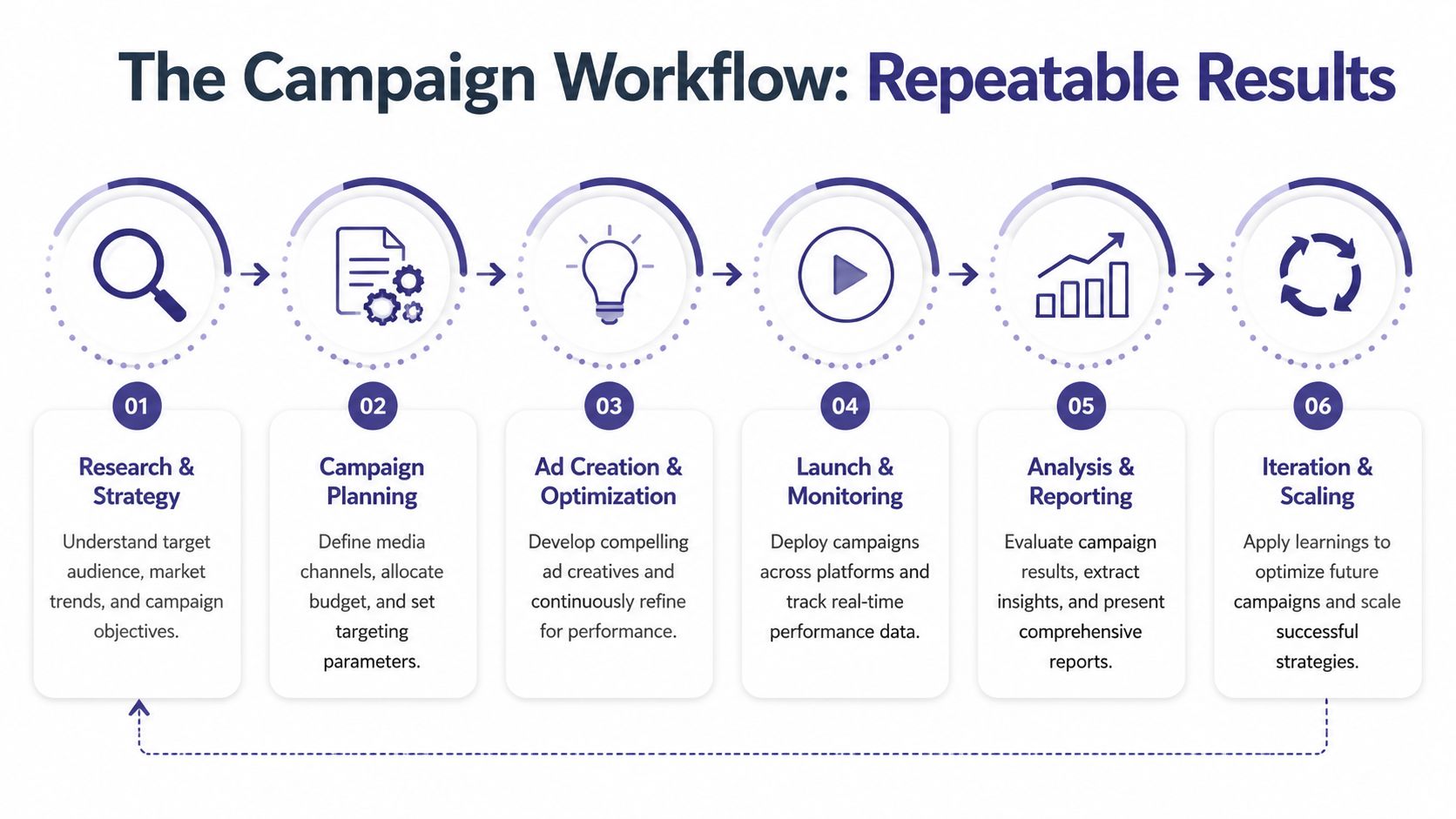
- The Campaign Workflow A System for Repeatable Results
- Understanding Pricing and Measuring What Matters
- Media Buying Use Cases for B2B Manufacturers
- How to Choose the Right Media Buying Partner
- Your First 90 Days A Sample Onboarding Plan
Diagnosing Your Ad Spend The Problem with Unmeasured Marketing
A plant manager wouldn’t trust a machine with no gauges, no alarms, and no output data. Yet a lot of companies treat advertising exactly that way. Money goes out. Some clicks come in. The sales team says a few leads were “pretty good.” Then everyone guesses whether the spend worked.
That setup fails because there’s no feedback loop.
If your team can’t connect spend to a qualified inquiry, a request for quote, or movement in the pipeline, your ad program is operating blind. Being visible online isn't the same as being effective online. Visibility without measurement often creates the illusion of progress while budget leaks into low-intent traffic, broad targeting, or campaigns that generate attention but not buying intent.

What unmeasured marketing usually looks like
A manufacturing company usually lands here through a familiar chain of decisions:
- A platform gets chosen too early: Someone starts with Google Ads or LinkedIn because it seems obvious, before defining what a qualified lead is.
- Campaigns optimize for easy signals: Clicks, impressions, and form fills get attention because they’re visible in dashboards.
- Sales data stays disconnected: The CRM knows which opportunities are real, but the ad platforms never get that feedback.
- Nobody closes the loop: Marketing reports one story, sales tells another, and finance sees only a line item.
Practical rule: If your reporting stops at leads, you’re still halfway short of the answer.
Professional media buying services solve this by installing process. They define the audience, choose channels deliberately, set up tracking, tie campaigns to CRM stages, and review outcomes against sales quality. That’s what turns ad spend from an expense people tolerate into a system people can manage.
The broader market is moving in that direction. The global media buying services market was valued at USD 80,510 million in 2025 and is projected to reach USD 151,128 million by 2035, growing at a 6.5% CAGR, according to Fact.MR’s media buying services market analysis. That growth tells you something important. More companies are professionalizing ad spend because channel complexity is too high for guesswork.
For teams that need a better measurement foundation first, start with a clear marketing analytics framework for B2B decision-making. The point isn't more dashboards. The point is better control.
Questions to ask yourself
- Can we trace a lead to its original campaign and channel?
- Do we know which inquiries became legitimate opportunities?
- Does sales agree with marketing’s definition of lead quality?
- Have we stopped spending on channels that generate noise instead of pipeline?
If those answers are unclear, media buying services aren't a luxury. They're a control system.
What Are Media Buying Services A Practical Definition
A practical definition is simpler than most agency language makes it sound. Media buying services are the discipline of placing your advertising budget where the right buyers are most likely to notice, engage, and convert. For manufacturers, that means buying attention from a narrow set of decision-makers instead of broadcasting to everyone.
Media buying operates as a purchasing function for demand generation. Your team already buys raw material, machining time, software, and freight with care. Media buying does the same for audience access. The buyer’s job is to determine where your ideal prospect spends attention, what that attention costs, how to reach it efficiently, and how to judge whether the purchase paid off.
The plain English definition
For industrial companies, media buying services usually include several connected tasks:
- Audience selection: Deciding whether the target is an engineer, plant manager, procurement lead, operations executive, or an account list with multiple stakeholders.
- Channel choice: Matching the message to the place. Search is different from LinkedIn. A trade publication is different from retargeting.
- Negotiation or platform setup: Some buys happen directly with publishers. Others happen through ad platforms and automated systems.
- Budget control: Managing pacing, bids, exclusions, frequency, and reallocation.
- Measurement: Connecting campaign activity to CRM stages and downstream sales outcomes.
A lot of confusion comes from the term itself. Some vendors only place ads. Others handle the full execution layer, including tracking, creative trafficking, optimization, and reporting. If you’re evaluating media buying services, you need to know which version you’re buying.
The cheapest media placement is often the most expensive lead source if the audience is wrong.
Types of media buys and their B2B use cases
The definitions matter less than the fit. Here’s the practical view.
| Media Buying Type | What It Is | Best For Manufacturers When… |
|---|---|---|
| Search buying | Ads placed in search engines against keywords with commercial or technical intent | buyers are actively researching a process, capability, machine, or supplier |
| Paid social buying | Ads placed inside platforms like LinkedIn to reach job titles, industries, or account lists | you need to get in front of engineers, operations leaders, or procurement teams before they search |
| Programmatic display | Automated buying of digital ad inventory across websites and placements | you want retargeting, account-based reach, or broader awareness around defined audience segments |
| Direct buys | Negotiated placements with trade journals, niche publications, newsletters, or associations | your market is concentrated in a small set of trusted industry media properties |
| Video and OTT | Video inventory bought on streaming or digital video environments | the product needs demonstration, or you need stronger message retention than a static ad can provide |
| Native and sponsored content | Paid placements designed to match the format of the publication or platform | you need to educate the market with longer-form messaging instead of asking for an immediate form fill |
When each type tends to work
Search buying works best when the buyer already knows the problem and is looking for a solution. If someone is searching for a machining capability, industrial automation component, or OEM partner, search can capture demand close to action.
Paid social, especially LinkedIn, works better earlier in the cycle. It’s useful when your buyers aren’t searching every day but can be identified by role, company type, or industry. That matters when the market is small and the buying committee is specific.
Programmatic display tends to underperform when companies use it as untargeted awareness. It tends to perform better when it’s tied to first-party audiences, retargeting pools, or named-account strategies.
Direct buys still earn their place when the publication owns attention in your niche. A respected industry newsletter or trade site can be more valuable than broader digital reach if the readership matches your buying committee.
The right mix depends on your sales motion. If you sell replacement parts with short urgency, search usually carries more weight. If you sell custom systems or capital equipment, you often need multiple channels working together over time.
The Campaign Workflow A System for Repeatable Results
Most failed ad programs don't fail because the market was impossible. They fail because execution was improvised. A repeatable campaign workflow gives you a controlled way to test channels, protect budget, and build learning over time.
What a disciplined workflow looks like
The workflow usually looks like this:
Research and strategy
Start with the offer, the audience, and the sales process. If the company can’t explain what counts as a sales-qualified lead, campaign setup is premature.Media planning
Pick channels based on buying behavior, not habit. Search captures active demand. LinkedIn targets roles. Trade media can support credibility. Retargeting follows known interest.Campaign build
This includes audiences, creative, landing pages, conversion tracking, CRM routing, and naming conventions. In this phase, sloppy teams create reporting chaos that they spend months trying to fix.Launch and monitoring
The first days aren't about victory laps. They're for checking lead flow, junk submissions, routing issues, spend pacing, and whether the landing page reflects the actual ad promise.Analysis and reporting
Review quality, not just quantity. Which campaigns produced serious conversations? Which channels filled the form but produced no usable opportunities?Iteration and scaling
Move budget toward what creates sales momentum. Cut what looks active but doesn't support pipeline.
A campaign should behave like a controlled production process. Input, monitoring, tolerance, adjustment, output.
Where campaigns usually break
The workflow is simple on paper. The breakdown usually happens in one of these places:
- Bad inputs: Weak offers, broad targeting, or generic creative.
- Broken handoff: Leads hit a form and sit in an inbox instead of entering HubSpot, Salesforce, or GoHighLevel correctly.
- Poor signal quality: Campaigns optimize to cheap leads instead of qualified leads.
- No review cadence: Teams launch, check in occasionally, and call that management.
For industrial companies, the hardest part is often the measurement layer after the click. Long sales cycles distort quick platform feedback. A campaign may look quiet for weeks and still influence an eventual opportunity. That’s why the workflow has to include CRM stage mapping and sales feedback from the beginning, not as an afterthought.
A practical review rhythm
A healthy workflow includes regular questions:
- Did the campaign reach the intended roles or accounts?
- Are leads moving from inquiry to real conversation?
- Which ad messages attract technical curiosity versus buying intent?
- Did sales accept, reject, or ignore the leads? Why?
That pattern is what makes results repeatable. Media buying services are most valuable when they enforce this discipline consistently, even when early data is messy.
Understanding Pricing and Measuring What Matters
Most companies ask about cost first. That’s fair, but it’s the wrong first filter. The better question is whether the pricing model supports accountability or hides it.
Common pricing models
You’ll typically see three models.
Percentage of ad spend is common. It scales as spend grows, which is easy to understand, but it can create a conflict. An agency gets paid more when you spend more, not necessarily when performance improves.
Flat retainer is cleaner when the work is operationally heavy. It fits accounts that need strategy, CRM coordination, reporting, landing page input, and frequent sales alignment. The downside is that a weak partner can hide behind activity if outcomes aren’t defined.
Performance-based pricing sounds attractive, but you need to define performance carefully. If “performance” means raw leads, you can end up paying for low-quality inquiries that never progress.
A good arrangement ties fees to scope and reporting discipline. It should be obvious who owns strategy, creative, landing pages, platform management, and CRM attribution.
Metrics that belong in the boardroom
For manufacturers, impressions, click-through rate, and traffic volume are secondary signals. They can help diagnose execution, but they don't answer whether the program is working.
The metrics that matter are closer to revenue:
- Qualified leads
- Sales accepted leads
- Quoted opportunities
- Pipeline contribution
- Customer acquisition cost
- Revenue or margin contribution by channel
If you're reporting performance internally, use the ad platform metrics as operational diagnostics. Use CRM and sales metrics for decision-making.
Board-level view: A campaign that generates fewer leads can still be the better investment if those leads become real opportunities.
Many media buying services often fall short. They provide elegant dashboards full of top-of-funnel data, then leave the company to guess whether the leads had any commercial value. That's not enough in B2B industrial markets.
Your reporting model should answer questions like:
- Which channel produced the most qualified conversations?
- Which campaign influenced requests for quote, not just downloads?
- How long does it take for a lead from each source to move into pipeline?
- Are we paying for demand creation or just paying to intercept existing demand?
If your current setup doesn't connect those dots, use a more rigorous marketing ROI measurement framework for B2B teams. The goal is not prettier reporting. It’s spending with confidence.
Media Buying Use Cases for B2B Manufacturers
Manufacturing companies don't buy media the way consumer brands do. The audience is smaller. The buying committee is broader. The path from first click to closed deal is longer and usually non-linear.
Use case one reaching engineers and specifiers
A company selling a technical product often needs to reach engineers before procurement gets involved. In that case, a role-based platform such as LinkedIn can work well when the message is educational and specific.
An engineer usually won't respond to vague claims about innovation or quality. They respond to clarity. Tolerance ranges, certifications, materials expertise, process capability, and application fit tend to pull better attention than brand slogans.
That campaign usually works best when paired with a landing page built for technical buyers. If the form is too aggressive, too long, or too generic, good traffic gets wasted. To address this, strong lead capture best practices for B2B forms can help. The form should collect enough detail to qualify interest without creating unnecessary friction.
Use case two retargeting high intent visitors
Retargeting makes more sense in manufacturing than broad awareness campaigns do. If someone visits a product page, downloads a spec sheet, or spends time on a capability page, that behavior is a stronger signal than a generic impression.
First-party data finds its practical application, moving beyond the theoretical. Brands in high-competition categories invest 2.5x more on paid channels. However, this can be offset by leveraging first-party data from your CRM and email lists, which 75% of media buyers increased investment in as of 2026, to target audiences more efficiently and reduce wasted spend by 5-20%, according to these media buying statistics compiled by Marketing LTB.
For a manufacturer, that can mean building audiences from:
- CRM contacts by customer type, product line, or opportunity stage
- Email engagement lists from newsletters or technical content
- Website behavior such as visits to quote pages, case-study pages, or product-detail pages
- Sales-owned account lists for named-account campaigns
That approach is more efficient than pushing budget into cold audiences with weak intent signals.
A short explainer can also carry part of the sales job when the product needs visual proof. Used carefully, video helps the buyer understand process, scale, or machine capability before a rep gets involved.
Use case three when direct buys still make sense
Direct buys still have value in industrial markets when the publication is trusted and the audience is narrow. A niche trade journal, association site, or industry newsletter can place your message in front of people who already self-identify with the category.
That works best when the offer matches the context. A direct placement pushing a hard “contact us” message often underperforms. A stronger move is usually a technical guide, application note, webinar, or comparison resource that helps the buyer do their job.
The attribution problem nobody should ignore
The hardest part isn't launching these campaigns. It’s proving contribution across a long buying cycle.
A manufacturer may have an engineer click a LinkedIn ad, a procurement contact later search the brand on Google, and an executive finally request a meeting after seeing the company in a trade publication. If all three touches matter, last-click reporting tells an incomplete story.
The practical fix is to track progression, not just conversion:
- First known source
- Lead-to-opportunity movement
- Account engagement across touches
- Quoted project creation
- Closed revenue linked back to campaign influence
That gives media buying services a fair test in a market where the sale doesn't happen on the same day as the click.
How to Choose the Right Media Buying Partner
A media buying partner shouldn't just know ad platforms. They should understand how industrial companies sell, how long decisions take, and how leads move through a CRM before money changes hands.
The vendor market is also tightening. The number of U.S. media buying agencies has declined by an average of 1.6% per year through 2025, signaling market consolidation. Partnering with an established, profitable agency, where the industry average profit margin is 25.9%, supports stability and access to stronger talent and technology, according to IBISWorld’s U.S. media buying agency industry analysis. Stability matters when your campaigns rely on continuity, historical learning, and cross-platform control.

Questions that expose real capability
Ask direct questions. If the answers are vague, keep looking.
How do you define a qualified lead for a manufacturing client?
They should ask about your sales stages, quote process, and buying committee.How do you connect ad platforms to our CRM?
They should be comfortable discussing HubSpot, Salesforce, GoHighLevel, field mapping, lifecycle stages, and closed-loop reporting.How do you handle long sales cycles?
If they only talk about clicks and immediate conversions, they’re probably not built for industrial accounts.What happens after launch?
Look for a review cadence, optimization process, and sales feedback loop.How do you decide where not to spend?
Good partners have exclusion logic. They can explain when a channel doesn't fit.
You should also review how they present their own services. A useful benchmark is how clearly they define their advertising agency services for B2B companies. Clarity in their own offer often reflects clarity in execution.
Choose the partner who can explain trade-offs plainly, not the one with the most complicated slide deck.
Red flags you should take seriously
Some warning signs show up early:
- They lead with platform preference instead of diagnosis
- They promise volume before understanding sales quality
- They avoid CRM integration details
- They report almost entirely on impressions, clicks, and traffic
- They can't explain how they’d work with your internal sales team
- They speak fluently about e-commerce but vaguely about industrial buying cycles
A good partner behaves like an operator, not a media salesperson. They ask uncomfortable questions about follow-up speed, lead routing, disqualification reasons, and opportunity stage definitions. That’s what accountability looks like.
Your First 90 Days A Sample Onboarding Plan
A good onboarding plan prevents two common failures. One is launching too fast with weak tracking. The other is spending a month in meetings without putting anything useful into market. You need both structure and momentum.
For small manufacturers, this matters even more. A structured 90-day plan helps prioritize channels and create a workflow for integrating media buying with existing sales processes, especially for teams working with limited staff and budgets in the $2K-$10K/month range, as discussed in Directive Consulting’s guidance on media buying agencies in 2026 in this overview of media buying agency planning for lean teams.
Days one through thirty build the measurement layer
The first month is for diagnosis and setup.
Your team and the media partner should align on the basics:
- What counts as a lead, a qualified lead, and an opportunity
- Which products or services deserve budget first
- Which audiences matter most
- Which channels are realistic now, not eventually
This period should also include technical work. Ad accounts, tracking, conversion actions, CRM integration, form routing, UTM standards, dashboards, and access permissions all need to be in place before scale becomes a discussion.
Days thirty one through sixty launch with restraint
Month two is for controlled launch, not channel sprawl.
Start with the channels most likely to produce usable signal. For many industrial companies, that means one high-intent channel and one support channel. For example, search plus retargeting, or LinkedIn plus retargeting. Launching five channels at once usually creates noise your team can't interpret.
During this phase, review:
- Lead quality from the first responses
- Search terms or audience fit
- Landing page friction
- CRM handoff speed
- Sales feedback on early inquiries
Days sixty one through ninety optimize and decide
By the third month, you should know enough to make decisions, even if the full revenue picture still takes longer to mature.
That means:
- Cutting waste from campaigns producing weak-fit traffic or low-quality inquiries
- Improving conversion paths by tightening landing pages, forms, messaging, and routing
- Reallocating budget toward the channels and audiences that create real sales movement
- Documenting the SOP so the process doesn't live only inside the agency account manager’s head
A useful ninety-day output is not just a dashboard. It’s a working operating model. You should know which messages resonate, which channels deserve another quarter of investment, what sales must do differently in follow-up, and what data is still missing.
If that clarity isn't present after the first ninety days, the issue usually isn't patience. It's system design.
If your ad spend feels active but not accountable, Machine Marketing can help you diagnose the system, connect media buying to your CRM and sales process, and build a practical plan for measurable B2B lead generation.