If you're running a machine shop, you already know the pattern. One month the RFQs pile up. The next month the phones go quiet, the inbox dries up, and everyone starts saying the same thing: "We need more sales."
Usually, you don't have a sales problem. You have a system problem.
Most shops still treat marketing like a set of disconnected tasks. Update the website once every few years. Post on LinkedIn when someone remembers. Buy a list. Attend a trade show. Hope referrals keep working. That approach breaks down fast when buyers research vendors online, compare capabilities before speaking to anyone, and expect a fast, clear response. B2B marketing for machine shops works when it functions like a production system: defined inputs, repeatable processes, measured outputs, and constant refinement.
Table of Contents
- Moving from Random Acts of Marketing to a Cohesive System
- The Foundation Defining Your Ideal Buyer and Value
- Your Digital Hub Building a Website That Converts
- The Engine CRM Automation and Re-engagement
- Fueling the Engine Content Strategy and Inbound SEO
- Targeted Thrust Outbound Outreach and LinkedIn
- The Control Panel Measurement and a 90-Day Roadmap
Moving from Random Acts of Marketing to a Cohesive System
A lot of shop owners think marketing means promotion. It doesn't. Marketing is the system that makes the right buyers aware of you, helps them trust your capability, and gives them a friction-free path to request a quote.
That matters more now because the buying environment is getting more competitive. The broader B2B marketing industry is projected to reach $30.79 billion by 2030, with 36% of B2B budgets dedicated to lead generation, according to these B2B marketing statistics. Translation: your competitors aren't waiting for referrals. They're building pipelines.
What random marketing looks like
You can usually diagnose it in ten minutes.
- The website is vague: It says "quality machining services" but doesn't clearly show materials, tolerances, certifications, industries served, or process fit.
- Lead handling is manual: RFQs come through a generic form or straight to email, then sit until someone has time to respond.
- No one owns follow-up: Sales, estimating, and management all assume someone else replied.
- Content is inconsistent: A few old project photos, maybe a trade show post, nothing that answers buyer questions.
- No measurement exists: You know revenue. You don't know which channel produced the opportunity.
Practical rule: If you can't trace a closed job back to the page, post, campaign, or contact source that created it, you don't have a marketing system. You have activity.
The fix isn't more tactics. The fix is integration.
What a real system looks like
A machine shop growth system has five connected parts:
| Component | Job |
|---|---|
| Positioning | Define who you want and why they should choose you |
| Website | Present capabilities clearly and capture RFQs |
| CRM | Store leads, track status, automate follow-up |
| Content | Educate buyers and support SEO, email, and sales conversations |
| Reporting | Show which efforts create quotes, wins, and revenue |
Most shops already own some of these pieces. They just aren't connected. That's why the results feel erratic.
If you need a simple planning reference before you build the system, this small business digital marketing roadmap is useful because it forces you to think in sequence instead of chasing channels one by one.
The mindset shift
Stop asking, "What marketing tactic should we try next?"
Start asking:
- Where does a qualified buyer first discover us?
- What proof do they see that we're a fit?
- How easily can they submit an RFQ?
- What happens in the first hour after inquiry?
- How do we follow up if they don't buy now?
Those are engineering questions. Inputs, flow, constraints, handoffs, and output. That's how you should approach B2B marketing for machine shops.
The Foundation Defining Your Ideal Buyer and Value
Most machine shops sabotage their own marketing before they launch anything. They try to speak to everyone. That guarantees weak messaging.
Your market is not "manufacturing companies." Your buyer isn't just "procurement." The shops that win consistently know exactly which type of work they want, which accounts fit their operation, and which problems they're built to solve.

Stop targeting everyone
Define your ideal customer profile, not in fluffy demographic terms, but in operational terms.
Ask yourself:
- Industry fit: Do you want aerospace, medical, defense, industrial OEMs, energy, or local manufacturers?
- Part profile: Are you strongest in repeat production, prototypes, short runs, complex geometries, or difficult materials?
- Tolerance reality: Where do you outperform other shops?
- Commercial fit: Do you want buyers who value speed, documentation, engineering support, or low price?
- Operational fit: Which customers create healthy margins and don't wreck your schedule?
A good ICP filters bad-fit work out. That's just as important as bringing good-fit work in.
For a deeper planning framework, this guide on building a predictable B2B pipeline is worth reading because it pushes you to define the buyer around revenue fit, not just job titles. If you want a practical companion piece, we've also covered how to create buyer personas for industrial marketing.
The wrong customer profile creates expensive marketing. The right one makes every page, email, ad, and sales call sharper.
Build a value proposition an engineer respects
Most machine shop value propositions are weak because they're generic.
Bad examples:
- Quality machining at competitive prices
- Precision parts delivered on time
- Full-service CNC machining solutions
Those statements describe half the market.
A stronger value proposition combines four things:
- Who you serve
- What you do well
- Why your process reduces risk
- What action the buyer should take next
Here is the difference:
| Weak message | Stronger message |
|---|---|
| We do CNC machining | We machine tight-tolerance aerospace components in difficult materials and return RFQs fast |
| High-quality parts | AS9100-certified machining with documented process control for regulated work |
| Fast turnaround | Rapid quoting and production planning for buyers under deadline pressure |
Questions to pressure-test your positioning
Use these in a leadership meeting. If the team can't answer them clearly, your messaging isn't ready.
- Which jobs do we want more of?
- Which jobs should we stop chasing?
- What proof do we have that we're credible for this work?
- What objections does the buyer have before requesting a quote?
- Why would a buyer shortlist us instead of a cheaper shop?
Your answers should show up everywhere. Homepage. Capability pages. Sales decks. Email follow-up. LinkedIn profile. RFQ forms.
If your message changes depending on who on your team is talking, you're still guessing. Tighten the language until everyone can explain your value the same way.
Your Digital Hub Building a Website That Converts
Your website isn't a brochure. It's your digital plant tour, estimator, qualification packet, and RFQ intake desk.
Most machine shop websites fail because they hide the information buyers need. Buyers want to know if you can make the part, hold the tolerance, work with the material, meet the quality requirement, and respond without drama. If your site makes them hunt for that, they leave.
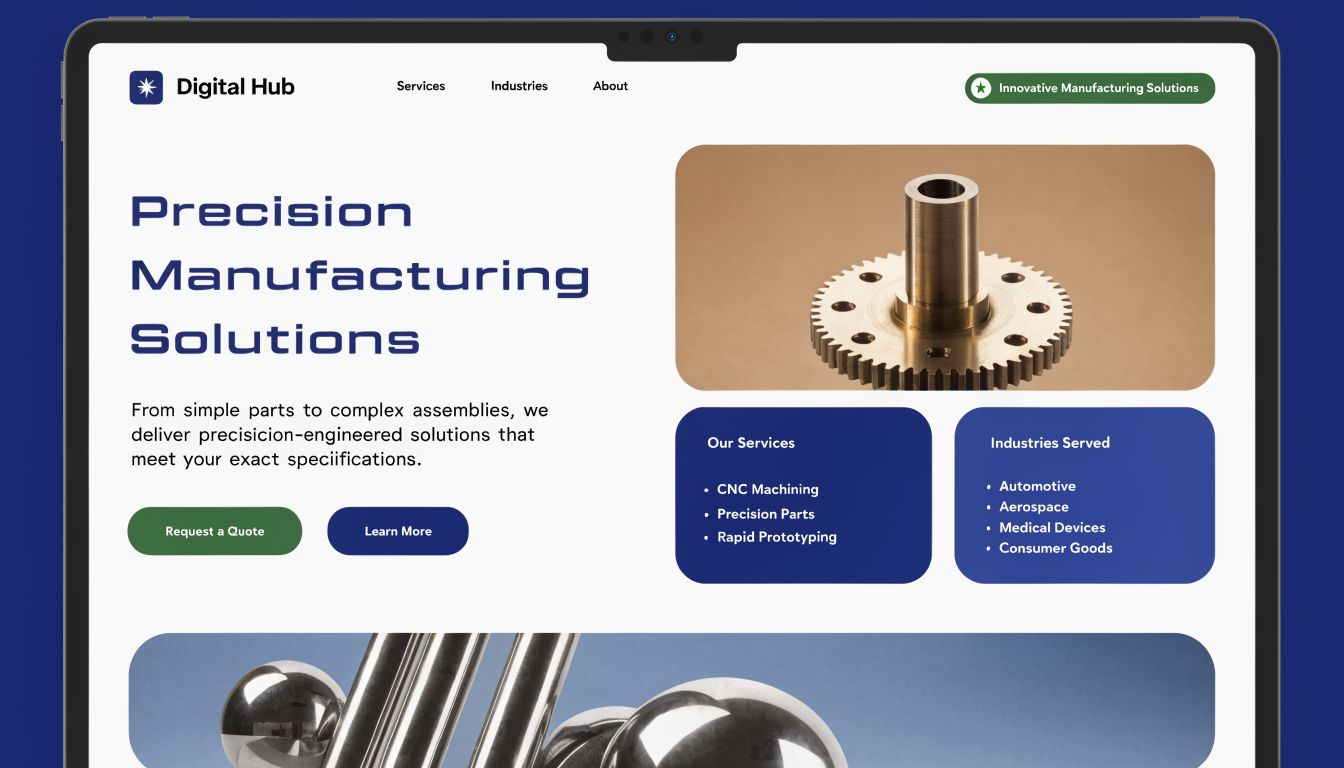
A real-world example proves the point. A 40-person Ohio machine shop achieved 63% growth in closed contracts after overhauling its website, adding dedicated capability pages, videos, and an RFQ upload portal. That work also produced a 410% increase in organic traffic and a 270% increase in RFQs, as documented in this machine shop website and SEO case study.
What your site must do
Your site needs a better structure than Home, About, Services, Contact.
Build these pages first:
- Capability pages: One page per core service, such as 5-axis machining, CNC milling, CNC turning, prototyping, wire EDM, or assembly.
- Industry pages: Show how you serve aerospace, medical, defense, or industrial buyers differently.
- Materials pages: Explain common materials, part challenges, and manufacturing considerations.
- Quality page: Certifications, inspection tools, process controls, and documentation.
- Equipment page: Machine list, work envelope, control details, and supporting tooling.
- RFQ page: Easy upload, clear next step, and confidence-building copy.
If you're evaluating a redesign, start with examples of industrial website design for manufacturers that prioritize clarity, navigation, and conversion instead of generic visual polish.
Turn traffic into RFQs
A good industrial website does two jobs at once. It ranks and it converts.
That means the site should include:
- Specific proof: Tolerances, materials, certifications, machine specs, and process photos.
- Visual evidence: Shop photos, part images, inspection process, and short video walkthroughs.
- Buyer-friendly calls to action: "Upload prints for review" works better than "Contact us."
- Fast trust signals: Response expectations, industries served, and quality documentation.
A short shop tour or process video belongs on the site because it reduces uncertainty. Buyers don't just want to read claims. They want to see how your operation works.
This walkthrough is a useful example format for industrial web presentation:
What to check this week
Audit your current site against this list:
- Can a buyer find each capability in one click?
- Does every important service have its own page?
- Can someone upload a CAD file or print without friction?
- Do you show actual equipment and actual parts?
- Is your Google Business Profile complete and aligned with your site copy?
A buyer should be able to answer "Can this shop do the job?" in under a minute.
If your website can't do that, fix it before spending more on ads or outreach.
The Engine CRM Automation and Re-engagement
Without a CRM, your marketing leaks opportunities. Leads sit in inboxes. Quote requests get buried. Old prospects disappear. Follow-up depends on memory.
That isn't a process. It's a gamble.
A tool like GoHighLevel gives you a central system for lead capture, pipeline stages, automated follow-up, reminders, email sequences, forms, and reporting. HubSpot can do it. Salesforce can do it. Pipedrive can do parts of it. GoHighLevel is often a practical fit for smaller industrial teams that need sales and marketing automation in one place without building a giant stack.

Why the CRM sits at the center
Every lead source should feed one system.
That includes:
- Website RFQs
- LinkedIn forms
- Trade show contacts
- Referral introductions
- Directory inquiries
- Reactivated old quotes
Once the lead enters the CRM, you assign status, source, owner, next action, and follow-up sequence. That's the difference between "we got an inquiry" and "we have a managed opportunity."
If your team is still debating who replied to which lead, stop adding marketing channels and fix your process first. We use CRM workflows as the operational layer for this, and if you want examples of how that logic works, our guide to campaigns in CRM for manufacturers shows the structure.
The follow-up flows every shop should build
You don't need complicated automation. You need reliable automation.
Start with these:
RFQ acknowledgment
- Triggered instantly after submission
- Confirms receipt
- Sets response expectation
- Routes the inquiry to the right internal owner
Post-quote follow-up
- Sent after the quote goes out
- Reinforces fit and answers common buying concerns
- Prompts a reply instead of passive waiting
Cold quote reactivation
- Targets quotes that stalled
- Asks whether the project is still active
- Offers a quick review call or updated estimate
Trade show nurture
- Sends a short thank-you
- Shares relevant capability content
- Creates a scheduled follow-up task
Field note: Automation should handle repetition. Your team should handle judgment.
What good automation sounds like
Bad automation sounds like marketing software. Good automation sounds like a competent operations team.
Keep messages short. Plain language. Useful next step.
For example:
- Immediately after RFQ: "We've received your files and our team is reviewing them."
- A few days later: "If timing or specifications changed, send the updated print and we'll review it."
- For dormant opportunities: "Should we keep this quote active, revise it, or close the file?"
That's not spam. That's professional follow-up.
One more point. You can also use a consultancy like Machine Marketing as one option for CRM, SEO, web development, and automation planning if you need outside implementation support instead of building the workflows internally. But the software choice matters less than the discipline. A bad process inside an expensive CRM is still a bad process.
Fueling the Engine Content Strategy and Inbound SEO
Once the website and CRM are in place, you need material that attracts qualified traffic and gives sales something useful to send.
Many shops either overcomplicate their strategy or avoid it entirely. Content doesn't mean publishing generic blog posts no one reads. It means creating assets that answer buyer questions, prove technical competence, and remove doubt before the RFQ.
For manufacturing buyers, video isn't optional anymore. 75% of B2B manufacturing buyers prefer video over written content to understand complex services, 93% of all B2B buyers say video is important for building trust, and short-form video can generate 2.5 times more engagement, according to these B2B video and personalization statistics.
Content types that actually help sell machining work
You don't need a content department. You need a realistic content matrix.
Start with these asset types:
- Capability explainers: Clear pages or short articles on processes, tolerances, materials, and common applications.
- Case studies: Show the problem, constraints, process, and result. Keep them factual and technical.
- Shop tour videos: Walk through equipment, workflow, inspection, and quality checks.
- Process clips: Short videos of setups, machining operations, inspection steps, or packaging.
- FAQ content: Answer quoting, lead times, file formats, tolerances, and secondary operation questions.
- Team expertise profiles: Introduce engineers, quality leaders, estimators, or operators to make the company feel real.
A practical publishing rhythm
If you're busy, use one core piece of content and repurpose it.
For example:
| Core asset | Reuse it as |
|---|---|
| Case study | Website page, email follow-up, LinkedIn post, sales leave-behind |
| Shop tour video | Homepage video, short social clips, trade show loop, email link |
| Technical article | SEO page, sales support PDF, LinkedIn carousel, FAQ answer |
This is how content becomes a system instead of a burden.
Buyers don't want more marketing language. They want evidence that you understand the job they're trying to source.
What good manufacturing content looks like
Good content is concrete.
Write about things like:
- Aluminum vs. steel considerations for a specific process
- What drives tolerance risk in a certain part category
- When 5-axis is worth it and when it isn't
- How your shop handles documentation for regulated work
- What buyers should include in an RFQ to get an accurate quote faster
That kind of content helps SEO because it matches real search behavior. It also helps sales because it gives your team something useful to send instead of a generic brochure.
If you're deciding what to publish first, don't ask your marketing team. Ask your estimators and salespeople which questions come up every week. Start there.
Targeted Thrust Outbound Outreach and LinkedIn
Inbound takes time. Outbound lets you pursue the accounts you want now.
For most machine shops, LinkedIn is the cleanest way to do that because the audience is identifiable and the context is professional. More important, it already performs at scale in B2B. LinkedIn sources 80% of all B2B leads, and a strong machine shop approach includes company page optimization, behind-the-scenes posting 5x/week, and CRM-connected lead forms for closed-loop tracking, based on this industrial LinkedIn lead generation framework.
Fix the profile before you send a single message
Most company pages and owner profiles are weak. They read like resumes or generic corporate descriptions.
Your LinkedIn presence should show:
- What work you want
- What equipment and process strengths you have
- Which industries you serve
- What proof supports your claims
- How someone can start a conversation
For a company page, include machine specs, part images, certifications, and a short video. For leadership profiles, speak in plain English about the work, the problems you solve, and what kinds of projects fit best.
Use LinkedIn like a business development system
Don't start by pitching. Start by identifying target accounts and building familiarity.
A simple outbound workflow looks like this:
- Build a list of target companies and buyer roles.
- Follow those companies and relevant decision-makers.
- Engage with posts when you can add something useful.
- Publish your own shop content consistently.
- Send short connection requests with context.
- Follow up with something relevant, not a sales deck.
Good outreach messages are specific. They reference a capability, a shared market, a problem you solve, or a relevant post. Bad outreach sounds automated and self-centered.
What to send instead of a cold pitch
Use assets from your system:
- A capability page tied to a known need
- A short shop tour video
- A case study for a similar part category
- A concise note offering review of prints or process fit
That approach works because it lowers friction. You're not demanding a meeting. You're making it easy for the buyer to assess fit.
Outreach rule: Earn the next step. Don't force it.
The final piece is tracking. If LinkedIn activity isn't connected to your CRM, you won't know what conversations became RFQs, quotes, or revenue. That makes improvement almost impossible.
The Control Panel Measurement and a 90-Day Roadmap
If your only marketing metric is "we need more leads," you're flying blind.
A machine shop doesn't run production without visibility into throughput, scrap, downtime, and schedule risk. Marketing deserves the same operational discipline. The point isn't to track everything. The point is to track the few numbers that show whether the system is producing qualified opportunities.
Track the few metrics that matter
Keep the dashboard lean.
Use metrics like these:
- RFQ volume: Are qualified inquiries increasing?
- Lead source: Did the opportunity come from organic search, LinkedIn, referral, email, or direct outreach?
- Quote-to-close rate: Are the opportunities you're generating the right fit?
- Response speed: How quickly does your team acknowledge and act on a new inquiry?
- Pipeline by stage: Where are deals stalling?
- Revenue by source: Which channels create closed business?
A lot of teams track vanity data because it's easy. Pageviews, impressions, and follower count have some diagnostic value, but they don't tell you whether the system is producing jobs.
If you need a planning template to organize this work, tools that help create marketing plans for manufacturers can be useful for turning goals, channels, and KPIs into a working document your team can consistently follow.
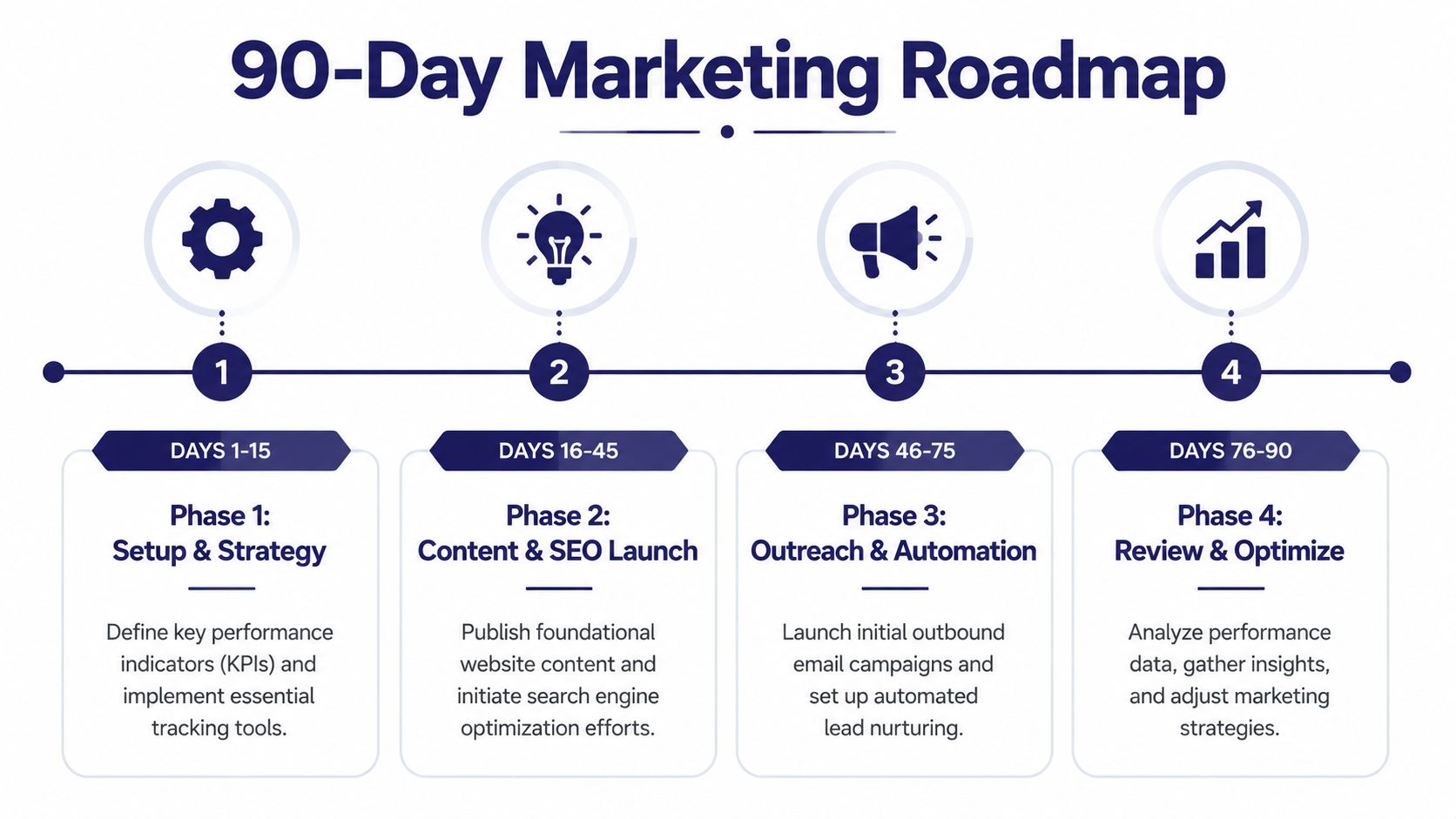
A 90-day implementation plan
Don't try to rebuild everything at once. Sequence it.
Days 1 to 15
Focus on diagnosis and setup.
- Define your ideal customer profile
- Tighten your value proposition
- Decide which services and industries deserve dedicated pages
- Set up baseline tracking in your website, forms, and CRM
- Audit your current follow-up process
Days 16 to 45
Build the core assets.
- Rewrite homepage messaging around fit and proof
- Publish essential capability pages
- Add RFQ form improvements and file upload if possible
- Create one case study
- Record one short shop or process video
- Clean up your LinkedIn company page
Days 46 to 75
Activate the engine.
- Launch CRM workflows for RFQ acknowledgment and follow-up
- Start email re-engagement for old quotes or dormant contacts
- Publish regular LinkedIn content
- Begin account-based outreach to a defined list
- Review which content sales can use in active conversations
Days 76 to 90
Review the data and tighten the system.
- Check source-to-RFQ performance
- Look at response times and missed handoffs
- Identify pages with strong engagement but weak conversion
- Refine emails, forms, and calls to action
- Decide what to double down on next quarter
Here's the important part. Don't judge the entire program by one channel. Judge it by whether the system is becoming more reliable. Better visibility. Faster follow-up. More qualified conversations. Cleaner attribution. Stronger pipeline.
B2B marketing for machine shops isn't about copying what software companies do. It's about building a demand generation and follow-up process that matches how industrial buyers evaluate risk.
If your shop has the capability but not the consistency, that's fixable. The fix is structure.
If you want help diagnosing the gaps in your current system, Machine Marketing works with manufacturers and machine shops on strategy, websites, CRM workflows, SEO, and lead generation systems that tie activity back to revenue.