If you're running a manufacturing company, there's a good chance your commercial engine feels uneven right now. Referrals still matter. Trade shows still help. Sales reps still open doors. But none of those channels creates predictable demand on its own anymore, and that's why growth feels harder than it should.
The problem usually isn't that your team forgot how to sell. It's that your sales and marketing system was built for a buying process that has changed. Buyers now research independently, compare suppliers online, and narrow their list before they ever ask for a quote. A specialized B2B marketing agency for manufacturers should help you adapt to that shift by building a system that turns expertise into discoverable, measurable pipeline.
Table of Contents
- Why Your Old Sales Playbook Is Failing
- The Agency as Your Growth Engineering Team
- The Core Components of a Manufacturing Growth Engine
- Your First 90 Days The Diagnostic and Buildout Plan
- How to Evaluate and Choose the Right Agency Partner
- The Metrics That Matter for Manufacturers
- Take the First Step Toward Predictable Growth
Why Your Old Sales Playbook Is Failing
A lot of manufacturing companies are still trying to grow with a playbook built around relationships, booth traffic, and outbound follow-up. Those things can still contribute, but they don't give you consistent visibility when buyers start researching on their own.

In manufacturing, this problem gets worse because the market is crowded and specialized. In the United States alone, there are about 623,000 manufacturing businesses, and 84% of producers planned to increase promotional spending in recent years, which shows both how fragmented the market is and how seriously firms are taking expert-led promotion, according to MarketVeep's analysis of manufacturer marketing agencies.
Generalist marketing usually breaks down here for a simple reason. Industrial buyers don't search like consumers, and they don't evaluate vendors with consumer logic. They want technical clarity, proof of fit, and enough information to decide whether you belong on the shortlist.
Practical rule: If your website can't answer buyer questions before your sales team gets involved, your sales team is doing work the website should already be doing.
What fails most often is not effort. It's system design.
- Referrals are uneven: Good months depend on who happens to remember you.
- Trade shows are episodic: Interest spikes, then fades without structured follow-up.
- Field sales is expensive to carry alone: Reps spend time educating buyers who should have been pre-qualified digitally.
- Generalist agencies miss technical intent: They write broad content that sounds polished but doesn't match how engineers and procurement teams search.
A manufacturer doesn't need more random activity. You need a repeatable engine that supports long buying cycles, technical evaluation, and sales follow-up. That's where a specialized agency becomes useful. Not as a vendor producing campaigns on request, but as a partner that diagnoses where demand is leaking out of your system and fixes it.
The Agency as Your Growth Engineering Team
The right agency for a manufacturer should operate more like an external engineering team than a creative shop. The job isn't to post more often, redesign slides, or chase attention for its own sake. The job is to inspect the growth system, find failure points, and build a stronger one.
What that role looks like in practice
A specialist agency starts by asking operational questions, not cosmetic ones. Where do qualified inquiries come from now? Which product lines get attention but don't convert? How quickly does sales follow up? Which pages attract technical buyers, and which ones confuse them?
That mindset matters because manufacturing growth problems usually sit between departments. Marketing says traffic is up. Sales says lead quality is poor. Leadership says revenue is inconsistent. A good agency connects those signals instead of treating them as separate complaints.
The fastest way to waste budget is to optimize campaigns before you've fixed the handoff between website, CRM, and sales.
That is why we treat marketing like a system with inputs, constraints, and outputs. Inputs include traffic sources, search visibility, and content. Constraints include weak positioning, poor site structure, slow follow-up, and fragmented data. Outputs are the things leadership actually cares about, like RFQs, qualified leads, and pipeline by product line.
How a specialist differs from a generalist
A generalist agency often brings a broad B2B process and applies it everywhere. Sometimes that works. In manufacturing, it often doesn't.
Here is the practical difference:
| Agency type | Typical approach | What happens in manufacturing |
|---|---|---|
| Generalist agency | Broad messaging, generic lead magnets, top-level campaigns | Traffic may increase, but technical buyers don't see enough detail to act |
| Manufacturing-focused agency | Technical search intent, product architecture, sales-process alignment | Buyers find relevant pages, self-qualify, and enter sales conversations better informed |
A true manufacturing partner should understand a few realities from day one:
- Buying cycles are long: Multiple stakeholders evaluate risk before moving.
- Products are technical: Messaging has to be accurate, specific, and useful.
- Sales capacity is limited: Marketing must reduce wasted conversations, not create more of them.
- Visibility happens before contact: Buyers form opinions well before they submit a form.
What you should expect them to build
You shouldn't hire an agency to "do some marketing." You should hire one to build operating discipline around growth.
That usually includes:
- Diagnosis: Review your current funnel, website, content, CRM, and sales handoff.
- Design: Define target segments, technical content priorities, and conversion paths.
- Implementation: Launch the pages, workflows, tracking, and campaigns that support the plan.
- Optimization: Improve what produces qualified demand and cut what doesn't.
If an agency can't explain your growth model in plain English, it probably can't improve it.
The Core Components of a Manufacturing Growth Engine
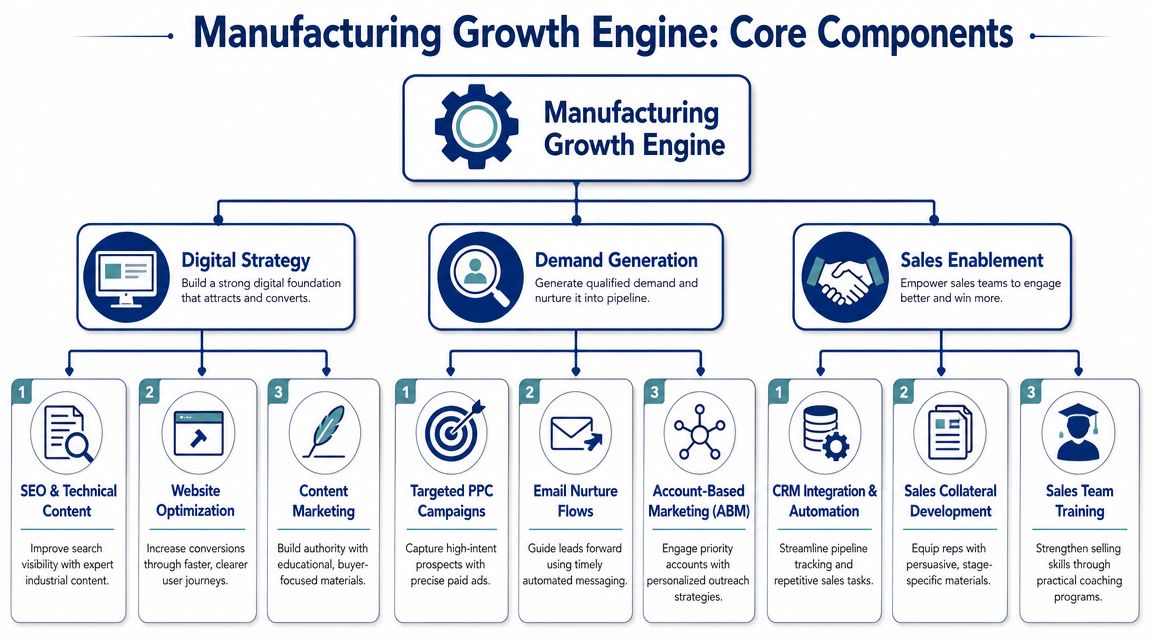
A manufacturing growth engine isn't one tactic. It's a connected set of components that help buyers find you, evaluate you, and move into a sales process with less friction.
Why disconnected tactics fail
Many manufacturers already have some pieces in place. They may have a website, a CRM, a few brochures, occasional email campaigns, maybe even some paid media. But when those parts aren't connected, the system stalls.
A common example looks like this. A prospect lands on a product page that gives only a short overview. There is no application detail, no downloadable technical content, no clear CTA, and no structured follow-up if they do convert. Sales gets a thin inquiry and has to restart the education process from scratch.
That is why the foundation matters. High-performing manufacturing marketing starts with industrial SEO built around technical intent, including specification-led queries, part numbers, and problem-based searches that engineers use, as explained in Workshop Digital's guide to digital marketing for B2B manufacturers.
What the engine actually includes
A useful growth engine typically has five working parts.
- CRM and automation as the chassis: Your CRM should hold lead source data, sales status, follow-up activity, and product interest in one place. Tools vary by company. Some teams use HubSpot, some use Salesforce, and some smaller firms use platforms like GoHighLevel or a focused system from providers such as Machine Marketing. The point isn't the brand name. The point is clean handoffs, usable reporting, and automated follow-up that sales will trust.
- Technical SEO as the discovery layer: Many agencies underperform in technical SEO. Manufacturers don't win search by publishing soft thought-leadership pieces alone. They win by structuring pages around specific buying language, including applications, tolerances, industries, certifications, materials, and product variations.
- Content as pre-sales education: White papers, case studies, eBooks, process pages, FAQ libraries, and videos all help buyers self-qualify. Good content reduces repetitive sales explanations. Weak content creates more of them.
- Website architecture as conversion infrastructure: Product and capability pages should guide the next step clearly. If you're reviewing examples of manufacturing-specific site structure, Wistec's B2B website design is a useful reference for how industrial firms can organize service and product information more effectively.
- Email and nurture flows as continuity: Most manufacturing deals don't close on first touch. Follow-up sequences should match buyer behavior. A visitor who downloaded a spec guide needs different messaging than someone who asked for pricing.
Good industrial marketing doesn't force the sales call early. It gives buyers enough clarity to decide whether the call is worth having.
A simple way to view the system is below:
| Component | What it does | What happens if it's weak |
|---|---|---|
| SEO | Makes technical capabilities discoverable | Buyers never find the right pages |
| Content | Answers evaluation questions | Leads arrive unqualified or not at all |
| Website structure | Routes visitors to the right next step | Traffic leaks without conversion |
| CRM | Tracks lead status and source | Marketing and sales argue about quality |
| Automation | Maintains follow-up over long cycles | Opportunities go cold between touches |
When these components work together, your website stops acting like a digital brochure and starts acting like infrastructure.
Your First 90 Days The Diagnostic and Buildout Plan
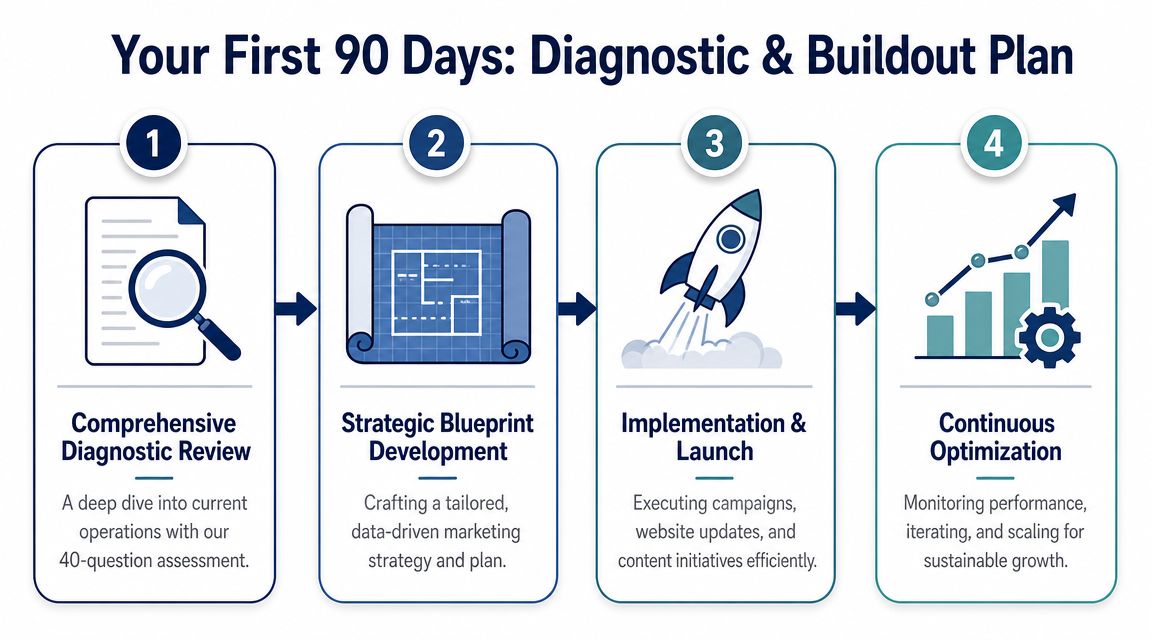
Most manufacturers don't need another vague retainer. They need a clear plan, fast. The first ninety days should look less like "we'll test some ideas" and more like a structured buildout with defined decisions, weekly execution, and visible checkpoints.
What the diagnostic review looks for
A strong kickoff starts with a 40-question review. That isn't busywork. It's how you uncover where growth is getting stuck.
The review should cover questions like these:
- Positioning and offer clarity: Can buyers tell what you do, who you serve, and what differentiates you?
- Website structure: Do product, service, and industry pages match real buyer journeys?
- Lead capture: Are forms, CTAs, and downloads mapped to different levels of buyer intent?
- CRM and pipeline setup: Can you trace inquiries from source to opportunity?
- Sales follow-up: What happens after an RFQ, brochure download, or contact request?
- Content coverage: Which capabilities are well documented, and which are still hidden inside your team's heads?
That process usually reveals familiar issues. Messaging is too broad. Product pages are too shallow. The CRM contains contacts but not useful attribution. Sales is following up manually with no consistent sequence. SEO exists in pieces, not as a system.
For a deeper look at one part of that process, this resource on SEO for manufacturing companies is a practical starting point.
How the buildout moves
Once the diagnosis is done, the first ninety days should move in short sprints. The exact order depends on the business, but the pattern is usually consistent.
Stabilize the foundation
Fix tracking, forms, CRM fields, and reporting first. If attribution is broken, everything that follows becomes harder to judge.Prioritize revenue pages
Start with the pages closest to pipeline. Product categories, high-value services, application pages, and quote paths usually matter more than general blog volume early on.Launch core workflows
Build email follow-up, lead routing, and internal notifications so no inquiry sits untouched.Create the first content cluster
Develop supporting pages and assets around a focused commercial theme, such as one product family or one industry segment.
This video gives a useful visual overview of the kind of structured rollout manufacturers should expect from a serious digital program.
Field note: If an agency can't tell you what gets built in the first month, the second month, and the third month, you're probably buying activity instead of a system.
How to Evaluate and Choose the Right Agency Partner
Choosing an agency gets easier when you stop asking whether they "do manufacturing marketing" and start asking how they think. Plenty of firms can show polished creative. Fewer can explain how they will make your products easier to discover, compare, and buy.
The biggest shift in evaluation is this. You are not hiring for campaigns alone. You are hiring for system design, technical understanding, and commercial accountability.
Questions worth asking in the first meeting
Start with operational questions. They expose depth quickly.
- How will you diagnose our current funnel? Ask them what they review before making recommendations. If they jump straight to tactics, that's a warning sign.
- How do you approach technical SEO for industrial products? They should talk about search intent, page structure, product taxonomy, and application language. If they only mention blogging frequency, that's not enough.
- How do you build content for engineers and procurement teams? Strong answers usually include interviews with subject matter experts, spec-led pages, and real buyer questions.
- How do you handle CRM integration and attribution? If they can't explain how leads move from first touch to opportunity status, reporting will stay fuzzy.
- What does sales enablement look like after a lead converts? Marketing that ends at the form fill is incomplete.
One question matters more than most right now. With 75% of B2B buyers preferring a rep-free sales experience, manufacturers need to ask how the agency will build self-serve discovery, including deep SKU-level content and page structures that make products discoverable and comparable online, as discussed in Ironpaper's manufacturing content marketing analysis.
That changes the interview. You are no longer asking, "Can you get us traffic?" You are asking, "Can you help buyers evaluate us before sales gets involved?"
Red flags that usually show up early
Not every weak fit looks obvious. Some sound compelling in the pitch and fail in execution.
Watch for these patterns:
| Red flag | What it usually means |
|---|---|
| They lead with social posting volume | They may not understand industrial buying behavior |
| They avoid CRM questions | They can't connect marketing to pipeline cleanly |
| They promise leads without discussing qualification | They'll optimize for form fills, not sales value |
| They show generic case studies only | Their process may not transfer well to technical markets |
It also helps to review a candid outside perspective on agency underperformance. This guide for B2B marketing agency issues is worth reading because it frames common delivery failures in operational terms, not just creative ones.
If you want a reference point for what a systems-focused engagement should look like, your sales and marketing agency outlines the kind of cross-functional alignment many manufacturers need.
A good partner should make your internal conversations easier. They should help leadership, marketing, and sales look at the same system and agree on where the bottlenecks are.
The Metrics That Matter for Manufacturers
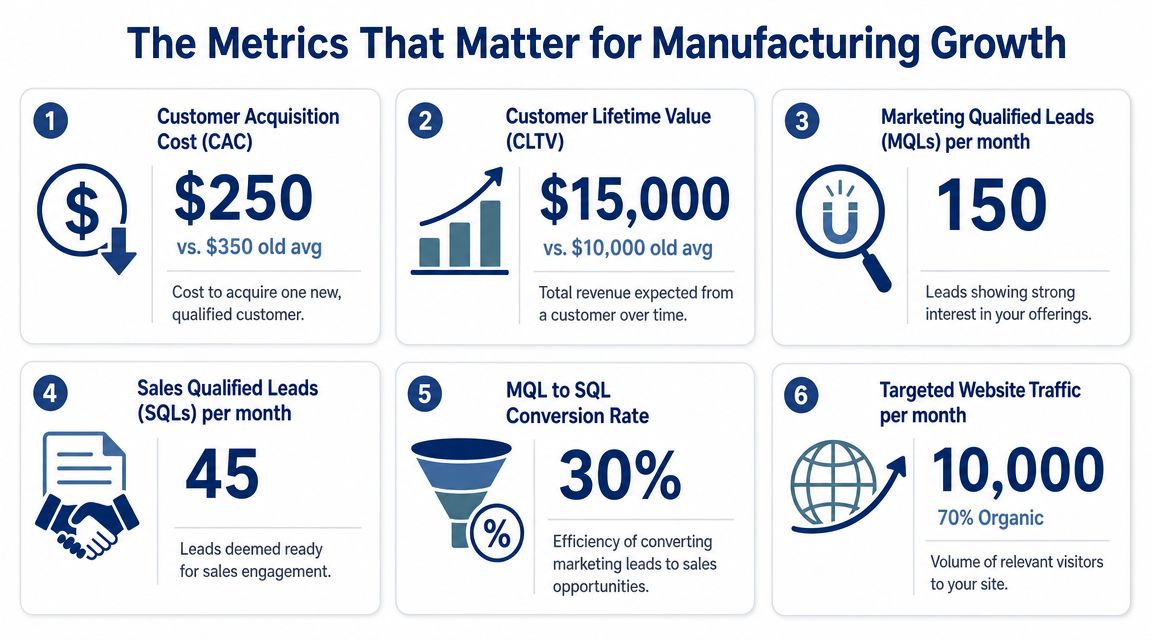
Manufacturers don't need prettier dashboards. They need measurements that tell them whether marketing is producing commercially useful demand.
What to track instead of vanity metrics
Impressions and clicks have some value, but they don't answer the core question a CEO asks. Are we getting more of the right opportunities?
For manufacturers, the most useful scorecard usually includes:
- RFQ submissions by product line: Not all quote requests have equal value. Break them down by category.
- Qualified leads: Separate raw inquiries from leads that match target industries, capabilities, and buying intent.
- Keyword visibility for technical terms: Rankings matter most when they reflect high-intent industrial searches, not broad vanity phrases.
- Cost per qualified lead: A lower-cost lead isn't better if sales can't close it.
- Revenue attributed to campaigns: Tie wins back to channels where possible, even if attribution is directional rather than perfect.
- Sales response time and progression: Marketing can generate demand, but weak follow-up still kills it.
A practical dashboard should help you answer three things quickly:
- Which channels are producing serious opportunities?
- Which pages are helping buyers self-qualify?
- Where are leads stalling after conversion?
For a more detailed KPI framework designed for industrial teams, this guide to marketing KPIs for manufacturing is a useful reference.
How channel performance should be judged
Some channel benchmarks are worth knowing because they shape where agencies should focus effort. One benchmark report found that SEO delivers a 748% ROI, and 89% of B2B marketers use LinkedIn for lead generation, according to GTM 80/20's B2B marketing agency statistics.
That doesn't mean every manufacturer should pour budget into the same mix. It means high-performing agency work should usually include a serious search strategy and a clear position on how LinkedIn supports distribution, outreach, or retargeting.
If a channel can't be tied to qualified conversations, it shouldn't survive on habit alone.
What matters is how each channel contributes to pipeline:
- SEO should bring in technical buyers already researching solutions.
- LinkedIn should support visibility, distribution, and account-level engagement.
- Email nurture should keep viable opportunities warm during long evaluation periods.
- Website conversion paths should make it easy to request a quote, download a document, or contact the right person.
The best reporting isn't flashy. It's decision-ready. It tells you what to scale, what to fix, and what to stop funding.
Take the First Step Toward Predictable Growth
A specialized B2B marketing agency for manufacturers shouldn't behave like an outsourced promotion team waiting for tasks. It should function like a growth engineering group that diagnoses failure points, builds connected systems, and helps your team produce more qualified demand with less waste.
That matters because most manufacturing companies already have pieces of the puzzle. They have product knowledge. They have sales experience. They may even have a CRM, a website, and content assets. What they often lack is integration. The right partner closes those gaps and turns isolated tools into a system that supports RFQs, qualified leads, and better sales conversations.
If you're evaluating agencies, keep the standard simple. Can they diagnose clearly? Can they build the infrastructure? Can they show how marketing activity connects to pipeline?
Those are the questions that separate a vendor from a real partner.
If you want a practical diagnosis before committing to a full engagement, Machine Marketing is a reasonable next step. We help manufacturers and industrial businesses review the systems they already have, identify where leads are leaking out, and map a clearer path toward consistent growth.