If you're a manufacturer, you probably know the pattern. A trade show creates a burst of conversations, a referral brings in a solid opportunity, LinkedIn gets a few inquiries, then the pipeline goes quiet and nobody can say when the next serious lead will arrive.
That isn't usually a traffic problem. It's a system problem. B2B lead generation for manufacturers works differently from consumer marketing because the buying process is slower, more technical, and more dependent on multiple stakeholders. Relationship channels still matter, but they need a digital system wrapped around them so inquiries don't die in inboxes and good prospects don't disappear between marketing and sales.
Table of Contents
- Moving Beyond Feast or Famine Lead Generation
- The Blueprint Your Ideal Customer Profile and Value Proposition
- Your Digital Factory Floor Website and Search Optimization
- Activating Your Lead Engine Content and Targeted Outreach
- Automating the Handoff CRM Workflows and Reactivation
- Your 90-Day Proof-of-Concept Plan
- Measuring What Matters to Scale Success
Moving Beyond Feast or Famine Lead Generation
The old model still shows up everywhere in manufacturing. A company leans on trade shows, referrals, rep relationships, and a website that mostly acts like a brochure. That can work for a while, especially if the sales team is experienced and the market is stable. It stops working when growth targets increase or when a few major accounts go quiet.
Manufacturing has always been relationship-heavy. A 2025 comparison of B2B strategies found that manufacturers ranked informal networking first, LinkedIn second, and webinars third, and the same research noted that B2B companies generated a median of 27 new leads versus 196.5 for B2C companies. That tells you two things. First, relationships still matter. Second, each lead carries more weight, so sloppy follow-up costs more.

A better approach is to think like an operator, not a campaign manager. Inputs go in. Qualification happens. Routing happens. Follow-up happens. Sales gets context, not just names.
What breaks most manufacturing lead generation
A random collection of tactics usually creates random outcomes. We see the same failure points repeatedly:
- Too much channel chasing: The team tries SEO, LinkedIn, ads, trade shows, and email at once, but none of them share one process.
- No common definition of a good lead: Marketing celebrates form fills. Sales ignores them.
- Slow response time: A contact form sends an email to a shared inbox and waits for someone to notice.
- Weak memory: Past inquiries, old trade show scans, and former customers sit unused in a spreadsheet.
Practical rule: If your lead flow depends on individual memory, it isn't a system.
The goal isn't to eliminate relationship selling. It is to support it with a reliable machine. That means one operating model that connects your market focus, your content, your website, your outreach, and your CRM.
What a working machine looks like
A functioning lead system for a manufacturer usually has five parts:
- A clear market definition so the team knows which accounts and roles matter.
- A website built for technical buying with pages that answer real buying questions.
- Content and outreach working together instead of living in separate silos.
- CRM automation that scores, routes, and tracks every inquiry.
- A feedback loop that shows which channels create qualified opportunities.
That is how you move from bursts of luck to repeatable pipeline creation.
The Blueprint Your Ideal Customer Profile and Value Proposition
Most manufacturers define their market too broadly. "We serve aerospace, medical, and industrial buyers" isn't a usable blueprint. It's a category list. It doesn't tell your team who to pursue, what problems matter most, or why one type of buyer moves faster than another.
A high-performing B2B lead generation system starts with a tightly defined ICP and buying committee map. The practical workflow is to define firmographics, identify decision-makers, map the buyer journey, and match channel and content to buyer intent at each stage, as outlined in Salesgenie's lead generation framework.
Start with the customers you actually want
Your ICP should describe the accounts that fit your operation well and produce healthy revenue with manageable sales friction.
That means asking practical questions such as:
- Which industries close cleanly: Not just who buys, but who buys without endless quoting cycles or compliance confusion.
- Which plant sizes fit your delivery model: A large multi-site enterprise and a specialized regional fabricator may require completely different motions.
- Which problems are urgent enough to fund: Downtime, lead-time pressure, quality risk, certification requirements, and supplier consolidation all create different purchase urgency.
- Which jobs trigger the search: New product launch, dual sourcing, cost reduction, process change, capacity shortfall, or vendor failure.
If your team hasn't done this formally, build a worksheet. Start with won deals, stalled deals, and poor-fit customers. The contrast is where the pattern becomes obvious.
For a deeper persona exercise, use a practical framework like this guide on creating buyer personas for industrial marketing.
Map the buying committee, not just the company
Manufacturing purchases usually don't move because one person likes your website. They move when several people get enough confidence at the same time.
A typical committee may include:
- Engineering or technical evaluators who care about tolerances, compatibility, documentation, and performance
- Operations or plant leadership who care about uptime, implementation risk, and throughput disruption
- Procurement who cares about supplier reliability, commercial terms, and comparison
- Finance or ownership who wants the business case to make sense
- Quality or compliance stakeholders who need proof, certifications, and process consistency
If your message only works for one role, it usually stalls in committee review.
One simple way to handle this is to map each role to three things: their concern, their proof requirement, and their likely objection. That gives sales and marketing one shared reference instead of vague persona talk.
Build value propositions by role
Most manufacturing messaging is too product-centered. Buyers don't want a list of machine features unless those features connect directly to their operational problem.
A stronger approach is role-based positioning:
| Stakeholder | What they care about | What your message should prove |
|---|---|---|
| Engineer | Technical fit | Specs, drawings, tolerances, materials, comparisons |
| Plant manager | Reliability | Downtime reduction, implementation clarity, service responsiveness |
| Procurement | Vendor confidence | Lead times, communication, consistency, sourcing stability |
| Executive or owner | Business outcome | Risk reduction, capacity support, strategic fit |
This doesn't require separate campaigns for every person. It requires disciplined messaging. Your homepage can speak to category fit. Product pages can carry technical detail. Email nurture can segment by interest. Sales outreach can reference the role-specific pain point directly.
The blueprint matters because every later decision depends on it. If your ICP is fuzzy, your SEO targets drift, your outreach gets generic, and your CRM fills with names that never should have entered the pipeline.
Your Digital Factory Floor Website and Search Optimization
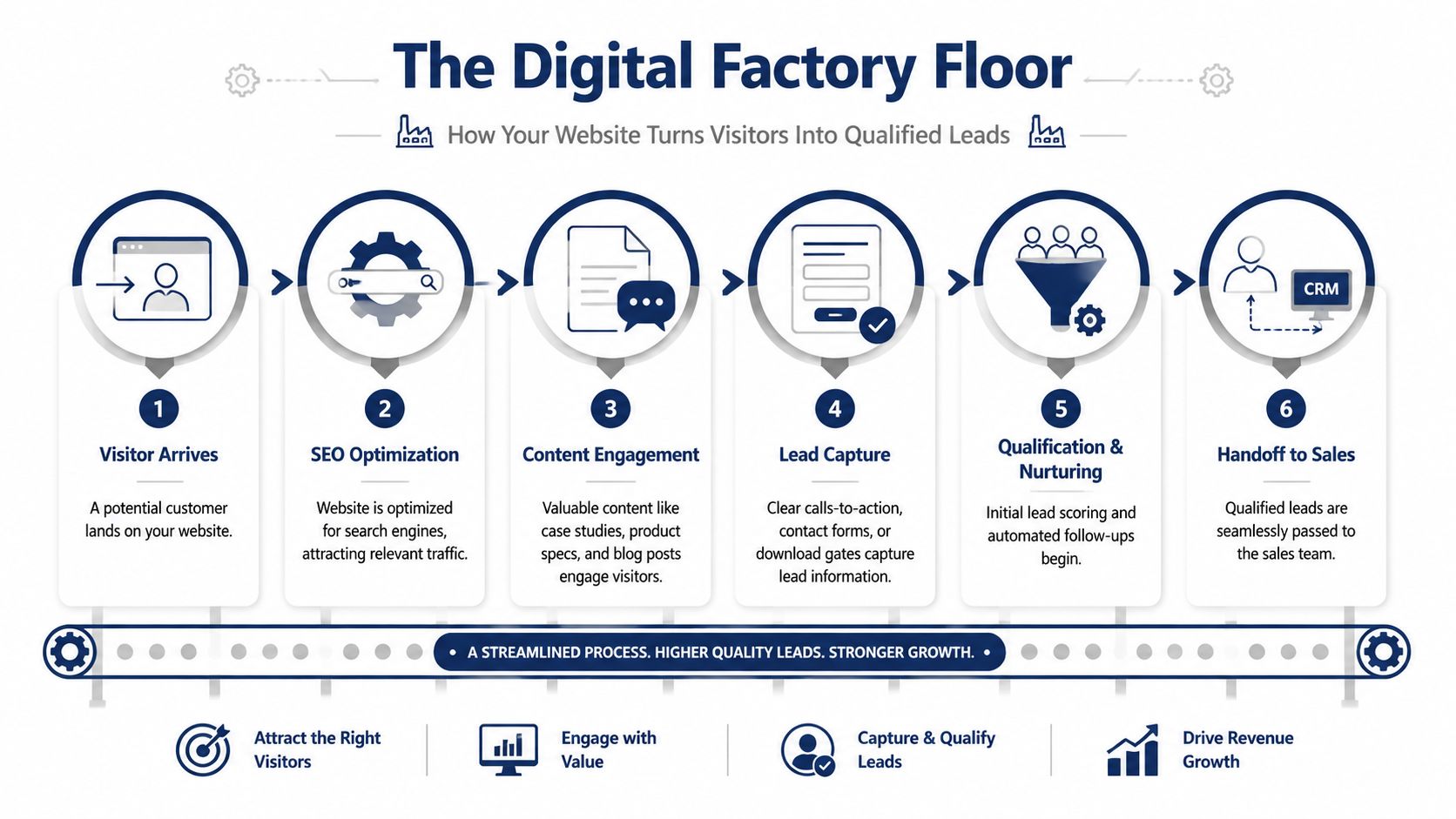
A manufacturing website should do more than look credible. It should help the right buyer confirm fit, gather proof, and take the next step without friction. Too many sites still read like digital brochures. They describe the company well, but they don't help a plant manager, engineer, or procurement lead move forward.
Your website should qualify, not just describe
When an industrial buyer lands on your site, they usually want answers fast. Can you do this job. Have you solved this type of problem before. How do I judge fit without getting trapped in a long sales call.
Your site should make those answers easy to find.
A solid manufacturing website usually includes:
- Clear industry pages: Show where you work and what use cases you understand.
- Product or capability pages with depth: Include specifications, process details, tolerances, materials, and common applications where appropriate.
- Proof assets: Case studies, certifications, technical resources, FAQs, and buying guides.
- Strong conversion paths: RFQ, consultation request, technical review, sample request, or resource download.
- CRM-connected forms: Every form should feed a lead record and trigger follow-up.
If you're rebuilding or tightening this structure, this guide on SEO for manufacturing companies is a practical place to start.
AEO changes how technical buyers find you
Classic SEO still matters, but it isn't enough anymore. Buyers increasingly ask narrow technical questions in AI interfaces, not just in search engines. That changes the structure of effective content.
According to Outfunnel's lead generation guidance, AI search is favoring answers-first content, and FAQ-style formats and structured content are especially useful for Answer Engine Optimization. For manufacturers, that's a serious opportunity because technical buyers often ask comparison-heavy questions that generic blog posts don't answer well.
What answers-first content looks like
An AEO-friendly manufacturing page is direct and specific. It doesn't bury the answer under a long introduction.
Use formats like these:
- Comparison FAQs: "When should you use aluminum instead of stainless steel for this application?"
- Process questions: "What information is needed before requesting a quote for custom machining?"
- Selection guides: "How to evaluate conveyor options for washdown environments"
- Constraint pages: "What tolerance range is realistic for this process"
A technical buyer doesn't need more adjectives. They need a usable answer.
This is also where content structure matters. Short paragraphs, obvious subheads, direct answers near the top, and scannable lists help both people and machines understand your page.
What doesn't work well anymore
A lot of manufacturing content still misses the mark because it does one of two things:
- It stays too vague, with generic claims about quality and service.
- It goes too deep technically without guiding a non-engineering stakeholder toward action.
Your site has to do both. It must support technical scrutiny and commercial progress. That means every core page should answer, reassure, and convert.
Activating Your Lead Engine Content and Targeted Outreach
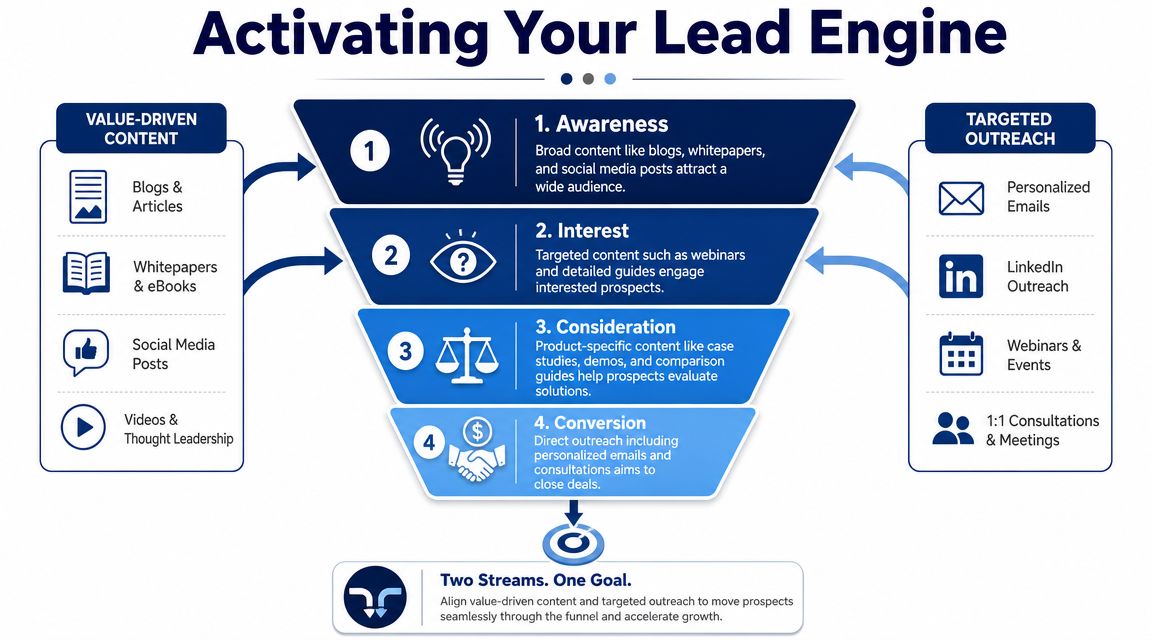
Once the foundation is in place, the engine needs fuel. In manufacturing, that fuel comes from two coordinated motions. One attracts demand from buyers who are researching. The other creates demand inside target accounts you already know you want.
Too many teams choose one and ignore the other. They either publish content and hope buyers appear, or they push outbound without enough proof behind the message. Both approaches leave money on the table.
Content creates the surface area
Good content gives buyers a reason to find you, trust you, and return. In manufacturing, that usually means practical assets, not fluffy thought leadership.
Useful formats include:
- Problem-solving articles that answer operational or technical questions
- Webinars for buyers who need deeper explanation or want to hear subject matter experts
- Application pages tied to industries, materials, or manufacturing processes
- Comparison content that helps buyers evaluate options
- Case-study style proof when you have permission to share the work
Lead generation is now tied much more closely to pipeline, not just visibility. In one 2025 research set summarized by Cirrus Insight's lead generation statistics, 89% of B2B marketers use LinkedIn for lead generation, 62% say it produces quality leads, and 80% of leads never convert to customers. That is why publishing more content alone isn't enough. Content has to support qualification and follow-up.
Targeted outreach turns interest into meetings
Content attracts. Outreach focuses.
For manufacturers, the most effective outbound motion usually looks like account-based work:
- Build a shortlist of accounts that fit your ICP.
- Identify the likely buying committee inside each account.
- Match outreach to the stakeholder's role and likely concern.
- Use content as the reason to start the conversation, not as an attachment dump.
- Track engagement inside the CRM so sales can see what happened.
LinkedIn is useful here, but not as a spam channel. It works best when your team uses it to identify people, understand their role, and put relevant insight in front of them over time.
A message like "Want to book 15 minutes?" is weak. A message tied to an actual operational issue is stronger. For example, if you're targeting food manufacturing plants, a note tied to washdown equipment constraints is more credible than a broad capabilities pitch.
The best outreach feels like a continuation of research, not an interruption.
Email still plays an important role, especially for multi-touch follow-up. But if your emails aren't landing, even good messaging gets wasted. This guide on How to Improve email deliverability is worth reviewing before you scale outbound sequences.
Paid distribution should amplify proven assets
Paid media has a role, but manufacturers often overspend because they advertise offers that haven't earned attention organically.
A better paid strategy is simple:
- Put budget behind the pages and content that already attract the right conversations.
- Use retargeting to stay visible to known visitors.
- Support webinars, buying guides, and comparison content that help mid-funnel buyers.
- Keep audiences narrow enough that sales would want the resulting inquiries.
This is where a connected system matters. If paid traffic, organic content, and outbound outreach all point into the same CRM workflow, you can see which motion creates real opportunities instead of just activity.
Tools vary. Some teams use HubSpot, Salesforce, or GoHighLevel. Some industrial firms also use strategy and CRM support from providers such as Machine Marketing when they need help connecting positioning, content, and automation into one operating model. The tool matters less than the discipline of one shared system.
Automating the Handoff CRM Workflows and Reactivation
Most lead systems don't fail at attraction. They fail at handoff.
A form gets submitted. A rep is traveling. An estimator plans to respond later. The prospect cools off. Nobody updates the CRM. Two months later, the company says lead quality is poor when the actual issue was process discipline.
Most lead loss happens after the form fill
This is the part many manufacturing companies underbuild. Public advice usually focuses on generating more leads through SEO, content, or ads. The operational problem gets far less attention.
That is backwards. Callbox's review of B2B lead generation challenges points directly to the common breakdowns: weak qualification criteria, poor sales alignment on what counts as sales-ready, missing lead scoring, unclear lead routing, and inconsistent follow-up tracking.
If those pieces are missing, more top-of-funnel volume just creates more waste.
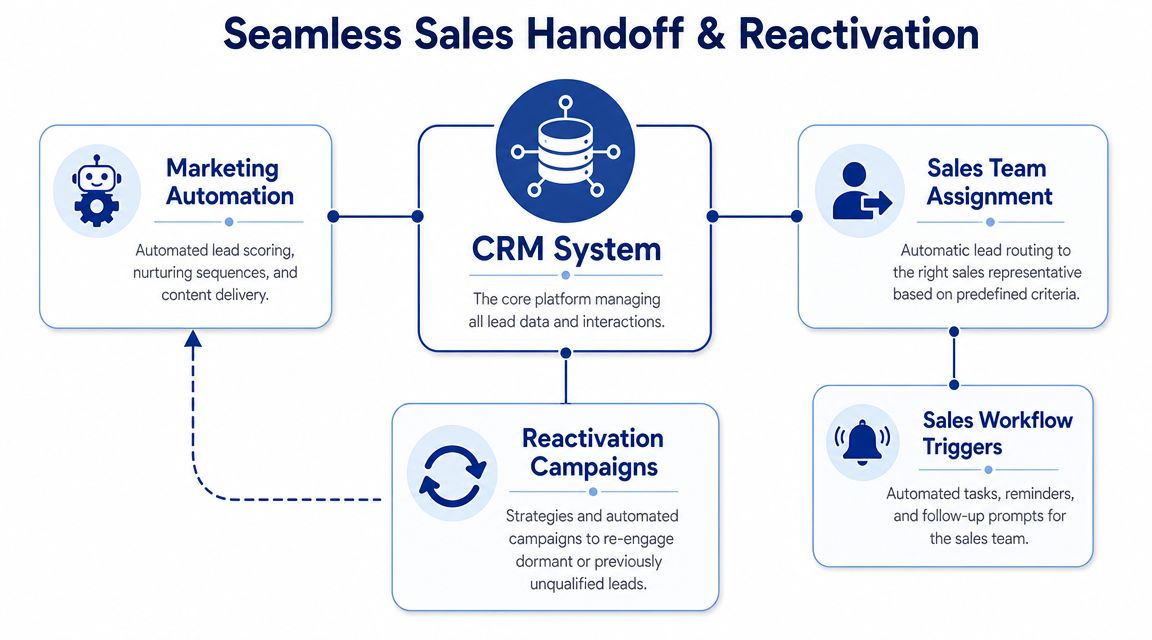
A CRM-centric setup fixes that by making the workflow explicit.
What the workflow should do automatically
A practical system inside a platform like GoHighLevel should handle the plumbing without depending on memory.
Use automation for tasks like these:
- Instant capture: Every form, chat, landing page, and manual import creates or updates a contact record.
- Lead source tagging: The system records whether the inquiry came from organic search, LinkedIn, webinar, outreach, referral, or trade show.
- Basic qualification: Fields and rules identify fit, urgency, product interest, geography, and role.
- Routing logic: Qualified inquiries go to the right rep, territory, or business unit automatically.
- Follow-up tasks: Sales gets reminders, due dates, and stage-specific next actions.
- Nurture sequences: Leads that aren't ready now still receive relevant follow-up.
A clean framework for that process is this guide to CRM for lead generation and follow-up.
This walkthrough is useful if you want to see the automation mindset in action.
Reactivation is usually easier than starting from zero
Most manufacturers are sitting on dormant opportunity pools:
- old RFQs
- trade show scans
- previous customers
- leads marked "not now"
- contacts that downloaded resources but never spoke to sales
Those lists are often messy, but they are still valuable. A reactivation campaign can segment those contacts by product interest, industry, or original inquiry type, then trigger a simple sequence through email and, where appropriate, SMS.
You don't need a complicated campaign. A practical reactivation flow might include:
| Sequence step | Purpose |
|---|---|
| Re-introduction message | Confirm relevance and offer a simple next step |
| Helpful resource | Share a guide, FAQ, or technical page tied to their likely interest |
| Direct check-in | Ask if timing, specs, or sourcing needs have changed |
| Sales task trigger | Notify a rep when someone engages or replies |
A dormant database is usually not a dead asset. It's an unworked asset.
The important part is governance. Define what qualifies for sales follow-up, who owns the next step, and when a lead returns to nurture. That turns your CRM from a contact graveyard into an operating system.
Your 90-Day Proof-of-Concept Plan
A manufacturer doesn't need a giant digital transformation project to prove this model. It needs a controlled build. Ninety days is enough to create a working proof of concept if the scope stays focused.
Days 1 through 30 build the foundation
The first month is about diagnosis and setup. Don't rush into campaigns before the basic architecture exists.
Priority actions in this phase:
- Define the ICP and buying committee
- Audit your website paths for key services, industries, and conversion points
- Choose the core CRM workflow for capture, routing, and follow-up
- Clean and organize existing contact data
- Agree on lead stage definitions so marketing and sales stop using different language
A useful checkpoint at the end of this phase is simple. Can the team point to one agreed target account profile, one clear lead flow, and one dashboard view of incoming inquiries?
Days 31 through 60 launch the engine
The second month is where activity starts, but with limited scope.
Launch a focused set of assets and motions:
- One pillar content asset tied to a real buying question
- Supporting website pages or FAQs
- One target account list
- A LinkedIn and email outreach sequence
- CRM-based nurture and routing automation
- A small reactivation campaign to past contacts
This stage is not about scale. It is about signal. You want to see whether the market responds, which messages get traction, and whether the handoff process works without manual heroics.
Days 61 through 90 tighten the system
By month three, the question shifts from "did anything happen?" to "what should we improve?"
Look for patterns such as:
- Which content topics generated meaningful conversations
- Which outreach messages got replies
- Which forms produced weak-fit inquiries
- Which reps followed up consistently
- Which lead sources entered pipeline
Here is the PoC plan in checklist form.
| Phase | Key Actions | Primary KPIs |
|---|---|---|
| Foundation | Define ICP, map buying committee, align lead stages, audit website paths, configure CRM capture and routing, clean existing database | ICP approved, lead stage definitions approved, CRM capture working, routing workflow active |
| Activation | Publish first pillar asset, build supporting FAQ or landing pages, launch target-account outreach, start nurture sequences, run reactivation campaign | Qualified conversations started, meetings booked, reply volume, form submissions, reactivated contacts |
| Optimization | Review source quality, refine messaging, adjust forms and CTAs, improve routing rules, tighten nurture logic, expand what is working | SQL volume, opportunity creation, response consistency, pipeline movement by source |
How to keep the PoC realistic
A few rules keep this from turning into another stalled initiative:
- Keep the offer narrow: Focus on one core capability, market segment, or buyer problem first.
- Use one source of truth: If notes live in inboxes, spreadsheets, and disconnected tools, the pilot will fail.
- Review weekly: Marketing and sales should look at the same records and discuss actual leads, not opinions.
- Document the SOP: If someone leaves or gets busy, the process should still run.
The point of a 90-day proof of concept isn't perfection. It's proof that the machine can produce measurable movement when the parts are connected.
Measuring What Matters to Scale Success
A working system needs instrumentation. If you only measure traffic, impressions, and raw form fills, you won't know whether marketing is helping revenue or just creating activity.
Use pipeline metrics, not vanity metrics
For manufacturers, the metrics that matter usually sit closer to sales:
- Lead-to-opportunity movement
- MQL to SQL conversion
- Sales response consistency
- Pipeline by source
- Customer acquisition cost
- Pipeline velocity
These metrics create useful pressure. They force the team to ask better questions. Which channels create real buying intent. Which content attracts poor-fit traffic. Which offers lead to RFQs versus casual downloads. Which reps act quickly and which leads age out.
Treat marketing like a controlled process
An engineering mindset works well here. Build the system. Observe the output. Find the constraint. Adjust one variable at a time.
The goal isn't more dashboards. The goal is better decisions.
That may mean removing a weak form, rewriting a key page, changing lead routing, narrowing the ICP, or doubling down on a webinar topic that generated serious conversations. The system improves because you can see where it breaks.
Consistent B2B lead generation for manufacturers doesn't come from one tactic. It comes from a connected operating model that turns market focus, content, outreach, and CRM discipline into repeatable pipeline creation.
If you want help diagnosing your current lead system, Machine Marketing works with manufacturers to connect strategy, SEO, outreach, CRM workflows, and follow-up into one measurable process. If your team already has tools in place but the pieces don't work together, that's the right place to start.