If you're a manufacturer, this probably sounds familiar. You invested in a new website, hired someone to handle marketing, posted on LinkedIn a few times, maybe ran some ads, and still ended up with scattered leads, uneven follow-up, and no clear answer to a basic question: what is marketing producing?
That frustration is real, and it explains why manufacturers often conclude that marketing is vague, expensive, or better suited to other industries. But the deeper issue isn't that manufacturing is “bad at marketing.” It's that many firms are trying to bolt modern marketing tactics onto sales processes, content habits, and reporting systems that were never designed for how buyers research and evaluate suppliers today.
Table of Contents
- Your Marketing Problem Is Actually a Systems Problem
- The Diagnosis Why Marketing Feels Like a Cost Center
- The Messaging Fix From Product Specs to Trust Signals
- The Systems Fix Building Your Marketing Machine
- High-Impact Lead Generation Tactics to Implement Now
- Your 90-Day Action Plan for Marketing Transformation
Your Marketing Problem Is Actually a Systems Problem
Most manufacturers don't have a single marketing problem. They have a chain of disconnected problems that show up as weak results.
A typical pattern looks like this. Sales owns customer knowledge. Marketing owns the website, brochures, and trade show support. Leadership wants more leads. Nobody has a shared map of the buying journey, the handoff points, or the numbers that matter before revenue closes. So every tactic gets judged in isolation, and every tactic looks underwhelming.
That environment makes marketing feel ineffective, especially in technical markets where buyers move slowly and comparison is intense. 43% of manufacturers say they struggle to stand out from competitors, and the average online B2B conversion rate for manufacturers is only 2.2%, according to industrial marketing statistics compiled by WebFX. Those numbers don't mean digital marketing can't work. They mean your system has very little margin for wasted traffic, weak follow-up, or unclear positioning.
Why tactics fail without a system
A website redesign won't fix unclear messaging.
More blog posts won't fix weak sales handoff.
Paid traffic won't fix missing attribution.
This is why we treat marketing as an operating system, not a campaign calendar. If you want predictable growth, you need the same mindset you'd use on the shop floor or in engineering. Define the process. Identify failure points. Instrument the system. Improve one constraint at a time.
A good starting point is understanding marketing operations as a business system, because that's where manufacturers usually discover the problem isn't effort. It's coordination.
Practical rule: If you can't explain how an inquiry moves from first touch to qualified opportunity, you don't have a lead generation issue yet. You have a system design issue.
What this means in practice
When manufacturers ask why manufacturers struggle with marketing, they often point to complexity. Complex product. Long sales cycle. Niche market. All true.
But those are constraints, not excuses. The true damage happens when the marketing system isn't built to handle those constraints. That's when leads go cold, content stays generic, and leadership starts seeing marketing as overhead instead of infrastructure for growth.
The Diagnosis Why Marketing Feels Like a Cost Center
Marketing gets treated like a cost center when the business can't see how it contributes to pipeline movement. In manufacturing, that usually comes from history, not intent.
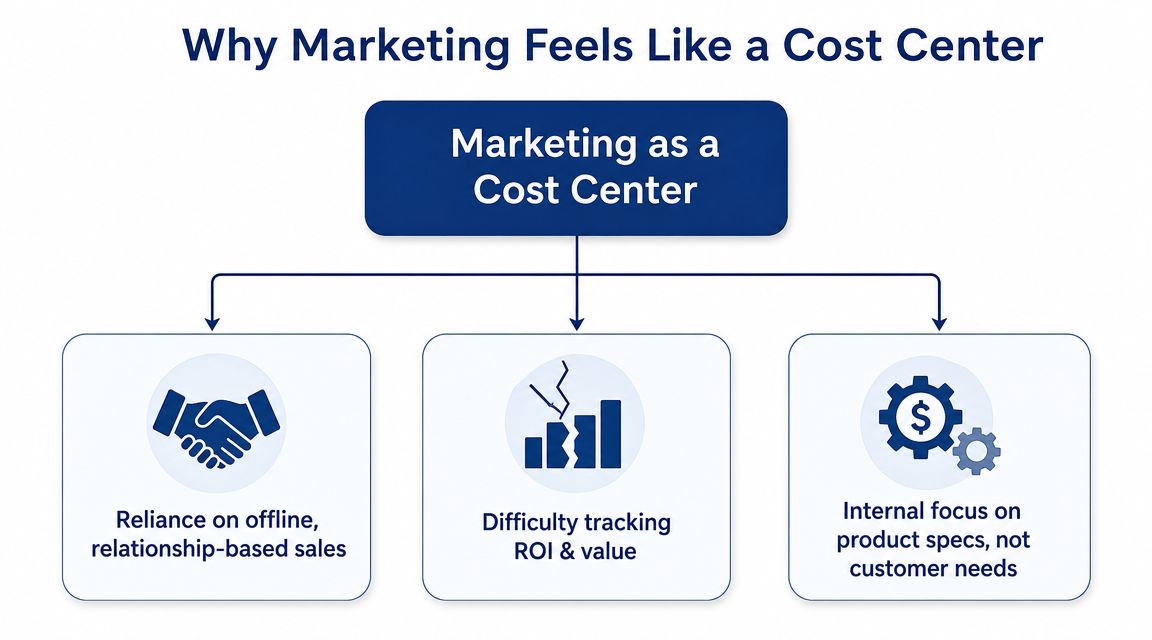
For years, many manufacturers grew through relationships, distributors, field sales, referrals, and trade shows. That model still matters. The problem is that buyer behavior changed faster than internal capability. Research summarized by Red-Fern notes that manufacturers have long relied on offline selling while digital buying behavior moved ahead, and it reports that 78% of industrial companies plan to increase AI spending while 70% name data quality as the barrier, which points to a systems problem, not just a creativity problem, in its review of marketing for manufacturers.
Old sales habits create modern marketing debt
When a company has grown through sales relationships, marketing usually gets defined narrowly. Build the booth graphics. Update the website. Make the line card. Write the email blast. Support the rep.
That's not useless work. But it traps marketing in a reactive role.
A sales-led culture creates three predictable issues:
- Marketing becomes production support. The team spends its time making materials instead of shaping positioning, demand capture, and measurement.
- Customer insight stays locked in sales conversations. Engineers, buyers, and operations leaders ask the same questions repeatedly, but those questions never get turned into scalable content.
- Results are judged only by closed deals. In long industrial sales cycles, that standard makes marketing look slow even when it's helping move real opportunities forward.
What to look for inside your business
If marketing feels expensive, check for these operating patterns:
| Pattern inside the business | What it usually causes |
|---|---|
| Sales and marketing use different definitions of a qualified lead | Endless debate about lead quality |
| Website forms route to inboxes instead of a CRM workflow | Slow follow-up and lost context |
| Content focuses on products, tolerances, and capabilities only | Buyers understand what you make, but not why you're lower risk |
| Reporting stops at traffic or email opens | Leadership still can't connect activity to pipeline |
A formal marketing audit process is useful here because most firms don't need more random activity. They need a diagnosis that shows where the system breaks.
Marketing looks like overhead when the company can only see spend, not movement.
The hardest part is that these problems reinforce each other. Sales doesn't trust marketing because attribution is weak. Marketing can't improve attribution because systems are fragmented. Leadership won't fund better systems because marketing hasn't proven ROI. That loop is why manufacturers struggle with marketing long after they have a decent website and a capable team.
The Messaging Fix From Product Specs to Trust Signals
Most industrial content is accurate and still ineffective.
It explains the machine, the material, the process, the capacity, and the options. But buyers making expensive, operationally sensitive decisions don't just need information. They need confidence that choosing you won't create downstream risk.

That distinction matters. Gushwork's analysis of industrial digital marketing argues that the issue is often a failure to build trust, not a lack of information, and points to application notes, proof of uptime, and implementation timelines as examples of de-risking content in its guidance on manufacturing marketing problems.
Informative content is not enough
A spec sheet answers, “What is this?”
A trust asset answers, “Why is this safe to buy?”
That second question is what many teams miss. Even technical buyers are managing risk. They have to defend vendor choices to operations, procurement, finance, leadership, and sometimes a plant team that has seen projects go sideways before.
Here's the practical difference:
- Informative content includes data sheets, feature lists, product pages, and standard capability summaries.
- De-risking content includes application notes, implementation timelines, failure-mode explanations, maintenance expectations, proof of uptime, and customer references that sound like real operators.
If your content only informs, buyers still have to do the risk translation themselves. Many won't.
A simple content audit for trust gaps
Use this lens when reviewing your current assets.
| If your content mostly says | Buyers may still be wondering |
|---|---|
| “Here are our features and specs” | Will this work in my environment? |
| “We serve many industries” | Have you solved my exact use case before? |
| “We provide quality and service” | What happens if something fails after install? |
| “Contact sales for details” | How long will implementation take and who owns what? |
One way to tighten this is to build messages around buyer questions instead of product categories. A solid marketing messaging framework for industrial firms should help you turn technical strengths into claims buyers can evaluate.
Buyers don't just need to understand your solution. They need enough evidence to defend choosing it.
What works better than feature-first messaging
The strongest industrial content usually does one of four jobs:
- Shows fit. It explains where the solution works well and where it doesn't.
- Shows consequences. It addresses failure modes, downtime exposure, or operational trade-offs.
- Shows implementation reality. It explains timing, onboarding, training, and internal responsibilities.
- Shows proof. It gives prospects language, evidence, and references they can carry into internal discussions.
What doesn't work is pretending technical buyers don't care about details. They do. But they care about details in context. Specs matter after trust starts forming, not before.
The Systems Fix Building Your Marketing Machine
Better messaging won't help much if leads still disappear into inboxes, reps follow up inconsistently, and nobody can tell which content influenced an opportunity. Fixing these issues provides the necessary solution.
Manufacturers often struggle most with proving ROI because the path from first inquiry to closed deal is long, involves multiple stakeholders, and leaves data scattered across email threads, CRMs, spreadsheets, and rep notes. NPWS highlights that problem directly and recommends using a CRM to track leading indicators and connect content engagement to sales stages in its discussion of manufacturing marketing challenges.
What a CRM should actually do
A CRM is not just a contact database. It should function as the control layer for your marketing and sales process.
For most manufacturers, that means the CRM should:
- Capture source and context. Form fill, trade show scan, referral, organic visit, email click, downloaded asset.
- Trigger follow-up. Assign ownership, create tasks, send acknowledgments, and start nurture sequences when appropriate.
- Track stage movement. Inquiry, qualified conversation, application fit, quote, active opportunity, closed outcome.
- Store engagement history. Which pages a prospect visited, which assets they consumed, which emails they opened, which meetings happened.
If your CRM only stores names and deal values, it can't answer the questions leadership asks.
A platform like GoHighLevel can handle automation and reporting for some firms. Others use HubSpot, Salesforce, or a simpler stack connected through integrations. Machine Marketing also works on CRM and marketing system implementation for B2B firms, which is relevant when a company already has tools but not a usable process. The tool matters less than disciplined setup.
A useful walkthrough on the systems side is below.
A practical attribution model for long sales cycles
Manufacturers often fail by asking marketing to prove closed revenue too early.
A better model is stage-based attribution. Track which actions precede meaningful sales movement, then report on those indicators consistently.
Use a structure like this:
First-touch indicators
- Organic visit to a solution page
- Download of an application note
- Trade show inquiry
- Contact form tied to a target use case
Mid-funnel indicators
- Return visits from the same company
- Email engagement from multiple stakeholders
- Request for drawings, tolerances, or consultative review
- Meeting booked with a rep or engineer
Pipeline indicators
- Qualified opportunity created
- Quote requested
- Technical review completed
- Proposal advanced to buying committee
This gives you a better reporting language. Instead of saying, “Marketing generated traffic,” you can say, “Marketing influenced opportunities that reached technical review,” or “This content is showing up before quote-stage deals.”
Operating principle: In long sales cycles, leading indicators are not vanity metrics. They are the earliest measurable signs that your system is working.
High-Impact Lead Generation Tactics to Implement Now
Once messaging and measurement are in place, lead generation gets simpler. Not easy, but simpler. You stop chasing channels and start choosing tactics that fit how industrial buyers search, compare, and shortlist.
A key constraint here is content quality and accountability. Salesmate reports that 49% of manufacturers struggle to create enough content, 66% say their content isn't converting, and 64% can't prove ROI in its review of manufacturing marketing challenges. That tells you something important. Tactics don't fail in isolation. They fail when weak content and weak attribution sit underneath them.
Technical SEO that matches buyer intent
Many manufacturing websites are optimized around internal language. Product family names. Acronyms. equipment categories. That helps existing customers. It doesn't do enough for buyers researching a problem.
Start with problem-solution search themes such as:
- process bottlenecks
- application-specific challenges
- material handling issues
- downtime-related queries
- compliance or tolerance concerns
Then build pages that answer practical questions, not marketing abstractions.
Good SEO targets include application pages, troubleshooting articles, comparison pages, and industry-specific use cases.
Weak SEO targets are generic service pages with no decision context and blog posts written only to hit a keyword.
Distribution where technical buyers already pay attention
A strong article that nobody sees is still a weak asset.
For manufacturers, useful distribution usually means focused promotion through LinkedIn, sales outreach, email nurtures, rep follow-up, and selective placement in industry communities or trade publications. Many teams often need outside ideas for these efforts, and a practical roundup of actionable demand generation tactics is useful because it helps teams think beyond “post more content” and toward repeatable campaigns.
Use one strong asset in multiple formats:
- Turn an application note into a short LinkedIn carousel for engineers or plant managers.
- Turn a webinar into email follow-up clips and a gated resource.
- Turn a sales FAQ into a web page that captures bottom-funnel search traffic.
ABM lite for industrial teams
Full account-based marketing can get bloated fast. Most small and midsize manufacturers don't need a complicated ABM program. They need a short target account list and coordinated outreach.
A practical version looks like this:
| Step | What to do |
|---|---|
| Build the list | Select a manageable group of target companies by fit, not just size |
| Map the buying roles | Identify engineering, operations, procurement, and leadership contacts |
| Match content to risk concerns | Send different assets to each role based on what they need to approve |
| Watch engagement | Track visits, replies, downloads, and repeat company activity |
| Trigger sales action | Alert reps when engagement suggests active evaluation |
What works here is focus. What doesn't work is blasting the same capability deck to every account and calling it personalization.
Your 90-Day Action Plan for Marketing Transformation
You don't need to rebuild everything at once. You need a sequence.
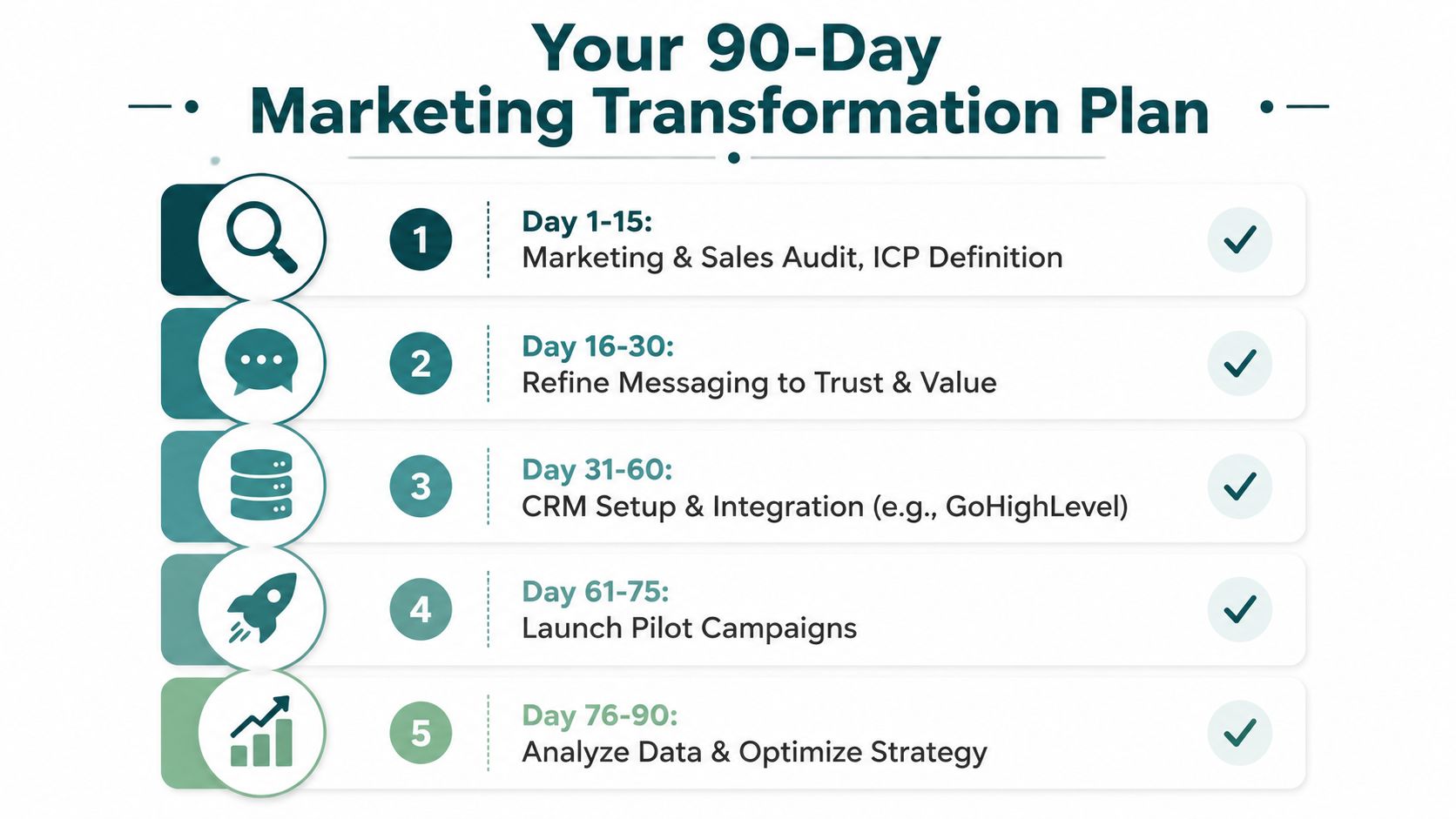
The fastest way to lose momentum is trying to launch SEO, paid media, automation, content, and reporting all in the same week. Manufacturers get better results when they fix the foundation first, then activate.
Days 1 through 30
Start with diagnosis.
- Audit the funnel. Review your website paths, inquiry forms, follow-up workflow, CRM stages, and reporting gaps.
- Interview sales and service. Pull the repeated buyer objections, technical questions, and trust concerns out of conversations.
- Define your ideal customer profile. Focus on fit, buying triggers, and the operational problems you solve best.
- Clean up ownership. Decide who owns inbound response, qualification, nurture, and handoff.
Days 31 through 60
Build the core assets and systems.
Create your first trust-building content set. That might be one application page, one implementation overview, one FAQ page, and one proof asset that addresses reliability or deployment risk.
At the same time, configure your CRM so every inquiry has a source, owner, next step, and stage. Add simple automation where it helps. Confirmation emails, task creation, reminders, and follow-up sequences are enough to start.
Most manufacturers don't need more software in the first month. They need cleaner process design.
Days 61 through 90
Launch focused campaigns and measure movement.
Choose one or two channels only. Organic search and LinkedIn distribution are often enough for a pilot. An ABM-lite outreach sequence can work too if sales and marketing are aligned.
Then review results weekly using leading indicators:
- Inquiry quality
- Speed to first response
- Meetings booked
- Content engagement by account
- Opportunity creation by source
If you're asking why manufacturers struggle with marketing, the short answer is this: they usually try to scale tactics before they build trust and measurement into the system. Fix those two layers, and marketing stops feeling random.
If you want help diagnosing where your marketing system is breaking, Machine Marketing works with manufacturers and industrial firms to connect strategy, messaging, CRM, and lead generation into a process you can measure. A focused diagnosis is usually the fastest next step.