If you're a manufacturing CEO or commercial leader, you've probably had this conversation already. You're funding trade shows, paid campaigns, website work, email, maybe content, maybe an agency, and when you ask what marketing is returning, you get activity reports instead of business answers.
That gap is normal in industrial companies. The buying process is long, several people influence the decision, offline touchpoints matter, and the final sale often lands far away from the first marketing interaction. The fix isn't more dashboards. It's a better measurement system built for how manufacturers sell.
Table of Contents
- Why Is Measuring Marketing ROI So Hard for Manufacturers
- What a Good Marketing ROI Actually Looks Like
- The 4 Marketing KPIs Every Manufacturer Must Track
- Choosing an Attribution Model That Fits Your Sales Cycle
- How to Calculate Your True Marketing ROI
- Building Your ROI Measurement and Dashboard System
- A Practical Roadmap to Improve Your Marketing ROI
- Frequently Asked Questions About Manufacturing ROI
Why Is Measuring Marketing ROI So Hard for Manufacturers
Manufacturers rarely have a marketing problem in the narrow sense. They usually have a measurement problem. Marketing creates touches across the sales cycle, but most companies still try to judge it with a short-cycle formula designed for simpler buying journeys.
BCG points out that measuring ROI gets difficult when sales cycles are long and multiple decision-makers are involved, and that no single measurement method is enough on its own in B2B environments like manufacturing. Their recommendation is a more nuanced model based on contribution margin or revenue per lead rather than simplistic last-click thinking, discussed in BCG's perspective on understanding marketing ROI.
Where generic ROI formulas break down
A manufacturer might meet a prospect at a trade show, follow up by email, get a technical content download, book a plant visit, and then wait while engineering, procurement, operations, and finance evaluate the purchase. If your reporting gives all the credit to the final form fill, your data is wrong before the sales meeting even starts.
That's why many industrial teams feel busy but blind. The issue usually isn't effort. It's that the reporting system doesn't reflect the actual machine.
Marketing in manufacturing behaves more like a production line than a slot machine. Several components work together before revenue comes out the other end.
What makes industrial ROI different
A few factors make marketing ROI for manufacturers harder than in many other sectors:
- Long decision windows: Buyers often need time to validate suppliers, specifications, risk, and internal approvals.
- Multiple stakeholders: Engineering may care about capability, procurement may care about price, and leadership may care about supply continuity.
- Offline influence: Trade shows, calls, site visits, distributor conversations, and field sales all affect the deal.
- High-value opportunities: A small number of wins can distort reporting if attribution is weak.
If this sounds familiar, it helps to compare your situation against common industrial patterns. Why manufacturers struggle with marketing lays out many of the operational issues that sit behind poor ROI visibility. For another outside perspective, Gilkes Media on digital marketing for manufacturers is also useful because it frames industrial marketing around process, not promotion.
What a Good Marketing ROI Actually Looks Like
Teams often start with the wrong question. They ask, “What ROI should marketing produce?” when the better question is, “What does a healthy marketing system look like when it's tied to revenue?”
Salesforce gives a practical benchmark here. A 5:1 return, meaning $5 in revenue for every $1 spent, is generally considered very good in B2B marketing, according to Salesforce's guide to marketing ROI. That number is useful, but only as a reference point. It isn't a verdict.
The benchmark is a starting point, not the answer
A 5:1 ratio sounds clean. In practice, manufacturers need more context.
A business selling standard products with shorter sales cycles may be able to judge channel performance more quickly. A company selling engineered systems, custom assemblies, or capital equipment usually can't. In those environments, a single quarter can hide the actual value of earlier marketing work.
That's why we don't treat ROI as one score. We treat it like a machine health check. If the output is weak, you inspect the inputs, the transfer points, and the loss points.
What must be included in the calculation
Salesforce also notes that ROI calculations should include all campaign costs, not just ad spend, and that companies should track conversion rates, customer lifetime value, and customer acquisition cost for a complete picture. That matters because many manufacturers understate cost on one side and over-credit revenue on the other.
A more honest view includes items like:
- Campaign execution costs: Ads, content production, design, trade show support, agency work.
- Platform costs: CRM, automation software, analytics, reporting tools.
- Labor and follow-up effort: Internal team time, sales enablement, and operational support tied to marketing.
- Revenue quality: Not just closed revenue, but whether the customer is profitable and likely to buy again.
Practical rule: If finance would count it as part of acquiring demand, it probably belongs in your ROI model.
For teams trying to benchmark lead economics before they tackle full-funnel ROI, Machine Marketing's article on cost of a lead is a useful companion read. It helps separate cheap leads from commercially valuable ones.
The 4 Marketing KPIs Every Manufacturer Must Track
You don't need more metrics. You need the right gauges on the panel.
Market Veep's manufacturing ROI guidance recommends tracking the full revenue cycle, including MQLs, SQLs, conversion rates, customer lifetime value, and customer acquisition cost, because lead quality directly shapes return. That framework appears in their article on inbound marketing ROI for manufacturing companies.
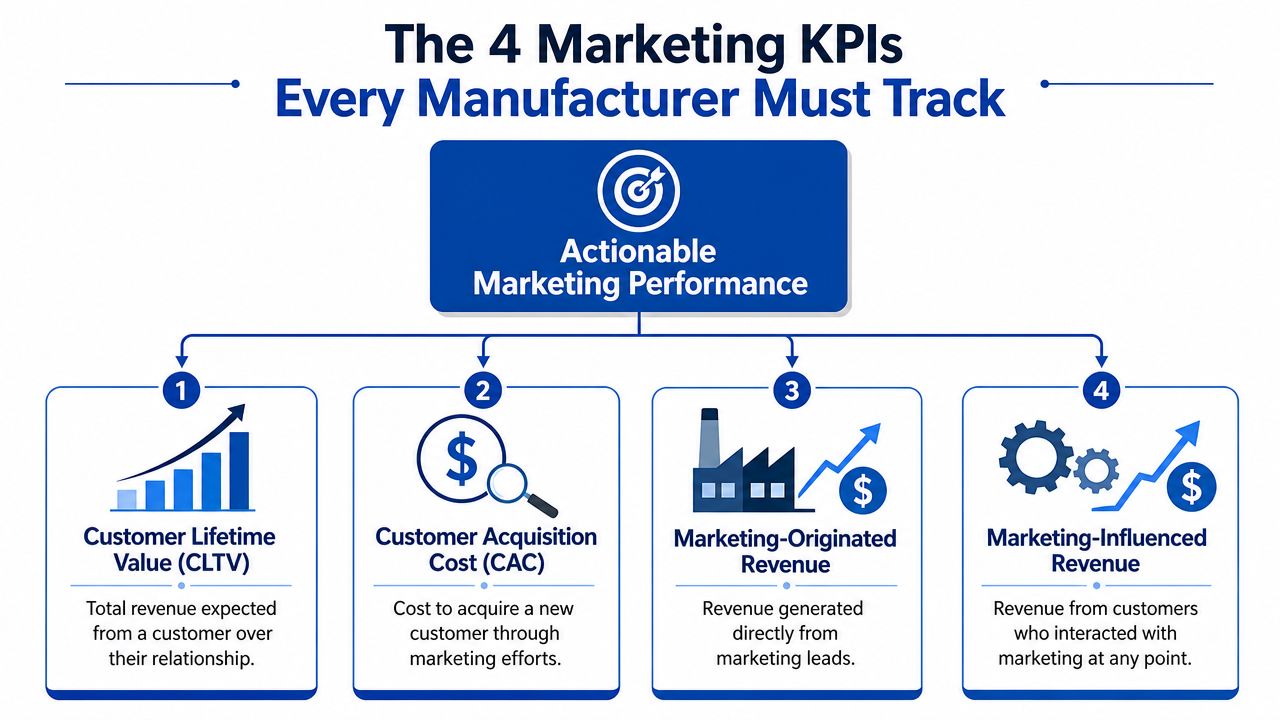
The four gauges that matter most
We recommend four core KPIs for marketing ROI for manufacturers:
| KPI | What it tells you | Why it matters |
|---|---|---|
| Customer Acquisition Cost | What it costs to win a new customer | Shows whether growth is efficient |
| Customer Lifetime Value | Total expected value of the customer relationship | Prevents short-term decisions that hurt long-term return |
| Pipeline Velocity | How quickly opportunities move through the pipeline | Reveals friction in the handoff from marketing to sales |
| MQL to SQL Conversion Rate | How many marketing-qualified leads become sales-qualified | Exposes lead quality and qualification issues |
How to use them as a system
Customer Acquisition Cost is your efficiency gauge. If CAC keeps rising while win quality stays flat, you likely have weak targeting, expensive channels, or a leakage problem between inquiry and sales follow-up.
Customer Lifetime Value keeps the business from cutting channels that produce better long-term customers. Some programs don't look impressive on first-touch revenue, but they create accounts with repeat orders, larger average deals, or stronger retention.
Pipeline Velocity acts like cycle time in operations. If opportunities enter the system but stall for too long, marketing might be attracting the wrong fit, sales might lack relevant follow-up content, or the buyer may not have enough confidence to move.
MQL to SQL Conversion Rate tells you whether marketing is producing usable demand or just filling the CRM with names. High volume with weak conversion usually means your targeting criteria are too loose or your offer is attracting early-stage curiosity rather than actual buying intent.
What to watch for in the data
If one KPI is out of line, don't rush to change budget. Diagnose the fault first.
- High lead volume, low SQL conversion: Your campaign message may be too broad.
- Healthy SQL creation, slow velocity: Sales tools or technical proof may be missing.
- Strong revenue, weak lifetime value: You may be attracting poor-fit accounts.
- Low CAC in one channel: Confirm that the quality holds up through closed-won, not just inquiry stage.
For teams building a stronger KPI framework, this guide to marketing KPIs for manufacturing helps tie dashboard metrics back to revenue decisions.
Choosing an Attribution Model That Fits Your Sales Cycle
Attribution answers a basic question. When a deal closes, which touches deserve credit?
For manufacturers, the wrong model usually creates the wrong budget decisions. If one prospect first meets your company at a trade show, later downloads a technical guide, then responds to an email and asks for a quote, a single-touch model will oversimplify what happened.
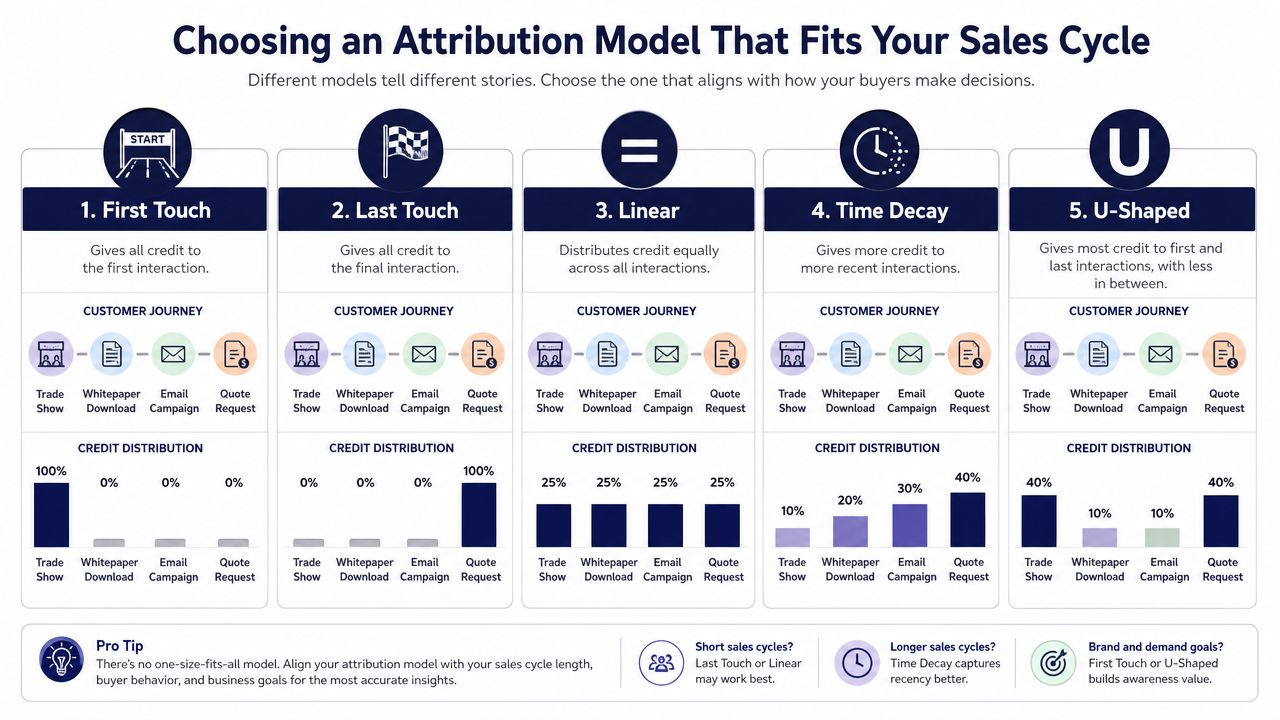
The simple models and their limits
Here's the short version:
- First touch: Gives all credit to the first interaction.
- Last touch: Gives all credit to the final interaction before conversion.
- Linear: Spreads credit evenly.
- Time decay: Gives more weight to recent touches.
- U-shaped: Heavily credits the first and conversion-driving interactions, with less credit in the middle.
A first-touch model can be useful when you want to understand which channels create initial awareness. A last-touch model can help you see which actions tend to trigger inquiry. Neither is enough by itself in an industrial sale with multiple stages.
What usually works better for manufacturers
Manufacturers typically need multi-touch attribution because the buying process is cumulative. Buyers build confidence over time. They don't move from ad click to purchase order in one motion.
A practical way to choose:
| Model | Best use | Main weakness for manufacturers |
|---|---|---|
| First touch | Awareness analysis | Ignores later persuasion and sales support |
| Last touch | Conversion trigger analysis | Overcredits the final action |
| Linear | Balanced overview | Treats all touches as equally important |
| Time decay | Late-stage influence | Can undervalue early technical education |
| U-shaped | Longer journeys with clear entry and conversion points | Still simplifies complex committee buying |
If your sales cycle includes trade shows, distributor conversations, sales calls, and technical content, single-touch reporting will almost always leave out part of the story.
The right model depends on how your buyers behave. But for most industrial companies, any system that shares credit across the journey will produce better decisions than one that hands all credit to a single click.
How to Calculate Your True Marketing ROI
The basic formula is simple. The hard part is making the inputs honest.
Most ROI errors happen in two places. Companies undercount the cost of marketing, and they overstate how confidently revenue can be assigned to one activity. For manufacturers, there's a third issue as well. Revenue alone can hide whether the business being won is worth having.
Start with the basic formula
At the simplest level, marketing ROI is:
| Element | Practical meaning |
|---|---|
| Return | Revenue or profit attributed to marketing |
| Investment | The full cost of producing and supporting that marketing |
| ROI | The financial gain relative to what you spent |
That formula is useful. But if you stop there, you'll reward channels that generate top-line activity while missing whether they create healthy business.
Revenue ROI versus profit ROI
A more rigorous approach for manufacturers is to measure profit ROI, not just revenue ROI. That matters when one product line has healthy margins and another requires high service effort, custom engineering time, or expensive support. The argument for profit-based measurement, with attention to contribution margin and customer lifetime value, is covered in this discussion of profit-focused B2B ROI measurement.
Here's the trade-off in plain English:
- Revenue ROI is easier to calculate and easier to explain.
- Profit ROI is harder to build but much closer to business reality.
A campaign that produces large quoted opportunities can look strong on revenue. If those jobs carry weak margins, heavy customization, or costly onboarding, the actual return may be much lower.
What to include in your true calculation
Your model should include more than ad spend. In a manufacturing setting, consider:
- Direct program costs: Media, trade shows, content, email tools, external support.
- Internal delivery costs: Team time, technical input, campaign operations, reporting.
- Sales support tied to acquisition: Follow-up workflows, meeting support, demo or quote prep if those are part of the acquisition path.
- Attributable business value: Revenue at minimum, contribution margin if you can support it cleanly.
Decision test: If two campaigns produce similar revenue but one brings in more profitable work, the higher-profit campaign is the better marketing investment.
If you can't move to profit ROI immediately, start with revenue ROI and build the process to add margin data later. Imperfect but consistent beats theoretically perfect and never implemented.
Building Your ROI Measurement and Dashboard System
A spreadsheet can hold numbers. It can't create trust.
If marketing ROI for manufacturers is going to influence budgets, hiring, and channel decisions, the company needs a reporting system that sales and leadership both believe. That means one source of truth, consistent tracking, and a dashboard that shows movement through the revenue cycle rather than disconnected campaign snapshots.
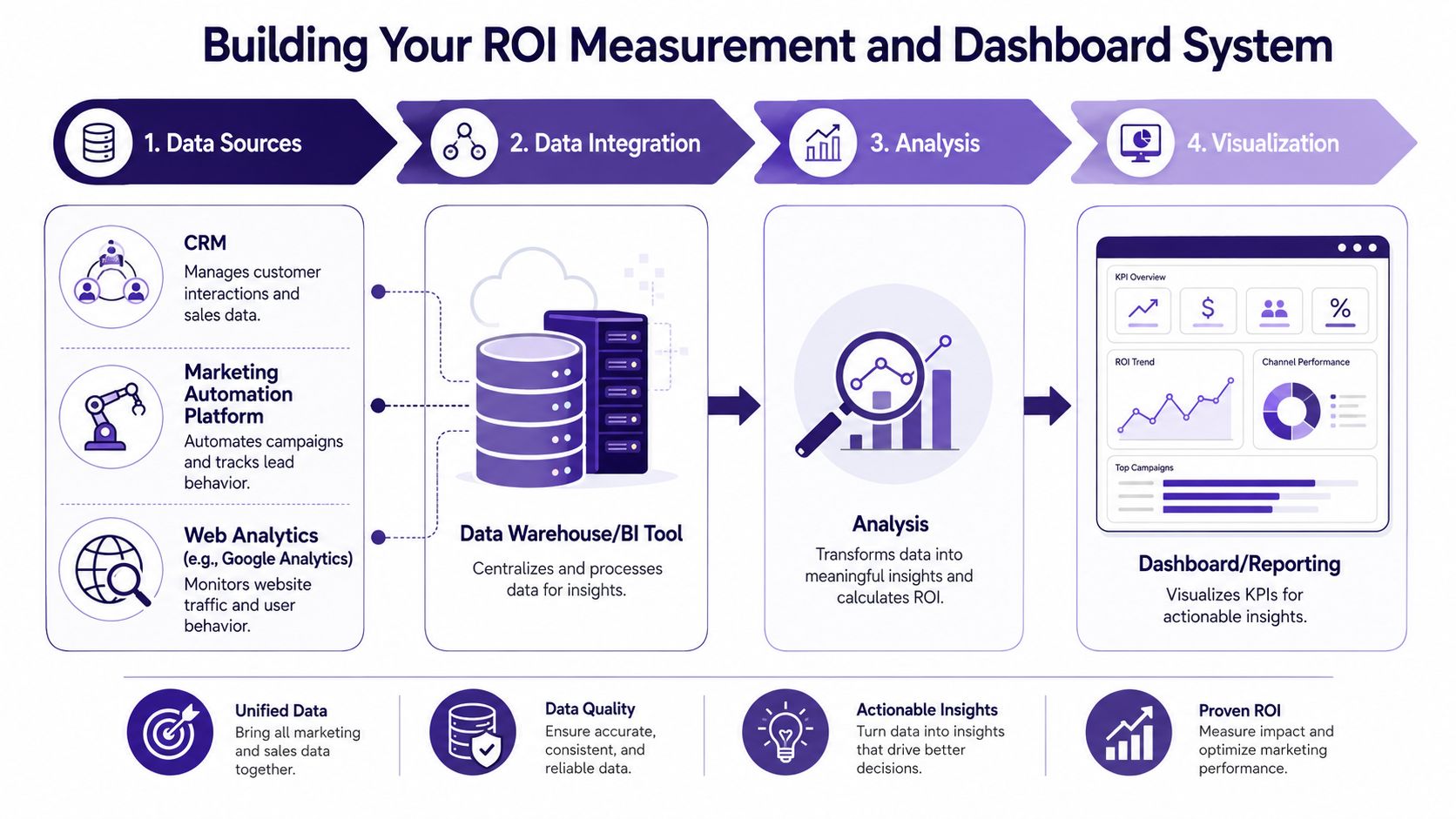
CRM is the center of the system
HockeyStack's B2B ROI guidance recommends integrating marketing platforms with the CRM so the business can track leads from first touch to closed deal. It also recommends combining CRM data with marketing automation, UTM parameters, and offline tracking such as call tracking and unique meeting links. That approach is laid out in HockeyStack's explanation of how to measure B2B marketing ROI.
Without that integration, teams end up with partial truths:
- Marketing sees clicks and form fills.
- Sales sees opportunities and deals.
- Leadership sees spend and asks why the numbers don't line up.
The minimum viable measurement stack
A workable system usually includes these components:
CRM
This is the master record for contacts, companies, opportunities, and revenue status.Marketing automation platform
This captures campaign engagement, lead behavior, and nurture activity.Web analytics with UTM discipline
UTM tagging helps identify where visits, conversions, and inquiries originated.Offline tracking methods
Call tracking, unique meeting links, event-specific forms, and CRM fields for trade show or field influence matter in industrial sales.Dashboard or BI layer
Leadership sees the combined view here.
What the dashboard should show
Don't crowd the dashboard with vanity metrics. A CEO-level view should answer a few practical questions:
- Where is qualified demand coming from
- How much pipeline marketing is creating or influencing
- How efficiently opportunities move toward closed-won
- What acquisition is costing
- Which channels produce commercially useful customers
For companies that already have tools but need the system tied together, Machine Marketing is one option among others for manufacturing-focused strategy, CRM structure, and reporting design. The key isn't the vendor name. It's whether the setup creates closed-loop visibility from first touch to won revenue.
A Practical Roadmap to Improve Your Marketing ROI
Most manufacturers don't improve ROI by finding one magic channel. They improve it by fixing the system in the right order.
First Page Sage reports that strong content-led campaigns can compound over time, with an example path of 367% ROI in Year 1, 633% in Year 2, and 656% in Year 3, and it also reports average yearly ROI of $984,000 for high-performing content marketing campaigns in its benchmark set. That pattern is explained in First Page Sage's content marketing ROI benchmarks by industry. For manufacturers, that matters because trust, authority, and search visibility often build value gradually rather than instantly.
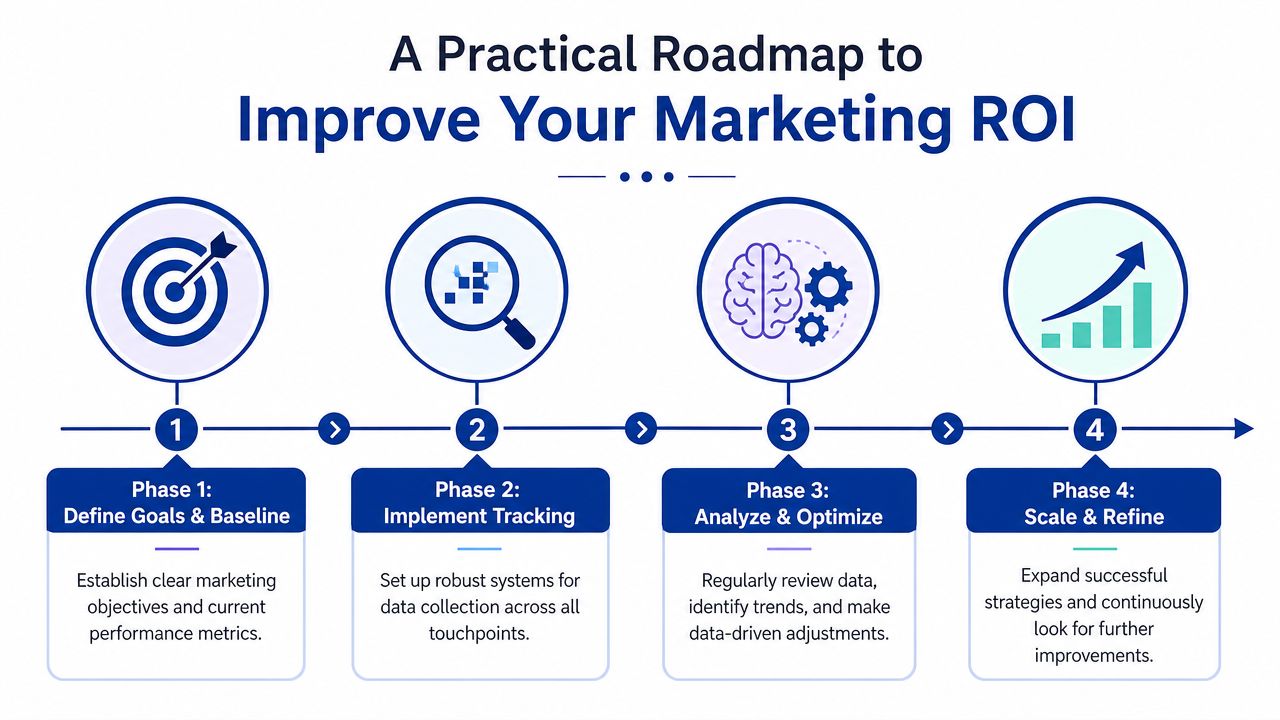
Phase 1 and Phase 2
The first half of the roadmap is diagnostic.
Phase 1 is baseline definition. Pull the last meaningful period of data and identify what you can trust. Separate raw inquiries from qualified opportunities. Confirm where source data is missing, inconsistent, or being entered manually.
Phase 2 is tracking repair. Tighten campaign naming, UTM usage, CRM fields, lead-source rules, and offline capture. If a trade show lead, a call, and a quote request all enter the CRM differently, your reporting won't hold.
Operator's note: Don't optimize campaigns while the data is still unreliable. Fix the instrumentation first.
This is also where conversion-rate work becomes useful. If landing pages, quote forms, and follow-up sequences are underperforming, ROI suffers even when traffic quality is decent. For teams thinking specifically about post-click improvement, Alpha Omega Digital helps increase online sales with practical CRO ideas that map well to industrial websites.
Phase 3 and Phase 4
After the instrumentation is stable, shift from cleanup to controlled improvement.
Phase 3 is budget reallocation. Move spend away from channels that create noise and toward channels that consistently produce qualified conversations, better-fit accounts, or stronger pipeline progression. This usually means judging channels by opportunity quality, not by lead count alone.
A short way into this phase, pause and review the process from end to end.
Phase 4 is compounding asset investment. Here, many manufacturers gain an advantage. Technical content, SEO, application pages, buying guides, and authority-building content often take longer to mature, but they can keep producing after the original spend is gone. That's why content can outperform short-term campaigns over time in industrial markets.
Questions to ask before scaling
- Are we attracting the right accounts, or just more names
- Which channels influence SQLs and revenue, not just traffic
- Where does the handoff from marketing to sales break down
- Which content reduces buyer hesitation
- Are we scaling profitable demand or expensive demand
The practical sequence is simple. Clean the data. Fix the leaks. Reallocate spend. Then invest in channels that compound.
Frequently Asked Questions About Manufacturing ROI
How long does it take to see ROI from manufacturing marketing
It depends on the channel and the sales process. Paid campaigns and outbound support can create earlier signals. SEO, technical content, and authority-building usually take longer. In manufacturing, that slower build doesn't mean the channel is weak. It often means the buying process requires more trust and more touches before a buyer is ready.
Should we treat marketing as an expense or an investment
Treat it like capital allocation. If marketing is measured poorly, it behaves like overhead. If it's connected to qualified pipeline, customer value, and profitability, it becomes an investment decision.
What if we don't have a sophisticated CRM yet
Start with the CRM you have. The critical step is consistent field structure, source capture, and opportunity tracking. A basic but disciplined setup is more useful than an expensive platform full of bad data.
What should we do first if our ROI is unclear
Start with a diagnosis:
- Audit lead sources: Check whether lead origin is being captured consistently.
- Review funnel stages: Make sure MQL, SQL, and opportunity definitions are clear.
- Inspect cost inputs: Confirm you're counting more than media spend.
- Check attribution logic: Identify where offline and multi-touch influence is being missed.
What usually hurts ROI the most
It's rarely one big failure. More often it's a chain of smaller problems. Weak targeting creates poor leads. Slow follow-up reduces conversion. Missing CRM discipline hides what worked. Leadership then cuts budget based on incomplete data.
The companies that improve ROI fastest usually don't market more. They measure better, then remove friction from the system.
If you want a clear diagnosis of your marketing ROI for manufacturers, Machine Marketing can help you map your funnel, clean up attribution, and build a measurement system that connects marketing activity to qualified pipeline and revenue.