If your shop does excellent work but your website brings in inconsistent leads, the problem usually isn't your capability. It's the gap between how buyers research and how your site shows up. We see this with manufacturers all the time. The company has strong equipment, tight tolerances, solid customer retention, and a sales team that knows the market, but online visibility is thin where it matters.
That gap has become harder to ignore. Gartner projected that by 2025, 80% of B2B sales interactions between suppliers and buyers would happen in digital channels, and Conductor's 2024 data showed organic search generated 33% of overall website traffic across seven key industries according to SalesLayer's summary of manufacturing SEO trends. If engineers, procurement teams, and operations leaders are researching online first, your industrial SEO strategy can't be a side task.
The practical question isn't “how do we get more traffic?” It's “how do we build a search system that supports quoting, spec review, vendor selection, and sales follow-up?” That's the frame that matters for industrial companies.
Table of Contents
- Why Your Industrial Business Isn't Getting Found Online
- Phase One Diagnosis and Technical Foundation
- Phase Two Mapping Your Audience and Keywords
- Phase Three Building High-Value Digital Assets
- Phase Four Expanding Your Digital Footprint
- Phase Five Measurement and CRM Integration
- Your 30-60-90 Day Industrial SEO Action Plan
Why Your Industrial Business Isn't Getting Found Online
A common scenario looks like this. A machining company has invested in better equipment, trained operators well, and built a reputation through referrals. Their website lists services, maybe shows a few parts, and has a contact form. Yet when a design engineer searches for a process capability, a procurement manager compares suppliers, or an operations lead looks for a backup vendor, the company barely appears.
That's not rare. It's typical.
Most industrial websites weren't built as search systems. They were built as digital brochures. They describe the company in broad terms, hide the technical details buyers need, and make it hard for search engines to understand what each page solves. The result is low visibility for high-intent queries and weak conversion paths for the buyers who do arrive.
The real issue is usually diagnosis, not effort
Many teams respond by publishing random blog posts or buying scattered SEO tasks. That rarely fixes the root problem. If the site is slow, pages are thin, product information is vague, and conversion tracking stops at form fills, more content just creates more noise.
Industrial SEO works when you treat the website like an engineered system. Inputs, constraints, throughput, failure points, and measurable output all need to be visible.
The other issue is audience mismatch. Industrial buyers don't all search the same way. Engineers look for tolerances, material compatibility, drawings, certifications, and process limits. Procurement teams care about lead time, vendor risk, geography, and quote responsiveness. Executives want confidence that you can support the account over time. A page that says “high-quality solutions for many industries” helps none of them.
What to look for on your site right now
Use this short test:
- Search clarity: Can a buyer tell within a few seconds what you make, for whom, and in what specs or applications?
- Page depth: Do your service and product pages include real technical information, or just marketing copy?
- Conversion path: Can visitors request a quote, download a spec sheet, or identify the right next step without friction?
- Search alignment: Does each important page target a distinct buyer question or buying task?
- Measurement: Can you trace organic visits to quote requests, downloads, or CRM records?
If several of those answers are no, your site isn't failing because your market is too niche. It's failing because the digital buying path is incomplete.
Phase One Diagnosis and Technical Foundation
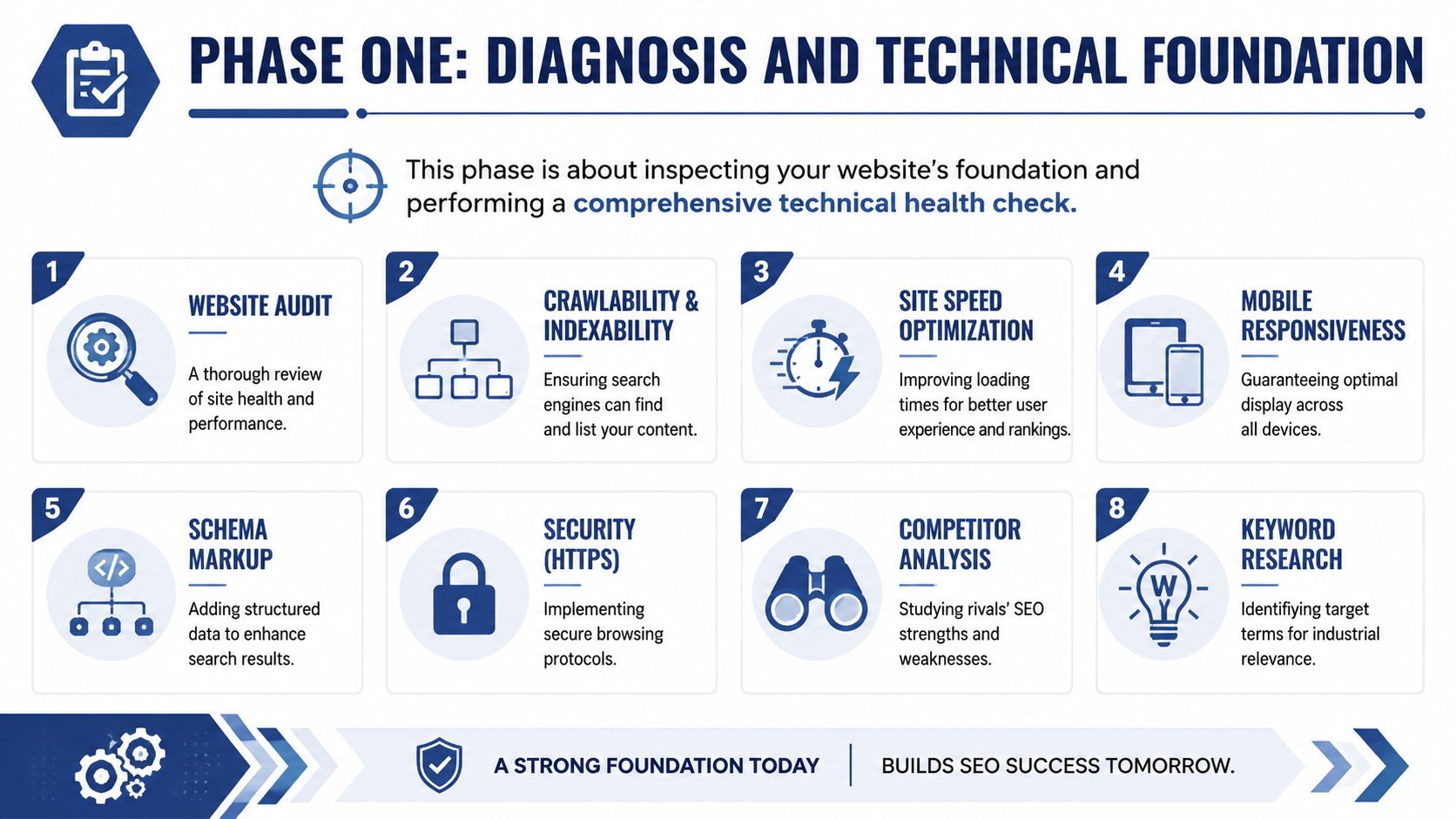
Most industrial SEO problems start below the surface. Before writing new pages or chasing backlinks, inspect the site the way you'd inspect a production line. You need to know what's accessible, what's broken, what's slow, and what's creating friction.
What usually breaks first
Industrial sites often have the same pattern of technical debt. Important pages are buried deep in navigation. PDFs hold critical product information that should also exist in HTML. Search engines hit duplicate pages, old redirects, broken links, and unclear canonicals. Mobile layouts also tend to degrade faster on industrial sites because many were designed around desktop product tables and dense spec content.
A measurement-first workflow is the right starting point. Walker Sands recommends setting KPIs such as organic traffic, rankings, keyword visibility, share of voice, CTR, and lead generation, then establishing a baseline in GA4 or Semrush before making changes in its guide to developing an SEO strategy. That baseline keeps teams from guessing.
Your technical baseline checklist
Dot IT's guidance on long-term SEO performance recommends prioritizing high-impact fixes first, especially high-impression, low-CTR pages, and maintaining site speed under 3 seconds alongside technical fundamentals like XML sitemaps, robots.txt, and canonical tags in its article on creating an SEO strategy that drives long-term results. For industrial sites, that's the practical benchmark.
Start with this checklist:
- Crawlability: Confirm that important pages can be discovered through internal links, your XML sitemap, and clean navigation.
- Index control: Review robots.txt, noindex settings, canonical tags, and duplicate URLs so search engines know which version matters.
- Speed: Test key templates, especially product pages and resource pages. Heavy images, scripts, and bloated plugins often slow them down.
- Mobile responsiveness: Check spec tables, quote forms, menus, and file download pages on actual phones, not just a browser preview.
- Broken pathways: Find broken links, redirect chains, missing files, and outdated URLs from old site migrations.
- Search snippets: Identify pages with high impressions but weak click-through. Those are often the fastest wins.
If you also need a clearer view of off-page authority signals, this guide on how to boost domain authority for B2B is useful context when you move beyond technical cleanup.
How to prioritize fixes
Don't fix everything at once. Rank issues by business impact.
A simple priority model works well:
| Issue type | Business effect | Priority |
|---|---|---|
| Broken quote or contact paths | Blocks lead capture | Immediate |
| Important pages not indexed | Prevents discovery | Immediate |
| High-impression, low-CTR pages | Fast visibility gains | High |
| Slow core templates | Hurts user experience and rankings | High |
| Duplicate or thin pages | Dilutes relevance | Medium |
| Cosmetic SEO tasks | Low direct impact | Later |
Practical rule: If a page drives buyer action or supports sales conversations, inspect and improve that page before publishing anything new.
This is also where a manufacturing-specific reference point helps. If you want a benchmark for how these pieces fit industrial sites specifically, review this guide on SEO for manufacturing companies. Use it as a comparison against your current setup, not as a substitute for your own audit.
Phase Two Mapping Your Audience and Keywords
Keyword research for industrial companies usually fails because it starts in a tool and ends in a spreadsheet. That produces terms, not strategy. Your buyers aren't searching casually. They're trying to solve design constraints, supplier gaps, compliance requirements, or production risks.
Stop treating all buyers the same
An engineer and a procurement manager may both arrive through organic search, but they won't use the same language or want the same next step.
Here's a practical way to split your audience:
- Engineers: Search by process, tolerance, material, application, performance requirement, or part type.
- Procurement teams: Search by supplier category, location, certification, availability, and quote comparison.
- Operations leaders: Search around reliability, capacity, quality systems, and support.
- Executives or owners: Search for capability fit, strategic vendor relationships, and risk reduction.
That distinction changes your page strategy. Engineers need technical specificity. Procurement needs commercial confidence. Leadership needs proof that you can support the relationship.
Where real industrial search language comes from
The best keyword inputs usually sit outside SEO tools. We've found stronger language in sales call notes, RFQ emails, customer service logs, product manuals, distributor catalogs, and the words buyers use when they misname a process or material.
Good sources include:
- Sales team feedback: Ask what prospects say before they're educated by your team.
- Competitor spec sheets: These often reveal naming conventions, application language, and comparison angles.
- Technical forums and communities: Look for repeated questions, not just terminology.
- Internal search logs: If your site has search, review what visitors try to find.
- Support and quoting emails: These show how buyers describe problems in plain language.
If you want an external starting point for structured idea gathering, this manufacturing sector keyword analysis resource can help surface categories you may want to validate against your real customer language.
Build a buyer intent map
Once you've gathered terms, don't sort them only by volume. Sort them by intent and sales relevance.
A simple buyer-intent map looks like this:
| Query type | What the buyer is doing | Best page type |
|---|---|---|
| Educational query | Learning a process or requirement | Guide, glossary, explainer |
| Comparative query | Comparing methods, materials, or suppliers | Comparison page, decision guide |
| Specification query | Validating fit or technical limits | Product or capability page |
| Transactional query | Looking to contact or quote | RFQ page, location page, service page |
This step keeps teams from overinvesting in terms that bring visitors but not opportunities.
A good industrial SEO strategy doesn't chase every keyword. It focuses on the searches that move someone toward qualification, quoting, or vendor selection.
When you map keywords this way, content decisions get easier. You stop asking, “What should we write next?” and start asking, “What buying task is still unsupported?”
Phase Three Building High-Value Digital Assets
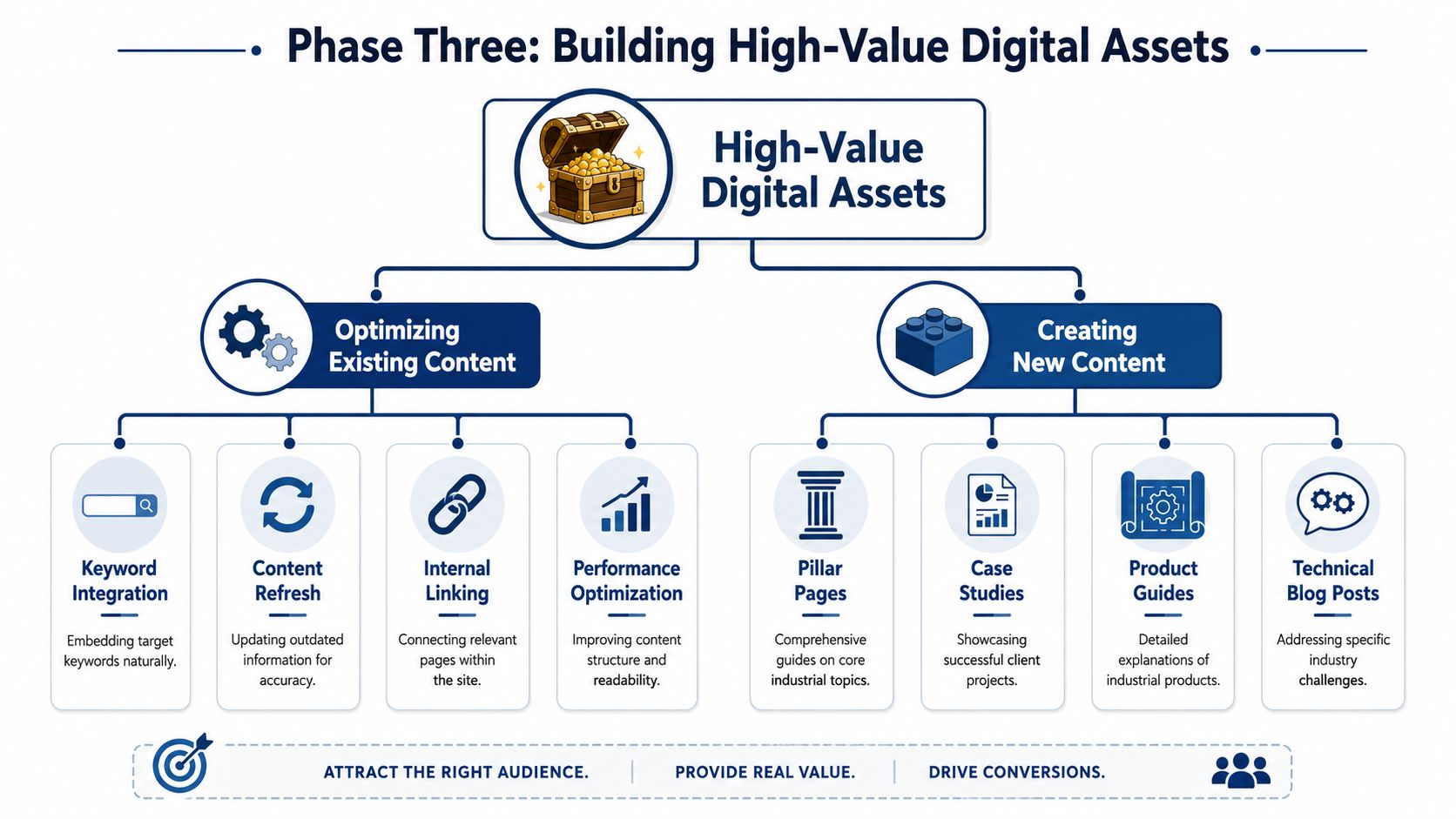
Once the foundation is stable and your intent map is clear, start building assets that support real buying behavior. For industrial companies, that usually means two categories. First, pages near revenue. Second, authority content that helps technical buyers trust and shortlist you.
Start with the pages that already sit closest to opportunity.
Fix the pages closest to revenue first
For many manufacturers, those pages are product, service, capability, industry, and application pages. Yet they're often the weakest assets on the site. They talk broadly about quality and service but skip the details buyers use to qualify a vendor.
A stronger industrial page includes:
- Technical specifications: Materials, tolerances, sizes, standards, finishes, machine ranges, or process limits.
- Application context: Where the product or service fits, and what problems it solves.
- Decision support: Compatibility notes, comparison details, certifications, file downloads, and FAQs.
- Clear next steps: Request a quote, submit a drawing, download a CAD file, talk to engineering, or ask about lead times.
Consider a CNC machining page. A weak version says you provide precision machining for multiple industries. A stronger version names materials, part sizes, supported processes, tolerance ranges, common applications, inspection methods, file types accepted for quoting, and the next action the buyer should take.
That's also where your content strategy should connect with broader industrial messaging. If you're developing deeper educational assets around these commercial pages, this guide to content marketing for industrial companies is a useful reference for planning supporting material around buyer questions.
A short video can also help your team think about search visibility as part of a larger growth system.
Build resource hubs that support technical buying
Resource hubs work well in industrial markets because buyers need context before they contact sales. A hub can anchor a core topic like metal fabrication techniques, material selection, industrial coatings, or tolerance design. Supporting pages then answer narrower questions linked to that topic.
A useful hub-and-spoke model often includes:
- A hub page: Broad topic overview with internal links to supporting pages.
- Technical explainers: Process comparisons, design considerations, or terminology.
- Decision guides: When to choose one method over another.
- Reference assets: Downloadable checklists, spec summaries, or qualification guides.
If a page can't help a buyer make a better decision, it probably doesn't deserve to exist.
This model works because it mirrors how industrial research happens. Buyers don't jump from zero knowledge to “request a quote” in one visit. They gather evidence, compare options, and return later with a more specific need.
Create pages that still earn the click
Many SEO playbooks are already outdated. Informational visibility still matters, but not every search deserves your effort. Gushwork notes that Google's AI Overviews reached more than 1.5 billion monthly users in 2025, and argues industrial firms should focus on queries tied to RFQs, product selection, compliance, and high-intent comparisons in its article on SEO for industrial companies.
That shifts what “good content” means.
Pages that still earn clicks usually offer something the search result can't fully replace:
- Detailed comparisons between materials, methods, or part options
- Compliance and certification pages buyers need to validate
- Application-specific guidance tied to actual industrial use cases
- Tools and structured resources such as calculators, selectors, or downloadable specs
- Original operational detail like process constraints, accepted formats, and quoting workflows
A weak content program aims for more indexed pages. A strong one builds fewer, more valuable pages that support qualification.
Phase Four Expanding Your Digital Footprint
A strong site alone won't carry your visibility. Industrial companies also need external signals that tell search engines and buyers your business is credible. However, many teams make a costly mistake in this area. They pursue link volume when they should pursue industry relevance.
Why authority beats volume in industrial link building
One link from a respected trade publication, industry association, technical directory, or manufacturing partner can matter more than a pile of unrelated blog links. Industrial buying is trust-heavy. Search engines read authority signals similarly.
The wrong approach looks like this:
- Generic guest posts on sites unrelated to manufacturing
- Paid placements on weak directories
- Outreach emails that ask for links without offering value
- Vendor pages with no context, no relationship, and no reason to exist
The better approach is slower, but it matches how industrial markets work. You earn mentions where your buyers already look for legitimacy.
A credible industrial backlink profile should look like your business network, not like a hacked-together SEO campaign.
Where industrial companies should earn links
Focus on sources that support brand trust and buying confidence.
Good targets include:
- Trade associations: Member profiles, event pages, committee pages, and technical resources
- Industry publications: Expert commentary, contributed articles, or feature coverage
- Supplier and partner sites: Formal partner listings, integration pages, and joint capability pages
- Distributor networks: Territory pages, manufacturer directories, and line card listings
- Educational or technical organizations: Training resources, certification bodies, and industry programs
This is relationship work, not mass outreach. A plant tour for an editor, a useful technical article for an association, a co-branded application page with a partner, or a better distributor profile can all produce links that make business sense even without SEO.
Local visibility still matters
For manufacturers with defined service areas, plants, or regional sales teams, local visibility still influences trust. Your Google Business Profile should describe capabilities, service geography, certifications, and operational fit clearly. Photos, categories, services, and business descriptions all shape whether a local buyer sees you as a realistic option.
Your website should support that footprint with location-aware pages where relevant. Not doorway pages. Real pages that explain which services, teams, or capabilities connect to a region.
If you need a broader framework for how search fits with paid, local, and sales-support channels, this overview of digital marketing for industrial companies is a good reference point.
Phase Five Measurement and CRM Integration
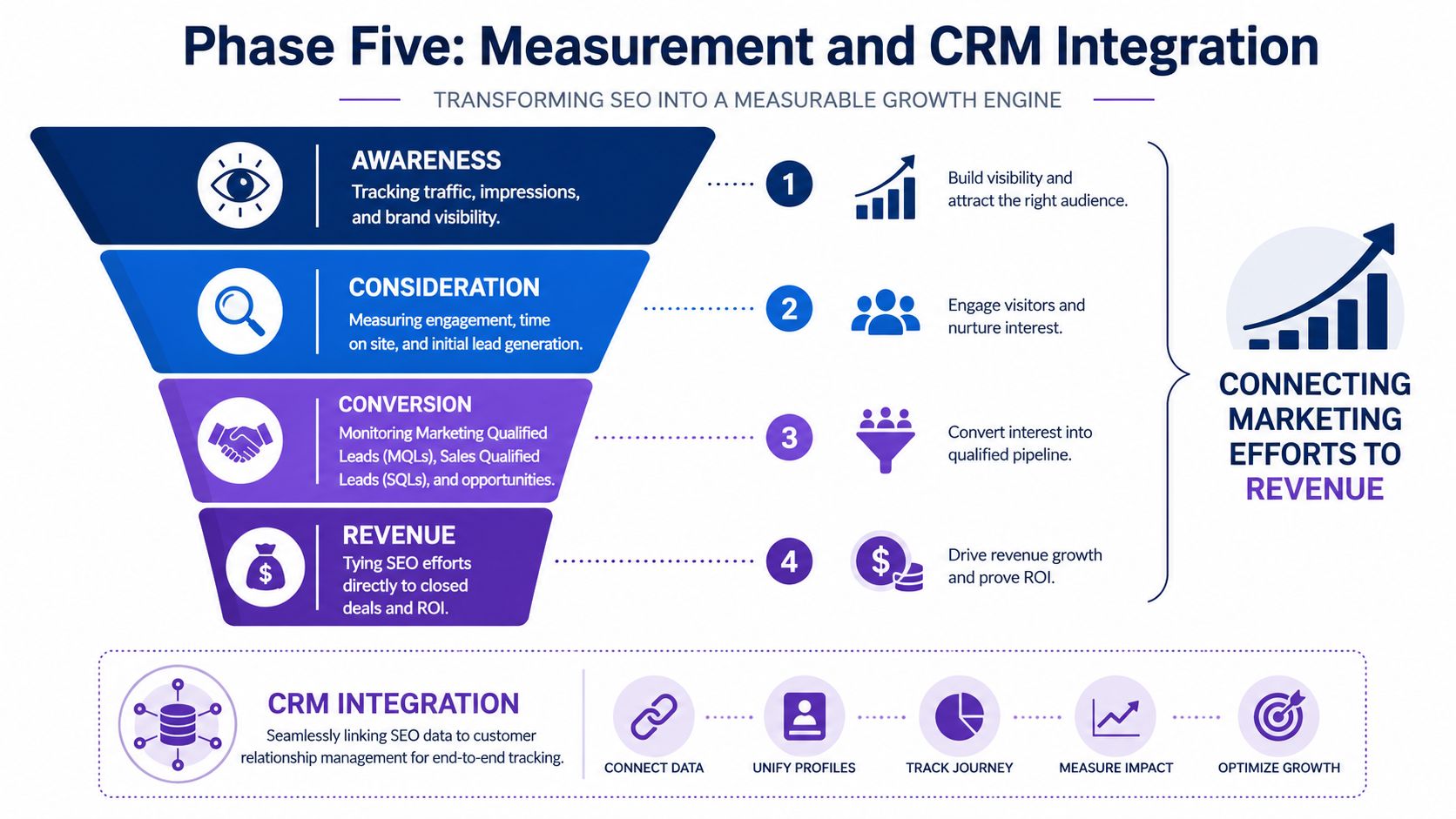
An industrial SEO strategy either becomes a growth system or stays a reporting exercise. Rankings are useful. Traffic is useful. Neither proves business impact on its own.
First Page Sage cites a WordStream benchmark showing an average 3.75% conversion rate for organic search in B2B compared with 1.77% for display ads, in its report on B2B SEO statistics. For industrial companies, that matters because the goal isn't high lead volume. It's better-fit opportunities that survive a long sales cycle.
Track actions that signal buying intent
In GA4, track events that indicate movement toward qualification, not just general engagement.
Useful industrial conversion events often include:
- Request a quote submissions
- Contact sales or engineering form completions
- Spec sheet or catalog downloads
- CAD or drawing downloads
- Clicks on quote buttons or key contact actions
- Visits to certification, compliance, or distributor pages
- Application page engagement tied to high-intent terms
Not every event should carry the same weight. A homepage visit and a drawing upload are not equivalent. Your reporting should separate soft engagement from strong buying signals.
Pass source data into your CRM
Value appears when website activity connects to the CRM record. That means passing original source, landing page, and campaign context into systems like Salesforce, HubSpot, or GoHighLevel when a lead converts.
A practical setup usually includes these fields:
| CRM field | Why it matters |
|---|---|
| Original source | Distinguishes organic search from paid, referral, or direct |
| Landing page | Shows which page started the relationship |
| Conversion page | Identifies where the action happened |
| Key content interaction | Captures downloads, form type, or quote behavior |
| Sales outcome | Connects SEO activity to pipeline and closed business |
For industrial teams, this is especially important because the first search visit often doesn't become the final conversion touch. A buyer may visit from search, return later from email, talk to a rep, involve procurement, and only then submit a formal RFQ. If the CRM doesn't preserve the original search context, SEO gets undercounted.
The first click rarely closes the deal in industrial sales. Your tracking needs to respect the whole buying committee and the whole timeline.
What a useful reporting system looks like
A useful dashboard doesn't drown the team in SEO metrics. It answers operational questions.
Ask for reporting that shows:
- Which organic landing pages produce qualified actions
- Which query themes lead to sales conversations
- Which content assets assist quoting or specification review
- Where leads stall after conversion
- Which pages attract traffic but don't support pipeline
Monthly or bi-weekly review cycles work well for tactical changes, and periodic technical audits help catch regressions before they suppress lead flow. That cadence keeps SEO connected to operations instead of isolated in marketing.
This is also the point where one implementation partner may be useful if your systems are fragmented. Machine Marketing works in this category by connecting SEO, CRM, and automation strategy for industrial businesses, which is relevant when traffic data, lead capture, and sales follow-up currently live in separate tools.
Your 30-60-90 Day Industrial SEO Action Plan
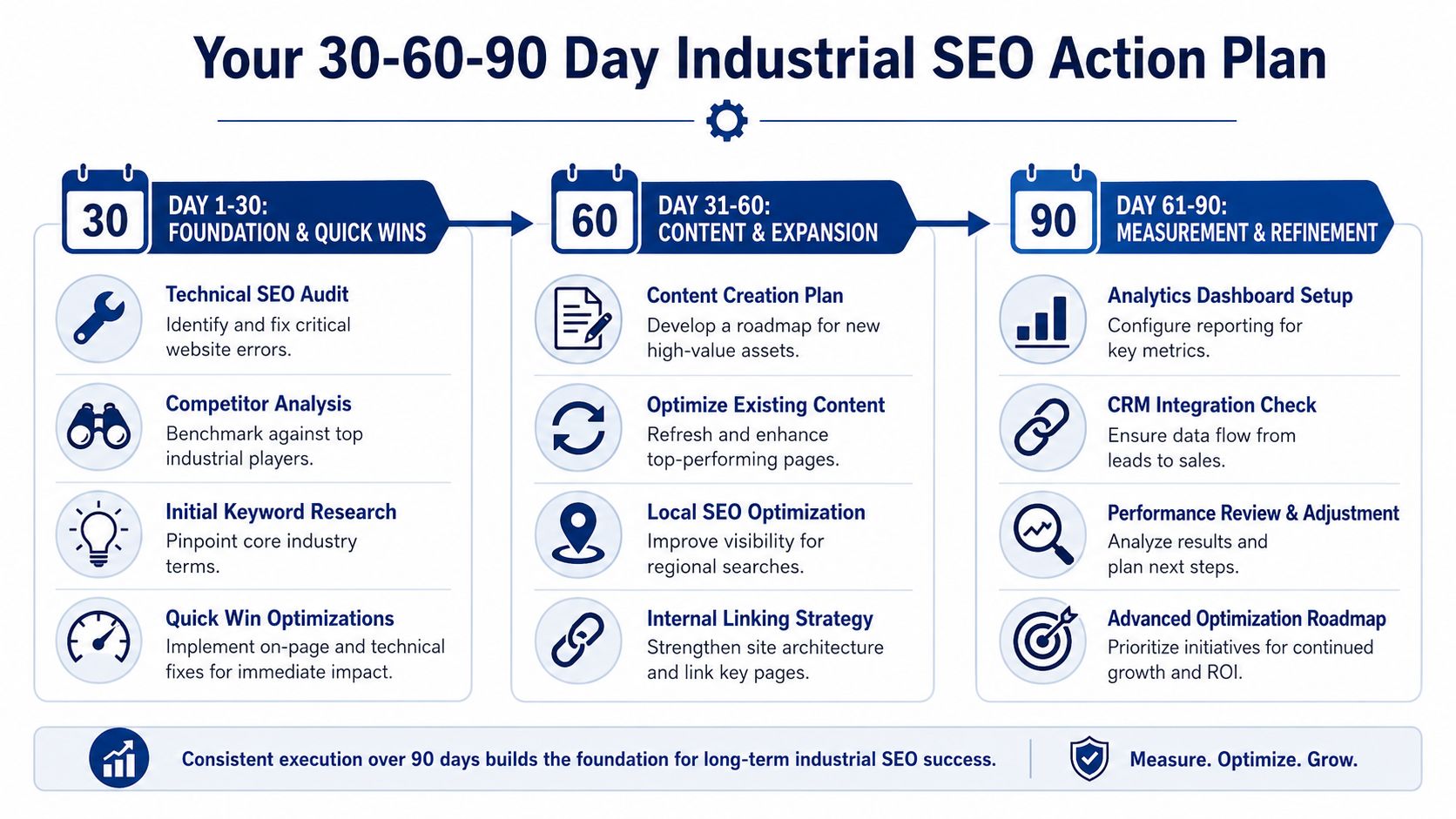
A good plan should reduce confusion, not add another layer of theory. If your team is busy, the right move is staged execution. Fix the system in the order that gives you visibility, buyer clarity, and measurement first.
Days 1 through 30
Start with diagnosis and control.
- Audit the site: Review crawlability, indexation, page speed, mobile usability, broken links, and key page templates.
- Set measurement: Configure GA4 events for quote requests, downloads, and other meaningful actions.
- Establish a baseline: Record rankings, impressions, CTR patterns, landing pages, and lead paths.
- Prioritize quick wins: Fix high-impression, low-CTR pages and repair anything blocking conversions.
Days 31 through 60
Shift to page quality and search alignment.
- Rewrite core pages: Improve service, product, and capability pages with real technical detail.
- Build one hub: Choose a core topic that supports both buyer education and commercial relevance.
- Improve internal links: Connect hub pages, product pages, application pages, and conversion pages logically.
- Tighten calls to action: Match each page's CTA to buyer intent, such as quote request, drawing upload, or spec download.
Days 61 through 90
Expand authority and connect reporting to revenue.
- Begin link outreach: Focus on associations, publications, partners, and directories that make sense commercially.
- Refine local visibility: Improve your Google Business Profile and any region-specific pages.
- Connect CRM fields: Pass source and landing-page data into your sales system.
- Review pipeline patterns: Identify which organic pages create useful opportunities and which need rework.
Progress in ninety days should look like cleaner tracking, stronger core pages, and clearer sales visibility. It doesn't need to look like finished perfection.
If your team follows that sequence, your industrial SEO strategy becomes much easier to manage. You're no longer asking marketing to “do SEO.” You're building a repeatable go-to-market system that helps buyers find you, qualify you, and enter your pipeline with context.
If you want help diagnosing where your current search visibility breaks down, Machine Marketing works with manufacturers and industrial businesses to connect SEO, content, CRM, and lead tracking into a more measurable growth system.