If you're a manufacturer, this situation is familiar. You have real capability, solid equipment, and a sales team that knows how to win business once a buyer gets in the door. But your website sits there like a brochure with a contact form. It gets some traffic, very few qualified inquiries, and almost no consistent RFQ flow.
That usually isn't a product problem. It isn't even strictly a traffic problem. It's a systems problem.
Most manufacturing websites were built around what the company wants to say about itself. Buyers search differently. Engineers search by spec, material, process, application, tolerance, certification, and location. Procurement teams search by supplier fit, lead time, risk, and proof. If your pages don't line up with those searches, your site won't function like a lead generation asset.
A practical keyword strategy for manufacturers fixes that gap. Not as a creative exercise. As an operating system. You diagnose how buyers search, map those searches to the right pages, and build content that captures demand at the moment it shows up.
Table of Contents
- Your Website Is an Underperforming Machine
- The Diagnostic Phase Understanding Search Intent
- Building Your Keyword Blueprint Sourcing and Prioritization
- From Blueprint to Factory Floor Mapping Keywords to Your Site
- On-Page SEO Execution for Industrial Websites
- Activating High-Intent Local and Product Keywords
- Your Content Engine Building and Measuring for Growth
Your Website Is an Underperforming Machine
Manufacturers understand throughput, bottlenecks, and wasted capacity. A website is no different. If qualified buyers aren't finding the right pages, the issue is usually upstream in the system.
Many industrial websites underperform because they were built around internal structure. The navigation mirrors departments. The copy uses company language. The service pages stay broad because broad feels safer. That approach sounds fine in a meeting. It breaks down in search.
A buyer rarely starts with your organization chart. They start with a need. They search for a machining process, a material combination, a tolerance issue, an application, or a supplier near a target market. If your site doesn't reflect that search behavior, Google has no reason to match your page to the query.
What underperformance looks like
You don't need a complicated audit to spot the pattern. It usually shows up in a few ways:
- Broad page titles: pages named things like "Capabilities" or "Services" with no clear search target
- Thin product and service pages: a few paragraphs, a stock image, and no real technical detail
- No page ownership: multiple pages trying to rank for the same phrase, or none clearly assigned
- Blog topics disconnected from revenue: content that attracts curiosity but not buyer intent
- Weak RFQ paths: pages that talk about process but don't make the next step obvious
Practical rule: If a sales rep can't tell you what page should rank for a specific buyer query, the site architecture is probably too vague.
What works better
A good keyword strategy for manufacturers behaves like a production system. Inputs go in, decisions get made, and each page has a job.
That means:
| Site problem | Better system response |
|---|---|
| One generic service page | Separate pages by process, material, application, or market |
| Random blog topics | Content tied to known buyer questions |
| Multiple pages chasing the same term | One primary keyword cluster per page |
| Homepage trying to rank for everything | Homepage for brand and trust, deeper pages for intent-specific searches |
The shift is simple but important. Stop treating keywords as labels. Treat them as signals of demand.
When you do that, your website stops acting like a static brochure and starts acting like an intake system for qualified interest. Not every visitor will request a quote. That's fine. The goal is to make sure the right visitors land on the right page at the right stage, then move forward without friction.
The Diagnostic Phase Understanding Search Intent
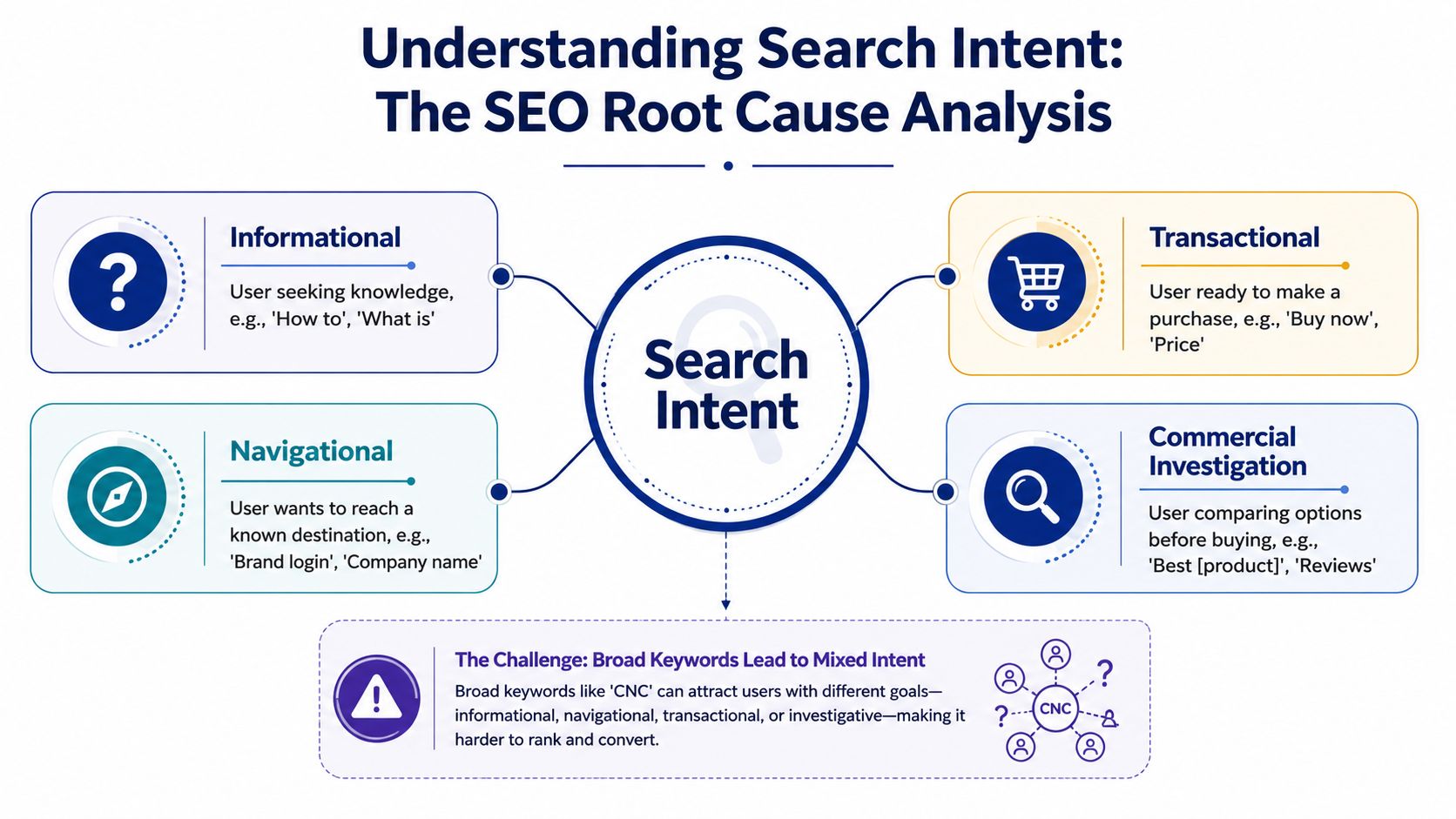
Search intent is the reason behind the query. In manufacturing SEO, it's the root cause analysis behind every keyword decision.
Modern search rewards pages that answer the exact query, not pages that merely repeat a keyword. For manufacturers, that means your strategy has to match how engineers and buyers search, including specification-driven queries, application terms, and industry use cases, as noted in this manufacturing SEO guidance.
Why broad keywords fail
A term like "CNC machining" looks attractive because it feels central to the business. But it's messy. One searcher may want a definition. Another wants to compare suppliers. Another wants a local machine shop. Another wants a quote for a titanium part.
That's mixed intent. When intent is mixed, a single page has a hard time satisfying everyone.
Broad keywords also create internal confusion. Teams start trying to make one page do too much. It explains the process, lists materials, mentions every industry served, and asks for a quote. The result is a page with no clear focus.
The four intent types that matter
Think of intent as four different job tickets.
Informational
The searcher wants to understand something. Examples include process questions, material comparisons, and specification explanations. These usually belong on educational pages, FAQs, or technical articles.Commercial investigation
The searcher is comparing options. They may be looking at supplier types, capability differences, certifications, or application fit. These terms often belong on service pages, comparison pages, or deeper capability content.Transactional
The searcher is close to action. They want pricing, a quote, a supplier, or a specific service. These terms belong on service, product, and RFQ-focused landing pages.Navigational
The searcher already knows the company or destination. They are trying to find your brand, a location page, or a specific internal page.
Broad terms create noise. Intent-specific terms create fit.
A practical way to diagnose intent is to ask one question: what would the searcher expect to see immediately after clicking?
If the answer is "a quote form," don't send them to a blog post. If the answer is "a technical explanation," don't force them onto a sales page.
Questions to ask during diagnosis
- What triggered the search? A design problem, a sourcing task, a supplier evaluation, or a direct need for production?
- What language would the buyer use? Internal company terms often differ from buyer language.
- What evidence does the buyer need right now? Specs, certifications, industries served, tolerances, materials, lead times?
- What action makes sense on this page? Read more, compare options, download a spec sheet, or request a quote?
When manufacturers get intent right, the rest of the system gets easier. The page type becomes clearer. The copy becomes tighter. Internal linking starts to make sense. A key outcome is that the traffic becomes more qualified because the page matches the reason for the search.
Building Your Keyword Blueprint Sourcing and Prioritization
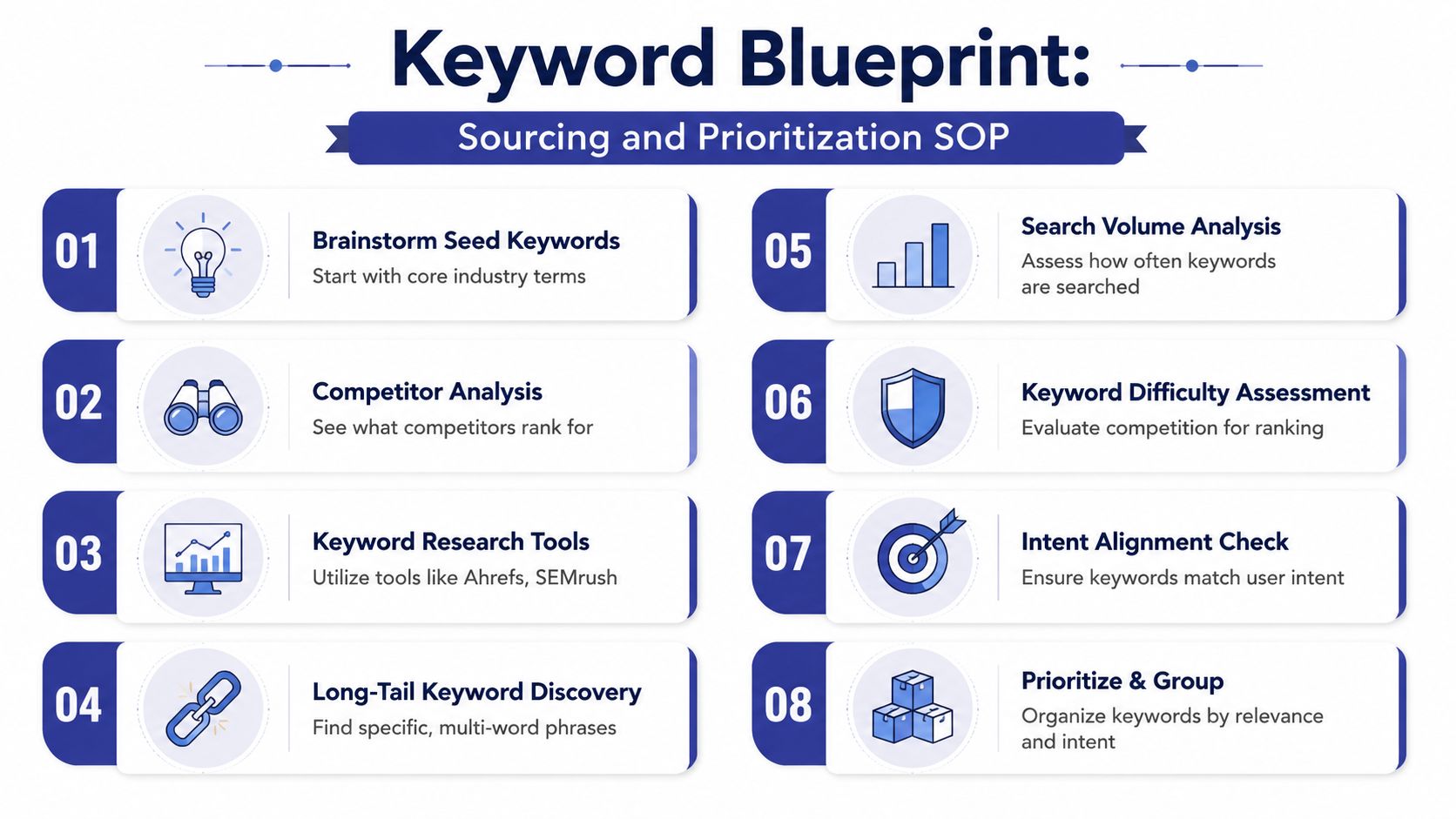
Once intent is clear, you need raw material. Not a giant spreadsheet full of disconnected phrases. A working blueprint.
Start with assets you already have. Then validate, filter, and pressure-test.
Start with the data you already own
A solid workflow starts in Google Search Console. Export your pages, queries, clicks, impressions, and average position. Then cross-reference those queries in a paid SEO platform to validate search volume and keyword difficulty. After that, review the top organic results to judge whether the keyword is realistically competitive based on domain strength and content type, using the workflow outlined in this keyword research process.
That matters because many manufacturers skip straight to brainstorming. They ignore the evidence already sitting in Search Console.
Look for three categories first:
Pages getting impressions but weak clicks
These often signal a relevance or title problem.Queries where you're visible but not competitive yet
These can become optimization targets for existing pages.Unexpected query themes
Buyers sometimes search in ways internal teams don't anticipate. That's useful signal, not noise.
A paid tool helps with validation. It won't replace judgment. It just tells you whether a phrase has enough demand and whether the competitive environment is realistic.
A quick explainer helps here if your team needs a visual walkthrough.
Use a filter before you write anything
Not every keyword belongs in the plan. A practical filter saves time.
When prioritizing keywords, many teams filter for commercial or transactional intent, keep keyword difficulty at 50% or lower, and require at least 100 monthly searches. At the same time, a niche term with 150 searches can still be worth targeting if it maps to a high-intent offer, based on guidance in this advanced keyword research resource.
Use that as a decision framework, not a rigid law.
- Relevance first: If the term doesn't match your actual offer, drop it.
- Intent second: Commercial and transactional phrases usually deserve priority.
- Difficulty third: A term can be attractive and still be unrealistic today.
- Volume fourth: Volume matters, but fit matters more.
A low-volume term tied to a strong RFQ page is often more valuable than a broad term that brings the wrong visitor.
Check the search results before you commit
Many keyword lists fall apart. A phrase may look good in a tool, then fail the SERP test.
Search the target term manually and review:
- Content type: Are the top results product pages, articles, directories, or local listings?
- Search intent match: Is Google rewarding educational content or supplier pages?
- Competitor fit: Are you up against giant publishers, direct competitors, or local shops?
- Depth requirement: Does the query demand specs, comparisons, or proof points?
If the search results are full of in-depth product and service pages, don't try to win with a short blog article. If the results are educational, don't force a quote page.
The blueprint is not the list. The blueprint is the shortlist after you've filtered out terms that are irrelevant, unrealistic, or misaligned with buyer intent.
From Blueprint to Factory Floor Mapping Keywords to Your Site
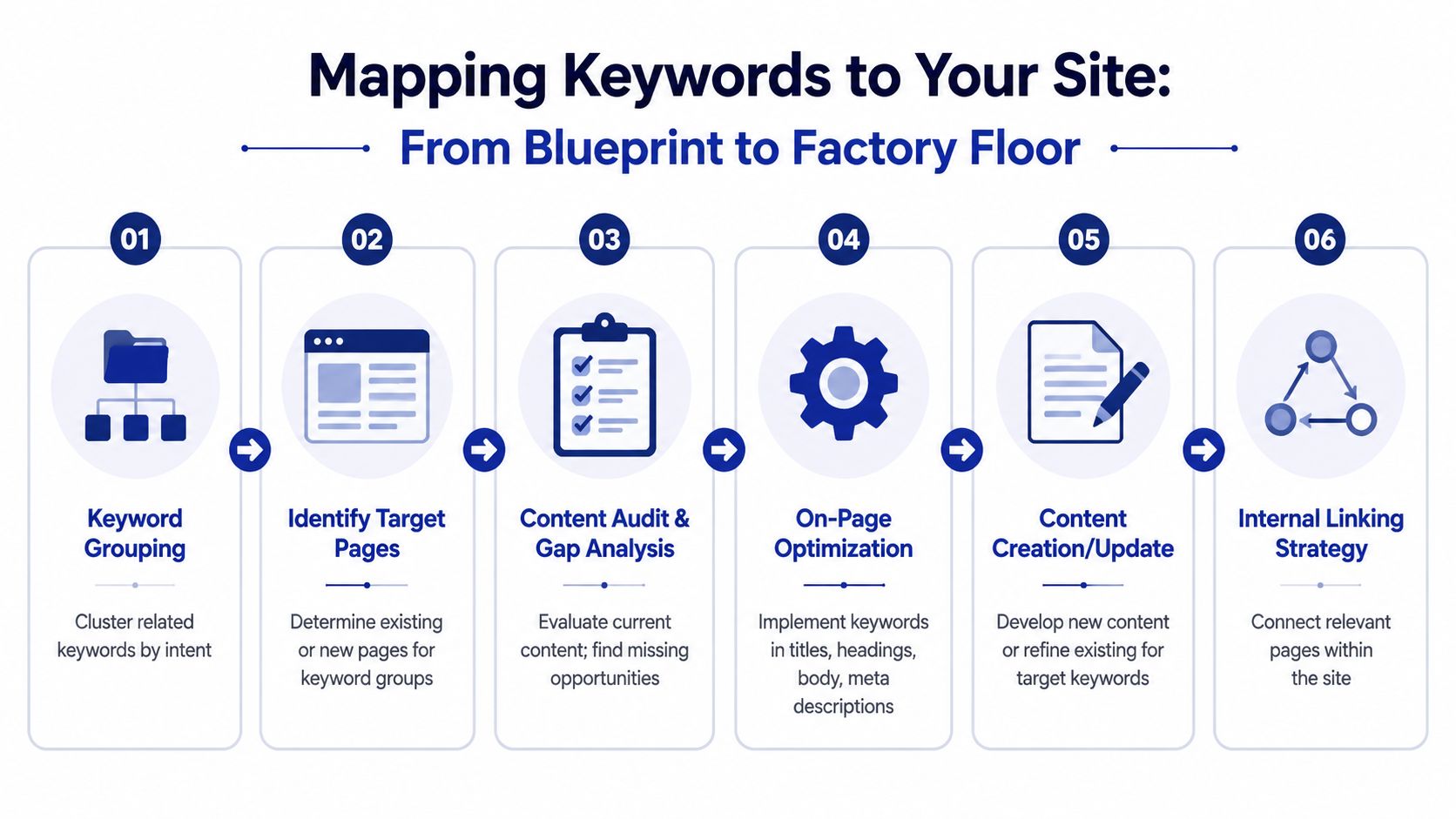
A keyword list by itself doesn't produce leads. Pages do.
This is the stage where strategy becomes architecture. Most manufacturers miss it because they stop after research. They have the phrases, but no clear assignment of which page should own which topic.
Most sites are organized for the company not the buyer
A complete manufacturing keyword strategy should separate product keywords, decisioning keywords, reputation keywords, and geographic keywords, then map them to unique pages so the site can capture RFQ-ready searches more effectively, as recommended in this industrial SEO guide.
That recommendation is more important than it sounds.
Many industrial sites group everything under a few top-level pages:
- Services
- Industries
- About
- Contact
That structure may be neat internally, but it doesn't help a buyer searching for a very specific solution. The page needs to match the search task.
A practical page mapping model
A useful way to map keywords is by buying stage and page type.
| Buying stage | Keyword type | Best page type |
|---|---|---|
| Awareness | Process questions, material questions, application questions | Blog articles, FAQs, learning pages |
| Consideration | Capability comparisons, supplier evaluation terms, service-specific phrases | Service pages, industry pages, comparison pages |
| Decision | Quote-ready service terms, local service terms, product-specific terms | RFQ pages, location pages, product pages |
| Validation | Brand terms, reviews, certifications, proof | About pages, case evidence pages, certification pages |
This creates a cleaner system. Awareness content educates. Consideration pages qualify. Decision pages convert. Validation pages remove risk.
If your taxonomy is messy, its significance begins to emerge. A cleaner structure makes keyword ownership easier. The thinking behind website taxonomy for manufacturers is useful here because it forces you to decide which topics belong where and why.
What to avoid when assigning keywords
The most common mistakes are operational, not technical.
- Cannibalization: two or more pages target the same keyword cluster
- One page trying to rank for everything: service, industry, material, and location all jammed together
- No new page creation: teams try to force every keyword into existing pages, even when the fit is poor
- Unclear internal linking: supporting content exists but doesn't route visitors to the commercial page
A good keyword map should answer these questions quickly:
- Which page owns the primary phrase?
- Which supporting phrases belong on that same page?
- Which related article should link to it?
- What stage of the buying journey does it serve?
- What action should the visitor take next?
The page map is your factory floor plan. Every query needs a destination, and every destination needs a job.
When that mapping is done well, the site starts to feel coherent. Not just to Google, but to the buyer. The path from question to supplier evaluation to RFQ becomes easier to follow.
On-Page SEO Execution for Industrial Websites
Good research fails all the time because execution is loose. The page exists, the keyword is assigned, and then the actual content doesn't support the target.
On-page SEO for industrial sites isn't mysterious. It's mostly disciplined page construction.
What a strong industrial page needs
For a product or service page, work through this checklist:
- Title tag with the main phrase: Keep it specific to the actual offer. Broad titles dilute relevance.
- Clear H1: Match the page's real topic, not a vague internal label.
- Useful subheadings: Break the content by capability, materials, applications, tolerances, certifications, or process details.
- Commercial fit: If the page targets a buying term, make quote and contact actions easy to find.
- Internal links: Send users to related pages that support evaluation and decision-making.
- Image optimization: Machinery, parts, and process photos should have descriptive file names and alt text.
- Technical detail: Include meaningful information buyers use to evaluate fit.
A lot of this overlaps with broader SEO for manufacturing companies. The difference is that industrial pages need to earn trust with specificity. Generic copy doesn't do that.
A simple before and after example
Here's a weak version of a fictional service page:
Page title: Services
H1: CNC Machining
Body: We offer high-quality CNC machining services for many industries. Contact us today to learn more.
Nothing on that page tells Google or a buyer what the page specializes in.
A stronger version looks more like this:
Page title: Precision CNC Machining Services for Aluminum and Stainless Parts
H1: Precision CNC Machining Services
Subheadings: Materials We Machine, Tolerance Capabilities, Industries Served, Prototype and Production Runs, Request a Quote
Body approach: Specific process language, application examples, capability details, and a direct RFQ path
What makes industrial pages convert better
A few trade-offs matter here.
- Don't overstuff terms: repeating the phrase unnaturally weakens readability and trust
- Don't stay too short: industrial buyers usually need enough detail to self-qualify
- Don't turn every page into a blog post: commercial pages should answer evaluation questions and move the visitor toward action
- Don't optimize for the wrong keyword: a page aimed at a transactional search should not be built like an educational article
If you're working from a filtered keyword set, keep the page tied to the original business case. Why did this term make the list? What buyer need does it represent? What evidence does that buyer need before contacting sales?
Those questions usually improve on-page SEO more than any plugin setting ever will.
Activating High-Intent Local and Product Keywords
For many manufacturers, the most valuable keyword opportunities aren't the broad industry terms. They're the specific searches that signal immediate need.
That usually means local intent and product-specific intent.
Local intent is often purchase intent
Google found that 76% of people who search on a smartphone for something nearby visit a business within a day, and 28% of those searches result in a purchase, according to Google research cited here. For industrial firms, that makes local visibility more than a branding metric. It can affect RFQs, site visits, and sales conversations.
This matters even if you don't think of yourself as "local."
A buyer searching for a machine shop, fabricator, or industrial supplier in a region often has urgency. They may need faster response, regional support, easier logistics, or a supplier visit. Those searches tend to be much closer to action than broad educational queries.
A practical local activation plan includes:
- Location pages: Build pages for real markets you serve, not thin doorway pages
- Google Business Profile: Keep categories, services, photos, and business details current
- Local proof: Show certifications, facility photos, service areas, and clear contact information
- Consistent service language: Align local page copy with the actual service terms buyers search
For more detail on execution, these local SEO best practices for service-area and industrial businesses are directly relevant.
Product-specific terms usually beat broad category terms
The same principle applies to product and service keywords. Specificity often wins.
A page built around a clear process, material, certification, application, or model reference tends to be more useful than a general category page. Searchers who use these terms usually know what they need. They aren't browsing. They're validating fit.
Examples of useful high-intent modifiers include:
- Material terms: aluminum, stainless, titanium, composite
- Process terms: laser cutting, CNC milling, extrusion, precision grinding
- Application terms: medical, aerospace, food processing, heavy equipment
- Qualification terms: certified, tight tolerance, prototype, production run
- Geographic terms: near a city, metro area, or plant region
If a keyword sounds narrow to your marketing team but clear to a buyer, it's often worth testing.
The mistake is assuming low breadth means low value. In manufacturing, narrow searches often carry strong intent because the buyer has already defined the need. Your job is to make sure the page proves capability and removes enough friction for the next conversation to happen.
Your Content Engine Building and Measuring for Growth
A lot of companies treat keyword research like a workshop. One meeting, one spreadsheet, one round of page edits, then everyone moves on.
That approach doesn't hold up. Search behavior changes. Offers evolve. New applications appear. Sales teams hear new objections. A useful keyword strategy for manufacturers has to operate like a maintained system.
Keyword research is not a one-time project
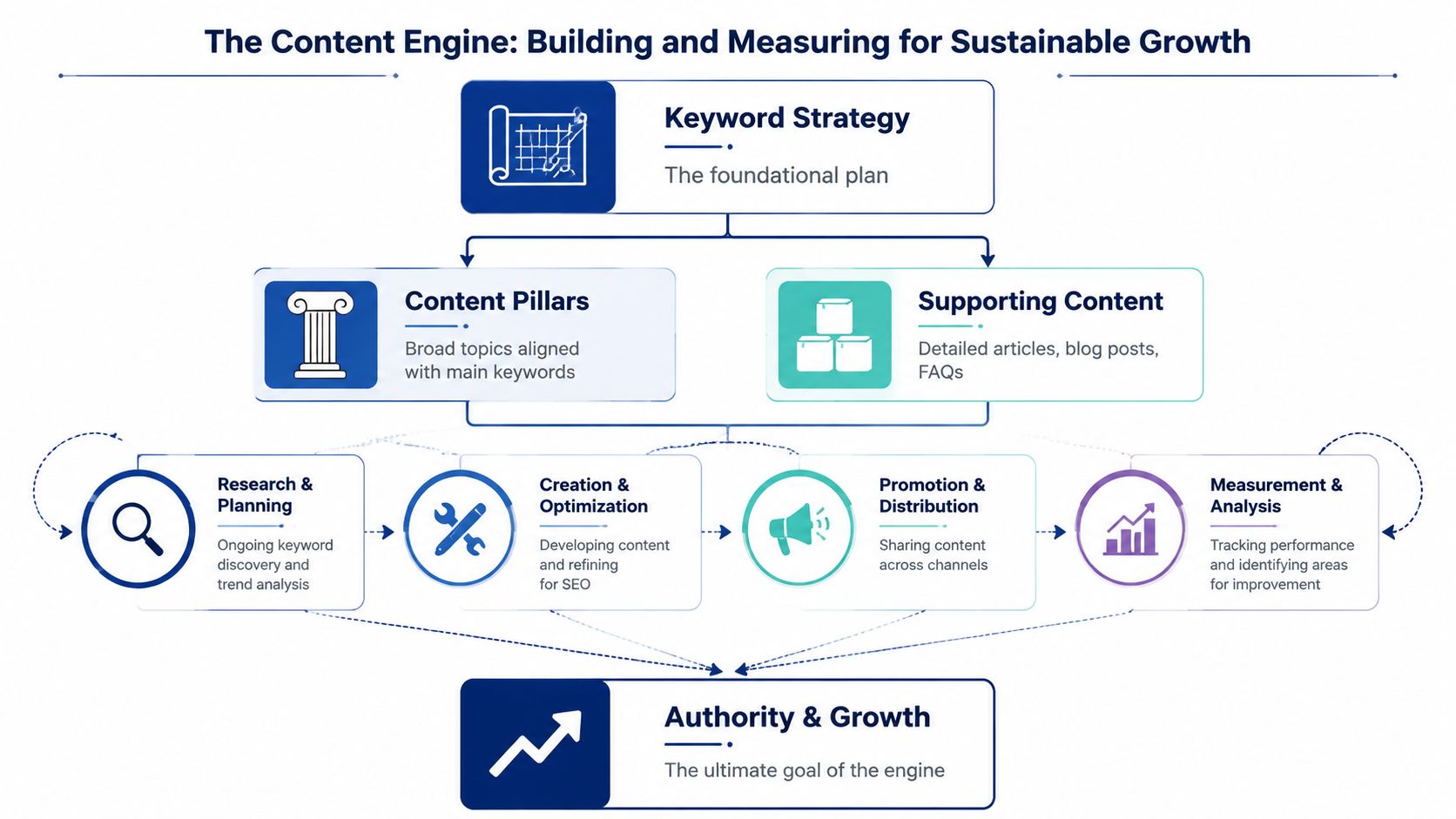
The strongest manufacturing content programs don't chase random topics. They build around commercial themes the company wants to win.
A practical structure looks like this:
- Pillar page: a central page around a major service or capability
- Supporting pages: deeper pages on related materials, applications, processes, FAQs, and evaluation questions
- Internal links: clear routing from educational pages to commercial pages
- Review cycle: regular updates based on search data, sales input, and service changes
This mirrors how technical buyers work. They don't usually search once and convert. They research, compare, validate, and come back.
Build around pillars and supporting pages
A good content engine starts with a core commercial topic. Then it expands around the questions that support that topic.
For example:
| Pillar topic | Supporting content ideas |
|---|---|
| Precision machining | tolerance questions, material comparisons, prototype vs production, industry applications |
| Industrial fabrication | process selection, finish options, common design mistakes, supplier evaluation criteria |
| OEM component manufacturing | quality documentation, production workflow questions, specification guidance, application-specific pages |
A simple content calendar can be lean. You don't need dozens of topics. You need consistency and alignment.
Try a sheet with these columns:
- Primary keyword cluster
- Page type
- Buyer stage
- Current status
- Owner
- Next internal link target
- Commercial page supported
If you need outside support, that can include your internal team, a freelance technical writer, an SEO platform, or a specialist firm such as Machine Marketing, which works on B2B strategy for manufacturers and industrial companies.
Measure business movement not just rankings
Rankings matter, but they aren't the whole story.
Track performance in layers:
- Visibility layer: impressions, clicks, average position
- Page layer: which service and product pages are earning qualified organic visits
- Conversion layer: RFQ submissions, contact form quality, sales conversations tied to organic entry pages
- Feedback layer: what sales hears after the lead arrives
If a page ranks but never contributes to pipeline, it may be attracting the wrong intent.
The useful test is simple. Did the content bring in the right buyer, on the right topic, with the right next step?
That's why the engineering mindset helps here. You're not publishing for activity. You're tuning a system. Inputs become pages. Pages attract searches. Searches become sessions. Sessions become inquiries if the page, intent, and offer are aligned.
A manufacturer doesn't need more random content. You need a better operating model for demand capture.
If your website has good building blocks but isn't producing consistent qualified inquiries, Machine Marketing can help you diagnose the gaps. We work with manufacturers and industrial companies to turn scattered SEO, content, and website efforts into a clearer lead generation system that supports real RFQs and sales conversations.