If your website gets traffic but not enough quote requests, your keyword strategy is probably the problem. We see this constantly in manufacturing. The site looks credible, the capabilities are real, the equipment is solid, but the SEO plan chases broad terms that attract weak traffic and vague interest.
Industrial buyers don't search like consumers. Engineers and procurement teams search with specs, materials, tolerances, machine types, certifications, and application constraints. If you want better leads, you need a long-tail keyword strategy built for manufacturing, not a generic SEO checklist.
Table of Contents
- The Hidden Problem with Your Current SEO Strategy
- A Repeatable System for Finding High-Intent Keywords
- How to Classify Intent for Manufacturing Buyers
- Turning Keywords into High-Value Content Assets
- Simple SEO Tweaks and KPIs That Drive Growth
- Your Next Step to a Predictable Lead System
The Hidden Problem with Your Current SEO Strategy
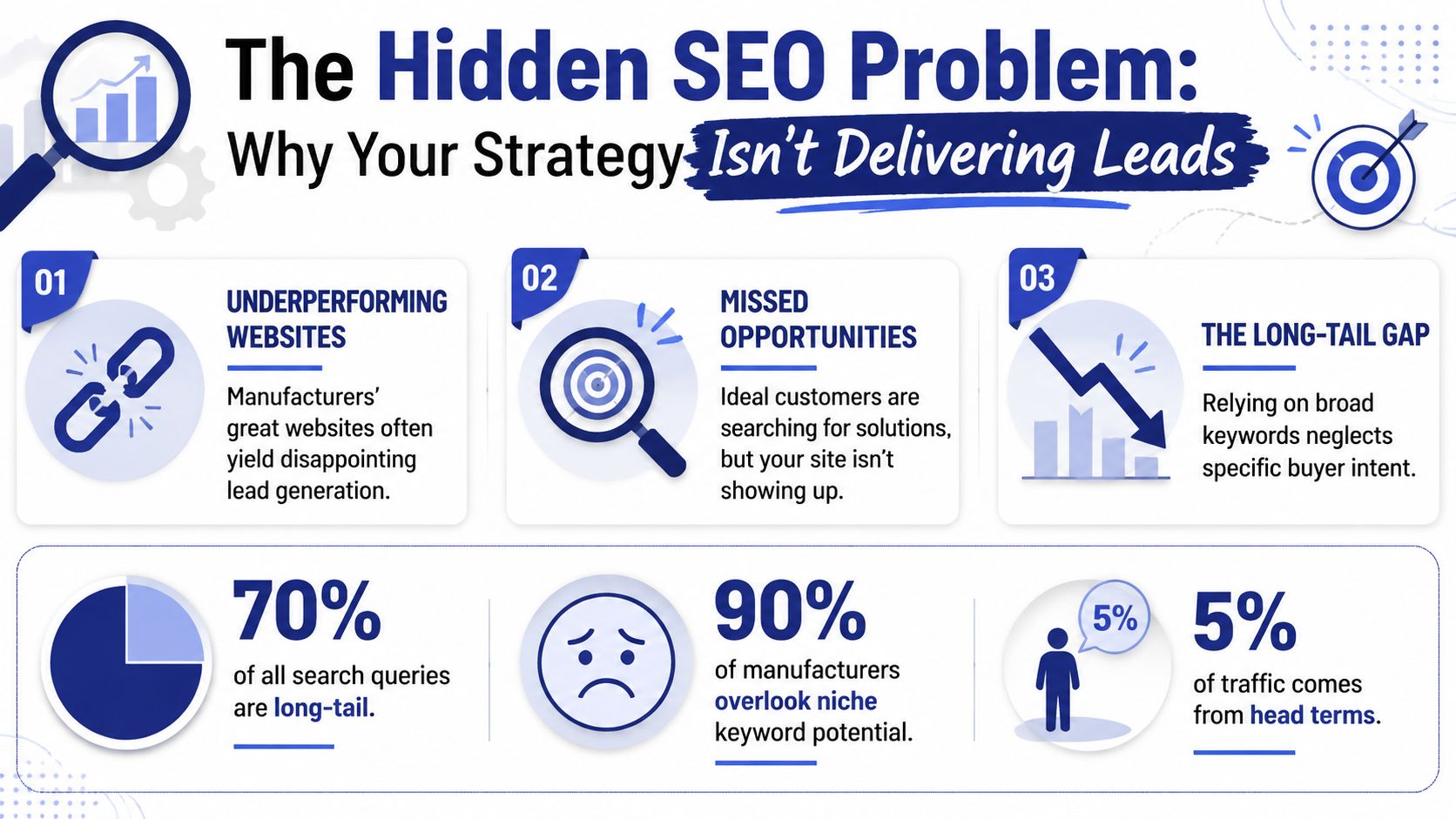
Most manufacturing SEO fails because it targets language that's too broad to reflect buying intent. Terms like “CNC machining,” “metal fabrication,” or “industrial automation” look important in a report, but they don't tell you whether the searcher needs a supplier, wants a definition, or is just browsing competitors.
That's a bad bet if you care about leads.
Broad keywords attract weak-fit traffic
A foundational study of search-engine marketing campaigns found that the top 100 keywords generated an average of 88.57% of all searches and 81.40% of all clicks in those campaigns, which shows how heavily demand concentrates around a small set of head terms while the rest of search behavior fragments into the long tail, according to this ScienceDirect study on keyword concentration in search campaigns.
That concentration creates a trap. Most manufacturers assume they need to compete for the head terms because those terms appear to define the market. In practice, that puts you into the most crowded battlefield while ignoring the specific searches that indicate a real project.
Broad terms also create messaging problems. A page optimized for “CNC machining” usually becomes generic because it has to cover too much. It can't speak directly to aerospace tolerances, medical-grade materials, prototype runs, anodized aluminum, or short-run production without turning into a mess.
Practical rule: If a keyword could apply to half the industry, it's usually too broad to drive strong sales conversations on its own.
Industrial buyers search with engineering intent
Manufacturing buyers often search like engineers because many of them are engineers. They search by material, compliance requirement, tolerance, application, equipment capability, or production constraint. That's where long tail keywords manufacturing strategy becomes commercially useful.
These are the patterns we push clients to look for first:
- Specification phrases like material grade, size range, tolerance band, or finish requirement.
- Application phrases tied to end use, industry, or operating environment.
- Problem phrases built around failure points, production bottlenecks, or replacement needs.
- Qualification phrases that imply vendor screening, such as certification, lead time, capacity, or geographic fit.
When someone searches for a highly specific phrase, they're telling you what page to build. That's the opportunity. Your SEO program stops being an abstract traffic project and starts acting like a sales support system.
A Repeatable System for Finding High-Intent Keywords
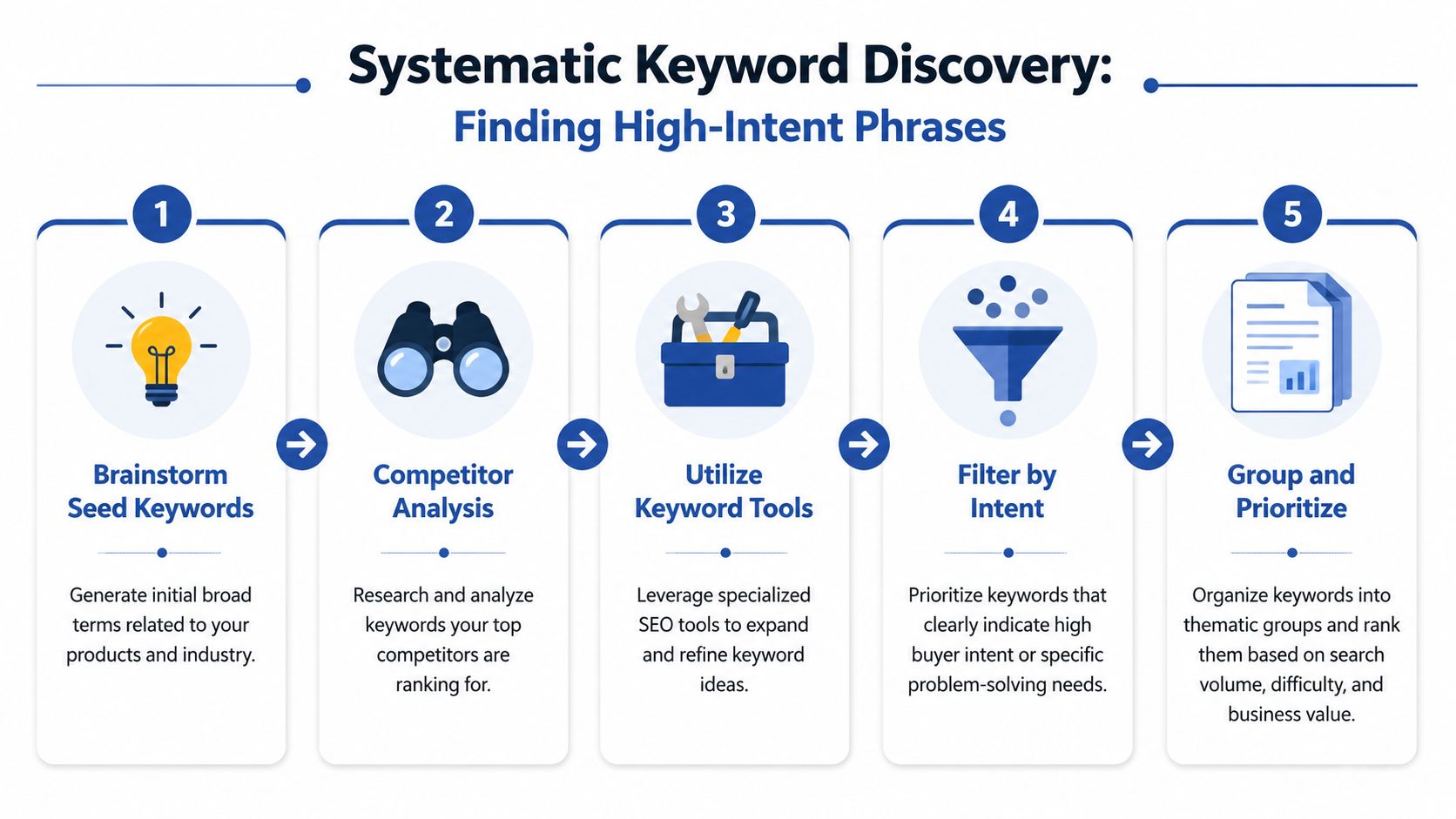
Keyword research for manufacturers shouldn't live inside one marketer's head. It needs to be a standard operating procedure your team can repeat every quarter.
That means using internal knowledge, search data, and external tools in a disciplined sequence. Not brainstorming random topics.
Start with seed terms from your operation
Your first keyword list should come from the business, not an SEO tool.
Pull seed terms from:
- Capabilities such as CNC milling, laser cutting, injection molding, assembly, finishing.
- Materials such as stainless steel, aluminum, copper alloys, plastics, composites.
- Industries served such as aerospace, medical, food processing, defense, energy.
- Specifications and constraints such as tight tolerance, high-temperature, corrosion-resistant, clean-room, ISO-compliant.
- Commercial qualifiers such as prototype, low-volume, production run, emergency replacement, local supplier.
Then add phrases from actual customer language. Ask sales what prospects request in quote forms. Ask engineering what technical questions come up before a job is approved. Ask customer service what buyers misunderstand. That language is usually better than anything a tool suggests.
If you need a broader planning model, our guide to keyword strategy for manufacturers is useful for organizing this initial list into a practical workflow.
Expand the list with real search behavior
Once you have seed terms, expand them with search-driven sources. Current SEO guidance treats Google Autocomplete, People Also Ask, Search Console query data, and tools like Ahrefs and Semrush as standard long-tail discovery methods, and Ahrefs notes that these queries are usually longer, more specific, and often carry higher conversion potential in its guide to finding long-tail keywords with modern SEO tools.
Use that in a fixed order:
Google Search Console first
Search Console is your easiest win because it shows queries you already appear for. Focus on terms in positions 11 to 20. Those are close enough to improve, and they often expose specific demand your current pages only partially answer.
Look for patterns like:
- Capability plus industry queries
- Material plus process queries
- Problem plus solution queries
- Location plus service queries
Google Autocomplete and People Also Ask next
Autocomplete shows how buyers phrase demand in the wild. People Also Ask gives you question-based variants that often map cleanly to FAQ sections, application guides, and troubleshooting articles.
Search your seed terms with modifiers like:
- for aerospace
- for food-grade use
- near me
- tight tolerance
- vs stainless
- cost
- lead time
- how to choose
Search bars give you buyer language. Your job is to capture it before a competitor does.
Filter for feasibility and buyer value
A giant keyword list is useless until you cut it down.
Semrush recommends filtering for low-volume, low-difficulty terms and using a Personal KD threshold of 0 to 29 when hunting for long-tail opportunities, according to current guidance summarized in the Ahrefs long-tail discussion above. That matters because manufacturers usually don't need mass traffic. They need a realistic path to visibility on terms that can produce qualified inquiries.
Filter your list through three questions:
| Filter | What to ask | What to keep |
|---|---|---|
| Business value | Would this query ever lead to a quote, spec review, or qualified conversation? | Terms tied to your offers and margins |
| Intent clarity | Can we tell what the searcher wants? | Phrases with obvious research or purchase context |
| Ranking feasibility | Can we build a page that answers this better than what ranks now? | Niche queries where your expertise is specific |
Don't chase volume for its own sake. Long-tail manufacturing keywords often look small in tools and large in revenue impact.
Build a master sheet with these columns:
- Keyword
- Intent category
- Relevant page type
- Primary audience
- Sales stage
- Priority
- Owner
- Status
That document becomes your SEO roadmap.
How to Classify Intent for Manufacturing Buyers
Finding the query isn't enough. You need to know what the buyer is trying to accomplish.
A search for “anodized aluminum vs stainless for marine use” is not the same as “custom machined marine brackets quote.” Treat them the same, and you'll either push too hard too early or bury a ready-to-buy prospect under educational fluff.
The four intent buckets that matter
For manufacturing, we use a simple intent model. It's practical, and sales teams can understand it without SEO jargon.
| Intent Type | Buyer Goal | Example Keywords | Best Content Asset |
|---|---|---|---|
| Informational | Learn a concept or process | what is passivation for stainless parts | Educational article or glossary page |
| Investigational | Evaluate methods, materials, or capabilities | titanium vs aluminum machining for aerospace | Comparison guide or application note |
| Comparison | Shortlist suppliers or approaches | best cnc shop for tight tolerance aerospace parts | Capability page with proof points |
| Transactional | Start a buying action | get quote for custom cnc machining aerospace tolerance | Quote page or service landing page |
This framework matters because different queries need different page structures. A buyer in research mode needs clarity. A buyer in transaction mode needs confidence, proof, and a short path to contact.
If the page doesn't match the intent, rankings might come, but leads usually won't.
For more targeted industrial search workflows, tools and datasets in resources like SamSearch manufacturing solutions can help teams understand how manufacturing-specific search behavior differs from generic B2B patterns.
Quote-driven and component-driven companies need different maps
Most industrial SEO advice falls apart. It assumes every manufacturer sells the same way.
A quote-driven manufacturer such as a custom machine shop, metal fabricator, or systems integrator needs keywords that reveal project intent. A verified Gartner finding states that 68% of manufacturing buyers use long-tail queries with specific tolerance or material specifications, yet few marketing strategies map those searches directly to lead generation workflows. That's a major gap.
A quote-driven company should prioritize phrases like:
- custom cnc machining for aerospace tolerance
- stainless steel fabrication for food-grade equipment
- prototype machining with tight tolerance aluminum
- local machine shop for emergency replacement parts
A component-driven manufacturer needs a different structure. If you sell standard parts or repeat-order components, buyers may search by part family, dimensions, compatibility, compliance, or replacement fit. Your architecture should lean harder into product taxonomy, specifications, and filterable detail pages.
Questions to ask yourself:
- Are you mostly winning custom jobs or repeatable product demand?
- Do buyers start with a spec sheet or with a problem?
- Does your sales team need quote requests, distributor inquiries, or direct product page conversions?
- Are your current pages organized by service category when buyers search by application or requirement?
If your answers are fuzzy, your keyword map is probably fuzzy too.
Turning Keywords into High-Value Content Assets
Keywords by themselves don't generate pipeline. Pages do. Good pages answer specific buyer questions and remove friction from the next step.
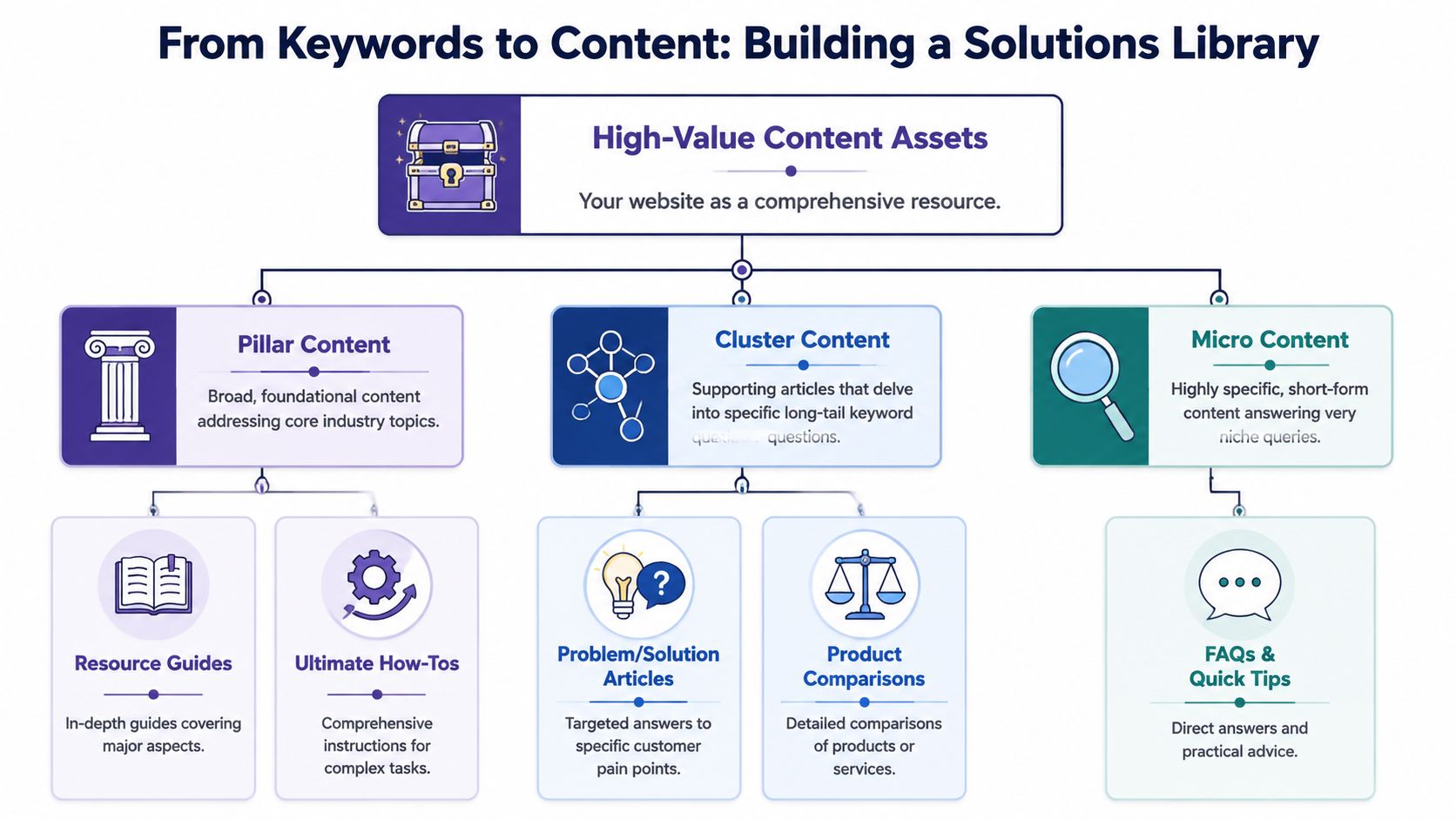
That's why your content program should look less like a blog calendar and more like a solutions library.
Build assets, not blog filler
For B2B industrial markets, the highest-value long-tail pages are usually use-case or problem-solving assets, and one industry guide reports that long-tail keyword searches can produce conversion rates 2.5x higher than head terms when the ranking page gives a direct, specific answer, according to Embryo's long-tail keyword statistics summary.
That lines up with what we see in manufacturing. Generic “about our services” pages rarely carry the whole load. Buyers want proof that you understand the exact problem they're trying to solve.
So stop publishing generic posts like:
- Benefits of CNC machining
- Why quality matters in manufacturing
- Trends in industrial automation
Those topics are too broad and too soft. They don't move buyers forward.
Instead, build assets like:
- Application notes for a specific end-use environment
- Material comparison guides tied to performance requirements
- Problem-solution pages around failure modes or production issues
- Capability pages linked to tolerance, compliance, or machine constraints
- Case-study style project breakdowns if you can publish them accurately
Match format to query type
Different long-tail phrases require different content formats. That's where a lot of teams waste effort. They write everything as a blog post because the CMS makes that easy.
Use this mapping instead:
| Query pattern | Better asset |
|---|---|
| material vs material | Comparison guide |
| process for application | Application note |
| problem + fix | Troubleshooting or problem-solution article |
| capability + industry | Service landing page |
| quote-oriented phrase | Conversion-focused quote page |
A page targeting “powder coating for outdoor steel enclosures” shouldn't read like a general coating overview. It should address environment, durability factors, finish considerations, and what buyers need to specify before requesting a quote.
If your team needs a broader framework for building this library, our guide on content marketing for manufacturing companies lays out how to connect content production to actual commercial priorities.
How to structure pages that convert
A manufacturing content asset should answer the query fast, prove competence, and make the next action easy.
Use this structure:
- Direct opening answer that reflects the exact query language.
- Technical detail that shows you understand the application.
- Decision criteria so the reader can evaluate options.
- Proof elements such as certifications, equipment range, materials handled, or process notes.
- Clear CTA tied to the stage of intent.
For teams refining page experience and messaging, this practical guide to optimizing content for conversions is useful because it focuses on readability, engagement, and conversion flow rather than just stuffing in keywords.
A strong industrial page doesn't sound clever. It sounds precise.
One more point. Don't force all long-tail content into a top-of-funnel mindset. Some of your best pages should ask for the quote directly because the query already signals commercial intent. When the buyer is ready, your page should be ready too.
Simple SEO Tweaks and KPIs That Drive Growth
Once you have the right pages, you need to make them discoverable and measurable. At this stage, many manufacturers either overcomplicate the work or obsess over the wrong numbers.
Keep it simple. Optimize the page so search engines understand it, then track whether it produces buying signals.

The on-page checklist that matters
Every long-tail page should have the basics locked down.
Use this checklist:
- Title tag: Include the core phrase and a precise qualifier. “CNC Machining” is weak. “Custom CNC Machining for Aerospace Tolerance Parts” is clearer.
- H1: Match the main intent of the search.
- Subheads: Break out materials, capabilities, compliance, applications, and FAQs.
- Body copy: Use the exact terminology buyers use. Don't sanitize technical language if engineers are the audience.
- Internal links: Point to related process pages, material guides, and quote pages.
- CTA placement: Put one above the fold and one near the end.
- Schema and technical hygiene: Keep pages crawlable, indexable, and free of duplication issues.
If you need a practical reference for this side of execution, our overview of SEO for manufacturing companies covers how these elements fit into a full industrial SEO system.
Track buying signals, not vanity metrics
Traffic is not the KPI. Impressions are not the KPI. Rankings are useful, but they're still not the KPI.
The metrics that matter are:
- Quote requests
- Contact forms from target accounts
- Calls tied to high-intent pages
- Sales-qualified leads influenced by organic landing pages
- Opportunities created from organic search
- Cost per qualified lead
Set up tracking so every key form submission records the landing page, keyword theme, and page type. Then review which asset classes create real pipeline. You'll usually find that specific service pages, application pages, and comparison pages outperform broad educational content when revenue is the goal.
Use local modifiers where they actually matter
Local intent is a serious opportunity in industrial search. A verified McKinsey finding states that 42% of manufacturing buyers prefer local suppliers for custom parts, while 75% of global manufacturers' content ignores local long-tail modifiers like “near [city]”, which creates an opening for companies that build regional long-tail pages effectively.
That doesn't mean you should spam city pages. It means you should create useful local relevance where proximity matters.
Use local modifiers on pages tied to:
- emergency replacement work
- onsite service capability
- fast-turn prototyping
- regional production support
- custom part supply where shipping time affects buying decisions
This matters most for custom and quote-driven work. If proximity shortens lead time, site visits, logistics headaches, or approval cycles, make that visible in your content.
Your Next Step to a Predictable Lead System
Most manufacturers don't have a traffic problem. They have a relevance problem.
The fix is straightforward. Build your keyword system around how industrial buyers search. Start with seed terms from your operation. Expand with Search Console, Autocomplete, People Also Ask, Ahrefs, and Semrush. Classify intent. Then publish pages built for specs, applications, problems, and quote actions.
Don't try to boil the ocean this quarter.
Pick one high-intent query already sitting in your Search Console data. Build one page that answers it better than anyone else. Add a clear CTA. Track whether it produces a real sales conversation. Then repeat the process until your website stops acting like a brochure and starts acting like a lead system.
If you want help diagnosing where your current SEO is missing high-intent manufacturing demand, Machine Marketing works with industrial companies to connect keyword strategy, content, and lead generation into a usable system.