If your manufacturing website gets traffic but the wrong kind of inquiries, your keyword strategy is probably broken.
We see this pattern constantly. A shop ranks for broad terms, publishes a few generic blog posts, and then wonders why the leads are weak, irrelevant, or nonexistent. The issue usually isn't effort. It's that the website wasn't built as a demand-capture system. It was built as a brochure with some SEO layered on top.
That distinction matters. Buyers don't search the same way at every stage, and they don't all want the same information. An engineer, a sourcing lead, and an operations manager can all end up buying from the same supplier, but they use different language to get there. If your pages don't match that language and intent, search visibility won't turn into sales conversations.
Table of Contents
- Diagnosing Your Current Keyword Problem
- Map Your Buyers and Their Search Intent
- Source and Prioritize High-Value Industrial Keywords
- Map Keywords to Your Website Architecture
- Execute with a Content Plan and On-Page SEO
- Measure Performance and Iterate Your System
Diagnosing Your Current Keyword Problem
Most manufacturers don't have a traffic problem. They have a relevance problem.
The website might rank for broad industry phrases, but those terms often bring in students, job seekers, competitors, or people looking for definitions rather than suppliers. Then leadership concludes that SEO doesn't work, when the actual problem is that the site was optimized around what the company makes, not how buyers search when they need help.
A weak keyword strategy for manufacturers usually shows up in a few predictable ways:
- Broad terms dominate the plan. Pages target phrases like “machining,” “fabrication,” or “industrial equipment” with no qualifier for application, process, certification, material, or location.
- Pages compete with each other. Multiple service pages, blog posts, and product pages all chase the same phrase, so none of them wins cleanly.
- Content attracts the wrong intent. Educational pages rank, but they don't connect to commercial pages, so visitors learn something and leave.
- Sales and marketing use different language. Sales hears real objections and buyer terminology every week. Marketing often builds pages without using that input.
Practical rule: If your website traffic doesn't sound like your sales pipeline, your keyword map is misaligned.
The fix isn't a larger spreadsheet of keywords. It's a system that connects search behavior to buyer roles, page types, and conversion paths. That means treating keywords as inputs for site architecture, content planning, and sales enablement.
You also need to accept a trade-off. Broad industry visibility can feel good, but it often produces weak commercial value. Specific visibility feels smaller on paper and stronger in the CRM. For manufacturers, the second outcome is the one that matters.
Map Your Buyers and Their Search Intent
A useful keyword strategy starts with the buyer, not the SEO tool.
Manufacturers often flatten the market into one audience called “customers.” That's too vague to be operational. Your website needs to help distinct people solve distinct problems. If you skip that step, you'll produce content that reads fine and converts poorly.
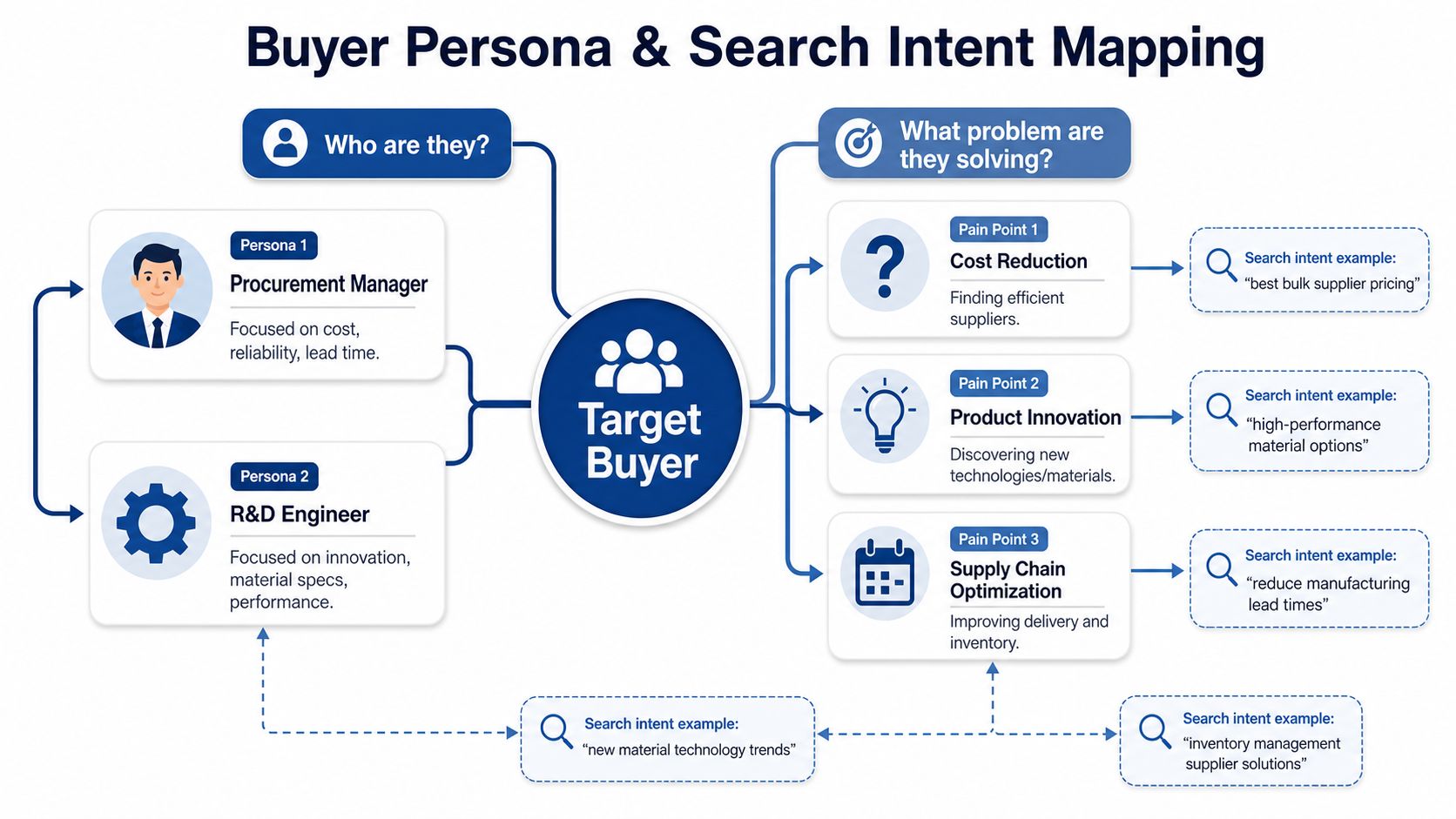
Start with job role, not keywords
In manufacturing, the same supplier can be evaluated by several stakeholders. The search behavior is different because the pressure on each person is different.
An R&D engineer may search for material performance, tolerances, process limitations, or application fit. A purchasing manager is more likely to search around supplier reliability, certifications, lead times, and geographic fit. A plant or operations manager often cares about uptime, replacement schedules, compatibility, and implementation risk.
That's why a generic keyword list doesn't work. You need role-based search paths.
A simple working model looks like this:
| Buyer role | Typical concern | Likely search style | Best page type |
|---|---|---|---|
| Engineer | Technical fit | Detailed, specification-driven | Technical article, capabilities page, FAQ |
| Purchasing manager | Supplier evaluation | Commercial, qualification-focused | Service page, certifications page, location page |
| Plant manager | Operational risk | Problem-solution, maintenance-oriented | Solution page, application page, troubleshooting content |
If your team hasn't documented these roles, start with a basic persona exercise. This guide on creating buyer personas for B2B marketing is a useful way to structure that work without overcomplicating it.
Match intent to buying stage
Search intent matters more than raw keyword volume because intent tells you what kind of page should exist.
Google's B2B research found that buyers complete about 57% of the purchasing process before first contacting a supplier, which means your site has to answer early research questions before someone fills out a form, as summarized in this manufacturing SEO guide referencing Google's B2B research.
That changes how manufacturers should think about content. You can't only target “quote request” searches. You also need pages for technical evaluation and problem framing.
Three intent buckets make this manageable:
- Informational intent. Searches that help a buyer understand a process, material, specification, or problem.
- Commercial intent. Searches that compare suppliers, capabilities, certifications, and service options.
- Transactional intent. Searches that show clear readiness to contact, request a quote, or vet a local supplier.
A good manufacturing site answers the engineer's question and then gives the buyer a reason to shortlist the supplier.
Questions to ask your team
Before adding a single keyword to a spreadsheet, ask sales, engineering, and customer service these questions:
- What language do qualified buyers use on calls? Write down exact phrases, acronyms, and shorthand.
- What questions show serious buying intent? Not general curiosity. Real pre-purchase questions.
- Which objections come up before a quote request? Those often become high-value informational pages.
- Which roles usually join the deal first? That tells you which pages should be built first.
This work feels slower than jumping into Semrush or Ahrefs. It saves time later because your content starts closer to revenue.
Source and Prioritize High-Value Industrial Keywords
A common manufacturing SEO failure looks like this. The marketing team builds a spreadsheet with 300 keywords, publishes a few blogs around the highest-volume phrases, and waits for leads that never turn into qualified conversations. The problem is rarely effort. The problem is that the list was built as research output, not as a demand-capture system.
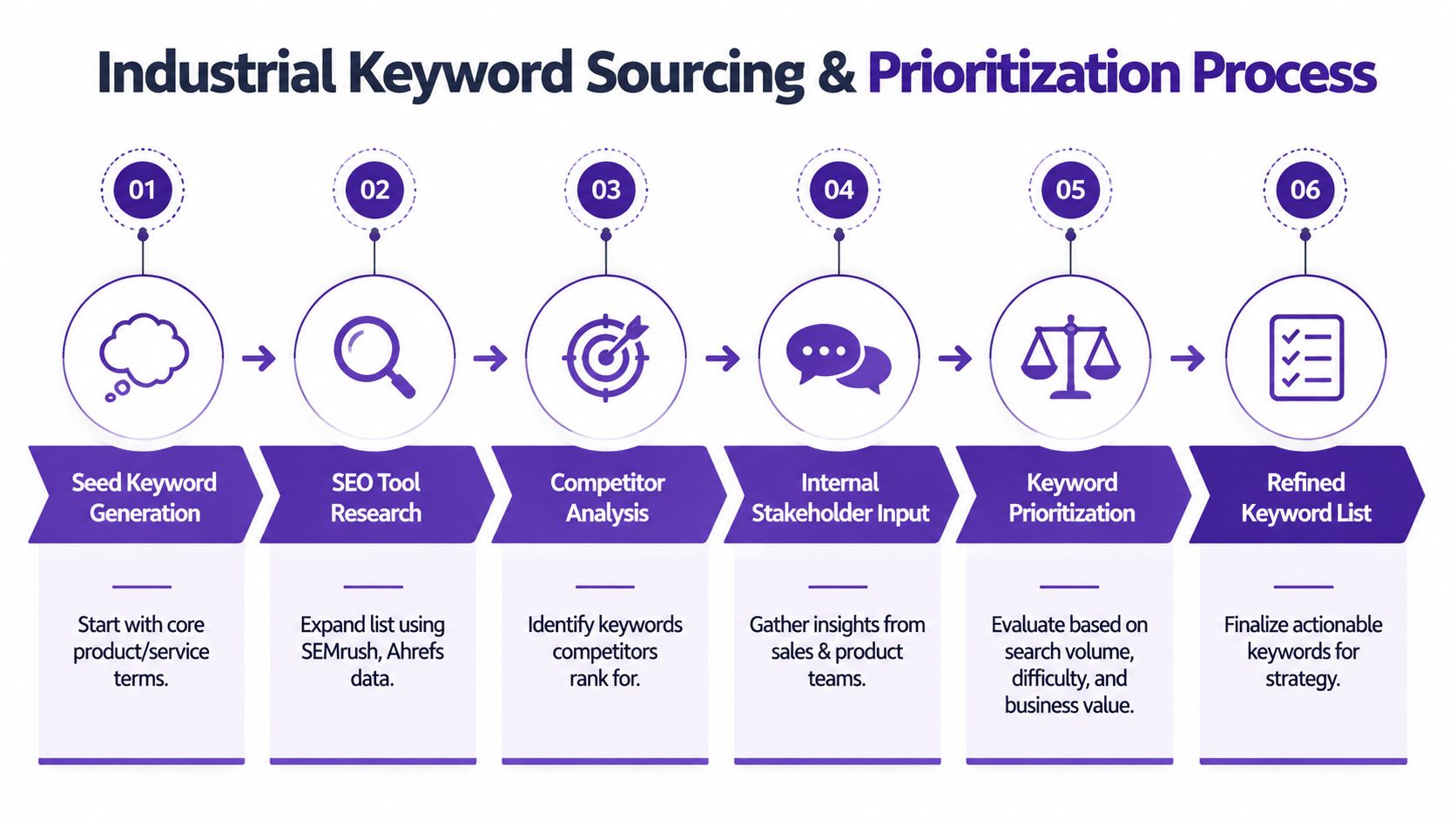
High-value industrial keywords sit at the intersection of buyer language, sales relevance, and page fit. An engineer searching a tolerance question is not looking for the same page as a purchasing manager comparing qualified suppliers. If those intents get mixed together, rankings get weaker and conversion paths get harder to follow.
Start with source material that reflects revenue
Pull terms from places where real buying conversations happen. That usually means sales emails, RFQs, quote request forms, call notes, service tickets, distributor feedback, and product documentation. These sources expose the language buyers use when a problem is active, budget is being discussed, or supplier qualification has started.
The strongest terms are often narrow.
A phrase with modest search volume can outperform a broader term if it matches a specific capability, material, tolerance, certification, or application your sales team closes regularly. Manufacturers lose time when they treat volume as the main filter. Volume matters, but only after intent and fit are clear.
Build a working list around demand patterns
After gathering internal language, use your SEO tools to expand and organize it. Search Console shows where your site already has traction. Competitor research shows where rival manufacturers are winning qualified visibility. Keyword tools help surface variants, modifiers, and adjacent terms you may have missed.
Use those sources to build clusters, not a flat list.
A useful starting structure looks like this:
Core commercial terms
Process, product, and capability phrases tied to what you sell.Technical modifier terms
Material, spec, tolerance, finish, certification, machine type, and production method variants.Application terms
Searches tied to end use, industry, environment, or performance requirement.Qualification terms
Queries buyers use when evaluating supplier risk, such as quality standards, lead times, capacity, or compliance.Problem and question terms
Searches that appear before a buyer is ready to contact sales, but still indicate a real manufacturing need.
A short training video can help your team align on the process before you build the spreadsheet:
Prioritize by buyer role, not just by keyword difficulty
This is the step that usually separates traffic growth from pipeline growth. A term should be prioritized based on who is searching, what decision they are trying to make, and whether your site has the right page type to serve that moment.
Here is a practical filter:
| Priority factor | What to check | Why it matters |
|---|---|---|
| Buyer role | Is this query more likely to come from engineering, operations, procurement, or leadership? | Different roles need different proof to move forward |
| Intent strength | Does the search reflect research, supplier evaluation, or purchase readiness? | Intent determines whether the term can influence revenue now or later |
| Offer alignment | Do you have a real capability, certification, or use case behind the phrase? | Rankings without operational fit waste sales time |
| Page ownership | Can one page clearly satisfy the query better than any other page on your site? | Clear ownership prevents overlap and weak internal competition |
| Competitive gap | Are current search results broad, outdated, or poorly matched to industrial buyers? | Specificity creates openings against larger competitors |
| Commercial impact | Would this query start or assist a sales conversation worth having? | Some traffic never reaches pipeline |
An engineer may search for a precise machining tolerance or material compatibility issue. A purchasing manager may search for approved suppliers, production capacity, or ISO certification. Both searches matter, but they do not have equal urgency and they should not be handled by the same content asset.
Score keywords with a simple business-first method
Use a lightweight scoring model so prioritization does not turn into opinion. Rate each keyword cluster on intent, relevance to your offer, competitiveness, and sales value. Then sort the list based on total opportunity, not internal politics.
For example:
- A broad head term with high volume but vague intent may score lower than expected.
- A lower-volume certification query may score high because it supports vendor selection.
- A technical application term may deserve priority if it consistently appears in qualified deals.
This also helps content planning later, because the keyword set is already organized around page purpose and buyer stage. A clean taxonomy makes that much easier to manage, especially once clusters start expanding across services, industries, and resources. website taxonomy for SEO and content structure
Cut the list harder than you think
Industrial teams often keep weak keywords because they sound important internally. Drop terms that attract students, job seekers, DIY traffic, or searchers outside your service area and production model. Remove phrases that describe work you do not want, margins you cannot support, or industries your team cannot serve well.
A shorter list with strong intent beats a large list full of edge cases. The goal is not to rank for everything related to your process. The goal is to capture the searches that lead to useful sales conversations.
Map Keywords to Your Website Architecture
A keyword list by itself doesn't create rankings. It creates confusion unless it's tied to page purpose.
The turning point for most manufacturing websites is when the team stops asking, “What keywords should we target?” and starts asking, “Which page should own this intent?” That shift prevents overlap, clarifies internal linking, and gives buyers a cleaner path from question to quote.
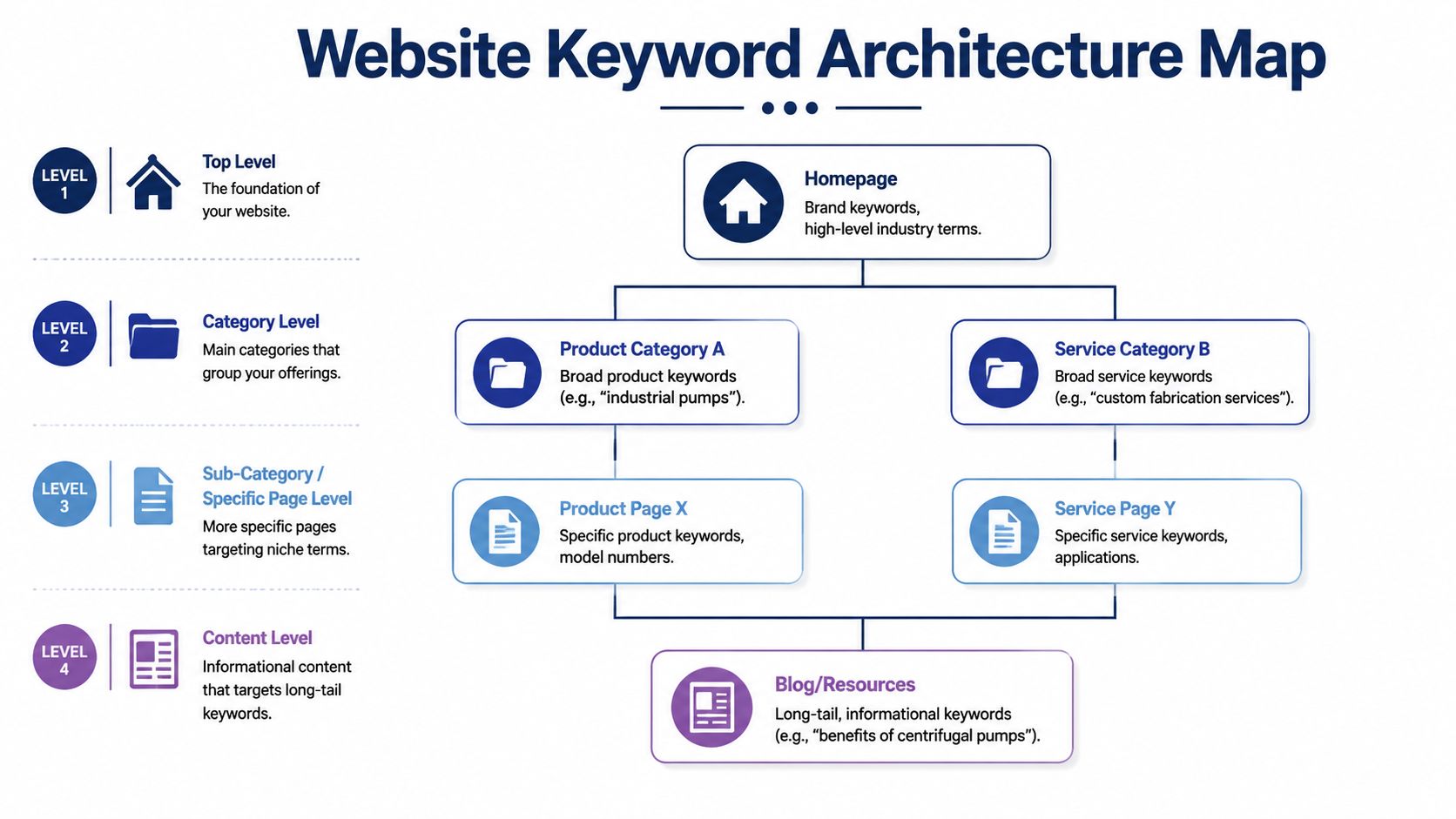
Assign one primary keyword to one page
Every core page should have a clear job.
That means one primary keyword target per page, supported by closely related secondary terms. When multiple pages chase the same phrase, Google gets mixed signals and your own content starts competing against itself.
A clean map usually includes:
- Homepage for brand terms and high-level category positioning
- Service pages for commercial-intent phrases
- Industry or application pages for vertical use cases
- Resource pages and articles for informational searches
- Certifications, quality, and process pages for qualification-related queries
This is also where site taxonomy matters. If your navigation, parent-child page structure, and internal categories are messy, your keyword map will be messy too. A practical primer on website taxonomy for better structure can help if your site grew page by page without a clear architecture.
Build clusters around commercial pages
Modern SEO for manufacturers has moved away from broad targeting and toward specific phrases that match buyer intent. Best practice is separating commercial-intent keywords for service pages from informational-intent keywords for technical articles, as explained in this SEO guidance for manufacturers.
That separation solves two problems at once.
First, it lets your service page stay focused on conversion. Second, it gives your educational content room to answer technical questions without trying to force a hard sell. Both page types can support each other through internal links.
A simple cluster structure might look like this:
Commercial page
CNC machining services for aerospaceSupporting informational pages
Aerospace machining tolerances
Materials used in aerospace CNC machining
When 5-axis machining is necessary for complex parts
AS9100 questions buyers ask before selecting a machine shop
A service page should sell capability. A supporting article should remove doubt.
A practical machine shop example
Let's say a machine shop wants more qualified RFQs for complex milling work.
A weak approach is to target one broad term on several pages and hope authority builds over time. A stronger architecture would assign intent this way:
| Page type | Primary focus | What the visitor needs |
|---|---|---|
| Core service page | Contract CNC machining services | Capability, process fit, proof, CTA |
| Subservice page | 5-axis CNC machining | Specific process depth and project fit |
| Industry page | Aerospace machining | Industry relevance and requirements |
| Article | What is 5-axis machining | Education and early-stage research |
| Article | CNC machining tolerances explained | Technical clarity |
| FAQ page | How to choose a contract machine shop | Supplier evaluation guidance |
This structure gives each page a distinct role. It also creates logical internal links. The informational article can send readers to the commercial page when they're ready. The service page can link back to technical resources that support buyer confidence.
What doesn't work is stuffing every term into one “capabilities” page and calling it SEO. That creates a page that's too broad to rank well and too vague to convert well.
Execute with a Content Plan and On-Page SEO
A manufacturer can build a solid keyword map and still get weak pipeline results if execution breaks between marketing and sales.
The pattern is familiar. Marketing publishes educational posts that attract visits. Sales needs pages that answer buying questions, support RFQs, and help a prospect choose your team over another supplier. If those two tracks are disconnected, traffic rises while qualified inquiries stay flat.

Build pages for the sales conversation they need to support
Each page should have a job in the buying process.
An engineer often needs tolerances, material options, process limits, and design constraints. A purchasing manager often needs supplier fit, lead times, certifications, geographic coverage, and a clear next step. If one page tries to cover every question for every role, it usually becomes vague. Good execution assigns the page a primary intent, then supports the secondary questions that help move the deal forward.
A strong service or product page usually includes:
- Clear scope so the visitor knows exactly what you make or process
- Application detail that helps technical buyers confirm fit
- Specifications or capabilities that answer evaluation questions early
- Proof points such as certifications, equipment, quality process, or industries served
- FAQ content drawn from real sales and quote-stage objections
- A direct conversion path such as quote request, drawing upload, or contact form
For a broader view of how page structure supports lead generation, see this guide on SEO for manufacturing companies.
The standard is simple. A page should help the right buyer take the next sales step.
Turn the keyword map into an operating plan
Content plans fail when they are built around topics alone. Manufacturing teams need a schedule tied to revenue pages, buyer questions, and page ownership.
Start with active sales demand. Review RFQs, emails, call notes, and questions your team answers repeatedly. Then assign those questions to the right format. Some belong on service pages. Some deserve an FAQ block. Some need a full article because the buyer has to understand a process issue before they are ready to request a quote.
A practical monthly cadence might look like this:
- One commercial page update tied to a priority service, industry, or application
- One technical article that answers a pre-sales question and links into that commercial page
- One short FAQ or resource page built from objections sales hears in active deals
- One refresh of an older page that ranks, but does not generate inquiries well
That cadence keeps keyword work connected to demand capture. It also forces a useful discipline. Every new article should strengthen a page that can influence revenue.
If it cannot, it moves down the list.
On-page SEO still decides whether good strategy performs
On-page work matters because it helps both search engines and buyers understand the page fast.
Use the target phrase in the title tag and heading where it fits naturally. Use subheads to separate technical topics a buyer may scan for, such as tolerances, materials, certifications, or industry applications. Use internal links to connect educational content to commercial pages and commercial pages to proof content, FAQs, or process detail that reduces hesitation.
A few details deserve extra attention in manufacturing:
- Technical vocabulary should match how buyers describe the process, part, or problem
- Images and diagrams need alt text that explains what the visual shows
- CTAs should fit the page intent, such as request a quote, send a print, or talk with an engineer
- Schema or technical enhancements help if your team can implement them correctly
- Page copy should answer buyer questions directly instead of repeating keyword variations
Keyword stuffing still fails. Thin copy dressed up with SEO formatting still fails. Buyers can tell when a page was written to rank first and inform second. Search engines have become better at spotting the same problem.
The pages that win in industrial search are usually the pages that make a sales conversation easier before the form fill happens.
Measure Performance and Iterate Your System
SEO for manufacturers isn't a one-time setup. It's a feedback loop.
The reason many companies abandon it too early is simple. They measure the wrong things. If you only watch total traffic, you'll miss whether the strategy is attracting the right buyers to the right pages.
Track the metrics that affect pipeline
A useful review process looks at business signals first and SEO signals second.
Pay attention to:
- Qualified leads from organic search
- Organic traffic to core service and industry pages
- Ranking movement for target commercial terms
- Search Console query trends tied to priority pages
- Contact form quality based on source and page path
If a technical article gets visits but never assists a conversion path, don't automatically delete it. Check whether it links to the right service page, answers a real pre-sales question, or needs a stronger CTA.
Use results to make the next decision
The point of measurement is not reporting. It's diagnosis.
When a page underperforms, look at page-intent fit first. Sometimes the keyword is right and the page type is wrong. Sometimes the page is sound but too thin. Sometimes the article ranks and the internal linking fails to move visitors deeper into the site.
The manufacturers that get lasting results treat keyword strategy as a managed system. They refine the map, update the pages, add missing clusters, and keep the website aligned with how buyers search.
If your website is getting attention but not producing the right sales conversations, Machine Marketing can help you diagnose the gap. We work with manufacturers to connect SEO, content, site structure, and lead generation into one system so your keyword strategy supports pipeline, not just rankings.