If you run a capable machine shop, OEM, or industrial service business, you may already know the frustrating pattern. Your team does excellent work. Your equipment is solid. Your customers stay with you. But when an engineer, buyer, or plant manager searches Google for the exact process, material, or capability you offer, your company barely shows up.
That usually isn't a branding problem. It's a systems problem.
Google remains the primary search surface because it processes an estimated 8.5 billion searches per day and holds more than 92% of global search market share, according to Market.us search engine statistics. For industrial companies, that makes Google ranking a practical route to RFQs, supplier discovery, and technical product visibility. The important shift is this. Google ranking for industrial companies isn't about chasing mass traffic. It's about making a small set of high-intent searches find the right pages, at the right moment, for the right buyer.
Table of Contents
- Why Your Industrial Company is Invisible on Google
- Start with Diagnosis A 40-Question Industrial SEO Audit
- Build Your Technical Foundation A Checklist for Manufacturers
- Develop Content That Converts Engineers and Buyers
- Dominate Local Search with Google Business Profile
- Earn Authority with Strategic B2B Link Building
- Your 90-Day Implementation Roadmap and KPIs
Why Your Industrial Company is Invisible on Google
Industrial companies usually don't disappear from Google because they lack expertise. They disappear because their websites don't express that expertise in a form Google can crawl, classify, and rank.
That gap shows up in familiar ways. A company has strong capabilities, but its service pages are thin. Product data exists, but it lives inside PDFs. The navigation makes sense to internal staff, but not to search engines. Sales knows which jobs are profitable, yet marketing hasn't mapped those opportunities to specific search terms.
This is why generic SEO advice fails in manufacturing. Industrial search behavior is narrow, technical, and intent-heavy. Buyers often use standards, part numbers, material grades, process combinations, and application language. If your site isn't organized around those realities, it won't rank for the searches that matter.
Practical rule: If your best capabilities can't be found through a dedicated, indexable page, Google has very little to work with.
The good news is that this is diagnosable. You can inspect the system the same way you'd inspect production flow, quoting bottlenecks, or quality drift. Look at crawlability. Look at page intent. Look at conversion paths. Then fix what blocks discovery, relevance, and trust.
For most manufacturers, the path to better Google ranking starts with three questions:
- Can Google find your important pages? If technical pages are buried, duplicated, or blocked, ranking won't follow.
- Do your pages match real buyer intent? A broad “solutions” page rarely wins against a page built around a precise capability or product query.
- Does the site show authority? Strong industrial content alone often isn't enough if competitors have better links, mentions, and technical site health.
Start with Diagnosis A 40-Question Industrial SEO Audit
Most industrial SEO work goes wrong before implementation starts. Teams jump into blog writing, page edits, or vendor outreach without diagnosing the site as a system. That creates activity, not progress.
A useful audit should pinpoint where the failure lies. Is the site hard to crawl? Are the wrong pages trying to rank? Are local signals stronger than product signals? Is authority the bottleneck? Those are very different problems.
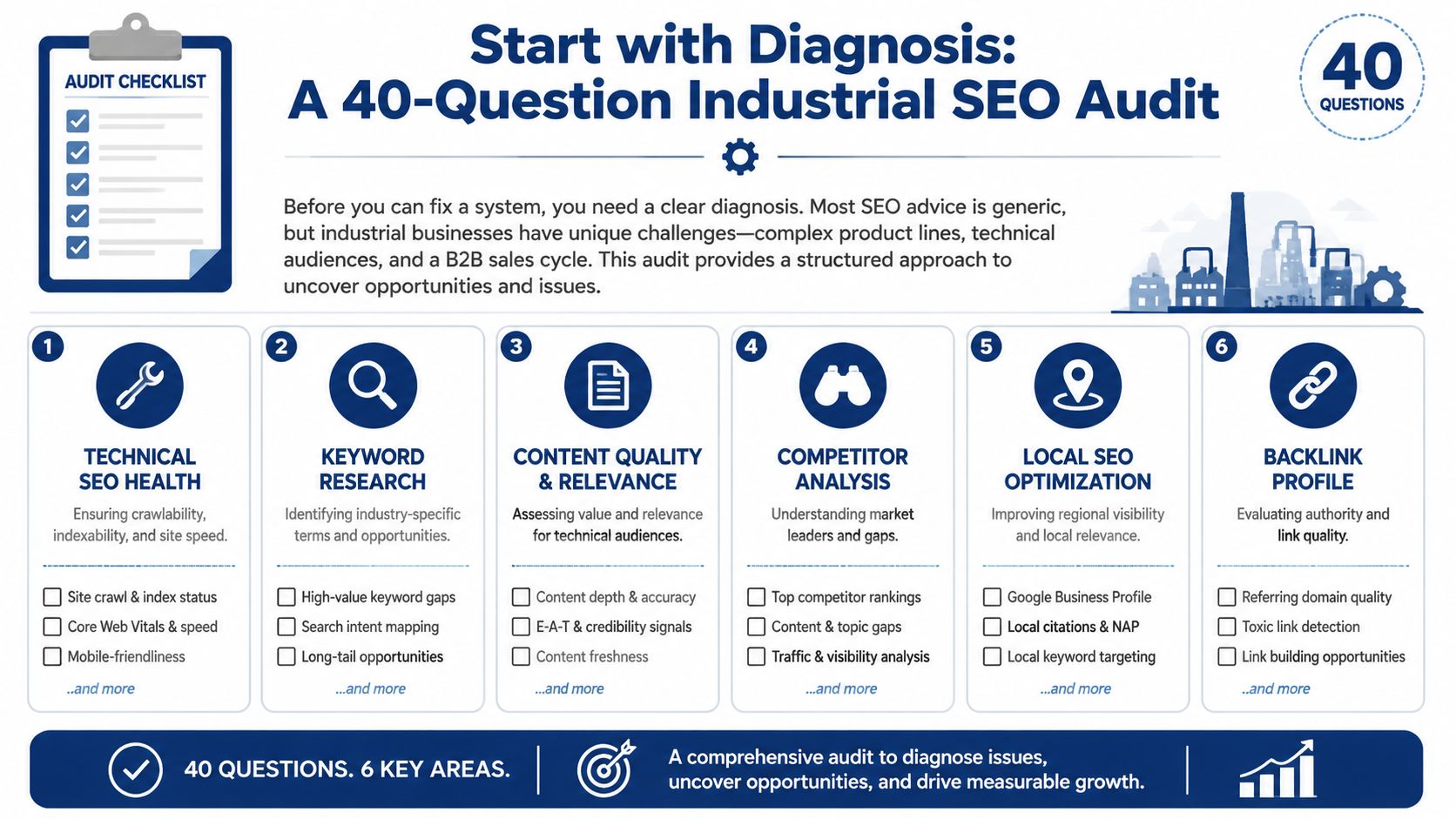
What this audit should uncover
Industrial sites tend to have more moving parts than standard B2B sites. Larger catalogs, layered product families, location pages, rep territories, technical files, and filtered category views all create SEO friction.
Use the audit below as a working diagnosis sheet. If too many answers are “no,” your ranking issue is structural, not tactical.
The fastest way to waste an SEO budget is to optimize pages that Google can't properly discover or pages buyers don't actually want.
The 40 audit questions
Technical health
- Is your site architecture simple enough that a buyer can reach key pages quickly?
- Do your most important product and service pages sit close to the main navigation?
- Does every priority page return a proper live status and load reliably?
- Have you checked for broken pages and broken internal links?
- Are duplicate versions of pages controlled?
- Are filtered or faceted URLs creating repetitive indexable pages?
- Is pagination handled in a way that keeps deeper catalog pages discoverable?
- Do you have an XML sitemap that includes priority URLs?
- Are important resources crawlable rather than blocked?
- Are technical documents supported by HTML pages, not just file downloads?
Keyword targeting
- Do you have a keyword sheet mapped to products, capabilities, industries, and locations?
- Is each high-value term assigned to one primary page?
- Have you separated informational queries from commercial-intent queries?
- Are you targeting exact process and material combinations?
- Are standards-based terms relevant to your buyers included where appropriate?
- Do key pages target part numbers or model-level searches where relevant?
- Are multiple pages competing for the same keyword?
- Have you checked whether first-page competitors already dominate your target terms?
- Are you trying to rank for broad head terms that don't fit your authority level?
- Do page titles reflect the terms buyers use?
Content quality
- Does each core page answer one clear search intent?
- Do product pages include specifications, applications, and use cases?
- Do service pages explain tolerances, materials, capacities, and constraints?
- Are your pages written for engineers and buyers rather than generic marketing language?
- Do you publish FAQs that handle technical objections?
- Are there clear next steps for RFQs, drawings, or quote requests?
- Do pages include original information, not reused manufacturer copy?
- Are thin pages inflating the site without adding value?
- Are important capability pages deeper and more useful than competitor pages?
- Do downloaded assets support the page rather than replace it?
Authority and trust
- Do you have backlinks from trade journals, associations, or industrial directories?
- Are suppliers, customers, distributors, or partner companies linking to you?
- Is your brand mentioned consistently across the web?
- Are key leadership, engineering, or technical experts visible on the site?
- Do case examples, certifications, and industries served reinforce credibility?
Local and measurement
- Is your Google Business Profile complete and accurate?
- Are categories, services, photos, and hours maintained?
- Do you know whether local map visibility or organic product visibility matters more to your sales model?
- Are you tracking impressions, clicks, and conversions at the page level?
- Can you tie priority pages to qualified leads or RFQ actions?
A completed audit usually reveals one of four realities:
| Situation | What it usually means |
|---|---|
| Technical issues dominate | Google can't efficiently process your site |
| Content gaps dominate | You don't have the right landing pages for intent |
| Authority gaps dominate | Competitors have stronger external trust signals |
| Local gaps dominate | You may be ignoring the search surface that matters most |
Build Your Technical Foundation A Checklist for Manufacturers
On large industrial sites, technical SEO is rarely glamorous, but it's often where ranking is won or lost. Manufacturers deal with site architecture, pagination, duplicate-content control, and crawl-budget management because search engines need a clean path through complex catalogs and document libraries. That's a core theme in Nopio's industrial SEO guidance, along with the shift from PDF-only resources to indexable HTML pages for detailed product and application searches.
If your site contains thousands of SKUs, multiple variants, or layered filters, technical discipline matters more than publishing another generic article.
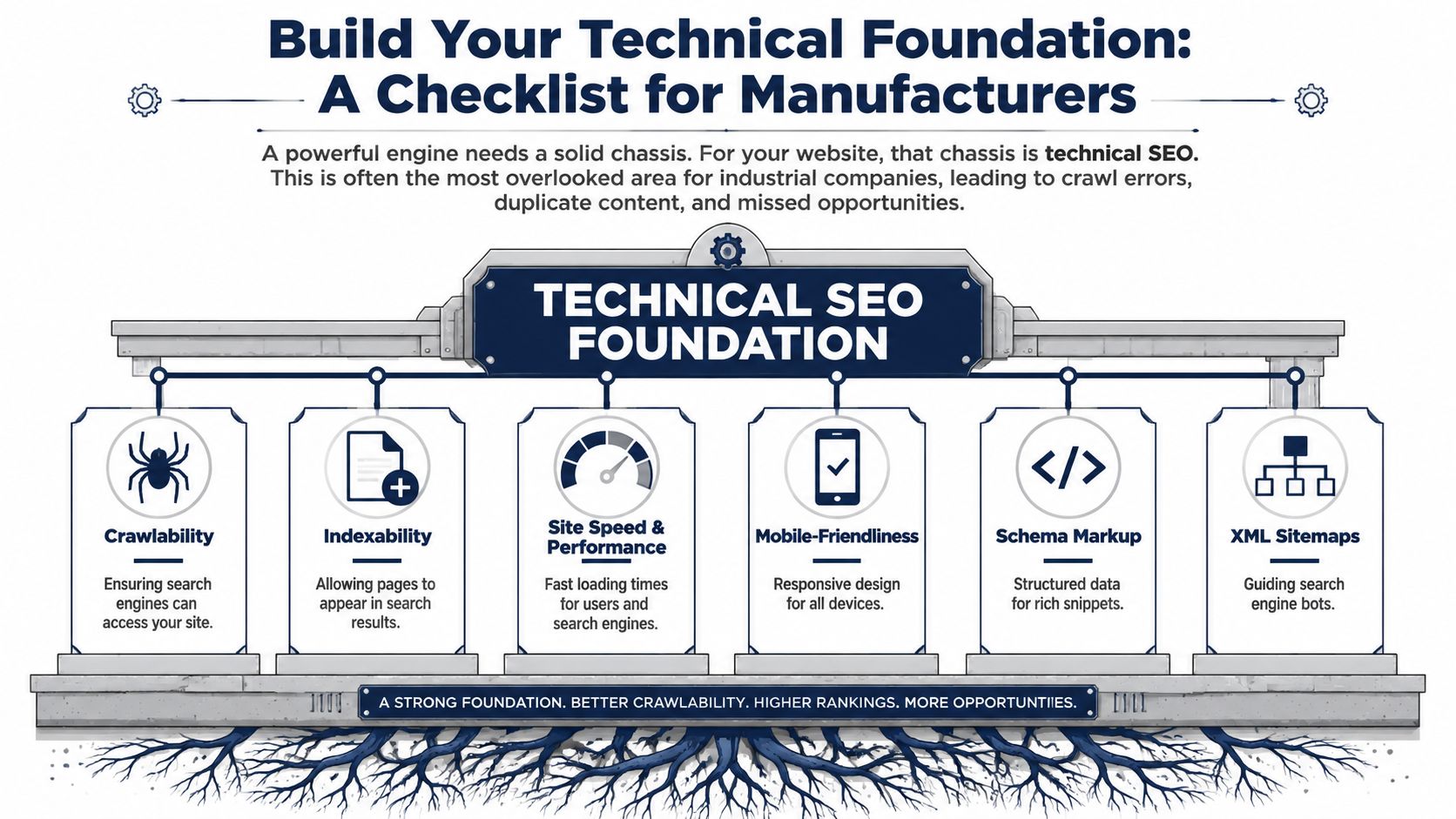
The technical issues that usually block ranking
Manufacturing websites commonly break SEO in predictable ways. Faceted navigation creates endless low-value URLs. Product pages vary only slightly, so duplicate signals pile up. Spec sheets are uploaded as PDFs with no supporting HTML page. Important pages sit too deep in the click path.
That creates a crawl-efficiency problem. Google spends time on repetitive URLs instead of your money pages.
A second issue is separation between engineering data and marketing pages. The site may have valuable technical information, but if it isn't structured as indexable web content, search visibility stays weak. For a broader website planning view, this B2B lead generation website guide is useful because it frames site structure around lead flow rather than design preference.
Your implementation checklist
Use this as a build list, not a theory list.
- Simplify architecture: Keep core capability, product, and industry pages close to top-level navigation. If a priority page takes too many clicks to reach, it's usually under-supported internally too.
- Control faceted navigation: Don't let every filter combination create a search-visible page. Reserve indexable status for pages with real demand and distinct intent.
- Create HTML landing pages for technical assets: If a spec sheet matters, give it a web page with summary copy, key specs, applications, and the download link.
- Consolidate duplicate variants: Similar products often need one stronger parent page instead of several weak near-duplicates.
- Audit broken paths: Fix 404s, redirect outdated URLs thoughtfully, and clean internal links so authority flows to active pages.
- Maintain XML sitemaps: Include important pages. Exclude junk URLs, parameter noise, and duplicates.
- Improve mobile usability: Engineers and buyers still review suppliers on phones, even in technical industries. Pages need to load cleanly and function without friction.
- Use schema markup where it helps interpretation: This can support product, organization, and other structured information that makes content easier for search engines to understand.
- Strengthen internal links: Link from category pages to products, from service pages to industries served, and from blog or resource pages to RFQ pages.
- Watch crawl waste: If Google spends time in filters, archives, search results, or duplicate file paths, your important pages receive less attention.
A manufacturer's website should behave like a well-laid-out plant. Clear flow, minimal waste, and no confusion about where the high-value work happens.
Develop Content That Converts Engineers and Buyers
Industrial SEO content fails when it tries to sound broad and impressive. Buyers don't reward that. They reward precision.
Google's own guidance emphasizes discoverable architecture, user-focused content, and careful use of titles, descriptions, canonical tags, and anchor text in a workflow that starts with keyword mapping and search intent, as outlined in the Google SEO Starter Guide. For manufacturers, that means product and service pages should target commercial-intent phrases such as part numbers, exact service terms, and material or process combinations.
What industrial buyers actually search for
An engineer rarely searches for “advanced machining partner.” A buyer rarely searches for “world-class metal solutions.” Those phrases belong in sales decks, not at the center of your SEO strategy.
Industrial search demand often lives in precise language:
- Part-number intent: Searches tied to exact components, assemblies, or replacement parts
- Material-plus-process intent: Combinations such as a machining method tied to a specific alloy or substrate
- Standards-based intent: Terms tied to ASTM, ISO, SAE, or ANSI requirements when those matter to qualification
- Service qualification intent: Searches that combine process, tolerance, capacity, or industry use case
- Application intent: Searches framed around where the product is used, not just what it is
The mistake is assuming low-volume technical phrases aren't worth dedicated pages. In industrial sales, a narrow search can represent a serious buying opportunity. One strong page for a specific capability can outperform a dozen broad blog posts if it matches intent and supports the quote process.
A page structure that supports RFQs
A high-performing industrial page usually does five jobs at once. It ranks, educates, qualifies, reassures, and converts.
Here's a practical structure for product and capability pages:
| Page element | Why it matters |
|---|---|
| Clear keyword-focused title | Aligns the page with the exact need |
| Short opening summary | Confirms the visitor is in the right place |
| Spec table or capability details | Gives technical buyers something useful immediately |
| Application notes | Connects the offering to real use cases |
| FAQ section | Handles technical objections and clarifies fit |
| Downloadable files | Supports deeper review without replacing page content |
| RFQ call to action | Moves the visitor toward a commercial next step |
Use plain language first, then add technical depth. Don't bury the answer under branding copy.
For example, a capability page should answer questions like these:
- What exactly do you make or do?
- Which materials, tolerances, standards, or sizes apply?
- Which industries or applications are a fit?
- What information should the buyer send for a quote?
- What happens after an RFQ is submitted?
If a page can't help a buyer decide whether to contact you, it probably won't help Google decide whether to rank you.
A final caution. Don't create five pages that all target the same service keyword with minor wording changes. Assign one main intent to one main page. Then support it with adjacent content, such as FAQs, application pages, or industry pages.
Dominate Local Search with Google Business Profile
A lot of industrial companies treat local search like it only matters to restaurants, contractors, and retail. That's a mistake, especially for job shops, fabricators, repair providers, field service companies, and regional manufacturers.
For many industrial businesses, a key strategic question isn't “How do we rank on Google?” It's whether local map visibility or product-page organic visibility should come first. Google's own local guidance emphasizes a complete Business Profile with accurate categories, verification, hours, services, photos, and location details in Google Business Profile help documentation.
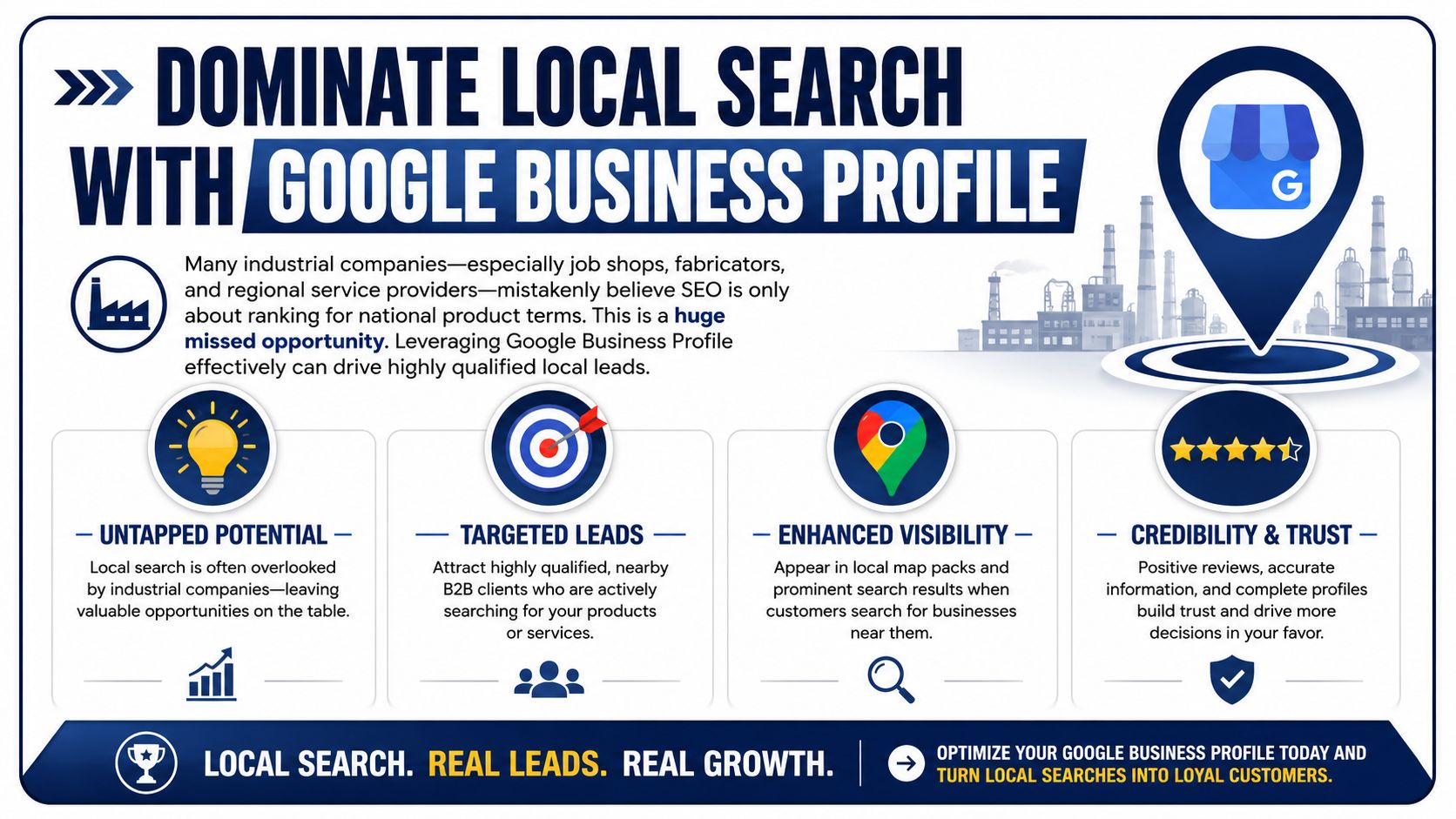
When local visibility should come first
Local should usually move to the front of the roadmap if your business wins work based on service area, response time, plant proximity, or regional reputation.
That includes companies such as:
- Machine shops serving a regional manufacturing base
- Field service firms supporting installed equipment within a defined radius
- Fabricators and finishers that depend on nearby logistics efficiency
- Repair and maintenance providers where local trust matters before national reach
- Industrial distributors competing in regional search behavior
If you're weighing how geography changes keyword selection, this resource on localized keyword research for AI search is a useful companion because it helps frame how location and intent intersect.
Later in the process, it helps to watch a practical walk-through before making profile edits:
How to optimize a B2B-focused profile
B2B-focused local optimization looks different from consumer local SEO. You're not trying to drive walk-in traffic. You're trying to reassure buyers, validate legitimacy, and appear for service-area searches.
Use this operating checklist:
- Choose the right primary category: This is one of the strongest signals for local relevance. Pick the closest match to the core business, not the broadest label.
- Complete every meaningful field: Services, hours, descriptions, contact methods, and service areas should be filled out and maintained.
- Use industrial photos: Show equipment, plant interiors, finished work, team members, and facility context. Generic stock photography weakens credibility.
- Request reviews from business customers: Especially from customers who can speak to responsiveness, quality, technical competence, or project execution.
- Match location data across channels: Your website and profile should tell the same location story.
- Link the profile to the right landing page: If local intent matters, send visitors to the most relevant service or location page.
For a deeper operational checklist, this guide on how to optimize Google Business Profile is a practical reference.
Many industrial firms don't need more visibility everywhere. They need better visibility in the exact geography where profitable work closes fastest.
Earn Authority with Strategic B2B Link Building
Authority is where many industrial SEO programs stall. The site gets cleaner. The pages get better. Rankings still lag because Google also evaluates signals beyond the website itself.
Google explains that ranking systems rely on factors tied to meaning, relevance, and quality in How Search Works. In industrial markets, that translates into practical authority signals such as backlinks and credible mentions from trade journals, supplier ecosystems, customer ecosystems, and respected directories.
What authority looks like in industrial markets
Not all links matter equally. A random low-quality directory submission usually does little. A listing in a respected industrial directory, a supplier profile link, a distributor mention, or a technical article in a trade publication carries far more weight.
Authority in this category is built through real market relationships:
- Trade journals that publish technical commentary, application articles, or expert bylines
- Supplier and distributor pages that list approved partners or featured fabricators
- Customer ecosystems where case mentions, project partners, or vendor pages create relevance
- Manufacturing associations with member directories and organization profiles
- Industrial directories that buyers consult during supplier research
If you need a primer on how link quality fits into overall off-page strength, this overview of a backlink profile is a solid reference.
A practical outreach list
Most industrial companies already have link opportunities sitting in their network. They just haven't organized them.
Start here:
Suppliers and OEM partners
Ask whether they maintain distributor, integrator, or partner pages. Many do.Customers with public vendor ecosystems
If you support visible projects or recurring supply relationships, request a listing or mention where appropriate.Trade publications
Pitch technical education, not promotion. Editors are more receptive to application notes, process advice, or compliance topics than sales copy.Associations and chambers tied to manufacturing
Make sure your profile is complete and links to the correct page.Industrial directories
Prioritize the ones buyers recognize and trust. Accuracy matters as much as presence.Events, sponsorships, and webinars
If your company participates, ask for a linked company profile or speaker page.
What doesn't work well? Mass outreach to irrelevant sites, cheap link packages, or generic guest posting on unrelated blogs. Those tactics ignore the way industrial trust is formed.
Your 90-Day Implementation Roadmap and KPIs
Most manufacturers don't need a longer strategy deck. They need a build order.
The right 90-day SEO roadmap starts with diagnosis, then fixes the site, then strengthens page intent, then adds authority and local signals. That sequence matters because link building and content promotion won't save a weak structure.
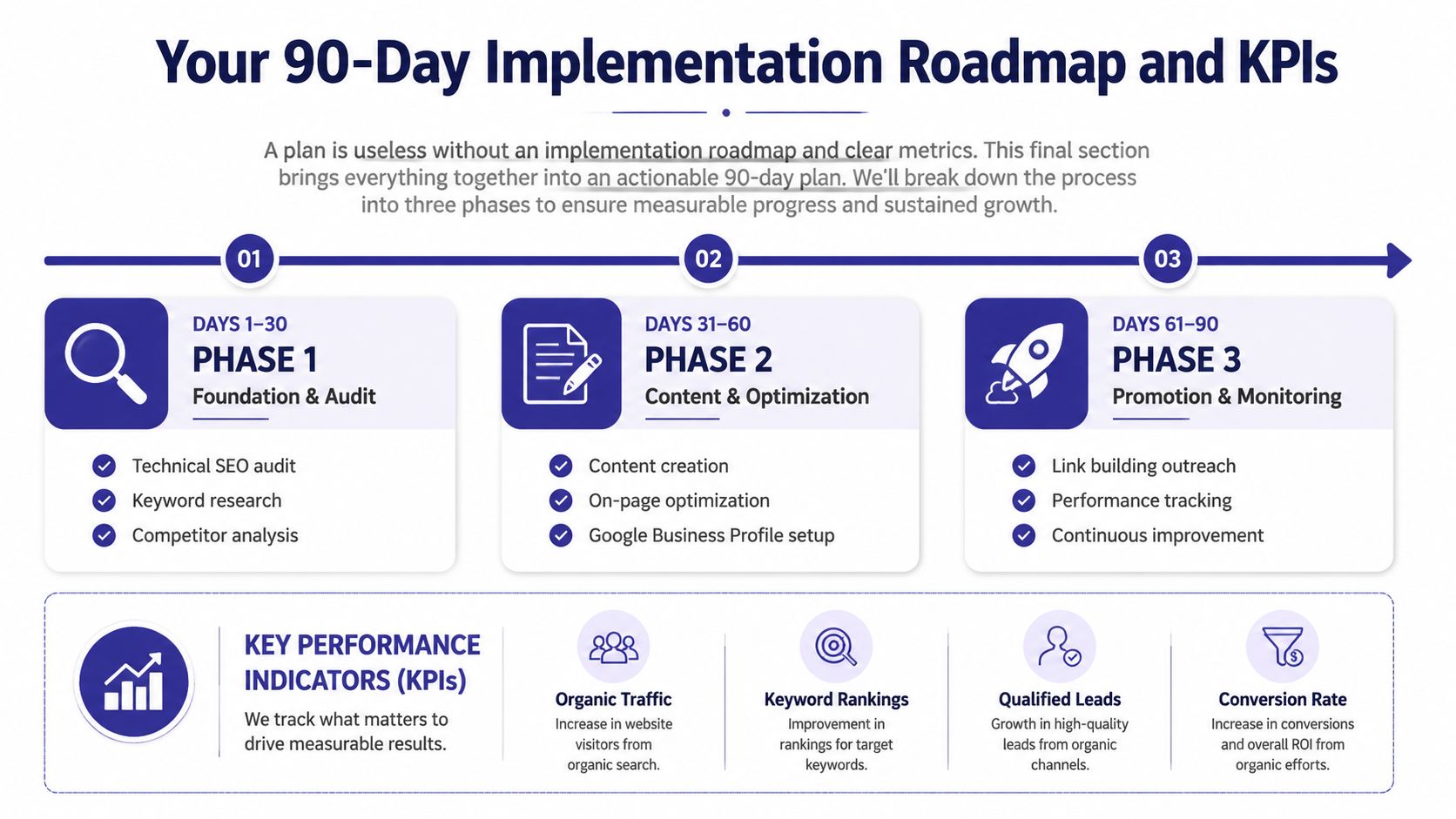
Days 1 to 30
Use the first month to remove uncertainty.
- Run the audit: Complete the 40-question diagnostic and sort findings by technical, content, authority, and local issues.
- Build the keyword map: Assign one main term or intent cluster to each priority page.
- Review competitors: Check which pages rank for your core searches and what those pages contain.
- Fix obvious technical blockers: Broken pages, duplicate paths, weak titles, missing metadata, poor internal linking.
Primary KPIs for this phase:
- Keyword baseline: Current ranking position for priority terms
- Indexation health: Whether core pages are discoverable and appearing
- Page readiness: Which revenue pages are technically sound and aligned to intent
Days 31 to 60
Month two is where the site starts becoming commercially useful.
- Rewrite priority pages: Focus first on capability pages, product pages, industry pages, and quote-entry pages.
- Create supporting HTML resource pages: Turn useful technical assets into indexable landing pages.
- Improve on-page conversion paths: RFQ forms, drawing upload prompts, phone calls, and contact routing should match page intent.
- Refine local landing pages if needed: Only where geography is part of the sales model.
Primary KPIs:
- Impressions and clicks: Tracked in Search Console for specific pages
- Organic visits to priority URLs: Especially product and capability pages
- Page-level conversions: RFQ submissions, contact actions, and quote-start behavior
Days 61 to 90
The third month adds external trust and decision-making discipline.
- Launch link outreach: Suppliers, associations, directories, publications, partners
- Tighten Google Business Profile performance: Categories, services, photo quality, review collection, landing page alignment
- Review page-level outcomes: Keep pages that attract qualified traffic. Rework pages that don't.
- Create an ongoing SOP: Monthly audits, content updates, and authority tasks
If your team needs more ideas for outreach planning, this guide on how to build SEO links is a useful supplement.
For execution discipline, keep your roadmap in one operating document. A structured marketing roadmap template makes it easier to assign owners, deadlines, and KPIs.
A simple KPI stack works best for industrial SEO:
| KPI | What it tells you |
|---|---|
| Rankings for high-intent terms | Whether visibility is improving for searches that matter |
| Organic traffic to key pages | Whether buyers are reaching your commercial pages |
| URL-level conversions | Whether SEO is producing RFQs and lead actions |
| Local visibility indicators | Whether map-based demand is improving where relevant |
Google ranking for industrial companies becomes manageable when you treat it like an engineered system. Diagnose the failure points. Fix the infrastructure. Build pages around buyer intent. Add authority where the market already trusts it. Then measure results at the page level, not just in aggregate traffic.
If you want a second set of eyes on your SEO system, Machine Marketing helps industrial companies diagnose visibility problems, prioritize the right fixes, and turn websites into lead-generation assets that support real sales growth.