If you're a manufacturer, this situation is probably familiar. Your sales team wants better leads, your website gets some traffic, trade shows still matter, and LinkedIn Ads look expensive enough to avoid. So the platform gets dismissed before anyone builds a real system around it.
That's usually the mistake. In industrial markets, b2b advertising on LinkedIn works best when you stop judging it like a cheap traffic source and start using it like a precision distribution system for reaching engineers, procurement teams, plant leaders, and executives who influence long sales cycles.
Table of Contents
- Why LinkedIn Ads Are a System Not Just a Channel
- The Blueprint for Your LinkedIn Advertising Account
- Precision Targeting to Reach Engineers and Buyers
- Ad Creative and Messaging That Actually Works for Engineers
- Setting Budgets and Measuring True Performance
- Your First 90 Days an Optimization Checklist
Why LinkedIn Ads Are a System Not Just a Channel
The common diagnosis in industrial firms
Most manufacturers don't fail on LinkedIn because the platform can't work. They fail because they treat it like a standalone media buy with no connection to audience strategy, content, CRM, sales follow-up, or offer design.
That creates a predictable chain of problems. Targeting is too broad. Ads ask for a demo too early. Sales gets leads with weak context. Marketing reports clicks while leadership asks about quote opportunities and pipeline.
In industrial markets, the buying group is rarely a single person. An engineer may care about tolerances, compatibility, and process fit. Procurement may care about vendor risk and pricing structure. A plant manager may care about uptime. The C-suite may care about payback, supply continuity, and implementation risk.
Practical rule: If your campaign doesn't account for multiple stakeholders inside one account, you're not running a B2B system. You're renting impressions.
Why cost per click confuses the conversation
A lot of teams look at LinkedIn CPC, compare it to other platforms, and stop there. That's an accounting shortcut, not a strategy.
LinkedIn's click cost is higher. But despite having a cost-per-click that is 3–9 times higher than competing platforms, LinkedIn delivers a cost-per-qualified-lead that is 28% lower than paid search for B2B campaigns, with conversion rates up to 2x higher than on other platforms, according to 2025 to 2026 LinkedIn performance data summarized by Digital Applied.
That trade-off matters in manufacturing. You don't need cheap curiosity clicks from the wrong people. You need relevant exposure to the right accounts and role groups, followed by measurable movement into your pipeline.
If your team also enriches account and contact data outside LinkedIn, this short explainer on the relation between LinkedIn and Icypeas is useful context. It helps clarify what LinkedIn does well natively and where teams often rely on adjacent data workflows.
What the system mindset changes
Once you view b2b advertising on LinkedIn as a system, the decisions get cleaner:
- Audience definition comes first. You start with target accounts, industries, plant types, job functions, and buying roles.
- Content gets mapped to buyer concerns. Engineers see technical substance. Executives see operational and commercial outcomes.
- Lead handling stops being vague. Form fills route into CRM with source detail, campaign context, and follow-up SOPs.
- Measurement shifts upward. You stop asking whether an ad got attention and start asking whether it influenced qualified opportunities.
A system also forces honesty. Not every manufacturer should run LinkedIn Ads immediately. If your offer is unclear, your landing pages are generic, or sales doesn't have a follow-up process, paid media will expose those weaknesses fast.
That's why some firms need strategy work before ad spend. If you're trying to sort out the bigger architecture behind channels, conversion paths, and revenue accountability, a focused strategic marketing consultation can surface the bottlenecks before budget gets wasted.
The Blueprint for Your LinkedIn Advertising Account
The account structure should make diagnosis easy. If it doesn't, you'll end up staring at blended results and guessing which audience, message, or offer caused them.
Choose the objective that matches your sales cycle
Industrial sales cycles are usually too complex for simplistic campaign thinking. The objective should reflect where the buyer is in the process, not what marketing wishes would happen.
Here's the practical lens:
| Objective | Best use in industrial B2B | Usually a mistake when |
|---|---|---|
| Brand Awareness | You need visibility in a defined market before asking for action | You expect immediate sales conversations |
| Website Traffic | You have strong educational pages, case studies, or technical resources | You send traffic to weak pages with no clear next step |
| Lead Generation | You offer a checklist, spec guide, webinar, or useful gated asset | You push cold audiences straight to demo requests |
For most manufacturers, early campaigns do better when the offer reduces friction. A spec sheet, process checklist, buyer's guide, or application-focused resource is often a better first conversion than a hard sales ask.
Push for the next logical step, not the final step. Technical buyers respond better when the ask matches their stage of evaluation.
Build a clean account hierarchy
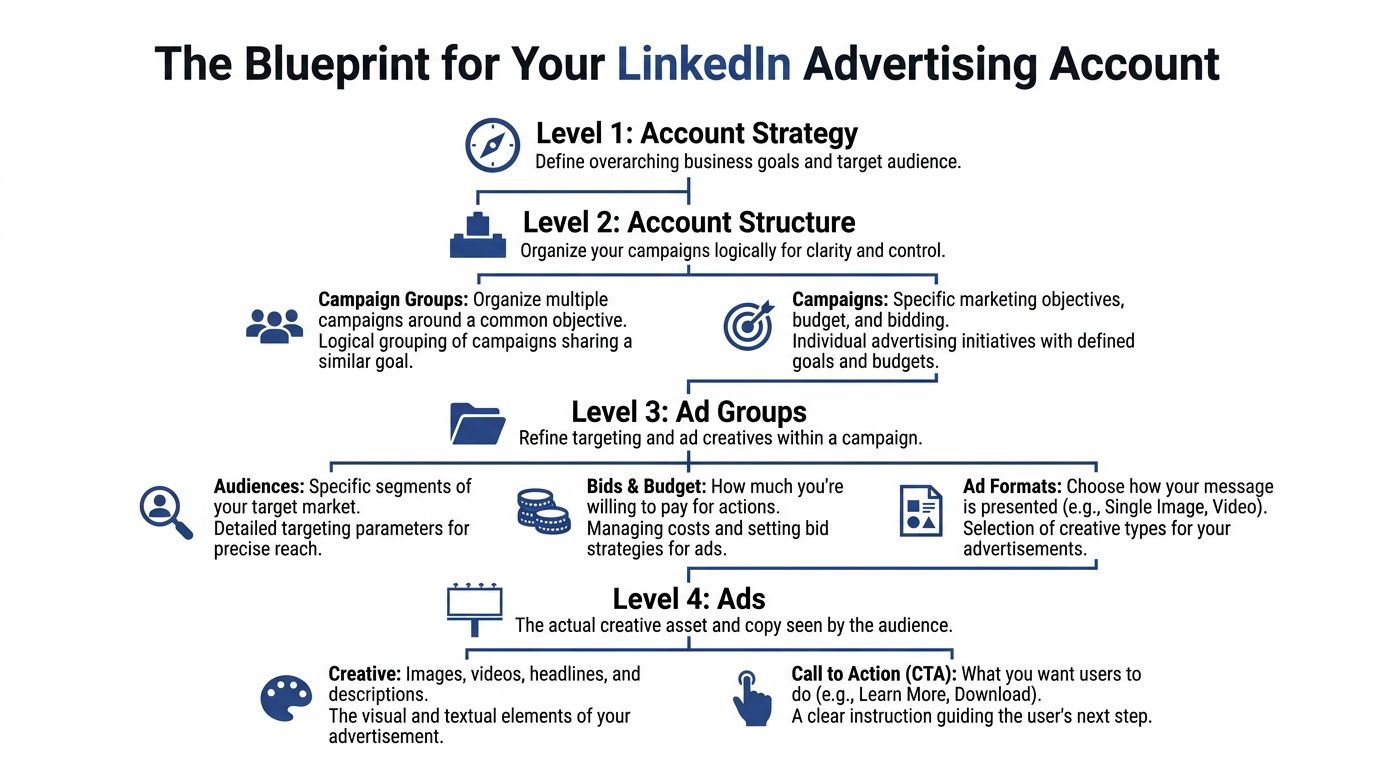
The cleanest LinkedIn setups follow a simple hierarchy:
Account strategy
Define the business outcome. Not "generate engagement." Something closer to "create qualified pipeline from OEMs in a specific manufacturing segment" or "increase penetration into named target accounts."
Campaign groups and campaigns
Use campaign groups to organize around business themes. For example, one group for industrial automation, one for machining services, one for aftermarket support.
Inside each group, campaigns should stay singular in purpose. One campaign for awareness. Another for retargeting. Another for lead capture tied to a specific offer.
Ad groups and ads
It's common for many teams to make a mess. They combine different audiences, different messages, and different offers in the same ad set. Then they can't tell what worked.
Keep variables controlled:
- Audience split: Separate engineers from procurement and operations when the message differs.
- Offer split: Don't mix webinar ads with guide downloads in one bucket.
- Creative split: Test distinct messages, not tiny cosmetic edits that tell you nothing.
A simple structure for industrial campaigns
A good starting model looks like this:
- Campaign group by business line
- Campaign by funnel role
- Ad group by audience segment
- Ads by message angle
For example, a pump manufacturer might run one campaign group for wastewater applications. Inside it, they might separate an awareness campaign for plant engineers from a lead generation campaign aimed at maintenance leaders downloading a reliability checklist.
That level of order doesn't just help marketing. It gives sales context about what each lead saw, what problem they raised their hand around, and how to continue the conversation.
Precision Targeting to Reach Engineers and Buyers
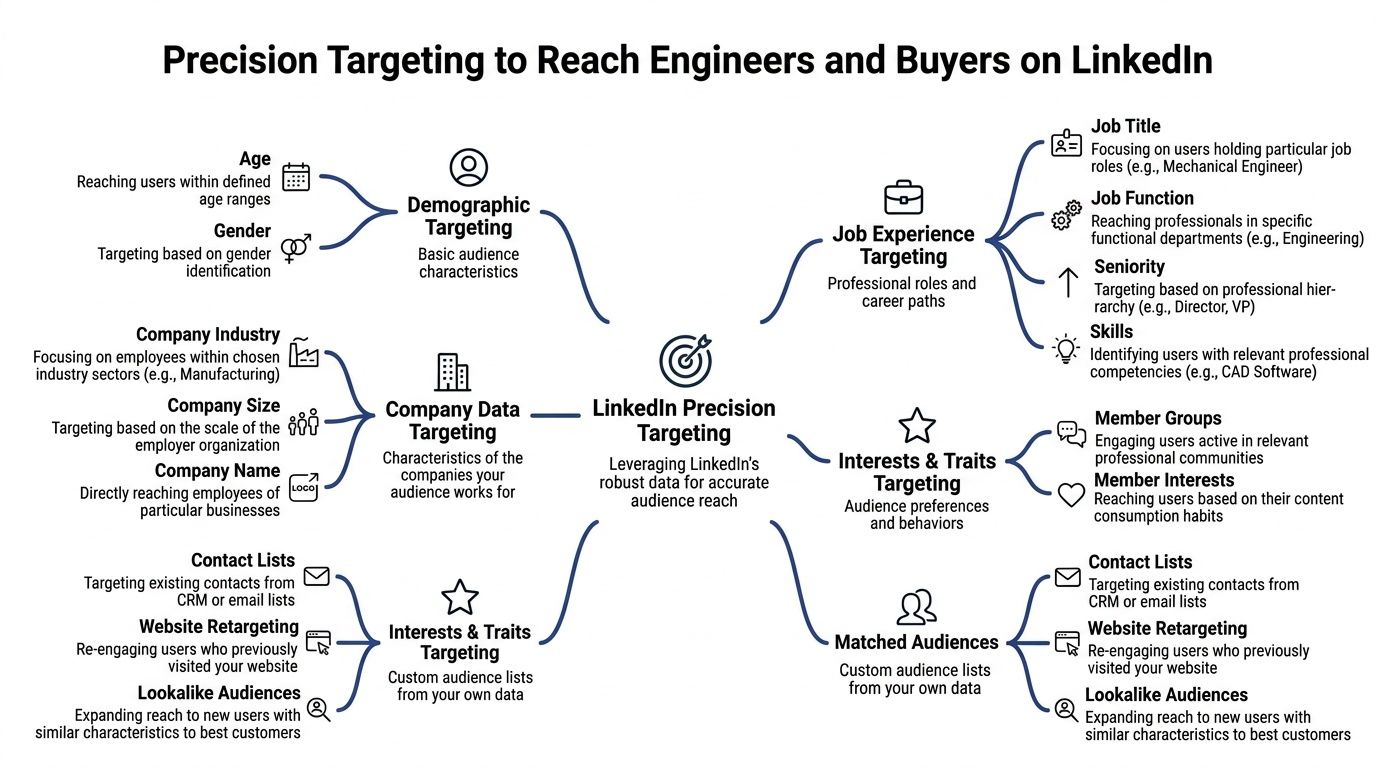
Good LinkedIn targeting isn't about finding everyone who could buy. It's about narrowing down to the people and accounts that matter enough to justify repeated exposure.
A visual map helps when you're building that audience logic across role, company, and intent layers.
Start with the account before the individual
Manufacturers often begin with job titles alone. That's incomplete. "Mechanical Engineer" inside the wrong industry, company size, or geography is still the wrong target.
A tighter method starts with firmographics:
- Industry filter: Machinery manufacturing, industrial automation, automotive, food processing, packaging, aerospace, or another relevant segment
- Company size: Large enough to support your sales motion, small enough to fit your delivery model
- Location: Regions your sales team can support
- Company name: Named accounts for ABM plays
Then layer in role-based filters such as job title, job function, and seniority. This is how you separate a real buying committee from generic professional traffic.
If your team is still refining this groundwork, this guide on how to identify your target audience helps clarify the inputs before you build campaigns.
How to build an industrial audience that stays tight
One of the biggest strategic mistakes in b2b advertising on LinkedIn is going too broad too early. Teams want reach, so they target a huge total addressable market and then wonder why the campaign feels expensive and forgettable.
For ROI, keep your target audience size between 20,000 and 80,000 because it avoids budget dilution and supports the audience penetration needed for the message to stick, as explained in ZenABM's LinkedIn ads metrics guidance.
That recommendation lines up with what we see in industrial campaigns. Smaller, qualified audiences usually outperform broad pools because the buying universe is narrower than often assumed.
A practical audience build often includes:
- Named account lists: Upload customer and prospect companies with Matched Audiences for ABM-style targeting.
- Role clusters: Group engineers, operations leaders, and executive stakeholders separately if they need different language.
- Retargeting layers: Re-engage website visitors who viewed product, solution, or industry pages.
- Exclusions: Remove current customers, job seekers, students, or irrelevant geographies.
Later in the buying cycle, video and retargeting become useful reinforcement tools. This walkthrough adds helpful visual context:
What to look for in audience quality
LinkedIn gives you useful demographic breakdowns by job title, seniority, and company size. Use them. A campaign can look active on the surface and still be reaching the wrong people.
Look for signs that the right accounts are seeing the ads:
- Relevant role exposure: Are impressions landing with engineers, operations leaders, procurement, or executives you care about?
- Account fit: Are employees from target companies engaging, visiting profiles, or returning to the site?
- Buying group spread: Is activity coming from more than one contact inside the same account?
A broad audience makes the dashboard look busy. A precise audience gives sales a reason to care.
Ad Creative and Messaging That Actually Works for Engineers
Industrial buyers are skeptical for good reason. They've seen inflated claims, polished visuals with no substance, and ads written by people who don't understand the application.
What technical buyers ignore
They ignore vague copy. They ignore empty adjectives. They ignore stock imagery of people in hard hats smiling at clipboards if the product itself never appears.
Most underperforming industrial ads share the same flaws:
- Buzzword-heavy headlines: "Transform your operations" says almost nothing.
- Generic visuals: If the image could belong to any company in any industry, it won't build trust.
- Premature CTAs: Asking for a sales call before proving relevance creates friction.
- Too many messages at once: Technical readers scan fast. Confused ads get skipped.
A better creative standard is simple. Show the actual machine, actual part, actual process, actual interface, or actual application. If you're promoting a service, use diagrams, inspection imagery, technical screenshots, or problem-solution visuals tied to real work.
What usually earns attention instead
The strongest industrial creative usually has one job. It introduces one problem and one reason to keep reading.
That can take several forms:
| Creative approach | Why it works for industrial audiences |
|---|---|
| Machinery or product imagery | It proves you do real work, not abstract consulting talk |
| CAD views or schematics | It signals technical depth and application specificity |
| Short process video | It shows function, setup, output, or workflow quickly |
| Direct copy with specs or use case | It respects the buyer's time and intelligence |
Copy should also sound like a competent operator, not a hype-driven brand voice. Instead of promising innovation, describe the problem you solve and the condition where your solution fits.
For example:
- Weak: Improve productivity with a next-generation manufacturing solution
- Stronger: Reduce manual handling in end-of-line packaging with a compact conveyor system built for tight floorplans
If your team wants to expand from direct response into brand authority, this resource on how to leverage LinkedIn for B2B thought leadership adds useful ideas for combining expertise with paid distribution.
A broader messaging framework also matters. If you're writing for technical audiences, this guide to B2B content strategy for engineers is a strong companion for aligning ad language with what engineers trust.
Why repetition beats constant reinvention
Many marketers rotate LinkedIn creative too fast because they're borrowing habits from other platforms. That often hurts performance in B2B.
Top-performing B2B LinkedIn ads repeat a few clear messages longer than feels comfortable, aiming for about 80%+ audience penetration with 10x frequency in 60 days, because familiarity compounds performance with skeptical professional buyers, according to Farsiight's LinkedIn ad format guidance.
That doesn't mean running one ad forever. It means holding onto the core message long enough for the market to absorb it.
Field note: In industrial campaigns, the problem usually isn't overexposure. It's underexposure to a buying group that needs multiple touchpoints before anyone takes action.
Pick two or three strong messages. Stay consistent. Refresh the presentation when needed, but don't throw away a sound positioning angle just because it feels repetitive internally.
Setting Budgets and Measuring True Performance
Many LinkedIn programs break down when leadership asks whether the spend is working, marketing points to clicks, and sales says the reports don't match real pipeline.
That conflict usually comes from measuring the wrong layer of the system.
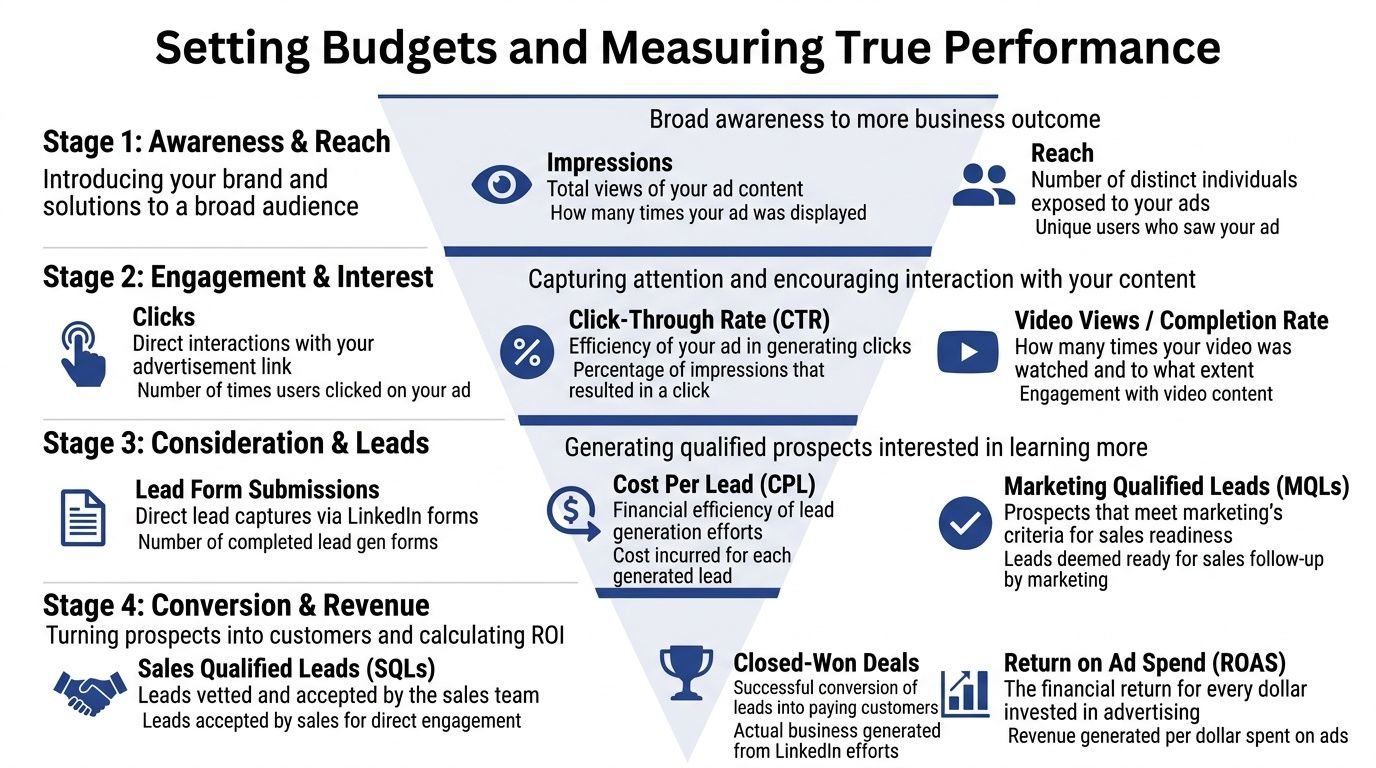
CTR is a signal not the business result
A healthy LinkedIn ad CTR sits at 0.4% to 0.6%, but that metric only indicates ad relevance. However, the key performance question is pipeline impact through metrics like cost per MQL and pipeline created, which requires CRM integration, as noted by Directive Consulting's LinkedIn ads and sales alignment analysis.
That's an important distinction for manufacturers. A decent CTR can still produce weak leads if the audience is too broad or the offer attracts low-intent contacts. On the other hand, an ad that doesn't look exciting in-platform can still influence serious buying activity inside target accounts.
A practical budget mindset looks like this:
- Use CPM and CPC as operating signals. They tell you what you're paying for delivery and engagement.
- Use lead quality as a filter. Sales feedback matters early.
- Use pipeline measures as the scoreboard. If the campaign isn't influencing real opportunities, optimization hasn't gone far enough.
What to monitor weekly
You don't need a bloated dashboard. You need a diagnostic one.
A weekly review should include:
- Spend pacing: Is budget delivering evenly, or is one audience consuming everything?
- Audience relevance: Are the right functions, titles, and companies receiving impressions?
- Offer response: Which asset or CTA pulls in the strongest conversations, not just the most fills?
- Lead routing: Are submissions entering the CRM cleanly with source and campaign data?
- Sales disposition: Are reps accepting, rejecting, or ignoring the leads?
In industrial accounts, qualitative notes often matter as much as quantitative ones. If sales says, "These leads know the application and asked informed questions," that can be more meaningful than a spike in click volume.
How to connect LinkedIn to revenue
CRM integration isn't optional if you want the truth. LinkedIn can tell you about form fills and engagement, but it can't tell you what turned into a qualified opportunity unless your systems are connected.
The basic architecture should do three things:
- Capture campaign source data at lead entry
- Sync that data into your CRM record
- Report downstream progression from lead to opportunity to closed business
Attribution gets complicated fast, especially when buyers see a LinkedIn ad, return later through search, and convert after several touches. If your team needs a practical primer on marketing attribution methods, that resource is a solid starting point for choosing a model that matches long B2B journeys.
When LinkedIn is doing its job, it often influences deals before it gets direct credit. That's why isolated platform reporting almost always understates its real value.
Your First 90 Days an Optimization Checklist
The early phase of a LinkedIn program is not proof that the channel works or doesn't work. It's a diagnostic period. Teams that expect certainty in a week usually either cut too soon or scale too soon.
The first 3 to 6 months of a B2B LinkedIn advertising campaign should be dedicated exclusively to A/B testing so you can identify which ad variations, messages, and offers resonate before scaling budget, according to MarketingProfs guidance on LinkedIn metrics for B2B lead generation.
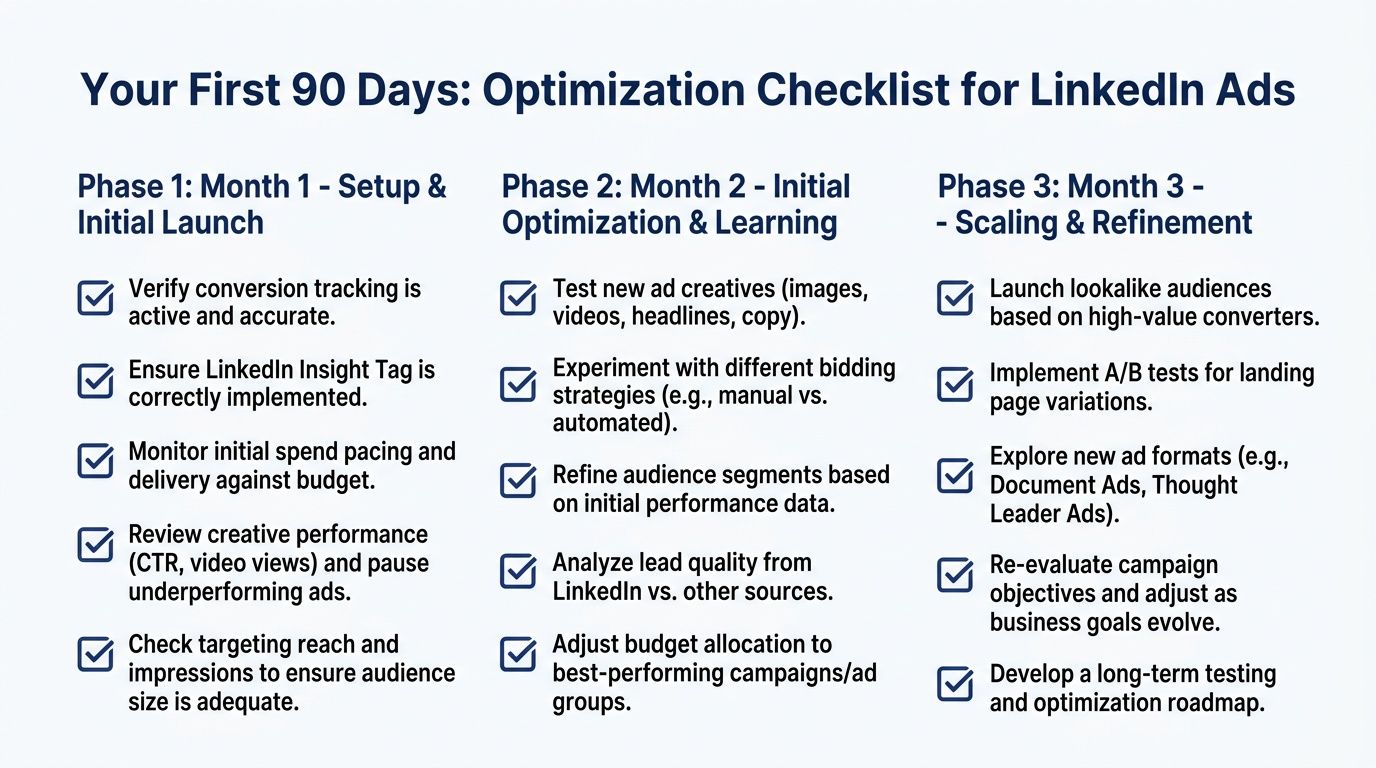
Month one focus
In the first month, the job is validation.
Check the mechanics first:
- Tracking integrity: Conversion tracking and Insight Tag setup need to be correct before any conclusion means anything.
- Audience delivery: Make sure ads are reaching the intended segment.
- Offer fit: Watch what kind of response the market gives to your first asset or CTA.
Avoid dramatic changes. Early noise can make teams overreact. If impressions are reaching the wrong roles, fix targeting. If the right roles are seeing the ads but no one responds, test message and offer before rewriting the whole strategy.
Month two focus
Month two is where actual learning starts. By now, you should have enough directional signal to compare angles.
Run controlled tests across:
- Message angle: Technical performance claim versus operational pain point
- Creative format: Static image versus short product or process video
- Offer type: Checklist, guide, webinar, calculator, or application note
- Audience segment: Engineers versus procurement versus operations
Don't test everything at once. Change one major variable at a time or you won't know what caused the difference.
Month three focus
Month three is for refinement, not victory laps. In this period, you start concentrating budget around what's showing real commercial promise.
Use this short checklist:
| Area | Question |
|---|---|
| Audience | Are the best leads clustered around a tighter segment than expected? |
| Message | Which problem statement consistently earns qualified interest? |
| Offer | Which conversion step creates sales conversations instead of passive downloads? |
| Sales follow-up | Are reps acting on leads fast enough and with the right context? |
| Landing path | Does the post-click experience match the ad promise exactly? |
If one audience-message-offer combination is clearly outperforming, shift budget there gradually. Keep testing around the winner instead of rebuilding from scratch.
Questions to ask before you scale
Before you increase spend, ask:
- Do we know which audience is producing relevant conversations?
- Do we know which message is resonating?
- Do we know whether the offer is attracting real buyers or just researchers?
- Can sales follow up consistently and report back clearly?
- Are we seeing movement into pipeline, not just top-of-funnel activity?
The manufacturers that get strong results from b2b advertising on LinkedIn aren't guessing. They build a repeatable optimization loop. They test patiently, interpret data with sales context, and scale only after they see evidence that the system is holding.
If you want help diagnosing whether LinkedIn fits your industrial sales motion, Machine Marketing works with manufacturers and technical B2B firms to build the strategy, targeting, messaging, and measurement systems that turn scattered marketing activity into consistent pipeline.