If you sell complex products to engineers, you've probably seen the pattern. Your team publishes blog posts, product pages, maybe a few PDFs. Traffic drifts in, but qualified conversations don't. Sales says leads aren't ready, marketing says content is live, and nobody can point to a system that moves technical buyers forward.
That usually isn't a writing problem. It's a design problem. Engineers don't buy the way broad B2B audiences buy. One industry guide notes that “nearly all engineers prefer to do online research and evaluate vendors before talking to sales” in Trew Marketing's guide for engineering marketers. If your content doesn't help them diagnose, compare, and de-risk a decision on their own, it won't do much.
A strong B2B content strategy for engineers works like an engineering project. You diagnose how buyers research. You design a content system around that behavior. You build distribution and workflow so the system runs consistently. Then you measure whether content is helping technical buyers take the next step.
Table of Contents
- Why Your Current Content Fails to Engage Engineers
- Diagnose Your Audience How Engineers Really Research
- Design the Content Blueprint From Datasheets to Deep Dives
- Build Your Technical SEO and Distribution Machine
- Implement Your Editorial Workflow and CRM Integration
- Measure What Matters KPIs for Technical Content
Why Your Current Content Fails to Engage Engineers
Most weak engineering content has the same flaw. It was built like a brochure, not like a decision tool.
Engineers are trained to test claims, check assumptions, and look for failure modes. So when they land on a page full of broad benefits, stock phrases, and thin product copy, they don't lean in. They back out. They're not looking for brand theater. They're looking for usable information that reduces uncertainty.
That's where many manufacturers miss the mark. They apply a generic B2B model that works better for simpler purchases. Then they wonder why technical audiences don't convert. If this is familiar, our perspective on digital marketing for engineers may help frame the gap more clearly.
The wrong assumptions behind underperforming content
A lot of teams assume engineers need persuasion first. In practice, they usually need clarity first.
Common examples include:
- Feature dumping: Listing capabilities without explaining where each one matters, what constraints apply, or when a buyer should care.
- Soft proof: Using phrases like “advanced solution” instead of showing tolerances, process fit, integration details, or implementation considerations.
- Funnel mismatch: Sending early-stage visitors straight to quote requests when they're still trying to understand options.
- Marketing-only authorship: Publishing content without input from engineering, applications, service, or technical sales.
Practical rule: If a page can't help a skeptical engineer make one better decision, it's probably promotional noise.
What works better
Good engineering content behaves more like field support than ad copy. It answers real technical questions in the order buyers ask them. It helps someone move from “What's causing this problem?” to “What approach fits?” to “Can this vendor support implementation without surprises?”
That shift changes everything. Your blog becomes a pre-sales education asset. Your white papers become evaluation tools. Your case studies stop acting like chest-thumping and start acting like evidence.
The companies that do this well don't just publish more. They build a system that respects how technical people think.
Diagnose Your Audience How Engineers Really Research
A plant engineer has a line issue at 2:15 p.m., a production meeting at 3:00, and pressure to recommend a fix by tomorrow. That person is not browsing for inspiration. They are diagnosing a fault, narrowing options, and looking for evidence they can defend in front of operations, maintenance, procurement, and management.
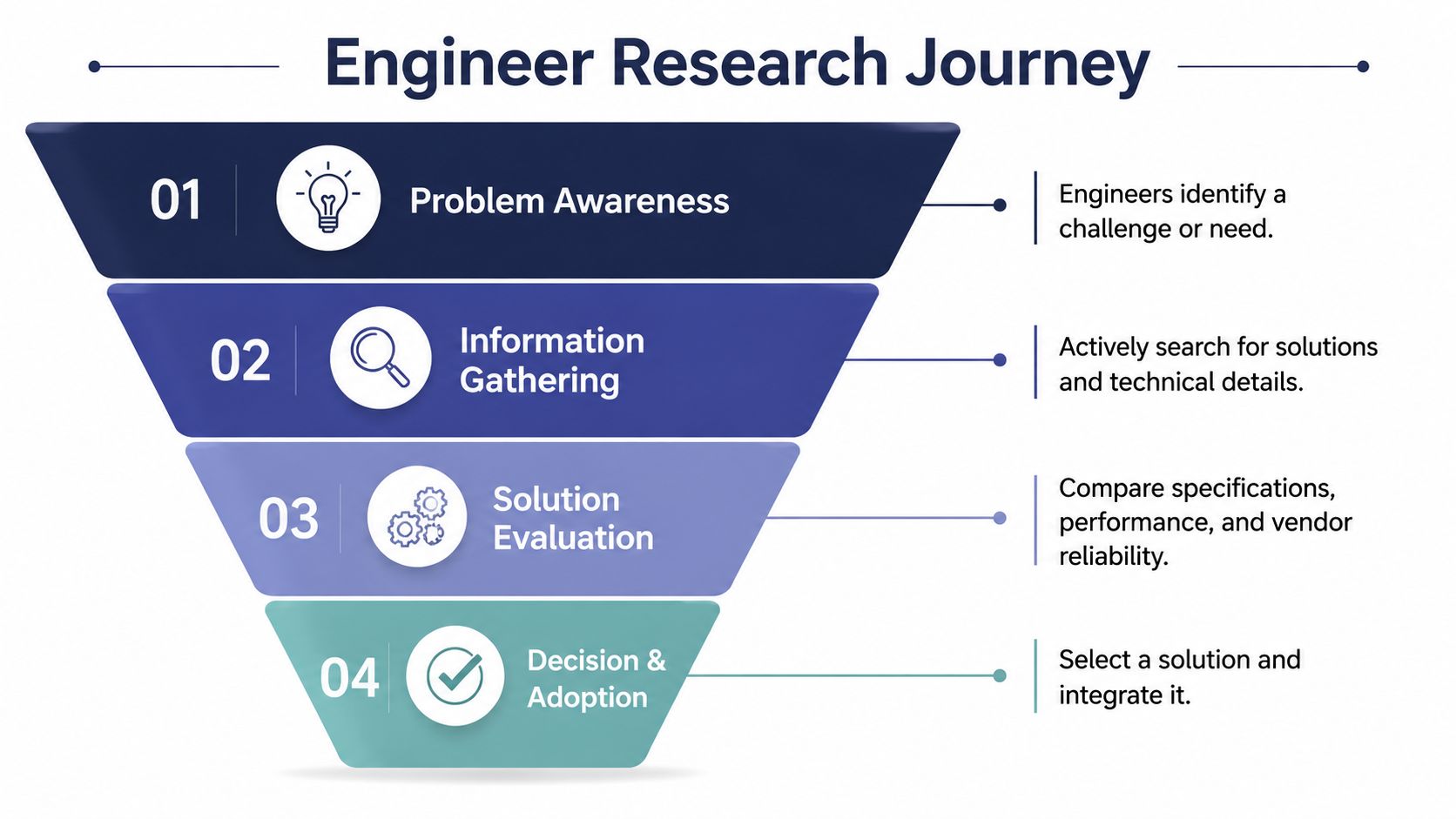
That is the starting point for audience research. Good strategy begins with the job under evaluation, the failure risk in play, and the decision path inside the account.
Start with the decision, not the persona
Job titles help with targeting. They do not explain research behavior well enough to plan content.
A controls engineer replacing a failing component is working under different constraints than an operations director comparing automation partners for a new line. Both may land on the same product page. One needs compatibility and failure-mode detail. The other needs implementation scope, support model, and project risk. If you treat both visits the same, your content will miss both.
Map research around the decisions engineers need to make:
- Define the problem: What is failing, drifting, overheating, wearing out, or slowing throughput?
- Screen possible approaches: Which materials, process changes, equipment types, or design options could solve it?
- Evaluate fit: What performance limits, tolerances, maintenance demands, integration issues, and safety constraints apply?
- Support adoption: What documentation, validation, training, service coverage, and internal approval will be required?
Engineers judge marketing the same way they judge documentation. By whether it helps them make the next correct decision.
Build an Information Needs Map
Use a working document that ties buyer questions to proof, format, and ownership. A spreadsheet is enough. The value is in the logic, not the template.
| Buying stage | Core question | Required proof | Preferred format | Internal owner |
|---|---|---|---|---|
| Problem awareness | What is causing this issue? | Clear diagnosis and correct terminology | Blog post, short video, troubleshooting guide | Marketing + SME |
| Information gathering | What approaches are available? | Trade-offs, use cases, process fit | Application note, comparison article, webinar | Product + applications |
| Solution evaluation | Will this work in our environment? | Specs, limitations, compatibility, performance context | Datasheet, white paper, technical FAQ | Engineering + sales |
| Decision and adoption | Can we install and support this with low risk? | Integration detail, service path, documentation | Implementation guide, case study, email nurture | Sales + service |
This map functions like an engineering requirements document. It keeps teams from publishing disconnected assets because someone suggested a topic in a meeting.
If you need examples of how technical expertise turns into usable assets, our guide to technical content marketing for B2B companies breaks that process down in more detail.
Get input from the people closest to friction
The best research inputs are usually already inside the business. The problem is capture, not access.
Start with these sources:
- Sales calls and deal reviews: Look for repeated objections, stalled evaluations, and questions that appear late in the cycle.
- Applications engineers, service, and support: These teams hear where buyers get confused, hesitate, or mis-specify.
- Site search, search query data, and industry forums: This language shows how prospects describe the problem before they know your terminology.
One prompt works especially well: “What did the buyer need to understand before they were comfortable approving this?” That question pulls out the missing proof, missing explanation, and missing format.
Separate curiosity from buying intent
Not every technical question deserves the same investment.
Some topics draw broad search traffic but have weak commercial value. Others bring in fewer visitors and produce better opportunities because they signal a live project, a specification decision, or a replacement cycle. A page about general automation trends may attract attention. A page on servo motor sizing errors in washdown environments is far more likely to reach a buyer with a real constraint and a budget behind it.
Diagnosis becomes more precise by reviewing past wins, lost deals, and long sales cycles. Identify the questions that appeared before a serious conversation started, then build content around those questions first.
If your team cannot explain what a buyer needed to know at each stage, the problem is not a lack of content. The problem is weak diagnosis.
Design the Content Blueprint From Datasheets to Deep Dives
Once you know how engineers research, content planning gets less subjective. You're no longer asking, “What should we post next month?” You're asking, “What asset helps this buyer make the next decision?”
That shift turns content planning into systems design.
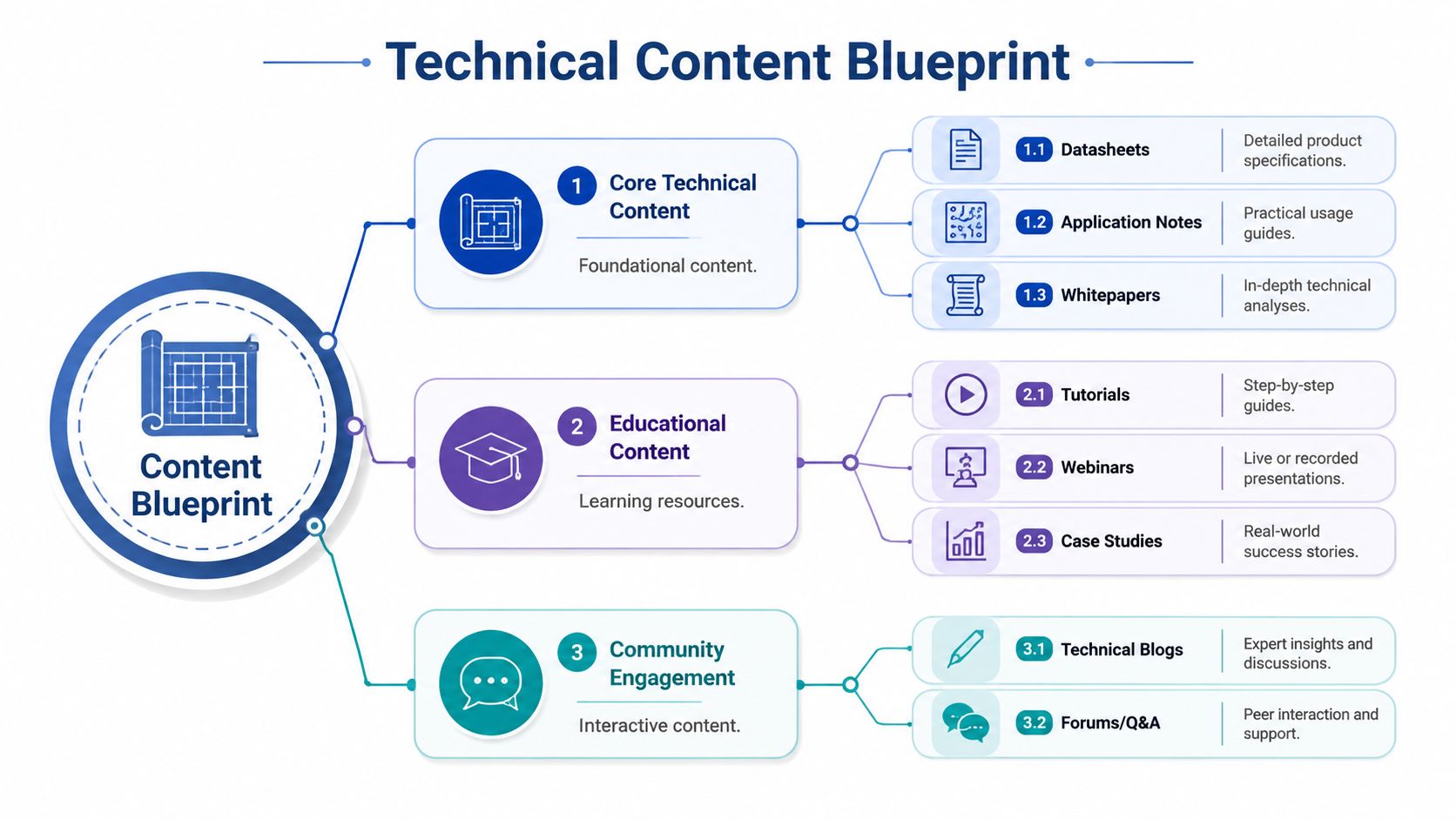
If you want a deeper companion piece on execution, our article on technical content marketing for B2B companies expands on how technical expertise becomes usable marketing assets.
Three content lanes that actually support the buying process
Most engineering-focused programs need three lanes of content. Not equal volume. Equal intent clarity.
Problem-awareness content
This content helps a buyer name a problem correctly and understand what kind of solution may fit.
Examples:
- Articles on failure causes, process bottlenecks, or application mistakes
- Short videos explaining concepts visually
- Technical blog posts that compare methods, not vendors
- Troubleshooting guides and checklists
A CNC manufacturer, for example, might publish content about when 5-axis machining is necessary, where simpler setups create tolerance or cycle-time problems, and what process factors change part quality.
This content works when it teaches without rushing to the quote form.
Solution-evaluation content
Engineers start narrowing options. They need more detail and more structure.
Useful formats include:
- White papers
- Application notes
- Recorded webinars
- Technical comparison pages
- In-depth tutorials
Here, trade-offs matter. A serious buyer wants to know not just what your solution does, but what it requires. Installation conditions, process compatibility, maintenance realities, and integration friction belong in this lane.
Field note: Evaluation content should reduce the number of open technical questions. If it only restates product benefits, it isn't evaluation content.
Vendor-selection content
At this stage, the buyer is asking a sharper question. Not “What is the right category?” but “Can this company execute?”
That's where these assets earn their keep:
- Datasheets
- Implementation guides
- Technical FAQs
- Case studies with real process context
- Documentation libraries
- Email sequences triggered after a download or inquiry
The same Trew guide discussed earlier recommends topic clusters, case studies, white papers, and automated email workflows as part of content programs built for long buying cycles. That combination matters because engineers often need repeated, role-specific education after they first engage.
A simple format selection table
Use this when your team debates what to create next.
| If the buyer is asking… | Build this first | Why it works |
|---|---|---|
| “What's causing this issue?” | Troubleshooting article or explainer video | It matches early diagnostic behavior |
| “What approaches are available?” | Comparison guide or webinar | It frames options and trade-offs |
| “Will this work in our environment?” | Application note or white paper | It gives technical detail and constraints |
| “Can your team support implementation?” | Case study, FAQ, implementation guide | It reduces execution risk |
What usually fails
Some formats underperform because they're used for the wrong job.
- Case studies too early: A buyer who hasn't defined the problem won't care about your successful project yet.
- Datasheets used as education: A spec sheet doesn't teach someone why a category matters.
- Thought leadership with no bridge: Broad industry commentary can build awareness, but it won't help engineers compare options unless it links to practical material.
The strongest B2B content strategy for engineers creates coverage across the whole journey. Not every asset needs a form. Not every topic needs a white paper. But every stage needs a useful next step.
Build Your Technical SEO and Distribution Machine
A manufacturing firm publishes a strong application note on vibration drift, then waits for organic traffic to appear. Six months later, the piece has barely moved. The problem usually is not the technical quality of the content. The problem is that discovery was never engineered.

Search and distribution need to work like a production line. One system captures intent. Another system routes the asset into the channels where technical buyers spend time. If either side is missing, even solid content underperforms.
For a closer look at search architecture and conversion alignment, see our guide to technical content SEO for B2B companies.
SEO for real engineering queries
Technical SEO in industrial markets starts with buyer language, not marketing language. Engineers rarely begin with broad category searches. They start with the failure mode, the process constraint, the material issue, or the compliance requirement in front of them.
That changes what you optimize for.
A useful keyword set usually includes:
- Problem-led queries: searches tied to drift, contamination, pressure loss, fatigue, wear, instability, yield loss, or failure analysis
- Comparison queries: searches that weigh one process, component type, or design path against another
- Implementation queries: searches about setup, integration, tolerances, maintenance, documentation, or compatibility
- Vendor evaluation queries: searches about lead times, certifications, technical support, testing standards, or application fit
This is why generic solutions pages often struggle. They are written at the level of product category. Engineers search at the level of operating condition.
Build pages around one technical question at a time. Use the exact phrasing your sales engineers hear on calls. Include constraints, not just benefits. A page on "how to reduce particulate contamination in pneumatic conveying" will usually attract better traffic than a broad page on "industrial conveying solutions" because it matches the diagnostic stage of the research process.
Distribution is part of the machine
Search compounds over time, but it is rarely enough on its own. Industrial teams that rely only on rankings usually wait too long to get useful reach, especially for specialized topics with low search volume.
A better approach is to pair every major asset with a distribution plan before it goes live.
Use channels based on how the content will be consumed:
- Search: for evergreen problem-solving content and specification-driven queries
- Email: for follow-up sequences, segmented nurture, and role-based education
- LinkedIn and similar professional networks: for expert commentary, charts, clips, and promotion to technical and commercial stakeholders
- Industry forums and associations: for selective participation, topic validation, and credibility in niche categories
- Paid promotion: for high-value assets such as calculators, webinars, guides, and application notes that deserve targeted visibility
Channel fit matters. A datasheet works on a product page or in a follow-up email. It usually fails as a cold social post. A webinar clip can perform well on LinkedIn because it gives a quick technical insight. The full slide deck belongs on a landing page with a stronger call to action.
Here's a useful walkthrough on content promotion and visibility:
Repurpose one technical asset into a campaign
A white paper should be the source document for a campaign, not the final deliverable. Good teams treat one asset like a core assembly and build smaller parts around it.
A practical repurposing sequence looks like this:
- Publish the full resource on a landing page with a clear next-step CTA tied to consultation, sample request, audit, or application discussion.
- Pull out one strong chart, table, or finding and turn it into a short post for LinkedIn or email.
- Create a follow-up email that points the reader to a narrower asset, such as an application guide, specification checklist, or FAQ.
- Build a sales version with objection-handling points, use cases, and qualification prompts.
- Record a short video explaining one technical concept from the asset for product pages, email, or social distribution.
- Add internal links from related blog articles, product pages, glossary entries, and support content.
Here, the system starts to pay off. One technical asset can support search, nurture, sales conversations, and retargeting if it is structured properly from the start.
Platforms matter too. HubSpot, GoHighLevel, and a disciplined CRM plus email stack can handle scoring, routing, and nurture logic. Agencies like Machine Marketing also work in this area by connecting SEO, CRM, and content operations for industrial companies that need one coordinated system instead of disconnected tactics.
Implement Your Editorial Workflow and CRM Integration
A manufacturing owner has seen this pattern before. Marketing lines up a strong topic. An engineer means to review it. Sales wants the finished piece for a prospect call. Then customer work takes priority, the draft stalls, and the lead from last week's download sits untouched in the CRM.
That is not a content problem. It is a systems problem.
A documented workflow gives technical content the same discipline you would expect in production or quality control. The gap is common. The Content Marketing Institute and MarketingProfs reported in their B2B Content Marketing Benchmarks, Budgets, and Trends report that many B2B marketers use content marketing, but far fewer work from a documented strategy. The issue is not effort. The issue is whether the process can run without constant improvisation.
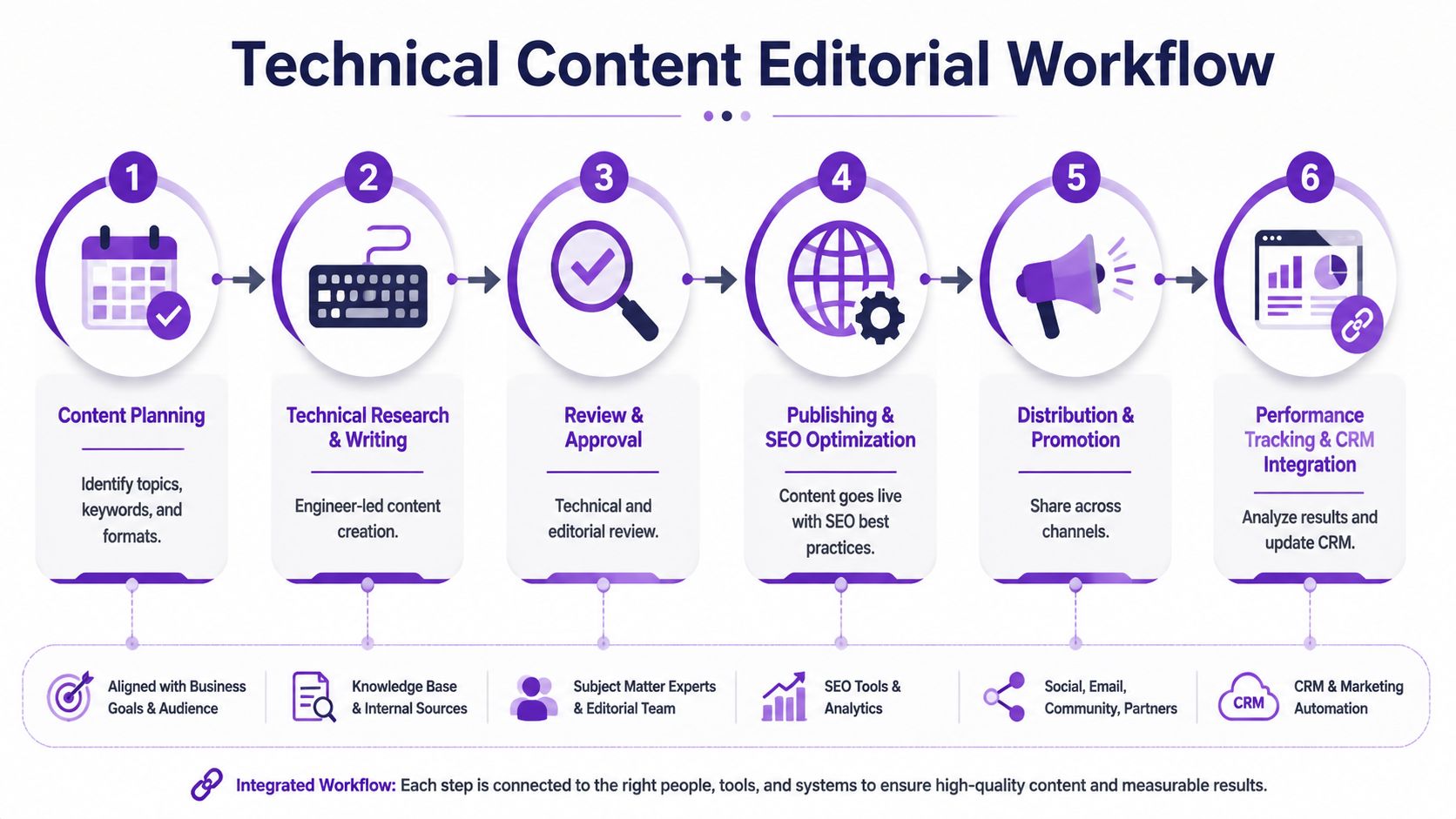
The workflow many industrial marketing teams are missing
Industrial content fails in the handoffs.
Marketing may own the calendar, but engineering owns technical truth, product teams own positioning details, and sales sees the objections prospects raise in live conversations. If those inputs are not built into one operating process, content gets delayed, watered down, or published without a clear next step.
Treat the workflow like an SOP. Each stage needs an owner, an input, and an output.
Planning
- Define the audience segment and buying stage
- Choose the target query or customer question
- Assign the format, CTA, and SME owner
- Set the deadline for technical review before drafting starts
Technical input
- Run a short interview with engineering, applications, service, or product management
- Capture diagrams, failure points, specs, and common buyer objections
- Document approved claims and any compliance constraints
Drafting
- Build the first version around the engineer's evaluation process
- Add examples, use conditions, trade-offs, and selection criteria
- Flag any open technical questions before review begins
Review
- Check technical accuracy first
- Edit for clarity, structure, and search intent second
- Set a hard review window so the piece does not sit in limbo
Publishing
- Confirm metadata, on-page SEO, CTA, and form routing
- Make sure the page matches the intended conversion path
Distribution and follow-up
- Send the asset to email, sales, and any paid or organic channels in scope
- Tag contacts in the CRM based on topic, product interest, and funnel stage
- Track what happens after engagement, not just whether the piece went live
Technical content breaks down when review is vague and ownership is shared by everyone and no one.
How CRM integration changes the value of content
Without CRM integration, a content program produces isolated events. A prospect downloads a guide. Sales never sees it. Marketing sends a generic nurture sequence. The buyer gets information, but your team gets little usable signal.
With CRM integration, content becomes part of the qualification system.
A design guide download can indicate early research. A datasheet request often signals product-level interest. Repeat visits to tolerance, compatibility, or implementation pages can mean the account is moving from problem definition to vendor evaluation. Those signals should change follow-up.
A practical setup might look like this:
| Trigger | CRM action | Follow-up |
|---|---|---|
| White paper download | Create or update contact record with topic tag | Send related application note |
| Webinar registration | Assign interest category and notify sales if account is active | Send replay and FAQ |
| Repeated visits to technical pages | Increase engagement score | Route to sales review |
| Datasheet request | Mark product-level intent | Deliver implementation or spec comparison content |
The trade-off is straightforward. More tagging and automation takes setup time, but it prevents slow, generic follow-up later. HubSpot, GoHighLevel, and similar systems can handle the routing. They do not solve process gaps on their own. They scale the process you define.
Questions to ask your team this week
Use this as a short diagnostic.
- Who owns topic selection, and what input does sales provide before the topic is approved?
- Who gives final technical approval, and how long do they have to review?
- What happens in the CRM after someone downloads a resource or requests a datasheet?
- Can sales see which technical assets a lead viewed before the first call?
- Which high-value topics are delayed because there is no reliable SME interview process?
If your team cannot answer those questions quickly, the content machine is still being built one part at a time instead of running as a system.
Measure What Matters KPIs for Technical Content
A lot of content dashboards look busy and say very little. Pageviews rise. Impressions fluctuate. Someone reports engagement. Meanwhile, leadership still asks the only question that matters. Is this helping us win more of the right business?
That question gets harder in industrial sales because buying cycles are long, deal volume can be low, and multiple stakeholders influence the decision. So a useful measurement model has to focus on movement, not just attention.
Stop treating attention as proof
Traffic can be helpful. So can time on page, downloads, and video views. But none of those metrics prove that content is improving pipeline quality.
A demand strategy article notes that proving impact in long industrial sales cycles is difficult and that the true test is whether content moves cautious buyers to the next evaluation step. The same article cites a projected trend from a 2026 B2B Trends Report that 82% of marketers prioritize short-form video, summarized by Pipeline360's demand strategy article. The format trend matters, but the bigger lesson matters more. Consumption alone isn't the point.
Content should earn its budget by reducing friction in the buying process.
The KPIs that matter more in industrial sales
For a B2B content strategy for engineers, we recommend tracking behavior that signals progress.
Start with these categories:
- Stage progression: Did a visitor move from early educational content to evaluation assets?
- Lead quality: Are content-engaged contacts more aligned with your target accounts, applications, or product lines?
- Sales handoff quality: Does sales receive better context because content behavior is attached to the record?
- Reactivation value: Does content help restart dormant opportunities or old contacts?
- Nurture responsiveness: Are follow-up sequences generating deeper technical engagement?
You can also compare content influence by asset type. A short video may attract initial attention. A white paper or implementation guide may do more to support serious evaluation. Those are different jobs, so don't force them into the same success definition.
A practical dashboard structure
Keep the dashboard readable enough that an owner or sales leader can understand it in a few minutes.
A simple structure:
| Dashboard area | What to review | Why it matters |
|---|---|---|
| Content consumption | Visits, downloads, video engagement | Shows which topics attract attention |
| Buyer movement | Progression to deeper assets or inquiry pages | Shows movement toward evaluation |
| CRM impact | Tagged contacts, account engagement, nurture activity | Connects content to pipeline behavior |
| Sales feedback | Objection reduction, better-informed calls, asset usage | Tests practical value in live deals |
Avoid one trap. Don't ask content to close the sale by itself. In engineering-led markets, content often works by shortening diagnosis, improving internal alignment, and helping buyers arrive at sales conversations better informed. That influence is real even when the final conversion happens later.
If your reporting can show which content helps a buyer move from uncertainty to evaluation, you're measuring something useful. If it only reports attention, you're still looking at the wrong gauges.
If you want help turning scattered content, SEO, CRM, and sales follow-up into one working system, Machine Marketing can help you diagnose the gaps and build a practical content engine for your industrial sales process.