If you're running an engineering firm, this probably sounds familiar. You've sponsored a trade show, posted a few project photos on LinkedIn, maybe sent an email blast when sales got quiet, and rebuilt part of the website because someone said it looked dated. Activity happened. Consistent pipeline didn't.
That gap usually isn't a talent problem. It's a systems problem. Digital marketing for engineers works when it's built like an operational process, not treated like a series of isolated campaigns.
Engineers already think this way. Inputs, constraints, process control, failure points, output quality. Marketing responds well to the same discipline. By 2025, global marketing spend was expected to allocate more than 70% to digital channels, which matters because industrial buying research increasingly happens online before a sales conversation starts, making technical content and SEO central to demand generation, according to Levoro Academy's 2025 digital marketing overview.
Table of Contents
- Why Marketing Fails and Systems Succeed for Engineers
- Define Your Battlefield with Market Research and Personas
- Engineer Your Website for Technical Buyers and Search Engines
- Fueling Growth with Technical Content and LinkedIn
- Automate Lead Nurturing with a GoHighLevel CRM Setup
- Measure What Matters – A KPI Dashboard for Engineers
- Your 90-Day Implementation Checklist
Why Marketing Fails and Systems Succeed for Engineers
Most industrial firms don't fail at marketing because they did nothing. They fail because they did disconnected things. A website update here. A brochure there. One webinar. One paid campaign. One sales follow-up list that never got cleaned up.
That creates noise, not momentum.
What broken marketing usually looks like
When we diagnose underperforming industrial marketing, the same pattern shows up over and over:
- Tactics without sequence. A white paper gets published, but there's no landing page, no follow-up email, and no sales notification.
- Traffic without intent. The site attracts visitors, but the pages don't match what a technical buyer is trying to evaluate.
- Leads without ownership. Someone fills out a form, then sits in a generic inbox until sales notices.
- Reporting without diagnosis. Teams talk about impressions and clicks, but nobody can explain where qualified opportunities are leaking out.
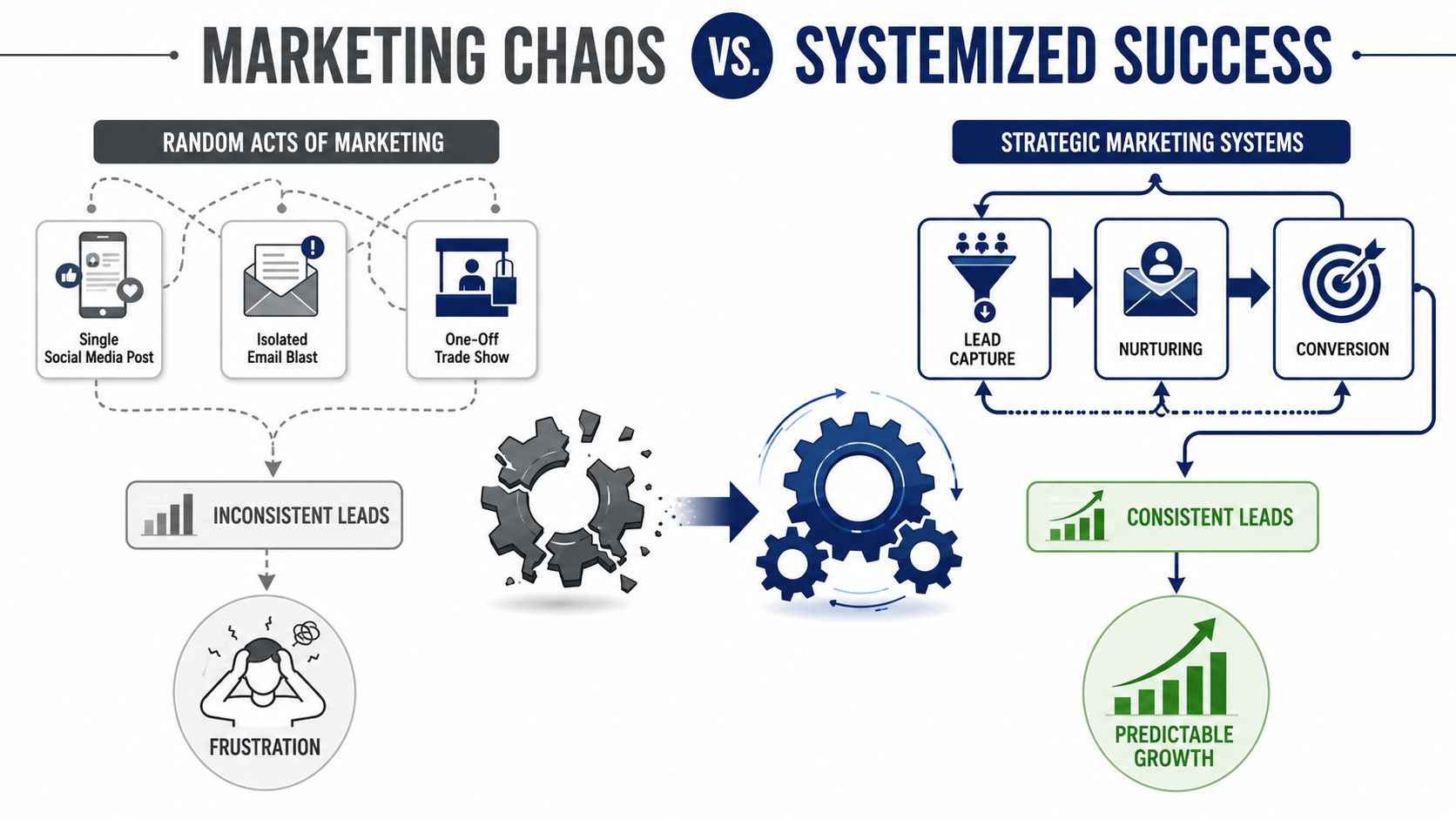
Engineers trust systems because systems can be inspected. Marketing should be no different.
A useful external reference on this mindset is The SEO Agent's founder guide, especially if you want a grounded view of how inbound marketing connects search, content, and lead capture rather than treating them as separate jobs.
The four-part operating model
A stronger approach uses four connected parts.
First is Diagnosis. You identify who buys, how they evaluate risk, what information they need, and where your current funnel breaks. Without diagnosis, teams usually optimize the wrong thing.
Second is Strategy. Here, you decide which audiences matter, which offers belong to each stage of the buying cycle, and what role your website, content, LinkedIn, email, and CRM will each play.
Third is Execution. This is the visible layer. Pages, campaigns, white papers, forms, sales alerts, nurturing workflows. Good execution follows the strategy. It doesn't improvise around it.
Fourth is Measurement. You don't ask whether marketing “feels busy.” You ask whether the system is producing the next desired outcome at each stage.
Practical rule: If a tactic can't be tied to a stage in your lead-generation system, it's probably a distraction.
That's the mindset shift that makes digital marketing for engineers manageable. You stop asking, “What should we post this week?” and start asking, “What system do we need so the right buyers can find us, evaluate us, and move forward?”
Define Your Battlefield with Market Research and Personas
Industrial companies often skip this step because they think they already know their customer. Usually they know the account. They don't always know the decision path inside that account.
That distinction matters. The engineer evaluating fit, the manager approving spend, and the procurement contact reducing vendor risk are not looking for the same proof.
Use lean personas, not corporate fiction
You don't need a glossy persona deck. You need a working document your sales and marketing teams will use.
Build three lean personas:
Technical user
This person cares about fit, tolerances, compatibility, implementation effort, documentation, and performance under real operating conditions.Economic buyer
This person cares about business risk, delivery confidence, operational efficiency, vendor reliability, and whether your solution solves an expensive problem.Gatekeeper or procurement contact
This person cares about responsiveness, compliance, documentation, purchasing process, and whether your company is easy to work with.
A practical way to build these profiles is to interview sales, customer service, and application engineers. Review real emails, RFQs, call notes, and lost-opportunity reasons. If you need to sharpen the competitive picture, this guide to web scraping for competitive intelligence is useful for collecting competitor page structures, messaging patterns, and content gaps at scale.
For a deeper internal framework, this walkthrough on creating buyer personas for industrial companies is a practical way to turn sales knowledge into usable marketing inputs.
Translate specs into role-specific value
A common failure in digital marketing for engineers is assuming that technical accuracy alone is enough. Accuracy is required. It isn't the same as positioning.
The same product feature needs different framing depending on the reader.
| Role | What they ask | What your message should answer |
|---|---|---|
| Technical user | Will this work in my application? | Show specs, tolerances, drawings, process detail, and limitations |
| Economic buyer | Is this worth the cost and effort? | Show business impact, implementation confidence, and project risk reduction |
| Procurement | Can I buy this without friction? | Show lead times, documentation, quality process, and communication clarity |
Ask sharper questions during research:
- Where does the process stall? Is the delay technical uncertainty, internal alignment, or vendor approval?
- What triggers urgency? Downtime, redesign, capacity limits, compliance issues, or a missed production target?
- What proof removes doubt? Drawings, sample parts, certification documents, application notes, or a real case study?
The strongest persona work sounds like customer language, not marketing language.
If your positioning says “advanced manufacturing partner,” it won't help much. If it says, “We help OEM teams shorten the path from prototype revision to repeatable production by documenting tolerance risk early,” now you're speaking to a real buying condition.
That level of specificity gives the rest of the system something solid to work from.
Engineer Your Website for Technical Buyers and Search Engines
Your website has one job. Help the right buyer find the right information fast enough to take the next step.
Many industrial sites still behave like digital brochures. They talk about the company, list broad capabilities, and bury useful technical information under vague navigation labels. That's costly because engineering buyers don't browse for inspiration. They visit with a task.
Build for task completion
The first design question isn't, “Does the homepage look modern?” It's, “Can a buyer complete their research task without friction?”
A technical buyer usually wants some combination of:
- Application fit. Can this solve my use case?
- Technical proof. Are there specs, drawings, tolerances, materials, process notes, or implementation details?
- Commercial next step. Can I request a quote, a sample, a consultation, or documentation without a phone maze?
That's why clear paths matter more than clever messaging. Your pages should separate services, industries, applications, and resources so users don't have to decode your internal structure.
If you're auditing your current site, this guide on industrial website design for manufacturers is a useful benchmark for structure, navigation, and conversion flow.
Structure pages for intent, not internal org charts
Search performance improves when page structure matches real search intent. That means specific pages for specific needs.
A better industrial site typically includes:
Service pages for each core capability
Not one generic “Services” page. Separate pages help both search engines and buyers understand scope.Application pages for real use cases
If buyers come in through a process, industry, or problem, give them a page that speaks directly to that context.Resource pages for technical evaluation
Datasheets, white papers, FAQs, design guidance, and case studies should be easy to locate.Quote paths that don't interrupt evaluation
“Request a quote” should be visible, but it shouldn't be the only action on every page. Some visitors need technical material first.
A website for engineers should reduce interpretation. The user shouldn't have to guess where the useful information lives.
The SEO side matters too, but industrial SEO is often misunderstood. High-intent visibility usually comes from precise phrases tied to capabilities, applications, and geography, not broad brand language. A page aimed at a specific machining process, material, or engineering problem is often far more useful than a catch-all page trying to rank for a generic industry term.
A few practical standards help:
Write page titles and headings around actual buyer tasks
Think in terms of process, component type, service category, or industry use.Put technical detail above the fold when it matters
Engineers shouldn't need six scrolls to find material specs or tolerance information.Give every page one primary next action
Download, request quote, contact engineering, or review documentation. Don't ask for everything at once.Keep forms proportional to the offer
A quote request can ask for project specifics. A datasheet or educational guide should ask for less.
The strongest industrial websites do two things at once. They satisfy search intent and they support technical evaluation. If either side is missing, the site underperforms.
Fueling Growth with Technical Content and LinkedIn
A lot of firms treat content as decoration. A monthly blog post, a few photos from the shop floor, maybe a company update when new equipment arrives. That's not a content system. It's filler.
Content is what moves a buyer from curiosity to trust. For engineering audiences, that means giving them material they can use to evaluate, compare, and justify a decision. Research shows 69% of engineers go straight to a supplier website when researching a product, and they favor technical resources like datasheets, CAD drawings, white papers, and case studies, according to Tiecas on why digital dominates engineer buying behavior.
Why content does the heavy lifting
For most industrial firms, three asset types do the most work.
First, technical articles. These answer narrow questions tied to design, process, material choice, troubleshooting, integration, or compliance. They help you show up in search and prove technical competence without a sales call.
Second, white papers. These work well when the buyer is evaluating a complex issue and needs a structured explanation. Good white papers reduce uncertainty. Weak ones read like brochures with a PDF cover.
Third, case studies. These are your trust bridge. They show how your team solved a real problem, under real constraints, with real decision logic.
The combination of content marketing + SEO + LinkedIn is a practical acquisition stack for engineering firms because it aligns with how professional buyers research complex purchases, as outlined in Market Veep's engineering marketing guidance.
A content strategy matrix for engineering audiences
| Content Type | Primary Persona | Funnel Stage | Objective |
|---|---|---|---|
| Technical article | Technical user | Early | Capture search demand and answer specific engineering questions |
| White paper | Technical user and manager | Mid | Provide structured evaluation material for a defined problem |
| Case study | Manager and procurement | Mid to late | Build trust and show delivery credibility |
A few content decisions improve results fast:
- Choose narrow topics. “CNC machining” is too broad. A specific process issue, material concern, or design constraint is more useful.
- Use real operating context. Include limitations, trade-offs, and design considerations. Engineers trust balanced information more than polished claims.
- Write for handoff. Your content should help one person forward it to another inside the buying group.
The best industrial content doesn't try to sound impressive. It helps the reader make a lower-risk decision.
How LinkedIn fits without wasting time
LinkedIn works best as a distribution and credibility channel, not as your entire strategy. Post links to technical articles. Share short observations from engineering or sales conversations. Turn one white paper into several smaller posts that point back to the full resource.
The firms that waste time on LinkedIn usually make one of two mistakes. They publish generic brand content, or they expect direct lead volume from social activity alone.
A better operating pattern looks like this:
- Company page distributes new resources and proof assets
- Subject matter experts comment on technical issues in plain language
- Sales team members share relevant content to named accounts and active conversations
- Google Business Profile stays current for firms that serve a local or regional market and need geographic credibility
That mix keeps LinkedIn in its proper role. It extends the reach of your technical content. It doesn't replace your website, SEO, or CRM.
Automate Lead Nurturing with a GoHighLevel CRM Setup
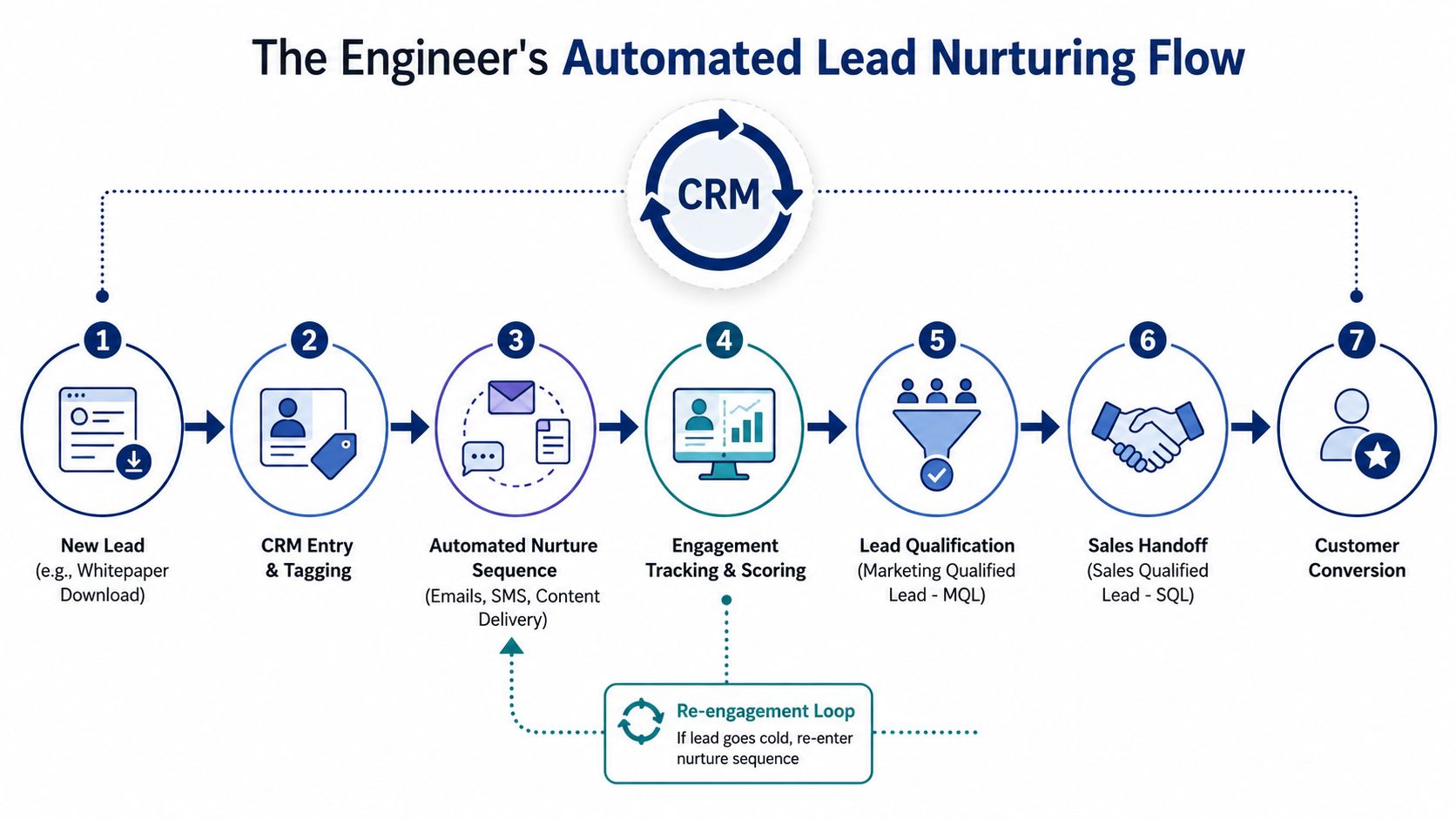
The lead you care about most usually doesn't arrive ready to buy. They download a white paper, compare vendors internally, disappear for a while, then resurface when the internal project finally moves. If you don't have a CRM and automation layer, that lead often vanishes into a spreadsheet, an inbox, or someone's memory.
That's where GoHighLevel becomes useful. It can act as the central nervous system that connects forms, tags, email follow-up, pipeline stages, reminders, and reactivation campaigns.
Email remains one of the strongest channels for long-cycle industrial sales. One 2025 summary reported that 63% of marketers actively use email marketing, and another cited roughly $36 to $42 in return for every $1 spent, according to Insivia's 2025 digital marketing statistics summary. For engineering firms, that matters because email works well when paired with a CRM that tracks repeat visits, downloads, and quote requests over time.
A simple engineer lead flow in practice
Say a design engineer downloads your white paper on reducing tolerance issues in a high-precision assembly.
The system should do more than send a thank-you email.
It should:
- create the contact in GoHighLevel
- apply a tag based on the asset topic
- assign the lead to the right pipeline or segment
- trigger a short nurture sequence tied to that topic
- notify sales only when engagement shows real buying intent
Here's the practical flow.
The engineer fills out a form on the website. GoHighLevel records the source and tags the contact as interested in that specific application or problem area. The first email delivers the asset and sets expectations. The second email might point to a related case study. The third could offer a technical discussion or quote request, depending on the asset and buyer stage.
Later in the cycle, if the same contact returns to key pages or requests another resource, the system can surface that behavior to sales.
A detailed implementation example is in this guide to GoHighLevel for manufacturers and industrial teams, which shows how firms use workflows, tags, and pipeline stages to reduce lead leakage. Machine Marketing offers this kind of CRM and automation setup alongside broader strategy work, which is relevant if you already have traffic and content but no clean follow-up system.
What your GoHighLevel setup should actually include
A lot of CRM builds fail because they're overcomplicated on day one. Start with a simple architecture.
Lead source tagging
Every form should identify where the lead came from and what offer they responded to.Topic-based segmentation
Don't put every contact into one generic list. Segment by problem area, service interest, product line, or buying stage.Short nurture sequences
Keep the initial workflow tight and useful. Deliver the promised asset, send a relevant follow-up, and create a clear next action.
Before building your own workflows, it helps to see the moving parts in action:
A few more components make the system dependable:
Sales alerts based on behavior
Notify a salesperson when someone shows repeated interest, not just when they exist in the database.Reactivation campaigns
If a prospect went quiet months ago, send a focused sequence tied to a new resource, product update, or consultation offer.Pipeline discipline
Use clear stages. New lead, engaged lead, qualified conversation, quoted, closed. If stages are vague, reporting will be vague too.
If your CRM only stores contacts, you don't have a marketing system. You have a database.
Digital marketing for engineers usually breaks at handoff points. GoHighLevel helps because it makes those handoffs visible and automated.
Measure What Matters – A KPI Dashboard for Engineers
Most marketing reporting for industrial firms is too noisy to be useful. Teams look at traffic, impressions, social reactions, or email sends and still can't answer the only question that matters: is the system creating more qualified sales conversations?
A useful dashboard should tell you where flow is healthy and where it's breaking.
Ignore vanity, diagnose flow
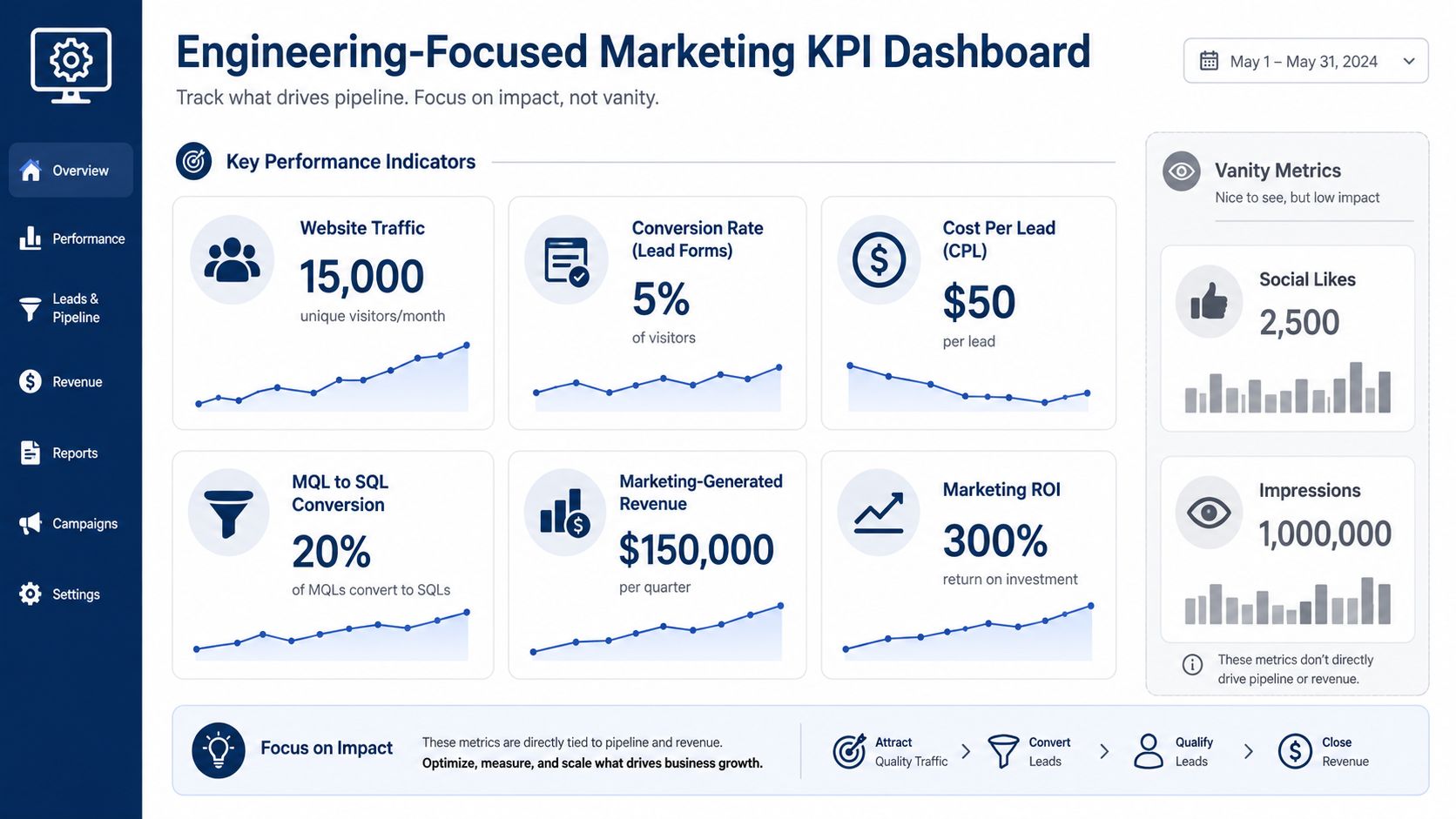
The most useful baseline KPIs are conversion rate, click-through rate, ROI, and bounce rate, and A/B testing is a recommended method for improving ads and landing pages, according to Northwestern Medill's guide to digital marketing success metrics.
Those metrics matter because each one points to a different type of system issue.
| KPI | What it tells you | Common failure signal |
|---|---|---|
| Conversion rate | Whether visitors are taking the next action | Good traffic, weak offer or landing page |
| CTR | Whether messaging earns attention | Weak ad copy, subject line, or call to action |
| Bounce rate | Whether the page matches visitor expectations | Intent mismatch, poor relevance, poor usability |
| ROI | Whether spend is creating business value | Channel mix or follow-up process is underperforming |
If conversion rate drops suddenly, don't change five things at once. Diagnose in sequence. Check traffic quality first. Then page relevance. Then message alignment. That order matters because bad traffic can make a strong page look weak.
A dashboard should support decisions, not decorate meetings.
A practical dashboard review routine
Review your dashboard with three questions.
Where is the drop-off happening?
Between ad and click, click and landing page, landing page and form fill, or form fill and sales follow-up?What changed recently?
New traffic source, new landing page copy, new offer, slower sales response, or form friction?What can we test cleanly?
One headline, one CTA, one layout change, one audience segment. Controlled tests beat opinion.
A disciplined review process usually reveals one of three realities. You have an acquisition problem. You have a conversion problem. Or you have a follow-up problem. Those are very different engineering issues, and they require different fixes.
That's why measurement belongs at the end of the system, but also feeds back into the beginning. It tells you what to keep, what to remove, and what to redesign.
Your 90-Day Implementation Checklist
You don't need a huge rollout. You need a controlled build.
Days 1 through 30
- Interview sales and technical staff to identify repeated buyer questions, common objections, and stalled deal patterns.
- Define three lean personas for technical user, economic buyer, and procurement.
- Audit your website for missing service pages, weak quote paths, buried technical information, and unclear navigation.
- Choose one core offer such as a white paper, engineering guide, or case study.
Days 31 through 60
- Publish one high-intent service page tied to a real buyer need.
- Create one technical article based on a repeated engineering question.
- Build one gated or ungated resource depending on buyer friction and sales cycle.
- Set up GoHighLevel basics including form capture, tags, pipeline stages, and a short nurture sequence.
Days 61 through 90
- Distribute content on LinkedIn through the company page and key team members.
- Launch one email nurture flow tied to the resource you created.
- Review KPI baselines for conversion rate, CTR, bounce rate, and ROI.
- Run one A/B test on a landing page or email subject line.
- Tighten the sales handoff so engaged leads receive fast, relevant follow-up.
A working marketing system beats a larger unfinished plan every time.
If you want help diagnosing the gaps in your current lead-generation system, Machine Marketing works with manufacturers and industrial firms to connect strategy, website structure, SEO, CRM automation, and measurement into a process you can manage.