If you run a manufacturing website, you probably treat it as a lead generation tool, a technical library, and a credibility asset. That's right. But it may also be an underused revenue asset. Engineers, buyers, and operations leaders visit your pages every month, and in many firms that attention goes completely unmonetized.
That gap matters because your traffic isn't random consumer traffic. It's narrow, specialized, and commercially valuable. A supply side platform gives you a system for turning some of that attention into controlled ad revenue without handing your site over to low-quality advertising.
Table of Contents
- Your Website Is an Untapped Revenue Asset
- What Is a Supply Side Platform in Plain English
- How an SSP Automates Ad Sales with RTB and DSPs
- The SSP Business Case for Industrial Companies
- The Build vs Partner Decision Framework
- How to Choose the Right SSP Partner
- Your Implementation and Management Checklist
Your Website Is an Untapped Revenue Asset
A typical industrial website has pages that attract exactly the people advertisers want to reach. Product category pages, application guides, CAD download areas, troubleshooting content, and spec libraries often bring in engineers and procurement teams with active buying intent. Yet many manufacturers never build a monetization system around that audience.
That's the diagnosis. You already own the digital real estate, you already attract qualified visitors, and you already pay to maintain the platform. What's missing is the mechanism that can sell ad inventory in a controlled, automated way.
A supply side platform fills that role. It acts as the selling system for your available ad space, connecting your website to programmatic demand and helping you capture the highest available bid for each impression. Instead of manual ad sales, email negotiations, and inconsistent pricing, you get software-driven inventory management.
Practical rule: If your site attracts a niche professional audience, the first question isn't “Are we a publisher?” It's “Are we leaving valuable attention unmanaged?”
The business importance of this category is hard to ignore. The global SSP market is valued at USD 57.46 billion in 2024 and is projected to reach USD 245.95 billion by 2035 according to Market Research Future's SSP market outlook. That projection signals a major shift toward automated ad inventory management.
Why this matters for a manufacturer
For industrial companies, monetization usually isn't the primary objective. Lead generation still comes first. Brand trust still comes first. Technical credibility still comes first.
But there are practical use cases where monetization makes sense:
- Non-converting traffic: Some visitors won't request a quote, book a demo, or call sales. You can still extract value from that traffic.
- Content-heavy sections: Resource libraries and educational pages often get attention that doesn't map directly to immediate pipeline.
- Adjacent vendors: Relevant advertisers may include software providers, automation companies, tooling suppliers, logistics partners, and training providers.
Questions to ask yourself
- Which pages attract industry professionals but don't convert directly?
- Where could advertising exist without disrupting usability?
- What categories of advertisers would strengthen credibility, and which would damage it?
If those questions produce clear answers, your website isn't just a marketing cost. It's an operational asset with another monetization layer available.
What Is a Supply Side Platform in Plain English
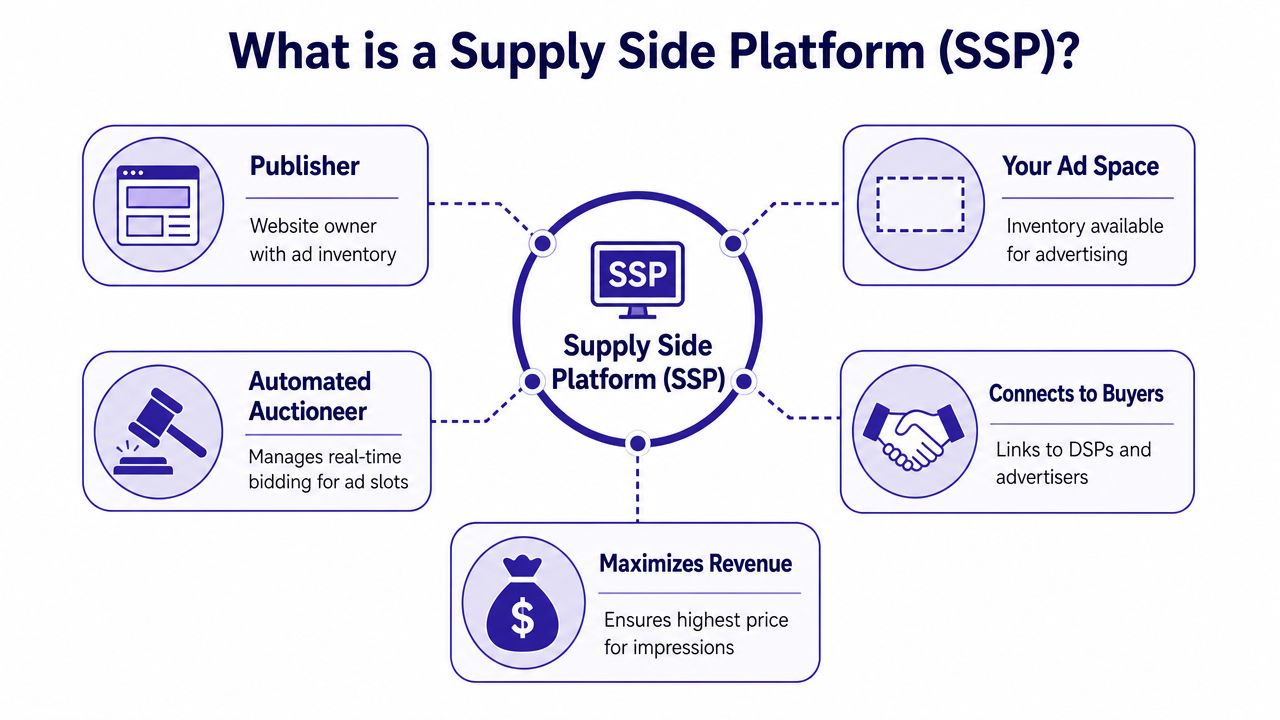
Think of a supply side platform as an automated auctioneer for the ad spaces on your website. You own the space. The SSP runs the sale. Its job is simple: expose your available impressions to buyers and try to get the best price while following your rules.
In manufacturing terms, it works like an automated procurement process in reverse. Instead of your purchasing team collecting bids from suppliers, your SSP collects bids from advertisers. Instead of you choosing the lowest acceptable cost, the platform selects the highest qualified bid for your inventory.
The plain-English definition
An SSP is software used by publishers to manage, price, and sell advertising inventory programmatically. It connects your site to advertisers, ad exchanges, and buying platforms so your ad slots can be sold automatically when a page loads.
That sounds abstract until you break it into moving parts:
- Your ad space: Banner placements, sidebar units, in-content units, or other approved placements on your site.
- Your rules: Blocked advertisers, approved categories, floor prices, and placement definitions.
- Buyer access: Connections to outside demand sources that want to bid on your audience.
- Auction logic: The process that decides which eligible ad wins.
An SSP is your seller's agent in programmatic advertising. It doesn't create traffic. It monetizes the traffic you already have.
What it is not
It isn't a magic revenue button. If your site has poor page structure, weak traffic quality, or no governance around ad placements, an SSP won't fix those problems.
It also isn't the same as a demand-side platform. Buyers use DSPs to purchase ads. Publishers use SSPs to sell inventory. One represents demand. The other represents supply.
Why the distinction matters
Industrial companies often get pitched generic ad tech as if every tool does everything. That leads to bad decisions. If your objective is monetizing your own website inventory, the SSP is the core system on the sell side.
That means you should evaluate it as operational infrastructure, not as a vague marketing add-on. Ask whether it gives you control, visibility, brand protection, and sensible monetization options for a niche audience. If it doesn't, it's the wrong fit regardless of how polished the sales demo looks.
How an SSP Automates Ad Sales with RTB and DSPs
The mechanics matter, as they determine whether many executives either gain confidence or decide the whole category sounds too opaque. In practice, the process is highly structured. A visitor loads your page, your ad slot becomes available, and the supply side platform starts an automated sale.
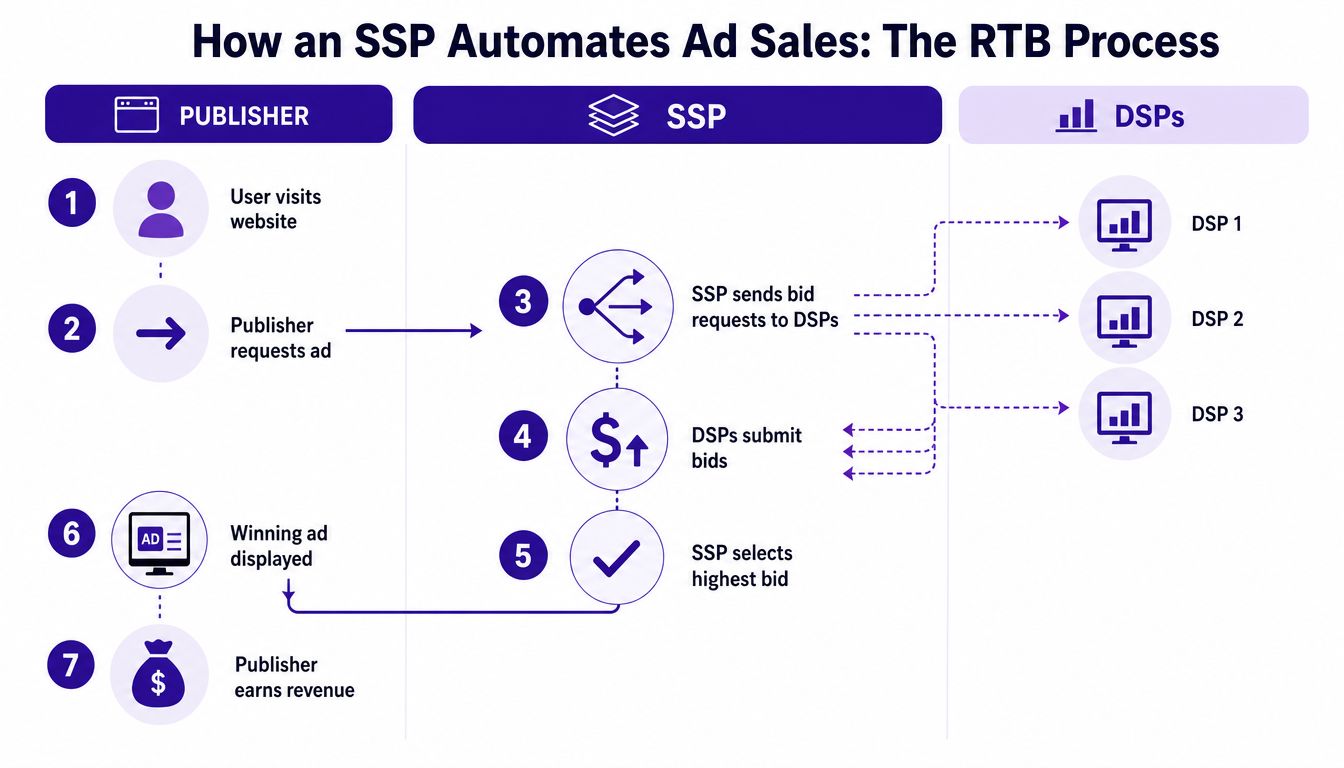
A useful way to think about it is this. The SSP represents your interests as the seller. The DSP represents the advertiser's interests as the buyer. They meet in an automated market that runs fast enough to finish before the page is fully rendered to the user.
The auction sequence
Here's the practical sequence for a single impression:
A visitor lands on your page.
The page contains one or more ad placements that are eligible to be filled.Your site signals that an impression is available.
The placement details, page context, and available user data are passed into the monetization workflow.The SSP creates a bid request.
It packages the impression into a format buyers can evaluate.The request goes out to connected DSPs and exchanges.
Buyers decide whether this specific impression is worth bidding on.DSPs submit bids.
Each bidder applies its own campaign rules, audience targeting logic, and value model.The SSP evaluates the responses.
It checks price, eligibility, deal terms, and your controls such as floors and blocklists.The winning creative is served.
The ad appears on the page, and the impression is monetized.
The technical requirement is speed. As Rishabh Software's explanation of SSP backend infrastructure notes, an SSP backend is designed to execute bid requests, conduct RTB auctions, and serve winning ad creatives within milliseconds to capture maximum yield.
Here's a short explainer if you want to see the process visually in action:
What the technology stack actually does
Under the hood, the SSP is doing more than passing messages around. It's enforcing your pricing logic, evaluating buyer demand, tracking outcomes, and feeding reporting back to the publisher interface.
That's why benchmarks matter. If you're trying to understand whether your inventory is priced sensibly, a reference point like this SaaS CPM benchmarks guide can help you think more clearly about how market pricing varies by audience and context, even if your industrial inventory needs its own interpretation.
If your team already runs paid campaigns and wants to understand the buy-side counterpart to this process, it helps to compare SSP behavior with media buying services for B2B campaigns. The workflows are related, but the incentives are opposite. Buyers want efficient acquisition. Publishers want yield and control.
Speed matters, but control matters more. A fast auction that fills low-value or off-brand ads isn't an optimization win.
For a CEO or operations leader, the core takeaway is simple. Programmatic monetization isn't random. It's a rules engine attached to an auction system. When the rules are sound, the outcome is useful. When the rules are sloppy, the platform will still work, but it won't work in your favor.
The SSP Business Case for Industrial Companies
An industrial company doesn't need massive consumer-scale traffic for a supply side platform to make sense. It needs the right audience, the right pages, and the right constraints. That distinction changes the business case completely.
Why industrial traffic is different
A manufacturer's site may bring in fewer visitors than a media publisher, but those visitors often have higher commercial relevance. An engineer reading a tolerancing guide, a sourcing manager comparing capabilities, or a plant leader reviewing process content is part of a narrower, more valuable audience.
That's why generic SSP advice often fails in B2B. Most documentation assumes high-volume traffic models, broad audience segments, and aggressive fill-rate goals. Industrial websites don't live in that world. If you push for maximum fill without guarding pricing and brand fit, you'll underprice premium attention.
The floor-price issue is the clearest example. According to AI Digital's discussion of SSP strategy for B2B publishers, 68% of small B2B publishers set static floors that are too low, losing 22% to 35% in potential revenue because standard SSP advice is built for high-volume consumer sites, not high-value industrial audiences.
That finding lines up with what we see in practice. Low-volume, high-value sites need tighter controls and more deliberate pricing logic.
What works and what backfires
A strong industrial setup usually has a narrow monetization footprint. You don't place ads everywhere. You choose pages where advertising won't interfere with conversion paths or technical usability.
What tends to work:
- Contextual alignment: Ads from adjacent vendors can feel useful on educational or reference pages.
- Premium positioning: Limited placements often protect trust better than aggressive page clutter.
- Selective floor strategy: Higher minimums can make sense when the audience is specialized.
What usually backfires:
- Static, low floor prices: These invite cheap demand and train the system to undervalue your inventory.
- Unfiltered advertiser categories: You can end up showing irrelevant offers or direct competitors.
- Monetizing bottom-funnel pages: Quote-request pages, contact forms, and key product pages are often the wrong places to squeeze in ads.
The right question isn't “How do we sell every impression?” It's “Which impressions deserve to be sold, and under what conditions?”
Questions to ask before you turn anything on
- Which parts of our site are informational rather than transactional?
- Would a relevant third-party ad help the visitor or distract them?
- Do we know which advertisers, industries, and topics are unacceptable?
- Are we willing to leave some inventory unsold to protect brand position?
For industrial firms, that last question is important. Unsold inventory is not always failure. Sometimes it's a sign that your floors and filters are doing their job. Premium audiences shouldn't be dumped into cheap demand just to create superficial fill.
The Build vs Partner Decision Framework
The engineering instinct is understandable. If software creates value, maybe you should build it yourself. For SSP infrastructure, that's rarely the smart move for a manufacturer. The complexity isn't in placing an ad tag. The complexity sits in auctions, integrations, reporting, governance, and ongoing optimization across multiple external relationships.
There's another complication. As eMarketer's SSP category overview notes, advertisers have reduced the number of DSPs they use, while publishers have responded by increasing the number of SSPs they engage to maintain competition and maximize revenue. That pushes the market toward multi-SSP configurations and makes partnership management harder, not easier.
Build vs partner comparison for SSP implementation
| Criteria | Build In-House | Partner with Vendor/Agency |
|---|---|---|
| Technical complexity | Very high. Your team owns integrations, auction logic, reporting, and maintenance. | Lower. The platform exists, and your job is governance and oversight. |
| Time to launch | Slow. Internal development and testing can drag. | Faster. You're configuring a working system, not inventing one. |
| Talent requirements | Requires ad tech expertise that most manufacturers don't have on staff. | Uses external specialists who already understand publisher monetization. |
| Control | Highest theoretical control, but only if your team can support it well. | Strong practical control if contracts, reporting, and rules are well defined. |
| Cost structure | Unpredictable. Development and support can sprawl. | More straightforward commercial model and implementation scope. |
| Risk | High operational risk if the system underperforms or breaks. | Lower technical risk, but vendor selection risk still matters. |
The real trade-off
The decision usually isn't build versus buy in the software sense. It's direct vendor management versus managed partnership. Both can work. The right path depends on your internal capacity to monitor performance, control ad quality, review reports, and adjust rules over time.
If your organization is already evaluating adjacent martech infrastructure, a broader view of marketing technology companies for B2B growth systems can help frame where SSP capability belongs. It's not a standalone magic box. It's one subsystem inside a larger revenue and data environment.
A direct vendor relationship can make sense if your team is disciplined, technically comfortable, and willing to own the operating cadence. An agency or specialist partner is usually the better fit when you want monetization capability without building internal ad operations from scratch.
Owning the system and operating the system are different jobs. Many firms can buy the first part and underestimate the second.
The practical test is simple. If nobody on your team will review partner quality, inventory rules, blocked advertisers, and reporting on a regular basis, you don't need more software. You need a clearer operating model.
How to Choose the Right SSP Partner
Most SSP sales conversations sound similar. Every vendor claims strong demand access, good yield, and smart automation. Those points don't help much if your actual concern is avoiding competitor ads on a niche manufacturing site.
Selection gets easier when you evaluate partners like operators, not like spectators at a product demo.
Questions worth asking in the first meeting
Start with controls, not dashboards.
- Brand safety controls: Can you block competitor domains, categories, and specific advertisers? Can you approve categories rather than only block them?
- Placement control: Can you apply different rules to resource pages, blog articles, and high-intent product pages?
- Floor-price flexibility: Can you set floor logic by placement, page type, or audience segment?
- Reporting clarity: Will you see revenue by placement, buyer, and category, or only a blended summary?
- Support model: Who handles troubleshooting, ad quality issues, and optimization recommendations?
You should also ask whether the partner has experience with B2B or industrial audiences. Consumer publishing experience helps, but it doesn't automatically transfer. A site that reaches process engineers is not managed the same way as a celebrity news property.
Commercial terms and operational fit
Commercial structure matters because SSPs typically make money by taking a share of transactions. According to Red Volcano's SSP guide, SSPs often use a take rate between 10% and 30%. That doesn't tell you which partner is best, but it does tell you where to focus your questions.
Ask for clarity on:
- Revenue share: What portion of transaction value does the partner keep?
- Fee transparency: Are there separate platform, service, or integration charges?
- Demand quality: Are they optimizing for raw fill, premium bids, or a balance of both?
- Operational ownership: Who changes floor settings, blocklists, and placement rules?
- Exit conditions: If the relationship doesn't work, how hard is it to unwind?
Infrastructure quality also deserves attention. Site performance and hosting environment influence user experience, and ad tech shouldn't make a fast industrial site feel bloated. If your business operates in Australia or serves that market heavily, a practical reference like this guide to choosing local Australian hosting is useful because regional hosting decisions can affect latency, control, and operational reliability.
A good SSP partner doesn't just increase buyer access. They help you say no to the wrong buyers.
The best partner for a manufacturer is often the one with the least flashy pitch and the clearest answers about controls, reporting, and accountability.
Your Implementation and Management Checklist
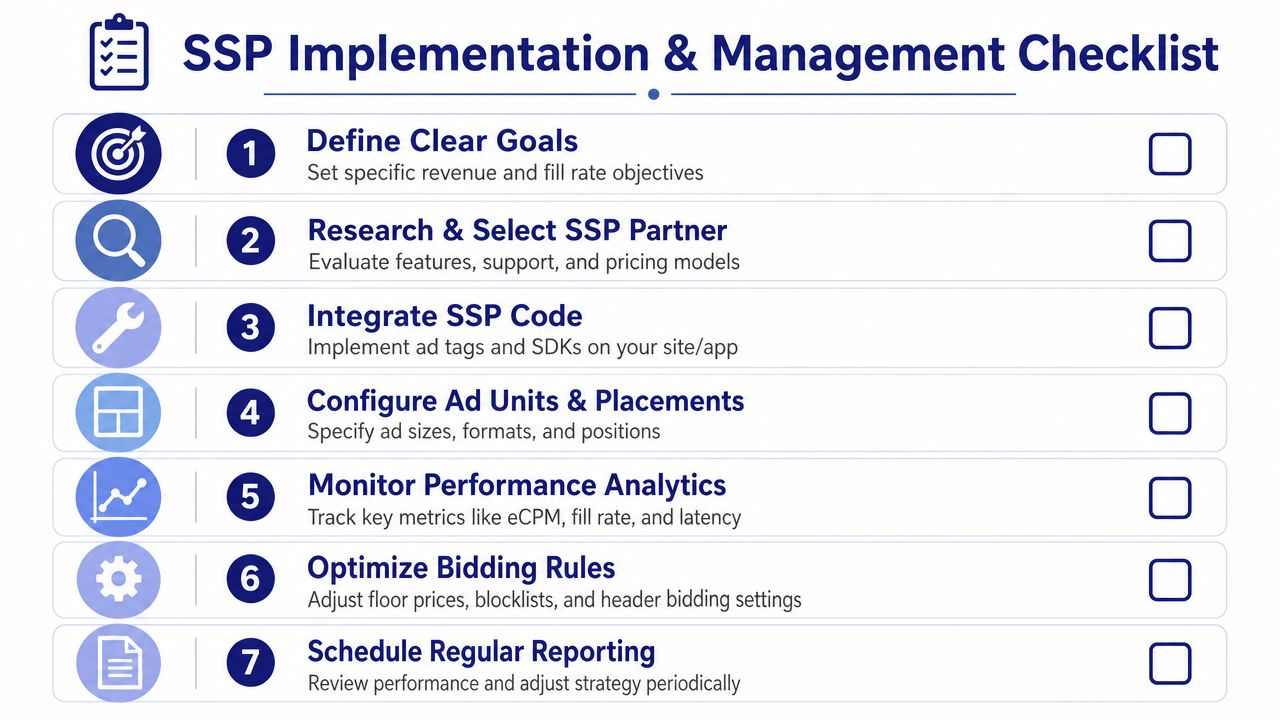
Execution is where this either becomes a useful revenue system or a small brand problem that nobody wants to touch again. A supply side platform should be rolled out the same way you'd roll out any production system. Define scope, set rules, test carefully, then review performance against clear objectives.
A practical rollout checklist
Decide why you're doing this
Revenue is only one objective. You may also want to monetize informational traffic while keeping commercial pages clean.Choose the pages that qualify
Start with resource pages, blog content, or technical libraries. Leave core conversion pages alone unless you have a very good reason.Define your blocked list
Include direct competitors, low-trust categories, and anything that weakens your positioning.Set initial floor logic
Don't treat all inventory the same. Narrow, high-value industrial content usually deserves stricter pricing than generic pages.Approve placements intentionally
Keep ad units visible without disrupting reading flow, technical diagrams, forms, or navigation.Build a reporting view your team will use
Focus on placement-level revenue, ad quality issues, and buyer trends. If nobody reads the report, the report is too complicated.Assign an owner
Someone has to review changes, exceptions, and performance. Systems drift when ownership is vague.
What to review after launch
Use a recurring review process, not a one-time setup.
- Ad quality: Are the creatives relevant and professional?
- Placement performance: Which pages monetize cleanly, and which create friction?
- Floor outcomes: Are your minimums too loose, too strict, or appropriately filtering demand?
- Sales overlap: Are ads appearing where your own offers should dominate?
- Technical impact: Has page experience stayed acceptable after implementation?
If your team is also tightening the rest of its stack, a broader review of marketing tech stacks for B2B companies can help you place SSP governance alongside CRM, analytics, automation, and lead handling. That matters because monetization shouldn't operate as an isolated experiment.
A disciplined implementation usually beats an aggressive one. Start narrow. Keep control tight. Learn which parts of your site can support monetization without weakening trust or lead generation.
If you want help diagnosing whether a supply side platform makes sense for your industrial website, Machine Marketing can help you evaluate the opportunity, define the right constraints, and build a practical plan that fits your traffic, brand, and growth goals.